CONVULSIVE DISORDERKhiddir bin Nasharuddin  2008202444Adam Safin Bin Abdul Mutti   2008402544Qhasmirabt Abu Hazir   2008409674
SEIZURES AND EPILEPSYBy: Qhasmirabt Abu Hazir
DEFINITIONSSEIZURES- clinical event in which there is sudden disturbance of neurological fx caused by an abnormal or excessive neuronal dischargeEPILEPSY- recurrent, unprovoked seizures.
EPILEPSIES25-30%  of these children have other neurological disorder (mental handicap, cerebral palsy)Diagnosed clinically, hence a detailed description of events experienced by patient or an adequate account by a reliable witness is crucialEpilepsy should be viewed as a symptom of an underlying neurological disorder and not as a single entity
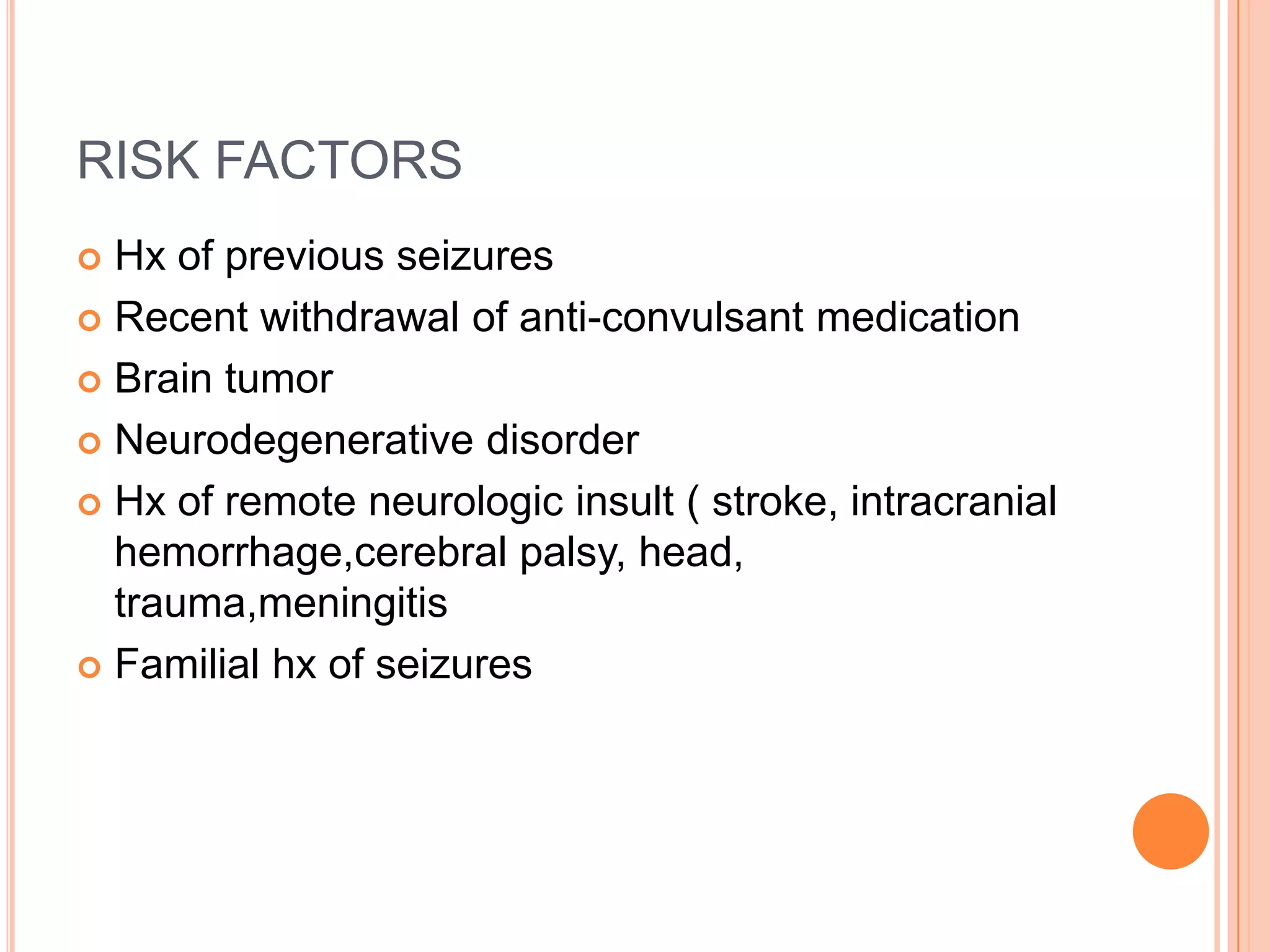
RISK FACTORSHx of previous seizuresRecent withdrawal of anti-convulsant medicationBrain tumorNeurodegenerative disorderHx of remote neurologic insult ( stroke, intracranial hemorrhage,cerebral palsy, head, trauma,meningitisFamilial hx of seizures
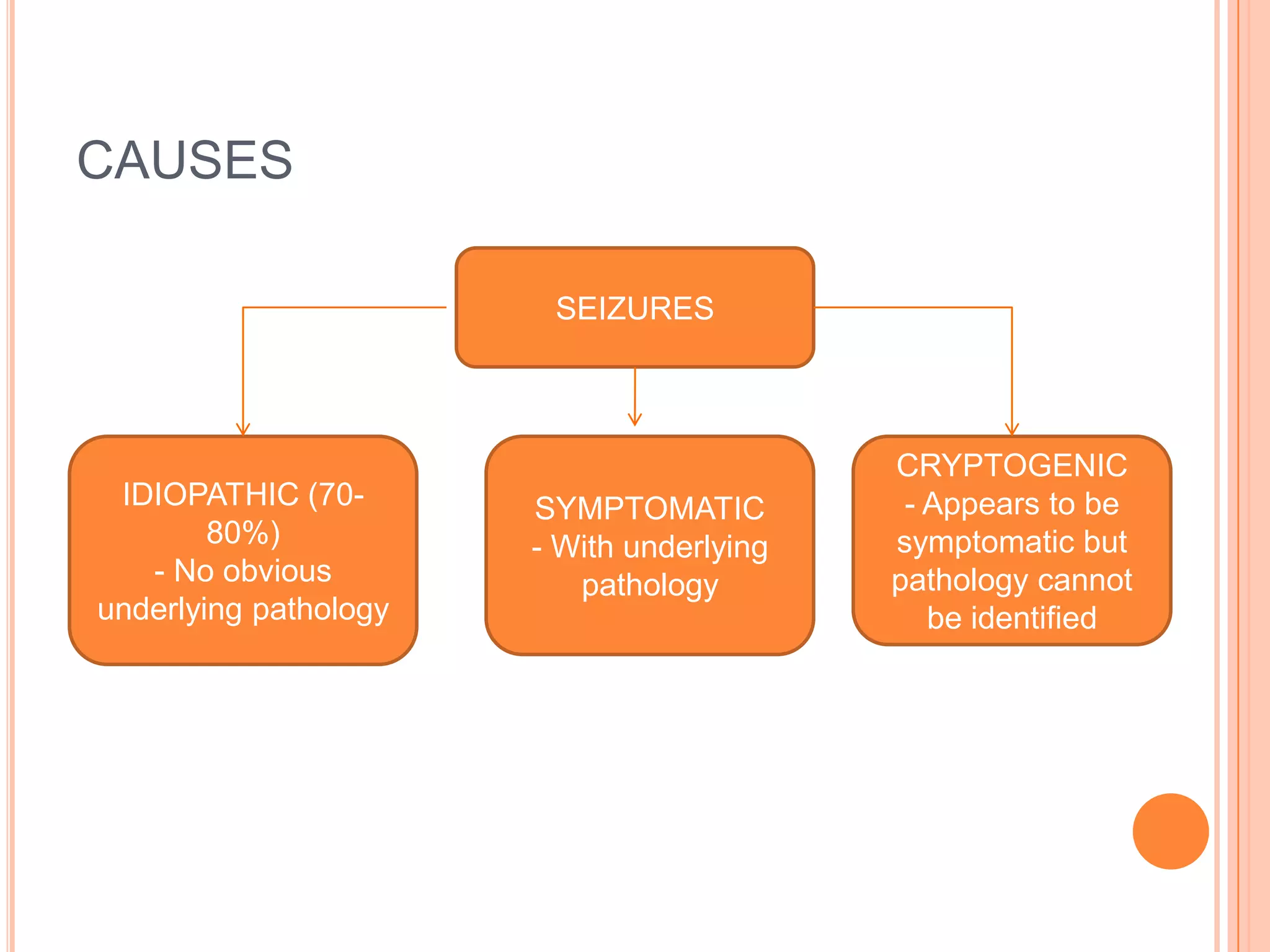
CAUSESSEIZURESIDIOPATHIC (70-80%)- No obvious underlying pathologySYMPTOMATIC- With underlying pathologyCRYPTOGENIC- Appears to be symptomatic but pathology cannot be identified
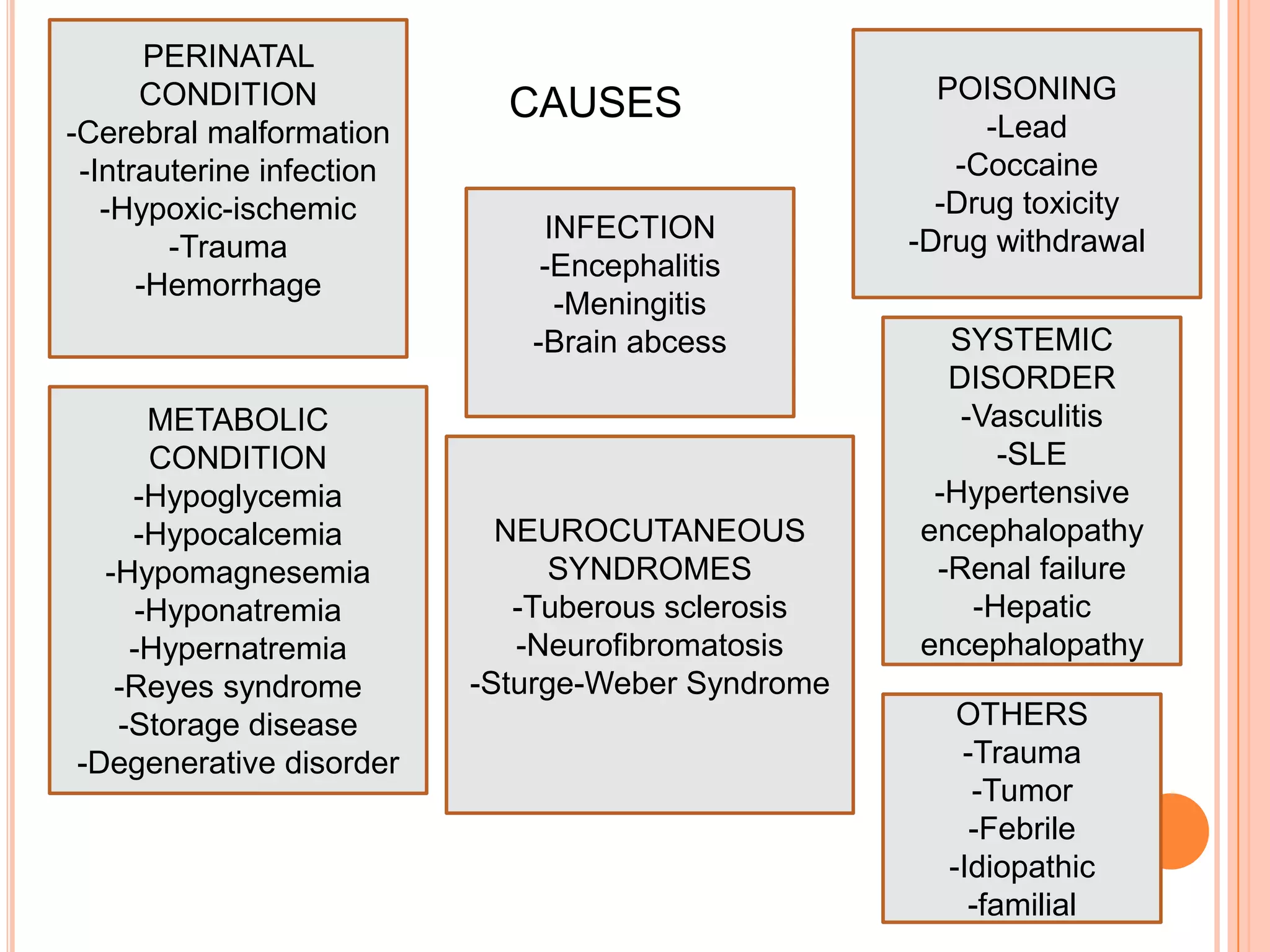
CAUSESPERINATAL CONDITIONCerebral malformation
Intrauterine infection
Hypoxic-ischemic
Trauma
HemorrhagePOISONINGLead
Coccaine
Drug toxicity
Drug withdrawalCAUSESINFECTIONEncephalitis
Meningitis
Brain abcessSYSTEMIC DISORDERVasculitis
SLE
Hypertensive encephalopathy
Renal failure
Hepatic encephalopathyMETABOLIC CONDITIONHypoglycemia
Hypocalcemia
Hypomagnesemia
Hyponatremia
Hypernatremia
Reyes syndrome
Storage disease
Degenerative disorderNEUROCUTANEOUS SYNDROMESTuberous sclerosis
Neurofibromatosis
Sturge-Weber SyndromeOTHERSTrauma
Tumor
Febrile
Idiopathic
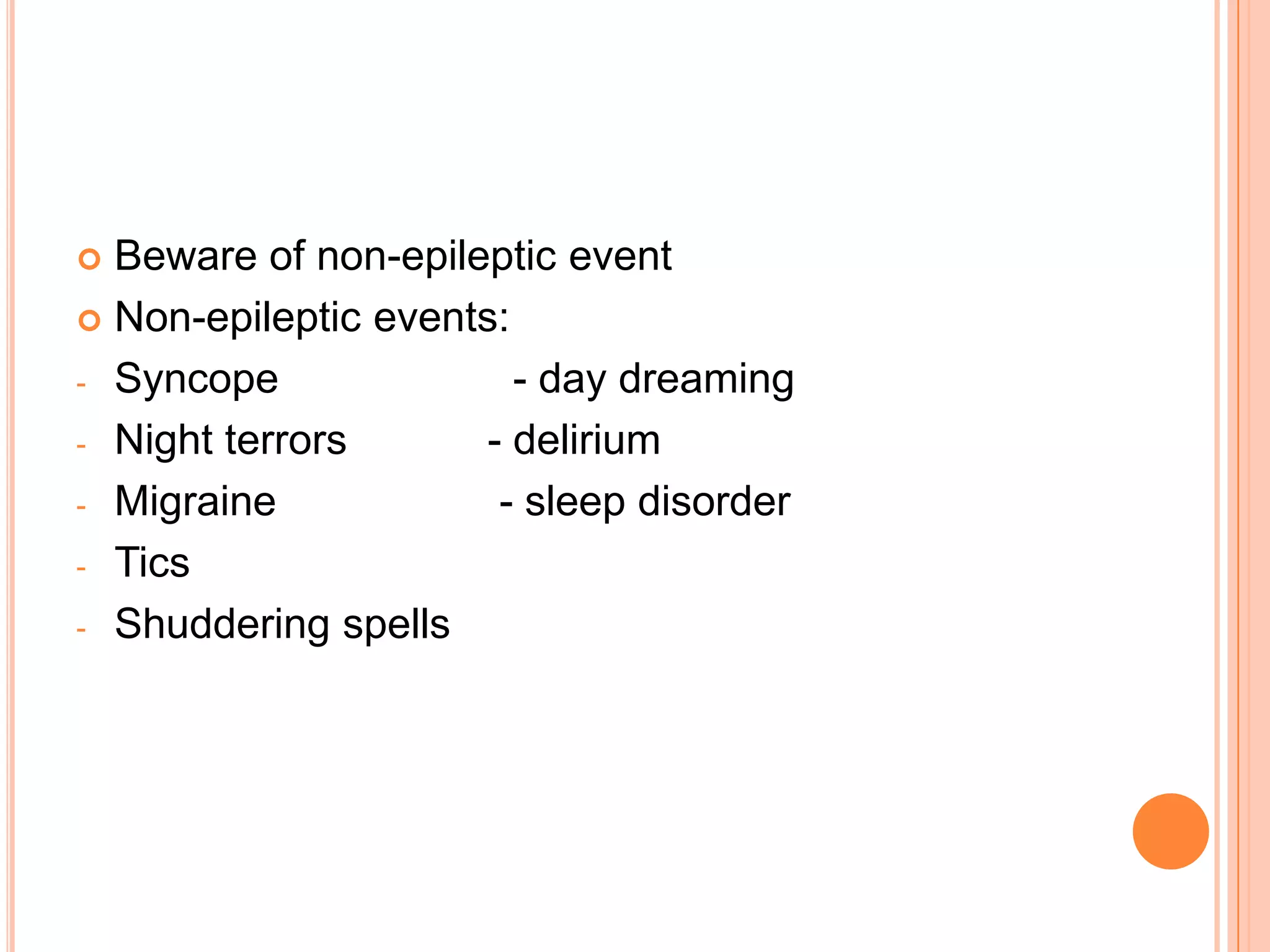
familialBeware of non-epileptic eventNon-epileptic events:Syncope                    - day dreaming
Night terrors            - delirium
Migraine                   - sleep disorder
Tics
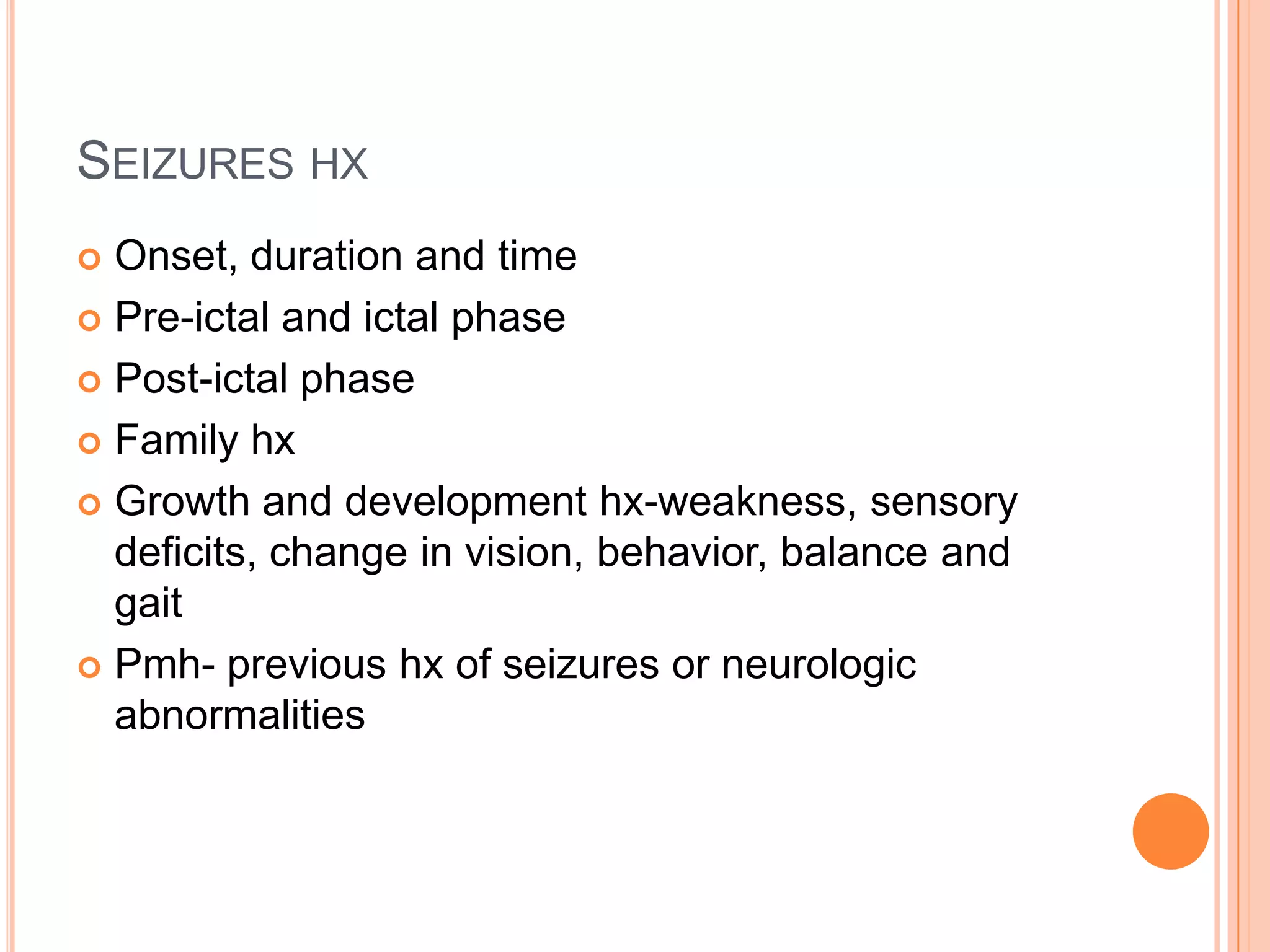
Shuddering spellsSeizures hxOnset, duration and timePre-ictal and ictal phasePost-ictal phaseFamily hxGrowth and development hx-weakness, sensory deficits, change in vision, behavior, balance and gaitPmh- previous hx of seizures or neurologic abnormalities
Precipitating factors:Fever
Preceding illness
Recent hx of head trauma
Possibility of ingestion or recent change in antiepileptic medication
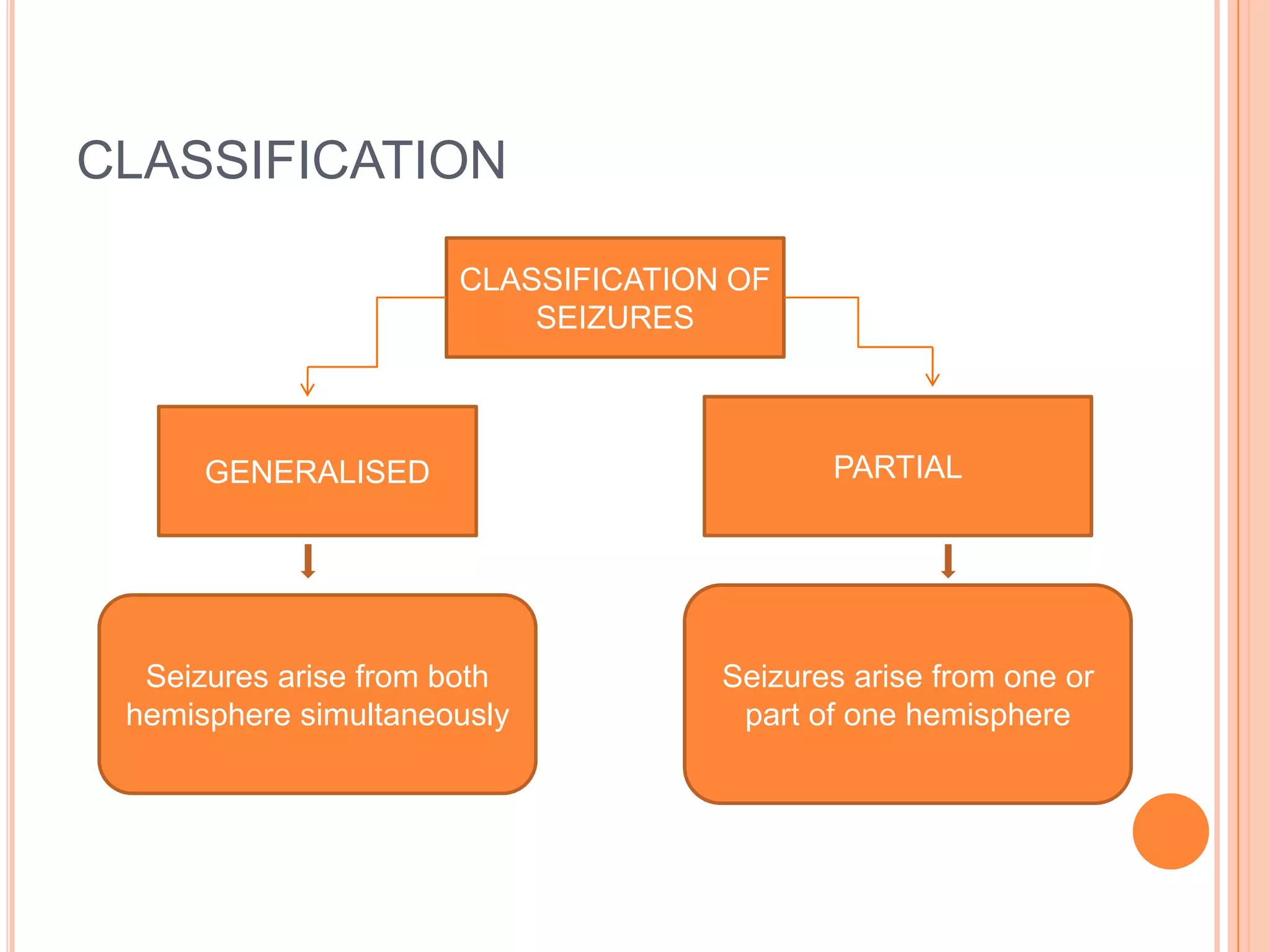
Risk factorCLASSIFICATIONCLASSIFICATION OF SEIZURESPARTIALGENERALISED Seizures arise from one or part of one hemisphereSeizures arise from both hemisphere simultaneously
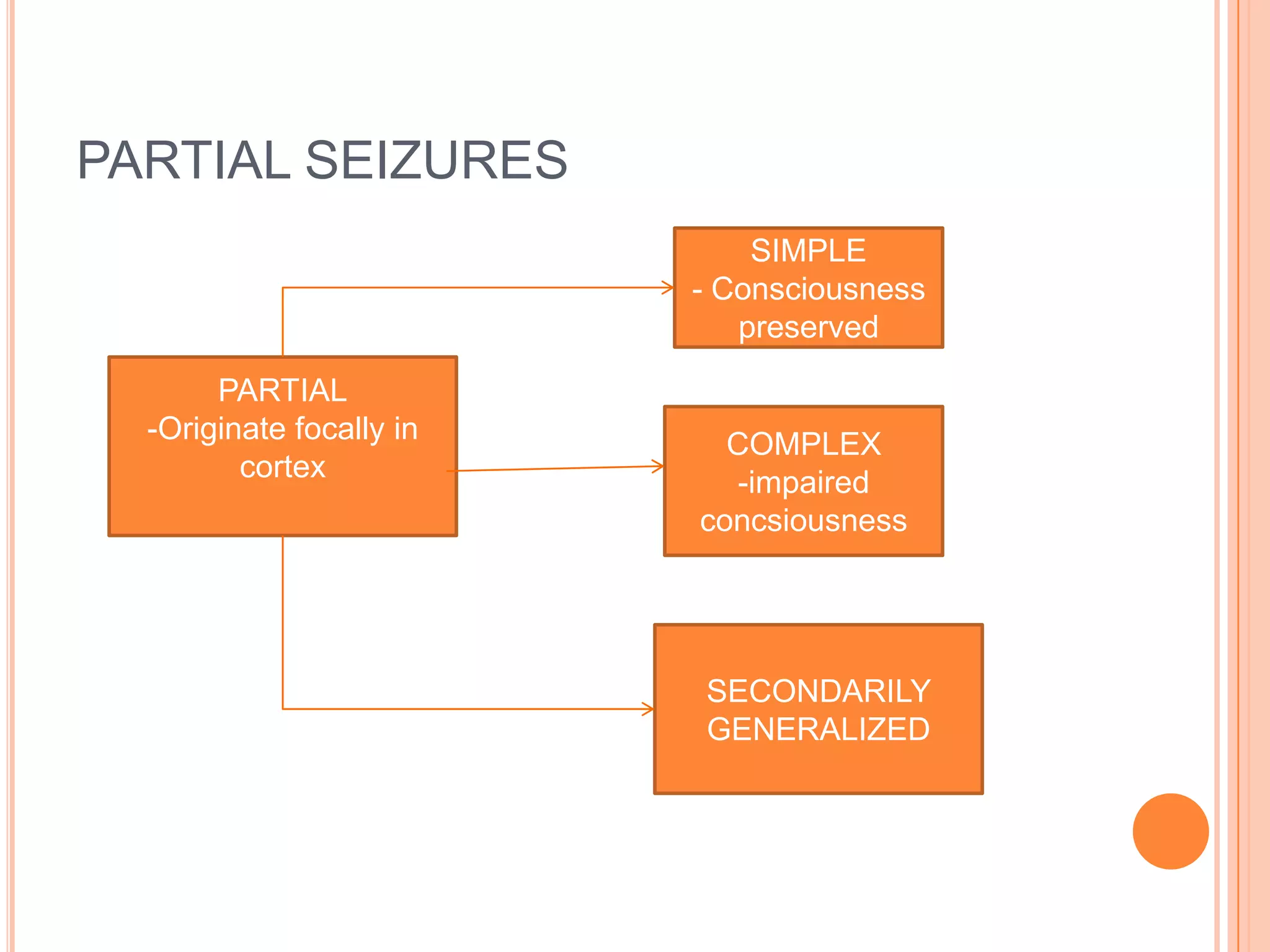
PARTIAL SEIZURESSIMPLE- Consciousness preservedPARTIALOriginate focally in cortexCOMPLEX-impaired concsiousnessSECONDARILY GENERALIZED
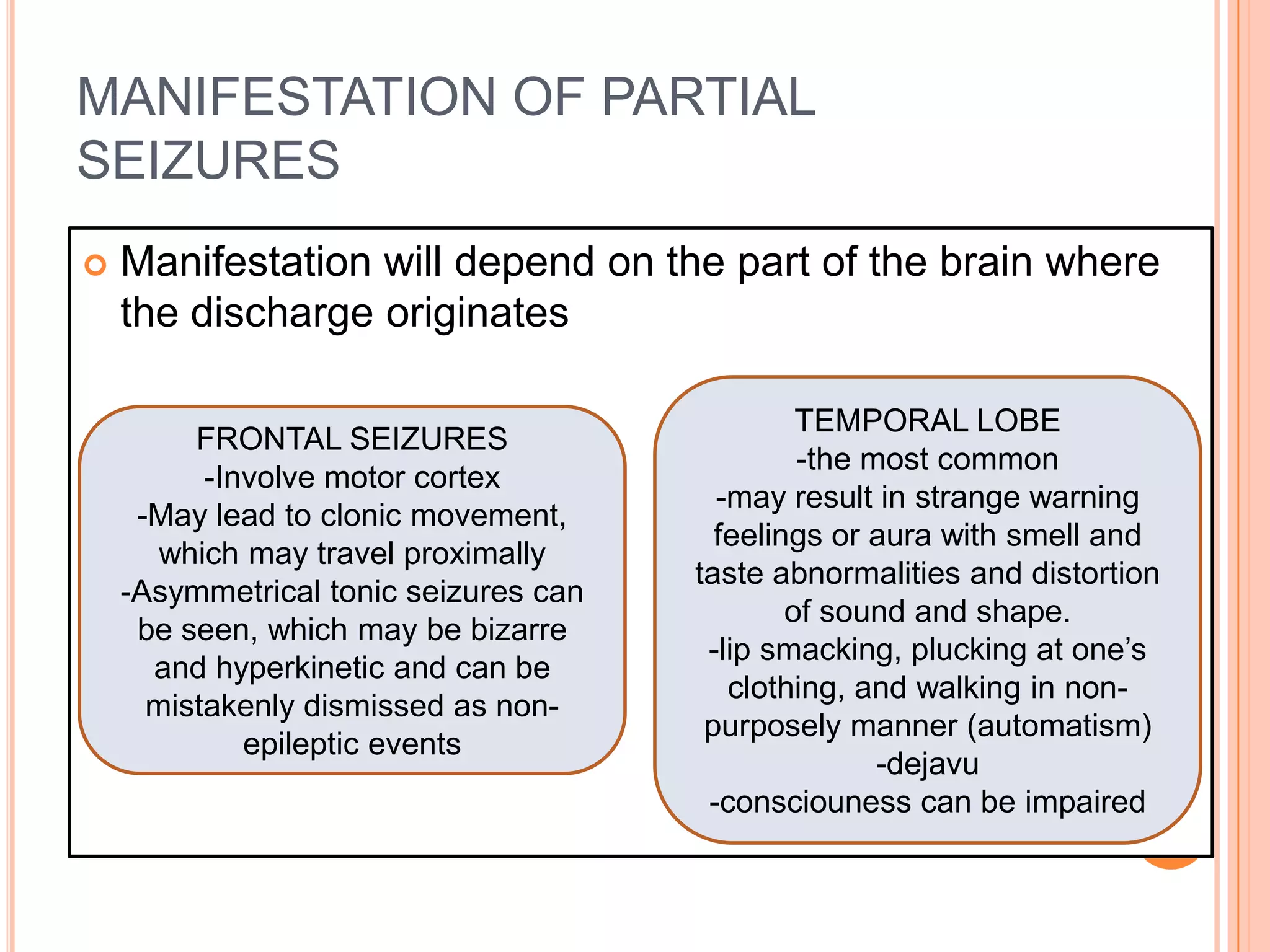
MANIFESTATION OF PARTIAL SEIZURESManifestation will depend on the part of the brain where the discharge originatesTEMPORAL LOBE-the most common-may result in strange warning feelings or aura with smell and taste abnormalities and distortion of sound and shape.-lip smacking, plucking at one’s clothing, and walking in non-purposely manner (automatism)-dejavu-consciouness can be impairedFRONTAL SEIZURESInvolve motor cortex
May lead to clonic movement, which may travel proximally
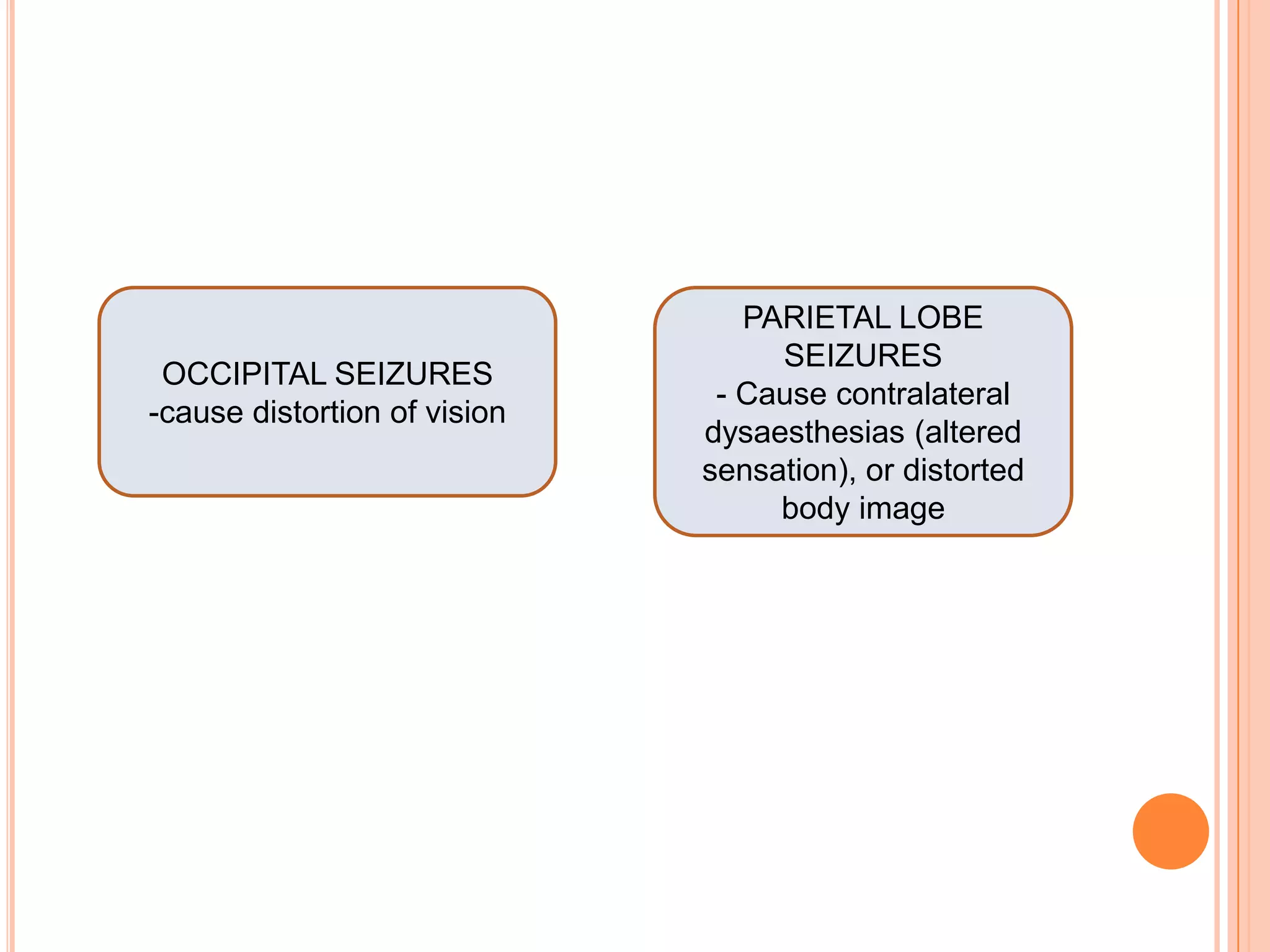
Asymmetrical tonic seizures can be seen, which may be bizarre and hyperkinetic and can be mistakenly dismissed as non-epileptic eventsOCCIPITAL SEIZURES-cause distortion of visionPARIETAL LOBE SEIZURES- Cause contralateraldysaesthesias (altered sensation), or distorted body image
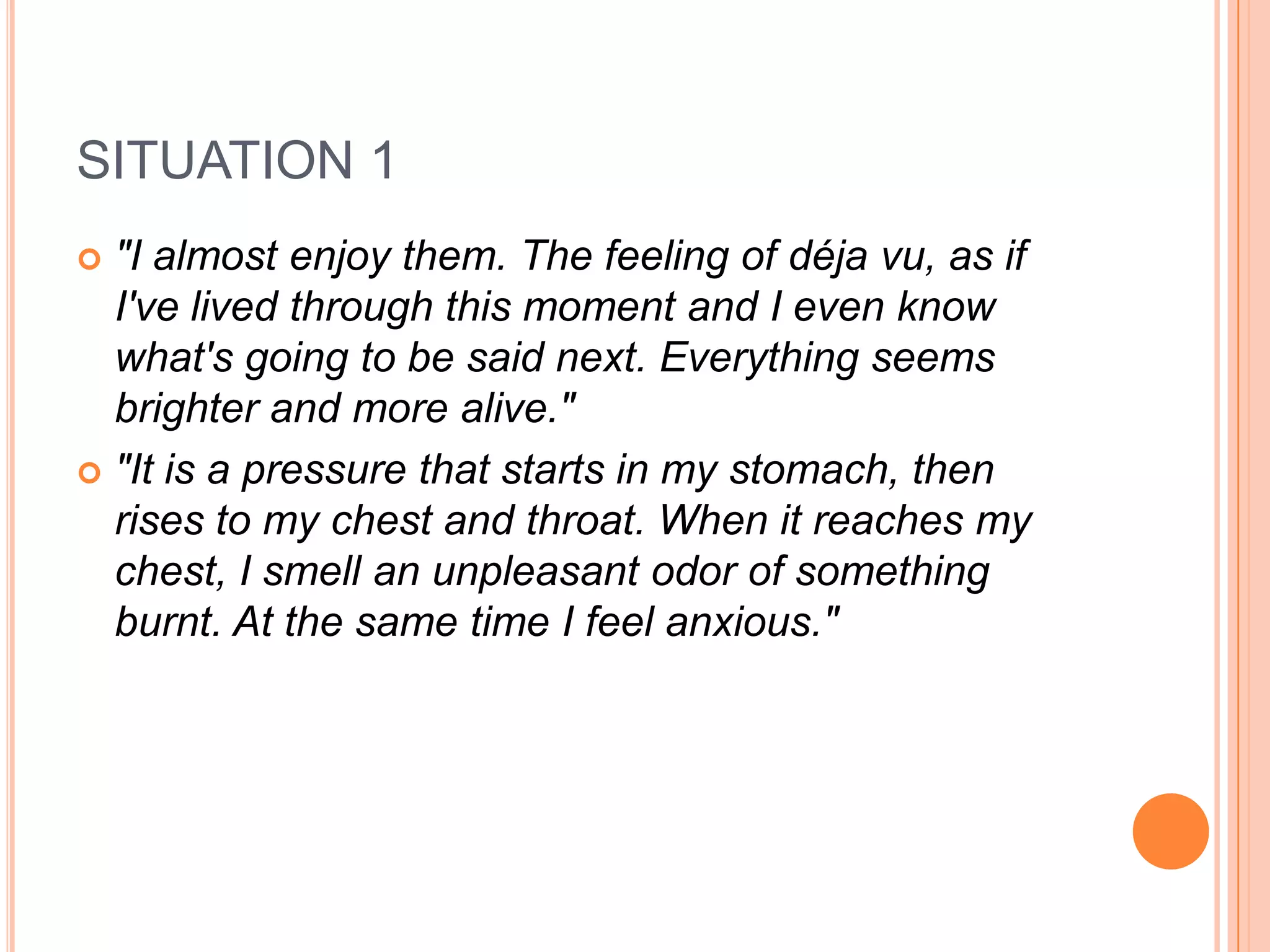
SITUATION 1"I almost enjoy them. The feeling of déja vu, as if I've lived through this moment and I even know what's going to be said next. Everything seems brighter and more alive." "It is a pressure that starts in my stomach, then rises to my chest and throat. When it reaches my chest, I smell an unpleasant odor of something burnt. At the same time I feel anxious."
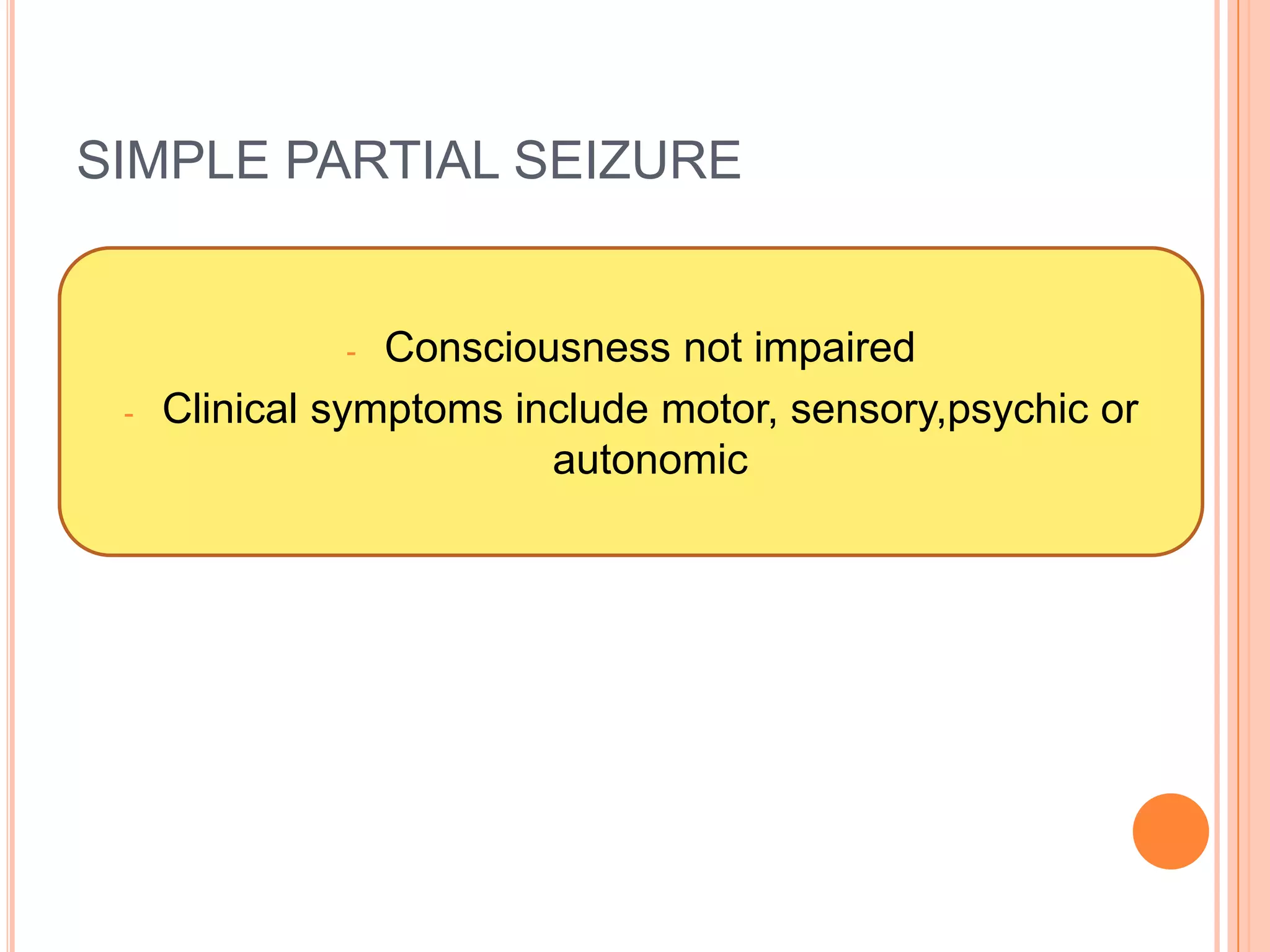
SIMPLE PARTIAL SEIZUREConsciousness not impaired
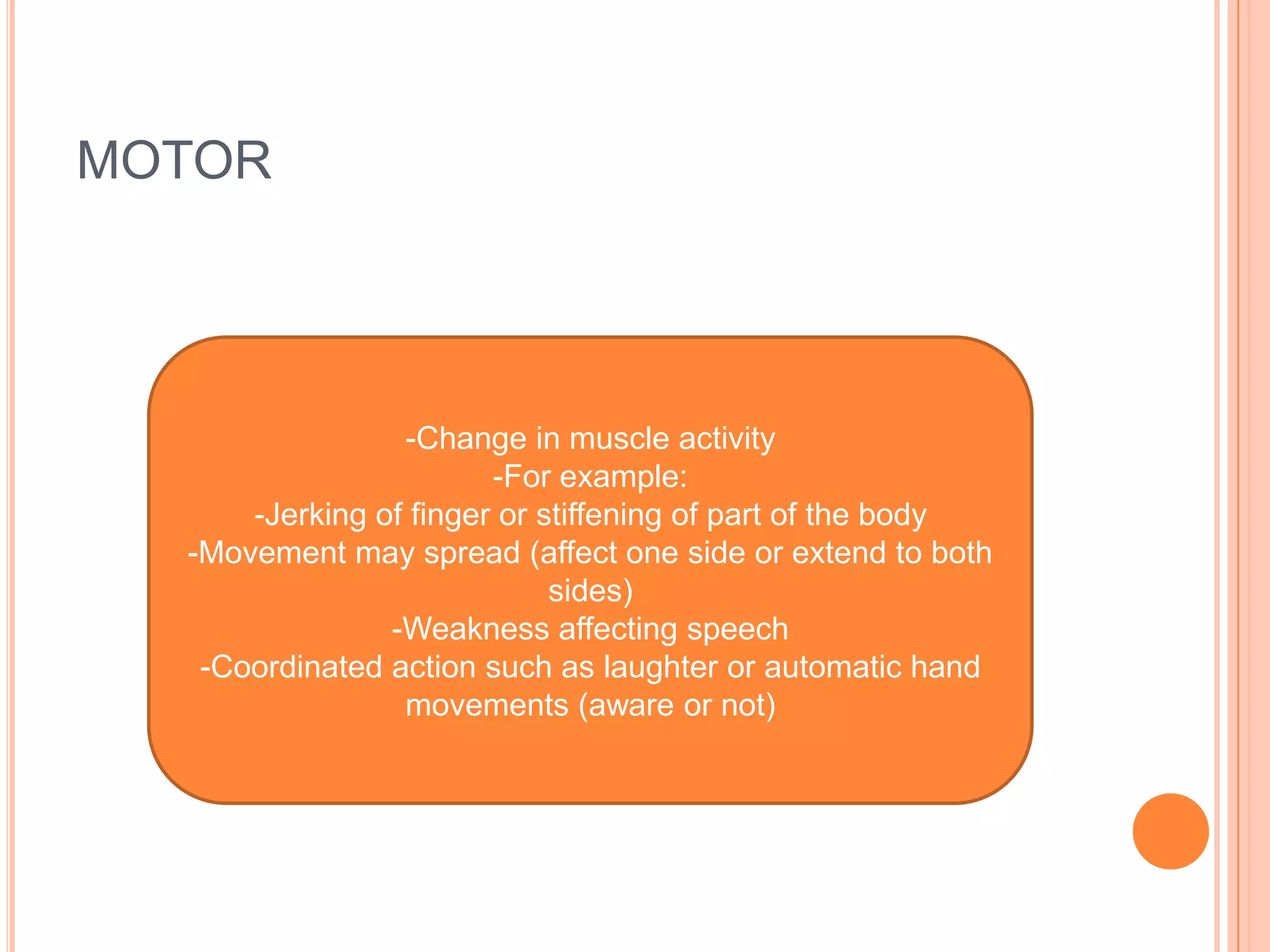
Clinical symptoms include motor, sensory,psychic or autonomicMOTORChange in muscle activity
For example:
Jerking of finger or stiffening of part of the body
Movement may spread (affect one side or extend to both sides)
Weakness affecting speech
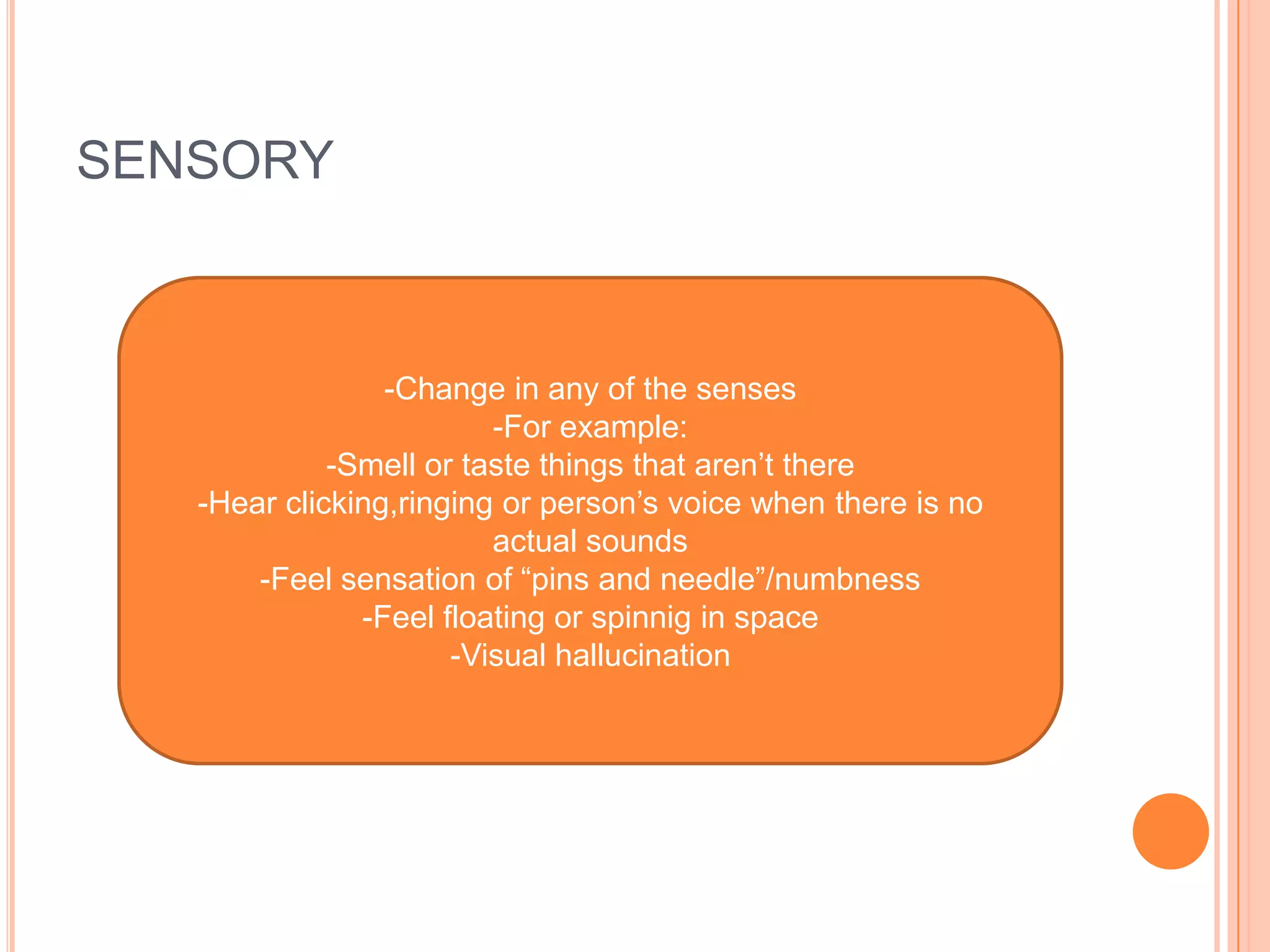
Coordinated action such as laughter or automatic hand movements (aware or not)SENSORYChange in any of the senses
For example:
Smell or taste things that aren’t there
Hear clicking,ringing or person’s voice when there is no actual sounds
Feel sensation of “pins and needle”/numbness
Feel floating or spinnig in space
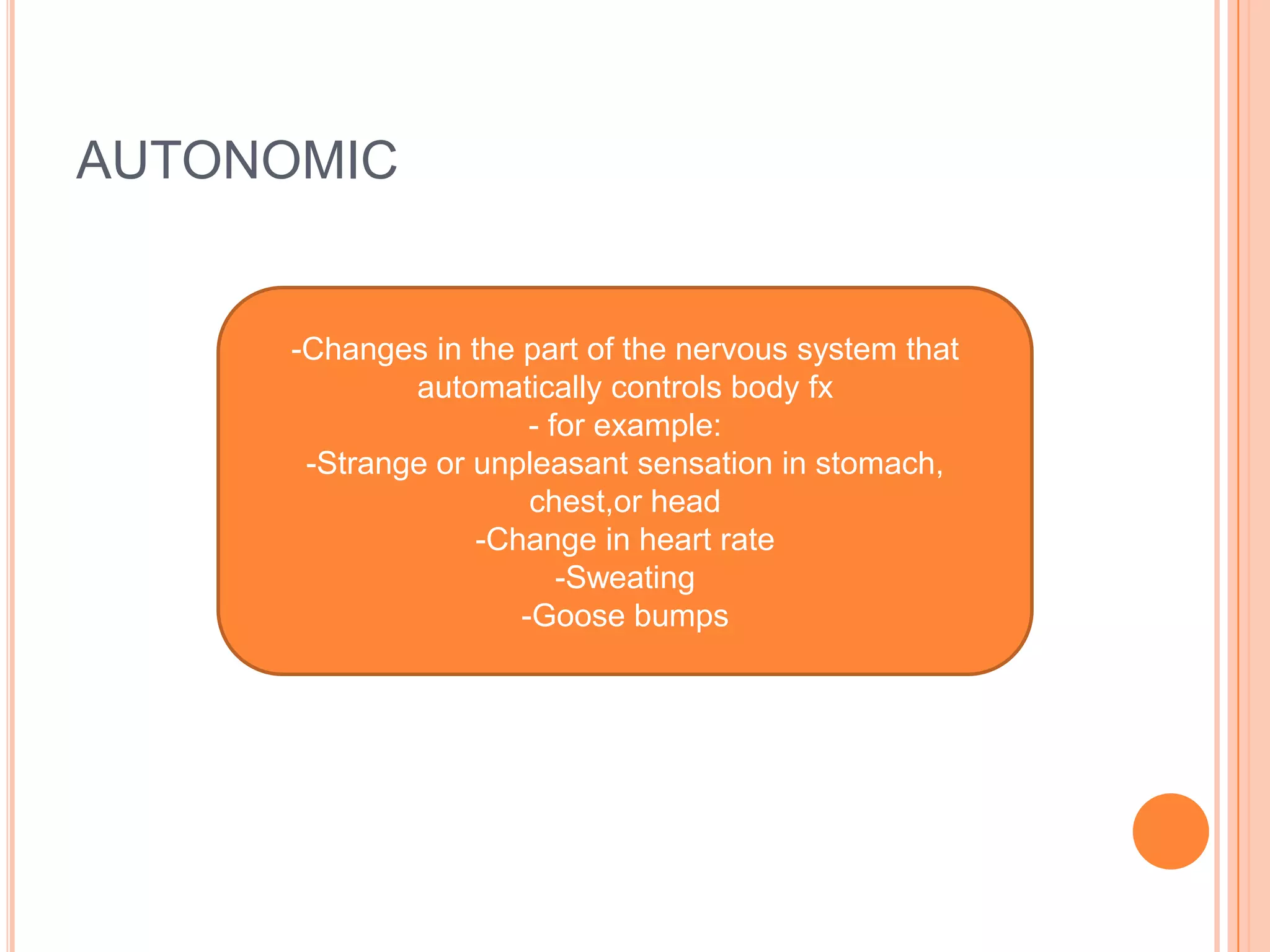
Visual hallucination AUTONOMICChanges in the part of the nervous system that automatically controls body fx
 for example:
Strange or unpleasant sensation in stomach, chest,or head
Change in heart rate
Sweating
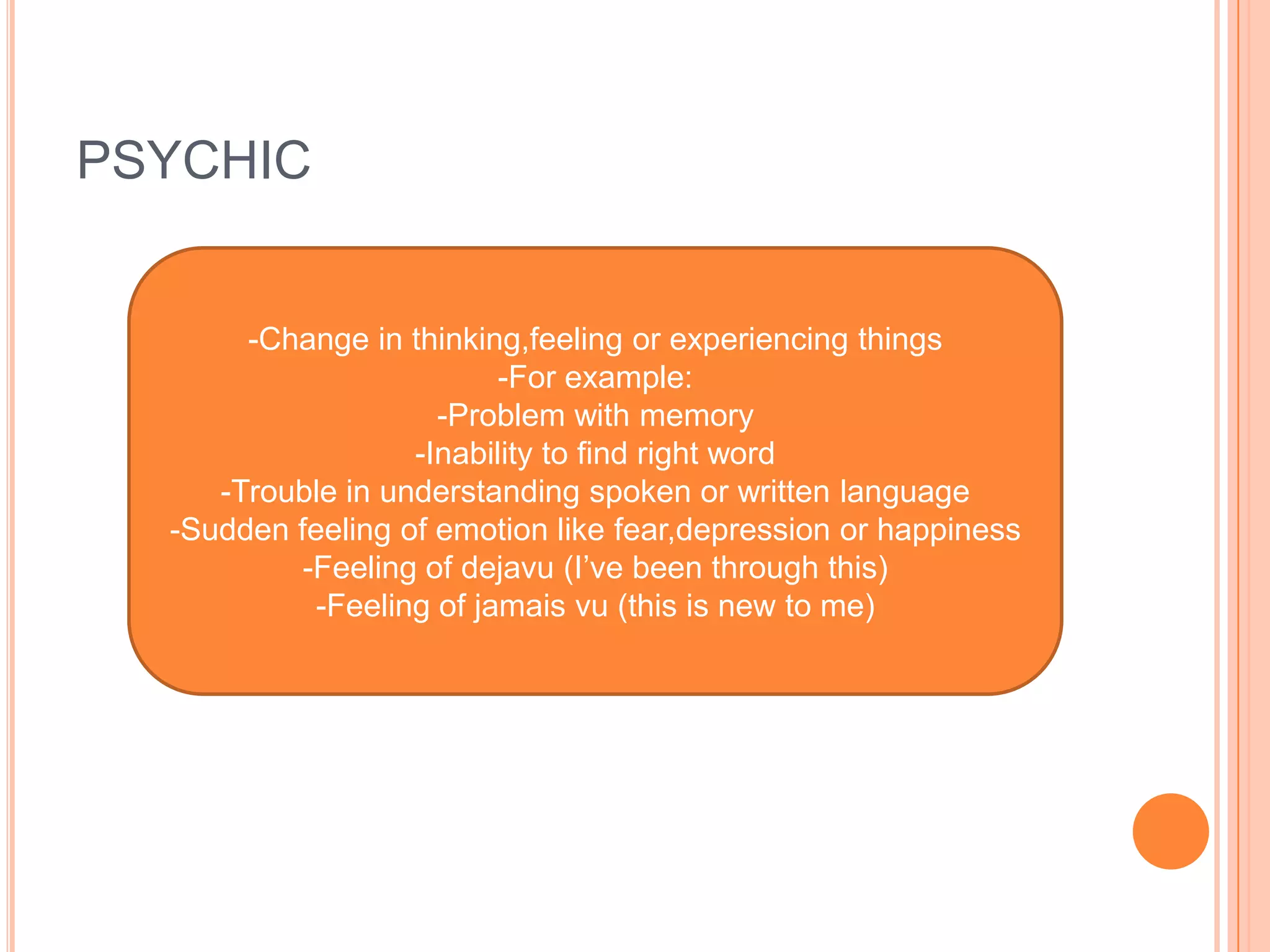
Goose bumpsPSYCHICChange in thinking,feeling or experiencing things
For example:
Problem with memory
Inability to find right word
Trouble in understanding spoken or written language
Sudden feeling of emotion like fear,depression or happiness
Feeling of dejavu (I’ve been through this)
Feeling of jamais vu (this is new to me)SITUATION 2“Micky's spells begin with a warning; he says he's going to have a seizure and usually sits down. If I ask him how he feels, he just says 'I feel it.' Then he makes a funny face, a mixture of surprise and distress. During the seizure he may look at me when I call his name but he never answers. He just stares and makes odd mouth movements, as if he's tasting something. Sometimes he'll grab the arm of the chair and squeeze it. He may also pull at his shirt as though he's picking lint off of it. After a few minutes, when he's coming out of it, he asks a lot of questions. He never remembers his 'warning' or these questions. The seizures make him tired; if he has two in the same day, he often goes to sleep after the second one."
COMPLEX PARTIAL SEIZURESCOMPLEX PARTIAL SEIZUREConsciousness impaired
Temporal lobe epilepsy is the most common type
The patient stops what he or she doing and stare blankly, often making rhythmic smacking movements of the lips or displaying other automatism, such as picking at their clothes
After few minutes return consciousness, may initially feel drowsy
Aura may present: alterations of mood, memory
Complex hallucinations of sound, smell, taste,vision,emotional changes (fear,sexual arousal) or visceral sensation (nausea, epigastric discomfort) may also occur.SITUATION 3The seizures start with a tingling in my right thumb. In seconds, my thumb starts jerking. Soon, my whole right hand is jerking. I have learned that by rubbing and scratching my forearm I can sometimes stop the seizure. Other times the jerking spreads up my arm. When it reaches my shoulder, I pass out and people tell me that my whole body starts to jerk.
SECONDARILY GENERALIZED ( “JACKSONIAN” SEIZURES)When partial seizures spread to involve the whole brain and produce generalized tonic-clonic seizures.
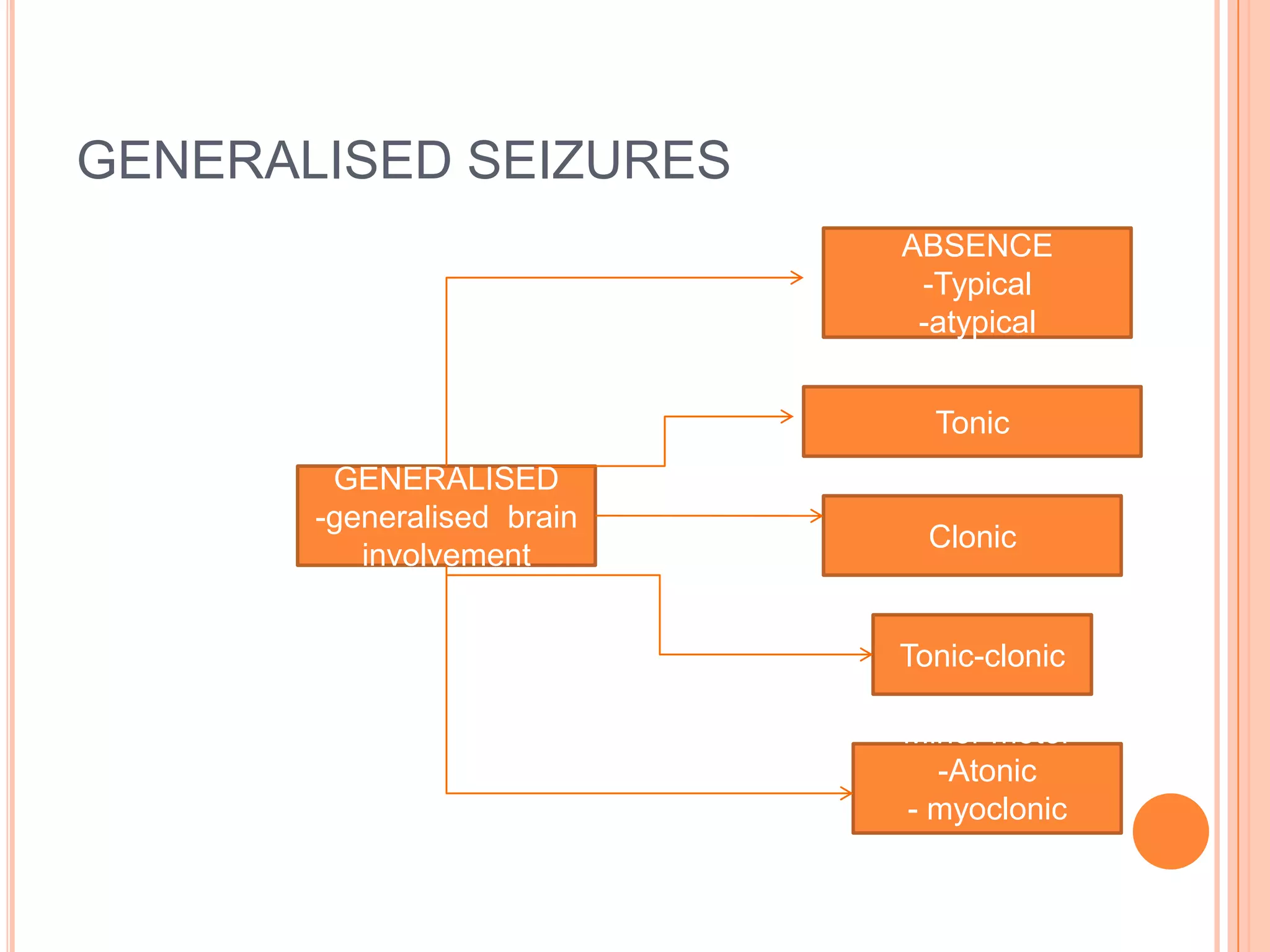
 focal seizure followed by generalised tonic-clonic seizureGENERALISED SEIZURESABSENCETypical
atypicalTonic GENERALISED-generalised  brain involvementClonicTonic-clonicMinor motorAtonic
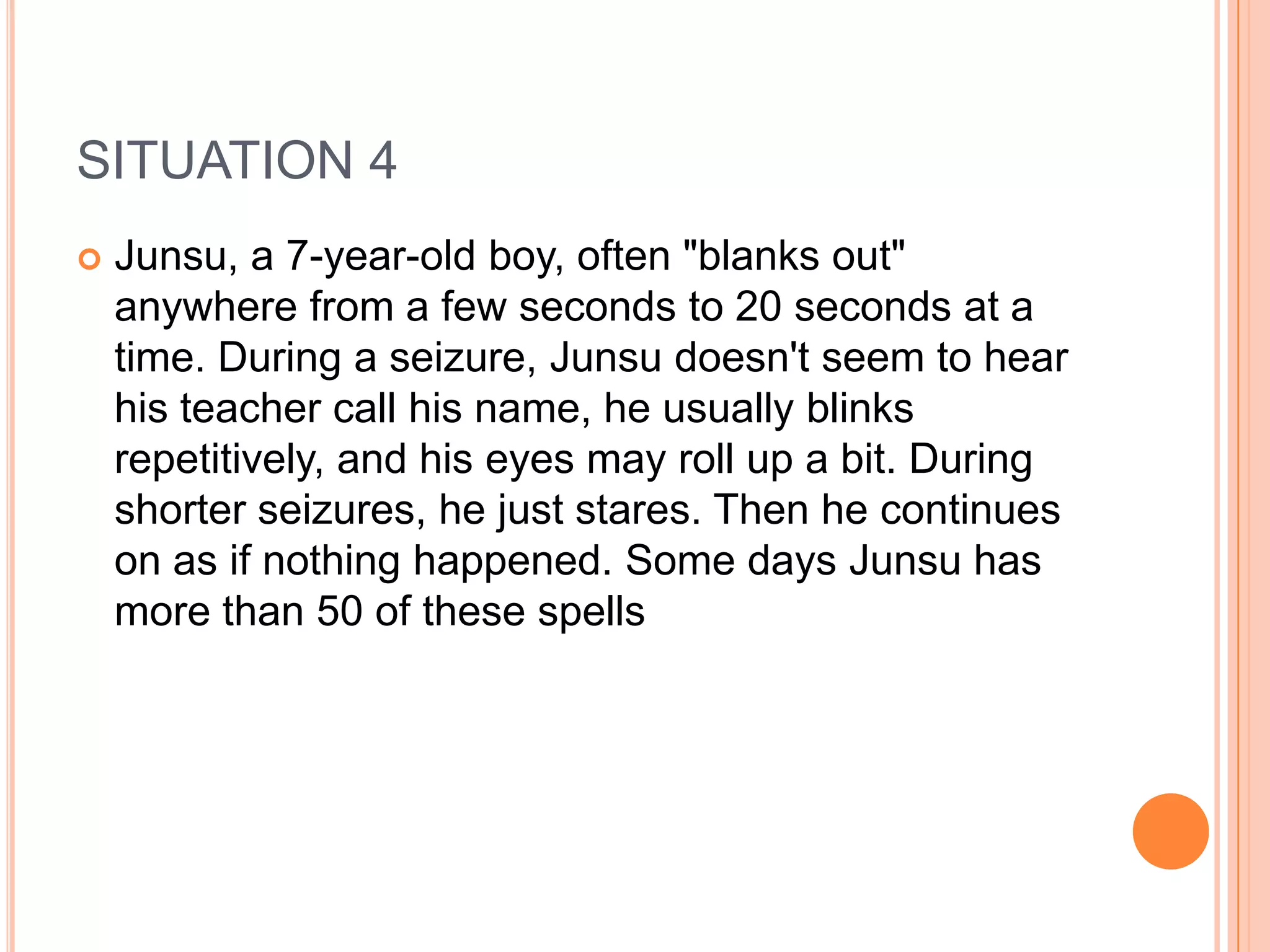
myoclonicSITUATION 4Junsu, a 7-year-old boy, often "blanks out" anywhere from a few seconds to 20 seconds at a time. During a seizure, Junsu doesn't seem to hear his teacher call his name, he usually blinks repetitively, and his eyes may roll up a bit. During shorter seizures, he just stares. Then he continues on as if nothing happened. Some days Junsu has more than 50 of these spells
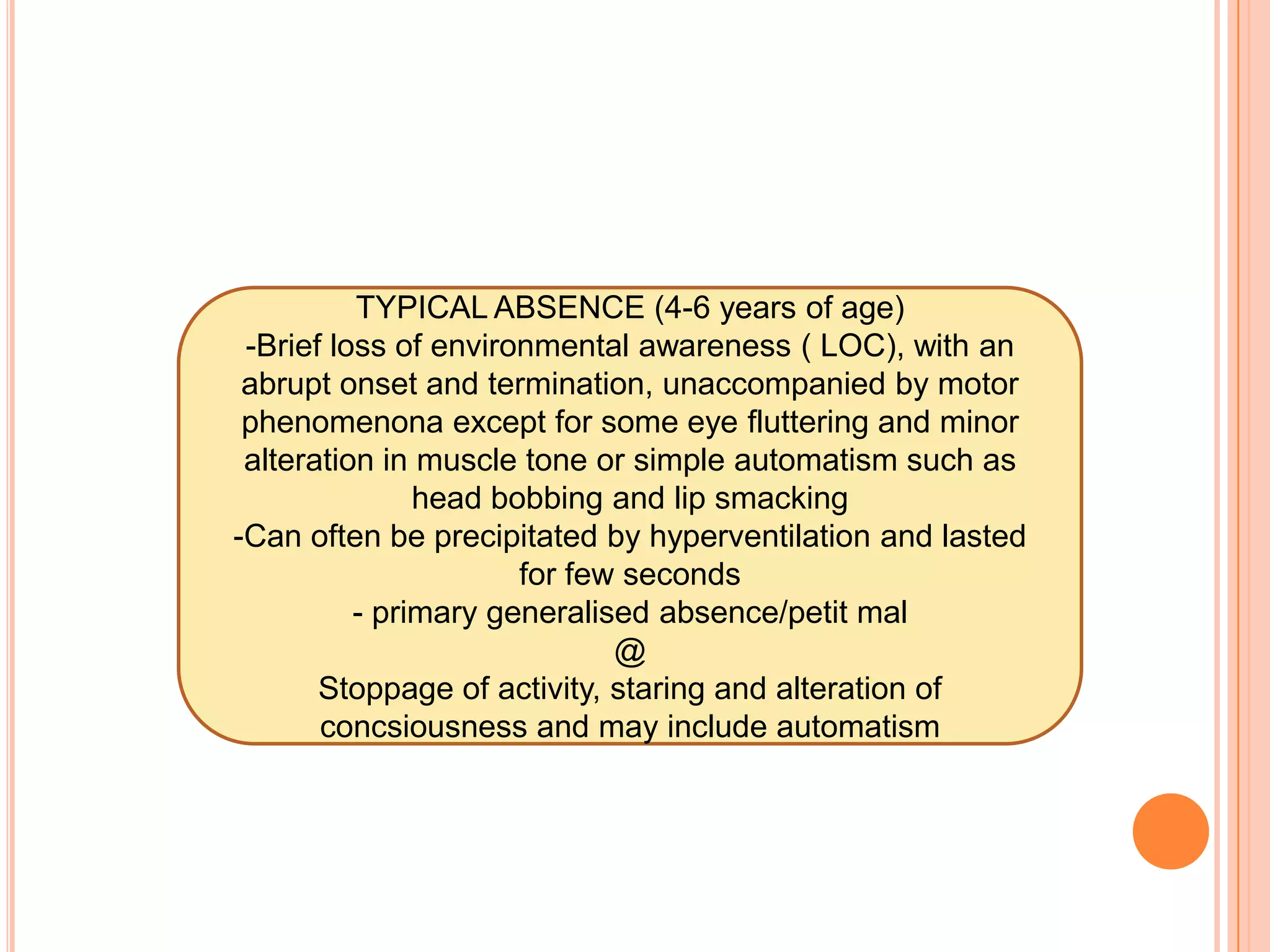
TYPICAL ABSENCE (4-6 years of age)Brief loss of environmental awareness ( LOC), with an abrupt onset and termination, unaccompanied by motor phenomenona except for some eye fluttering and minor alteration in muscle tone or simple automatism such as head bobbing and lip smacking
Can often be precipitated by hyperventilation and lasted for few seconds
 primary generalised absence/petit mal@Stoppage of activity, staring and alteration of concsiousness and may include automatism
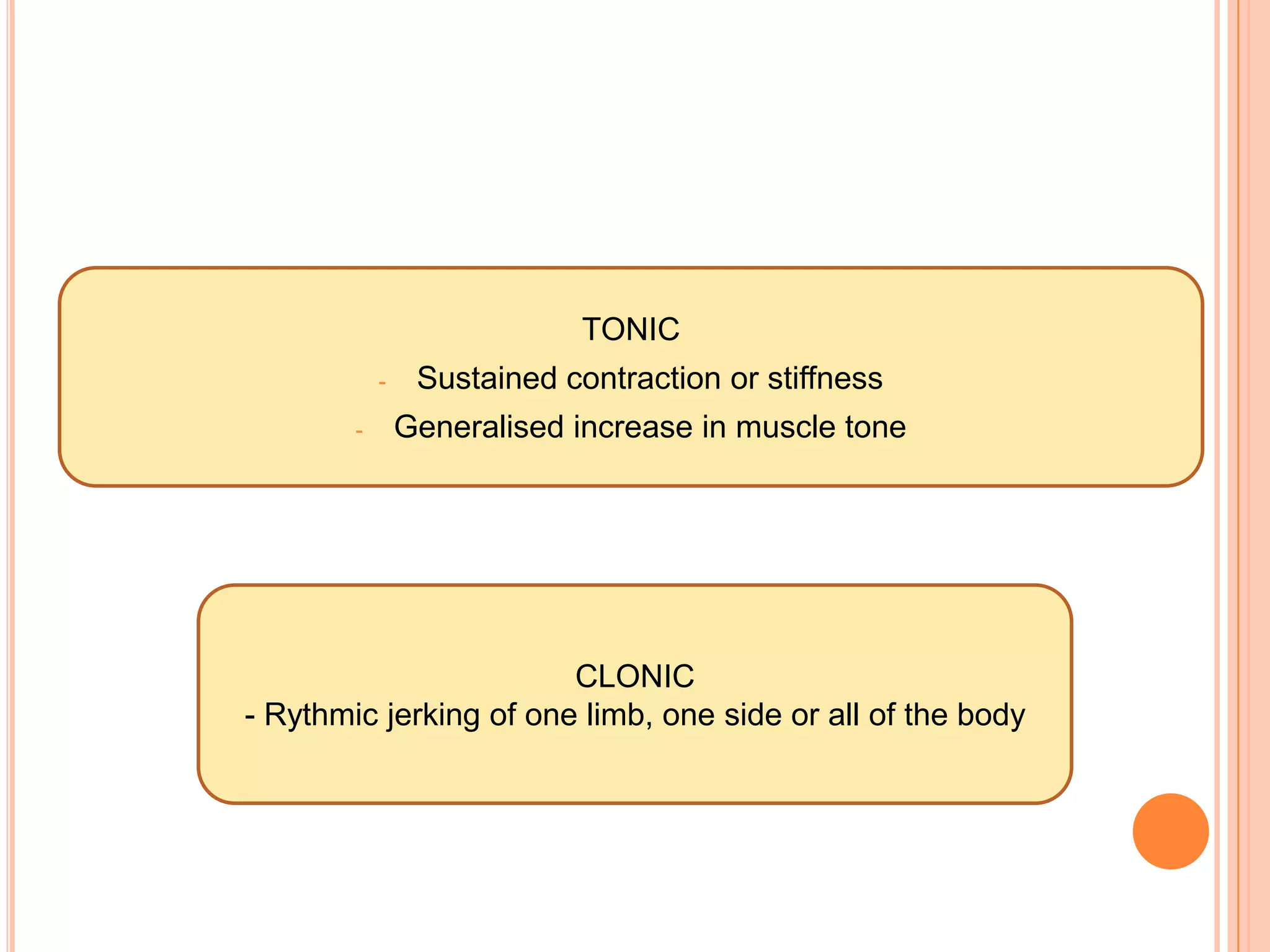
TONICSustained contraction or stiffness
Generalised increase in muscle toneCLONIC- Rythmic jerking of one limb, one side or all of the body
SITUATION 6"These seizures frighten me. They only last a minute or two but it seems like an eternity. I can often tell Jessica's going to have one because she acts cranky and out of sorts. It begins with an unnatural shriek. Then she falls, and every muscle seems to be activated. Her teeth clench. She's pale, and later she turns slightly bluish. Shortly after she falls, her arms and upper body start to jerk, while her legs remain more or less stiff. This is the longest part of the seizure. Finally it stops and she falls into a deep sleep."
TONIC-CLONICRhythmical contraction of muscle groups following the tonic phase
In the rigid tonic phase, children may fall to the ground, sometimes  injuring themselves. They do not breathe and become cyanosed.
this is followed by clonic phase, with jerking of the limbs. Breathing is irregular, cyanosis persists and saliva may accummulate in the mouth.
There may be biting of tongue and incontinence of urine

4. Convulsive disorder

  • 1.
    CONVULSIVE DISORDERKhiddir binNasharuddin 2008202444Adam Safin Bin Abdul Mutti 2008402544Qhasmirabt Abu Hazir 2008409674
  • 2.
    SEIZURES AND EPILEPSYBy:Qhasmirabt Abu Hazir
  • 3.
    DEFINITIONSSEIZURES- clinical eventin which there is sudden disturbance of neurological fx caused by an abnormal or excessive neuronal dischargeEPILEPSY- recurrent, unprovoked seizures.
  • 4.
    EPILEPSIES25-30% ofthese children have other neurological disorder (mental handicap, cerebral palsy)Diagnosed clinically, hence a detailed description of events experienced by patient or an adequate account by a reliable witness is crucialEpilepsy should be viewed as a symptom of an underlying neurological disorder and not as a single entity
  • 5.
    RISK FACTORSHx ofprevious seizuresRecent withdrawal of anti-convulsant medicationBrain tumorNeurodegenerative disorderHx of remote neurologic insult ( stroke, intracranial hemorrhage,cerebral palsy, head, trauma,meningitisFamilial hx of seizures
  • 6.
    CAUSESSEIZURESIDIOPATHIC (70-80%)- Noobvious underlying pathologySYMPTOMATIC- With underlying pathologyCRYPTOGENIC- Appears to be symptomatic but pathology cannot be identified
  • 7.
  • 8.
  • 9.
  • 10.
  • 11.
  • 12.
  • 13.
  • 14.
  • 15.
  • 16.
  • 17.
  • 18.
  • 19.
  • 20.
  • 21.
  • 22.
  • 23.
  • 24.
  • 25.
  • 26.
  • 27.
  • 28.
  • 29.
  • 30.
  • 31.
  • 32.
  • 33.
    familialBeware of non-epilepticeventNon-epileptic events:Syncope - day dreaming
  • 34.
    Night terrors - delirium
  • 35.
    Migraine - sleep disorder
  • 36.
  • 37.
    Shuddering spellsSeizures hxOnset,duration and timePre-ictal and ictal phasePost-ictal phaseFamily hxGrowth and development hx-weakness, sensory deficits, change in vision, behavior, balance and gaitPmh- previous hx of seizures or neurologic abnormalities
  • 38.
  • 39.
  • 40.
    Recent hx ofhead trauma
  • 41.
    Possibility of ingestionor recent change in antiepileptic medication
  • 42.
    Risk factorCLASSIFICATIONCLASSIFICATION OFSEIZURESPARTIALGENERALISED Seizures arise from one or part of one hemisphereSeizures arise from both hemisphere simultaneously
  • 43.
    PARTIAL SEIZURESSIMPLE- ConsciousnesspreservedPARTIALOriginate focally in cortexCOMPLEX-impaired concsiousnessSECONDARILY GENERALIZED
  • 44.
    MANIFESTATION OF PARTIALSEIZURESManifestation will depend on the part of the brain where the discharge originatesTEMPORAL LOBE-the most common-may result in strange warning feelings or aura with smell and taste abnormalities and distortion of sound and shape.-lip smacking, plucking at one’s clothing, and walking in non-purposely manner (automatism)-dejavu-consciouness can be impairedFRONTAL SEIZURESInvolve motor cortex
  • 45.
    May lead toclonic movement, which may travel proximally
  • 46.
    Asymmetrical tonic seizurescan be seen, which may be bizarre and hyperkinetic and can be mistakenly dismissed as non-epileptic eventsOCCIPITAL SEIZURES-cause distortion of visionPARIETAL LOBE SEIZURES- Cause contralateraldysaesthesias (altered sensation), or distorted body image
  • 47.
    SITUATION 1"I almostenjoy them. The feeling of déja vu, as if I've lived through this moment and I even know what's going to be said next. Everything seems brighter and more alive." "It is a pressure that starts in my stomach, then rises to my chest and throat. When it reaches my chest, I smell an unpleasant odor of something burnt. At the same time I feel anxious."
  • 48.
  • 49.
    Clinical symptoms includemotor, sensory,psychic or autonomicMOTORChange in muscle activity
  • 50.
  • 51.
    Jerking of fingeror stiffening of part of the body
  • 52.
    Movement may spread(affect one side or extend to both sides)
  • 53.
  • 54.
    Coordinated action suchas laughter or automatic hand movements (aware or not)SENSORYChange in any of the senses
  • 55.
  • 56.
    Smell or tastethings that aren’t there
  • 57.
    Hear clicking,ringing orperson’s voice when there is no actual sounds
  • 58.
    Feel sensation of“pins and needle”/numbness
  • 59.
    Feel floating orspinnig in space
  • 60.
    Visual hallucination AUTONOMICChangesin the part of the nervous system that automatically controls body fx
  • 61.
  • 62.
    Strange or unpleasantsensation in stomach, chest,or head
  • 63.
  • 64.
  • 65.
    Goose bumpsPSYCHICChange inthinking,feeling or experiencing things
  • 66.
  • 67.
  • 68.
  • 69.
    Trouble in understandingspoken or written language
  • 70.
    Sudden feeling ofemotion like fear,depression or happiness
  • 71.
    Feeling of dejavu(I’ve been through this)
  • 72.
    Feeling of jamaisvu (this is new to me)SITUATION 2“Micky's spells begin with a warning; he says he's going to have a seizure and usually sits down. If I ask him how he feels, he just says 'I feel it.' Then he makes a funny face, a mixture of surprise and distress. During the seizure he may look at me when I call his name but he never answers. He just stares and makes odd mouth movements, as if he's tasting something. Sometimes he'll grab the arm of the chair and squeeze it. He may also pull at his shirt as though he's picking lint off of it. After a few minutes, when he's coming out of it, he asks a lot of questions. He never remembers his 'warning' or these questions. The seizures make him tired; if he has two in the same day, he often goes to sleep after the second one."
  • 74.
    COMPLEX PARTIAL SEIZURESCOMPLEXPARTIAL SEIZUREConsciousness impaired
  • 75.
    Temporal lobe epilepsyis the most common type
  • 76.
    The patient stopswhat he or she doing and stare blankly, often making rhythmic smacking movements of the lips or displaying other automatism, such as picking at their clothes
  • 77.
    After few minutesreturn consciousness, may initially feel drowsy
  • 78.
    Aura may present:alterations of mood, memory
  • 79.
    Complex hallucinations ofsound, smell, taste,vision,emotional changes (fear,sexual arousal) or visceral sensation (nausea, epigastric discomfort) may also occur.SITUATION 3The seizures start with a tingling in my right thumb. In seconds, my thumb starts jerking. Soon, my whole right hand is jerking. I have learned that by rubbing and scratching my forearm I can sometimes stop the seizure. Other times the jerking spreads up my arm. When it reaches my shoulder, I pass out and people tell me that my whole body starts to jerk.
  • 80.
    SECONDARILY GENERALIZED (“JACKSONIAN” SEIZURES)When partial seizures spread to involve the whole brain and produce generalized tonic-clonic seizures.
  • 81.
    focal seizurefollowed by generalised tonic-clonic seizureGENERALISED SEIZURESABSENCETypical
  • 82.
    atypicalTonic GENERALISED-generalised brain involvementClonicTonic-clonicMinor motorAtonic
  • 83.
    myoclonicSITUATION 4Junsu, a7-year-old boy, often "blanks out" anywhere from a few seconds to 20 seconds at a time. During a seizure, Junsu doesn't seem to hear his teacher call his name, he usually blinks repetitively, and his eyes may roll up a bit. During shorter seizures, he just stares. Then he continues on as if nothing happened. Some days Junsu has more than 50 of these spells
  • 84.
    TYPICAL ABSENCE (4-6years of age)Brief loss of environmental awareness ( LOC), with an abrupt onset and termination, unaccompanied by motor phenomenona except for some eye fluttering and minor alteration in muscle tone or simple automatism such as head bobbing and lip smacking
  • 85.
    Can often beprecipitated by hyperventilation and lasted for few seconds
  • 86.
    primary generalisedabsence/petit mal@Stoppage of activity, staring and alteration of concsiousness and may include automatism
  • 87.
  • 88.
    Generalised increase inmuscle toneCLONIC- Rythmic jerking of one limb, one side or all of the body
  • 89.
    SITUATION 6"These seizuresfrighten me. They only last a minute or two but it seems like an eternity. I can often tell Jessica's going to have one because she acts cranky and out of sorts. It begins with an unnatural shriek. Then she falls, and every muscle seems to be activated. Her teeth clench. She's pale, and later she turns slightly bluish. Shortly after she falls, her arms and upper body start to jerk, while her legs remain more or less stiff. This is the longest part of the seizure. Finally it stops and she falls into a deep sleep."
  • 90.
    TONIC-CLONICRhythmical contraction ofmuscle groups following the tonic phase
  • 91.
    In the rigidtonic phase, children may fall to the ground, sometimes injuring themselves. They do not breathe and become cyanosed.
  • 92.
    this is followedby clonic phase, with jerking of the limbs. Breathing is irregular, cyanosis persists and saliva may accummulate in the mouth.
  • 93.
    There may bebiting of tongue and incontinence of urine
  • 94.
    Lasts from afew second to minutes
  • 95.
    followed by unconsciousnessor deep sleep up to several hours
  • 96.
    post-ictal confusionor headache and a period of subsequent malaise is commonSITUATION 7"In the morning, I get these 'jumps.' My arms fly up for a second, and I often spill my coffee or drop what I'm holding. Now and then my mouth may shut for a split second. Sometimes I get a few jumps in a row. Once I've been up for a few hours, the jumps stop."
  • 97.
  • 98.
    Caused by rapidcontraction and relaxation of muscles
  • 99.
  • 100.
    Usually associated withmultiple seizure type
  • 101.
    non-epileptic myoclonusmovement are also seen physiologically in hiccoughs (myoclonus of diaphragm) or on passing through stage ii sleep (sleep myoclonus)SITUATION 8"When Minho has a 'drop' seizure, he falls to the ground and often hits his head and bruises his body. Even if I'm right next to him and prepared, I may not catch him. Even with carpet in the bedroom and mats in the bathroom, he gets hurt."
  • 102.
    ATONIC SEIZURES @DROP SEIZURESOften combined with myoclonic jerk followed by transient loss of muscle tone causing a sudden fall to the floor or drop of the head
  • 103.
    Consciousness is impairedduring fall and regain alertness immediately upon striking the floor
  • 104.
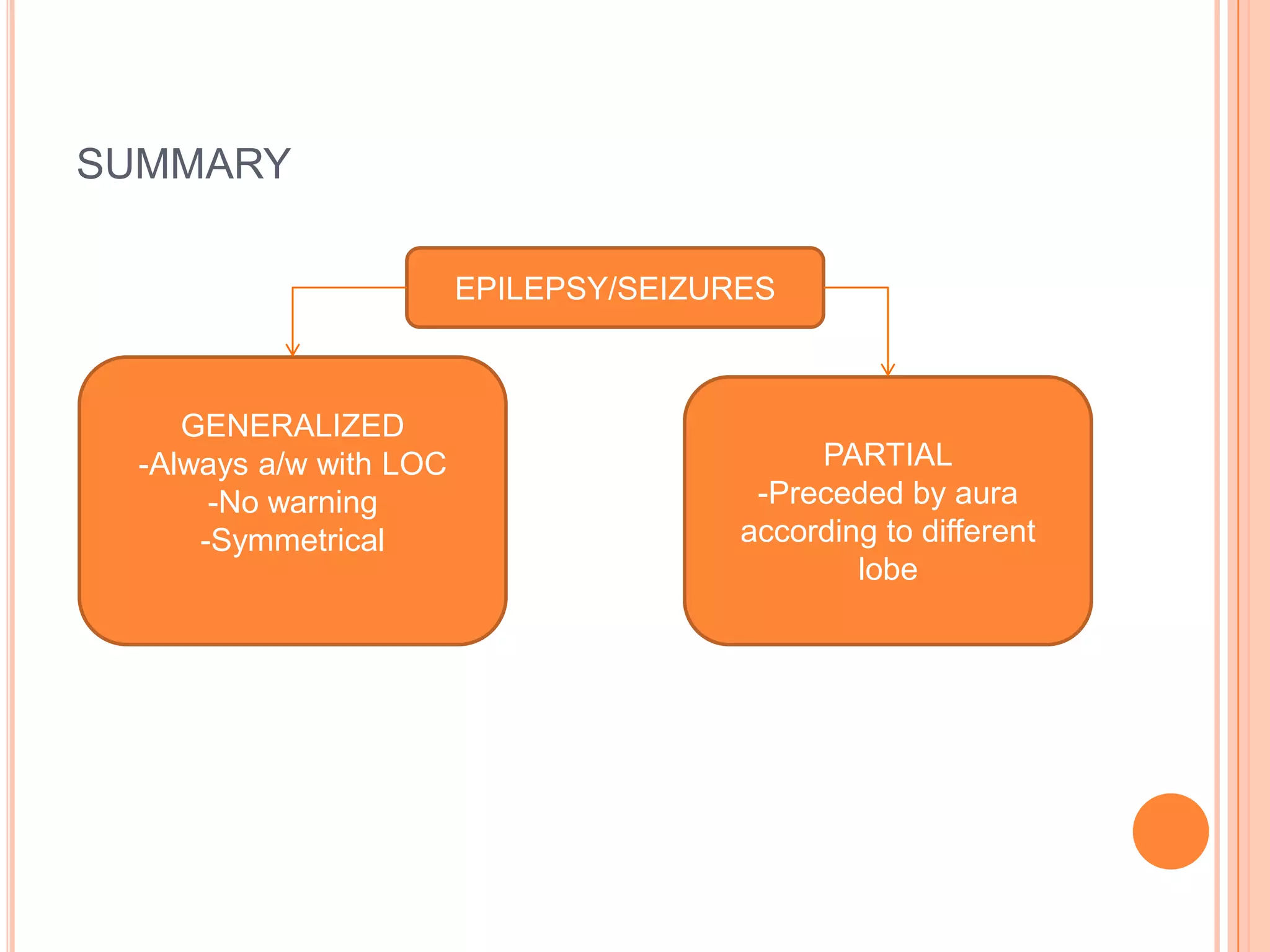
    they onlyoccur in context of epilepsy syndromes with other forms of seizuresummaryEPILEPSY/SEIZURESGENERALIZEDAlways a/w with LOC
  • 105.
  • 106.
    SymmetricalPARTIALPreceded by auraaccording to different lobeLaboratory and diagnostic evaluation of seizuresComplete lab evaluation of child with new onset of seizures:FBC
  • 107.
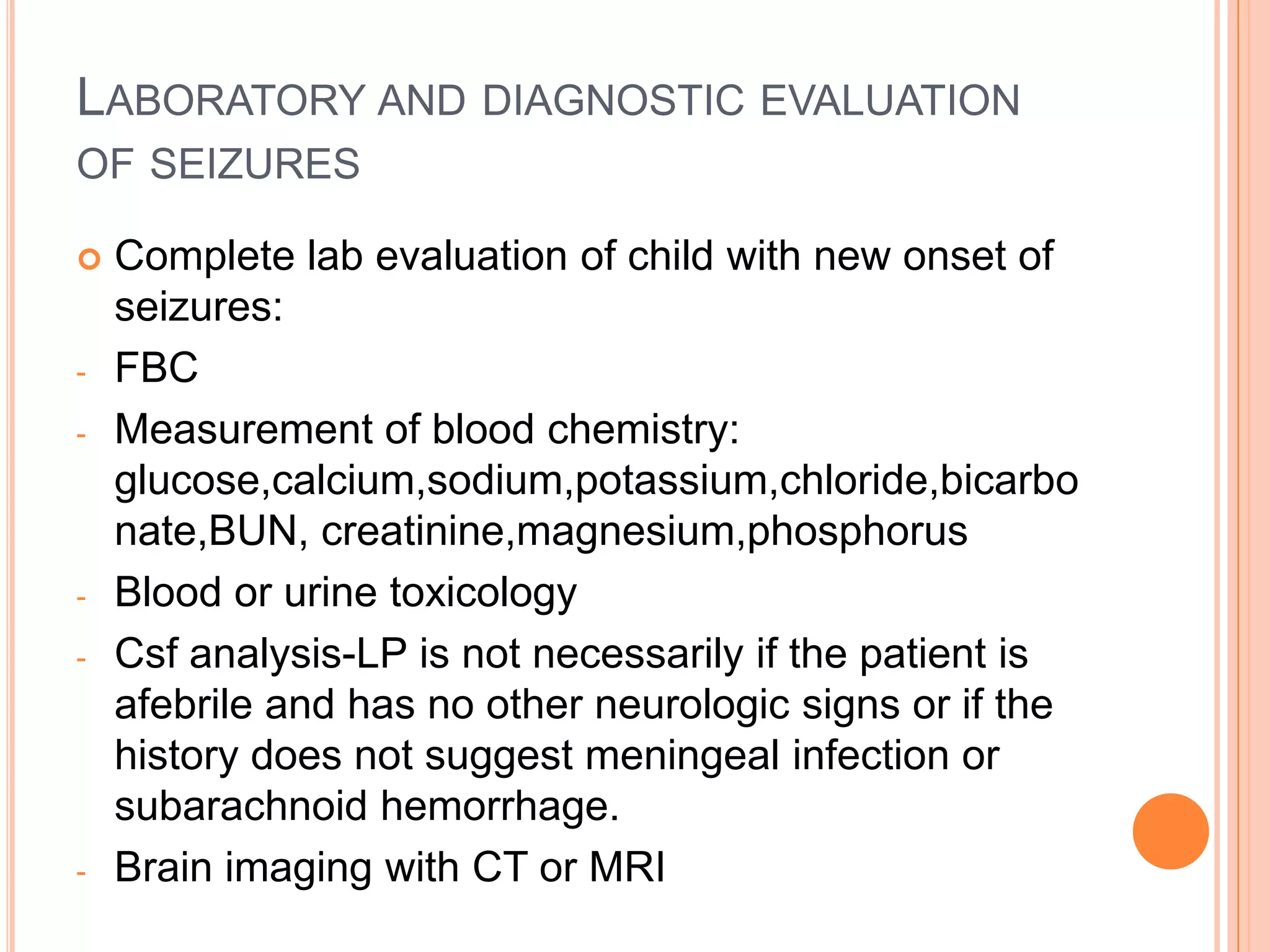
    Measurement of bloodchemistry: glucose,calcium,sodium,potassium,chloride,bicarbonate,BUN, creatinine,magnesium,phosphorus
  • 108.
    Blood or urinetoxicology
  • 109.
    Csf analysis-LP isnot necessarily if the patient is afebrile and has no other neurologic signs or if the history does not suggest meningeal infection or subarachnoid hemorrhage.
  • 110.
    Brain imaging withCT or MRIINDICATION OF BRAIN IMAGING IN AFEBRILE SEIZURESFirst afebrile seizure episode- to exclude any intracranial pathology ie:hematoma,space-occupying lesion which may lead to seizureComplex seizure disorderSuspected epilepsy
  • 111.
  • 112.
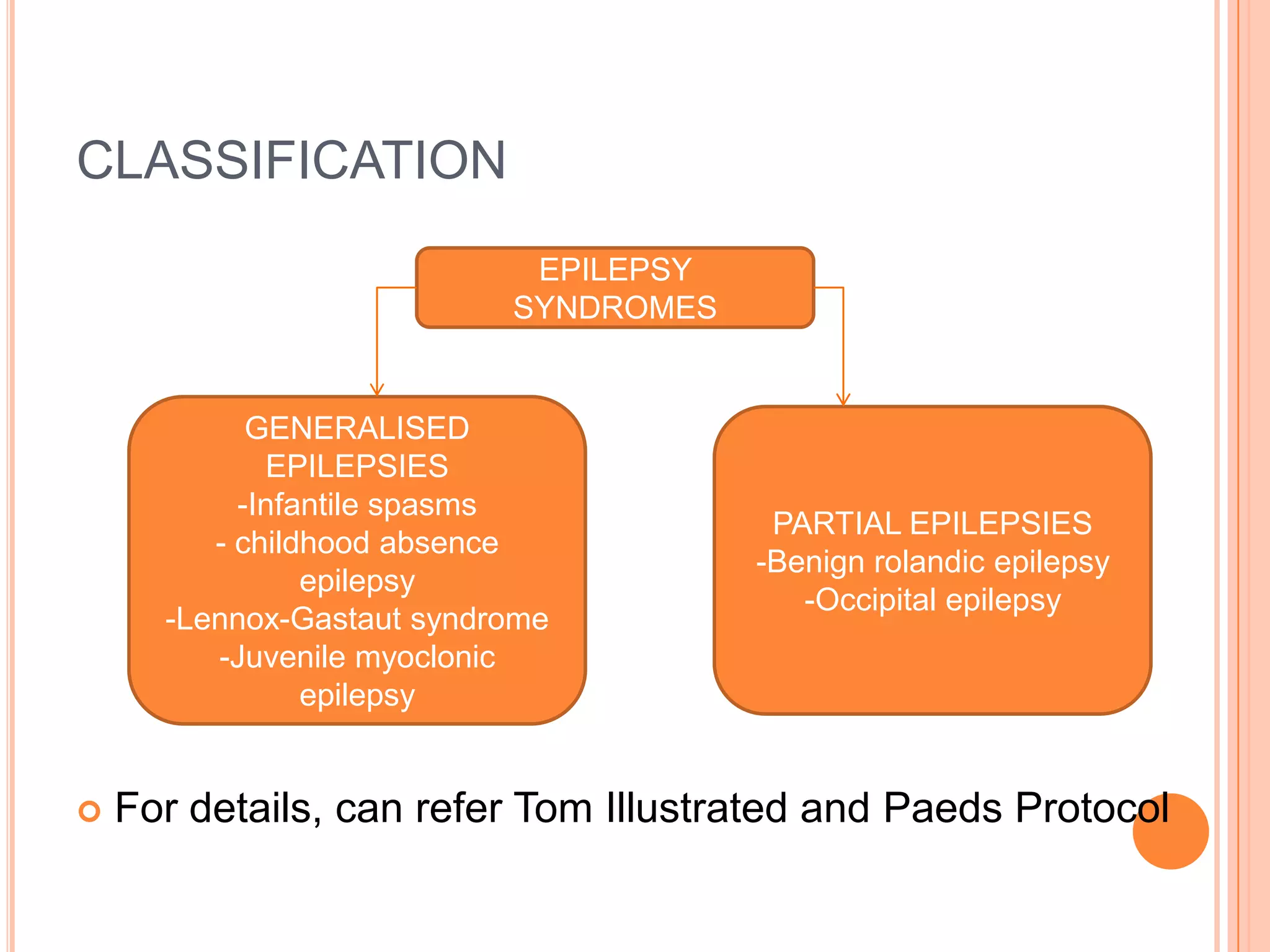
    DEFINITIONEPILEPTIC SYNDROMES- complexof signs and symptoms that define a unique epilepsy condition. Syndromes are classified on the basis of seizure type(s), clinical context, EEG features and neuroimaging.Paediatric Protocol for Malaysian Hospitalepilepsies that can grouped together according to age, sex, hx, seizure semiology and EEG pattern.
  • 113.
    CLASSIFICATIONFor details, canrefer Tom Illustrated and Paeds ProtocolEPILEPSY SYNDROMESGENERALISED EPILEPSIESInfantile spasms
  • 114.
  • 115.
  • 116.
    Juvenile myoclonic epilepsyPARTIALEPILEPSIESBenign rolandic epilepsy
  • 117.
    Occipital epilepsyDiagnosing epilepsyDiagnosingepilepsy is a multi-step process, usually involving the following evaluations:Confirmation through patient history, neurological exam, and supporting blood and other clinical tests that the patient has epileptic seizures and not some other type of episode such as fainting, breath-holding (in children), transient ischemic attacks, hypoglycemia, or non-epileptic seizures. Identification of the type of seizure involved. Determination of whether the seizure disorder falls within a recognized syndrome. A clinical evaluation in search of the cause of the epilepsy. Based on all previous findings, selection of the most appropriate therapy.
  • 118.
  • 119.
    Situation 1Junho couldfeel it. He was in the middle of an exam and didn't want to make a scene, so he tried to control it. But it was no use. The stress of the exam was getting to him, and the longer he held in his tic, the more he could feel it building up inside him. Finally he had no choice but to let it out. It wasn't as bad as he anticipated — his shoulders jerked slightly and no one seemed to notice.
  • 120.
    TICUsually a temporarycondition (transient tic)Affect 25% of people before the age of 18Sudden, repetitive movement or sound that can be difficult to control.Motor and vocal tics (simple or complex)Shoulder shrugging is one of the most common simple motor tics (nose wrinkling,headtwitching,eyeblinking,lipbiting,kicking,jumping)Vocal tics:coughing,throatclearing,sniffing,hissingCauses: no definite causes (emotional factors like stress)Diagnosis: accidental,no specific test,run test to rule out other condition with similar presentation
  • 121.
    Situation 2My two-year-oldson continually holds his breath, either after hurting himself or when he doesn't get his own way. He went blue today and actually appeared to faint – this only lasted a short time. Following this his lips looked blue for a while and he then slept for half an hour.
  • 122.
    Breath-holding spellsAn episodein which the child stop breathing and loses consciousness for a short period immediately after a frightening or emotionally upsetting event or a painful experienceUsually triggered by physically or emotionally upsetting eventsUsually begin in the first year of life and peak at the age of 2Cyanotic/blue type or pallid typeFurther diagnostic and evaluation needed if the spells occur often May resolve in later year
  • 123.
    Situation 3Emily Stevens*is afraid to do the ordinary things most of us take for granted. For years, she has been afraid to drive a car, be active in sports or even walk to the grocery store. Ever since Emily was diagnosed with epilepsy as a child, the constant threat of seizures - with loss of body control and consciousness - has made this 41-year-old woman a prisoner in her own home.As a child, Emily experienced sexual abuse and extreme emotional trauma. As an adult, she again became a victim, but this time of rape. To deal with the horror in her life, Emily learned a long time ago to keep her emotions and feelings to herself.When even large doses of epilepsy medications couldn't stop all her seizures, Emily went to the University of Michigan Epilepsy Clinic. It was not long before Linda Selwa, M.D., medical director of the Adult Neurology Outpatient Clinic, discovered that Emily's problem was not only epilepsy, but a recently discovered condition called pseudoseizures.
  • 124.
    PSYCHOGENIC NONEPILEPTIC SEIZURES/PSEUDOSEIZUREParoxysmalepisodes that resemble and often misdiagnosed as epileptic seizurePNES are psychological (emotional,stress-related) in originDo not result from an abnormal electrical discharge from the brainPNES-commonly misdiagnosed as epilepsy in patient with previous diagnosis of epilepsy that does not respond to drugPsychiatric disorderThe diagnosis requires an inpatient admission where the patient is continuously monitored by both an electroencephalogram (EEG) and video camera
  • 125.
    Physicians believe pseudoseizuresare psychological defense mechanisms induced by stress or episodes of severe emotional trauma. The seizures happen when patients try to avoid or forget the trauma.
  • 126.
    syncopeterm used todescribe the loss of consciousness from temporary disruption of cerebral oxygenationdue to the interruption of blood flow to the brain, and the loss of consciousness usually lasts for less than 30 secondsLay term-faintPatients who complain of dizziness, light-headedness, passing out, and/or blacking out must be questioned carefully.a careful history often can clarify the condition and guide further evaluation and careSyncope is a symptom of either cardiac or hemodynamic dysfunction and not a disease
  • 127.
    tremoran unintentional, somewhatrhythmic, muscle movement involving to-and-fro movements (oscillations) of one or more parts of the bodymost common of all involuntary movements and can affect the hands, arms, head, face, vocal cords, trunk, and legs.In some people, tremor is a symptom of another neurological disorder. The most common form of tremor, however, occurs in otherwise healthy people
  • 128.
    Causes and diagnosiscausedby problems in parts of the brain that control muscles throughout the body or in particular areas, such as the handsNeurological disorder ie multiple sclerosis,neurodegenerative diseaseDrugs-amphetamine,psychotic drugAlcohol abuseInheritanceUnknown causesDiagnosis: detailed hx,physicalexamination,brain imaging
  • 129.
    Management and treatmentof epilepsyKhiddir bin Nasharuddin
  • 130.
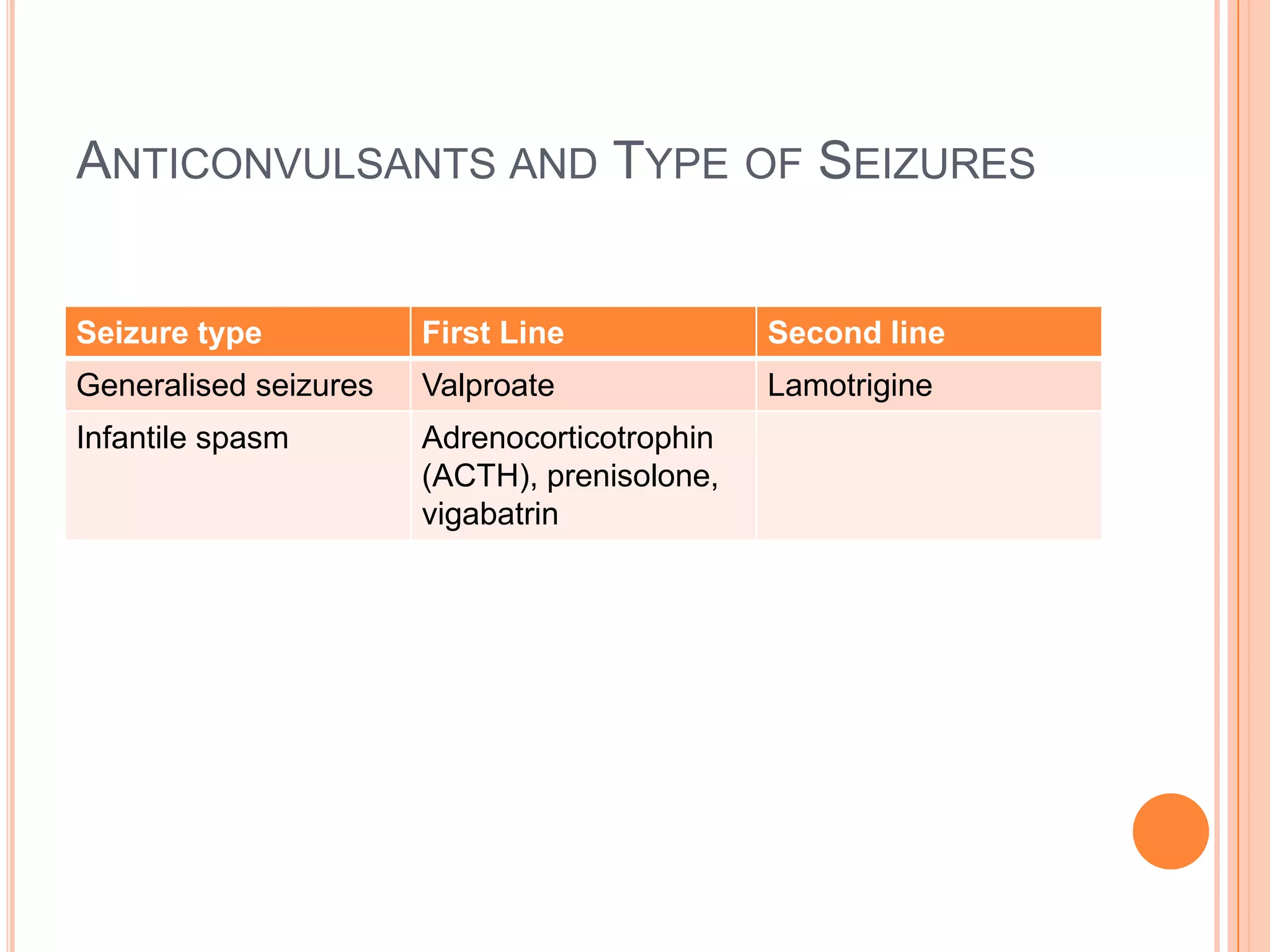
    Treatment recommended >2 episodes (recurrence risk up to 80%Attempt to classify the seizure and epileptic syndromeAdd on the 2nd drug if first drug failedRational combination therapy (usually 2 / max 3 drugs ) i.e combine drug with different MOA and consider their spectrum of efficacy, drug interactions and adverse effectsMonitor drug levelsGive consideration when planned for medication withdrawalPrinciple of anticonvulsants therapy for Epilepsy
  • 131.
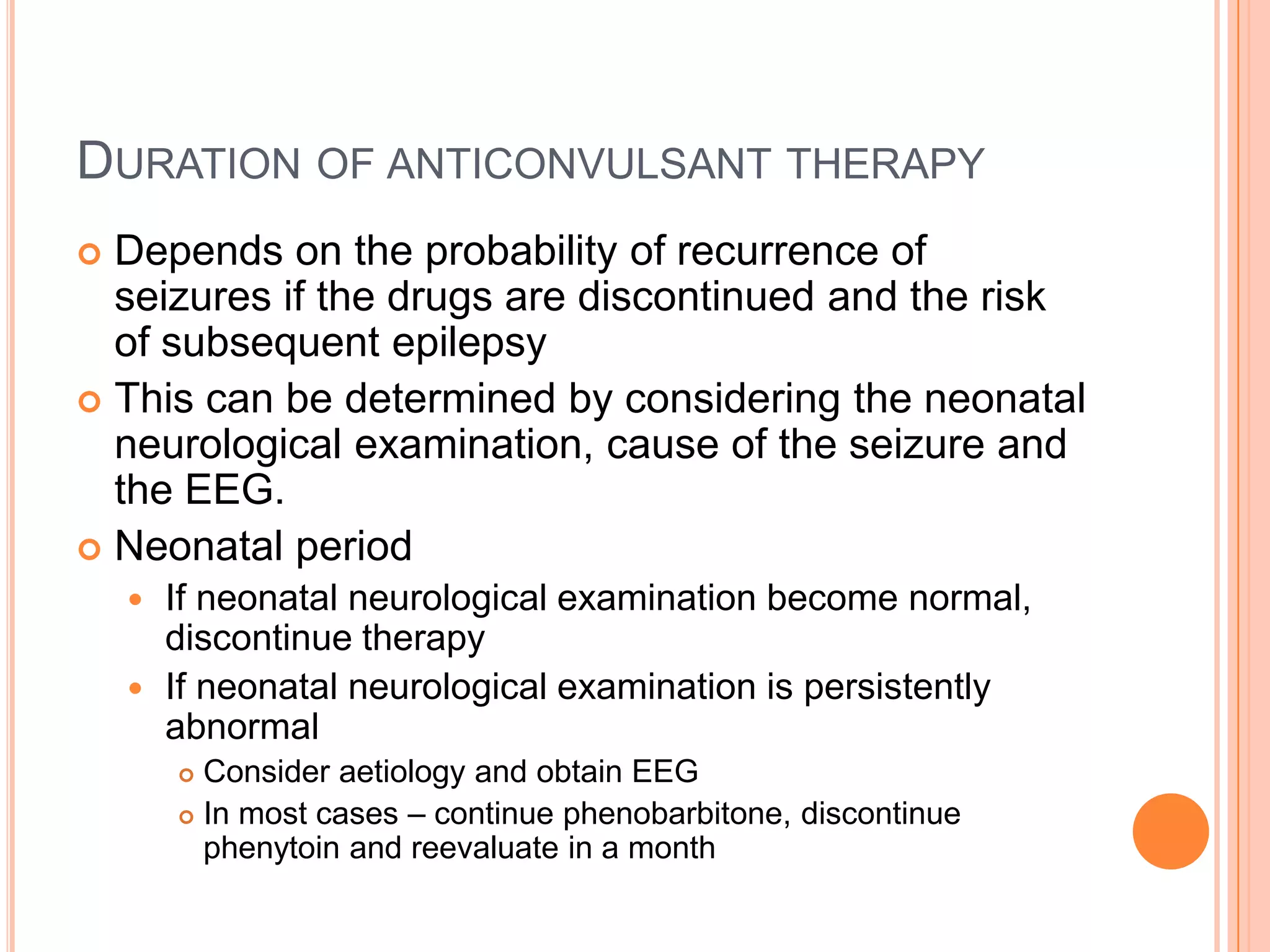
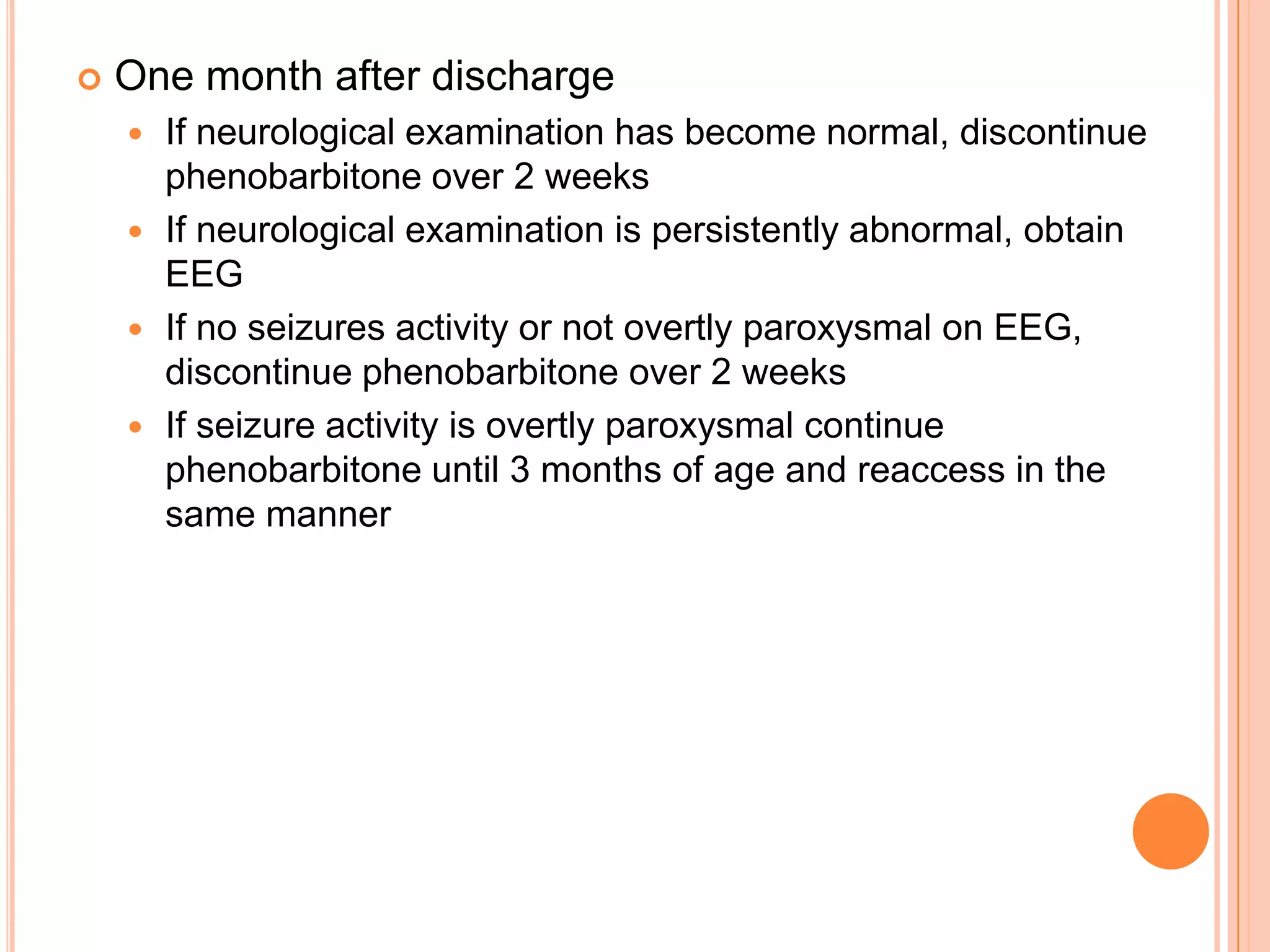
    Depends on theprobability of recurrence of seizures if the drugs are discontinued and the risk of subsequent epilepsyThis can be determined by considering the neonatal neurological examination, cause of the seizure and the EEG.Neonatal periodIf neonatal neurological examination become normal, discontinue therapyIf neonatal neurological examination is persistently abnormalConsider aetiology and obtain EEGIn most cases – continue phenobarbitone, discontinue phenytoin and reevaluate in a monthDuration of anticonvulsant therapy
  • 132.
    One month afterdischargeIf neurological examination has become normal, discontinue phenobarbitone over 2 weeksIf neurological examination is persistently abnormal, obtain EEGIf no seizures activity or not overtly paroxysmal on EEG, discontinue phenobarbitone over 2 weeksIf seizure activity is overtly paroxysmal continue phenobarbitone until 3 months of age and reaccess in the same manner
  • 133.
  • 134.
  • 135.
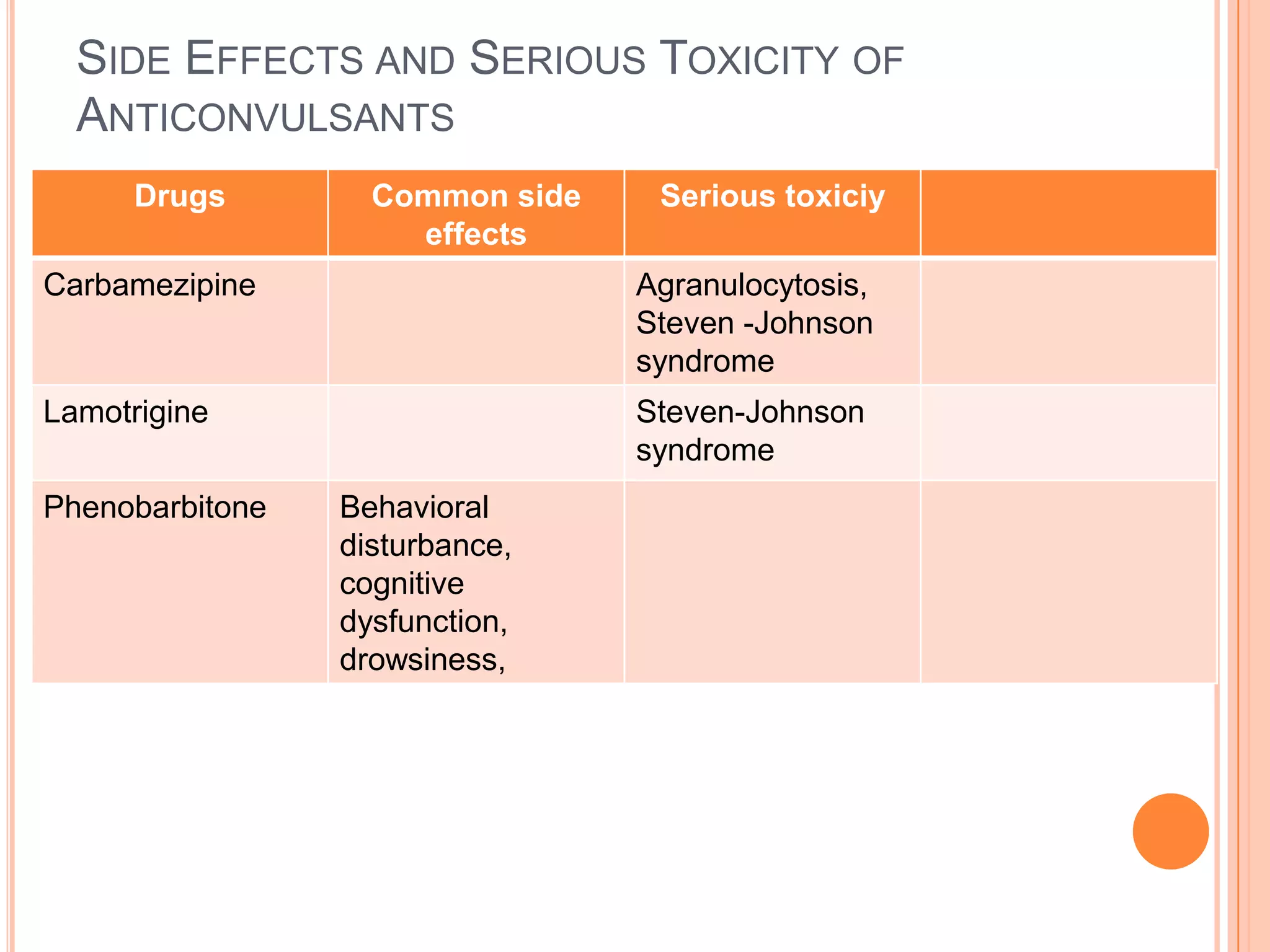
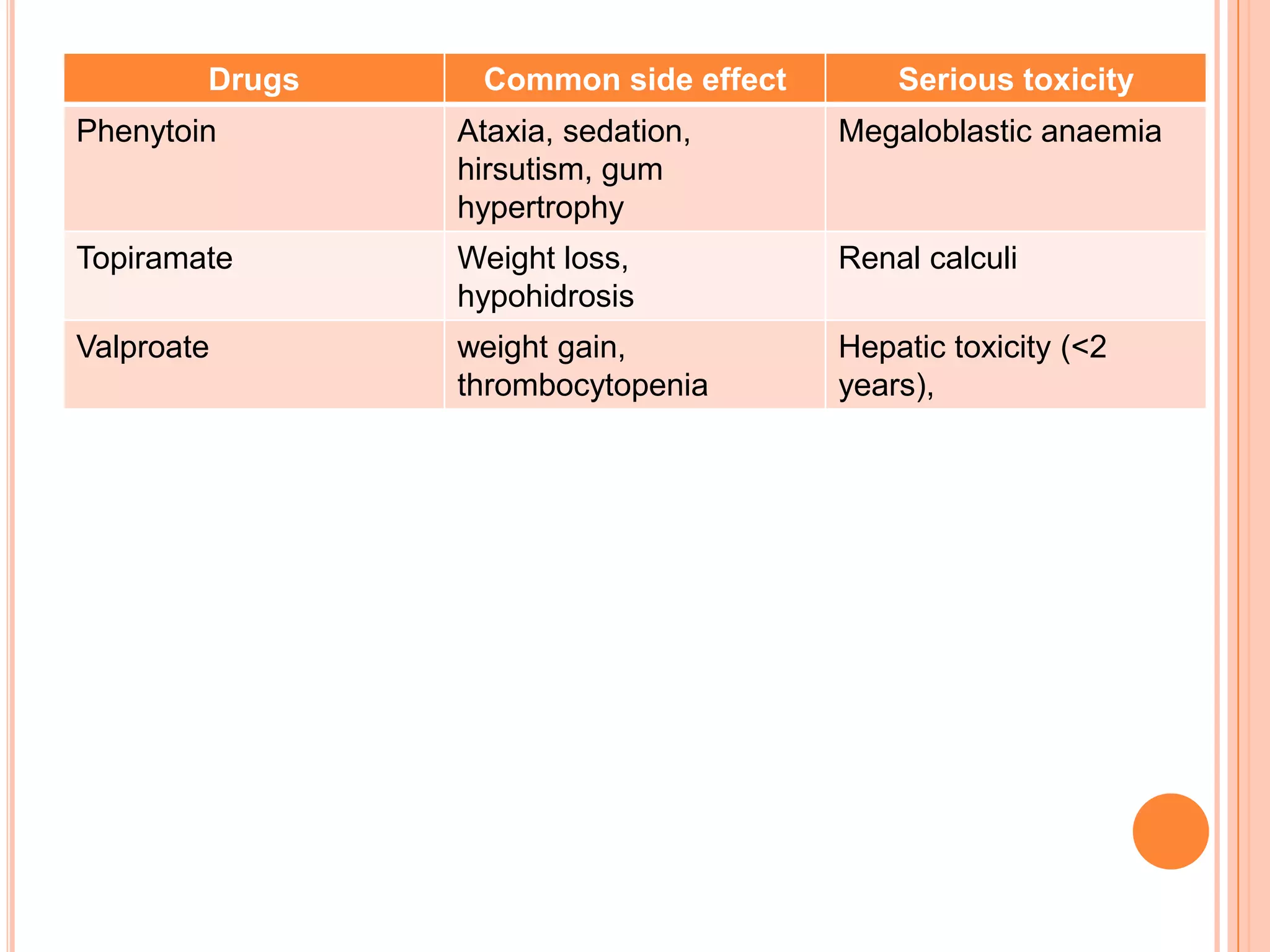
    Side Effects andSerious Toxicity of Anticonvulsants
  • 137.
  • 138.
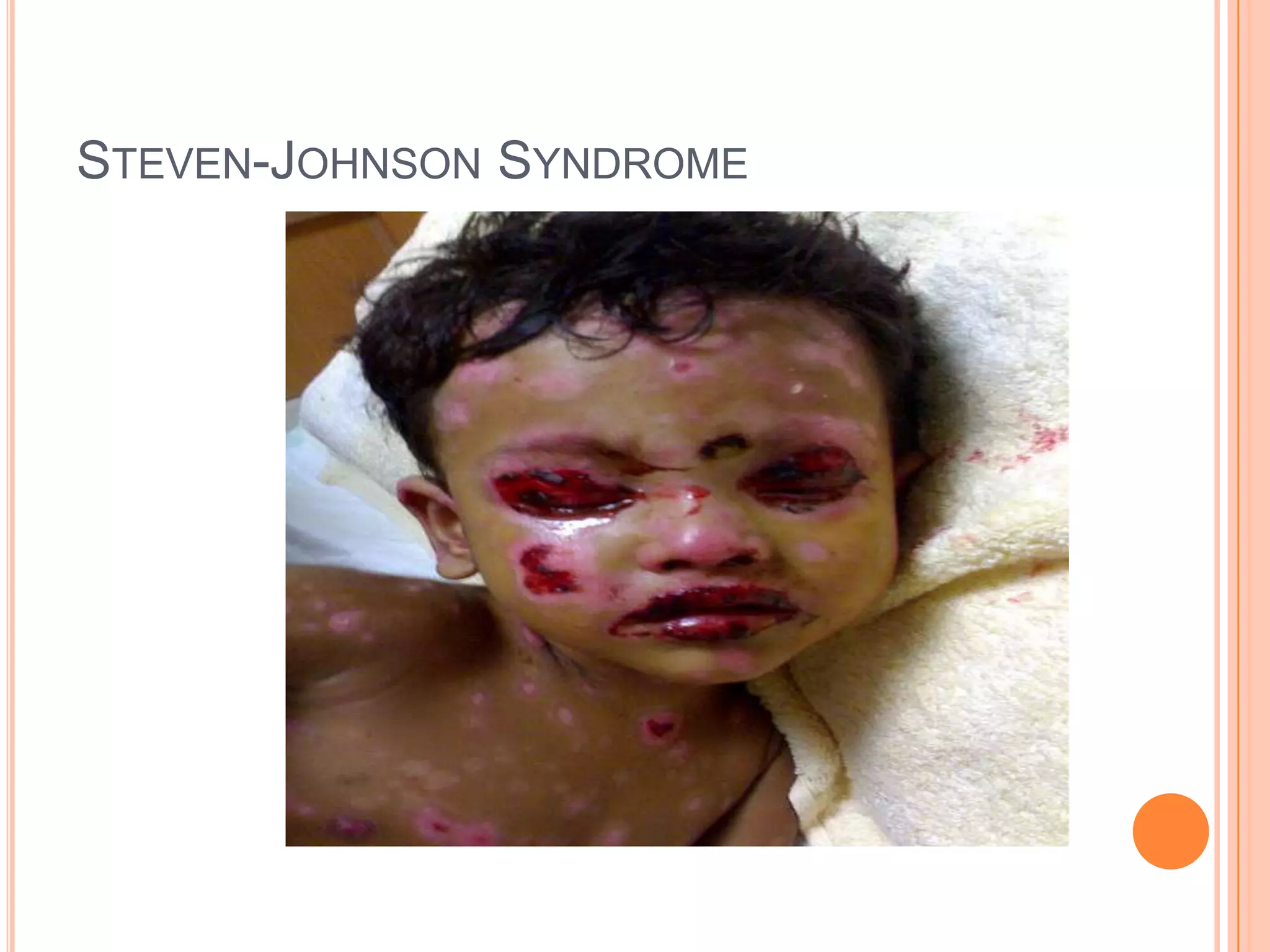
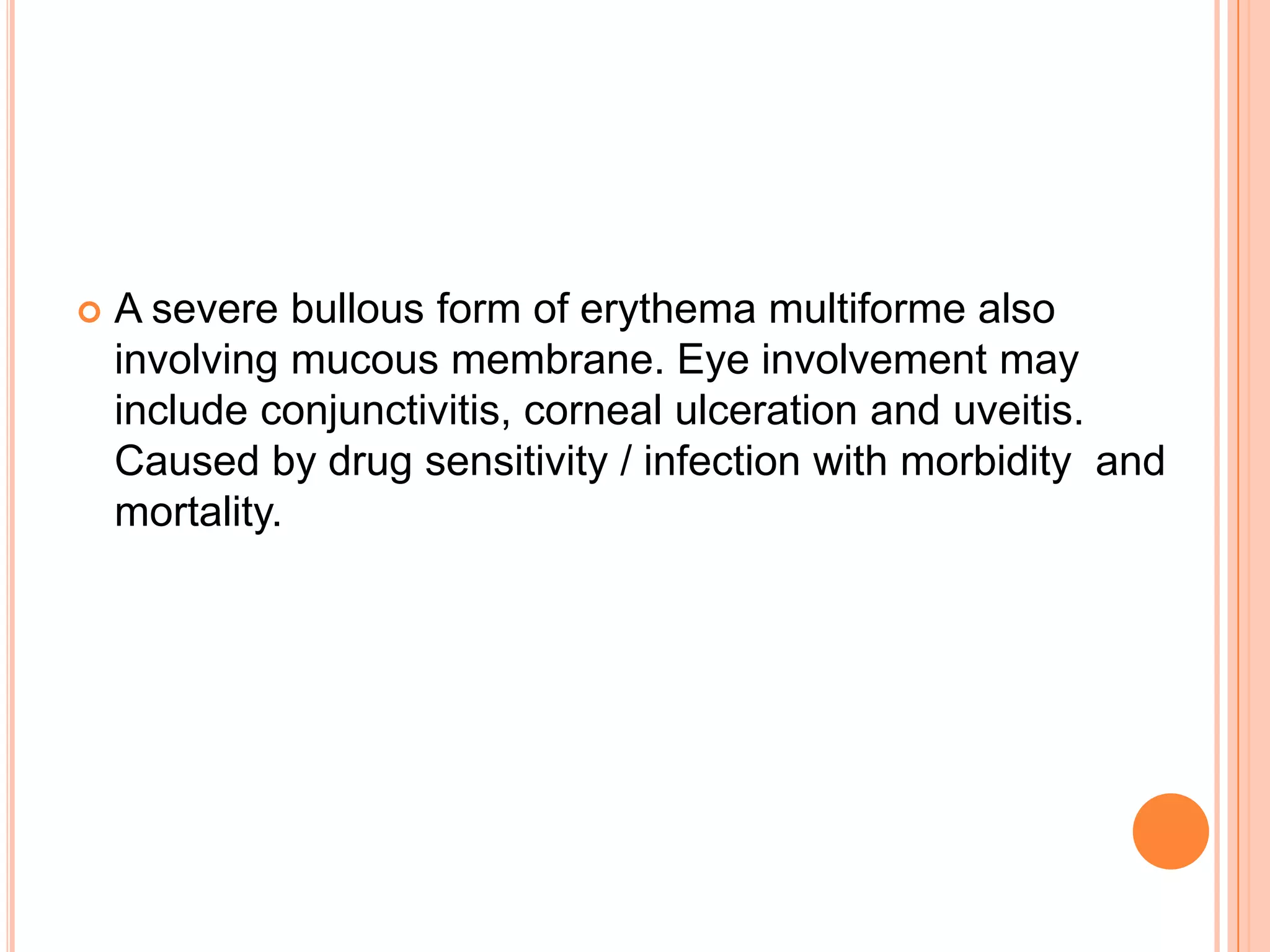
    A severe bullousform of erythemamultiforme also involving mucous membrane. Eye involvement may include conjunctivitis, corneal ulceration and uveitis. Caused by drug sensitivity / infection with morbidity and mortality.
  • 139.
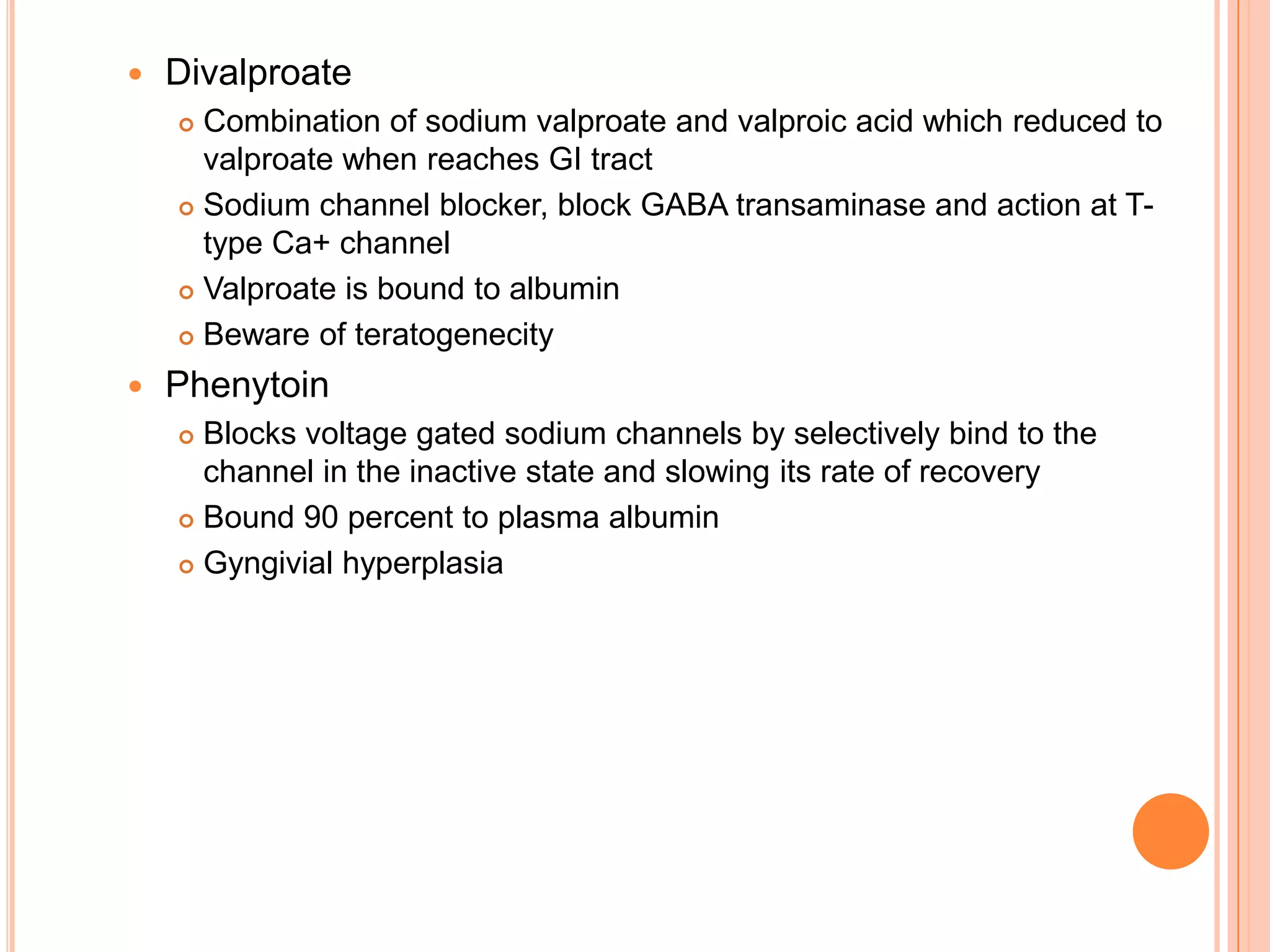
    BenzodiazepinesInc. in frequencyof channel opening produced by GABABinding of GABA to its receptor triggers an opening of a chloride channel which leads to an increase in chloride conductanceInflux of chloride ion causes a small hyperpolarization that moves the postsynaptic potential away from its firing threshold and thus inhibiting the formation of action potentialMechanism of Action of Anticonvulsants Drug
  • 140.
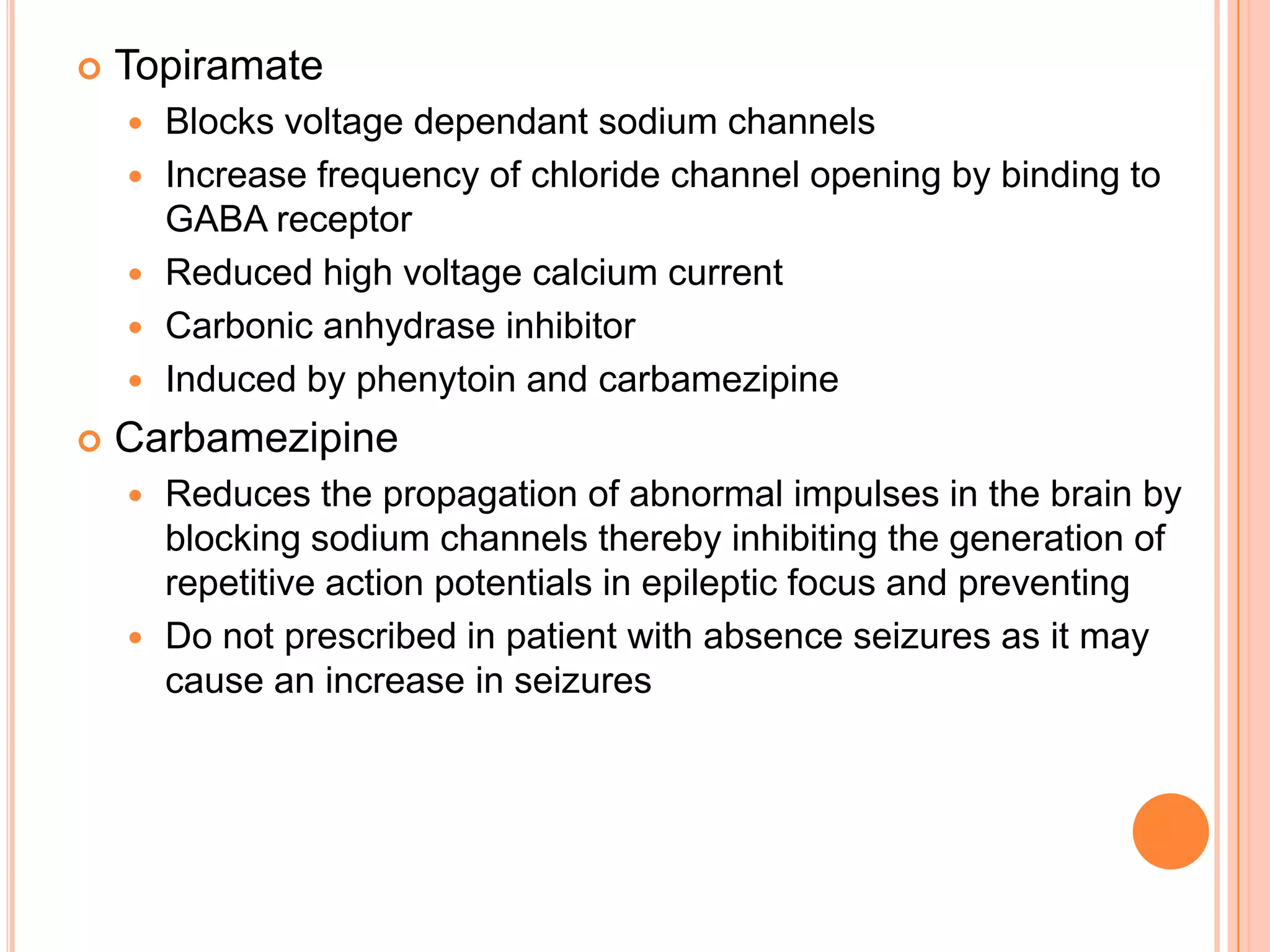
    DivalproateCombination of sodiumvalproate and valproic acid which reduced to valproate when reaches GI tractSodium channel blocker, block GABA transaminase and action at T-type Ca+ channelValproate is bound to albuminBeware of teratogenecityPhenytoinBlocks voltage gated sodium channels by selectively bind to the channel in the inactive state and slowing its rate of recoveryBound 90 percent to plasma albuminGyngivial hyperplasia
  • 141.
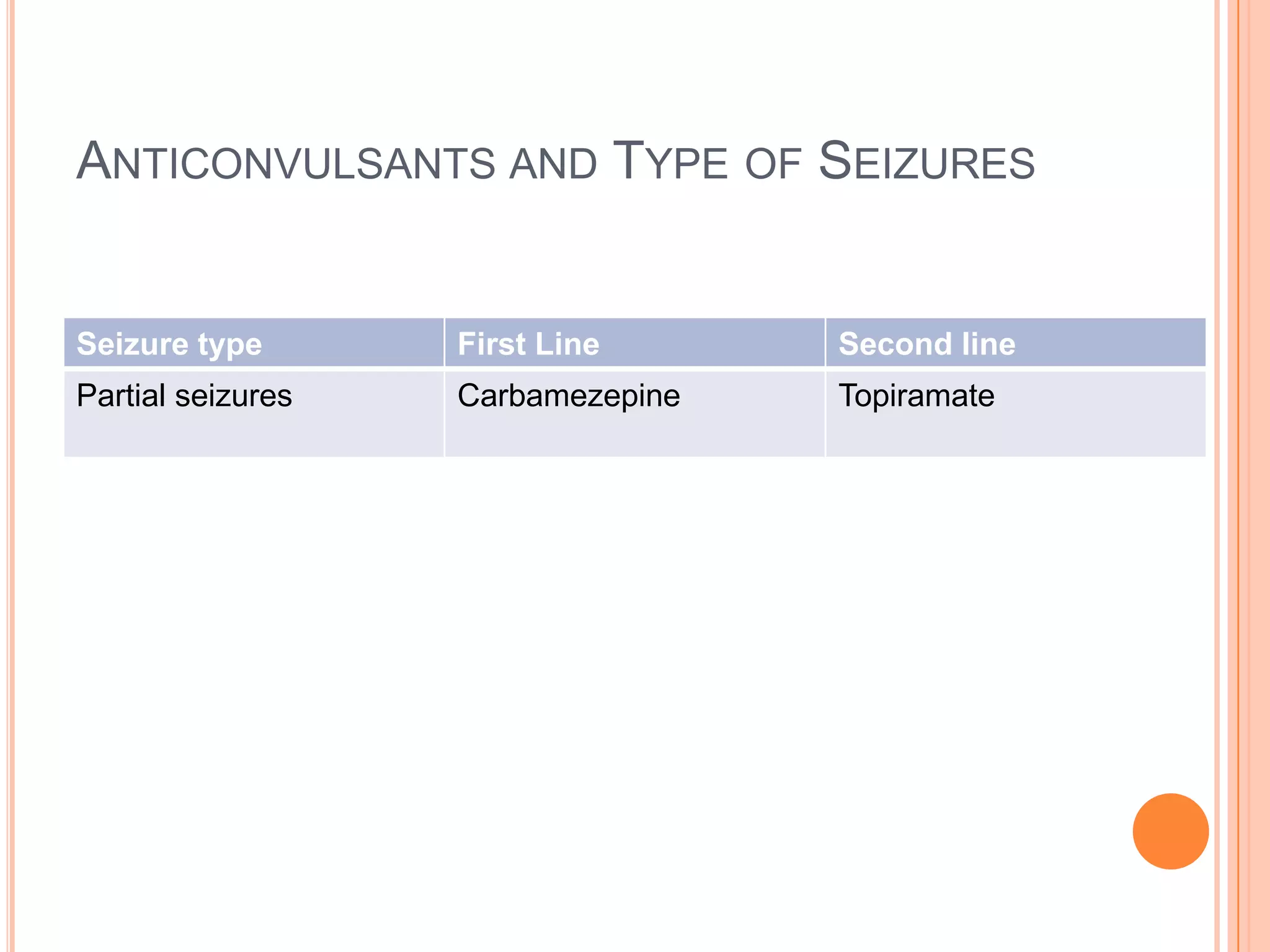
    TopiramateBlocks voltage dependantsodium channelsIncrease frequency of chloride channel opening by binding to GABA receptorReduced high voltage calcium currentCarbonic anhydrase inhibitorInduced by phenytoin and carbamezipineCarbamezipineReduces the propagation of abnormal impulses in the brain by blocking sodium channels thereby inhibiting the generation of repetitive action potentials in epileptic focus and preventing Do not prescribed in patient with absence seizures as it may cause an increase in seizures
  • 142.
  • 143.
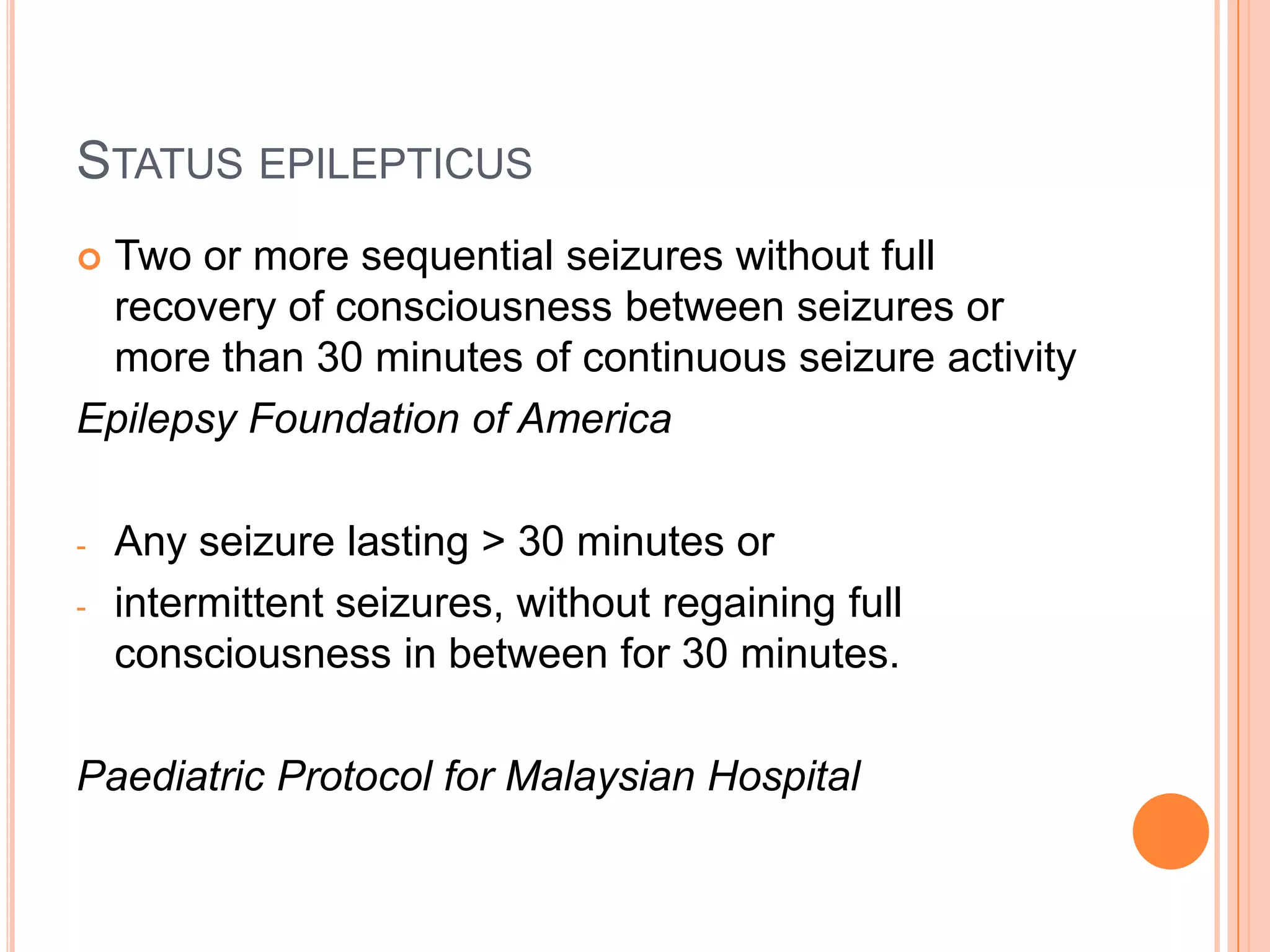
    Status epilepticusTwo ormore sequential seizures without full recovery of consciousness between seizures or more than 30 minutes of continuous seizure activityEpilepsy Foundation of AmericaAny seizure lasting > 30 minutes or
  • 144.
    intermittent seizures, withoutregaining full consciousness in between for 30 minutes.Paediatric Protocol for Malaysian Hospital
  • 145.
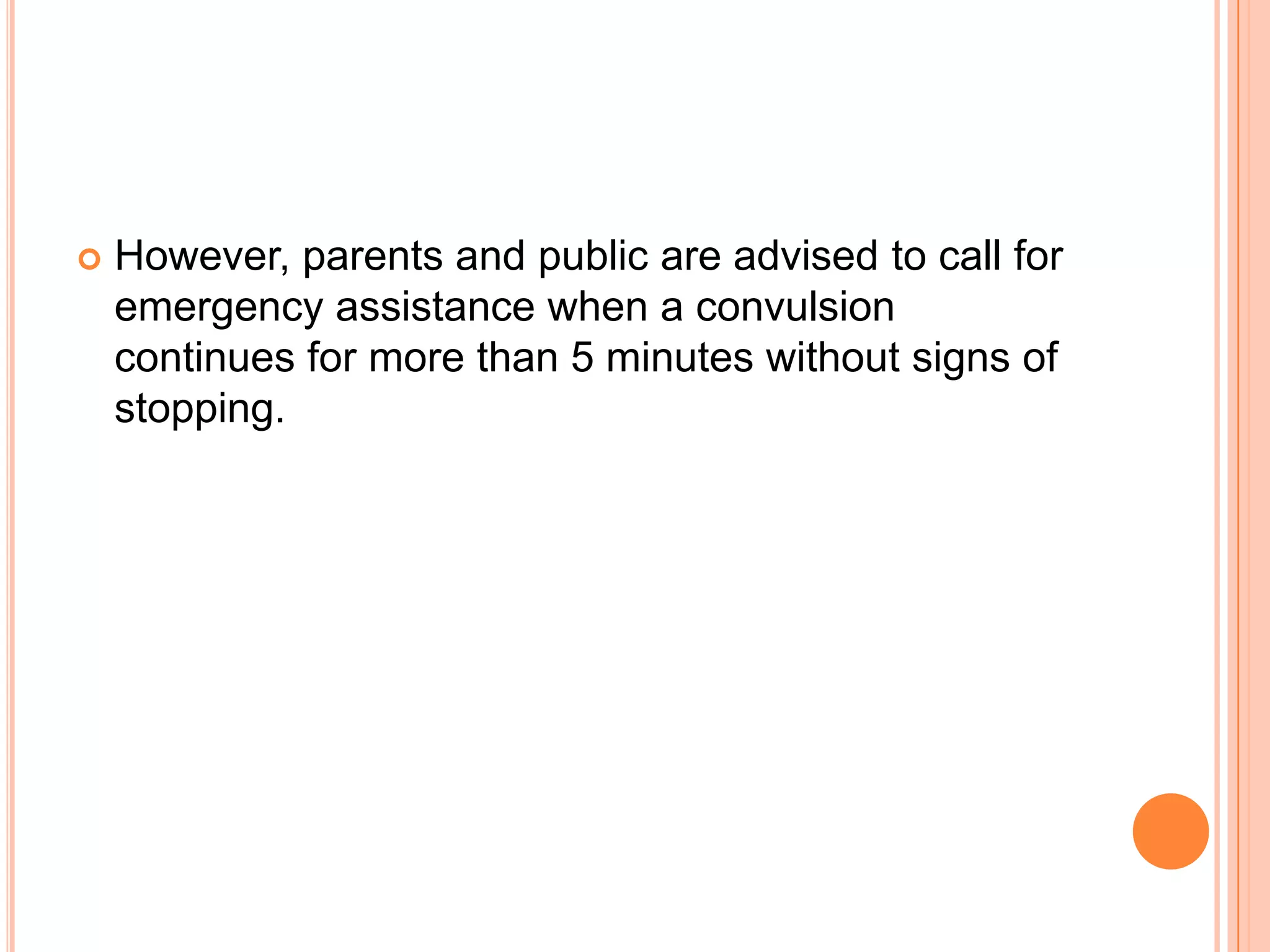
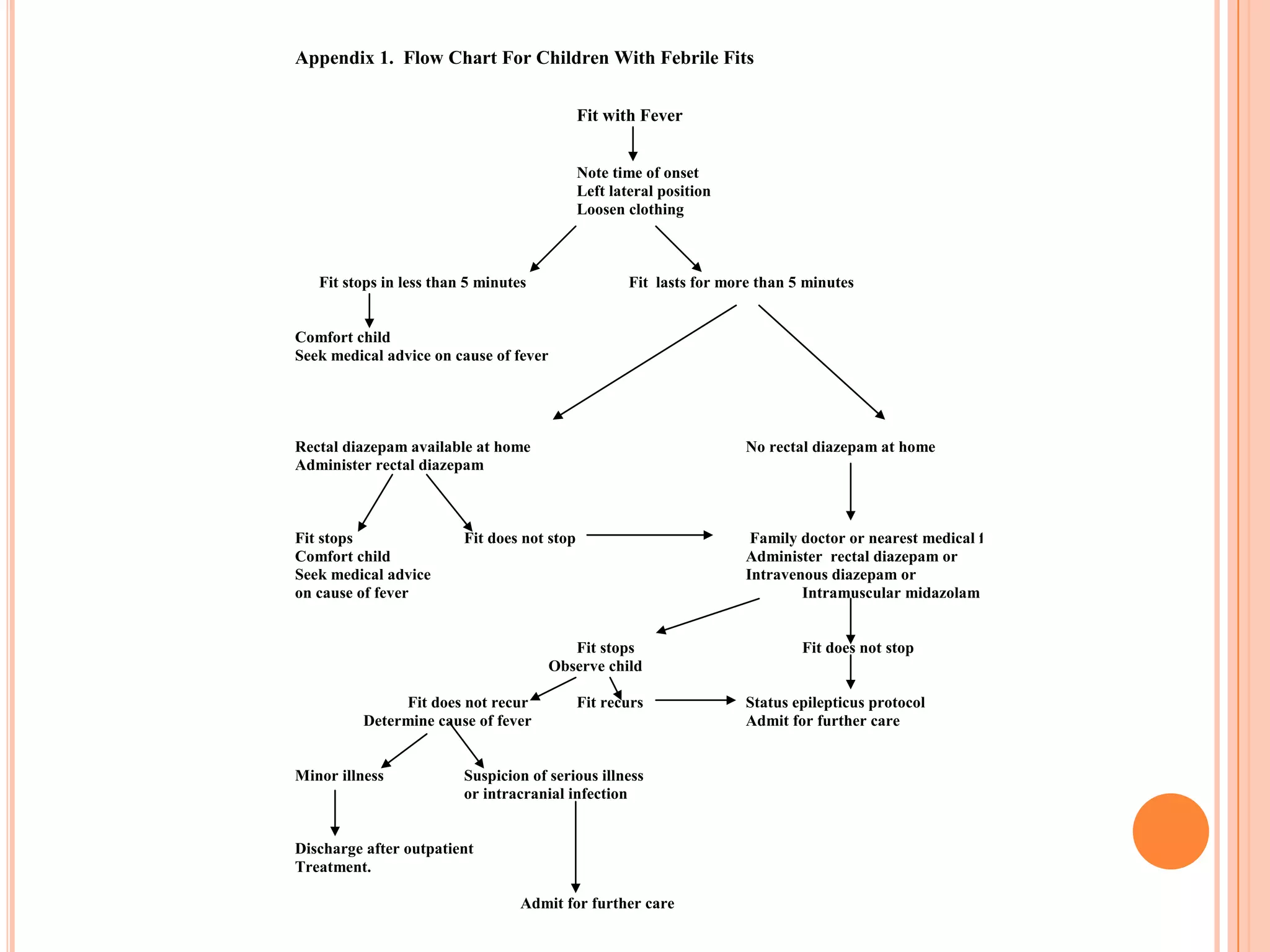
    However, parents andpublic are advised to call for emergency assistance when a convulsion continues for more than 5 minutes without signs of stopping.
  • 146.
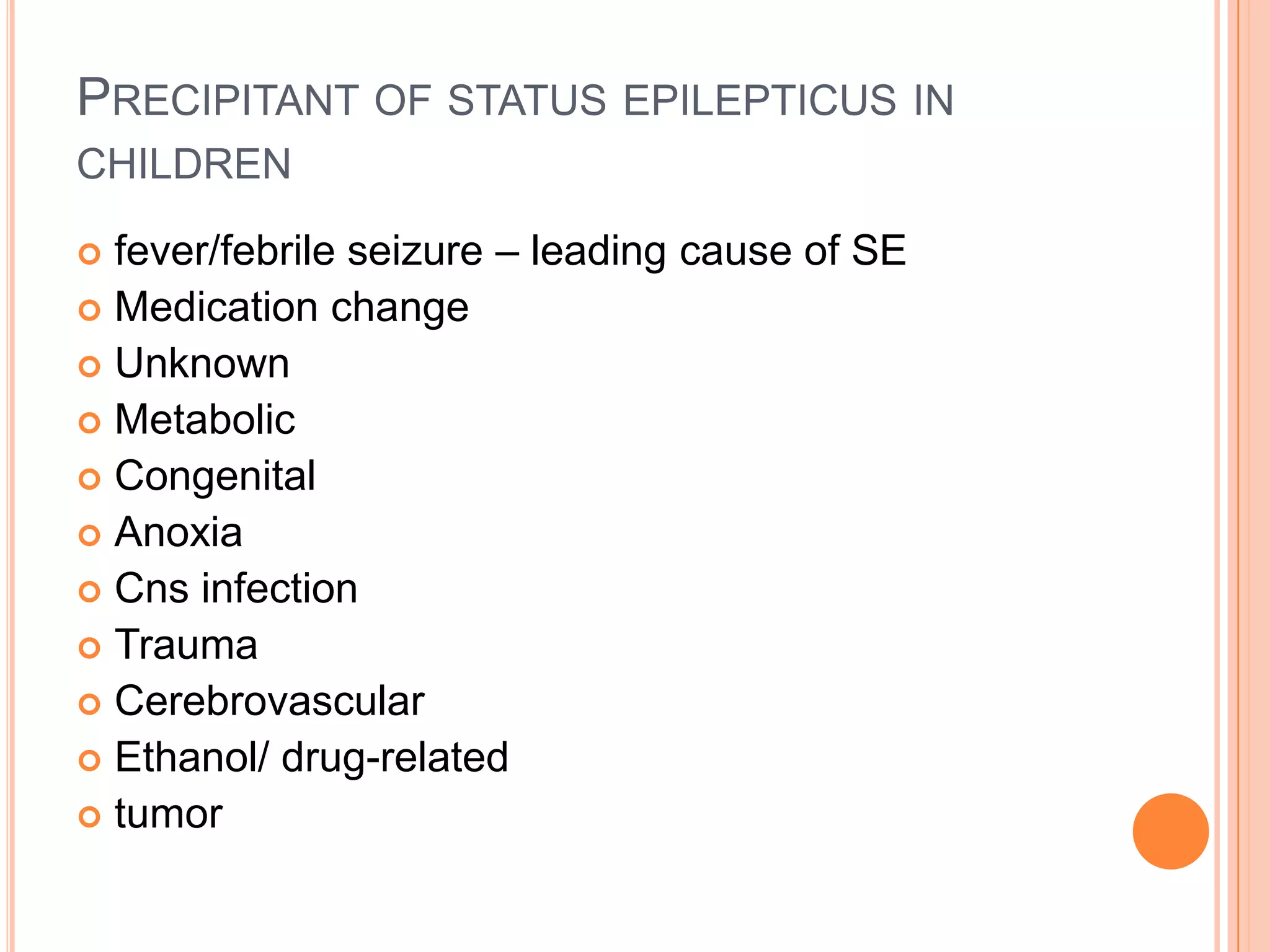
    Precipitant of statusepilepticus in childrenfever/febrile seizure – leading cause of SEMedication changeUnknownMetabolicCongenitalAnoxiaCns infectionTraumaCerebrovascularEthanol/ drug-relatedtumor
  • 147.
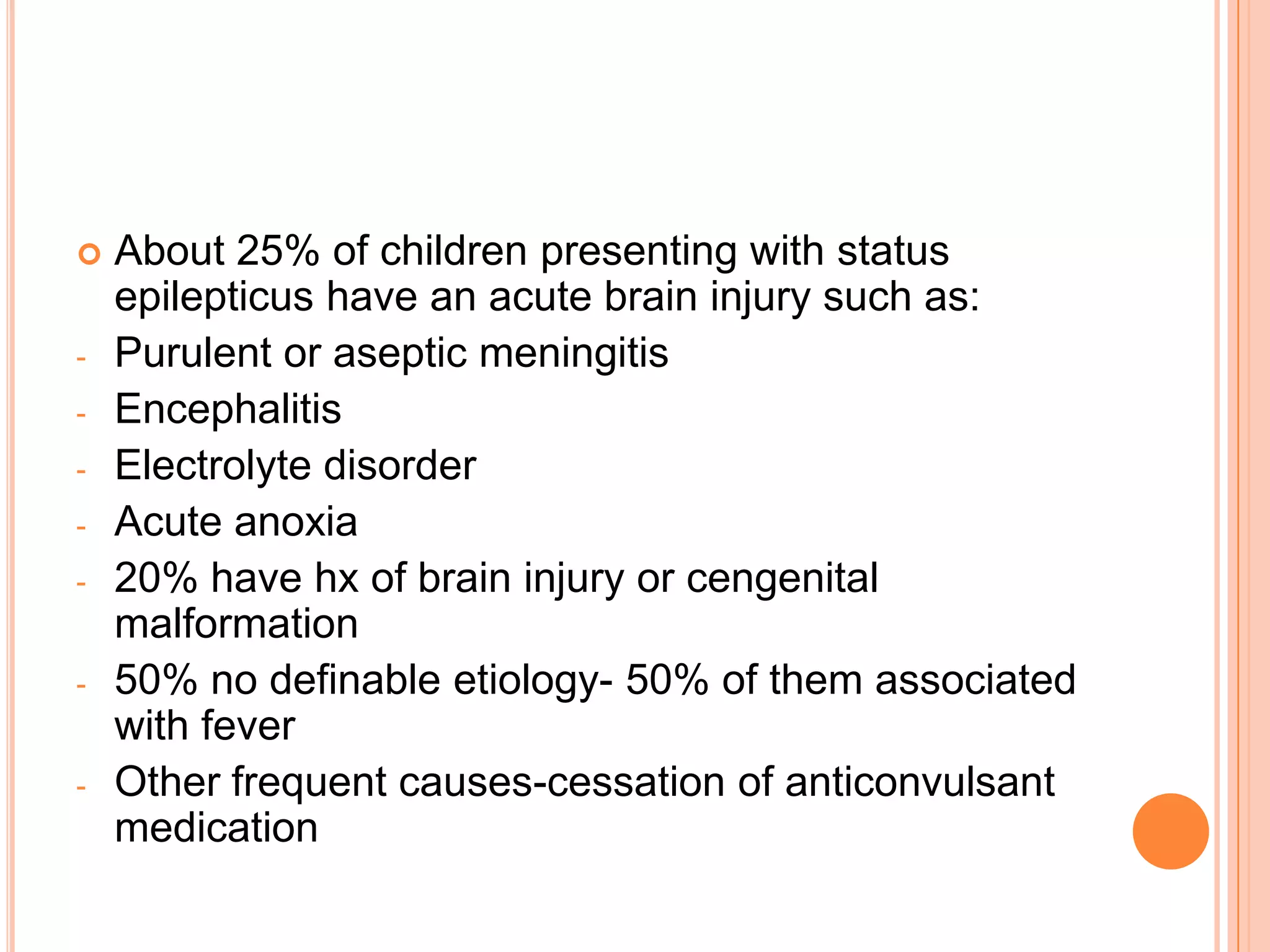
    About 25% ofchildren presenting with status epilepticus have an acute brain injury such as:Purulent or aseptic meningitis
  • 148.
  • 149.
  • 150.
  • 151.
    20% have hxof brain injury or cengenital malformation
  • 152.
    50% no definableetiology- 50% of them associated with fever
  • 153.
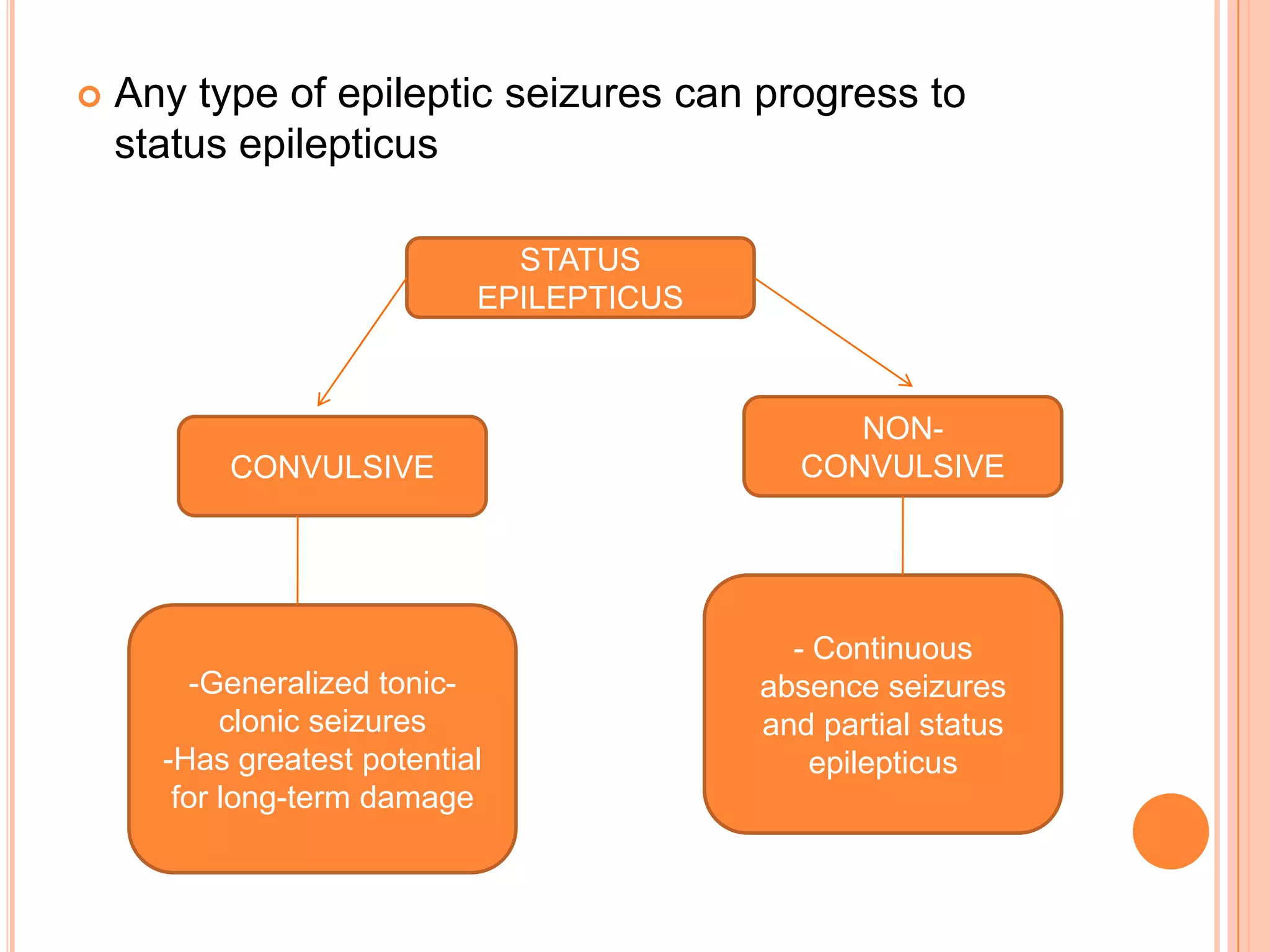
    Other frequent causes-cessationof anticonvulsant medicationAny type of epileptic seizures can progress to status epilepticusSTATUS EPILEPTICUSNON-CONVULSIVECONVULSIVE- Continuous absence seizures and partial status epilepticusGeneralized tonic-clonic seizures
  • 154.
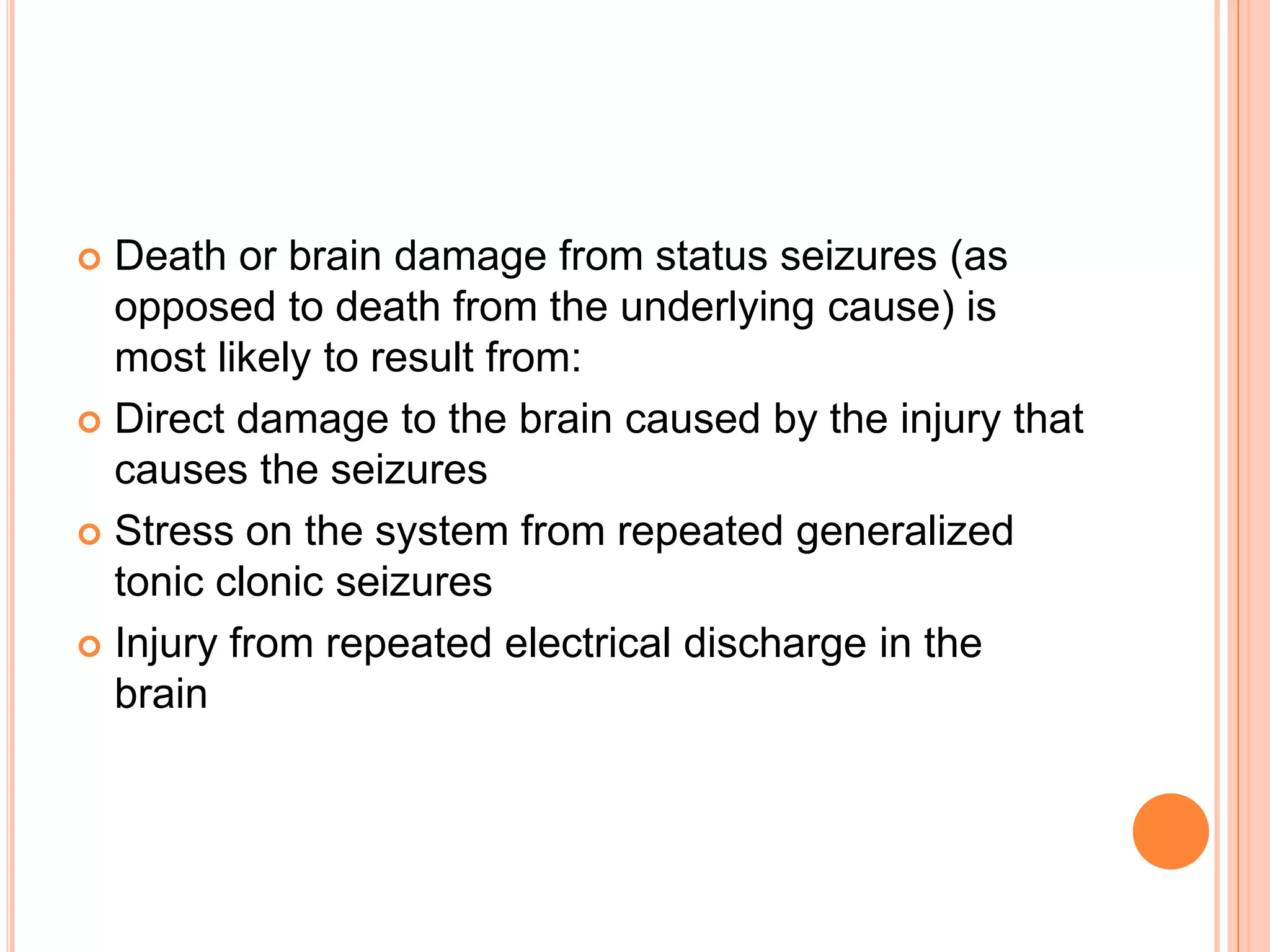
    Has greatest potentialfor long-term damageDeath or brain damage from status seizures (as opposed to death from the underlying cause) is most likely to result from:Direct damage to the brain caused by the injury that causes the seizures Stress on the system from repeated generalized tonic clonic seizures Injury from repeated electrical discharge in the brain
  • 155.
    Convulsivestatus epilepticus is a medical emergency
  • 156.
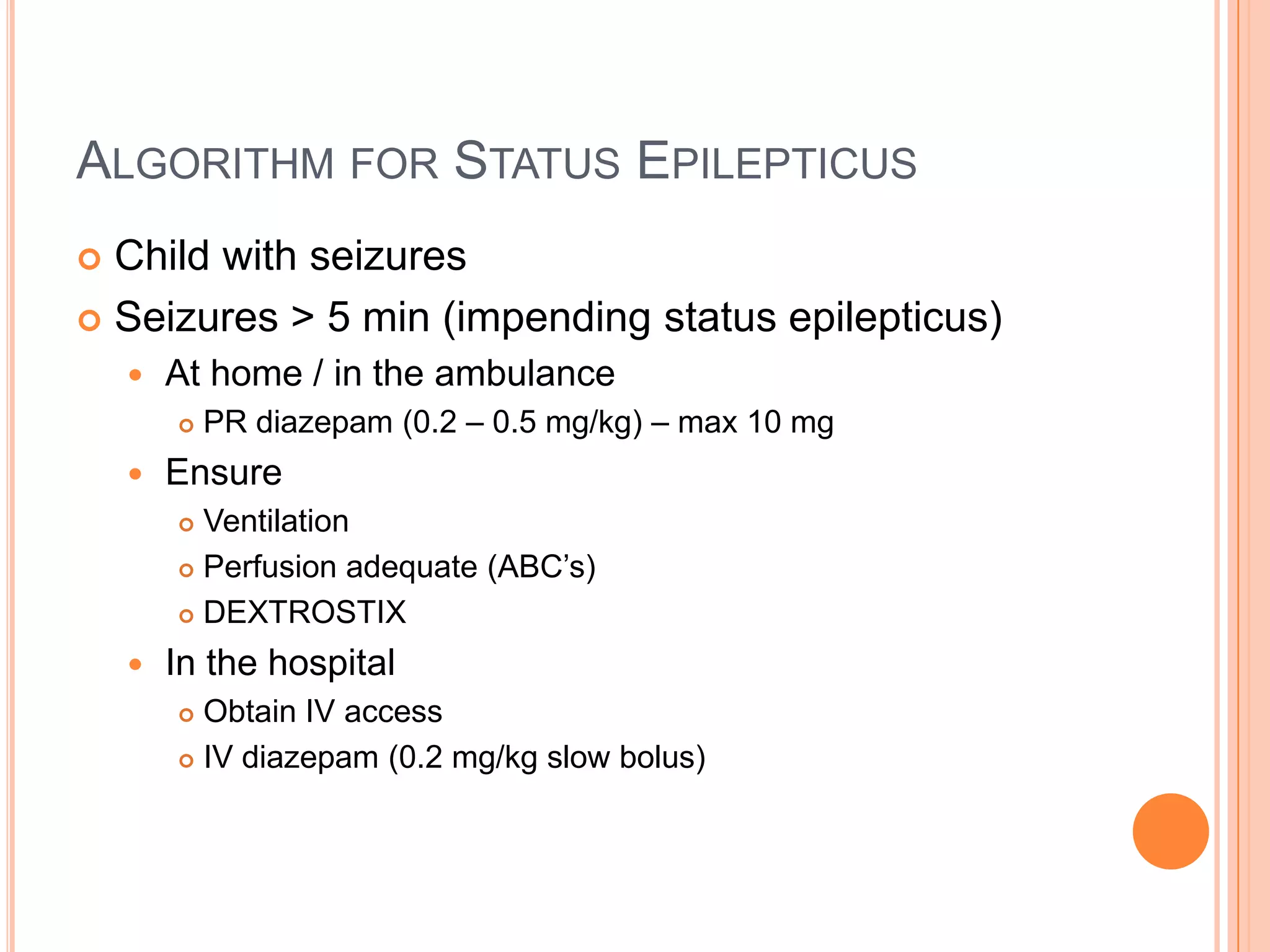
    Algorithm for StatusEpilepticusChild with seizuresSeizures > 5 min (impending status epilepticus)At home / in the ambulancePR diazepam (0.2 – 0.5 mg/kg) – max 10 mgEnsureVentilationPerfusion adequate (ABC’s)DEXTROSTIXIn the hospitalObtain IV accessIV diazepam (0.2 mg/kg slow bolus)
  • 157.
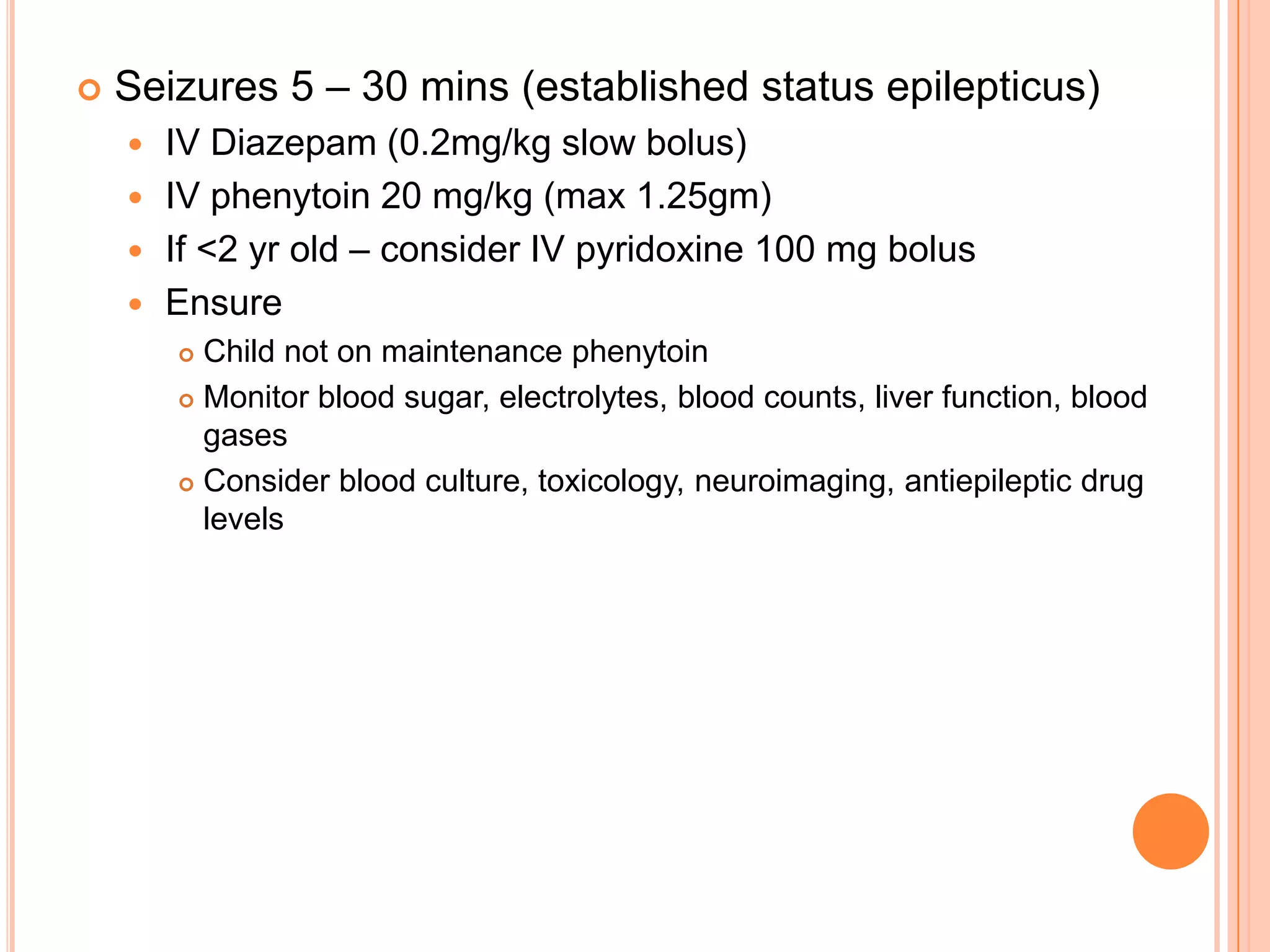
    Seizures 5 –30 mins (established status epilepticus)IV Diazepam (0.2mg/kg slow bolus)IV phenytoin 20 mg/kg (max 1.25gm)If <2 yr old – consider IV pyridoxine 100 mg bolusEnsureChild not on maintenance phenytoinMonitor blood sugar, electrolytes, blood counts, liver function, blood gasesConsider blood culture, toxicology, neuroimaging, antiepileptic drug levels
  • 158.
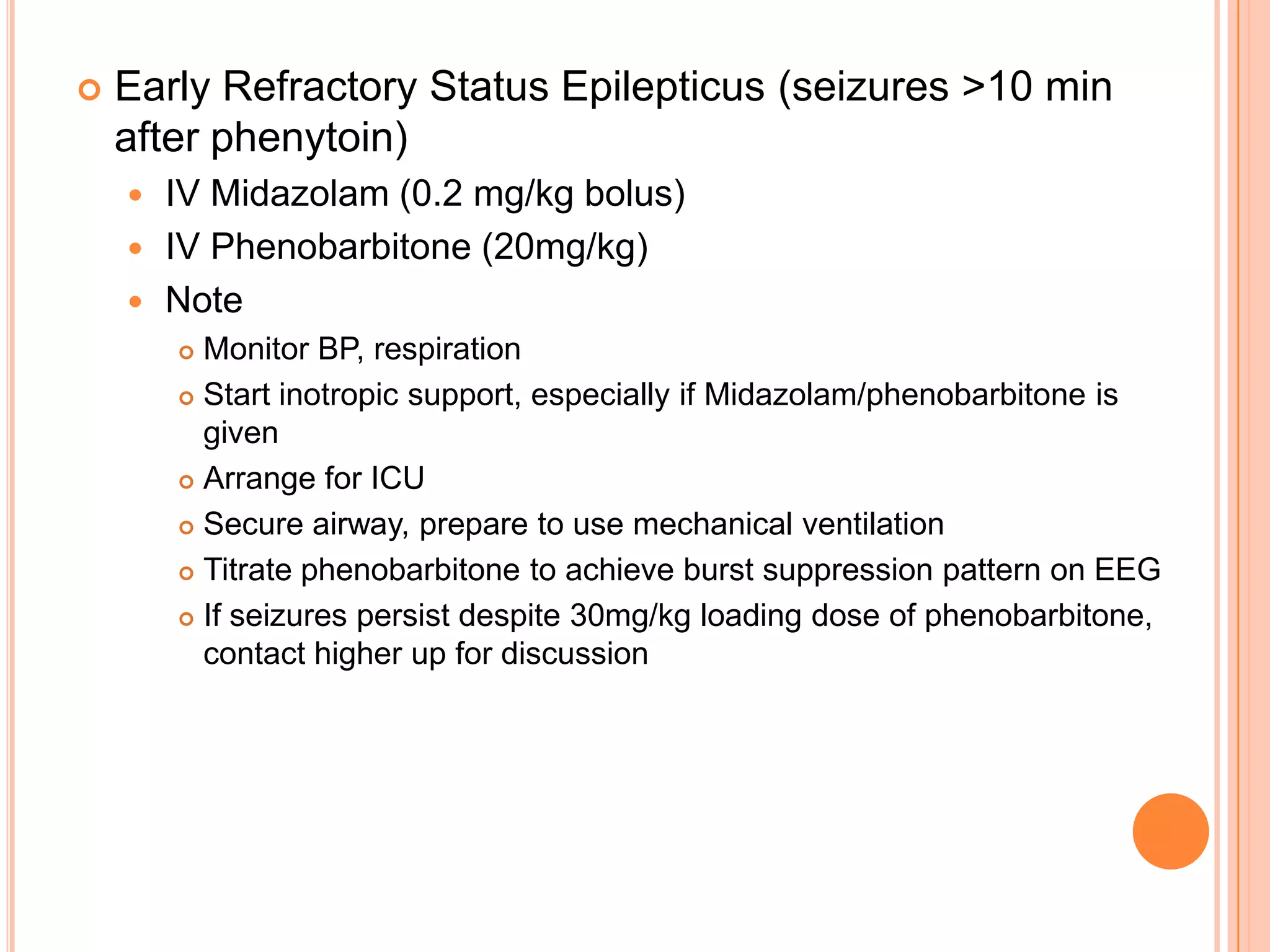
    Early Refractory StatusEpilepticus (seizures >10 min after phenytoin)IV Midazolam (0.2 mg/kg bolus)IV Phenobarbitone (20mg/kg)NoteMonitor BP, respirationStart inotropic support, especially if Midazolam/phenobarbitone is givenArrange for ICUSecure airway, prepare to use mechanical ventilationTitrate phenobarbitone to achieve burst suppression pattern on EEGIf seizures persist despite 30mg/kg loading dose of phenobarbitone, contact higher up for discussion
  • 159.
    FEBRILE CONVULSIONBy :Adam Safin bin Abdul Mutti
  • 160.
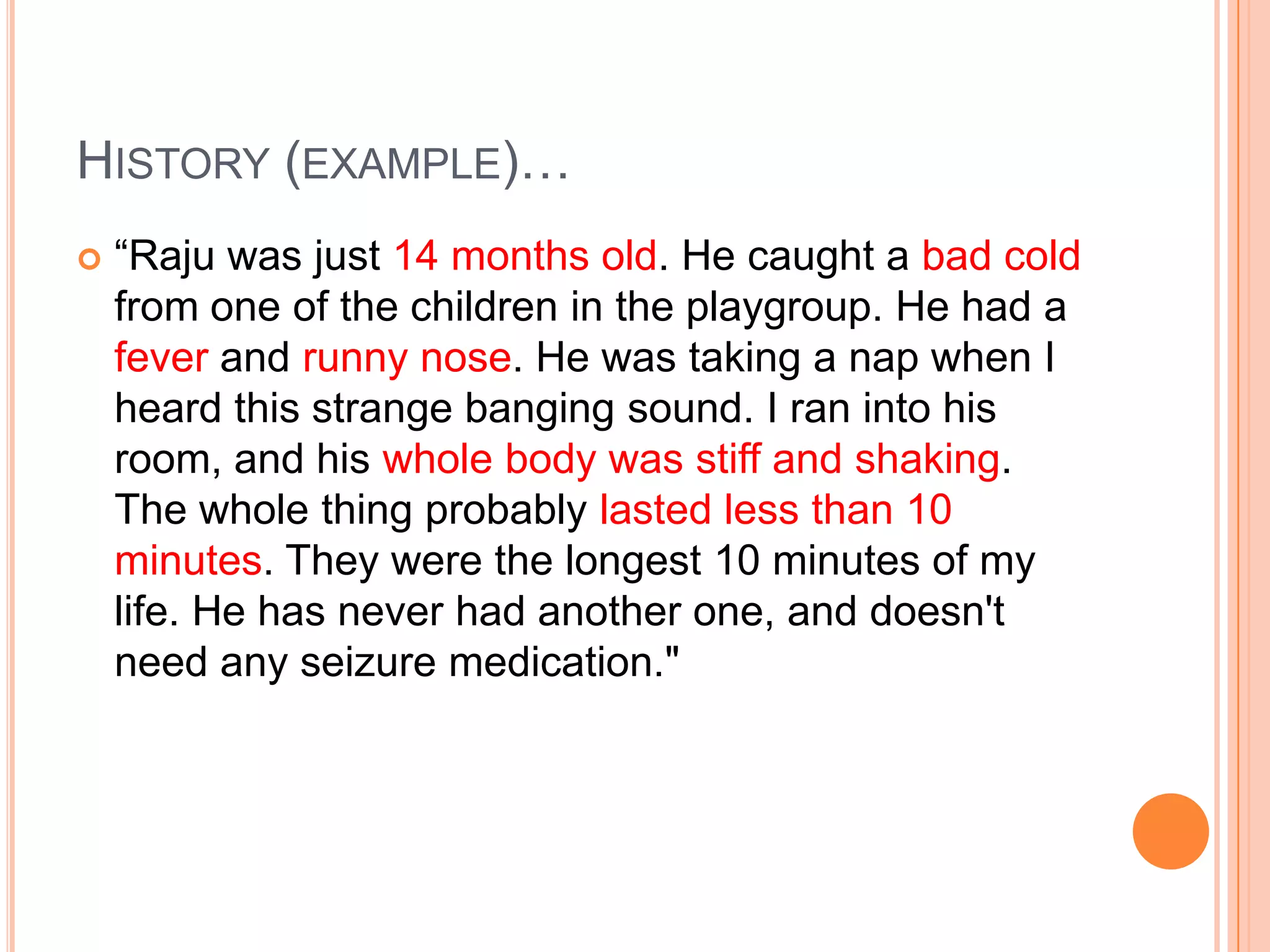
    History (example)…“Raju wasjust 14 months old. He caught a bad cold from one of the children in the playgroup. He had a fever and runny nose. He was taking a nap when I heard this strange banging sound. I ran into his room, and his whole body was stiff and shaking. The whole thing probably lasted less than 10 minutes. They were the longest 10 minutes of my life. He has never had another one, and doesn't need any seizure medication."
  • 161.
    Definition“ A seizureassociated with fever in the absence of another cause and not due to intracranial infection from meningitis or encephalitis” [ Illustrated Textbook of Paediatrics, 3rd edition].Occur in children between 3 months old and 6 years old.
  • 162.
    Some information…Occur in3% of children between the ages of 6 months and 5 years.Has a genetic predisposition; 10% risk if the child has a first-degree relative with febrile seizures.
  • 163.
    Why it iscommon in children???Seizure threshold is low in children.Viral infection (predominant causes)  rapid increase in temperature  can’t tolerate well  seizures.
  • 164.
  • 165.
    How to differentiatemeningitis and febrile seizure in children???Sign and symptom of meningitis :Headache.Irritability.Nausea.Photophobia.Nuchal rigidity.Positive Kernig and Brudzinski sign (> than 12 months old child).
  • 166.
    Continue…There are signof increase intracranial pressure in meningitis, not in febrile seizure :Bulging fontanelle.Ptosis.Sixth nerve palsy.
  • 167.
    Recurrent Febrile Seizures30-40%of children will have recurrent febrile fits.Risk factors :Early age of onset (less than 15 months old).Epilepsy in first degree relatives.Febrile fits in first degree relatives.Low degree of fever (less than 40°C) during first febrile fits.Brief duration between onset of fever and initial fits.
  • 168.
    Why Children NeedAdmission???Main reason :To exclude intracranial pathology.Fear of recurrent fits.To treat or investigate the cause of fever besides meningitis or encephalitis.To allay parental anxiety, especially those who staying far from hospital.
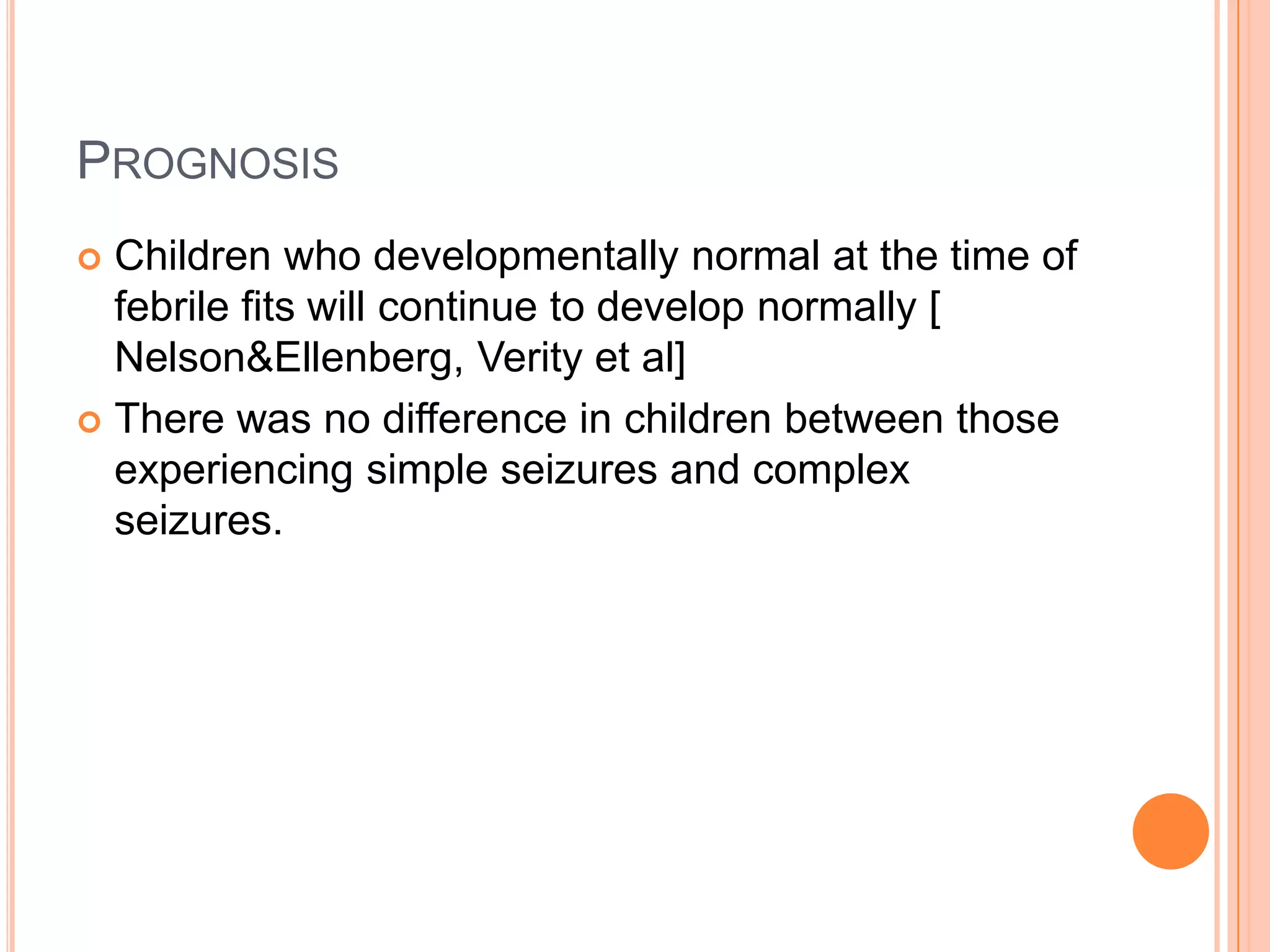
  • 170.
    Prognosis Children whodevelopmentally normal at the time of febrile fits will continue to develop normally [ Nelson&Ellenberg, Verity et al]There was no difference in children between those experiencing simple seizures and complex seizures.
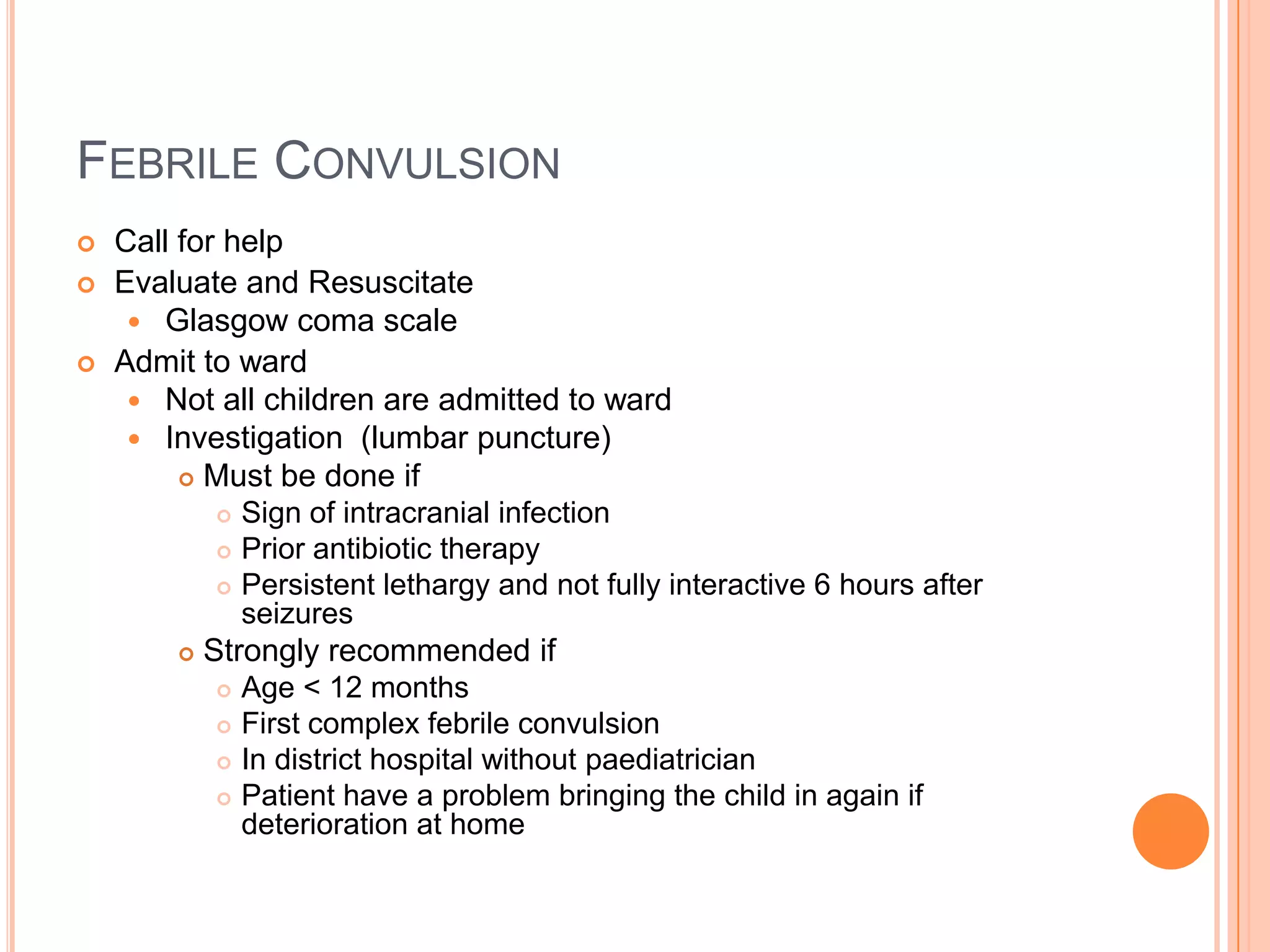
  • 171.
    Management and treatmentof febrile convulsion
  • 172.
    Call for helpEvaluateand Resuscitate Glasgow coma scaleAdmit to wardNot all children are admitted to wardInvestigation (lumbar puncture)Must be done ifSign of intracranial infectionPrior antibiotic therapyPersistent lethargy and not fully interactive 6 hours after seizuresStrongly recommended if Age < 12 monthsFirst complex febrile convulsionIn district hospital without paediatricianPatient have a problem bringing the child in again if deterioration at homeFebrile Convulsion
  • 173.
    Control FeverTake ofcloth and tepid spongingAntipyretic Monitor the patient conditionVital signsCounseled parents regarding the benign nature of the diseaseAdvised parents on first aid measures during a convulsionDo not panicLoosen child cloth especially around neckPlace child on left lateral position with head lower than bodyWipe out any vomitusDon’t insert any object or drugStay near the child
  • 174.
    Rectal diazepamFor parentswhose children have high risk of recurrence febrile convulsionConvulsion last more than 5 minutesPrevention of recurrent febrile convulsionsAnticonvulsants are not recommended for prevention of recurrent febrile convulsions