EPILEPSY (SEIZURE DISORDER)EPILEPSY (SEIZURE DISORDER)
•Epilepsy is a disorder of brain in which
a fit occurs because of abnormal
electrical discharge between certain
brain cells.
•a sudden loss of consciousness which is
often accompanied by repeated jerky
movements called convulsions.
•These attacks are sometimes called
fits or seizures.
•Epilepsy is due to disturbance in the
electrical activity of the brain.
Contd….Contd….
Is caused by a transient, excessive
and abnormal discharge of nerve
cells.
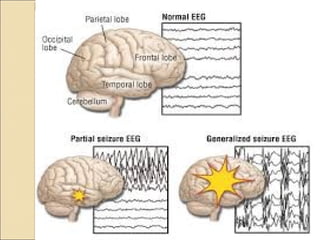
The abnormal discharge may involve
a small part of brain only ( partial or
focal seizure) or much more
extensive area in both hemispheres
(generalized seizures).
It can start at any age.
In majority of the cases, it starts in
childhood and adolescence.
1. Primary( idiopathic) epilepsy:-
 Unknown genetic or biochemical
predisposition
2. Secondary epilepsy:-
a. Intracranial
 Tumor
 Cerebro -vascular disease
 Arteriovenous malformation
 Trauma ( birth injury, depressed
fracture, penetrating wound)
Contd…Contd…
Infection ( meningitis,
encephalitis)
Congenital and hereditary disease
(tuberous sclerosis)
b. Extra cranial
Metabolic
Electrolyte
Biochemical
Inborn errors of metabolism
anoxia
Contd….Contd….
Hypoglycemia
Drugs
Drug withdrawal
Alcohol withdrawal
DIFFERENT CAUSES OF EPILEPSY ARE
COMMON IN CERTAIN AGE GROUPS:
NEONATAL PERIOD AND EARLY INFACY:
HYPOXIC ISCHEMIC ENCEPHALOPATHY,
CNS INFECTIONS, TRAUMA, CONGENITAL
CNS ABNORMALITIES, METABOLIC
DISORDES.
LATE INFANCY AND EARLY
CHILDHOOD: CNS INFECTIONS AND
TRAUMA
CHILDHOOD: WELL DEFINED EPILEPSY
SYNDROME.
• ADOLESCENCE AND ADULTHOOD:
SECONDARY TO ANY CNS LESIONS,
IDIOPATHIC EPILEPSY, STRESS,
TRAUMA, CNS, INFECTIONS, BRAIN
TUMORS, ILLICITS DRUGS.
•OLDER ADULT:
CEREBROVASCULAR DISEASES,
TUMORS, HEAD TRAUMAS, OTHER
DEGENERATIVE DISEASES SUCH AS
DEMENTA.
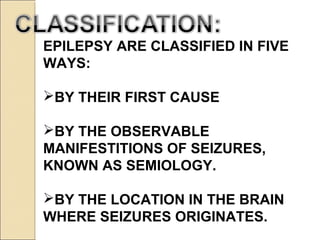
EPILEPSY ARE CLASSIFIED IN FIVE
WAYS:
BY THEIR FIRST CAUSE
BY THE OBSERVABLE
MANIFESTITIONS OF SEIZURES,
KNOWN AS SEMIOLOGY.
BY THE LOCATION IN THE BRAIN
WHERE SEIZURES ORIGINATES.
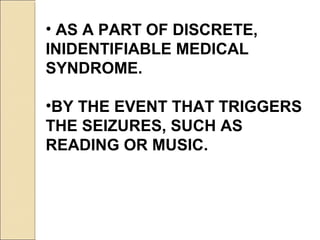
• AS A PART OF DISCRETE,
INIDENTIFIABLE MEDICAL
SYNDROME.
•BY THE EVENT THAT TRIGGERS
THE SEIZURES, SUCH AS
READING OR MUSIC.
ANOTHER CLASSIFICATIONSANOTHER CLASSIFICATIONS
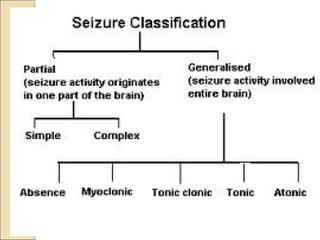
1. Generalized seizures
 Major epilepsy( Grand mal
seizure/epilepsy)
 Minor epilepsy(Petit mal,
absence seizure)
 Myoclonic seizures
2. Partial seizures ( Focal/
Jacksonian seizure)
3. Status epilepticus
GENERALIZED SEIZUREGENERALIZED SEIZURE
Involves the entire brain
Consciousness is lost and the
seizure may last from several
seconds to several minutes
Types include;
1.Major epilepsy
2.Minor epilepsy
3.Myoclonic epilepsy
Major (Grand mal) EpilepsyMajor (Grand mal) Epilepsy
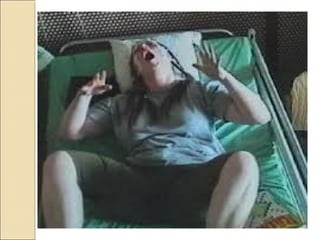
The attack or fit occurs suddenly
at any place or time.
The patient falls down and loses
awareness of his surroundings
Convulsion proceeds as follows:
Aura :
Is a warning signal prior to onset
of seizures e.g sensation of
peculiar test or smell, spots
before eyes, dizziness and feeling
of weakness.
contd….contd….
Epileptic cry:
Patient loses consciousness with an
epileptic cry, it is caused by spasm of
thoracic and abdominal muscles
expelling air through the glottis.
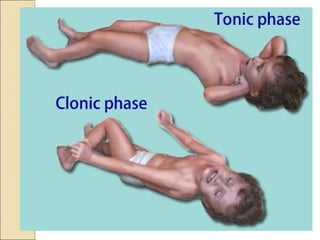
Tonic stage:
Patient falls to the ground with all his
muscle in an increased tone with
rigidity.
The skin become pale and cyanotic,
the respiration ceases.
Pupil dilated and fixed. It lasts for
10-30 sec.
Contd…Contd…
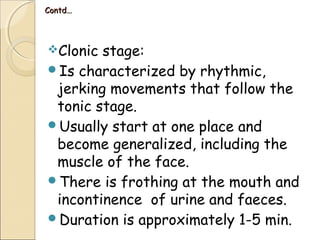
Clonic stage:
Is characterized by rhythmic,
jerking movements that follow the
tonic stage.
Usually start at one place and
become generalized, including the
muscle of the face.
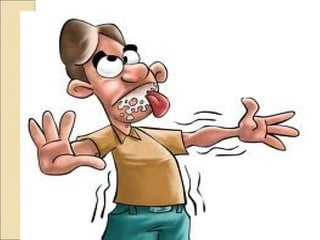
There is frothing at the mouth and
incontinence of urine and faeces.
Duration is approximately 1-5 min.
Contd…Contd…
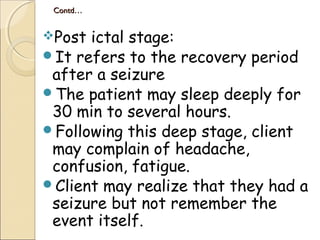
Post ictal stage:
It refers to the recovery period
after a seizure
The patient may sleep deeply for
30 min to several hours.
Following this deep stage, client
may complain of headache,
confusion, fatigue.
Client may realize that they had a
seizure but not remember the
event itself.
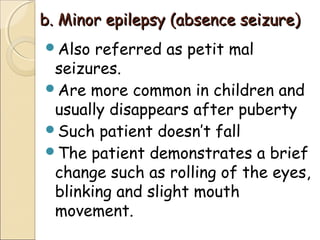
b. Minor epilepsy (absence seizure)b. Minor epilepsy (absence seizure)
Also referred as petit mal
seizures.
Are more common in children and
usually disappears after puberty
Such patient doesn’t fall
The patient demonstrates a brief
change such as rolling of the eyes,
blinking and slight mouth
movement.
Contd…Contd…
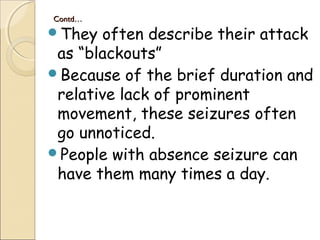
They often describe their attack
as “blackouts”
Because of the brief duration and
relative lack of prominent
movement, these seizures often
go unnoticed.
People with absence seizure can
have them many times a day.
Myoclonic seizureMyoclonic seizure
Are characterized by sudden,
excessive jerking of the arms,
legs or entire body.
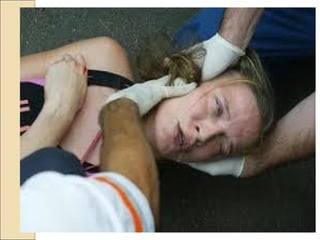
In some instances, the muscle
activity is so severe that the
client falls to the ground
These seizures are brief.
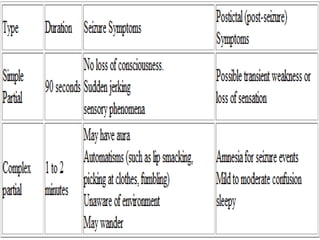
2. Partial seizure( Focal/Jacksonian)2. Partial seizure( Focal/Jacksonian)
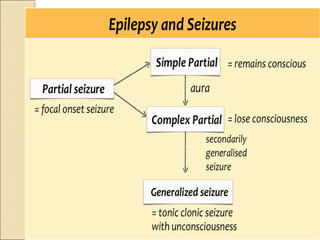
It begins in a specific area of the
cerebral cortex.
A partial seizure can progress to a
generalized seizure.
It begins as a localized motor
seizure, with convulsions starting
in one part of the body eg. From
the thumb and gradually involving
hand and arms, face and other
parts.
Contd…Contd…
Patient may or may not loose
consciousness.
Feeling of nausea, sweating, skin
flushing and dilation of pupil can
also occur.
3.Status epilepticus3.Status epilepticus
It is characterized by at least
30 min of repetitive seizure
activity with out return to
consciousness.
In other words, it is state in
which a person has continuous
seizures lasting at least 30 min.
This is medical emergency and
requires prompt intervention to
prevent irreversible neurological
Contd..Contd..
Abrupt cessation of
anticonvulsant therapy is the
usual cause of status
epilepticus.
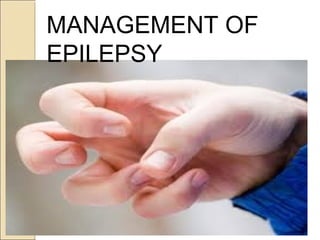
MANAGEMENT OF
EPILEPSY
APPROACH CONSIDERATIONS:
THE GOAL OF TREATMENT IN
PATIENTS WITH EPILEPTIC
SEIZURES IS TO ACHIEVE A
SEIZURES FREE STATUS WITHOUT
ADVERSE EFFECTS. THIS GOAL IS
ACCOMPLISHED BY IN MORE THAN
60% OF PATIENTS WHO REQUIRE
TREATMENT WITH ANTI-
CONVULSANTS.
ANTICONVULSANT THERAPY:
THE MAINSTAY OF SEIZURE
TREATMENT IS ANTICONVULSANT
MEDICATION. THE DRUG OF CHOICE
DEPENDS ON AN ACCURATE
DIAGNOSIS OF THE EPILEPTIC
SYNDROME, AS RESPONSE TO
SPECIFIC ANTICONVULSANTS
VARIES AMONG DIFFERENT
SYNDROMES.
ANTI CONVULSANTS CAN BE DIVIDED
INTO LARGE GROUP BASED ON THEIR
MECHANISM, AS FOLLOWS:
• BLOKERS OF REPETITIVE ACTIVATION
OF THE SODIUM CHANNEL:
PHENYTOIN, CARBAMAZEPINE.
• ENHANCER OF SLOW INACTIVATION OF
THE SODIUM CHANNEL:
LACOSAMIDE, RUFINAMIDE.
• GABA-A RECEPTOR ENHANCERS:
PHENOBARBITAL.
•N AND L- CALCIUM CHANNEL
BLOCKERS: LAMOTRIGINE,
VALPORATE
•H- CURRENT MODULATORS:
GABAPENTIN, LAMOTRIGINE.
•BLOCKERS OF UNIQUE BINDING
SITES: GABAPENTIN
•NEURONAL POTASSIUM CHANNEL
OPENER: EZOGABINE.
THE TWO METHODS ARE:
 A KETOGENIC OR MODIFIED
ATKINS DIET( LOW
CARBOHYDATE DIET)
 VAGAL NERVE STIMULATION
(VNS)
THE KETOGENIC DIET, WHICH RELIES
HEAVILY ON THE USE OF FAT, SUCH AS
HYDROGENATED VEGETABLE OIL
SHORTENING, HAS A ROLE IN THE
TREATMENT OF CHILDREN WUTH
SEVERE EPILEPSY.
ALTHOUGH THIS DIET IS
UNQUESTIONABLY EFFECTIVE IN SOME
REFRECTORY CASES OF SEIZURE, A
KETOGENIC DIET IS DIFFICULT TO
MAINTAIN; LESS THAN 10% OF
PATIENTS CONTINUE THE DIET AFTER
YEAR.
FURTHERMORE, ANY SMALL
CARBOHYDRATES IN TAKE
RESETS KETONE METABOLISM
FOR 2 WEEKS, THEREBY
ELIMINATING ANTISEIZURE
EFFICACY.
VAGAL NERVE STIMULATION:
VNS IS A PALLIATIVE
TECHNIQUE THAT INVOLVES
SURGICAL IMPLANTATION OF A
STIMULATING DEVICE. IT IS
CURRENTLY INDICATED FOR
PATIENT OLDER THAN 12
YEARS WITH MEDICALLY
PARTIAL SEIZURE THAT ARE
NOT TREATED SURGICALLY.
• VNS MAY HAVE IMPROVED
EFFICACY OVER TIME.
•CHILDREN SHOULD BE
CAREFULLY MONITORED FOR
THE SITE OF INFECTION AFTER
VNS IMPLANTATION.
 LOBECTOMY
 LESIONECTOMY
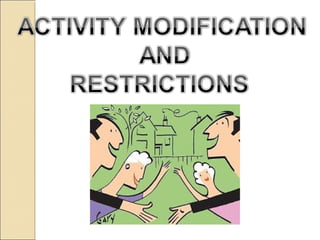
THE MAJOR PROBLEM FOR
PATIENTS WITH SEIZURES IN
THE UNPREDICTABILITY OF THE
NEXT SEIZURE. CLINICIANS
SHOULD DISCUSS THE
FOLOWING TYPES OF SEIZURES
PRECAUTIONS WITH PATIENTS
WHO HAVW EPILEPTIC
SEIZURES:
• DRIVING
•ASCENDING HEIGHTS
•WORKING WITH FIRE OR COOKING
•USING POWER TOOLS OR
•DANGEROUS ITEMS
•TAKING UNSUPERVISED BATHS
•SWIMMING
THESE LIFESTYLES
PRECAUTIONS ARE CLEARLY
MORE APPLICABLE TO SOME
PATIENTS THAN TO OTHERS.
ASSESSMENT:
• HISTORY, INCLUDING PRENATAL,
BIRTH, AND DEVELOPMENTAL
HISTORY, FAMILY HISTORY, AGE AT
SEIZURE ONSET, HISTORY OF ALL
ILLNESS AND TRAUMAS.
•DETERMINE WHETHER THE
PATIENT HAS AN AURA BEFORE AN
EPILEPTIC SEIZURE, WHICH MAY
INDICATE THE ORIGIN OF SEIZURE.
•OBSERVE AND ASSESS
NEUROLOGICAL CONDITION.
•ASSESS VITALS AND
EUROLOGICAL SIGNS
CONTINUOUSLY.
•ASSESS EFFECT OF EPILEPSY ON
LIFESTYLE.
•RISK FOR INJURY RELATED TO
SEIZURE ACTIVITY.
•FEAR RELATED TO POSSIBILITY OF
HAVING SEIZURES.
•INFEECTIVE COPING RELATED TO
STRESS IMPOSED BY EPILEPSY.
•DEFICIT KNOWLEDGE ABOUT
EPILEPSY AND ITS CONTROL.
 PREVENTION OF INJURY.
CONTROL OF SEIZURES.
ACHIEVEMENT OF
PSYCHOSOCIAL ADJUSTEMENT.
ACQUISITION OF KNOWLEDGE.
ABSENCE OF COMPLICATIONS.
Epilepsy (seizure disorder)

Epilepsy (seizure disorder)

  • 4.
    EPILEPSY (SEIZURE DISORDER)EPILEPSY(SEIZURE DISORDER) •Epilepsy is a disorder of brain in which a fit occurs because of abnormal electrical discharge between certain brain cells. •a sudden loss of consciousness which is often accompanied by repeated jerky movements called convulsions. •These attacks are sometimes called fits or seizures. •Epilepsy is due to disturbance in the electrical activity of the brain.
  • 5.
    Contd….Contd…. Is caused bya transient, excessive and abnormal discharge of nerve cells. The abnormal discharge may involve a small part of brain only ( partial or focal seizure) or much more extensive area in both hemispheres (generalized seizures). It can start at any age. In majority of the cases, it starts in childhood and adolescence.
  • 7.
    1. Primary( idiopathic)epilepsy:-  Unknown genetic or biochemical predisposition 2. Secondary epilepsy:- a. Intracranial  Tumor  Cerebro -vascular disease  Arteriovenous malformation  Trauma ( birth injury, depressed fracture, penetrating wound)
  • 8.
    Contd…Contd… Infection ( meningitis, encephalitis) Congenitaland hereditary disease (tuberous sclerosis) b. Extra cranial Metabolic Electrolyte Biochemical Inborn errors of metabolism anoxia
  • 9.
  • 11.
    DIFFERENT CAUSES OFEPILEPSY ARE COMMON IN CERTAIN AGE GROUPS: NEONATAL PERIOD AND EARLY INFACY: HYPOXIC ISCHEMIC ENCEPHALOPATHY, CNS INFECTIONS, TRAUMA, CONGENITAL CNS ABNORMALITIES, METABOLIC DISORDES. LATE INFANCY AND EARLY CHILDHOOD: CNS INFECTIONS AND TRAUMA CHILDHOOD: WELL DEFINED EPILEPSY SYNDROME.
  • 12.
    • ADOLESCENCE ANDADULTHOOD: SECONDARY TO ANY CNS LESIONS, IDIOPATHIC EPILEPSY, STRESS, TRAUMA, CNS, INFECTIONS, BRAIN TUMORS, ILLICITS DRUGS. •OLDER ADULT: CEREBROVASCULAR DISEASES, TUMORS, HEAD TRAUMAS, OTHER DEGENERATIVE DISEASES SUCH AS DEMENTA.
  • 15.
    EPILEPSY ARE CLASSIFIEDIN FIVE WAYS: BY THEIR FIRST CAUSE BY THE OBSERVABLE MANIFESTITIONS OF SEIZURES, KNOWN AS SEMIOLOGY. BY THE LOCATION IN THE BRAIN WHERE SEIZURES ORIGINATES.
  • 16.
    • AS APART OF DISCRETE, INIDENTIFIABLE MEDICAL SYNDROME. •BY THE EVENT THAT TRIGGERS THE SEIZURES, SUCH AS READING OR MUSIC.
  • 17.
    ANOTHER CLASSIFICATIONSANOTHER CLASSIFICATIONS 1.Generalized seizures  Major epilepsy( Grand mal seizure/epilepsy)  Minor epilepsy(Petit mal, absence seizure)  Myoclonic seizures 2. Partial seizures ( Focal/ Jacksonian seizure) 3. Status epilepticus
  • 18.
    GENERALIZED SEIZUREGENERALIZED SEIZURE Involvesthe entire brain Consciousness is lost and the seizure may last from several seconds to several minutes Types include; 1.Major epilepsy 2.Minor epilepsy 3.Myoclonic epilepsy
  • 19.
    Major (Grand mal)EpilepsyMajor (Grand mal) Epilepsy The attack or fit occurs suddenly at any place or time. The patient falls down and loses awareness of his surroundings Convulsion proceeds as follows: Aura : Is a warning signal prior to onset of seizures e.g sensation of peculiar test or smell, spots before eyes, dizziness and feeling of weakness.
  • 20.
    contd….contd…. Epileptic cry: Patient losesconsciousness with an epileptic cry, it is caused by spasm of thoracic and abdominal muscles expelling air through the glottis. Tonic stage: Patient falls to the ground with all his muscle in an increased tone with rigidity. The skin become pale and cyanotic, the respiration ceases. Pupil dilated and fixed. It lasts for 10-30 sec.
  • 21.
    Contd…Contd… Clonic stage: Is characterizedby rhythmic, jerking movements that follow the tonic stage. Usually start at one place and become generalized, including the muscle of the face. There is frothing at the mouth and incontinence of urine and faeces. Duration is approximately 1-5 min.
  • 22.
    Contd…Contd… Post ictal stage: Itrefers to the recovery period after a seizure The patient may sleep deeply for 30 min to several hours. Following this deep stage, client may complain of headache, confusion, fatigue. Client may realize that they had a seizure but not remember the event itself.
  • 25.
    b. Minor epilepsy(absence seizure)b. Minor epilepsy (absence seizure) Also referred as petit mal seizures. Are more common in children and usually disappears after puberty Such patient doesn’t fall The patient demonstrates a brief change such as rolling of the eyes, blinking and slight mouth movement.
  • 26.
    Contd…Contd… They often describetheir attack as “blackouts” Because of the brief duration and relative lack of prominent movement, these seizures often go unnoticed. People with absence seizure can have them many times a day.
  • 28.
    Myoclonic seizureMyoclonic seizure Arecharacterized by sudden, excessive jerking of the arms, legs or entire body. In some instances, the muscle activity is so severe that the client falls to the ground These seizures are brief.
  • 30.
    2. Partial seizure(Focal/Jacksonian)2. Partial seizure( Focal/Jacksonian) It begins in a specific area of the cerebral cortex. A partial seizure can progress to a generalized seizure. It begins as a localized motor seizure, with convulsions starting in one part of the body eg. From the thumb and gradually involving hand and arms, face and other parts.
  • 31.
    Contd…Contd… Patient may ormay not loose consciousness. Feeling of nausea, sweating, skin flushing and dilation of pupil can also occur.
  • 35.
    3.Status epilepticus3.Status epilepticus Itis characterized by at least 30 min of repetitive seizure activity with out return to consciousness. In other words, it is state in which a person has continuous seizures lasting at least 30 min. This is medical emergency and requires prompt intervention to prevent irreversible neurological
  • 36.
    Contd..Contd.. Abrupt cessation of anticonvulsanttherapy is the usual cause of status epilepticus.
  • 38.
  • 39.
    APPROACH CONSIDERATIONS: THE GOALOF TREATMENT IN PATIENTS WITH EPILEPTIC SEIZURES IS TO ACHIEVE A SEIZURES FREE STATUS WITHOUT ADVERSE EFFECTS. THIS GOAL IS ACCOMPLISHED BY IN MORE THAN 60% OF PATIENTS WHO REQUIRE TREATMENT WITH ANTI- CONVULSANTS.
  • 40.
    ANTICONVULSANT THERAPY: THE MAINSTAYOF SEIZURE TREATMENT IS ANTICONVULSANT MEDICATION. THE DRUG OF CHOICE DEPENDS ON AN ACCURATE DIAGNOSIS OF THE EPILEPTIC SYNDROME, AS RESPONSE TO SPECIFIC ANTICONVULSANTS VARIES AMONG DIFFERENT SYNDROMES.
  • 41.
    ANTI CONVULSANTS CANBE DIVIDED INTO LARGE GROUP BASED ON THEIR MECHANISM, AS FOLLOWS: • BLOKERS OF REPETITIVE ACTIVATION OF THE SODIUM CHANNEL: PHENYTOIN, CARBAMAZEPINE. • ENHANCER OF SLOW INACTIVATION OF THE SODIUM CHANNEL: LACOSAMIDE, RUFINAMIDE. • GABA-A RECEPTOR ENHANCERS: PHENOBARBITAL.
  • 42.
    •N AND L-CALCIUM CHANNEL BLOCKERS: LAMOTRIGINE, VALPORATE •H- CURRENT MODULATORS: GABAPENTIN, LAMOTRIGINE. •BLOCKERS OF UNIQUE BINDING SITES: GABAPENTIN •NEURONAL POTASSIUM CHANNEL OPENER: EZOGABINE.
  • 44.
    THE TWO METHODSARE:  A KETOGENIC OR MODIFIED ATKINS DIET( LOW CARBOHYDATE DIET)  VAGAL NERVE STIMULATION (VNS)
  • 45.
    THE KETOGENIC DIET,WHICH RELIES HEAVILY ON THE USE OF FAT, SUCH AS HYDROGENATED VEGETABLE OIL SHORTENING, HAS A ROLE IN THE TREATMENT OF CHILDREN WUTH SEVERE EPILEPSY. ALTHOUGH THIS DIET IS UNQUESTIONABLY EFFECTIVE IN SOME REFRECTORY CASES OF SEIZURE, A KETOGENIC DIET IS DIFFICULT TO MAINTAIN; LESS THAN 10% OF PATIENTS CONTINUE THE DIET AFTER YEAR.
  • 46.
    FURTHERMORE, ANY SMALL CARBOHYDRATESIN TAKE RESETS KETONE METABOLISM FOR 2 WEEKS, THEREBY ELIMINATING ANTISEIZURE EFFICACY.
  • 47.
    VAGAL NERVE STIMULATION: VNSIS A PALLIATIVE TECHNIQUE THAT INVOLVES SURGICAL IMPLANTATION OF A STIMULATING DEVICE. IT IS CURRENTLY INDICATED FOR PATIENT OLDER THAN 12 YEARS WITH MEDICALLY PARTIAL SEIZURE THAT ARE NOT TREATED SURGICALLY.
  • 48.
    • VNS MAYHAVE IMPROVED EFFICACY OVER TIME. •CHILDREN SHOULD BE CAREFULLY MONITORED FOR THE SITE OF INFECTION AFTER VNS IMPLANTATION.
  • 50.
  • 52.
    THE MAJOR PROBLEMFOR PATIENTS WITH SEIZURES IN THE UNPREDICTABILITY OF THE NEXT SEIZURE. CLINICIANS SHOULD DISCUSS THE FOLOWING TYPES OF SEIZURES PRECAUTIONS WITH PATIENTS WHO HAVW EPILEPTIC SEIZURES:
  • 53.
    • DRIVING •ASCENDING HEIGHTS •WORKINGWITH FIRE OR COOKING •USING POWER TOOLS OR •DANGEROUS ITEMS •TAKING UNSUPERVISED BATHS •SWIMMING
  • 54.
    THESE LIFESTYLES PRECAUTIONS ARECLEARLY MORE APPLICABLE TO SOME PATIENTS THAN TO OTHERS.
  • 56.
    ASSESSMENT: • HISTORY, INCLUDINGPRENATAL, BIRTH, AND DEVELOPMENTAL HISTORY, FAMILY HISTORY, AGE AT SEIZURE ONSET, HISTORY OF ALL ILLNESS AND TRAUMAS. •DETERMINE WHETHER THE PATIENT HAS AN AURA BEFORE AN EPILEPTIC SEIZURE, WHICH MAY INDICATE THE ORIGIN OF SEIZURE.
  • 57.
    •OBSERVE AND ASSESS NEUROLOGICALCONDITION. •ASSESS VITALS AND EUROLOGICAL SIGNS CONTINUOUSLY. •ASSESS EFFECT OF EPILEPSY ON LIFESTYLE.
  • 59.
    •RISK FOR INJURYRELATED TO SEIZURE ACTIVITY. •FEAR RELATED TO POSSIBILITY OF HAVING SEIZURES. •INFEECTIVE COPING RELATED TO STRESS IMPOSED BY EPILEPSY. •DEFICIT KNOWLEDGE ABOUT EPILEPSY AND ITS CONTROL.
  • 60.
     PREVENTION OFINJURY. CONTROL OF SEIZURES. ACHIEVEMENT OF PSYCHOSOCIAL ADJUSTEMENT. ACQUISITION OF KNOWLEDGE. ABSENCE OF COMPLICATIONS.