SEIZURE: STATUS EPILEPTICUS
PRESENTED BY: DAVE JAY S. MANRIQUEZ RN. For ADULT HEALTH
                       NURSING 1
SEIZURE
sudden, excessive, disorderly electrical discharges of
the neurons.

EFFECTS OF SEIZURE: alteration in the following
 mental status
 LOC
 sensory and special senses
 motor funtion

              CLASSIFICATION OF SEIZURES

A. Primary Generalized Seizure
B. Partial Seizure

GENERALIZED SEIZURES:
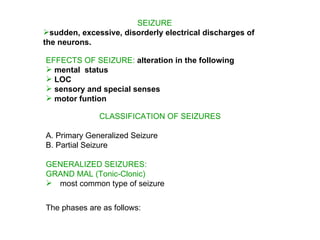
GRAND MAL (Tonic-Clonic)
 most common type of seizure
The phases are as follows:
PETIT MAL (Absence Seizure or Little Sickness)
  not preceeded by AURA
  little or no toni-clonic
  charac blank facial expression, automatism like lip-chewing,
   cheek smacking
  regain of consciousness as rapid as it was lot for 10-20secs
  usually occurs during childhood and adolescence
 JACKSONIAN / FOCAL SEIZURE
  common for patients with organic brain lesion like frontal
 lobe tumor
  aura is present(numbness, tingling, crawling feeling)
  charac by tonic-clonic movements of group muscle e.g.
 hands, foot, or face then it proceeds toi grand mal seizure
FEBRILE SEIZURE
 this is common for children <5yo, when temp. is rising
PSYCHOMOTOR SEIZURE
 aura is present (hallucinations or illusion)
 charac by mental clouding (being out of touch with the
envt)
 appears intoxicated
 the client may commit violent or antisocial acts, e.g. Going
naked public, running
PARTIAL SEIZURE
2 TYPES OF PARTIAL SEIZURES:
A. Simple Partial Seizure
B. Complex Partial Seizure


 Simple Partial Seizure

 Awareness Preserved
 Memory Preserved
 Consciousness Preserved
Complex Partial Seizure

Awareness Preserved
Memory Preserved
Consciousness Preserved
CAUSES OF SEIZURES IN CHILDREN
•   Birth Traumas
•   Infections – Meningitis
•   Congenital Abnormalities
•   High Fever
CAUSES OF SEIZURES IN MIDDLE YEARS
•   Head Injuries
•   Infections
•   Alcohol
•   Stimulant Drugs
•   Medications its Side Effects
CAUSES OF SEIZURES IN THE ELDERLY
•   Brain Tumors
•   Strokes
CHEMICAL IMBALANCES CAUSE SEIZURE

•   Alcohol
•   Cocaine
•   Other Drugs
•   Low blood sugar, low oxygen, low blood sodium,
    low calcium, kidney and renal failure
Nursing Management During a Seizure
-   The nursing goal is to prevent injury to the patient. This includes not
    only physical support but psychological support as well.
   Provide privacy
   Ease the patient on the floor, if possible
   Protect the head with a pad to prevent injury
   Loosen constrictive clothing
   If aura precedes the seizure, place a padded tongue blade between
    the teeth
   Do not attempt to pry open jaws that are clenched in a spasm to
    insert anything
   No attempt should be made to restrain the patient during the seizure
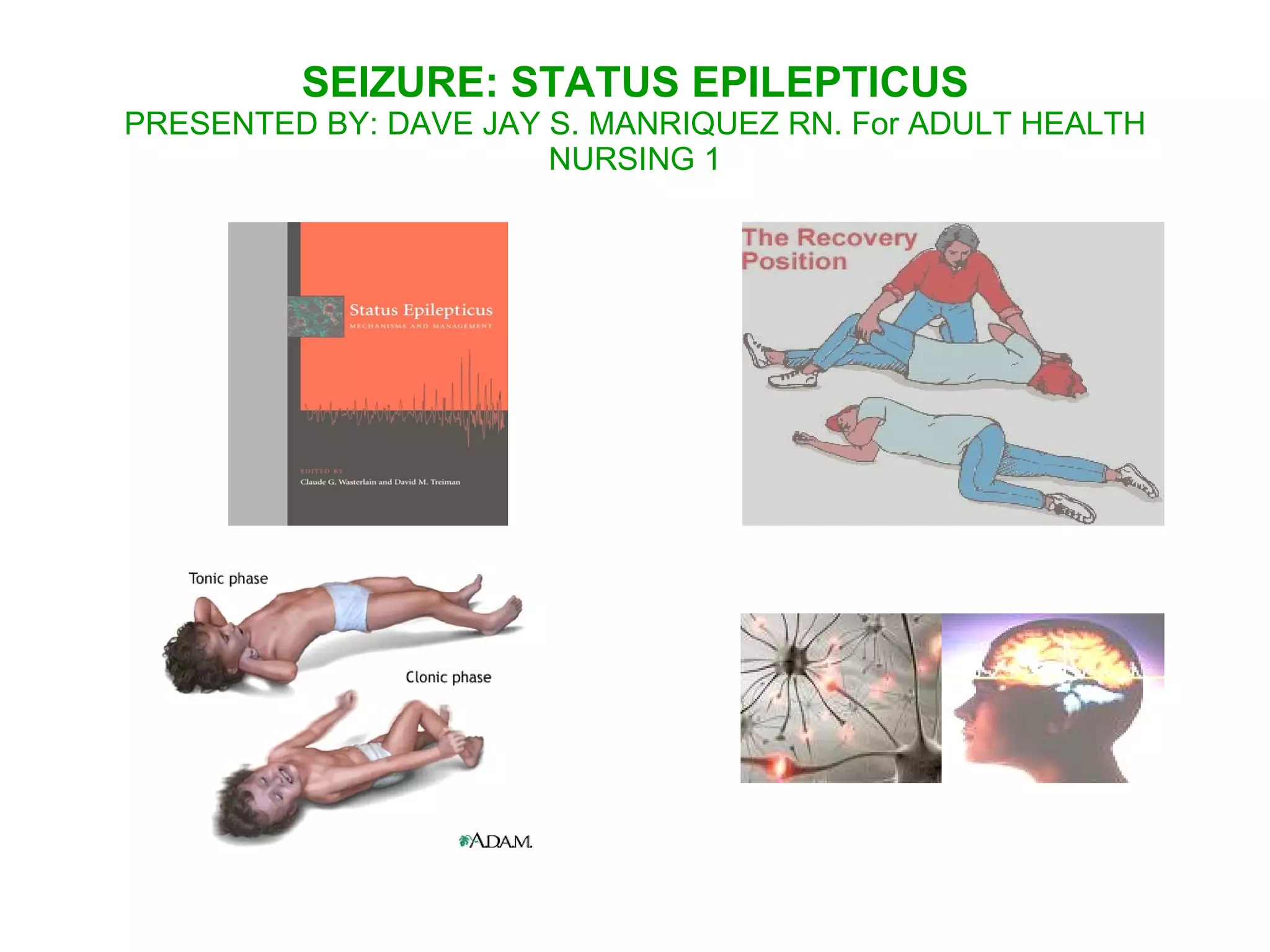
   Place the patient on one side with head flexed forward
   The patent should be reoriented to the environments and happening
    upon awakening
Nursing Assessment during a Seizure
-    Observe and to record the sequence of symptoms.

3.   Description of the circumstances before the attack.
4.   The first thing a patient does in an attack.
5.   The type of movements in the part of the body
     involved.
6.   The size of both pupils.
7.   Whether or not there is automatisms
8.   Duration of each phase of the attack
9.   Unconsciousness, ability to speak, consciousness
Epilepsy
Disorders of brain function characterized
 by recurring seizures.
Disturbance in consciousness, movement,
 behavior, mood, sensation, perception. It
 is not a disease but a symptom.
Electrical disturbance in one section of
 nerve cells causing uncontrolled electrical
 discharges.
How is Epilepsy Diagnosed?
History
Physical Exam
Electroencephalogram
MRI (Neuro-imaging)
CT Scan
6 Truths about Epilepsy
1.   Not to be called epileptic but a person with a seizure
     disorders
2.   In epilepsy there might be seldom brain damage, brain
     function is disturb by seizure
3.   Difference level of Intelligence
4.   Violence does not follow epilepsy
5.   Non usually inherited – cause is unknown and usually
     associated with environmental causes
6.   Epilepsy is not a curse is a medical condition
Nursing Diagnoses
• Fear related to the ever-present possibility
  of having seizures
• Ineffective coping related to stresses
  imposed by epilepsy
• Knowledge deficit about epilepsy and its
  control
• High risk for injury during seizures
Goals:
Short Term Goals:
• Maintenance of control of seizures
• Achievement of a satisfactory psychosocial adjustment
• Acquisition of knowledge and understanding about the condition
Long Term Goals:
• To achieve a satisfactory life adjustment
• To prevent or manage episodes of status epilepticus

Nursing Interventions:
• Seizure Control
• Improved Coping Mechanisms
• Patient Education
STATUS EPILEPTICUS
 (ACUTE PROLONGED SEIZURE ACTIVITY)

 IS A SERIES OF GENERALIZED SEIZURE THAT
  OCCUR WITHOUT FULL RECOVERY OF
  CONSCIOUSNESS BETWEEN ATTACKS

 THE TERM HAS BEEN BROADENED TO INCLUDE
  CONTINUOUS CLINICAL OR ELECTRICAL
  SEIZURES LASTING AT LEAST 30 MINUTES, EVEN
  WITHOUT IMPAIRMENT OF CONSCIOUSNESS.

 A seizure is a sudden disruption of the brain's
  normal electrical activity, which can cause a loss of
  consciousness and make the body twitch and jerk.
  This condition is a medical emergency.
CAUSES

Not taking anticonvulsant medication

Also caused by an underlying condition,
 such as meningitis, sepsis, encephalitis,
 brain tumor, head trauma, extremely
 high fever, low glucose levels, or
 exposure to toxins.
SymptomS
 The characteristic symptom of status
  epilepticus is seizures occurring so frequently
  that they appear to be one continuous seizure.
  These seizures include severe muscle
  contractions and difficulty breathing.
  Permanent damage can occur to the brain and
  heart if treatment is not immediate. A
  person's symptoms can range from simply
  appearing dazed to the more serious muscle
  contractions, spasms, and loss of
  consciousness. The specific symptoms depend
  on the underlying type of seizure.
TW C
   O ATEGORIES OF STATUS EPILEP US
                               TIC

CONVULSIVE
 Epilepsia partialis continua is a variant it involve an hour, day
 or even week-long jerking. It is a consequence of vascular
 disease, tumor or encepalitis and drug resistant.

NONCONVULSIVE
 Complex Partial Status Epilepticus CPSE and absence status
 epilepticus are rare forms of the condition which are marked by
 nonconvulsive seizures. In the case of CPSE, the seizure is
 confined to a small area of the brain, normally the temporal
 lobe. But the latter, absence status epilepticus, is marked by a
 generalised seizure affecting the whole brain, and an EEG is
 needed to differentiate between the two conditions. This results
 in episodes characterized by a long-lasting stupor, staring and
 unresponsiveness.
NURSING DIAGNOSIS

High Risk for Injury r/t Seizure
 Activity

Individual Coping r/t perceive social
 stigma, potential changes in
 employment
HOW IT IS DIAGNOSED?
  Status epilepticus is diagnosed according to its
  characteristics symptoms. The doctor will order test to
  look for the cause of the seizures. This may include:

 Blood test

 ECG to check for an abnormal heart rhythm

 EEG to check electrical activity in the brain

 MRI or CT scan to check for braing tumord or signs of
  damage to the brain tissue.
MEDICATIONS
Diazepam (Valium) this will stop motor movement

Phenytoin (Dilatin)

Phenobarbital (Barbita)

Paraldehyde

Thiopentahl sodium (Pentotal sodium)

General anesthesia may also be used as a
 treatment of last resort to stop seizure activity
NURSING INTERVENTIONS

PREVENTING INJURY
REDUCING FEARS OF SEIZURE
IMPROVING COPING MECHANISMS
PROVIDING PATIENT AND FAMILY
EDUCATION
MONITORING AND MANAGING POTENTIAL COMPL
TEACHING PATIENTS SELF-CARE
PREVENTING INJURY
Injury prevention for the patient with seizure is a
 PRIORITY.

    patient should be placed on the floor and
    remove any obstructive items
    patient should never be forced into a
    position
    pad side rails
    do not attempt to pry open jaws that are
    clenched in a spasm to insert anything.
    if possible place the patient on one side with
    head flexed forward,
PATIENT EDUCATION

 TAKE MEDICATION AT REGULAR BASIS

 AVOID ALCOHOL. Lowers seizure threshold

 ADEQUATE REST

 WELL-BALANCED DIET

 AVOID DRIVING, OPERATING MACHINES,
  SWIMMING UNTIL SEIZURES ARE WELL
  CONTROLLED.

 LIVE AN ACTIVE LIFE
REDUCING FEARS OF SEIZURE

Fear that a seizure may occur unexpectedly can
 be reduced by the patients adherence to the
 prescribed treatment regimen. Cooperation of
 the patient and family and their trust in the
 prescribed regimen are essential for control of
 seizures.

Periodic monitoring is necessary to ensure the
 adequacy of the treatment regimen and to
 prevent the side effects..
IMPROVING COPING MECHANISMS

It has been noted that the social, psychological,
 and behavioral problems frequently
 accompanying the attack can be more handicap
 than the actual seizure.
Counselling assists the individual and family to
 understand the condition and the limitations
 imposed by it. Social and recreational
 opportunities are good for mental health .
 Nurses can improve the quality of life for patients
 with the disorder by educating them and their
 family about the symptom and also the
 management.
PROVIDING PATIENT AND FAMILY EDUCATION

Ongoing education and encouragement should
 be given to patients to enable them to overcome
 these feelings. The patient and family should be
 educated about the medications as well as care
 during a seizure.
Perhaps the most valuable facets are education
 and efforts to modify the attitudes of the patient
 and family toward the disorder.
MONITORING AND MANAGING POTENTIAL
         COMPLICATIONS

 Patients should have plan to have
  serum drug levels drawn at regular
  intervals. The patient and family are
  instructed about the side effects and
  are given specific guidelines to
  assess and report signs and
  symptoms indicating medication
  overdose.
TEACHING PATIENTS SELF CARE

Like thorough oral hygiene after each meal, gum
 massage, daily flossing, and regular dental care.

The patient is also instructed to inform all health
 care providers of the medication being taken
 because of the possibility of drug interactions.
 An individualized comprehensive teaching plan
 is needed to assist the patient and family to
 adjust to this chronic disorder.

Seizure: Status Epilepticus

  • 1.
    SEIZURE: STATUS EPILEPTICUS PRESENTEDBY: DAVE JAY S. MANRIQUEZ RN. For ADULT HEALTH NURSING 1
  • 2.
    SEIZURE sudden, excessive, disorderlyelectrical discharges of the neurons. EFFECTS OF SEIZURE: alteration in the following  mental status  LOC  sensory and special senses  motor funtion CLASSIFICATION OF SEIZURES A. Primary Generalized Seizure B. Partial Seizure GENERALIZED SEIZURES: GRAND MAL (Tonic-Clonic)  most common type of seizure The phases are as follows: The phases are as follows:
  • 4.
    PETIT MAL (AbsenceSeizure or Little Sickness)  not preceeded by AURA  little or no toni-clonic  charac blank facial expression, automatism like lip-chewing, cheek smacking  regain of consciousness as rapid as it was lot for 10-20secs  usually occurs during childhood and adolescence JACKSONIAN / FOCAL SEIZURE  common for patients with organic brain lesion like frontal lobe tumor  aura is present(numbness, tingling, crawling feeling)  charac by tonic-clonic movements of group muscle e.g. hands, foot, or face then it proceeds toi grand mal seizure FEBRILE SEIZURE  this is common for children <5yo, when temp. is rising PSYCHOMOTOR SEIZURE  aura is present (hallucinations or illusion)  charac by mental clouding (being out of touch with the envt)  appears intoxicated  the client may commit violent or antisocial acts, e.g. Going naked public, running
  • 5.
    PARTIAL SEIZURE 2 TYPESOF PARTIAL SEIZURES: A. Simple Partial Seizure B. Complex Partial Seizure  Simple Partial Seizure  Awareness Preserved  Memory Preserved  Consciousness Preserved
  • 6.
    Complex Partial Seizure AwarenessPreserved Memory Preserved Consciousness Preserved
  • 7.
    CAUSES OF SEIZURESIN CHILDREN • Birth Traumas • Infections – Meningitis • Congenital Abnormalities • High Fever CAUSES OF SEIZURES IN MIDDLE YEARS • Head Injuries • Infections • Alcohol • Stimulant Drugs • Medications its Side Effects CAUSES OF SEIZURES IN THE ELDERLY • Brain Tumors • Strokes
  • 8.
    CHEMICAL IMBALANCES CAUSESEIZURE • Alcohol • Cocaine • Other Drugs • Low blood sugar, low oxygen, low blood sodium, low calcium, kidney and renal failure
  • 9.
    Nursing Management Duringa Seizure - The nursing goal is to prevent injury to the patient. This includes not only physical support but psychological support as well.  Provide privacy  Ease the patient on the floor, if possible  Protect the head with a pad to prevent injury  Loosen constrictive clothing  If aura precedes the seizure, place a padded tongue blade between the teeth  Do not attempt to pry open jaws that are clenched in a spasm to insert anything  No attempt should be made to restrain the patient during the seizure  Place the patient on one side with head flexed forward  The patent should be reoriented to the environments and happening upon awakening
  • 10.
    Nursing Assessment duringa Seizure - Observe and to record the sequence of symptoms. 3. Description of the circumstances before the attack. 4. The first thing a patient does in an attack. 5. The type of movements in the part of the body involved. 6. The size of both pupils. 7. Whether or not there is automatisms 8. Duration of each phase of the attack 9. Unconsciousness, ability to speak, consciousness
  • 11.
    Epilepsy Disorders of brainfunction characterized by recurring seizures. Disturbance in consciousness, movement, behavior, mood, sensation, perception. It is not a disease but a symptom. Electrical disturbance in one section of nerve cells causing uncontrolled electrical discharges.
  • 12.
    How is EpilepsyDiagnosed? History Physical Exam Electroencephalogram MRI (Neuro-imaging) CT Scan
  • 13.
    6 Truths aboutEpilepsy 1. Not to be called epileptic but a person with a seizure disorders 2. In epilepsy there might be seldom brain damage, brain function is disturb by seizure 3. Difference level of Intelligence 4. Violence does not follow epilepsy 5. Non usually inherited – cause is unknown and usually associated with environmental causes 6. Epilepsy is not a curse is a medical condition
  • 14.
    Nursing Diagnoses • Fearrelated to the ever-present possibility of having seizures • Ineffective coping related to stresses imposed by epilepsy • Knowledge deficit about epilepsy and its control • High risk for injury during seizures
  • 15.
    Goals: Short Term Goals: •Maintenance of control of seizures • Achievement of a satisfactory psychosocial adjustment • Acquisition of knowledge and understanding about the condition Long Term Goals: • To achieve a satisfactory life adjustment • To prevent or manage episodes of status epilepticus Nursing Interventions: • Seizure Control • Improved Coping Mechanisms • Patient Education
  • 16.
    STATUS EPILEPTICUS  (ACUTEPROLONGED SEIZURE ACTIVITY)  IS A SERIES OF GENERALIZED SEIZURE THAT OCCUR WITHOUT FULL RECOVERY OF CONSCIOUSNESS BETWEEN ATTACKS  THE TERM HAS BEEN BROADENED TO INCLUDE CONTINUOUS CLINICAL OR ELECTRICAL SEIZURES LASTING AT LEAST 30 MINUTES, EVEN WITHOUT IMPAIRMENT OF CONSCIOUSNESS.  A seizure is a sudden disruption of the brain's normal electrical activity, which can cause a loss of consciousness and make the body twitch and jerk. This condition is a medical emergency.
  • 17.
    CAUSES Not taking anticonvulsantmedication Also caused by an underlying condition, such as meningitis, sepsis, encephalitis, brain tumor, head trauma, extremely high fever, low glucose levels, or exposure to toxins.
  • 18.
    SymptomS  The characteristicsymptom of status epilepticus is seizures occurring so frequently that they appear to be one continuous seizure. These seizures include severe muscle contractions and difficulty breathing. Permanent damage can occur to the brain and heart if treatment is not immediate. A person's symptoms can range from simply appearing dazed to the more serious muscle contractions, spasms, and loss of consciousness. The specific symptoms depend on the underlying type of seizure.
  • 19.
    TW C O ATEGORIES OF STATUS EPILEP US TIC CONVULSIVE Epilepsia partialis continua is a variant it involve an hour, day or even week-long jerking. It is a consequence of vascular disease, tumor or encepalitis and drug resistant. NONCONVULSIVE Complex Partial Status Epilepticus CPSE and absence status epilepticus are rare forms of the condition which are marked by nonconvulsive seizures. In the case of CPSE, the seizure is confined to a small area of the brain, normally the temporal lobe. But the latter, absence status epilepticus, is marked by a generalised seizure affecting the whole brain, and an EEG is needed to differentiate between the two conditions. This results in episodes characterized by a long-lasting stupor, staring and unresponsiveness.
  • 20.
    NURSING DIAGNOSIS High Riskfor Injury r/t Seizure Activity Individual Coping r/t perceive social stigma, potential changes in employment
  • 21.
    HOW IT ISDIAGNOSED? Status epilepticus is diagnosed according to its characteristics symptoms. The doctor will order test to look for the cause of the seizures. This may include:  Blood test  ECG to check for an abnormal heart rhythm  EEG to check electrical activity in the brain  MRI or CT scan to check for braing tumord or signs of damage to the brain tissue.
  • 22.
    MEDICATIONS Diazepam (Valium) thiswill stop motor movement Phenytoin (Dilatin) Phenobarbital (Barbita) Paraldehyde Thiopentahl sodium (Pentotal sodium) General anesthesia may also be used as a treatment of last resort to stop seizure activity
  • 23.
    NURSING INTERVENTIONS PREVENTING INJURY REDUCINGFEARS OF SEIZURE IMPROVING COPING MECHANISMS PROVIDING PATIENT AND FAMILY EDUCATION MONITORING AND MANAGING POTENTIAL COMPL TEACHING PATIENTS SELF-CARE
  • 24.
    PREVENTING INJURY Injury preventionfor the patient with seizure is a PRIORITY.  patient should be placed on the floor and remove any obstructive items  patient should never be forced into a position  pad side rails  do not attempt to pry open jaws that are clenched in a spasm to insert anything.  if possible place the patient on one side with head flexed forward,
  • 25.
    PATIENT EDUCATION  TAKEMEDICATION AT REGULAR BASIS  AVOID ALCOHOL. Lowers seizure threshold  ADEQUATE REST  WELL-BALANCED DIET  AVOID DRIVING, OPERATING MACHINES, SWIMMING UNTIL SEIZURES ARE WELL CONTROLLED.  LIVE AN ACTIVE LIFE
  • 26.
    REDUCING FEARS OFSEIZURE Fear that a seizure may occur unexpectedly can be reduced by the patients adherence to the prescribed treatment regimen. Cooperation of the patient and family and their trust in the prescribed regimen are essential for control of seizures. Periodic monitoring is necessary to ensure the adequacy of the treatment regimen and to prevent the side effects..
  • 27.
    IMPROVING COPING MECHANISMS Ithas been noted that the social, psychological, and behavioral problems frequently accompanying the attack can be more handicap than the actual seizure. Counselling assists the individual and family to understand the condition and the limitations imposed by it. Social and recreational opportunities are good for mental health . Nurses can improve the quality of life for patients with the disorder by educating them and their family about the symptom and also the management.
  • 28.
    PROVIDING PATIENT ANDFAMILY EDUCATION Ongoing education and encouragement should be given to patients to enable them to overcome these feelings. The patient and family should be educated about the medications as well as care during a seizure. Perhaps the most valuable facets are education and efforts to modify the attitudes of the patient and family toward the disorder.
  • 29.
    MONITORING AND MANAGINGPOTENTIAL COMPLICATIONS  Patients should have plan to have serum drug levels drawn at regular intervals. The patient and family are instructed about the side effects and are given specific guidelines to assess and report signs and symptoms indicating medication overdose.
  • 30.
    TEACHING PATIENTS SELFCARE Like thorough oral hygiene after each meal, gum massage, daily flossing, and regular dental care. The patient is also instructed to inform all health care providers of the medication being taken because of the possibility of drug interactions. An individualized comprehensive teaching plan is needed to assist the patient and family to adjust to this chronic disorder.