EPILEPSY
Presented by:
Post graduate students
Course: MD Phase A (Psychiatry)
BSMMU, Dhaka
18/8/2013
1
Contents
• Introduction
• Pathogenesis
• Clinical features & Diagnostic approach
• Management
• Interphase & Summary
2
Introduction
Dr Towhidul Islam
3
Past
• Oldest record SakikKu -babilonian medcal text
1067 B.C
• Aurvedic description as “Apasmara” 400 B.C
• “epilambanein”
to be overwhelmed by surprise
• Falling sickness
• Demonic possession
4
Past
• “its cause lies in the brain”
• 1920- Human EEG (Hans Berger)
5
Basics
Seizure:
• Any clinical event
• Abnormal brain discharge
6
Basics
Epilepsy :
• Recurrence
• Seizure attack
Pseudo seizure/PNES:
• Resemblance
• Psychology
• No abnormal brain discharge
7
PNES
8
Basics
SEIZURE PSEUDO
SEIZURE
SYNCOPE
• Sudden
• Unconscious
• Cyanosis
• Injury
• Sec to mints
• Hand on face
• Post ictal
confusion
• EEG,CPK,
Prolactin
• Gradual
• Conscious
• Thrusting
• Mins to hr
• Eye opening
• Pupil- Normal
• Psycho social
• Suggestive
• Light
headedness
• Standing
• Preventive-
lying
• Brief- lost
consciousness
9
Current scenario
• 60 million people worldwide
• 85% people-inadequate/not at all
• Specialist care:
LIC- 56%, HIC-89%
• AEDs: Govt priority, high cost , PB
10
Current scenario
• Age: any age (childhood, old age)
• Prevalence:
Single episode - 5%
Repeated- 0.5 to 2.5%
Our country- 2%
Developing country- 5 times higher
11
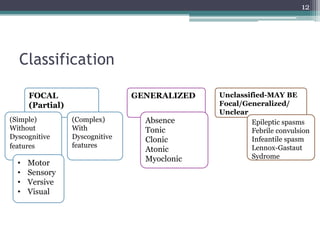
Classification
FOCAL
(Partial)
GENERALIZED Unclassified-MAY BE
Focal/Generalized/
Unclear
(Complex)
With
Dyscognitive
features
(Simple)
Without
Dyscognitive
features
Absence
Tonic
Clonic
Atonic
Myoclonic
Epileptic spasms
Febrile convulsion
Infeantile spasm
Lennox-Gastaut
Sydrome
• Motor
• Sensory
• Versive
• Visual
12
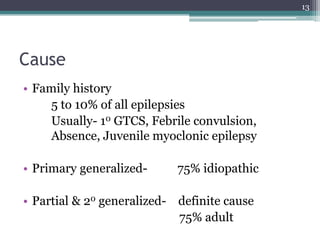
Cause
• Family history
5 to 10% of all epilepsies
Usually- 10 GTCS, Febrile convulsion,
Absence, Juvenile myoclonic epilepsy
• Primary generalized- 75% idiopathic
• Partial & 20 generalized- definite cause
75% adult
13
Cause
Neonates
<1 month
Infants
< 12 years
Adolescents
12-18 years
Young adult
18-35 years
Older
>35 years
Perinatal
hypoxia and
ischemia
ICH
Ca++ , Glucose
Bilirubin
Water
intoxication
Inborn error of
metabolism
Trauma
Febrile
seizures
CNS infection
Trauma
Developmental
disorder
Inborn error of
metabolism
Trauma
CNS infection
AVM
Infection
Congenital
defect
Tumors
Trauma
CNS infection
Brain tumor
AVM
Drugs and
alcohol
Drugs and
alcohol
Trauma
Tumor
CVD
Degenerative
CNS infection
14
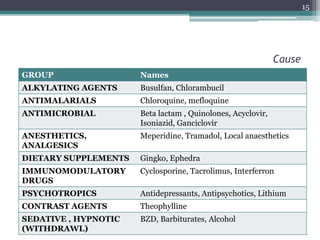
Cause
GROUP Names
ALKYLATING AGENTS Busulfan, Chlorambucil
ANTIMALARIALS Chloroquine, mefloquine
ANTIMICROBIAL Beta lactam , Quinolones, Acyclovir,
Isoniazid, Ganciclovir
ANESTHETICS,
ANALGESICS
Meperidine, Tramadol, Local anaesthetics
DIETARY SUPPLEMENTS Gingko, Ephedra
IMMUNOMODULATORY
DRUGS
Cyclosporine, Tacrolimus, Interferron
PSYCHOTROPICS Antidepressants, Antipsychotics, Lithium
CONTRAST AGENTS Theophylline
SEDATIVE , HYPNOTIC
(WITHDRAWL)
BZD, Barbiturates, Alcohol
15
What happens inside?
Dr Md Saleh Uddin
16
Why & How?
• Shift of balance: Excitation & Inhibition(CNS)
17
Why & How?
• Endogenous factor
Neuronal propensity to burst
Intrinsic : conductance to ion channel, receptor
response, second messenger, translation etc.
Extrinsic : neuro transmitter, receptor, temporal
/spatial property
18
Why & How?
• Epileptogenesis
Transformation - normal to hyper
excitable(structural change)
Lowered seizure threshold
Lost inhibition
Sprouting of surviving neurons
19
Why & How?
• Precipitating factor
Sleep deprivation
Alcohol
Recreational drug misuse
Physical and mental exhaustion
Flickering lights
Intercurrent infections and metabolic disturbance
20
What & How?
Seizure initiation and propagation
• Initiation:
Bursts of action potential
Hyper synchronization
• Propagation:
Extracellular K+
Presynaptic Ca2+
Cortical connections
& Commissural fibers
21
Why & How?
22
Updates
23
Why & How?
Endogenous
Factor
Precipitating
Factor
Epileptogenic
Factor
24
Clinical features &
Diagnostic approach
Dr Hosnea Ara
25
GTCS/Grand mal
• Prodrome
• Aura
• Tonic phase
• Clonic phase
• Relaxation
• Post ictal phase
26
Absence Seizure
• Petit mal
• Childhood
• Frequency
• Stops doing, vacant stares
• Hyperventilation
• No post ictal symptoms
• EEG diagnostic
27
Complex partial seizure
• Temporal lobe/psychomotor epilepsy
• Never fall
• Mood ,memory, perception
• Features :
28
Atonic seizure
• Brief loss of muscle tone
• Heavy fall
• Consciousness
29
Simple partial
• Motor
• Sensory
• Versive
• Visual
30
Diagnostic approach
• History
• Clinical exam
• Lab enquiry
• Differentials
31
Diagnostic approach
• HISTORY
Age group
Past history of illness
Personal history
Triggering factors
Eye witness description
32
Diagnostic approach
• CLINICAL EXAM
General survey
Vital signs
Cyanosis, Jaundice
Tongue bite mark
Systemic exam
Neurological, CVS, HBS, Resp System
33
Diagnostic approach
• LAB INQUIRY
Hematology
Biochemistry
Serology
CSF, Hormone, ECG
Imaging
• Late in onset
• Partial / 2o
generalized
• Refractory to drug
• Focal neuro deficit
• Status epilepticus
• Suspected ICSOL
• EEG shows focal
seizure
MRI/CT brain
Indication
34
Diagnostic approach
• LAB ENQUIRY
EEG
Type of epilepsy
Drug choice
Advanced lab test
Sphenoidal intra operative oval and
telemetric EEG
Ambulatory EEG, Videotelemetry
PET, SPET
35
Diagnostic approach
• DIFFERENTIALS
Syncope
TIA
Migraine
Drop attack
Panic attack
Hypoglycemia
Cataplexy/Narcolepsy
Pseudoseizure
Cardiac arrhythmia
Episodic confusion
36
Management
Dr Mahjabeen Aftab Solaiman
37
Management
• Immediate care
• Medical treatment
• Pregnancy
• Status epilepticus
• Surgical treatment
38
Management
• Immediate Care:
First Aid
Move
Semi prone
Airway
Don’t insert
Immediately
Patency of airway
O2, IV diazepam, blood
39
Management
• Medical treatment
AEDs :
Carbamazepine
Na valproate
Phenytoin
Phenobarbitone
40
Management
• Indication AEDs:
Single seizure( lesion , EEG, family history)
Unprovoked seizure
Adult- > 1
Child- > 2
41
Management
• AEDs-
Single drug , Low dose, Compliance
Switching
3rd drug prior combination
Two drugs at a time
Resistant to drug- metabolic/structural
42
Type First line Second line Third line
Partial / Secondary
GTCS
Carbamazepine Lamotrigine
Na Valproate
Topiramaate
Tigabine
Gabapentin
Clobazam
Phenytoin
Primidone
Phenobarbital
Oxcarbazepine
Levetiracetam
Vigabatrin
Acetazoalmide
Primary GTCS Na Valproate Lamotrigine
Topiramate
Carbamazepine
Phenytoin
Gabapentin
Primidone
Phenobarbital
Tigabine
Acetazolamide
Absence Ethosuximide Na Valproate Lamotirizine
Clonazepam
Acetazolamide
Myoclonic Na Valproate Clonazepam Piracetam
Lamotrizine
Phenobarbital
43
Management
AEDs withdrawal :
Control 2 to 4 years
Gradually, 6-12 months
Prognosis:
Primary generalized
Absence-Best
Others- Recurrence
44
Management
Pregnancy
• AEDs:
Enzyme inducer
Congenital abnormalities(First trimester)
Number & risk %
• Folic acid supplement
• Partial seizure-little risk
• Vit K supplement
45
Management
• Status epilepticus
Series of seizures
Without regaining awareness
30 minutes
Management:
General
Pharmacological
46
Surgical treatment:
• 20-30% patients
• Localization (video EEG, MRI, SPET,PET, Cortical
mapping at surgery)
• Temporal lobectomy
• Hemispherectomy
• Corpus callosotomy
• VNS
47
Interphase & Summary
48
Interphase
49
Interphase
• Psychiatric disorders in epilepsy
50% patient with epilepsy.
Ictal, peri-ictal , inter ictal (depression)
• Treatment related psychiatric problem
Depression, psychosis etc
AEDs (PB, Vigabatrin etc)
“Forced normalization”
50
Summary
51
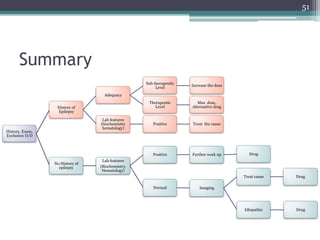
History, Exam,
Exclusion D/D
History of
Epilepsy
Adequacy
Sub therapeutic
Level
Increase the dose
Therapeutic
Level
Max dose,
Alternative drug
Lab features
(biochemistry
hematology)
Positive Treat the cause
No History of
epilepsy
Lab features
(Biochemistry,
Hematology)
Positive Further work up Drug
Normal Imaging
Treat cause Drug
Idiopathic Drug
References
• Davidson’s principal & practice of Medicine, 21st edition, elsevier publisher,
2012
• Harrison’s Principales of internal medicine, 18th edition.
• Lecture Notes-Prof AKM Anwarullah
• Epilepsia, 44(suppl 6): 12-143. 2003, Blackwell publishing Inc, ILAE
• History of epilepsy 1909-2009: The ILAE century
• Recognition of psychogenic non epileptic seizure: acurable neurophobia, S S
O Sallivan et al, Journal of Neurosurg Psychiatry, 2013, 84: 228-231
• Why do some brain seize? Molecular ,cellular and network mechanism,
Andrew Trevelyan, Jphysiol(editorial)591.4(2013) 751-752
• The treatment gap in epilepsy, A Neliga, J W Sander, Epileptology 1 (2013)
28-30
52
“The sadness will last forever”
(Vincent van Gogh)
53
Wheat field with crows (1890)
Thank You
54

Epilepsy

  • 1.
    EPILEPSY Presented by: Post graduatestudents Course: MD Phase A (Psychiatry) BSMMU, Dhaka 18/8/2013 1
  • 2.
    Contents • Introduction • Pathogenesis •Clinical features & Diagnostic approach • Management • Interphase & Summary 2
  • 3.
  • 4.
    Past • Oldest recordSakikKu -babilonian medcal text 1067 B.C • Aurvedic description as “Apasmara” 400 B.C • “epilambanein” to be overwhelmed by surprise • Falling sickness • Demonic possession 4
  • 5.
    Past • “its causelies in the brain” • 1920- Human EEG (Hans Berger) 5
  • 6.
    Basics Seizure: • Any clinicalevent • Abnormal brain discharge 6
  • 7.
    Basics Epilepsy : • Recurrence •Seizure attack Pseudo seizure/PNES: • Resemblance • Psychology • No abnormal brain discharge 7
  • 8.
  • 9.
    Basics SEIZURE PSEUDO SEIZURE SYNCOPE • Sudden •Unconscious • Cyanosis • Injury • Sec to mints • Hand on face • Post ictal confusion • EEG,CPK, Prolactin • Gradual • Conscious • Thrusting • Mins to hr • Eye opening • Pupil- Normal • Psycho social • Suggestive • Light headedness • Standing • Preventive- lying • Brief- lost consciousness 9
  • 10.
    Current scenario • 60million people worldwide • 85% people-inadequate/not at all • Specialist care: LIC- 56%, HIC-89% • AEDs: Govt priority, high cost , PB 10
  • 11.
    Current scenario • Age:any age (childhood, old age) • Prevalence: Single episode - 5% Repeated- 0.5 to 2.5% Our country- 2% Developing country- 5 times higher 11
  • 12.
  • 13.
    Cause • Family history 5to 10% of all epilepsies Usually- 10 GTCS, Febrile convulsion, Absence, Juvenile myoclonic epilepsy • Primary generalized- 75% idiopathic • Partial & 20 generalized- definite cause 75% adult 13
  • 14.
    Cause Neonates <1 month Infants < 12years Adolescents 12-18 years Young adult 18-35 years Older >35 years Perinatal hypoxia and ischemia ICH Ca++ , Glucose Bilirubin Water intoxication Inborn error of metabolism Trauma Febrile seizures CNS infection Trauma Developmental disorder Inborn error of metabolism Trauma CNS infection AVM Infection Congenital defect Tumors Trauma CNS infection Brain tumor AVM Drugs and alcohol Drugs and alcohol Trauma Tumor CVD Degenerative CNS infection 14
  • 15.
    Cause GROUP Names ALKYLATING AGENTSBusulfan, Chlorambucil ANTIMALARIALS Chloroquine, mefloquine ANTIMICROBIAL Beta lactam , Quinolones, Acyclovir, Isoniazid, Ganciclovir ANESTHETICS, ANALGESICS Meperidine, Tramadol, Local anaesthetics DIETARY SUPPLEMENTS Gingko, Ephedra IMMUNOMODULATORY DRUGS Cyclosporine, Tacrolimus, Interferron PSYCHOTROPICS Antidepressants, Antipsychotics, Lithium CONTRAST AGENTS Theophylline SEDATIVE , HYPNOTIC (WITHDRAWL) BZD, Barbiturates, Alcohol 15
  • 16.
    What happens inside? DrMd Saleh Uddin 16
  • 17.
    Why & How? •Shift of balance: Excitation & Inhibition(CNS) 17
  • 18.
    Why & How? •Endogenous factor Neuronal propensity to burst Intrinsic : conductance to ion channel, receptor response, second messenger, translation etc. Extrinsic : neuro transmitter, receptor, temporal /spatial property 18
  • 19.
    Why & How? •Epileptogenesis Transformation - normal to hyper excitable(structural change) Lowered seizure threshold Lost inhibition Sprouting of surviving neurons 19
  • 20.
    Why & How? •Precipitating factor Sleep deprivation Alcohol Recreational drug misuse Physical and mental exhaustion Flickering lights Intercurrent infections and metabolic disturbance 20
  • 21.
    What & How? Seizureinitiation and propagation • Initiation: Bursts of action potential Hyper synchronization • Propagation: Extracellular K+ Presynaptic Ca2+ Cortical connections & Commissural fibers 21
  • 22.
  • 23.
  • 24.
  • 25.
    Clinical features & Diagnosticapproach Dr Hosnea Ara 25
  • 26.
    GTCS/Grand mal • Prodrome •Aura • Tonic phase • Clonic phase • Relaxation • Post ictal phase 26
  • 27.
    Absence Seizure • Petitmal • Childhood • Frequency • Stops doing, vacant stares • Hyperventilation • No post ictal symptoms • EEG diagnostic 27
  • 28.
    Complex partial seizure •Temporal lobe/psychomotor epilepsy • Never fall • Mood ,memory, perception • Features : 28
  • 29.
    Atonic seizure • Briefloss of muscle tone • Heavy fall • Consciousness 29
  • 30.
    Simple partial • Motor •Sensory • Versive • Visual 30
  • 31.
    Diagnostic approach • History •Clinical exam • Lab enquiry • Differentials 31
  • 32.
    Diagnostic approach • HISTORY Agegroup Past history of illness Personal history Triggering factors Eye witness description 32
  • 33.
    Diagnostic approach • CLINICALEXAM General survey Vital signs Cyanosis, Jaundice Tongue bite mark Systemic exam Neurological, CVS, HBS, Resp System 33
  • 34.
    Diagnostic approach • LABINQUIRY Hematology Biochemistry Serology CSF, Hormone, ECG Imaging • Late in onset • Partial / 2o generalized • Refractory to drug • Focal neuro deficit • Status epilepticus • Suspected ICSOL • EEG shows focal seizure MRI/CT brain Indication 34
  • 35.
    Diagnostic approach • LABENQUIRY EEG Type of epilepsy Drug choice Advanced lab test Sphenoidal intra operative oval and telemetric EEG Ambulatory EEG, Videotelemetry PET, SPET 35
  • 36.
    Diagnostic approach • DIFFERENTIALS Syncope TIA Migraine Dropattack Panic attack Hypoglycemia Cataplexy/Narcolepsy Pseudoseizure Cardiac arrhythmia Episodic confusion 36
  • 37.
  • 38.
    Management • Immediate care •Medical treatment • Pregnancy • Status epilepticus • Surgical treatment 38
  • 39.
    Management • Immediate Care: FirstAid Move Semi prone Airway Don’t insert Immediately Patency of airway O2, IV diazepam, blood 39
  • 40.
    Management • Medical treatment AEDs: Carbamazepine Na valproate Phenytoin Phenobarbitone 40
  • 41.
    Management • Indication AEDs: Singleseizure( lesion , EEG, family history) Unprovoked seizure Adult- > 1 Child- > 2 41
  • 42.
    Management • AEDs- Single drug, Low dose, Compliance Switching 3rd drug prior combination Two drugs at a time Resistant to drug- metabolic/structural 42
  • 43.
    Type First lineSecond line Third line Partial / Secondary GTCS Carbamazepine Lamotrigine Na Valproate Topiramaate Tigabine Gabapentin Clobazam Phenytoin Primidone Phenobarbital Oxcarbazepine Levetiracetam Vigabatrin Acetazoalmide Primary GTCS Na Valproate Lamotrigine Topiramate Carbamazepine Phenytoin Gabapentin Primidone Phenobarbital Tigabine Acetazolamide Absence Ethosuximide Na Valproate Lamotirizine Clonazepam Acetazolamide Myoclonic Na Valproate Clonazepam Piracetam Lamotrizine Phenobarbital 43
  • 44.
    Management AEDs withdrawal : Control2 to 4 years Gradually, 6-12 months Prognosis: Primary generalized Absence-Best Others- Recurrence 44
  • 45.
    Management Pregnancy • AEDs: Enzyme inducer Congenitalabnormalities(First trimester) Number & risk % • Folic acid supplement • Partial seizure-little risk • Vit K supplement 45
  • 46.
    Management • Status epilepticus Seriesof seizures Without regaining awareness 30 minutes Management: General Pharmacological 46
  • 47.
    Surgical treatment: • 20-30%patients • Localization (video EEG, MRI, SPET,PET, Cortical mapping at surgery) • Temporal lobectomy • Hemispherectomy • Corpus callosotomy • VNS 47
  • 48.
  • 49.
  • 50.
    Interphase • Psychiatric disordersin epilepsy 50% patient with epilepsy. Ictal, peri-ictal , inter ictal (depression) • Treatment related psychiatric problem Depression, psychosis etc AEDs (PB, Vigabatrin etc) “Forced normalization” 50
  • 51.
    Summary 51 History, Exam, Exclusion D/D Historyof Epilepsy Adequacy Sub therapeutic Level Increase the dose Therapeutic Level Max dose, Alternative drug Lab features (biochemistry hematology) Positive Treat the cause No History of epilepsy Lab features (Biochemistry, Hematology) Positive Further work up Drug Normal Imaging Treat cause Drug Idiopathic Drug
  • 52.
    References • Davidson’s principal& practice of Medicine, 21st edition, elsevier publisher, 2012 • Harrison’s Principales of internal medicine, 18th edition. • Lecture Notes-Prof AKM Anwarullah • Epilepsia, 44(suppl 6): 12-143. 2003, Blackwell publishing Inc, ILAE • History of epilepsy 1909-2009: The ILAE century • Recognition of psychogenic non epileptic seizure: acurable neurophobia, S S O Sallivan et al, Journal of Neurosurg Psychiatry, 2013, 84: 228-231 • Why do some brain seize? Molecular ,cellular and network mechanism, Andrew Trevelyan, Jphysiol(editorial)591.4(2013) 751-752 • The treatment gap in epilepsy, A Neliga, J W Sander, Epileptology 1 (2013) 28-30 52
  • 53.
    “The sadness willlast forever” (Vincent van Gogh) 53 Wheat field with crows (1890)
  • 54.