MICRO ORGANISMS
VIRUSES
Diversity, Change and Continuity
MICROBES/MICRO ORGANISMS
• Some organisms are so small, that it can’t be
seen with the naked eye
• This group includes:
• VIRUSES: Smaller than a cell and does not
form part of the 5 Kingdom system that
classifies living organisms
• • The basic characteristics and structure of
viruses
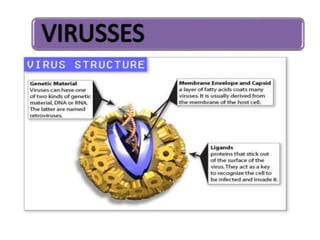
• • Viruses consist of a central core of nucleic
acid either DNA or RNA.
• • They have a capsid or protein coat around
the nucleic acid
• • Viruses have various shapes that consist of
symmetrical faces
Viruses do not perform any metabolic reactions
of living organisms (no cellular respiration)
• Viruses cannot reproduce unless they have
a host
• Viruses are parasitic on plants, animals,
protistsa and bacteria
• Most viruses are pathogens and can cause
diseases in their host
• They contain either DNA or RNA but never both.
• They are OBLIGATE INTRA-CELLULAR PARASITES –
can only replicate within a living host cell
• Viruses are host or tissue specific
• They are PATHOGENS (disease causing
organisms)
• Viruses REPRODUCE by changing the genetic
material of the host cell to its own
WHY ARE VIRUSSES REGARDED AS NON-LIVING?
• They can’t feed
• They can’t respire
• They can’t reproduce, only multiply
• They can’t excrete
• They show no form of locomotion
• They show no sensitivity
• They can’t grow
• They have no nucleus
• They have no cytoplasm
• They have no organelles
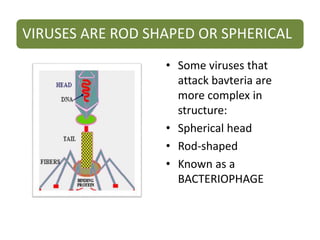
VIRUSES ARE ROD SHAPED OR SPHERICAL
• Some viruses that
attack bavteria are
more complex in
structure:
• Spherical head
• Rod-shaped
• Known as a
BACTERIOPHAGE
REPRODUCTION OF VIRUSES
1. The virus approaches a cell
2. Virus attaches to receptor on cell membrane of host
cell
3. Virus engulfed by endocytosis
4. Virus wall disintegrates
5. Virus releases its nucleic acid
6. A new virus nucleic acid is formed from nucleic acid of
host cell
7. New virus with protein shield is formed
8. Host cell bursts open and new viruses are released
9. Host cell destroyed in the process
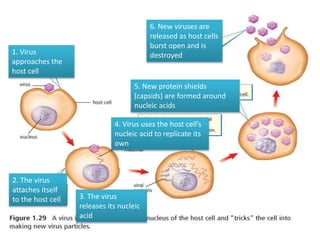
1. Virus
approaches the
host cell
2. The virus
attaches itself
to the host cell 3. The virus
releases its nucleic
acid
4. Virus uses the host cell’s
nucleic acid to replicate its
own
5. New protein shields
(capsids) are formed around
nucleic acids
6. New viruses are
released as host cells
burst open and is
destroyed
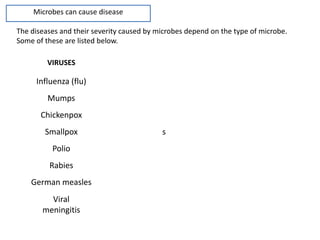
Microbes can cause disease
The diseases and their severity caused by microbes depend on the type of microbe.
Some of these are listed below.
VIRUSES
Influenza (flu)
Mumps
Chickenpox
Smallpox s
Polio
Rabies
German measles
Viral
meningitis

Virus slides

  • 1.
  • 2.
    MICROBES/MICRO ORGANISMS • Someorganisms are so small, that it can’t be seen with the naked eye • This group includes: • VIRUSES: Smaller than a cell and does not form part of the 5 Kingdom system that classifies living organisms
  • 3.
    • • Thebasic characteristics and structure of viruses • • Viruses consist of a central core of nucleic acid either DNA or RNA. • • They have a capsid or protein coat around the nucleic acid • • Viruses have various shapes that consist of symmetrical faces
  • 4.
    Viruses do notperform any metabolic reactions of living organisms (no cellular respiration) • Viruses cannot reproduce unless they have a host • Viruses are parasitic on plants, animals, protistsa and bacteria • Most viruses are pathogens and can cause diseases in their host
  • 6.
    • They containeither DNA or RNA but never both. • They are OBLIGATE INTRA-CELLULAR PARASITES – can only replicate within a living host cell • Viruses are host or tissue specific • They are PATHOGENS (disease causing organisms) • Viruses REPRODUCE by changing the genetic material of the host cell to its own
  • 7.
    WHY ARE VIRUSSESREGARDED AS NON-LIVING? • They can’t feed • They can’t respire • They can’t reproduce, only multiply • They can’t excrete • They show no form of locomotion • They show no sensitivity • They can’t grow
  • 8.
    • They haveno nucleus • They have no cytoplasm • They have no organelles
  • 9.
    VIRUSES ARE RODSHAPED OR SPHERICAL • Some viruses that attack bavteria are more complex in structure: • Spherical head • Rod-shaped • Known as a BACTERIOPHAGE
  • 10.
    REPRODUCTION OF VIRUSES 1.The virus approaches a cell 2. Virus attaches to receptor on cell membrane of host cell 3. Virus engulfed by endocytosis 4. Virus wall disintegrates 5. Virus releases its nucleic acid 6. A new virus nucleic acid is formed from nucleic acid of host cell 7. New virus with protein shield is formed 8. Host cell bursts open and new viruses are released 9. Host cell destroyed in the process
  • 11.
    1. Virus approaches the hostcell 2. The virus attaches itself to the host cell 3. The virus releases its nucleic acid 4. Virus uses the host cell’s nucleic acid to replicate its own 5. New protein shields (capsids) are formed around nucleic acids 6. New viruses are released as host cells burst open and is destroyed
  • 12.
    Microbes can causedisease The diseases and their severity caused by microbes depend on the type of microbe. Some of these are listed below. VIRUSES Influenza (flu) Mumps Chickenpox Smallpox s Polio Rabies German measles Viral meningitis