
Digestive System
Human Anatomy & Physiology
Ms RAKHSHANDA HASHMI
BS Ed,Department of Education
Digestive System
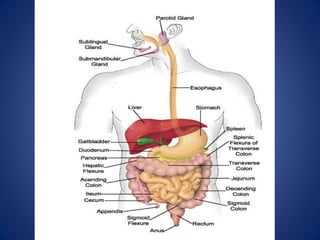
The human digestive system is a complex series of
organs and glands that processes food. In order to
use the food we eat, our body has to break the food
down into smaller molecules that it can process; it
also has to excrete waste
Digestive System Function
• Acquires nutrients from environment
• Anabolism
– Uses raw materials to synthesize essential compounds
• Catabolism
– Decomposes substances to provide energy cells need to
function
Actions of Digestive (GI) Tract
• Ingestion
– Occurs when material
enters via the mouth
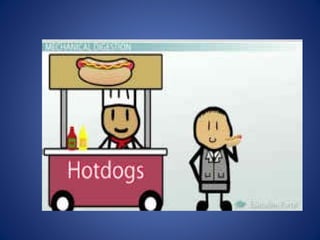
• Mechanical
ProcessingPhysical
Process
• Chew,Tear,Grind,Mash
Mix, Crushing / Shearing –
makes material easier to
move through the tract
Digestion
– Chemical breakdown of
food into small organic
compounds for absorption
• Secretion
– Release of water ,acids,
enzymes & salts by
epithelium of GI tract and
glandular organs
• Absorption
– Movement of organic
substrates, electrolytes,
vitamins & water
Excretion
– Removal of waste products
from body fluids
The Digestive Process
The start of the process - the mouth: The
digestive process begins in the mouth. Food is
partly broken down by the process of chewing
and by the chemical action of salivary enzymes
(these enzymes are produced by the salivary
glands and break down starches into smaller
molecules).
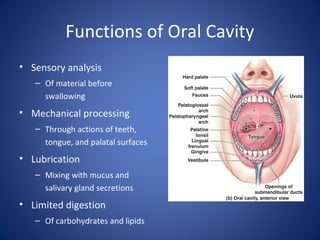
Functions of Oral Cavity
• Sensory analysis
– Of material before
swallowing
• Mechanical processing
– Through actions of teeth,
tongue, and palatal surfaces
• Lubrication
– Mixing with mucus and
salivary gland secretions
• Limited digestion
– Of carbohydrates and lipids
EPIGLOTTIS
Epiglottis is a flap-like structure at the back
of the throat that closes over the trachea
preventing food from entering it.
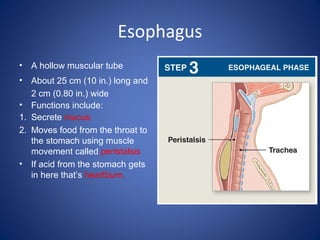
Esophagus
• A hollow muscular tube
• About 25 cm (10 in.) long and
2 cm (0.80 in.) wide
• Functions include:
1. Secrete mucus
2. Moves food from the throat to
the stomach using muscle
movement called peristalsis
• If acid from the stomach gets
in here that’s heartburn.
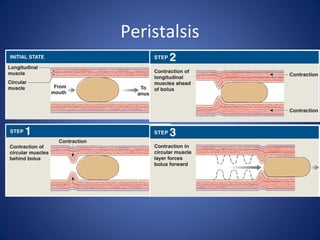
Peristalsis
STOMACH
J-shaped muscular bag that stores the food you
eat, breaks it down into tiny pieces.
Mixes food with digestive juices that contain
enzymes to break down proteins and lipids.
Acid in the stomach kills bacteria.
Food found in the stomach is called chyme
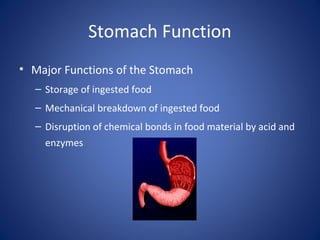
Stomach Function
• Major Functions of the Stomach
– Storage of ingested food
– Mechanical breakdown of ingested food
– Disruption of chemical bonds in food material by acid and
enzymes
Digestion in the Stomach
• Stomach performs preliminary digestion of proteins
by pepsin
– Some digestion of carbohydrates
– Lipids
• Stomach contents
– Become more fluid
– pH approaches 2.0
– Pepsin activity increases
– Protein disassembly begins
• Although digestion occurs in the stomach, nutrients
are not absorbed there
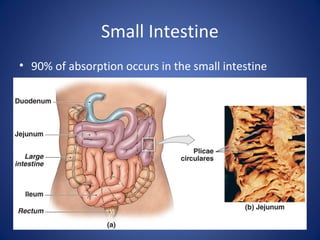
Small Intestine
• 90% of absorption occurs in the small intestine
Small Intestine
• The Duodenum
– The segment of small intestine closest to stomach
– 25 cm (10 in.) long
– Lining of intestine walls has finger-like projections called villi, to increase
surface area.
– “Mixing bowl” that receives chyme from stomach and digestive
secretions from pancreas and liver
– Functions of the duodenum
• To receive chyme from stomach
• To neutralize acids before they can damage the absorptive surfaces
of the small intestine
Small Intestine
• The Jejunum
– Is the middle segment of small intestine
– 2.5 meters (8.2 ft) long
– Is the location of most
• Chemical digestion
• Nutrient absorption
– Has few plicae circulares
– Small villi
Small Intestine
• The Ileum
– The final segment of small intestine
– 3.5 meters (11.48 ft) long
– Ends at the ileocecal valve, a sphincter that
controls flow of material from the ileum into the
large intestine
Small Intestine
Large Intestine
• Is horseshoe shaped
• Extends from end of ileum to anus
• Lies inferior to stomach and liver
• Frames the small intestine
• Also called large bowel
• Is about 1.5 meters (4.9 ft) long and 7.5 cm (3 in.)
wide
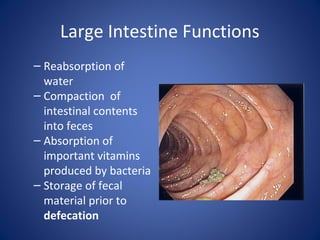
Large Intestine Functions
– Reabsorption of
water
– Compaction of
intestinal contents
into feces
– Absorption of
important vitamins
produced by bacteria
– Storage of fecal
material prior to
defecation
Parts of Large Intestine
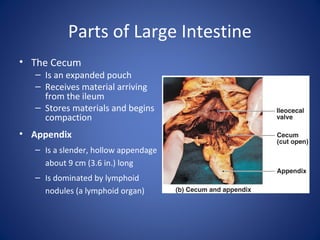
• The Cecum
– Is an expanded pouch
– Receives material arriving
from the ileum
– Stores materials and begins
compaction
• Appendix
– Is a slender, hollow appendage
about 9 cm (3.6 in.) long
– Is dominated by lymphoid
nodules (a lymphoid organ)
Parts of Large Intestine
• The Colon
– Has a larger diameter and thinner wall than small
intestine
– The wall of the colon
• Forms a series of pouches (haustra)
– Haustra permit expansion and elongation of colon
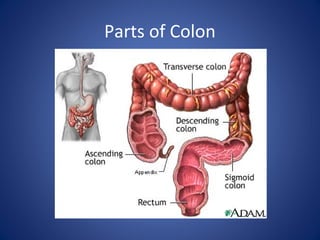
Parts of Colon
• Ascending Colon
• Transverse Colon
Parts of Colon
Physiology of the Large Intestine
• Absorption in the Large Intestine
– Reabsorption of water
– Reabsorption of bile salts
• In the cecum
• Transported in blood to liver
– Absorption of vitamins produced by bacteria
– Absorption of organic wastes
Physiology of the Large Intestine
Three Vitamins Produced in the Large Intestine
1. Vitamin K (fat soluble):
• Required by liver for synthesizing four clotting factors, including
prothrombin
2. Biotin (water soluble):
• Important in glucose metabolism
3. Pantothenic acid: B5(water soluble):
• Required in manufacture of steroid hormones and some
neurotransmitters
Physiology of the Large Intestine
• Organic Wastes
– Bacteria convert bilirubin to urobilinogens and
stercobilinogens
– Bacteria break down peptides in feces and generate
• Ammonia, Indole & skatole, hydrogen sulfide
– Bacteria feed on indigestible carbohydrates (complex
polysaccharides)
• Produce flatus, or intestinal gas, in large intestine
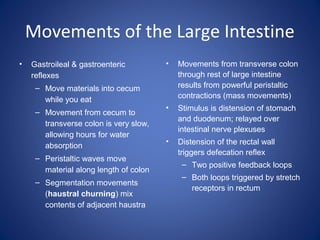
Movements of the Large Intestine
• Gastroileal & gastroenteric
reflexes
– Move materials into cecum
while you eat
– Movement from cecum to
transverse colon is very slow,
allowing hours for water
absorption
– Peristaltic waves move
material along length of colon
– Segmentation movements
(haustral churning) mix
contents of adjacent haustra
• Movements from transverse colon
through rest of large intestine
results from powerful peristaltic
contractions (mass movements)
• Stimulus is distension of stomach
and duodenum; relayed over
intestinal nerve plexuses
• Distension of the rectal wall
triggers defecation reflex
– Two positive feedback loops
– Both loops triggered by stretch
receptors in rectum
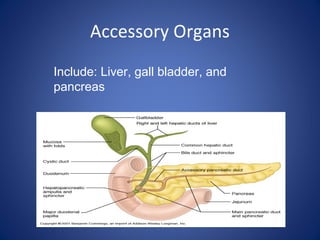
Accessory Organs
Include: Liver, gall bladder, and
pancreas
Lies posterior to stomach from duodenum
toward spleen
Is bound to posterior wall of abdominal cavity
Is wrapped in thin, connective tissue capsule
Functions of the Pancreas
1.Endocrine cells of the pancreatic islets:
Secrete insulin and glucagon into
bloodstream
2.Exocrine cells:
secrete pancreatic juice
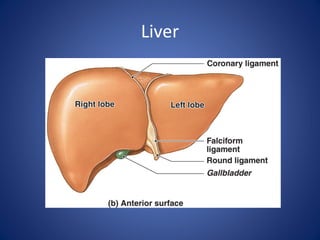
Liver
Liver Function
The Physiology of the Liver
1. Metabolic regulation
2. Hematological Regulation
3. Bile production
Liver Function
• Metabolic Regulation
– The liver regulates:
1. Composition of circulating blood
2. Nutrient metabolism (carbohydrate, lipid & amino
acid)
3. Waste product removal
4. Vitamin Storage (A, D, E & K)
5. Nutrient storage (iron)
6. Drug inactivation
Liver Function
• Composition of Circulating Blood
– All blood leaving absorptive surfaces of digestive tract
• Enters hepatic portal system
• Flows into the liver
– Liver cells extract nutrients or toxins from blood
• Before they reach systemic circulation through hepatic veins
– Liver removes and stores excess nutrients
• Corrects nutrient deficiencies by mobilizing stored reserves or
performing synthetic activities
Liver Function
• Hematological Regulation
– Largest blood reservoir in the body
• Receives 25% of cardiac output
• Functions of Hematological Regulation
1. Phagocytosis and antigen presentation
2. Synthesis of plasma proteins
3. Removal of circulating hormones
4. Removal of antibodies
5. Removal or storage of toxins
6. Synthesis and secretion of bile
Liver Function
• The Functions of Bile
– Dietary lipids are not water soluble
– Mechanical processing in stomach creates large drops
containing lipids
– Pancreatic lipase is not lipid soluble
• Interacts only at surface of lipid droplet
– Bile salts break droplets apart (emulsification)
• Increases surface area exposed to enzymatic attack
• Creates tiny emulsion droplets coated with bile salts
Gallbladder
• Is a pear-shaped, muscular sac
• Stores and concentrates bile prior to excretion
into small intestine
• Is located on the posterior surface of the
liver’s right lobe
• The Cystic Duct
– Extends from gallbladder
Gallbladder
• Functions of the Gallbladder
– Stores bile
– Releases bile into duodenum, but only under stimulation
of hormone cholecystokinin (CCK)
Coordination of Secretion &
Absorption
Coordination of Secretion &
Absorption
• Intestinal Absorption
– It takes about 5 hours for materials
to pass from duodenum to end of ileum
– Movements of the mucosa increases absorptive
effectiveness
• Stir and mix intestinal contents
• Constantly change environment around epithelial cells
Digestion
• Digestive system handles each nutrient
differently
– Large organic molecules
• Must be digested before absorption can occur
– Water, electrolytes, and vitamins
• Can be absorbed without processing
• May require special transport
Digestion
• Digestive Enzymes
– Break molecular bonds in large organic molecules
• Carbohydrates, proteins, lipids, and nucleic acids
• In a process called hydrolysis
– Are divided into classes by targets
• Carbohydrases break bonds between simple sugars
• Proteases break bonds between amino acids
• Lipases separate fatty acids from glycerides
Digestion
• Water Absorption
– Cells cannot actively absorb or
secrete water
– All movement of water across
lining of digestive tract
• Involves passive water flow down
osmotic gradients
REVISION
•HOW LONG ARE YOUR INTESTINES?
At least 25 feet in an adult. Be glad you're
not a full-grown horse -- their coiled-up
intestines are 89 feet long!
• Food drying up and hanging out in the
large intestine can last 18 hours to 2 days!
• In your lifetime, your digestive system
may handle about 50 tons!!
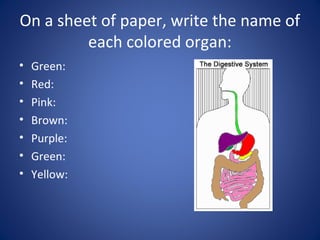
On a sheet of paper, write the name of
each colored organ:
• Green:
• Red:
• Pink:
• Brown:
• Purple:
• Green:
• Yellow:
How’d you do?
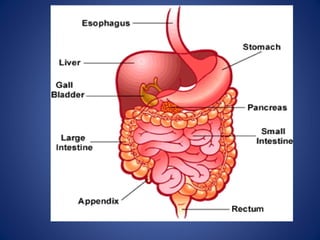
• Green: Esophagus
• Red: Stomach
• Pink: Small Intestine
• Brown: Large Intestine
• Purple: Liver
• Green: Gall Bladder
• Yellow: Pancreas
Great Job!
Bs ed,gen sc,human digestive system.unit 13

Bs ed,gen sc,human digestive system.unit 13

  • 1.
    Digestive System Human Anatomy& Physiology Ms RAKHSHANDA HASHMI BS Ed,Department of Education
  • 2.
    Digestive System The humandigestive system is a complex series of organs and glands that processes food. In order to use the food we eat, our body has to break the food down into smaller molecules that it can process; it also has to excrete waste
  • 4.
    Digestive System Function •Acquires nutrients from environment • Anabolism – Uses raw materials to synthesize essential compounds • Catabolism – Decomposes substances to provide energy cells need to function
  • 5.
    Actions of Digestive(GI) Tract • Ingestion – Occurs when material enters via the mouth • Mechanical ProcessingPhysical Process • Chew,Tear,Grind,Mash Mix, Crushing / Shearing – makes material easier to move through the tract Digestion – Chemical breakdown of food into small organic compounds for absorption • Secretion – Release of water ,acids, enzymes & salts by epithelium of GI tract and glandular organs • Absorption – Movement of organic substrates, electrolytes, vitamins & water Excretion – Removal of waste products from body fluids
  • 8.
    The Digestive Process Thestart of the process - the mouth: The digestive process begins in the mouth. Food is partly broken down by the process of chewing and by the chemical action of salivary enzymes (these enzymes are produced by the salivary glands and break down starches into smaller molecules).
  • 9.
    Functions of OralCavity • Sensory analysis – Of material before swallowing • Mechanical processing – Through actions of teeth, tongue, and palatal surfaces • Lubrication – Mixing with mucus and salivary gland secretions • Limited digestion – Of carbohydrates and lipids
  • 10.
    EPIGLOTTIS Epiglottis is aflap-like structure at the back of the throat that closes over the trachea preventing food from entering it.
  • 11.
    Esophagus • A hollowmuscular tube • About 25 cm (10 in.) long and 2 cm (0.80 in.) wide • Functions include: 1. Secrete mucus 2. Moves food from the throat to the stomach using muscle movement called peristalsis • If acid from the stomach gets in here that’s heartburn.
  • 12.
  • 13.
    STOMACH J-shaped muscular bagthat stores the food you eat, breaks it down into tiny pieces. Mixes food with digestive juices that contain enzymes to break down proteins and lipids. Acid in the stomach kills bacteria. Food found in the stomach is called chyme
  • 14.
    Stomach Function • MajorFunctions of the Stomach – Storage of ingested food – Mechanical breakdown of ingested food – Disruption of chemical bonds in food material by acid and enzymes
  • 15.
    Digestion in theStomach • Stomach performs preliminary digestion of proteins by pepsin – Some digestion of carbohydrates – Lipids • Stomach contents – Become more fluid – pH approaches 2.0 – Pepsin activity increases – Protein disassembly begins • Although digestion occurs in the stomach, nutrients are not absorbed there
  • 16.
    Small Intestine • 90%of absorption occurs in the small intestine
  • 17.
    Small Intestine • TheDuodenum – The segment of small intestine closest to stomach – 25 cm (10 in.) long – Lining of intestine walls has finger-like projections called villi, to increase surface area. – “Mixing bowl” that receives chyme from stomach and digestive secretions from pancreas and liver – Functions of the duodenum • To receive chyme from stomach • To neutralize acids before they can damage the absorptive surfaces of the small intestine
  • 18.
    Small Intestine • TheJejunum – Is the middle segment of small intestine – 2.5 meters (8.2 ft) long – Is the location of most • Chemical digestion • Nutrient absorption – Has few plicae circulares – Small villi
  • 19.
    Small Intestine • TheIleum – The final segment of small intestine – 3.5 meters (11.48 ft) long – Ends at the ileocecal valve, a sphincter that controls flow of material from the ileum into the large intestine
  • 20.
  • 21.
    Large Intestine • Ishorseshoe shaped • Extends from end of ileum to anus • Lies inferior to stomach and liver • Frames the small intestine • Also called large bowel • Is about 1.5 meters (4.9 ft) long and 7.5 cm (3 in.) wide
  • 22.
    Large Intestine Functions –Reabsorption of water – Compaction of intestinal contents into feces – Absorption of important vitamins produced by bacteria – Storage of fecal material prior to defecation
  • 23.
    Parts of LargeIntestine • The Cecum – Is an expanded pouch – Receives material arriving from the ileum – Stores materials and begins compaction • Appendix – Is a slender, hollow appendage about 9 cm (3.6 in.) long – Is dominated by lymphoid nodules (a lymphoid organ)
  • 24.
    Parts of LargeIntestine • The Colon – Has a larger diameter and thinner wall than small intestine – The wall of the colon • Forms a series of pouches (haustra) – Haustra permit expansion and elongation of colon
  • 25.
    Parts of Colon •Ascending Colon • Transverse Colon
  • 26.
  • 27.
    Physiology of theLarge Intestine • Absorption in the Large Intestine – Reabsorption of water – Reabsorption of bile salts • In the cecum • Transported in blood to liver – Absorption of vitamins produced by bacteria – Absorption of organic wastes
  • 28.
    Physiology of theLarge Intestine Three Vitamins Produced in the Large Intestine 1. Vitamin K (fat soluble): • Required by liver for synthesizing four clotting factors, including prothrombin 2. Biotin (water soluble): • Important in glucose metabolism 3. Pantothenic acid: B5(water soluble): • Required in manufacture of steroid hormones and some neurotransmitters
  • 29.
    Physiology of theLarge Intestine • Organic Wastes – Bacteria convert bilirubin to urobilinogens and stercobilinogens – Bacteria break down peptides in feces and generate • Ammonia, Indole & skatole, hydrogen sulfide – Bacteria feed on indigestible carbohydrates (complex polysaccharides) • Produce flatus, or intestinal gas, in large intestine
  • 30.
    Movements of theLarge Intestine • Gastroileal & gastroenteric reflexes – Move materials into cecum while you eat – Movement from cecum to transverse colon is very slow, allowing hours for water absorption – Peristaltic waves move material along length of colon – Segmentation movements (haustral churning) mix contents of adjacent haustra • Movements from transverse colon through rest of large intestine results from powerful peristaltic contractions (mass movements) • Stimulus is distension of stomach and duodenum; relayed over intestinal nerve plexuses • Distension of the rectal wall triggers defecation reflex – Two positive feedback loops – Both loops triggered by stretch receptors in rectum
  • 31.
    Accessory Organs Include: Liver,gall bladder, and pancreas
  • 32.
    Lies posterior tostomach from duodenum toward spleen Is bound to posterior wall of abdominal cavity Is wrapped in thin, connective tissue capsule Functions of the Pancreas 1.Endocrine cells of the pancreatic islets: Secrete insulin and glucagon into bloodstream 2.Exocrine cells: secrete pancreatic juice
  • 33.
  • 34.
    Liver Function The Physiologyof the Liver 1. Metabolic regulation 2. Hematological Regulation 3. Bile production
  • 35.
    Liver Function • MetabolicRegulation – The liver regulates: 1. Composition of circulating blood 2. Nutrient metabolism (carbohydrate, lipid & amino acid) 3. Waste product removal 4. Vitamin Storage (A, D, E & K) 5. Nutrient storage (iron) 6. Drug inactivation
  • 36.
    Liver Function • Compositionof Circulating Blood – All blood leaving absorptive surfaces of digestive tract • Enters hepatic portal system • Flows into the liver – Liver cells extract nutrients or toxins from blood • Before they reach systemic circulation through hepatic veins – Liver removes and stores excess nutrients • Corrects nutrient deficiencies by mobilizing stored reserves or performing synthetic activities
  • 37.
    Liver Function • HematologicalRegulation – Largest blood reservoir in the body • Receives 25% of cardiac output • Functions of Hematological Regulation 1. Phagocytosis and antigen presentation 2. Synthesis of plasma proteins 3. Removal of circulating hormones 4. Removal of antibodies 5. Removal or storage of toxins 6. Synthesis and secretion of bile
  • 38.
    Liver Function • TheFunctions of Bile – Dietary lipids are not water soluble – Mechanical processing in stomach creates large drops containing lipids – Pancreatic lipase is not lipid soluble • Interacts only at surface of lipid droplet – Bile salts break droplets apart (emulsification) • Increases surface area exposed to enzymatic attack • Creates tiny emulsion droplets coated with bile salts
  • 39.
    Gallbladder • Is apear-shaped, muscular sac • Stores and concentrates bile prior to excretion into small intestine • Is located on the posterior surface of the liver’s right lobe • The Cystic Duct – Extends from gallbladder
  • 40.
    Gallbladder • Functions ofthe Gallbladder – Stores bile – Releases bile into duodenum, but only under stimulation of hormone cholecystokinin (CCK)
  • 41.
  • 42.
    Coordination of Secretion& Absorption • Intestinal Absorption – It takes about 5 hours for materials to pass from duodenum to end of ileum – Movements of the mucosa increases absorptive effectiveness • Stir and mix intestinal contents • Constantly change environment around epithelial cells
  • 43.
    Digestion • Digestive systemhandles each nutrient differently – Large organic molecules • Must be digested before absorption can occur – Water, electrolytes, and vitamins • Can be absorbed without processing • May require special transport
  • 44.
    Digestion • Digestive Enzymes –Break molecular bonds in large organic molecules • Carbohydrates, proteins, lipids, and nucleic acids • In a process called hydrolysis – Are divided into classes by targets • Carbohydrases break bonds between simple sugars • Proteases break bonds between amino acids • Lipases separate fatty acids from glycerides
  • 45.
    Digestion • Water Absorption –Cells cannot actively absorb or secrete water – All movement of water across lining of digestive tract • Involves passive water flow down osmotic gradients
  • 46.
    REVISION •HOW LONG AREYOUR INTESTINES? At least 25 feet in an adult. Be glad you're not a full-grown horse -- their coiled-up intestines are 89 feet long! • Food drying up and hanging out in the large intestine can last 18 hours to 2 days! • In your lifetime, your digestive system may handle about 50 tons!!
  • 48.
    On a sheetof paper, write the name of each colored organ: • Green: • Red: • Pink: • Brown: • Purple: • Green: • Yellow:
  • 49.
    How’d you do? •Green: Esophagus • Red: Stomach • Pink: Small Intestine • Brown: Large Intestine • Purple: Liver • Green: Gall Bladder • Yellow: Pancreas Great Job!

Editor's Notes

  • #5 Catabolic Reactions Require two essential ingredients: Oxygen Organic molecules broken down by intracellular enzymes: e.g., carbohydrates, fats, and proteins
  • #10 Salivary Glands Three pairs secrete into oral cavity Each pair has distinctive cellular organization And produces saliva with different properties Salivary Glands Produce 1.0–1.5 liters of saliva each day Saliva 99.4% water 0.6% includes Electrolytes (Na+, Cl-, and HCO3-) Buffers Glycoproteins (mucins) Antibodies Enzymes Waste products Muscles of Mastication Close the jaws Slide or rock lower jaw from side to side Chewing involves mandibular Elevation and depression Protraction and retraction Medial and lateral movement
  • #12 Swallowing Also called deglutition Can be initiated voluntarily Proceeds automatically Is divided into three phases Buccal phase Pharyngeal phase Esophageal phase
  • #13 Peristaltic Motion Circular muscles contract behind bolus: While circular muscles ahead of bolus relax Longitudinal muscles ahead of bolus contract: Shortening adjacent segments Wave of contraction in circular muscles: Forces bolus forward
  • #21 Brush Border Enzymes Integral membrane proteins On surfaces of intestinal microvilli Break down materials in contact with brush border Intestinal Glands Enteropeptidase A brush border enzyme Activates pancreatic proenzyme trypsinogen Enteroendocrine cells Produce intestinal hormones such as gastrin, cholecystokinin, and secretin Duodenal Glands Also called submucosal glands or Brunner glands Produce copious quantities of mucus When chyme arrives from stomach
  • #22 Functions of the Large Intestine Reabsorption of water Compaction of intestinal contents into feces Absorption of important vitamins produced by bacteria Storage of fecal material prior to defecation
  • #28 Physiology of the Large Intestine Less than 10% of nutrient absorption occurs in large intestine Prepares fecal material for ejection from the body
  • #29 Vitamins Are organic molecules Important as cofactors or coenzymes in metabolism Normal bacteria in colon make three vitamins that supplement diet
  • #30 Vitamins Are organic molecules Important as cofactors or coenzymes in metabolism Normal bacteria in colon make three vitamins that supplement diet
  • #34 Is the largest visceral organ (1.5 kg; 3.3 lb) Lies in right hypochondriac and epigastric regions Extends to left hypochondriac and umbilical regions Performs essential metabolic and synthetic functions Anatomy of the Liver Is wrapped in tough fibrous capsule Is covered by visceral peritoneum Is divided into lobes
  • #36 Metabolic Activities of the Liver Carbohydrate metabolism Lipid metabolism Amino acid metabolism Waste product removal Vitamin storage Mineral storage Drug inactivation
  • #38 Removes damaged / old red blood cells Plasma proteins: albumin – contrbutes to osmotic concentration Reabsorped Epinephrine, norepinephrine, insulin, thyroid & steroid hormones Removes antibodies and converts to amino acids Traps some lipid-soluble toxins (DDT) or breaks down and removes from blood Bile production
  • #41 Physiology of the Gallbladder Full gallbladder contains 40–70 mL bile Bile composition gradually changes in gallbladder Water is absorbed Bile salts and solutes become concentrated
  • #42 Secretin Is released when chyme arrives in duodenum Increases secretion of bile and buffers by liver and pancreas Cholecystokinin (CCK) Is secreted in duodenum When chyme contains lipids and partially digested proteins Accelerates pancreatic production and secretion of digestive enzymes Relaxes hepatopancreatic sphincter and gallbladder Ejecting bile and pancreatic juice into duodenum Gastric Inhibitory Peptide (GIP) Is secreted when fats and carbohydrates enter small intestine Vasoactive Intestinal Peptide (VIP) Stimulates secretion of intestinal glands Dilates regional capillaries Inhibits acid production in stomach Gastrin Is secreted by G cells in duodenum When exposed to incompletely digested proteins Promotes increased stomach motility Stimulates acids and enzyme production Enterocrinin Is released when chyme enters small intestine Stimulates mucin production by submucosal glands of duodenum
  • #43 Secretin Is released when chyme arrives in duodenum Increases secretion of bile and buffers by liver and pancreas Cholecystokinin (CCK) Is secreted in duodenum When chyme contains lipids and partially digested proteins Accelerates pancreatic production and secretion of digestive enzymes Relaxes hepatopancreatic sphincter and gallbladder Ejecting bile and pancreatic juice into duodenum Gastric Inhibitory Peptide (GIP) Is secreted when fats and carbohydrates enter small intestine Vasoactive Intestinal Peptide (VIP) Stimulates secretion of intestinal glands Dilates regional capillaries Inhibits acid production in stomach Gastrin Is secreted by G cells in duodenum When exposed to incompletely digested proteins Promotes increased stomach motility Stimulates acids and enzyme production Enterocrinin Is released when chyme enters small intestine Stimulates mucin production by submucosal glands of duodenum
  • #44 The Processing and Absorption of Nutrients Breaks down physical structure of food Disassembles component molecules Molecules released into bloodstream are Absorbed by cells Broken down to provide energy for ATP synthesis Or used to synthesize carbohydrates, proteins, and lipids
  • #45 Digestive Enzymes Are secreted by Salivary glands Tongue Stomach Pancreas Digestive Enzymes Brush border enzymes break nucleotides into Sugars Phosphates Nitrogenous bases