THE SCIENTIFIC METHOD
Copyright © The McGraw-Hill Companies, Inc. Permission required for reproduction or display.1-
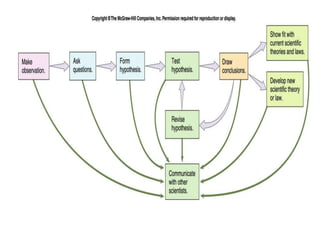
The Scientific Method: Observation
• An observation is a thoughtful and careful
recognition of an event or a fact.
• The careful observation of a phenomenon
leads to a question.
– How does this happen?
– What causes it to occur?
Copyright © The McGraw-Hill Companies, Inc. Permission required for reproduction or display.1-
The Scientific Method:
The Hypothesis
• Hypothesizing
– question an observation
– propose possible solutions to questions based on
what is already understood about the phenomenon
• Hypotheses must:
– be logical
– account for all current information
– make the least possible assumptions
– be testable
Copyright © The McGraw-Hill Companies, Inc. Permission required for reproduction or display.1-
Testing Hypotheses
• Hypotheses need to be tested to see if they are
supported or disproved.
– Disproved hypotheses are rejected
– Hypotheses can be supported but not proven
• Ways to test a hypothesis:
– Gathering relevant historical information
• Retrospective Studies
– Make additional observations from the natural world
– Experimentation
Copyright © The McGraw-Hill Companies, Inc. Permission required for reproduction or display.1-
The Scientific Method:
Experimentation
• Experiments
– rigorous tests to determine if the solutions are
supported
• Experiments attempt to recreation an occurrence
– tests whether or not the hypothesis can be supported
or rejected
• There are many types of experiments
– laboratory, clinical trials, surveys, statistical analyses
Copyright © The McGraw-Hill Companies, Inc. Permission required for reproduction or display.1-
Experimental Design
• Experiments must:
– use large numbers of subjects and/or must be
repeated several times (replication)
– be independently reproducible
• The validity of experimental results must:
– be tested statistically
• chi-squared test for statistical significance
– be scrutinized by other scientists
• peer reviewed
Copyright © The McGraw-Hill Companies, Inc. Permission required for reproduction or display.1-
Experimental Design
• Experiments must:
– use large numbers of subjects and/or must be
repeated several times (replication)
– be independently reproducible
• The validity of experimental results must:
– be tested statistically
• chi-squared test for statistical significance
– be scrutinized by other scientists
• peer reviewed
Copyright © The McGraw-Hill Companies, Inc. Permission required for reproduction or display.1-
Theory
• If the hypothesis is supported by ample experimental data, it
leads to a theory.
• A theory may be defined as a widely accepted, plausible general
statement about a fundamental concept in science.
– The germ theory states that infectious diseases are caused by
microorganisms.
• Many diseases are not caused by microorganisms, so
we must be careful not to generalize theories too
broadly.
– Theories continue to be tested
• Exceptions identified
• Modifications made
Copyright © The McGraw-Hill Companies, Inc. Permission required for reproduction or display.1-
A Scientific Law
• A scientific law is a uniform and constant fact of nature that
describes what happens in nature.
– An example: All living things come from pre-existing living things.
• Scientific laws promote the process of generalization.
– Inductive reasoning
– Since every bird that has been studied lays eggs, we can generalize that all
birds lay eggs.
• Once a theory becomes established, it can be used to predict
specific facts.
– Deductive reasoning
– We can predict that a newly discovered bird species will lay eggs.
Copyright © The McGraw-Hill Companies, Inc. Permission required for reproduction or display.1-
Scientific Communication
• Data is shared with the scientific
community through research
articles published in scientific
journals.
– peer review
• Scientists present preliminary data
at conferences.
• Scientists collaborate directly by
phone and
e-mail.

Bs ed,gen sc the scientific method

  • 1.
  • 3.
    Copyright © TheMcGraw-Hill Companies, Inc. Permission required for reproduction or display.1- The Scientific Method: Observation • An observation is a thoughtful and careful recognition of an event or a fact. • The careful observation of a phenomenon leads to a question. – How does this happen? – What causes it to occur?
  • 4.
    Copyright © TheMcGraw-Hill Companies, Inc. Permission required for reproduction or display.1- The Scientific Method: The Hypothesis • Hypothesizing – question an observation – propose possible solutions to questions based on what is already understood about the phenomenon • Hypotheses must: – be logical – account for all current information – make the least possible assumptions – be testable
  • 5.
    Copyright © TheMcGraw-Hill Companies, Inc. Permission required for reproduction or display.1- Testing Hypotheses • Hypotheses need to be tested to see if they are supported or disproved. – Disproved hypotheses are rejected – Hypotheses can be supported but not proven • Ways to test a hypothesis: – Gathering relevant historical information • Retrospective Studies – Make additional observations from the natural world – Experimentation
  • 6.
    Copyright © TheMcGraw-Hill Companies, Inc. Permission required for reproduction or display.1- The Scientific Method: Experimentation • Experiments – rigorous tests to determine if the solutions are supported • Experiments attempt to recreation an occurrence – tests whether or not the hypothesis can be supported or rejected • There are many types of experiments – laboratory, clinical trials, surveys, statistical analyses
  • 7.
    Copyright © TheMcGraw-Hill Companies, Inc. Permission required for reproduction or display.1- Experimental Design • Experiments must: – use large numbers of subjects and/or must be repeated several times (replication) – be independently reproducible • The validity of experimental results must: – be tested statistically • chi-squared test for statistical significance – be scrutinized by other scientists • peer reviewed
  • 8.
    Copyright © TheMcGraw-Hill Companies, Inc. Permission required for reproduction or display.1- Experimental Design • Experiments must: – use large numbers of subjects and/or must be repeated several times (replication) – be independently reproducible • The validity of experimental results must: – be tested statistically • chi-squared test for statistical significance – be scrutinized by other scientists • peer reviewed
  • 9.
    Copyright © TheMcGraw-Hill Companies, Inc. Permission required for reproduction or display.1- Theory • If the hypothesis is supported by ample experimental data, it leads to a theory. • A theory may be defined as a widely accepted, plausible general statement about a fundamental concept in science. – The germ theory states that infectious diseases are caused by microorganisms. • Many diseases are not caused by microorganisms, so we must be careful not to generalize theories too broadly. – Theories continue to be tested • Exceptions identified • Modifications made
  • 10.
    Copyright © TheMcGraw-Hill Companies, Inc. Permission required for reproduction or display.1- A Scientific Law • A scientific law is a uniform and constant fact of nature that describes what happens in nature. – An example: All living things come from pre-existing living things. • Scientific laws promote the process of generalization. – Inductive reasoning – Since every bird that has been studied lays eggs, we can generalize that all birds lay eggs. • Once a theory becomes established, it can be used to predict specific facts. – Deductive reasoning – We can predict that a newly discovered bird species will lay eggs.
  • 11.
    Copyright © TheMcGraw-Hill Companies, Inc. Permission required for reproduction or display.1- Scientific Communication • Data is shared with the scientific community through research articles published in scientific journals. – peer review • Scientists present preliminary data at conferences. • Scientists collaborate directly by phone and e-mail.