DIGESTIVE SYSTEMDIGESTIVE SYSTEM
MOHAMMED AMIRMOHAMMED AMIR
CONTENTS
 Digestive system
 Actions of Digestive (GI) Tract
 Digestive system Organs
 Oral cavity
 Esophagus
 Stomach
 Small Intestine
 Pancreas
 Liver
 Gallbladder
 Large Intestine
 Conclusion
 References
INTRODUCTION
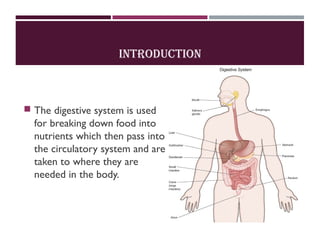
 The digestive system is used
for breaking down food into
nutrients which then pass into
the circulatory system and are
taken to where they are
needed in the body.
DIGESTIVE SYSTEM FUNCTION
 Acquires nutrients from environment
 Anabolism
 Uses raw materials to synthesize essential compounds
 Catabolism
 Decomposes substances to provide energy cells need to
function
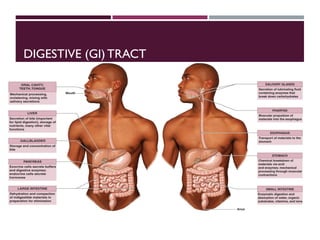
DIGESTIVE (GI) TRACT
ACTIONS OF DIGESTIVE (GI) TRACT
 Ingestion
 Occurs when material enters
via the mouth
 Mechanical Processing
 Crushing / Shearing – makes
material easier to move
through the tract
 Digestion
 Chemical breakdown of food
into small organic compounds
for absorption
 Secretion
 Release of water acids,
buffers, enzymes & salts by
epithelium of GI tract and
glandular organs
 Absorption
 Movement of organic
substrates, electrolytes,
vitamins & water across
digestive epithelium
 Excretion
 Removal of waste products
from body fluids
ORAL CAVITY
 Sensory analysis
 Of material before swallowing
 Mechanical processing
 Through actions of teeth, tongue,
and palatal surfaces
 Lubrication
 Mixing with mucus and salivary gland
secretions
 Limited digestion
 Of carbohydrates and lipids
ESOPHAGUS
 A hollow muscular tube
 About 25 cm (10 in.) long and
2 cm (0.80 in.) wide
 Conveys solid food and
liquids to the stomach
 Begins posterior to cricoid
cartilage
 Is innervated by fibers from
the esophageal plexus
STOMACH
 Major Functions of the Stomach
 Storage of ingested food
 Mechanical breakdown of ingested food
 Disruption of chemical bonds in food material by acid and
enzymes
 Production of intrinsic factor, a glycoprotein required for
absorption of vitamin B12 in small intestine
GASTRIC ANATOMY
DIGESTION IN THE STOMACH
• Stomach performs preliminary digestion of proteins by
pepsin
– Some digestion of carbohydrates (by salivary amylase)
– Lipids (by lingual lipase)
• Stomach contents
– Become more fluid
– pH approaches 2.0
– Pepsin activity increases
– Protein disassembly begins
• Although digestion occurs in the stomach, nutrients are
not absorbed there
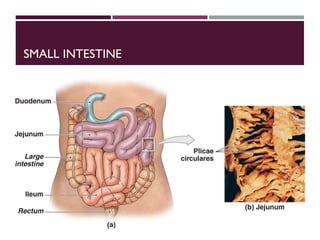
SMALL INTESTINE
 90% of absorption occurs in the small intestine
SMALL INTESTINE
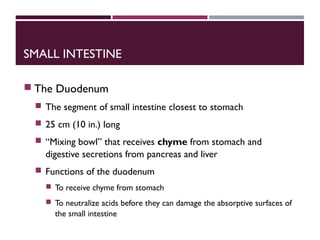
 The Duodenum
 The segment of small intestine closest to stomach
 25 cm (10 in.) long
 “Mixing bowl” that receives chyme from stomach and
digestive secretions from pancreas and liver
 Functions of the duodenum
 To receive chyme from stomach
 To neutralize acids before they can damage the absorptive surfaces of
the small intestine
SMALL INTESTINE
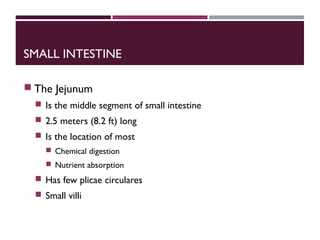
 The Jejunum
 Is the middle segment of small intestine
 2.5 meters (8.2 ft) long
 Is the location of most
 Chemical digestion
 Nutrient absorption
 Has few plicae circulares
 Small villi
SMALL INTESTINE
 The Ileum
 The final segment of small intestine
 3.5 meters (11.48 ft) long
 Ends at the ileocecal valve, a sphincter that controls flow of
material from the ileum into the large intestine
SMALL INTESTINE
SMALL INTESTINE
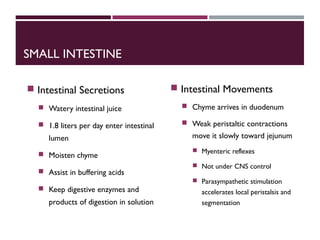
 Intestinal Secretions
 Watery intestinal juice
 1.8 liters per day enter intestinal
lumen
 Moisten chyme
 Assist in buffering acids
 Keep digestive enzymes and
products of digestion in solution
 Intestinal Movements
 Chyme arrives in duodenum
 Weak peristaltic contractions
move it slowly toward jejunum
 Myenteric reflexes
 Not under CNS control
 Parasympathetic stimulation
accelerates local peristalsis and
segmentation
PANCREAS
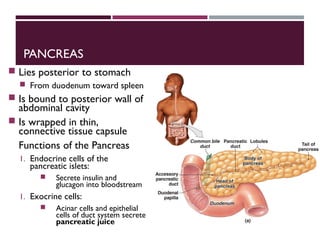
 Lies posterior to stomach
 From duodenum toward spleen
 Is bound to posterior wall of
abdominal cavity
 Is wrapped in thin,
connective tissue capsule
Functions of the Pancreas
1. Endocrine cells of the
pancreatic islets:
 Secrete insulin and
glucagon into bloodstream
1. Exocrine cells:
 Acinar cells and epithelial
cells of duct system secrete
pancreatic juice
PANCREAS
 Pancreatic Enzymes
 Pancreatic alpha-amylase
 A carbohydrase
 Breaks down starches
 Similar to salivary amylase
 Pancreatic lipase
 Breaks down complex lipids
 Releases products (e.g., fatty acids)
that are easily absorbed
 Pancreatic Enzymes
 Nucleases
 Break down nucleic acids
 Proteolytic enzymes
 Break certain proteins apart
 Proteases break large protein
complexes
 Peptidases break small peptides
into amino acids
 70% of all pancreatic enzyme
production
 Secreted as inactive proenzymes
 Activated after reaching small
intestine
LIVER
LIVER
 Hepatocytes
 Are liver cells
 Adjust circulating levels of nutrients
 Through selective absorption and secretion
 In a liver lobule form a series of irregular plates arranged like wheel
spokes
 Many Kupffer cells (stellate reticuloendothelial cells) are located in
sinusoidal lining
 As blood flows through sinusoids
 Hepatocytes absorb solutes from plasma
 And secrete materials such as plasma proteins
PALPATION OF LIVER
 Normal Findings:
1. Place left hand under person’s
back parallel to 11th
& 12th
ribs
and lift up to support
abdominal contents.
2. Place deeply down & under
right costal margin.
3. Ask person to take a deep
breath.
4. Normal to feel edge of liver
bump fingertips as diaphragm
pushes it down during
inhalation. Feels like firm regular
ridge. May not be palpable, may
feel nothing.
 Abnormal Findings:
1. Except for depressed diaphra, l
liver palpated more than 1-2 cm
below right costal margin is
enlarged.
2. Record number in cm it descends
& note consistency (hard,
nodular), and tenderness.
LIVER FUNCTION
The Physiology of the Liver
1. Metabolic regulation
2. Hematological regulation
3. Bile production
GALLBLADDER
 Is a pear-shaped, muscular sac
 Stores and concentrates bile
prior to excretion into small
intestine
 Is located in the fossa on the
posterior surface of the liver’s
right lobe
 The Cystic Duct
 Extends from gallbladder
 Union with common hepatic
duct forms common bile duct
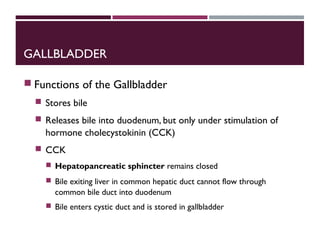
GALLBLADDER
 Functions of the Gallbladder
 Stores bile
 Releases bile into duodenum, but only under stimulation of
hormone cholecystokinin (CCK)
 CCK
 Hepatopancreatic sphincter remains closed
 Bile exiting liver in common hepatic duct cannot flow through
common bile duct into duodenum
 Bile enters cystic duct and is stored in gallbladder
COORDINATION OF SECRETION & ABSORPTION
LARGE INTESTINE
 Is horseshoe shaped
 Extends from end of ileum to anus
 Lies inferior to stomach and liver
 Frames the small intestine
 Also called large bowel
 Is about 1.5 meters (4.9 ft) long and
7.5 cm (3 in.) wide
LARGE INTESTINE FUNCTIONS
 Reabsorption of water
 Compaction of intestinal contents into feces
 Absorption of important vitamins produced by bacteria
 Storage of fecal material prior to defecation
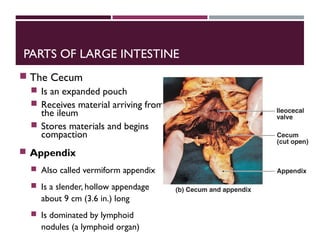
PARTS OF LARGE INTESTINE
 The Cecum
 Is an expanded pouch
 Receives material arriving from
the ileum
 Stores materials and begins
compaction
 Appendix
 Also called vermiform appendix
 Is a slender, hollow appendage
about 9 cm (3.6 in.) long
 Is dominated by lymphoid
nodules (a lymphoid organ)
CONCLUSION
 The digestive system is a group of organs working together to convert food into
energy and basic nutrients to feed the entire body. Food passes through a long
tube inside the body known as the alimentary canal or the gastrointestinal tract
(GI tract).The alimentary canal is made up of the oral cavity, pharynx, esophagus,
stomach, small intestines, and large intestines.
 Accessory organs of the digestive system include the teeth, tongue, salivary
glands, liver, gallbladder, and pancreas.To achieve the goal of providing energy and
nutrients to the body, six major functions take place in the digestive system:
 Ingestion
 Secretion
 Mixing and movement
 Digestion
 Absorption
 Excretion
REFERENCES
 http://www.innerbody.com/image/digeov.html#full-description
 http://www.webmd.com/heartburn-gerd/your-digestive-system
 http://kidshealth.org/teen/your_body/body_basics/digestive_system.html
 http://digestive system for kids.ppt
 http://www.niddk.nih.gov/health-information/health-topics/Anatomy/your-
digestive-system/Pages/anatomy.aspx
THANK YOU !!!THANK YOU !!!

Digestive system

  • 1.
  • 2.
    CONTENTS  Digestive system Actions of Digestive (GI) Tract  Digestive system Organs  Oral cavity  Esophagus  Stomach  Small Intestine  Pancreas  Liver  Gallbladder  Large Intestine  Conclusion  References
  • 3.
    INTRODUCTION  The digestivesystem is used for breaking down food into nutrients which then pass into the circulatory system and are taken to where they are needed in the body.
  • 4.
    DIGESTIVE SYSTEM FUNCTION Acquires nutrients from environment  Anabolism  Uses raw materials to synthesize essential compounds  Catabolism  Decomposes substances to provide energy cells need to function
  • 5.
  • 6.
    ACTIONS OF DIGESTIVE(GI) TRACT  Ingestion  Occurs when material enters via the mouth  Mechanical Processing  Crushing / Shearing – makes material easier to move through the tract  Digestion  Chemical breakdown of food into small organic compounds for absorption  Secretion  Release of water acids, buffers, enzymes & salts by epithelium of GI tract and glandular organs  Absorption  Movement of organic substrates, electrolytes, vitamins & water across digestive epithelium  Excretion  Removal of waste products from body fluids
  • 7.
    ORAL CAVITY  Sensoryanalysis  Of material before swallowing  Mechanical processing  Through actions of teeth, tongue, and palatal surfaces  Lubrication  Mixing with mucus and salivary gland secretions  Limited digestion  Of carbohydrates and lipids
  • 8.
    ESOPHAGUS  A hollowmuscular tube  About 25 cm (10 in.) long and 2 cm (0.80 in.) wide  Conveys solid food and liquids to the stomach  Begins posterior to cricoid cartilage  Is innervated by fibers from the esophageal plexus
  • 9.
    STOMACH  Major Functionsof the Stomach  Storage of ingested food  Mechanical breakdown of ingested food  Disruption of chemical bonds in food material by acid and enzymes  Production of intrinsic factor, a glycoprotein required for absorption of vitamin B12 in small intestine
  • 10.
  • 11.
    DIGESTION IN THESTOMACH • Stomach performs preliminary digestion of proteins by pepsin – Some digestion of carbohydrates (by salivary amylase) – Lipids (by lingual lipase) • Stomach contents – Become more fluid – pH approaches 2.0 – Pepsin activity increases – Protein disassembly begins • Although digestion occurs in the stomach, nutrients are not absorbed there
  • 12.
    SMALL INTESTINE  90%of absorption occurs in the small intestine
  • 13.
    SMALL INTESTINE  TheDuodenum  The segment of small intestine closest to stomach  25 cm (10 in.) long  “Mixing bowl” that receives chyme from stomach and digestive secretions from pancreas and liver  Functions of the duodenum  To receive chyme from stomach  To neutralize acids before they can damage the absorptive surfaces of the small intestine
  • 14.
    SMALL INTESTINE  TheJejunum  Is the middle segment of small intestine  2.5 meters (8.2 ft) long  Is the location of most  Chemical digestion  Nutrient absorption  Has few plicae circulares  Small villi
  • 15.
    SMALL INTESTINE  TheIleum  The final segment of small intestine  3.5 meters (11.48 ft) long  Ends at the ileocecal valve, a sphincter that controls flow of material from the ileum into the large intestine
  • 16.
  • 17.
    SMALL INTESTINE  IntestinalSecretions  Watery intestinal juice  1.8 liters per day enter intestinal lumen  Moisten chyme  Assist in buffering acids  Keep digestive enzymes and products of digestion in solution  Intestinal Movements  Chyme arrives in duodenum  Weak peristaltic contractions move it slowly toward jejunum  Myenteric reflexes  Not under CNS control  Parasympathetic stimulation accelerates local peristalsis and segmentation
  • 18.
    PANCREAS  Lies posteriorto stomach  From duodenum toward spleen  Is bound to posterior wall of abdominal cavity  Is wrapped in thin, connective tissue capsule Functions of the Pancreas 1. Endocrine cells of the pancreatic islets:  Secrete insulin and glucagon into bloodstream 1. Exocrine cells:  Acinar cells and epithelial cells of duct system secrete pancreatic juice
  • 19.
    PANCREAS  Pancreatic Enzymes Pancreatic alpha-amylase  A carbohydrase  Breaks down starches  Similar to salivary amylase  Pancreatic lipase  Breaks down complex lipids  Releases products (e.g., fatty acids) that are easily absorbed  Pancreatic Enzymes  Nucleases  Break down nucleic acids  Proteolytic enzymes  Break certain proteins apart  Proteases break large protein complexes  Peptidases break small peptides into amino acids  70% of all pancreatic enzyme production  Secreted as inactive proenzymes  Activated after reaching small intestine
  • 20.
  • 21.
    LIVER  Hepatocytes  Areliver cells  Adjust circulating levels of nutrients  Through selective absorption and secretion  In a liver lobule form a series of irregular plates arranged like wheel spokes  Many Kupffer cells (stellate reticuloendothelial cells) are located in sinusoidal lining  As blood flows through sinusoids  Hepatocytes absorb solutes from plasma  And secrete materials such as plasma proteins
  • 22.
    PALPATION OF LIVER Normal Findings: 1. Place left hand under person’s back parallel to 11th & 12th ribs and lift up to support abdominal contents. 2. Place deeply down & under right costal margin. 3. Ask person to take a deep breath. 4. Normal to feel edge of liver bump fingertips as diaphragm pushes it down during inhalation. Feels like firm regular ridge. May not be palpable, may feel nothing.  Abnormal Findings: 1. Except for depressed diaphra, l liver palpated more than 1-2 cm below right costal margin is enlarged. 2. Record number in cm it descends & note consistency (hard, nodular), and tenderness.
  • 23.
    LIVER FUNCTION The Physiologyof the Liver 1. Metabolic regulation 2. Hematological regulation 3. Bile production
  • 24.
    GALLBLADDER  Is apear-shaped, muscular sac  Stores and concentrates bile prior to excretion into small intestine  Is located in the fossa on the posterior surface of the liver’s right lobe  The Cystic Duct  Extends from gallbladder  Union with common hepatic duct forms common bile duct
  • 25.
    GALLBLADDER  Functions ofthe Gallbladder  Stores bile  Releases bile into duodenum, but only under stimulation of hormone cholecystokinin (CCK)  CCK  Hepatopancreatic sphincter remains closed  Bile exiting liver in common hepatic duct cannot flow through common bile duct into duodenum  Bile enters cystic duct and is stored in gallbladder
  • 26.
  • 27.
    LARGE INTESTINE  Ishorseshoe shaped  Extends from end of ileum to anus  Lies inferior to stomach and liver  Frames the small intestine  Also called large bowel  Is about 1.5 meters (4.9 ft) long and 7.5 cm (3 in.) wide
  • 28.
    LARGE INTESTINE FUNCTIONS Reabsorption of water  Compaction of intestinal contents into feces  Absorption of important vitamins produced by bacteria  Storage of fecal material prior to defecation
  • 29.
    PARTS OF LARGEINTESTINE  The Cecum  Is an expanded pouch  Receives material arriving from the ileum  Stores materials and begins compaction  Appendix  Also called vermiform appendix  Is a slender, hollow appendage about 9 cm (3.6 in.) long  Is dominated by lymphoid nodules (a lymphoid organ)
  • 30.
    CONCLUSION  The digestivesystem is a group of organs working together to convert food into energy and basic nutrients to feed the entire body. Food passes through a long tube inside the body known as the alimentary canal or the gastrointestinal tract (GI tract).The alimentary canal is made up of the oral cavity, pharynx, esophagus, stomach, small intestines, and large intestines.  Accessory organs of the digestive system include the teeth, tongue, salivary glands, liver, gallbladder, and pancreas.To achieve the goal of providing energy and nutrients to the body, six major functions take place in the digestive system:  Ingestion  Secretion  Mixing and movement  Digestion  Absorption  Excretion
  • 31.
    REFERENCES  http://www.innerbody.com/image/digeov.html#full-description  http://www.webmd.com/heartburn-gerd/your-digestive-system http://kidshealth.org/teen/your_body/body_basics/digestive_system.html  http://digestive system for kids.ppt  http://www.niddk.nih.gov/health-information/health-topics/Anatomy/your- digestive-system/Pages/anatomy.aspx
  • 32.

Editor's Notes

  • #5 Catabolic Reactions Require two essential ingredients: Oxygen Organic molecules broken down by intracellular enzymes: e.g., carbohydrates, fats, and proteins
  • #8 Salivary Glands Three pairs secrete into oral cavity Each pair has distinctive cellular organization And produces saliva with different properties Salivary Glands Produce 1.0–1.5 liters of saliva each day Saliva 99.4% water 0.6% includes Electrolytes (Na+, Cl-, and HCO3-) Buffers Glycoproteins (mucins) Antibodies Enzymes Waste products Muscles of Mastication Close the jaws Slide or rock lower jaw from side to side Chewing involves mandibular Elevation and depression Protraction and retraction Medial and lateral movement
  • #9 Swallowing Also called deglutition Can be initiated voluntarily Proceeds automatically Is divided into three phases Buccal phase Pharyngeal phase Esophageal phase
  • #11 Regions of the Stomach Cardia Fundus Body Pylorus Constantly being replaced, covered thick mucus, same simple columnar epithelium Pyloric Sphincter – regulates gastric emptying Gastric Glands In fundus and body of stomach Extend deep into underlying lamina propria Each gastric pit communicates with several gastric glands Parietal cells Chief cells Parietal Cells Secrete intrinsic factor and hydrochloric acid (HCl) Chief Cells Secrete hydrochloric acid (HCl) Are most abundant near base of gastric gland Secrete pepsinogen (inactive proenzyme) Pepsinogen Is converted by HCl in the gastric lumen To pepsin (active proteolytic enzyme)
  • #17 Brush Border Enzymes Integral membrane proteins On surfaces of intestinal microvilli Break down materials in contact with brush border Intestinal Glands Enteropeptidase A brush border enzyme Activates pancreatic proenzyme trypsinogen Enteroendocrine cells Produce intestinal hormones such as gastrin, cholecystokinin, and secretin Duodenal Glands Also called submucosal glands or Brunner glands Produce copious quantities of mucus When chyme arrives from stomach
  • #19 Pancreatic Acini Blind pockets Are lined with simple cuboidal epithelium Contain scattered pancreatic islets Pancreatic Islets Endocrine tissues of pancreas Scattered (1% of pancreatic cells)
  • #21 Is the largest visceral organ (1.5 kg; 3.3 lb) Lies in right hypochondriac and epigastric regions Extends to left hypochondriac and umbilical regions Performs essential metabolic and synthetic functions Anatomy of the Liver Is wrapped in tough fibrous capsule Is covered by visceral peritoneum Is divided into lobes
  • #23 Hooking technique- an alternative method of palpating liver- stand up at person’s shoulder & swivel body to right so you face person’s feet. Hook Fingers over costal margin from above. Ask person to take breath. Try to feel liver edge bump fingertips.
  • #26 Physiology of the Gallbladder Full gallbladder contains 40–70 mL bile Bile composition gradually changes in gallbladder Water is absorbed Bile salts and solutes become concentrated
  • #27 Secretin Is released when chyme arrives in duodenum Increases secretion of bile and buffers by liver and pancreas Cholecystokinin (CCK) Is secreted in duodenum When chyme contains lipids and partially digested proteins Accelerates pancreatic production and secretion of digestive enzymes Relaxes hepatopancreatic sphincter and gallbladder Ejecting bile and pancreatic juice into duodenum Gastric Inhibitory Peptide (GIP) Is secreted when fats and carbohydrates enter small intestine Vasoactive Intestinal Peptide (VIP) Stimulates secretion of intestinal glands Dilates regional capillaries Inhibits acid production in stomach Gastrin Is secreted by G cells in duodenum When exposed to incompletely digested proteins Promotes increased stomach motility Stimulates acids and enzyme production Enterocrinin Is released when chyme enters small intestine Stimulates mucin production by submucosal glands of duodenum
  • #28 Functions of the Large Intestine Reabsorption of water Compaction of intestinal contents into feces Absorption of important vitamins produced by bacteria Storage of fecal material prior to defecation