Posterior abdominal wall
Sanjaya Adikari
Department of Anatomy
Objectives
 Describe the arrangement of muscles and
fascia in the posterior abdominal wall
 Describe the structures found in the posterior
abdominal wall
 Describe the posterior abdominal viscera
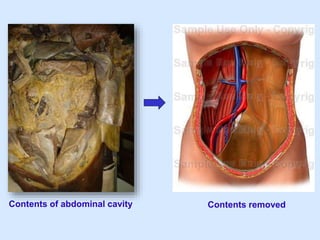
Contents of abdominal cavity Contents removed
Posterior abdominal wall
• A musculoskeletal wall between the lower border of
the rib cage and the pelvic brim
• Marks the posterior boundary of the abdominal cavity
• Anteriorly lie the retroperitoneal organs and the
parietal peritoneum
• Posteriorly lie muscles, fascia and the lumbar spine
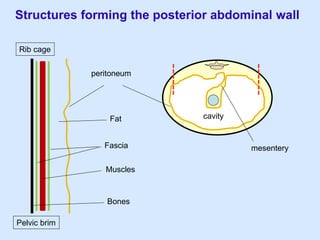
mesentery
cavity
Structures forming the posterior abdominal wall
peritoneum
Fat
Fascia
Muscles
Bones
Rib cage
Pelvic brim
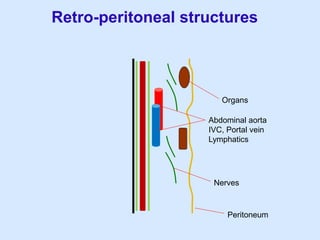
Peritoneum
Organs
Abdominal aorta
IVC, Portal vein
Lymphatics
Nerves
Retro-peritoneal structures
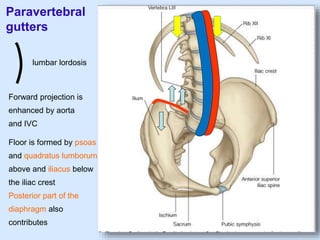
Paravertebral
gutters
lumbar lordosis
Forward projection is
enhanced by aorta
and IVC
Floor is formed by psoas
and quadratus lumborum
above and iliacus below
the iliac crest
Posterior part of the
diaphragm also
contributes
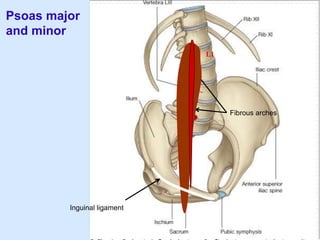
Psoas major
and minor
Fibrous arches
Inguinal ligament
L1
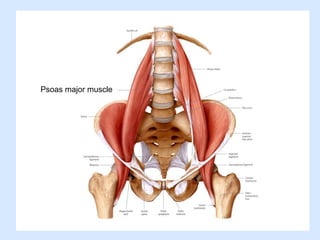
Psoas major muscle
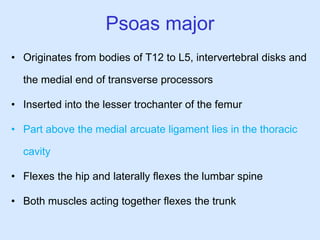
Psoas major
• Originates from bodies of T12 to L5, intervertebral disks and
the medial end of transverse processors
• Inserted into the lesser trochanter of the femur
• Part above the medial arcuate ligament lies in the thoracic
cavity
• Flexes the hip and laterally flexes the lumbar spine
• Both muscles acting together flexes the trunk
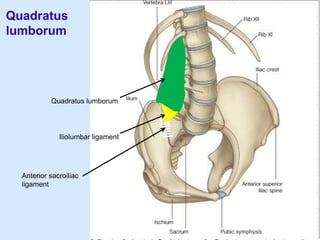
Quadratus
lumborum
Quadratus lumborum
Iliolumbar ligament
Anterior sacroiliac
ligament
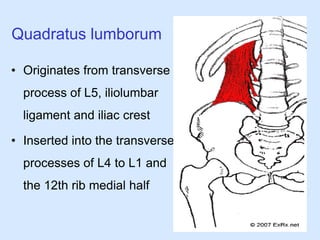
Quadratus lumborum
• Originates from transverse
process of L5, iliolumbar
ligament and iliac crest
• Inserted into the transverse
processes of L4 to L1 and
the 12th rib medial half
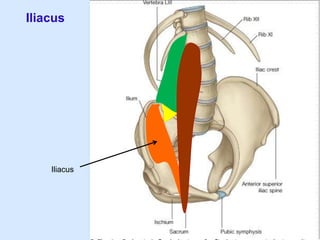
Iliacus
Iliacus
Iliacus
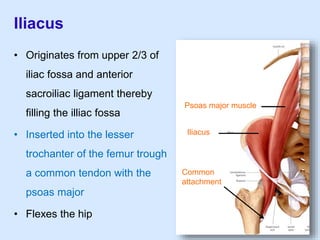
• Originates from upper 2/3 of
iliac fossa and anterior
sacroiliac ligament thereby
filling the illiac fossa
• Inserted into the lesser
trochanter of the femur trough
a common tendon with the
psoas major
• Flexes the hip
Psoas major muscle
Iliacus
Common
attachment
Fascia of the posterior
abdominal wall
• Psoas fascia
• Iliac fascia
• Lumbar part of the thoracolumbar fascia
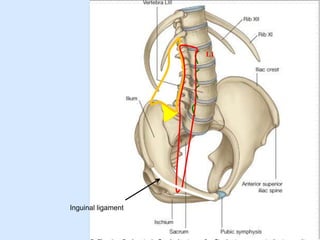
Psoas fascia
• Thick fascial sheath surrounding the psoas
muscle
• Arises as the muscle enters the abdominal
cavity under the medial arcuate ligament
• Ends at the pelvic brim as the muscle leaves the
abdomen inferior to the inguinal ligament
(does not extend into the thigh)
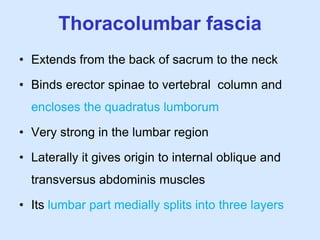
Thoracolumbar fascia
• Extends from the back of sacrum to the neck
• Binds erector spinae to vertebral column and
encloses the quadratus lumborum
• Very strong in the lumbar region
• Laterally it gives origin to internal oblique and
transversus abdominis muscles
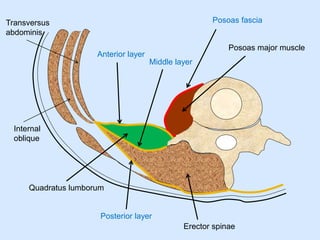
• Its lumbar part medially splits into three layers
Anterior layer
Middle layer
Posterior layer
Posoas major muscle
Quadratus lumborum
Erector spinae
Posoas fascia
Internal
oblique
Transversus
abdominis
L1
Inguinal ligament
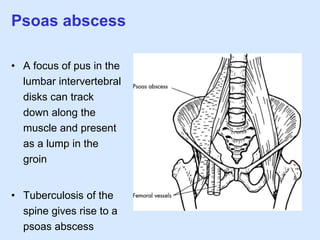
Psoas abscess
• A focus of pus in the
lumbar intervertebral
disks can track
down along the
muscle and present
as a lump in the
groin
• Tuberculosis of the
spine gives rise to a
psoas abscess
Skeleton of the posterior abdominal wall
include
A. Ischium
B. 11th rib
C. 12th vertebra
D. Sacrum
E. Intervertebral disks
Correct: B, C, D, E
Muscles of the posterior abdominal wall
include
A. Iliopsoas
B. Erector spinae
C. Quadratus lumborum
D. Diaphragm
E. Transversus abdominis
Correct: A, C, D
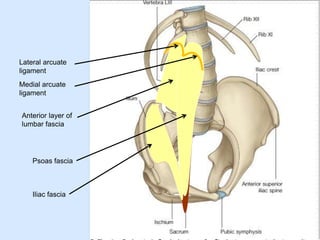
Anterior layer of
lumbar fascia
Iliac fascia
Psoas fascia
Lateral arcuate
ligament
Medial arcuate
ligament
Lateral arcuate
ligament
Medial arcuate
ligament
L1
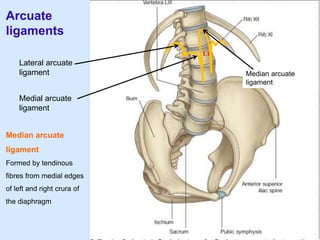
Arcuate
ligaments
Median arcuate
ligament
Median arcuate
ligament
Formed by tendinous
fibres from medial edges
of left and right crura of
the diaphragm
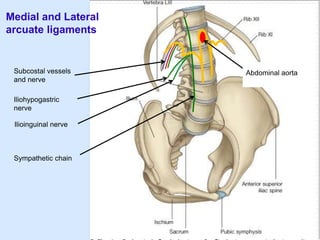
Medial and Lateral
arcuate ligaments
Sympathetic chain
Subcostal vessels
and nerve
Abdominal aorta
Iliohypogastric
nerve
Ilioinguinal nerve
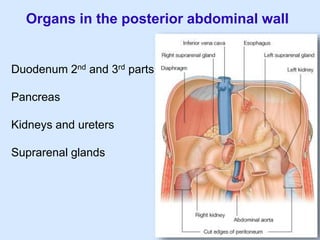
Organs in the posterior abdominal wall
Duodenum 2nd and 3rd parts
Pancreas
Kidneys and ureters
Suprarenal glands
Vessels
• Aorta and its branches
• Inferior vena cava and its tributaries
• Portal vein and its tributaries
• Lymphatics and lymph nodes
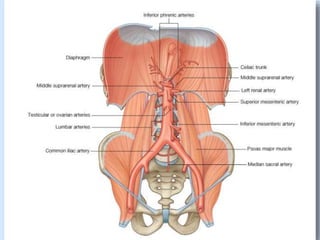
Branches of abdominal aorta
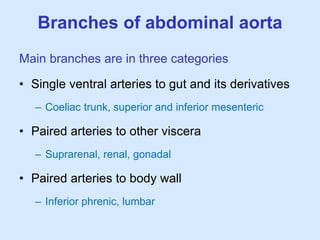
Main branches are in three categories
• Single ventral arteries to gut and its derivatives
– Coeliac trunk, superior and inferior mesenteric
• Paired arteries to other viscera
– Suprarenal, renal, gonadal
• Paired arteries to body wall
– Inferior phrenic, lumbar
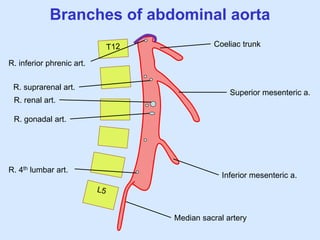
Branches of abdominal aorta
Coeliac trunk
Superior mesenteric a.
Inferior mesenteric a.
Median sacral artery
R. inferior phrenic art.
R. 4th lumbar art.
R. suprarenal art.
R. renal art.
R. gonadal art.
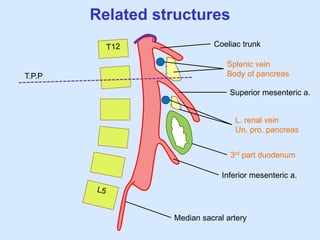
Related structures
Coeliac trunk
Superior mesenteric a.
Inferior mesenteric a.
Splenic vein
Body of pancreas
L. renal vein
Un. pro. pancreas
3rd part duodenum
Median sacral artery
T.P.P
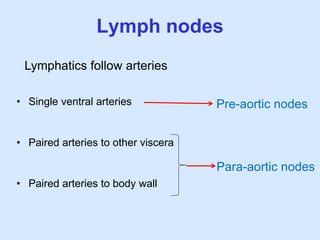
Lymph nodes
• Single ventral arteries
• Paired arteries to other viscera
• Paired arteries to body wall
Pre-aortic nodes
Para-aortic nodes
Lymphatics follow arteries
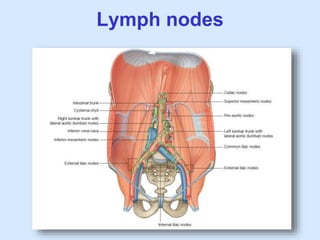
Lymph nodes
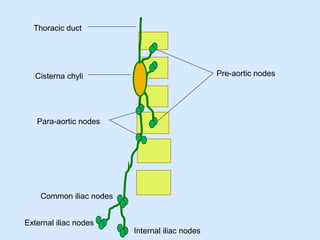
Internal iliac nodes
External iliac nodes
Common iliac nodes
Para-aortic nodes
Pre-aortic nodesCisterna chyli
Thoracic duct
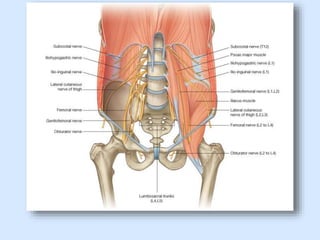
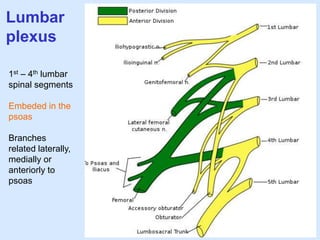
Lumbar
plexus
1st – 4th lumbar
spinal segments
Embeded in the
psoas
Branches
related laterally,
medially or
anteriorly to
psoas
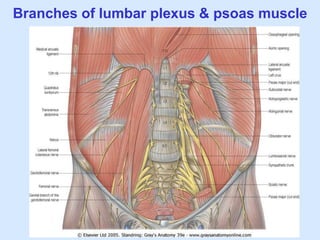
Branches of lumbar plexus & psoas muscle

Posterior abdominal wall

  • 1.
    Posterior abdominal wall SanjayaAdikari Department of Anatomy
  • 2.
    Objectives  Describe thearrangement of muscles and fascia in the posterior abdominal wall  Describe the structures found in the posterior abdominal wall  Describe the posterior abdominal viscera
  • 3.
    Contents of abdominalcavity Contents removed
  • 4.
    Posterior abdominal wall •A musculoskeletal wall between the lower border of the rib cage and the pelvic brim • Marks the posterior boundary of the abdominal cavity • Anteriorly lie the retroperitoneal organs and the parietal peritoneum • Posteriorly lie muscles, fascia and the lumbar spine
  • 5.
    mesentery cavity Structures forming theposterior abdominal wall peritoneum Fat Fascia Muscles Bones Rib cage Pelvic brim
  • 6.
    Peritoneum Organs Abdominal aorta IVC, Portalvein Lymphatics Nerves Retro-peritoneal structures
  • 7.
    Paravertebral gutters lumbar lordosis Forward projectionis enhanced by aorta and IVC Floor is formed by psoas and quadratus lumborum above and iliacus below the iliac crest Posterior part of the diaphragm also contributes
  • 8.
    Psoas major and minor Fibrousarches Inguinal ligament L1
  • 9.
  • 10.
    Psoas major • Originatesfrom bodies of T12 to L5, intervertebral disks and the medial end of transverse processors • Inserted into the lesser trochanter of the femur • Part above the medial arcuate ligament lies in the thoracic cavity • Flexes the hip and laterally flexes the lumbar spine • Both muscles acting together flexes the trunk
  • 11.
  • 12.
    Quadratus lumborum • Originatesfrom transverse process of L5, iliolumbar ligament and iliac crest • Inserted into the transverse processes of L4 to L1 and the 12th rib medial half
  • 13.
  • 14.
    Iliacus • Originates fromupper 2/3 of iliac fossa and anterior sacroiliac ligament thereby filling the illiac fossa • Inserted into the lesser trochanter of the femur trough a common tendon with the psoas major • Flexes the hip Psoas major muscle Iliacus Common attachment
  • 15.
    Fascia of theposterior abdominal wall • Psoas fascia • Iliac fascia • Lumbar part of the thoracolumbar fascia
  • 16.
    Psoas fascia • Thickfascial sheath surrounding the psoas muscle • Arises as the muscle enters the abdominal cavity under the medial arcuate ligament • Ends at the pelvic brim as the muscle leaves the abdomen inferior to the inguinal ligament (does not extend into the thigh)
  • 17.
    Thoracolumbar fascia • Extendsfrom the back of sacrum to the neck • Binds erector spinae to vertebral column and encloses the quadratus lumborum • Very strong in the lumbar region • Laterally it gives origin to internal oblique and transversus abdominis muscles • Its lumbar part medially splits into three layers
  • 18.
    Anterior layer Middle layer Posteriorlayer Posoas major muscle Quadratus lumborum Erector spinae Posoas fascia Internal oblique Transversus abdominis
  • 19.
  • 20.
    Psoas abscess • Afocus of pus in the lumbar intervertebral disks can track down along the muscle and present as a lump in the groin • Tuberculosis of the spine gives rise to a psoas abscess
  • 21.
    Skeleton of theposterior abdominal wall include A. Ischium B. 11th rib C. 12th vertebra D. Sacrum E. Intervertebral disks Correct: B, C, D, E
  • 22.
    Muscles of theposterior abdominal wall include A. Iliopsoas B. Erector spinae C. Quadratus lumborum D. Diaphragm E. Transversus abdominis Correct: A, C, D
  • 24.
    Anterior layer of lumbarfascia Iliac fascia Psoas fascia Lateral arcuate ligament Medial arcuate ligament
  • 25.
    Lateral arcuate ligament Medial arcuate ligament L1 Arcuate ligaments Medianarcuate ligament Median arcuate ligament Formed by tendinous fibres from medial edges of left and right crura of the diaphragm
  • 26.
    Medial and Lateral arcuateligaments Sympathetic chain Subcostal vessels and nerve Abdominal aorta Iliohypogastric nerve Ilioinguinal nerve
  • 27.
    Organs in theposterior abdominal wall Duodenum 2nd and 3rd parts Pancreas Kidneys and ureters Suprarenal glands
  • 29.
    Vessels • Aorta andits branches • Inferior vena cava and its tributaries • Portal vein and its tributaries • Lymphatics and lymph nodes
  • 30.
    Branches of abdominalaorta Main branches are in three categories • Single ventral arteries to gut and its derivatives – Coeliac trunk, superior and inferior mesenteric • Paired arteries to other viscera – Suprarenal, renal, gonadal • Paired arteries to body wall – Inferior phrenic, lumbar
  • 31.
    Branches of abdominalaorta Coeliac trunk Superior mesenteric a. Inferior mesenteric a. Median sacral artery R. inferior phrenic art. R. 4th lumbar art. R. suprarenal art. R. renal art. R. gonadal art.
  • 32.
    Related structures Coeliac trunk Superiormesenteric a. Inferior mesenteric a. Splenic vein Body of pancreas L. renal vein Un. pro. pancreas 3rd part duodenum Median sacral artery T.P.P
  • 34.
    Lymph nodes • Singleventral arteries • Paired arteries to other viscera • Paired arteries to body wall Pre-aortic nodes Para-aortic nodes Lymphatics follow arteries
  • 35.
  • 36.
    Internal iliac nodes Externaliliac nodes Common iliac nodes Para-aortic nodes Pre-aortic nodesCisterna chyli Thoracic duct
  • 37.
    Lumbar plexus 1st – 4thlumbar spinal segments Embeded in the psoas Branches related laterally, medially or anteriorly to psoas
  • 38.
    Branches of lumbarplexus & psoas muscle