6.1 Digestion
Topic 6 Human Health and Physiology
6.1.1 Explain why digestion of large food molecules is
essential.
6.1.2 Explain the need for enzymes in digestion.
(The need for increasing the rate of digestion at
body temperature should be emphasized.)
6.1.3 State the source, substrate, products and optimum
pH conditions for one amylase, one protease and one
lipase.
Aim 7: Data logging with pH sensors and lipase, and
data logging with colorimeters and amylase can be used.
6.1.4 Draw and label a diagram of the digestive system.
(Show the mouth, esophagus, stomach, small intestine,
large intestine, anus, liver, pancreas and gall bladder.
The diagram should clearly show the interconnections
between these structures.)
6.1.5 Outline the function of the stomach, small intestine
and large intestine.
6.1.6 Distinguish between absorption and assimilation.
6.1.7 Explain how the structure of the villus is related to
its role in absorption and transport of the products of
digestion.
Digestion
 The mammalian digestive system has 5 basic functions:
 ingestion –taking food into the digestive system (mouth)
 peristalsis – the movement of food along the alimentary canal
 digestion – the breakdown of large, insoluble food molecules
into smaller, soluble molecules
 absorption –the uptake of digested food from the gut into the
blood stream
 egestion – (or defecation) the elimination of undigested food,
bacteria and dead cells from the digestive system (large
intestine).
Why Digestion?
 Food is composed of large, insoluble molecules:
 Carbohydates.
 Proteins.
 Lipids.
 Humans need to break these molecules down into smaller
units that:
 are small enough to be absorbed by the villi in the small intestine.
 Are in a form that can be used by the cells of the body.
Two Types of Digestion.
 The alimentary canal is a long muscular tube running from
the mouth to the anus.
 Digestion starts in the mouth.
 The two types of digestion occurring in the mammalian
digestive system are:
 Physical Digestion (Mechanical Digestion)
 the action of teeth chewing food, physically breaking the food into
smaller pieces
 Chemical Digestion
 Involves chemical reactions (Hydrolysis) and the help of catalysts to
break food into smaller pieces
Enzymes in Digestion
 Digestion is a slow process, so special specific catalysts called
enzymes are used to speed up digestion at body temperature.
 The are many different enzymes.
 Enzymes are:
 highly specific – one enzyme catalyses one chemical reaction.
 always proteins
 sensitive to pH – work best at an certain pH
 Reusable – not used in the chemical reactions they catalyse
 Sensitive to heat - broken down (destroyed) by heat - denatured
 Enzyme names are generally characterised by the ending -ase
(however there are exceptions)
Types of Digestive Enzymes
 Digestive enzymes can be classified into groups depending
on their action:
 Carbohydrases (Amylases) – work on carbohydrates
 Proteases – work on proteins
 Lipases – work on lipids
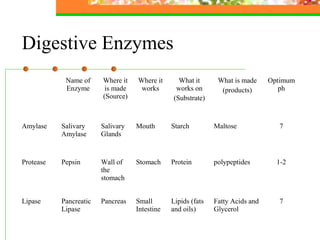
Digestive Enzymes
Name of
Enzyme
Where it
is made
(Source)
Where it
works
What it
works on
(Substrate)
What is made
(products)
Optimum
ph
Amylase Salivary
Amylase
Salivary
Glands
Mouth Starch Maltose 7
Protease Pepsin Wall of
the
stomach
Stomach Protein polypeptides 1-2
Lipase Pancreatic
Lipase
Pancreas Small
Intestine
Lipids (fats
and oils)
Fatty Acids and
Glycerol
7
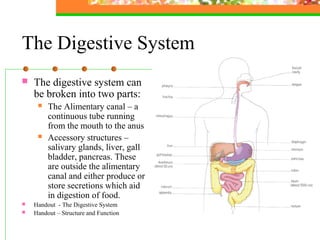
The Digestive System
 The digestive system can
be broken into two parts:
 The Alimentary canal – a
continuous tube running
from the mouth to the anus
 Accessory structures –
salivary glands, liver, gall
bladder, pancreas. These
are outside the alimentary
canal and either produce or
store secretions which aid
in digestion of food.
 Handout - The Digestive System
 Handout – Structure and Function
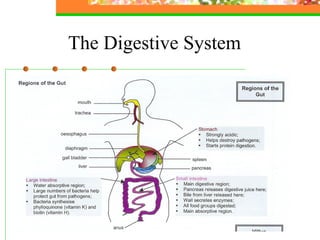
The Digestive System
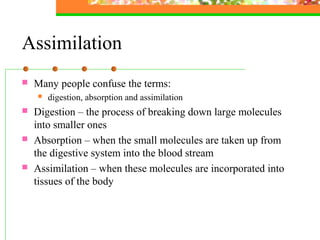
Assimilation
 Many people confuse the terms:
 digestion, absorption and assimilation
 Digestion – the process of breaking down large molecules
into smaller ones
 Absorption – when the small molecules are taken up from
the digestive system into the blood stream
 Assimilation – when these molecules are incorporated into
tissues of the body
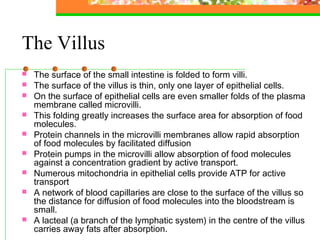
The Villus
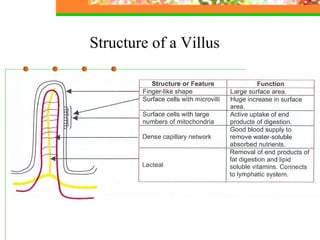
 The surface of the small intestine is folded to form villi.
 The surface of the villus is thin, only one layer of epithelial cells.
 On the surface of epithelial cells are even smaller folds of the plasma
membrane called microvilli.
 This folding greatly increases the surface area for absorption of food
molecules.
 Protein channels in the microvilli membranes allow rapid absorption
of food molecules by facilitated diffusion
 Protein pumps in the microvilli allow absorption of food molecules
against a concentration gradient by active transport.
 Numerous mitochondria in epithelial cells provide ATP for active
transport
 A network of blood capillaries are close to the surface of the villus so
the distance for diffusion of food molecules into the bloodstream is
small.
 A lacteal (a branch of the lymphatic system) in the centre of the villus
carries away fats after absorption.
Structure of a Villus
6.1.1 Explain why digestion of large food molecules is
essential.
6.1.2 Explain the need for enzymes in digestion.
(The need for increasing the rate of digestion at
body temperature should be emphasized.)
6.1.3 State the source, substrate, products and optimum
pH conditions for one amylase, one protease and one
lipase.
Aim 7: Data logging with pH sensors and lipase, and
data logging with colorimeters and amylase can be used.
6.1.4 Draw and label a diagram of the digestive system.
(Show the mouth, esophagus, stomach, small intestine,
large intestine, anus, liver, pancreas and gall bladder.
The diagram should clearly show the interconnections
between these structures.)
6.1.5 Outline the function of the stomach, small intestine
and large intestine.
6.1.6 Distinguish between absorption and assimilation.
6.1.7 Explain how the structure of the villus is related to
its role in absorption and transport of the products of
digestion.

6.1 digestion

  • 1.
    6.1 Digestion Topic 6Human Health and Physiology
  • 2.
    6.1.1 Explain whydigestion of large food molecules is essential. 6.1.2 Explain the need for enzymes in digestion. (The need for increasing the rate of digestion at body temperature should be emphasized.) 6.1.3 State the source, substrate, products and optimum pH conditions for one amylase, one protease and one lipase. Aim 7: Data logging with pH sensors and lipase, and data logging with colorimeters and amylase can be used.
  • 3.
    6.1.4 Draw andlabel a diagram of the digestive system. (Show the mouth, esophagus, stomach, small intestine, large intestine, anus, liver, pancreas and gall bladder. The diagram should clearly show the interconnections between these structures.) 6.1.5 Outline the function of the stomach, small intestine and large intestine. 6.1.6 Distinguish between absorption and assimilation. 6.1.7 Explain how the structure of the villus is related to its role in absorption and transport of the products of digestion.
  • 4.
    Digestion  The mammaliandigestive system has 5 basic functions:  ingestion –taking food into the digestive system (mouth)  peristalsis – the movement of food along the alimentary canal  digestion – the breakdown of large, insoluble food molecules into smaller, soluble molecules  absorption –the uptake of digested food from the gut into the blood stream  egestion – (or defecation) the elimination of undigested food, bacteria and dead cells from the digestive system (large intestine).
  • 5.
    Why Digestion?  Foodis composed of large, insoluble molecules:  Carbohydates.  Proteins.  Lipids.  Humans need to break these molecules down into smaller units that:  are small enough to be absorbed by the villi in the small intestine.  Are in a form that can be used by the cells of the body.
  • 6.
    Two Types ofDigestion.  The alimentary canal is a long muscular tube running from the mouth to the anus.  Digestion starts in the mouth.  The two types of digestion occurring in the mammalian digestive system are:  Physical Digestion (Mechanical Digestion)  the action of teeth chewing food, physically breaking the food into smaller pieces  Chemical Digestion  Involves chemical reactions (Hydrolysis) and the help of catalysts to break food into smaller pieces
  • 7.
    Enzymes in Digestion Digestion is a slow process, so special specific catalysts called enzymes are used to speed up digestion at body temperature.  The are many different enzymes.  Enzymes are:  highly specific – one enzyme catalyses one chemical reaction.  always proteins  sensitive to pH – work best at an certain pH  Reusable – not used in the chemical reactions they catalyse  Sensitive to heat - broken down (destroyed) by heat - denatured  Enzyme names are generally characterised by the ending -ase (however there are exceptions)
  • 8.
    Types of DigestiveEnzymes  Digestive enzymes can be classified into groups depending on their action:  Carbohydrases (Amylases) – work on carbohydrates  Proteases – work on proteins  Lipases – work on lipids
  • 9.
    Digestive Enzymes Name of Enzyme Whereit is made (Source) Where it works What it works on (Substrate) What is made (products) Optimum ph Amylase Salivary Amylase Salivary Glands Mouth Starch Maltose 7 Protease Pepsin Wall of the stomach Stomach Protein polypeptides 1-2 Lipase Pancreatic Lipase Pancreas Small Intestine Lipids (fats and oils) Fatty Acids and Glycerol 7
  • 10.
    The Digestive System The digestive system can be broken into two parts:  The Alimentary canal – a continuous tube running from the mouth to the anus  Accessory structures – salivary glands, liver, gall bladder, pancreas. These are outside the alimentary canal and either produce or store secretions which aid in digestion of food.  Handout - The Digestive System  Handout – Structure and Function
  • 11.
  • 12.
    Assimilation  Many peopleconfuse the terms:  digestion, absorption and assimilation  Digestion – the process of breaking down large molecules into smaller ones  Absorption – when the small molecules are taken up from the digestive system into the blood stream  Assimilation – when these molecules are incorporated into tissues of the body
  • 13.
    The Villus  Thesurface of the small intestine is folded to form villi.  The surface of the villus is thin, only one layer of epithelial cells.  On the surface of epithelial cells are even smaller folds of the plasma membrane called microvilli.  This folding greatly increases the surface area for absorption of food molecules.  Protein channels in the microvilli membranes allow rapid absorption of food molecules by facilitated diffusion  Protein pumps in the microvilli allow absorption of food molecules against a concentration gradient by active transport.  Numerous mitochondria in epithelial cells provide ATP for active transport  A network of blood capillaries are close to the surface of the villus so the distance for diffusion of food molecules into the bloodstream is small.  A lacteal (a branch of the lymphatic system) in the centre of the villus carries away fats after absorption.
  • 14.
  • 15.
    6.1.1 Explain whydigestion of large food molecules is essential. 6.1.2 Explain the need for enzymes in digestion. (The need for increasing the rate of digestion at body temperature should be emphasized.) 6.1.3 State the source, substrate, products and optimum pH conditions for one amylase, one protease and one lipase. Aim 7: Data logging with pH sensors and lipase, and data logging with colorimeters and amylase can be used.
  • 16.
    6.1.4 Draw andlabel a diagram of the digestive system. (Show the mouth, esophagus, stomach, small intestine, large intestine, anus, liver, pancreas and gall bladder. The diagram should clearly show the interconnections between these structures.) 6.1.5 Outline the function of the stomach, small intestine and large intestine. 6.1.6 Distinguish between absorption and assimilation. 6.1.7 Explain how the structure of the villus is related to its role in absorption and transport of the products of digestion.