BRUSHLESS DC MOTOR
Instructor
Prof. Engr. Mr. NAZAM SIDDIQUE
Presented by
MIRZA AHMAD BAIG (19013122-003)
AHMED RAZA (19013122-016)
USMAN HAIDER (19013122-017)
Department of Electrical Engineering
ELECTRIC MOTOR
• MOTOR
• Converts Electrical energy to Mechanical energy
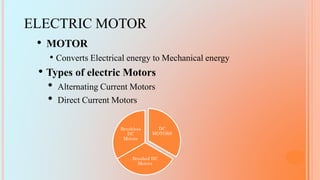
• Types of electric Motors
• Alternating Current Motors
• Direct Current Motors
DC
MOTORS
Brushed DC
Motors
Brushless
DC
Motors
BRUSHLESS DC MOTOR
• A Brushless DC motor is a permanent magnet synchronous
electric motor
• It is driven by Direct Current (DC) electricity
• It accomplishes electronically controlled commutation system
• The armature coils are switched electronically by transistors or
silicon controlled rectifiers.
• BLDC motors are highly efficient motors and are capable of
running at high speeds.
4
BRUSHLESS DC MOTORS
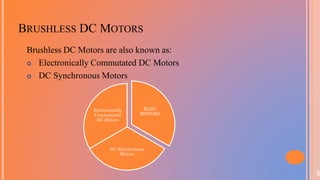
Brushless DC Motors are also known as:
 Electronically Commutated DC Motors
 DC Synchronous Motors
5
BLDC
MOTORS
DC Synchronous
Motors
Electronically
Commutated
DC Motors
6
WORKING PRINCIPLE
• Working principle of BLDC is based on Lorentz Force Law
• Whenever a current carrying conductor is placed in a magnetic
field, it experiences a force.
• A consequence of reaction force, the magnet will experience an
equal and opposite force.
 In case of BLDC motor:
 Current carrying conductor is stationary
 Permanent magnet rotates
7
WORKING
• When stator coils are electrically switched by supply source, it
becomes an electromagnet.
• Switching makes to generate an AC voltage waveform with
trapezoidal shape
• Due to force of interaction between electromagnet stator and
permanent magnet rotor, the rotor continues to rotate.
• By this way, motor moves in clockwise direction.
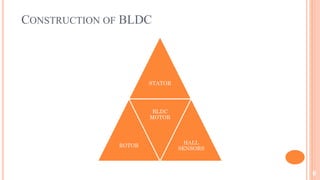
CONSTRUCTION OF BLDC
8
STATOR
ROTOR
BLDC
MOTOR
HALL
SENSORS
STATOR
9
 Stator of BLDC motor is made up of stacked
steel laminations to carry the windings.
 Most BLDC motors have three phase star
connected stator
 Each winding is constructed with numerous
interconnected coils
 The stator must be chosen with correct
rating of voltage depending on power supply
capability.
ROTOR
 BLDC motor incorporates a permanent
magnet as a rotor
 Number of poles in rotor can vary from 2
to 8 pole pairs with alternate south and
north poles.
 For maximum torque in motor, the flux
density of magnetic material should be
high
 Rare Earth alloy magnets are commonly
used for new designs.
10
HALL SENSORS
 Hall Effect sensors provide the information to synchronize stator
armature excitation with rotor position
 Before energizing a particular stator winding, acknowledgement
of rotor position is necessary
 Hall Effect Sensor embedded in stator senses the rotor position.
 Each sensor generates low and high signals whenever poles pass
near to it.
 The exact commutation sequence can be determined based on
combination of these three sensor’s response.
11
CONTROLLER
 The Controller converts single phase AC to DC output.
 Then this DC output will be given to invertor that will convert DC
signal to 3-phase AC.
 This three phase input is not completely sine waved (and a
rectangular form AC wave that contains ripples).
 When this 3-phase signal is given to the stator winding, it will
create a rotating magnetic field that runs the motor.
 It is important that DC input is needed to drive the motor.
 Hence it is known as Brushless DC Motor.
12
ADVANTAGES AND LIMITATIONS
Advantages
 Less overall maintenance
 Reduced size with far superior thermal characteristics
 Higher speed range and Low electric noise generation
 No mechanical commutator and associated problems
 High efficiency and high output power
Limitations
 Electronic controller required to control this motor is expensive
 Requires complex drive circuitry
13
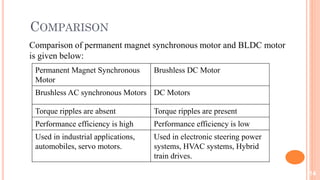
COMPARISON
Comparison of permanent magnet synchronous motor and BLDC motor
is given below:
14
Permanent Magnet Synchronous
Motor
Brushless DC Motor
Brushless AC synchronous Motors DC Motors
Torque ripples are absent Torque ripples are present
Performance efficiency is high Performance efficiency is low
Used in industrial applications,
automobiles, servo motors.
Used in electronic steering power
systems, HVAC systems, Hybrid
train drives.
APPLICATIONS
Now-a-days BLDC motors are being used in variety of applications. Some of
them are mentioned below:
 Computer hard drives and DVD players
 Electric vehicles and hybrid vehicles
 Industrial robots, CNC machine tools
 Washing machines, compressors and dryers
 Fans, pumps and blowers
15
16

Brushless DC Motor.pptx

  • 2.
    BRUSHLESS DC MOTOR Instructor Prof.Engr. Mr. NAZAM SIDDIQUE Presented by MIRZA AHMAD BAIG (19013122-003) AHMED RAZA (19013122-016) USMAN HAIDER (19013122-017) Department of Electrical Engineering
  • 3.
    ELECTRIC MOTOR • MOTOR •Converts Electrical energy to Mechanical energy • Types of electric Motors • Alternating Current Motors • Direct Current Motors DC MOTORS Brushed DC Motors Brushless DC Motors
  • 4.
    BRUSHLESS DC MOTOR •A Brushless DC motor is a permanent magnet synchronous electric motor • It is driven by Direct Current (DC) electricity • It accomplishes electronically controlled commutation system • The armature coils are switched electronically by transistors or silicon controlled rectifiers. • BLDC motors are highly efficient motors and are capable of running at high speeds. 4
  • 5.
    BRUSHLESS DC MOTORS BrushlessDC Motors are also known as:  Electronically Commutated DC Motors  DC Synchronous Motors 5 BLDC MOTORS DC Synchronous Motors Electronically Commutated DC Motors
  • 6.
    6 WORKING PRINCIPLE • Workingprinciple of BLDC is based on Lorentz Force Law • Whenever a current carrying conductor is placed in a magnetic field, it experiences a force. • A consequence of reaction force, the magnet will experience an equal and opposite force.  In case of BLDC motor:  Current carrying conductor is stationary  Permanent magnet rotates
  • 7.
    7 WORKING • When statorcoils are electrically switched by supply source, it becomes an electromagnet. • Switching makes to generate an AC voltage waveform with trapezoidal shape • Due to force of interaction between electromagnet stator and permanent magnet rotor, the rotor continues to rotate. • By this way, motor moves in clockwise direction.
  • 8.
  • 9.
    STATOR 9  Stator ofBLDC motor is made up of stacked steel laminations to carry the windings.  Most BLDC motors have three phase star connected stator  Each winding is constructed with numerous interconnected coils  The stator must be chosen with correct rating of voltage depending on power supply capability.
  • 10.
    ROTOR  BLDC motorincorporates a permanent magnet as a rotor  Number of poles in rotor can vary from 2 to 8 pole pairs with alternate south and north poles.  For maximum torque in motor, the flux density of magnetic material should be high  Rare Earth alloy magnets are commonly used for new designs. 10
  • 11.
    HALL SENSORS  HallEffect sensors provide the information to synchronize stator armature excitation with rotor position  Before energizing a particular stator winding, acknowledgement of rotor position is necessary  Hall Effect Sensor embedded in stator senses the rotor position.  Each sensor generates low and high signals whenever poles pass near to it.  The exact commutation sequence can be determined based on combination of these three sensor’s response. 11
  • 12.
    CONTROLLER  The Controllerconverts single phase AC to DC output.  Then this DC output will be given to invertor that will convert DC signal to 3-phase AC.  This three phase input is not completely sine waved (and a rectangular form AC wave that contains ripples).  When this 3-phase signal is given to the stator winding, it will create a rotating magnetic field that runs the motor.  It is important that DC input is needed to drive the motor.  Hence it is known as Brushless DC Motor. 12
  • 13.
    ADVANTAGES AND LIMITATIONS Advantages Less overall maintenance  Reduced size with far superior thermal characteristics  Higher speed range and Low electric noise generation  No mechanical commutator and associated problems  High efficiency and high output power Limitations  Electronic controller required to control this motor is expensive  Requires complex drive circuitry 13
  • 14.
    COMPARISON Comparison of permanentmagnet synchronous motor and BLDC motor is given below: 14 Permanent Magnet Synchronous Motor Brushless DC Motor Brushless AC synchronous Motors DC Motors Torque ripples are absent Torque ripples are present Performance efficiency is high Performance efficiency is low Used in industrial applications, automobiles, servo motors. Used in electronic steering power systems, HVAC systems, Hybrid train drives.
  • 15.
    APPLICATIONS Now-a-days BLDC motorsare being used in variety of applications. Some of them are mentioned below:  Computer hard drives and DVD players  Electric vehicles and hybrid vehicles  Industrial robots, CNC machine tools  Washing machines, compressors and dryers  Fans, pumps and blowers 15
  • 16.