Brushless Dc motor
Presented by:
Sanjeet kumar
Registration No.-1308143
Branch: Electrical & Electronics Engineering
Brushless Dc Motor
• Brushless DC Motors are a type of
synchronous motor.
 magnetic fields generated by the stator and rotor
rotate at the same frequency
 no slip
 Has no brushes and commutators.
 Rotation of the rotor depends on the accurate
position with stator.
• Detected by Hall Sensor,
mounted on rotor, shifted at
60º or 120º phase shift.
• Electronic commutation
used to vary the PWM duty-
cycle for speed control,
using software.
• Available in single-phase,
2-phase, and 3-phase
configurations
BLDC Motor Stator
BLDC Motor Rotors
Working of Brushless dc motor
 As there is no commutator ,the
current direction of the conductor
on the stator controlled
electronically.
 Rotor consists the permanent
magnet where as stator consist a no.
of windings. Current through these
winding produces magnetic field
and force.
 Hall sensor used to determine the
position during commutation.
Commutation of BLDCM…
 Brushless DC motor requires external commutation circuit to
rotate the rotor.
 Rotor position is very important.
 HALL SENSOR senses the position of the coil accurately.
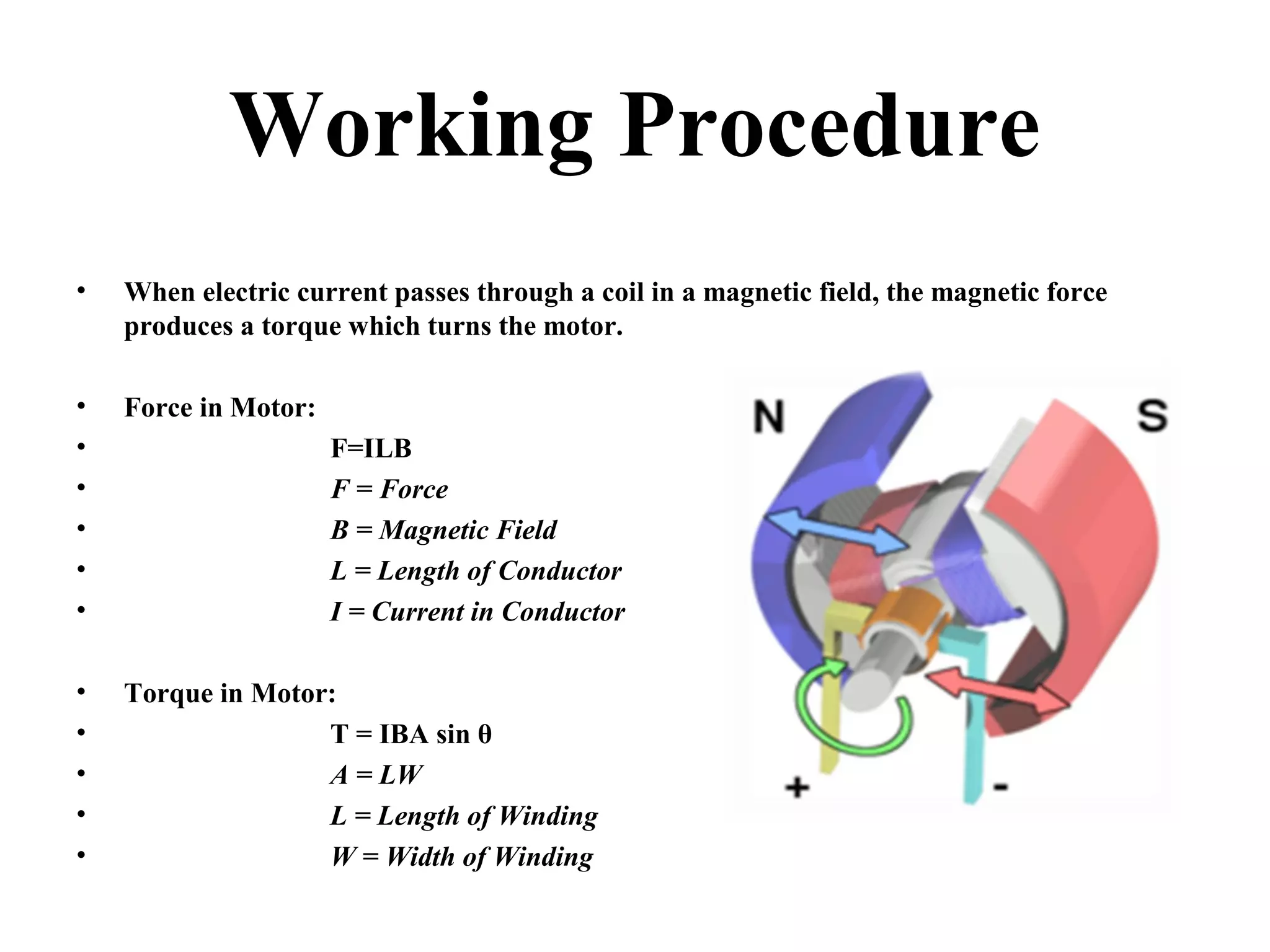
Working Procedure
• When electric current passes through a coil in a magnetic field, the magnetic force
produces a torque which turns the motor.
• Force in Motor:
• F=ILB
• F = Force
• B = Magnetic Field
• L = Length of Conductor
• I = Current in Conductor
• Torque in Motor:
• T = IBA sin θ
• A = LW
• L = Length of Winding
• W = Width of Winding
Hall-Effect
• If a current-carrying conductor is kept in a
magnetic field, the magnetic field exerts a
force on the moving charge carriers, tending to
push them to one side of the conductor,
producing a measurable voltage difference
between the two sides of the conductor.
Hall-Effect Sensors
• Need 3 sensors to determine the position of the
rotor
• When a rotor pole passes a Hall-Effect sensor,
get a high or low signal, indicating that a
North or South pole
Transverse Sectional View of Rotor
Commutation Sequence
• Each sequence has
 one winding energized positive (current into the
winding)
 one winding energized negative (current out of the
winding)
 one winding non-energized
Torque-Speed Characteristic
Advantage
 In BLDC motor PM are on the rotor &
electromagnets are on the stator
controlled by software. Thus the
advantages are:
1. Because of computer control it is more
precise & more efficient.
2. There is no sparking & less electrical
noise.
3. Voltage and current rating is high.
4. High speed can be achieved.
5. As there is no brushes it requires no
servicing.
6. It has longer life.
7. Low Radio Frequency Interference and
electromagnetic Interference.
Disadvantage
 Requires Complex Drive Circuitry.
 Requires additional Sensors.
 Expensive.
 Some designs require manual labor.
(Hand wound Stator Coils)
Applications
• PMBLDC motors are
increasingly being used in a wide
spectrum of applications:
• domestic equipments,
• automobiles
• information technology equipment
• industries
• public life appliances
• transportation
• aerospace, defence equipments, power
tools, toys, vision and sound equipments
• medical and health care equipment
ranging from microwatts to megawatts.
Presented By:
Sanjeet Kumar
sanjeetkumar2101@gmail.com
+91-8968143473

Brushless motor/sanjeet-1308143

  • 1.
    Brushless Dc motor Presentedby: Sanjeet kumar Registration No.-1308143 Branch: Electrical & Electronics Engineering
  • 2.
    Brushless Dc Motor •Brushless DC Motors are a type of synchronous motor.  magnetic fields generated by the stator and rotor rotate at the same frequency  no slip  Has no brushes and commutators.  Rotation of the rotor depends on the accurate position with stator.
  • 3.
    • Detected byHall Sensor, mounted on rotor, shifted at 60º or 120º phase shift. • Electronic commutation used to vary the PWM duty- cycle for speed control, using software. • Available in single-phase, 2-phase, and 3-phase configurations
  • 4.
  • 5.
  • 6.
    Working of Brushlessdc motor  As there is no commutator ,the current direction of the conductor on the stator controlled electronically.  Rotor consists the permanent magnet where as stator consist a no. of windings. Current through these winding produces magnetic field and force.  Hall sensor used to determine the position during commutation.
  • 7.
    Commutation of BLDCM… Brushless DC motor requires external commutation circuit to rotate the rotor.  Rotor position is very important.  HALL SENSOR senses the position of the coil accurately.
  • 8.
    Working Procedure • Whenelectric current passes through a coil in a magnetic field, the magnetic force produces a torque which turns the motor. • Force in Motor: • F=ILB • F = Force • B = Magnetic Field • L = Length of Conductor • I = Current in Conductor • Torque in Motor: • T = IBA sin θ • A = LW • L = Length of Winding • W = Width of Winding
  • 9.
    Hall-Effect • If acurrent-carrying conductor is kept in a magnetic field, the magnetic field exerts a force on the moving charge carriers, tending to push them to one side of the conductor, producing a measurable voltage difference between the two sides of the conductor.
  • 10.
    Hall-Effect Sensors • Need3 sensors to determine the position of the rotor • When a rotor pole passes a Hall-Effect sensor, get a high or low signal, indicating that a North or South pole
  • 11.
  • 12.
    Commutation Sequence • Eachsequence has  one winding energized positive (current into the winding)  one winding energized negative (current out of the winding)  one winding non-energized
  • 13.
  • 15.
    Advantage  In BLDCmotor PM are on the rotor & electromagnets are on the stator controlled by software. Thus the advantages are: 1. Because of computer control it is more precise & more efficient. 2. There is no sparking & less electrical noise. 3. Voltage and current rating is high. 4. High speed can be achieved. 5. As there is no brushes it requires no servicing. 6. It has longer life. 7. Low Radio Frequency Interference and electromagnetic Interference.
  • 16.
    Disadvantage  Requires ComplexDrive Circuitry.  Requires additional Sensors.  Expensive.  Some designs require manual labor. (Hand wound Stator Coils)
  • 17.
    Applications • PMBLDC motorsare increasingly being used in a wide spectrum of applications: • domestic equipments, • automobiles • information technology equipment • industries • public life appliances • transportation • aerospace, defence equipments, power tools, toys, vision and sound equipments • medical and health care equipment ranging from microwatts to megawatts.
  • 19.