Md. Shahabuddin
Shaikh
Student ID : 555131010
2nd Batch 4th Semester
Department of EEE
Presented By :
 Introduction
 Construction of Repulsion Motor
 Types of Repulsion Motor
 Advantage of Repulsion Motor
 Disadvantage of Repulsion Motor
 Application of Repulsion motors
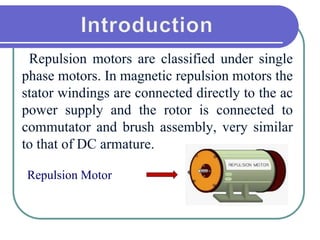
Repulsion motors are classified under single
phase motors. In magnetic repulsion motors the
stator windings are connected directly to the ac
power supply and the rotor is connected to
commutator and brush assembly, very similar
to that of DC armature.
Repulsion Motor
Construction of Repulsion Motor:
Repulsion motors are based on the principle
of repulsion between two magnetic fields.
Consider a 2-pole motor with a vertical magnetic
axis. The armature is connected to a
commutator and brushes. The brushes are short
circuited using a low-resistance jumper. When
alternating current is supplied to the field (stator)
winding, it induces an electromotive force (emf)
in the armature.
Construction of Repulsion Motor:
The direction of alternating current
is such that it creates a north pole at
the top and a south pole at the bottom.
The direction of induced emf is given by
Lenz's law, according to which the
direction of induced emf opposes the
cause producing it. The induced emf
induces current in the armature
conductors and the direction of the
induced current depends on the
position of the brushes.
Circuit-diagram of Repulsion motor
Types of Repulsion Motor
The various types of motors which works under
the repulsion principle are :
 Compensated repulsion motor
 Repulsion-start Induction-run motor
 Repulsion Induction motor
Types of Repulsion Motor
Compensated repulsion motor :
• It carries an additional winding, called
compensating winding.
• There is another set of two brushes which
are placed midway between the usual
short circuit brush set.
• The compensating winding and this
added set are connect in series.
Types of Repulsion Motor
Repulsion-start Induction-run motor:
This motor starts as a repulsion motor, but normally
run as an induction motor, with constant speed
characteristics. It consist,
• One stator
• One rotor which is similar to the wire-wound d.c
armature
• A commutator and
• A centrifugal mechanism which short-circuits the
commutator bars.
Types of Repulsion Motor
Repulsion Induction motor :
It works on the combined principle of repulsion
and induction. It consist,
• Stator winding
• Two rotor winding : one squirrel cage and other
usual d.c winding connected to the commutator
and
• A short-circuit set of two brushes.
Advantage of Repulsion Motor
Most commutator motors are limited to
about 1,500 volts because higher voltages give
rise to a risk of arcing across the commutator.
Repulsion motors can be used at higher voltages
because the rotor circuit is not electrically
connected to the supply.
Disadvantages of Repulsion
Motor:
 Occurrence of sparks at brushes.
 Commutator and brushes wear out quickly.
This is primarily due to arcing and heat
generated at brush assembly.
 The power factor is poor at low speeds.
 No load speed is very high and dangerous.
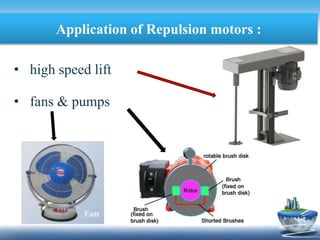
Application of Repulsion motors :
• high speed lift
• fans & pumps
Application of Repulsion motors :
• Hoists
• Air Compressors
• Mining Equipment
Repulsion type motor

Repulsion type motor

  • 1.
    Md. Shahabuddin Shaikh Student ID: 555131010 2nd Batch 4th Semester Department of EEE Presented By :
  • 2.
     Introduction  Constructionof Repulsion Motor  Types of Repulsion Motor  Advantage of Repulsion Motor  Disadvantage of Repulsion Motor  Application of Repulsion motors
  • 3.
    Repulsion motors areclassified under single phase motors. In magnetic repulsion motors the stator windings are connected directly to the ac power supply and the rotor is connected to commutator and brush assembly, very similar to that of DC armature. Repulsion Motor
  • 4.
    Construction of RepulsionMotor: Repulsion motors are based on the principle of repulsion between two magnetic fields. Consider a 2-pole motor with a vertical magnetic axis. The armature is connected to a commutator and brushes. The brushes are short circuited using a low-resistance jumper. When alternating current is supplied to the field (stator) winding, it induces an electromotive force (emf) in the armature.
  • 5.
    Construction of RepulsionMotor: The direction of alternating current is such that it creates a north pole at the top and a south pole at the bottom. The direction of induced emf is given by Lenz's law, according to which the direction of induced emf opposes the cause producing it. The induced emf induces current in the armature conductors and the direction of the induced current depends on the position of the brushes.
  • 6.
  • 7.
    Types of RepulsionMotor The various types of motors which works under the repulsion principle are :  Compensated repulsion motor  Repulsion-start Induction-run motor  Repulsion Induction motor
  • 8.
    Types of RepulsionMotor Compensated repulsion motor : • It carries an additional winding, called compensating winding. • There is another set of two brushes which are placed midway between the usual short circuit brush set. • The compensating winding and this added set are connect in series.
  • 9.
    Types of RepulsionMotor Repulsion-start Induction-run motor: This motor starts as a repulsion motor, but normally run as an induction motor, with constant speed characteristics. It consist, • One stator • One rotor which is similar to the wire-wound d.c armature • A commutator and • A centrifugal mechanism which short-circuits the commutator bars.
  • 10.
    Types of RepulsionMotor Repulsion Induction motor : It works on the combined principle of repulsion and induction. It consist, • Stator winding • Two rotor winding : one squirrel cage and other usual d.c winding connected to the commutator and • A short-circuit set of two brushes.
  • 11.
    Advantage of RepulsionMotor Most commutator motors are limited to about 1,500 volts because higher voltages give rise to a risk of arcing across the commutator. Repulsion motors can be used at higher voltages because the rotor circuit is not electrically connected to the supply.
  • 12.
    Disadvantages of Repulsion Motor: Occurrence of sparks at brushes.  Commutator and brushes wear out quickly. This is primarily due to arcing and heat generated at brush assembly.  The power factor is poor at low speeds.  No load speed is very high and dangerous.
  • 13.
    Application of Repulsionmotors : • high speed lift • fans & pumps
  • 14.
    Application of Repulsionmotors : • Hoists • Air Compressors • Mining Equipment