Brucellosis
and
Pregnancy
Prof. Aboubakr
Elnashar
Benha University
Hospital, Egypt
Aboubakr Elnashar
Other names for Brucellosis
 Undulant fever
 Malta fever
 Mediterranean fever.
Aboubakr Elnashar
CONTENTS
1. Causative organism
2. Epidemiology
3. Transmission to human
4. Clinical Manifestation
5. Investigations
6. Treatment
7. Prevention
Aboubakr Elnashar
1. Causative organism
Brucella
Coccobacillus, gram negative, non-sporing
Non-motile aerobic bacterium
Hosts: mostly animals.
Four species:
Melitensis: most frequent human infection
Abortus
Suis
Canis
Aboubakr Elnashar
2. Epidemiology
 Major zoonotic disease.
 Worldwide
 Major endemic areas:
Mediterranean basin
Arabian Gulf
Indian subcontinent,
Parts of Mexico
Central and South America
Aboubakr Elnashar
Risk factors:
1. Family history of brucellosis
2. Stockbreeding
3. Ingestion of non-pasteurized dairy products:
most common source of transmission.
 Occupational status and
family history of brucellosis should be
obtained during prenatal care in at-risk areas.
‫الماشيه‬ ‫تربيه‬
Aboubakr Elnashar
Brucellosis in Saudi Arabia
Endemic
National prevalence: 15%
1. Persistence of domestic animal reservoirs for
Brucella species
2. Human consumption of unpasteurized products
Aboubakr Elnashar
Brucellosis in Egypt:
Incidence:
common.
Among pregnant women
3.5%
{Sherif et al.2003]
12 .2 %
(Alshamy and Ahmed, 2008)
Aboubakr Elnashar
3. Methods of transmission
1. Direct
1. inoculation through cuts and skin abrasions from
handling animal carcasses, placentas, or contact
with animal vaginal secretions
2. Direct conjunctival inoculation
2. Inhalation
of infectious aerosols
3. Ingestion
of contaminated food such as raw milk, cheese
made from unpasteurized (raw) milk, or raw meat
 Venereal
has been suggested, but the data are not
conclusive
Aboubakr Elnashar
 Types of transmission
1. Consumption of:
1. unpasteurized milk
2. soft cheeses made from the milk of infected
animals, primarily goats, infected with B melitensis
2. Occupational
1. laboratory workers
2. Veterinarians
3. Slaughterhouse workers.
Aboubakr Elnashar
Incubation period
 Few days to a few months.
 In most patients
 2 and 6 w
 Duration depend on:
 virulence of the infecting strain
 size of the inoculum
 route of infection
 resistance of the host
Aboubakr Elnashar
Portals of entry
 Oral entry
 Most common route
 Ingestion of contaminated animal products
(often raw milk or its derivatives)
 Contact with contaminated fingers
 Aerosols
 Inhalation of bacteria
 Contamination of the conjunctivae
 Per cutaneous
 through skin abrasions or by accidental
inoculation Aboubakr Elnashar
4. Clinical Manifestation
Usually Acute febrile illness
accompanied by a wide array of other symptoms
 Night sweats
 Malaise
 Anorexia
 Arthralgia
 Fatigue
 Weight loss
 Depression.
Aboubakr Elnashar
Fever
1. Acute stages: high
2. undulant stages: low grade and intermittent
3. Chronic stages: low grade or absent
Aboubakr Elnashar
 Complications may affect any organ system
1. Osteoarticular disease
most common complication (i.e., sacroiliitis and
peripheral arthritis)
2. Genitourinary disease
second most common complication.
3. Liver disease
second most common medical complication in
brucellosis are more susceptible to develop
liver disease.
Aboubakr Elnashar
4. Hematological disease
Anaemia:
found in 72.3%
{role of iron in the biology of Brucella}
Leukopenia and lymphopenia
(the latter considered a prognostic factor)
Leukocytosis
23.1%
Thrombocytopenia:
occurs rarely
: fatal CNS bleeding.
Aboubakr Elnashar
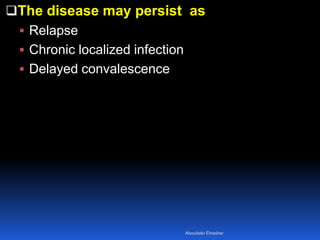
The disease may persist as
 Relapse
 Chronic localized infection
 Delayed convalescence
Aboubakr Elnashar
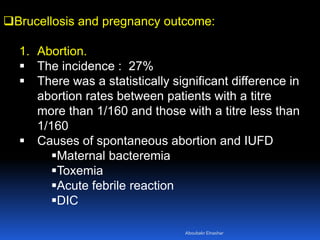
Brucellosis and pregnancy outcome:
1. Abortion.
 The incidence : 27%
 There was a statistically significant difference in
abortion rates between patients with a titre
more than 1/160 and those with a titre less than
1/160
 Causes of spontaneous abortion and IUFD
Maternal bacteremia
Toxemia
Acute febrile reaction
DIC
Aboubakr Elnashar
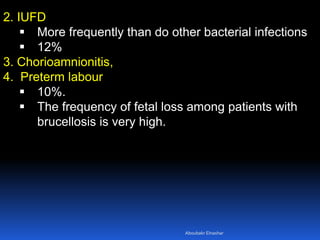
2. IUFD
 More frequently than do other bacterial infections
 12%
3. Chorioamnionitis,
4. Preterm labour
 10%.
 The frequency of fetal loss among patients with
brucellosis is very high.
Aboubakr Elnashar
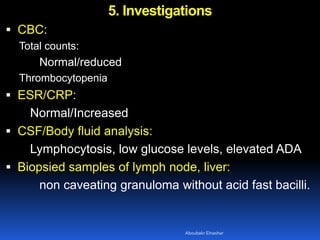
5. Investigations
 CBC:
Total counts:
Normal/reduced
Thrombocytopenia
 ESR/CRP:
Normal/Increased
 CSF/Body fluid analysis:
Lymphocytosis, low glucose levels, elevated ADA
 Biopsied samples of lymph node, liver:
non caveating granuloma without acid fast bacilli.
Aboubakr Elnashar
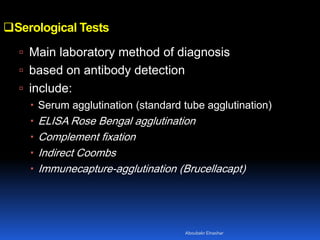
Serological Tests
 Main laboratory method of diagnosis
 based on antibody detection
 include:
 Serum agglutination (standard tube agglutination)
 ELISA Rose Bengal agglutination
 Complement fixation
 Indirect Coombs
 Immunecapture-agglutination (Brucellacapt)
Aboubakr Elnashar
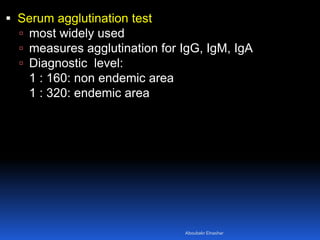
 Serum agglutination test
 most widely used
 measures agglutination for IgG, IgM, IgA
 Diagnostic level:
1 : 160: non endemic area
1 : 320: endemic area
Aboubakr Elnashar
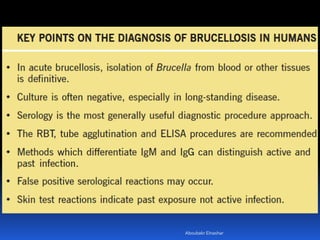
Aboubakr Elnashar
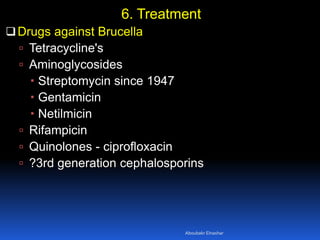
6. Treatment
Drugs against Brucella
 Tetracycline's
 Aminoglycosides
 Streptomycin since 1947
 Gentamicin
 Netilmicin
 Rifampicin
 Quinolones - ciprofloxacin
 ?3rd generation cephalosporins
Aboubakr Elnashar
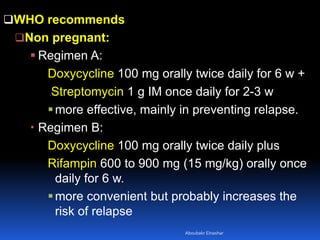
WHO recommends
Non pregnant:
 Regimen A:
Doxycycline 100 mg orally twice daily for 6 w +
Streptomycin 1 g IM once daily for 2-3 w
more effective, mainly in preventing relapse.
 Regimen B:
Doxycycline 100 mg orally twice daily plus
Rifampin 600 to 900 mg (15 mg/kg) orally once
daily for 6 w.
more convenient but probably increases the
risk of relapse
Aboubakr Elnashar
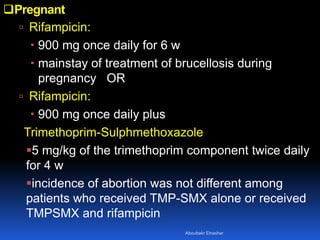
Pregnant
 Rifampicin:
 900 mg once daily for 6 w
 mainstay of treatment of brucellosis during
pregnancy OR
 Rifampicin:
 900 mg once daily plus
Trimethoprim-Sulphmethoxazole
5 mg/kg of the trimethoprim component twice daily
for 4 w
incidence of abortion was not different among
patients who received TMP-SMX alone or received
TMPSMX and rifampicin
Aboubakr Elnashar
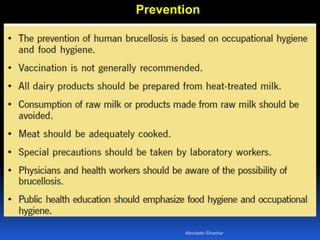
Prevention
Aboubakr Elnashar
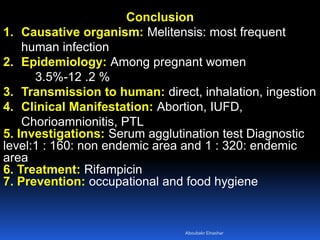
Conclusion
1. Causative organism: Melitensis: most frequent
human infection
2. Epidemiology: Among pregnant women
3.5%-12 .2 %
3. Transmission to human: direct, inhalation, ingestion
4. Clinical Manifestation: Abortion, IUFD,
Chorioamnionitis, PTL
5. Investigations: Serum agglutination test Diagnostic
level:1 : 160: non endemic area and 1 : 320: endemic
area
6. Treatment: Rifampicin
7. Prevention: occupational and food hygiene
Aboubakr Elnashar
Aboubakr Elnashar
You can get this lecture from:
1.My scientific page on Face book:
Aboubakr Elnashar Lectures.
https://www.facebook.com/groups/2277
44884091351/
2.Slide share web site
3.elnashar53@hotmail.com
4.My clinic: Elthwara St. Mansura

Brucellosis and pregnancy

  • 1.
  • 2.
    Other names forBrucellosis  Undulant fever  Malta fever  Mediterranean fever. Aboubakr Elnashar
  • 3.
    CONTENTS 1. Causative organism 2.Epidemiology 3. Transmission to human 4. Clinical Manifestation 5. Investigations 6. Treatment 7. Prevention Aboubakr Elnashar
  • 4.
    1. Causative organism Brucella Coccobacillus,gram negative, non-sporing Non-motile aerobic bacterium Hosts: mostly animals. Four species: Melitensis: most frequent human infection Abortus Suis Canis Aboubakr Elnashar
  • 5.
    2. Epidemiology  Majorzoonotic disease.  Worldwide  Major endemic areas: Mediterranean basin Arabian Gulf Indian subcontinent, Parts of Mexico Central and South America Aboubakr Elnashar
  • 6.
    Risk factors: 1. Familyhistory of brucellosis 2. Stockbreeding 3. Ingestion of non-pasteurized dairy products: most common source of transmission.  Occupational status and family history of brucellosis should be obtained during prenatal care in at-risk areas. ‫الماشيه‬ ‫تربيه‬ Aboubakr Elnashar
  • 7.
    Brucellosis in SaudiArabia Endemic National prevalence: 15% 1. Persistence of domestic animal reservoirs for Brucella species 2. Human consumption of unpasteurized products Aboubakr Elnashar
  • 8.
    Brucellosis in Egypt: Incidence: common. Amongpregnant women 3.5% {Sherif et al.2003] 12 .2 % (Alshamy and Ahmed, 2008) Aboubakr Elnashar
  • 9.
    3. Methods oftransmission 1. Direct 1. inoculation through cuts and skin abrasions from handling animal carcasses, placentas, or contact with animal vaginal secretions 2. Direct conjunctival inoculation 2. Inhalation of infectious aerosols 3. Ingestion of contaminated food such as raw milk, cheese made from unpasteurized (raw) milk, or raw meat  Venereal has been suggested, but the data are not conclusive Aboubakr Elnashar
  • 10.
     Types oftransmission 1. Consumption of: 1. unpasteurized milk 2. soft cheeses made from the milk of infected animals, primarily goats, infected with B melitensis 2. Occupational 1. laboratory workers 2. Veterinarians 3. Slaughterhouse workers. Aboubakr Elnashar
  • 11.
    Incubation period  Fewdays to a few months.  In most patients  2 and 6 w  Duration depend on:  virulence of the infecting strain  size of the inoculum  route of infection  resistance of the host Aboubakr Elnashar
  • 12.
    Portals of entry Oral entry  Most common route  Ingestion of contaminated animal products (often raw milk or its derivatives)  Contact with contaminated fingers  Aerosols  Inhalation of bacteria  Contamination of the conjunctivae  Per cutaneous  through skin abrasions or by accidental inoculation Aboubakr Elnashar
  • 13.
    4. Clinical Manifestation UsuallyAcute febrile illness accompanied by a wide array of other symptoms  Night sweats  Malaise  Anorexia  Arthralgia  Fatigue  Weight loss  Depression. Aboubakr Elnashar
  • 14.
    Fever 1. Acute stages:high 2. undulant stages: low grade and intermittent 3. Chronic stages: low grade or absent Aboubakr Elnashar
  • 15.
     Complications mayaffect any organ system 1. Osteoarticular disease most common complication (i.e., sacroiliitis and peripheral arthritis) 2. Genitourinary disease second most common complication. 3. Liver disease second most common medical complication in brucellosis are more susceptible to develop liver disease. Aboubakr Elnashar
  • 16.
    4. Hematological disease Anaemia: foundin 72.3% {role of iron in the biology of Brucella} Leukopenia and lymphopenia (the latter considered a prognostic factor) Leukocytosis 23.1% Thrombocytopenia: occurs rarely : fatal CNS bleeding. Aboubakr Elnashar
  • 17.
    The disease maypersist as  Relapse  Chronic localized infection  Delayed convalescence Aboubakr Elnashar
  • 18.
    Brucellosis and pregnancyoutcome: 1. Abortion.  The incidence : 27%  There was a statistically significant difference in abortion rates between patients with a titre more than 1/160 and those with a titre less than 1/160  Causes of spontaneous abortion and IUFD Maternal bacteremia Toxemia Acute febrile reaction DIC Aboubakr Elnashar
  • 19.
    2. IUFD  Morefrequently than do other bacterial infections  12% 3. Chorioamnionitis, 4. Preterm labour  10%.  The frequency of fetal loss among patients with brucellosis is very high. Aboubakr Elnashar
  • 20.
    5. Investigations  CBC: Totalcounts: Normal/reduced Thrombocytopenia  ESR/CRP: Normal/Increased  CSF/Body fluid analysis: Lymphocytosis, low glucose levels, elevated ADA  Biopsied samples of lymph node, liver: non caveating granuloma without acid fast bacilli. Aboubakr Elnashar
  • 21.
    Serological Tests  Mainlaboratory method of diagnosis  based on antibody detection  include:  Serum agglutination (standard tube agglutination)  ELISA Rose Bengal agglutination  Complement fixation  Indirect Coombs  Immunecapture-agglutination (Brucellacapt) Aboubakr Elnashar
  • 22.
     Serum agglutinationtest  most widely used  measures agglutination for IgG, IgM, IgA  Diagnostic level: 1 : 160: non endemic area 1 : 320: endemic area Aboubakr Elnashar
  • 23.
  • 24.
    6. Treatment Drugs againstBrucella  Tetracycline's  Aminoglycosides  Streptomycin since 1947  Gentamicin  Netilmicin  Rifampicin  Quinolones - ciprofloxacin  ?3rd generation cephalosporins Aboubakr Elnashar
  • 25.
    WHO recommends Non pregnant: Regimen A: Doxycycline 100 mg orally twice daily for 6 w + Streptomycin 1 g IM once daily for 2-3 w more effective, mainly in preventing relapse.  Regimen B: Doxycycline 100 mg orally twice daily plus Rifampin 600 to 900 mg (15 mg/kg) orally once daily for 6 w. more convenient but probably increases the risk of relapse Aboubakr Elnashar
  • 26.
    Pregnant  Rifampicin:  900mg once daily for 6 w  mainstay of treatment of brucellosis during pregnancy OR  Rifampicin:  900 mg once daily plus Trimethoprim-Sulphmethoxazole 5 mg/kg of the trimethoprim component twice daily for 4 w incidence of abortion was not different among patients who received TMP-SMX alone or received TMPSMX and rifampicin Aboubakr Elnashar
  • 27.
  • 28.
    Conclusion 1. Causative organism:Melitensis: most frequent human infection 2. Epidemiology: Among pregnant women 3.5%-12 .2 % 3. Transmission to human: direct, inhalation, ingestion 4. Clinical Manifestation: Abortion, IUFD, Chorioamnionitis, PTL 5. Investigations: Serum agglutination test Diagnostic level:1 : 160: non endemic area and 1 : 320: endemic area 6. Treatment: Rifampicin 7. Prevention: occupational and food hygiene Aboubakr Elnashar
  • 29.
    Aboubakr Elnashar You canget this lecture from: 1.My scientific page on Face book: Aboubakr Elnashar Lectures. https://www.facebook.com/groups/2277 44884091351/ 2.Slide share web site 3.elnashar53@hotmail.com 4.My clinic: Elthwara St. Mansura