low dose
Aspirin
in obstetrics
Aboubakr
Elnashar
Benha University
Hospital, Egypt
Aboubakr Elnashar
Contents
I. SAFETY
II. Mechanism of action
III.USES:
1.Prevention of
1.PET
2. IUGR
3.PTL
4.hypertension in multiple pregnancy
5.repeated miscarriage
6.DVT
2.Treatment of antiphysolipid syndrome
Aboubakr Elnashar
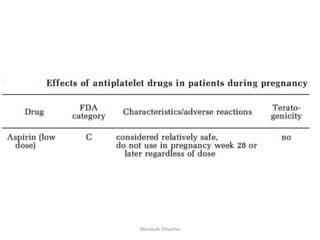
I. SAFETY
Fetal and neonatal complications
stillbirths, neonatal death, birth defects:
Similar
(Ahren et al, 2016).
No increased risk of hemorrhage
either before or after delivery
(HR: .57, 95% CI: .25-1.33; p = .194).
(Ayal et al, 2013)
Aboubakr Elnashar
SCH
LDA: 40.2%
Control: 10.9%
LDA may be associated with an increased risk of
developing a SCH during the first trimester.
(Truong et al, 2016)
Vaginal bleeding:
LDA: 22%
Control: 17%, P=0.02
(Ahren et al, 2016).
Aboubakr Elnashar
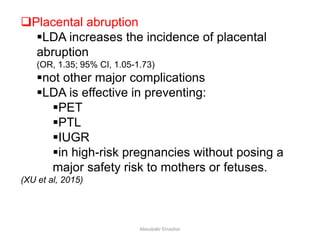
Placental abruption
LDA increases the incidence of placental
abruption
(OR, 1.35; 95% CI, 1.05-1.73)
not other major complications
LDA is effective in preventing:
PET
PTL
IUGR
in high-risk pregnancies without posing a
major safety risk to mothers or fetuses.
(XU et al, 2015)
Aboubakr Elnashar
No adverse effects on infants
Decrease behavioral difficulties
(Vinod et al, 2009)
Aboubakr Elnashar
Aboubakr Elnashar
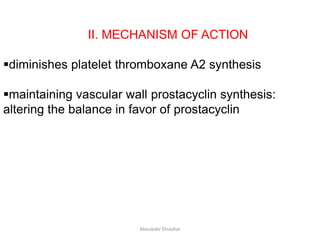
II. MECHANISM OF ACTION
diminishes platelet thromboxane A2 synthesis
maintaining vascular wall prostacyclin synthesis:
altering the balance in favor of prostacyclin
Aboubakr Elnashar
Aboubakr Elnashar
III. USES
1. Prevention of PET
Rationale
PE:
increased platelet turnover
increased platelet derived thromboxane levels
LDA:
diminishes platelet thromboxane A2
synthesis while
maintaining vascular wall prostacyclin
synthesis: altering the balance in favor of
prostacyclin
Aboubakr Elnashar
I. Studies on moderate and high risk women
low dose aspirin: effective
modest reduction in risk of
PE (0-3% in treated vs 12-35% in controls)
other adverse pregnancy outcome:
PTL, IUGR (by 10-20%).
[Dekker et al, 2001].level 2 evidence (Cochrane SR, 2007 )
Aboubakr Elnashar
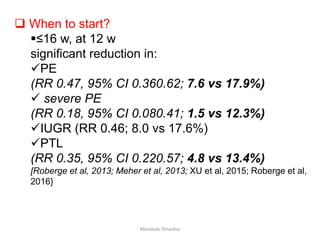
 When to start?
≤16 w, at 12 w
significant reduction in:
PE
(RR 0.47, 95% CI 0.360.62; 7.6 vs 17.9%)
 severe PE
(RR 0.18, 95% CI 0.080.41; 1.5 vs 12.3%)
IUGR (RR 0.46; 8.0 vs 17.6%)
PTL
(RR 0.35, 95% CI 0.220.57; 4.8 vs 13.4%)
[Roberge et al, 2013; Meher et al, 2013; XU et al, 2015; Roberge et al,
2016}
Aboubakr Elnashar
Dose:
75-80 mg seems to be the right dosage for about
two thirds of the women
[Rey et al, 2011]
1/3: need higher dosages up to 160 mg
Aspirin resistance test:
woman is resistant to 75-80 mg: increase the
dose.
(Bujold, 2013)
100 mg/d should be the minimum dose for
prevention of complications in pregnancy
(Ayal et al, 2013)
Aboubakr Elnashar
Aspirin non-responsiveness= Aspirin
resistance= Aspirin treatment failure
Significant proportion of aspirin-treated
individuals exhibit suboptimal platelet response
inability of aspirin to reduce platelet
production of thromboxane A2 and thereby
platelet activation and aggregation.
Determination:
Measurements of
whole blood TXA2 formation
urinary excretion of TXA2 metabolites
Aboubakr Elnashar
Causes
inadequate dose
drug interactions
genetic polymorphisms of COX-1 and other
genes involved in thromboxane biosynthesis
upregulation of non-platelet sources of
thromboxane biosynthesis
increased platelet turnover.
can be overcome by
treating the cause or causes
 minimising thromboxane production and activity
blocking other pathways of platelet activation.
Aboubakr Elnashar
 At bed time:
 Not upon awakening
 significantly regulates ambulatory BP
 reduces the incidence of
 Preeclampsia
 gestational hypertension
 preterm delivery, and
 IUGR.
(Ayal et al, 2013)
Aboubakr Elnashar
II. Unselected nulliparous women
little or no benefit
[Sibai et al, 1993]
no effect on incidence of FGR, or length of
gestation
[Subtil et al, 2003].
1. Although nulliparity is a risk factor for PE,
prevalence rates are relatively low (4%)
compared with moderate to high risk groups
(8-30%)
[Henderson et al, 2014].
2. Pathogenesis of PE in nulliparous is
different from that in women with previous
PE or preexisting vascular disease
[Sibai et al, 2005].
Aboubakr Elnashar
III. Studies on women with abnormal uterine artery
Doppler (UAD)
Abnormal UAD: identified women who are likely
to develop PE and IUGR
[Subtil et al, 2003].
PE: 6 vs 1%
IUGR: 18 vs 8%
LDA of abnormal UAD:
Did not reduce the incidence of PE
PE occurred in 2% of patients in each group.
Did not reduce the incidence of IUGR.
Aboubakr Elnashar
Guidelines
ACOG, 2013
LDA:
not recommended for women at low risk for
PE.
Recommend in high risk women: women
with history of :
early onset PE
superimposed PE plus delivery at <34 w
or
PE in >1 pregnancy.
Aboubakr Elnashar
NICE, 2010
low dose (75 mg) aspirin for
 1 high risk factor for PE
chronic hypertension
kidney disease
diabetes
autoimmune disease
hypertension in previous pregnancy OR
2 moderate risk factors for PE
age ≥40 y
first pregnancy
multiple gestation
>10 y between pregnancies,
BMI≥35 kg/m at presentation
family history of PE
Aboubakr Elnashar
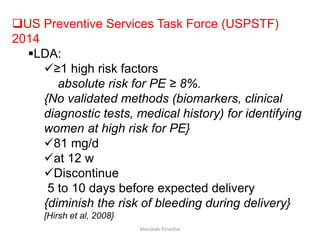
US Preventive Services Task Force (USPSTF)
2014
LDA:
≥1 high risk factors
absolute risk for PE ≥ 8%.
{No validated methods (biomarkers, clinical
diagnostic tests, medical history) for identifying
women at high risk for PE}
81 mg/d
at 12 w
Discontinue
5 to 10 days before expected delivery
{diminish the risk of bleeding during delivery}
[Hirsh et al, 2008}
Aboubakr Elnashar
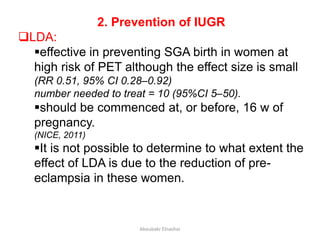
2. Prevention of IUGR
LDA:
effective in preventing SGA birth in women at
high risk of PET although the effect size is small
(RR 0.51, 95% CI 0.28–0.92)
number needed to treat = 10 (95%CI 5–50).
should be commenced at, or before, 16 w of
pregnancy.
(NICE, 2011)
It is not possible to determine to what extent the
effect of LDA is due to the reduction of pre-
eclampsia in these women.
Aboubakr Elnashar
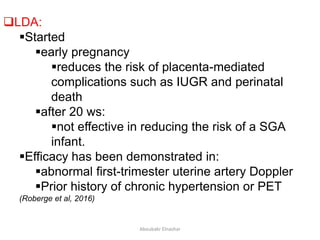
LDA:
Started
early pregnancy
reduces the risk of placenta-mediated
complications such as IUGR and perinatal
death
after 20 ws:
not effective in reducing the risk of a SGA
infant.
Efficacy has been demonstrated in:
abnormal first-trimester uterine artery Doppler
Prior history of chronic hypertension or PET
(Roberge et al, 2016)
Aboubakr Elnashar
3. Prevention of PTL
LDA
started early in pregnancy in high-risk women:
prevent more than half of PET and IUGR
significant decrease of PTL
(relative risk 0.22, 95% confidence interval: 0.10-0.49).
(Bujol et al, 2011)
could become an additional weapon in the
prevention of PTL
Aboubakr Elnashar
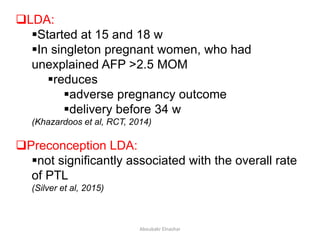
LDA:
Started at 15 and 18 w
In singleton pregnant women, who had
unexplained AFP >2.5 MOM
reduces
adverse pregnancy outcome
delivery before 34 w
(Khazardoos et al, RCT, 2014)
Preconception LDA:
not significantly associated with the overall rate
of PTL
(Silver et al, 2015)
Aboubakr Elnashar
4. Prevention of adverse pregnancy outcome In
multiple pregnancy
LDA:
75 mg daily from 12 w until the birth of the babies
if they have one or more of the following risk factors
for hypertension:
1. first pregnancy
2. age 40 years or older
3. pregnancy interval of more than 10 y
4. BMI of 35 kg/m2 or more at first visit
5. family history of PET.
(NICE, 2011)
Aboubakr Elnashar
5. Prevention of RM
Preconception initiated LDA:
1-2 previous losses:
no significantly associated with live birth or
pregnancy loss
Single documented loss at less than 20 ws during
the previous year:
higher live birth rates
Not recommended for the prevention of pregnancy
loss
(Schisterma et al, 2014; Mumfor et al, 2016)
Aboubakr Elnashar
Preconception-initiated LDA
history of 1-2 pregnancy losses:
non significant increase in fecundability of
14%
history of only one pregnancy loss of <20 w in
the preceding year:
significant increase of 28%
Preconception-initiated LDA may increase
fecundability in certain women with a recent
early pregnancy loss
(Schisterma et al, 2015)
Aboubakr Elnashar
LDA+ LMWH:
No reduction in pregnancy loss rate in pregnant
women with 2 or more consecutive previous
pregnancy losses.
(SPIN (Scottish Pregnancy Intervention) multicenter, RCT; Clar
et al, 2010)
Aboubakr Elnashar
6. Prevention of thrombosis
Not recommended in:
Any patient group
(American College of Physicians)
Obstetric patient:
(RCOG, 2015)
Postoperative
(NICE,2013)
Aboubakr Elnashar
7. Treatment of APAS
Improvement of fetal outcomes in APAS
LDA
in combination with heparin is the first line
treatment
(MRCOG, 2011)
-Success:
70%
(Rai et al,1997)
-Reduces the miscarriage rate by
54%
(Empson et al, Cochrane Database Syst Rev, 2005)
Aboubakr Elnashar
 Baseline nonpregnant studies of aPLs:
 CBC with platelets
 PT, PTT
 LA, aCL and aβ2GP
LDA:
75-81 mg:
initiated before conception
discontinued 4 ws before EDD
resumed postpartum
continued for life unless otherwise contraindicated
Aboubakr Elnashar
Thanks
Aboubakr Elnashar

low dose Aspirin in obstetrics

  • 1.
    low dose Aspirin in obstetrics Aboubakr Elnashar BenhaUniversity Hospital, Egypt Aboubakr Elnashar
  • 2.
    Contents I. SAFETY II. Mechanismof action III.USES: 1.Prevention of 1.PET 2. IUGR 3.PTL 4.hypertension in multiple pregnancy 5.repeated miscarriage 6.DVT 2.Treatment of antiphysolipid syndrome Aboubakr Elnashar
  • 3.
    I. SAFETY Fetal andneonatal complications stillbirths, neonatal death, birth defects: Similar (Ahren et al, 2016). No increased risk of hemorrhage either before or after delivery (HR: .57, 95% CI: .25-1.33; p = .194). (Ayal et al, 2013) Aboubakr Elnashar
  • 4.
    SCH LDA: 40.2% Control: 10.9% LDAmay be associated with an increased risk of developing a SCH during the first trimester. (Truong et al, 2016) Vaginal bleeding: LDA: 22% Control: 17%, P=0.02 (Ahren et al, 2016). Aboubakr Elnashar
  • 5.
    Placental abruption LDA increasesthe incidence of placental abruption (OR, 1.35; 95% CI, 1.05-1.73) not other major complications LDA is effective in preventing: PET PTL IUGR in high-risk pregnancies without posing a major safety risk to mothers or fetuses. (XU et al, 2015) Aboubakr Elnashar
  • 6.
    No adverse effectson infants Decrease behavioral difficulties (Vinod et al, 2009) Aboubakr Elnashar
  • 7.
  • 8.
    II. MECHANISM OFACTION diminishes platelet thromboxane A2 synthesis maintaining vascular wall prostacyclin synthesis: altering the balance in favor of prostacyclin Aboubakr Elnashar
  • 9.
  • 10.
    III. USES 1. Preventionof PET Rationale PE: increased platelet turnover increased platelet derived thromboxane levels LDA: diminishes platelet thromboxane A2 synthesis while maintaining vascular wall prostacyclin synthesis: altering the balance in favor of prostacyclin Aboubakr Elnashar
  • 11.
    I. Studies onmoderate and high risk women low dose aspirin: effective modest reduction in risk of PE (0-3% in treated vs 12-35% in controls) other adverse pregnancy outcome: PTL, IUGR (by 10-20%). [Dekker et al, 2001].level 2 evidence (Cochrane SR, 2007 ) Aboubakr Elnashar
  • 12.
     When tostart? ≤16 w, at 12 w significant reduction in: PE (RR 0.47, 95% CI 0.360.62; 7.6 vs 17.9%)  severe PE (RR 0.18, 95% CI 0.080.41; 1.5 vs 12.3%) IUGR (RR 0.46; 8.0 vs 17.6%) PTL (RR 0.35, 95% CI 0.220.57; 4.8 vs 13.4%) [Roberge et al, 2013; Meher et al, 2013; XU et al, 2015; Roberge et al, 2016} Aboubakr Elnashar
  • 13.
    Dose: 75-80 mg seemsto be the right dosage for about two thirds of the women [Rey et al, 2011] 1/3: need higher dosages up to 160 mg Aspirin resistance test: woman is resistant to 75-80 mg: increase the dose. (Bujold, 2013) 100 mg/d should be the minimum dose for prevention of complications in pregnancy (Ayal et al, 2013) Aboubakr Elnashar
  • 14.
    Aspirin non-responsiveness= Aspirin resistance=Aspirin treatment failure Significant proportion of aspirin-treated individuals exhibit suboptimal platelet response inability of aspirin to reduce platelet production of thromboxane A2 and thereby platelet activation and aggregation. Determination: Measurements of whole blood TXA2 formation urinary excretion of TXA2 metabolites Aboubakr Elnashar
  • 15.
    Causes inadequate dose drug interactions geneticpolymorphisms of COX-1 and other genes involved in thromboxane biosynthesis upregulation of non-platelet sources of thromboxane biosynthesis increased platelet turnover. can be overcome by treating the cause or causes  minimising thromboxane production and activity blocking other pathways of platelet activation. Aboubakr Elnashar
  • 16.
     At bedtime:  Not upon awakening  significantly regulates ambulatory BP  reduces the incidence of  Preeclampsia  gestational hypertension  preterm delivery, and  IUGR. (Ayal et al, 2013) Aboubakr Elnashar
  • 17.
    II. Unselected nulliparouswomen little or no benefit [Sibai et al, 1993] no effect on incidence of FGR, or length of gestation [Subtil et al, 2003]. 1. Although nulliparity is a risk factor for PE, prevalence rates are relatively low (4%) compared with moderate to high risk groups (8-30%) [Henderson et al, 2014]. 2. Pathogenesis of PE in nulliparous is different from that in women with previous PE or preexisting vascular disease [Sibai et al, 2005]. Aboubakr Elnashar
  • 18.
    III. Studies onwomen with abnormal uterine artery Doppler (UAD) Abnormal UAD: identified women who are likely to develop PE and IUGR [Subtil et al, 2003]. PE: 6 vs 1% IUGR: 18 vs 8% LDA of abnormal UAD: Did not reduce the incidence of PE PE occurred in 2% of patients in each group. Did not reduce the incidence of IUGR. Aboubakr Elnashar
  • 19.
    Guidelines ACOG, 2013 LDA: not recommendedfor women at low risk for PE. Recommend in high risk women: women with history of : early onset PE superimposed PE plus delivery at <34 w or PE in >1 pregnancy. Aboubakr Elnashar
  • 20.
    NICE, 2010 low dose(75 mg) aspirin for  1 high risk factor for PE chronic hypertension kidney disease diabetes autoimmune disease hypertension in previous pregnancy OR 2 moderate risk factors for PE age ≥40 y first pregnancy multiple gestation >10 y between pregnancies, BMI≥35 kg/m at presentation family history of PE Aboubakr Elnashar
  • 21.
    US Preventive ServicesTask Force (USPSTF) 2014 LDA: ≥1 high risk factors absolute risk for PE ≥ 8%. {No validated methods (biomarkers, clinical diagnostic tests, medical history) for identifying women at high risk for PE} 81 mg/d at 12 w Discontinue 5 to 10 days before expected delivery {diminish the risk of bleeding during delivery} [Hirsh et al, 2008} Aboubakr Elnashar
  • 22.
    2. Prevention ofIUGR LDA: effective in preventing SGA birth in women at high risk of PET although the effect size is small (RR 0.51, 95% CI 0.28–0.92) number needed to treat = 10 (95%CI 5–50). should be commenced at, or before, 16 w of pregnancy. (NICE, 2011) It is not possible to determine to what extent the effect of LDA is due to the reduction of pre- eclampsia in these women. Aboubakr Elnashar
  • 23.
    LDA: Started early pregnancy reduces therisk of placenta-mediated complications such as IUGR and perinatal death after 20 ws: not effective in reducing the risk of a SGA infant. Efficacy has been demonstrated in: abnormal first-trimester uterine artery Doppler Prior history of chronic hypertension or PET (Roberge et al, 2016) Aboubakr Elnashar
  • 24.
    3. Prevention ofPTL LDA started early in pregnancy in high-risk women: prevent more than half of PET and IUGR significant decrease of PTL (relative risk 0.22, 95% confidence interval: 0.10-0.49). (Bujol et al, 2011) could become an additional weapon in the prevention of PTL Aboubakr Elnashar
  • 25.
    LDA: Started at 15and 18 w In singleton pregnant women, who had unexplained AFP >2.5 MOM reduces adverse pregnancy outcome delivery before 34 w (Khazardoos et al, RCT, 2014) Preconception LDA: not significantly associated with the overall rate of PTL (Silver et al, 2015) Aboubakr Elnashar
  • 26.
    4. Prevention ofadverse pregnancy outcome In multiple pregnancy LDA: 75 mg daily from 12 w until the birth of the babies if they have one or more of the following risk factors for hypertension: 1. first pregnancy 2. age 40 years or older 3. pregnancy interval of more than 10 y 4. BMI of 35 kg/m2 or more at first visit 5. family history of PET. (NICE, 2011) Aboubakr Elnashar
  • 27.
    5. Prevention ofRM Preconception initiated LDA: 1-2 previous losses: no significantly associated with live birth or pregnancy loss Single documented loss at less than 20 ws during the previous year: higher live birth rates Not recommended for the prevention of pregnancy loss (Schisterma et al, 2014; Mumfor et al, 2016) Aboubakr Elnashar
  • 28.
    Preconception-initiated LDA history of1-2 pregnancy losses: non significant increase in fecundability of 14% history of only one pregnancy loss of <20 w in the preceding year: significant increase of 28% Preconception-initiated LDA may increase fecundability in certain women with a recent early pregnancy loss (Schisterma et al, 2015) Aboubakr Elnashar
  • 29.
    LDA+ LMWH: No reductionin pregnancy loss rate in pregnant women with 2 or more consecutive previous pregnancy losses. (SPIN (Scottish Pregnancy Intervention) multicenter, RCT; Clar et al, 2010) Aboubakr Elnashar
  • 30.
    6. Prevention ofthrombosis Not recommended in: Any patient group (American College of Physicians) Obstetric patient: (RCOG, 2015) Postoperative (NICE,2013) Aboubakr Elnashar
  • 31.
    7. Treatment ofAPAS Improvement of fetal outcomes in APAS LDA in combination with heparin is the first line treatment (MRCOG, 2011) -Success: 70% (Rai et al,1997) -Reduces the miscarriage rate by 54% (Empson et al, Cochrane Database Syst Rev, 2005) Aboubakr Elnashar
  • 32.
     Baseline nonpregnantstudies of aPLs:  CBC with platelets  PT, PTT  LA, aCL and aβ2GP LDA: 75-81 mg: initiated before conception discontinued 4 ws before EDD resumed postpartum continued for life unless otherwise contraindicated Aboubakr Elnashar
  • 33.