Ovarian
Reserve
SOGC, 2011
NICE, 2013
ESHRE, ACOG, 2015
Aboubakr Elnashar
Benha university, Egypt
ABOUBAKR ELNASHAR
CONTENTS
1.OVARIAN AGING
2.OVARIAN RESERVE
3.OVARIAN RESERVE TESTS
ABOUBAKR ELNASHAR
OVARIAN AGING
What:
Oocytes peak in number during fetal life.
Over time, oocytes decrease in quantity and
quality and do not regenerate
Although this reproductive decline occurs with age,
there is significant variation in fertility among women
of similar age, which highlights the unpredictability
and individuality of the reproductive aging process
ABOUBAKR ELNASHAR
ABOUBAKR ELNASHAR
At birth:
1–2 million oocytes in her ovaries
As a woman ages:
absolute number of developing follicles declines at a
rate that is bi-exponential to her age.
At 37.5 y:
Rate of follicle loss (atresia) more than doubles
OR falls below the critical level of 25,000
As the ovarian follicular pool decreases:
Infertility
Cycle shortening
Cycle irregularity and finally
Menopause
ABOUBAKR ELNASHAR
Number of primordial follicles and
Poor quality of oocytes in relation to
Female age and
Reproductive events.
ABOUBAKR ELNASHAR
ABOUBAKR ELNASHAR
OVARIAN RESERVE
What:
Reproductive potential
function of the number and quality of remaining
oocytes.
ABOUBAKR ELNASHAR
Predictors of ovarian reserve
1. Age
2. History of poor response or cancelled cycles
3. Menstrual cycle length
4. ORT:
Most important: AFC &AMH
best test for quantitative OR
(Broer et al., 2009; IMPORT study 2013)
ABOUBAKR ELNASHAR
Decreased or diminished ovarian reserve (DOR)
What:
Commonly have regular menses but
reduced quantity of ovarian follicles:
limited response to ovarian stimulation
reduced fecundity
(probability of achieving a live birth in a single
reproductive cycle).
Distinct from:
menopause or
premature ovarian failure (also referred to as
primary ovarian insufficiency)
ABOUBAKR ELNASHAR
Causes:
In most cases, are unknown.
It is unclear whether DOR represents a
pathologic condition resulting from
1. abnormally rapid atresia in a normal pool
of oocytes,
2. normal atresia of an abnormally small
initial pool of oocytes, or
3. simply the extreme end of a normal bell-
shaped population distribution of the
number of oocytes at a given age.
ABOUBAKR ELNASHAR
Risk Factors
• Advanced reproductive age (older than 35 years)
• Family history of early menopause
• Genetic conditions:
45,X mosaicism
• FMR1 (Fragile X) premutation carrier
• Conditions that can cause ovarian injury
endometriosis
pelvic infection
• Previous ovarian surgery (eg, for endometriomas)
• Oophorectomy
• History of
gonadotoxic therapy or
pelvic irradiation
• Smoking ABOUBAKR ELNASHAR
OVARIAN RESERVE TESTS:
The purpose
Predict ovarian reserve and/or reproductive
potential
Identify infertility patients at risk for DOR, who
are more likely to
exhibit a ‘‘poor’’ response to gonadotropin
stimulation
have a lesser chance of achieving pregnancy
with ART.
 Prognosis
 Dose of the drugs
 Safety consideration
ABOUBAKR ELNASHAR
Indications:
≥ 35 ys not conceived after 6 months or
< 35 ys
Endometriosis
Unexplained infertility
Single ovary
Previous ovarian surgery,
Poor response to FSH,
Previous exposure to chemotherapy or
radiation
(Iii-b) SOGC, 2011
ABOUBAKR ELNASHAR
Types:
Biochemical tests
reflect the biology of the aging ovary, the one
component of the reproductive system most
closely related to decreased fecundity.
Basal measurements
FSH, AMH, E2, inhibin B
Dynamic= Provocative tests
assess the response of the
hypothalamic–pituitary– ovarian axis to
a stimulus.
CCCT.
ABOUBAKR ELNASHAR
Ultrasonographic
AFC
ovarian volume.
ABOUBAKR ELNASHAR
The ideal screening test
Purpose of a screening test is to identify persons
at risk for a disease.
Reproducible:
with low intercycle and intracycle variability
High specificity
to minimize the risk of a false-positive
determination of DOR in a woman with
normal ovarian reserve
Specificity
Probability of the test to be negative when the disease is absent
True negative test ABOUBAKR ELNASHAR
ABOUBAKR ELNASHAR
Selection of tests
AMH, AFC and FSH individually predict low and high
response, and combinations did not have any better
predictive accuracy criteria, no merit in
recommending them in combination.
The choice should be based
laboratory resources
availability of a skilled ultrasonographer.
Do not use any of the following tests
ovarian volume
ovarian blood flow
inhibin B
E2 as individual tests
CCCT.
(NICE, 2013) ABOUBAKR ELNASHAR
The most appropriate ORT to use in practice are
basal FSH plus E2 levels or
AMH levels.
AFC, also may be useful if there is an indication
to perform TVS
(ESHRE, ACOG, 2015)
ABOUBAKR ELNASHAR
Use a woman’s age
 as an initial predictor of her overall chance of
success through natural conception or with IVF
Use one of the following
High responseLow response
16 or more4 or lessTotal AFC
3.5 or more
25
0.8 or less
5.5
AMH
ng/ml
pmol/l
Conversion ratio:7
4 or less8.9 or moreFSH IU/L
ABOUBAKR ELNASHAR
Significance:
1. All detect the quantity rather than the quality of the
follicular pool
2. Although these tests are used to assess oocyte
quantity and quality, the best surrogate marker for
oocyte quality is age
(Broekmans et al. 2006)
3. Add prognostic information to the counseling and
planning process:
help couples choose among treatment options
ABOUBAKR ELNASHAR
4. Predict response to ovarian stimulation and
potentially, successful outcome with ART.
5. Help in determining
dose of HMG/FSH
protocol of stimulation to be used
but they are poor predictors of PR
(Fauser et al 2007)
ABOUBAKR ELNASHAR
6. Poor predictive value for non pregnancy:
should be used to exclude women from tt only
if levels are significantly abnormal.
(II-2a) SOGC, 2011
should not be the sole criteria used to deny
patients access to ART or other treatments.
{Evidence of DOR does not necessarily equate
with inability to conceive}.
(ACOG, ESHRE, 2015)
ABOUBAKR ELNASHAR
Female age and ovarian reserve test
useful for discussing prognosis and recommending a
treatment plan.
Younger women with DOR:
 reduced oocyte numbers but
may have normal oocyte quality
older women with normal OR:
 may have a good number of oocytes but
an age-appropriate decrease in oocyte quality.
ABOUBAKR ELNASHAR
When test results suggest DOR:
Infertility evaluation
Counsel the woman
opportunity to conceive may be shorter than
anticipated
attempting to conceive sooner rather than later is
encouraged.
Pursue more aggressive treatment options to
achieve pregnancy.
ABOUBAKR ELNASHAR
>39 y34–38 y24–33yParameter
1.1
(0.5–2.3)
1.6
(0.8–2.9)
2.1
(1.1–3.4)
AMH level
(ng/mL)
Median (interquartile range)
7.9
(6.2–10.6)
7.4
(6–9.4)
6.9
(5.5–8.3)
FSH level (IU/L)
Median (interquartile range)
7
(4–11)
10
(6–13)
11
(8–16)
AFC
Median (interquartile range)
(Imog et al ,2011)ABOUBAKR ELNASHAR
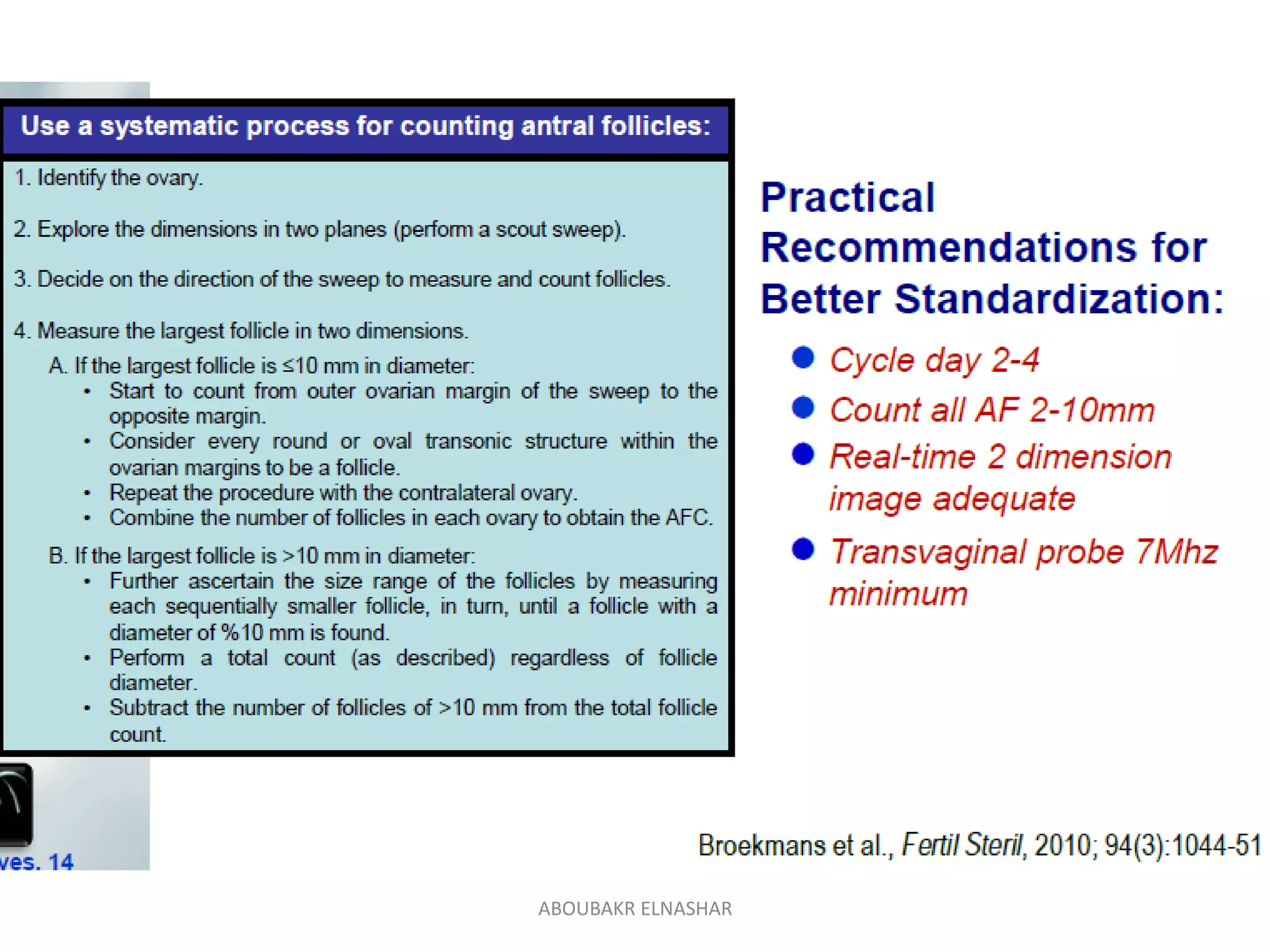
1. Antral Follicle Count (AFC)
 Total number of follicles measuring 2–10 millimeters
in diameter that are observed during an early
follicular phase TVS.
 Follicles >2mm are sensitive to FSH, termed as
recruitable
(Broekmans et al.,2010; La Marca et al.,2011)
 Correlates with size of
 the remaining follicular pool
 number of oocytes retrieved following stimulation.
– Inter-observer variation does not affect the
predictive power of the test.
– Automated 3D measurement of AFC
ABOUBAKR ELNASHAR
Antral follicle count
ABOUBAKR ELNASHAR
AFC
Standardize: 2–10 mm, D2-4 for more consistency and practicality
(Broekmans et al., 2010).
ABOUBAKR ELNASHAR
ABOUBAKR ELNASHAR
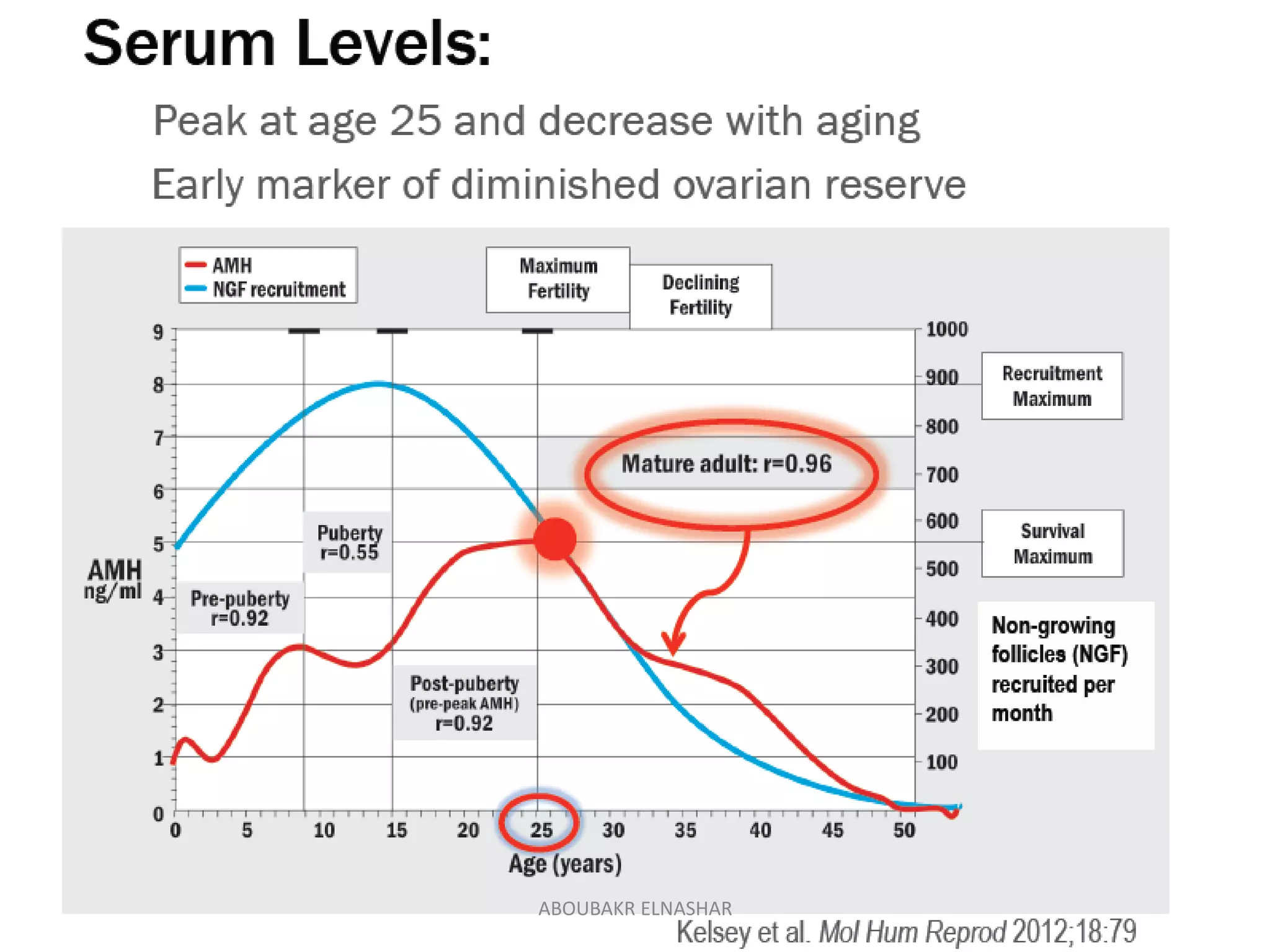
2. Anti-Mullerian hormone (AMH)
 Glycoprotein
 Produced by:
 granulosa cells of pre-antral and small antral
follicles
 falls linearly with increasing age
 Not cycle dependant:
 can be measured any day
 Less cycle to cycle variation than FSH
 Not effected by GnRHa:
 can be measured during downregulation
 Expensive
ABOUBAKR ELNASHAR
AMH gene expression and total AMH protein increased until a follicular diameter of 8
mm, after which a sharp decline occurred. In vivo modelling confirmed that 5–8 mm
follicles make the greatest contribution to serum AMH, estimated for the first time in
human to be 60% of the circulating concentration. J.V. Jeppesen et al, 2013
ABOUBAKR ELNASHAR
ABOUBAKR ELNASHAR
ABOUBAKR ELNASHAR
SELECTION OF PROTOCOL ACCORDING TO
OVARIAN Reserve
Reserve ‘Low’ ‘Average’ ‘High’
AFC <7 7-14 >14
AMH <1.1 ng/ml 1.1-3.5 >3.5
Starting FSH
dose IU
Amp
375
5
225
3
150
2
Protocol - Antagonist
-Microdose flare
-Agonist stop
-GH
-Natural
-Modified natural
-Long
protocol
-Antagonist
-Long
protocol
-Antagonist
ABOUBAKR ELNASHAR
3. Follicle Stimulating Hormone (FSH)
– Produced by the pituitary gland to stimulate eggs recruitment
and development
– If there are lots of eggs in the ovary,
– The ovary will send a signal to reduce FSH production
– FSH remains low
– If there are few eggs in the ovary,
– no meaningful signal will be send back and so
– FSH keep rising till it exhibits a response
– Measured Day 2 or 3 of cycle:
• Inconvenience of timing the sample
– Cannot predict hyper response
– Require concomitant oestradiol measurement
• Inter cycle variability from month to month
(Brown et al., J Repro Med 1995)
– Different laboratories different techniques/ levels
ABOUBAKR ELNASHAR
ABOUBAKR ELNASHAR
AMH Vs FSH
1. more expensive
2. significantly less inter- and intra-menstrual cycle
variability.
3. can be measured at any point of the menstrual
cycle unlike FSH, which is only interpretable
when measured during the first few days of the
cycle (‘baseline’).
4. During the earlier stages of decreased ovarian
reserve, there are often wide cycle to cycle
fluctuations in FSH level, not seen with AMH.
ABOUBAKR ELNASHAR
Thank youABOUBAKR ELNASHAR

OVARIAN RESERVE

  • 1.
    Ovarian Reserve SOGC, 2011 NICE, 2013 ESHRE,ACOG, 2015 Aboubakr Elnashar Benha university, Egypt ABOUBAKR ELNASHAR
  • 2.
  • 3.
    OVARIAN AGING What: Oocytes peakin number during fetal life. Over time, oocytes decrease in quantity and quality and do not regenerate Although this reproductive decline occurs with age, there is significant variation in fertility among women of similar age, which highlights the unpredictability and individuality of the reproductive aging process ABOUBAKR ELNASHAR
  • 4.
  • 5.
    At birth: 1–2 millionoocytes in her ovaries As a woman ages: absolute number of developing follicles declines at a rate that is bi-exponential to her age. At 37.5 y: Rate of follicle loss (atresia) more than doubles OR falls below the critical level of 25,000 As the ovarian follicular pool decreases: Infertility Cycle shortening Cycle irregularity and finally Menopause ABOUBAKR ELNASHAR
  • 6.
    Number of primordialfollicles and Poor quality of oocytes in relation to Female age and Reproductive events. ABOUBAKR ELNASHAR
  • 7.
  • 8.
    OVARIAN RESERVE What: Reproductive potential functionof the number and quality of remaining oocytes. ABOUBAKR ELNASHAR
  • 9.
    Predictors of ovarianreserve 1. Age 2. History of poor response or cancelled cycles 3. Menstrual cycle length 4. ORT: Most important: AFC &AMH best test for quantitative OR (Broer et al., 2009; IMPORT study 2013) ABOUBAKR ELNASHAR
  • 10.
    Decreased or diminishedovarian reserve (DOR) What: Commonly have regular menses but reduced quantity of ovarian follicles: limited response to ovarian stimulation reduced fecundity (probability of achieving a live birth in a single reproductive cycle). Distinct from: menopause or premature ovarian failure (also referred to as primary ovarian insufficiency) ABOUBAKR ELNASHAR
  • 11.
    Causes: In most cases,are unknown. It is unclear whether DOR represents a pathologic condition resulting from 1. abnormally rapid atresia in a normal pool of oocytes, 2. normal atresia of an abnormally small initial pool of oocytes, or 3. simply the extreme end of a normal bell- shaped population distribution of the number of oocytes at a given age. ABOUBAKR ELNASHAR
  • 12.
    Risk Factors • Advancedreproductive age (older than 35 years) • Family history of early menopause • Genetic conditions: 45,X mosaicism • FMR1 (Fragile X) premutation carrier • Conditions that can cause ovarian injury endometriosis pelvic infection • Previous ovarian surgery (eg, for endometriomas) • Oophorectomy • History of gonadotoxic therapy or pelvic irradiation • Smoking ABOUBAKR ELNASHAR
  • 13.
    OVARIAN RESERVE TESTS: Thepurpose Predict ovarian reserve and/or reproductive potential Identify infertility patients at risk for DOR, who are more likely to exhibit a ‘‘poor’’ response to gonadotropin stimulation have a lesser chance of achieving pregnancy with ART.  Prognosis  Dose of the drugs  Safety consideration ABOUBAKR ELNASHAR
  • 14.
    Indications: ≥ 35 ysnot conceived after 6 months or < 35 ys Endometriosis Unexplained infertility Single ovary Previous ovarian surgery, Poor response to FSH, Previous exposure to chemotherapy or radiation (Iii-b) SOGC, 2011 ABOUBAKR ELNASHAR
  • 15.
    Types: Biochemical tests reflect thebiology of the aging ovary, the one component of the reproductive system most closely related to decreased fecundity. Basal measurements FSH, AMH, E2, inhibin B Dynamic= Provocative tests assess the response of the hypothalamic–pituitary– ovarian axis to a stimulus. CCCT. ABOUBAKR ELNASHAR
  • 16.
  • 17.
    The ideal screeningtest Purpose of a screening test is to identify persons at risk for a disease. Reproducible: with low intercycle and intracycle variability High specificity to minimize the risk of a false-positive determination of DOR in a woman with normal ovarian reserve Specificity Probability of the test to be negative when the disease is absent True negative test ABOUBAKR ELNASHAR
  • 18.
  • 19.
    Selection of tests AMH,AFC and FSH individually predict low and high response, and combinations did not have any better predictive accuracy criteria, no merit in recommending them in combination. The choice should be based laboratory resources availability of a skilled ultrasonographer. Do not use any of the following tests ovarian volume ovarian blood flow inhibin B E2 as individual tests CCCT. (NICE, 2013) ABOUBAKR ELNASHAR
  • 20.
    The most appropriateORT to use in practice are basal FSH plus E2 levels or AMH levels. AFC, also may be useful if there is an indication to perform TVS (ESHRE, ACOG, 2015) ABOUBAKR ELNASHAR
  • 21.
    Use a woman’sage  as an initial predictor of her overall chance of success through natural conception or with IVF Use one of the following High responseLow response 16 or more4 or lessTotal AFC 3.5 or more 25 0.8 or less 5.5 AMH ng/ml pmol/l Conversion ratio:7 4 or less8.9 or moreFSH IU/L ABOUBAKR ELNASHAR
  • 22.
    Significance: 1. All detectthe quantity rather than the quality of the follicular pool 2. Although these tests are used to assess oocyte quantity and quality, the best surrogate marker for oocyte quality is age (Broekmans et al. 2006) 3. Add prognostic information to the counseling and planning process: help couples choose among treatment options ABOUBAKR ELNASHAR
  • 23.
    4. Predict responseto ovarian stimulation and potentially, successful outcome with ART. 5. Help in determining dose of HMG/FSH protocol of stimulation to be used but they are poor predictors of PR (Fauser et al 2007) ABOUBAKR ELNASHAR
  • 24.
    6. Poor predictivevalue for non pregnancy: should be used to exclude women from tt only if levels are significantly abnormal. (II-2a) SOGC, 2011 should not be the sole criteria used to deny patients access to ART or other treatments. {Evidence of DOR does not necessarily equate with inability to conceive}. (ACOG, ESHRE, 2015) ABOUBAKR ELNASHAR
  • 25.
    Female age andovarian reserve test useful for discussing prognosis and recommending a treatment plan. Younger women with DOR:  reduced oocyte numbers but may have normal oocyte quality older women with normal OR:  may have a good number of oocytes but an age-appropriate decrease in oocyte quality. ABOUBAKR ELNASHAR
  • 26.
    When test resultssuggest DOR: Infertility evaluation Counsel the woman opportunity to conceive may be shorter than anticipated attempting to conceive sooner rather than later is encouraged. Pursue more aggressive treatment options to achieve pregnancy. ABOUBAKR ELNASHAR
  • 27.
    >39 y34–38 y24–33yParameter 1.1 (0.5–2.3) 1.6 (0.8–2.9) 2.1 (1.1–3.4) AMHlevel (ng/mL) Median (interquartile range) 7.9 (6.2–10.6) 7.4 (6–9.4) 6.9 (5.5–8.3) FSH level (IU/L) Median (interquartile range) 7 (4–11) 10 (6–13) 11 (8–16) AFC Median (interquartile range) (Imog et al ,2011)ABOUBAKR ELNASHAR
  • 28.
    1. Antral FollicleCount (AFC)  Total number of follicles measuring 2–10 millimeters in diameter that are observed during an early follicular phase TVS.  Follicles >2mm are sensitive to FSH, termed as recruitable (Broekmans et al.,2010; La Marca et al.,2011)  Correlates with size of  the remaining follicular pool  number of oocytes retrieved following stimulation. – Inter-observer variation does not affect the predictive power of the test. – Automated 3D measurement of AFC ABOUBAKR ELNASHAR
  • 29.
  • 30.
    AFC Standardize: 2–10 mm,D2-4 for more consistency and practicality (Broekmans et al., 2010). ABOUBAKR ELNASHAR
  • 31.
  • 32.
    2. Anti-Mullerian hormone(AMH)  Glycoprotein  Produced by:  granulosa cells of pre-antral and small antral follicles  falls linearly with increasing age  Not cycle dependant:  can be measured any day  Less cycle to cycle variation than FSH  Not effected by GnRHa:  can be measured during downregulation  Expensive ABOUBAKR ELNASHAR
  • 33.
    AMH gene expressionand total AMH protein increased until a follicular diameter of 8 mm, after which a sharp decline occurred. In vivo modelling confirmed that 5–8 mm follicles make the greatest contribution to serum AMH, estimated for the first time in human to be 60% of the circulating concentration. J.V. Jeppesen et al, 2013 ABOUBAKR ELNASHAR
  • 34.
  • 35.
  • 36.
    SELECTION OF PROTOCOLACCORDING TO OVARIAN Reserve Reserve ‘Low’ ‘Average’ ‘High’ AFC <7 7-14 >14 AMH <1.1 ng/ml 1.1-3.5 >3.5 Starting FSH dose IU Amp 375 5 225 3 150 2 Protocol - Antagonist -Microdose flare -Agonist stop -GH -Natural -Modified natural -Long protocol -Antagonist -Long protocol -Antagonist ABOUBAKR ELNASHAR
  • 37.
    3. Follicle StimulatingHormone (FSH) – Produced by the pituitary gland to stimulate eggs recruitment and development – If there are lots of eggs in the ovary, – The ovary will send a signal to reduce FSH production – FSH remains low – If there are few eggs in the ovary, – no meaningful signal will be send back and so – FSH keep rising till it exhibits a response – Measured Day 2 or 3 of cycle: • Inconvenience of timing the sample – Cannot predict hyper response – Require concomitant oestradiol measurement • Inter cycle variability from month to month (Brown et al., J Repro Med 1995) – Different laboratories different techniques/ levels ABOUBAKR ELNASHAR
  • 38.
  • 39.
    AMH Vs FSH 1.more expensive 2. significantly less inter- and intra-menstrual cycle variability. 3. can be measured at any point of the menstrual cycle unlike FSH, which is only interpretable when measured during the first few days of the cycle (‘baseline’). 4. During the earlier stages of decreased ovarian reserve, there are often wide cycle to cycle fluctuations in FSH level, not seen with AMH. ABOUBAKR ELNASHAR
  • 40.