GENITAL WARTS
Genital warts - Introduction
 Epidermal manifestation attributed to epidermotropic human
papilloma virus
 About 100 types of ds HPV have been isolated and about 35 types
have affinity to genital sites
 frequently affected sites: penis, vulva, vagina, cervix, perineum, and
perianal area
 The mucosal lesions occasionally can be found in the oropharynx
,larynx, trachea and extremities
Introduction contd…
• Two categories of genital HPV exist: low-risk benign
HPV lesions and high-risk neoplastic HPV lesions
• The low-risk strains are responsible for genital warts,
recurrent respiratory papillomatosis (RRP),low-grade
cervical lesions.
• Types 6 and 11account for more than 90% of genital
warts and most cases of RRP.
• Type 16,18,31,33 and 35 are found as coinfection with
HPV 6 and 11 and are associated with foci of high grade
intraepithelial neoplasia (HIV infection)
Human Papillomavirus (HPV)
Human Papillomavirus
Features Description
Family Papillomaviridae
Virion Icosahedreal , 55 nm in diameter
composition Ds DNA (10%) and 2 structural protein (90%)
envelope absent
Outstanding features Restricted host range and tissue tropism
Significant cause of human cancer – cervical cancer
Viral oncoproteins interact with cellular tumor supression proteins
Genital Warts
 Features:
 Usually asymptomatic but can be painful or pruritic
 Flat, papular or pedunculated growth on genital mucosa
 Sites:
• introitus in women
• under foreskin of uncircumcised penis
• shaft of circumcised penis
• Anogenital epithelium: cervix, vagina, urethra, perineum, perianal
skin and scrotum
Genital Warts -Appearance
 Condylomata acuminata (anogenital warts )
• Cauliflower-like appearance
• Skin-colored, pink or hyper pigmented
• keratotic on skin and non-keratinized on mucosal surfaces
Genital Warts - Appearance contd….
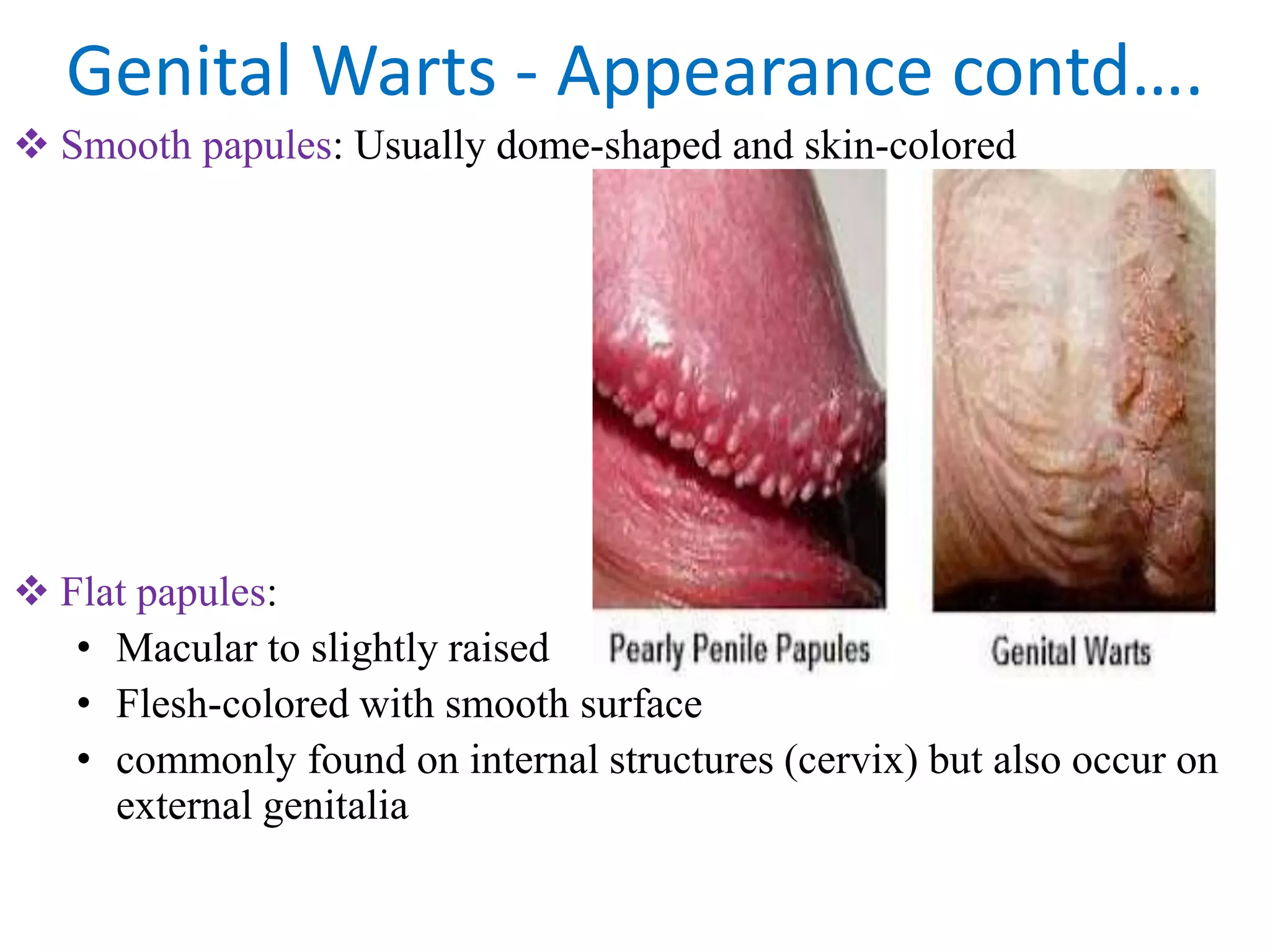
 Smooth papules: Usually dome-shaped and skin-colored
 Flat papules:
• Macular to slightly raised
• Flesh-colored with smooth surface
• commonly found on internal structures (cervix) but also occur on
external genitalia
Genital Wart-Appearance contd….
Keratotic warts :Thick horny layer that can resemble common
warts or seborrheic keratosis
Skin Papilloma
•HPV infection occur at the basal
cell layer of stratified Squamous
epithelial cells
•Stimulate cellular proliferation in
epithelium and infected cells
•interaction between viral proteins
and cellular proteins (anti-
oncoproteins) that normally
function to regulate the cell cycle.
•Two of these antioncogenic
cellular proteins are p53 (cellular
growth suppressor protein) and
pRb (retinoblastoma gene
product)
•Display a broad spectrum of changes
ranging from benign hyperplasia to
dysplasia to invasive cancer
Pathogenesis
Clinical manifestations
• Painless bumps, pruritus and discharge: chief complaints
• multiple lesions rather than a single wart
• Oral, laryngeal, or tracheal mucosal lesions (transfer through oral-genital contact)
• Urethral bleeding or urinary obstruction: wart involving the meatus.
• Vaginal bleeding during pregnancy: due to condyloma eruptions
• Coital bleeding also may occur
• h/o of previous or current sexually transmitted diseases (STDs)
• Lesions may regress spontaneously, remain static, or progress
Clinical Diagnosis
 visual inspection
 confirmed by biopsy and is indicated if:
1) the diagnosis is uncertain
2) the lesions do not respond to standard therapy
3) the disease worsens during therapy
4) the lesion is atypical
5) the patient has comprised immunity
 application of 3%–5% acetic acid causes skin color to turn white
used to detect HPV-infected genital mucosa(not recommended)
 Papanicolaou test
 Non specific tests :immunoassay, insitu hybridization and PCR (
HPV doesnot grow in routine tissue culture )
Papanicolaou test- Pap test
• cervical screening used to detect potentially pre-cancerous and
cancerous processes in the cervix
• Findings: perinuclear cytoplasmic vacuolization and nuclear
enlargement
• Abnormal findings are often followed up by more sensitive diagnostic
procedures aiming to prevent progression to cervical cancer
Pharmacological therapy
Management during pregnancy
• Genital warts can proliferate and become more friable during
pregnancy
• Cytotoxic agents (podophyllin, podofilox, imiquimod) should not be
used
• Cryotherapy, Trichloroacetic acid(TCA), bichloroacetic acid(BCA)
and surgical removal may be used
• HPV types 6 and 11 can cause recurrent respiratory papillomatosis in
childrens
Genital Warts in HIV infected patients
• No data that treatment should be different
• Larger, more numerous warts
• Might not respond as well to therapy
• More frequent recurrence of lesions after treatment
• Squamous cell carcinomas arising in or resembling genital warts
might occur more frequently among immunosuppressed persons
• Require biopsy for confirmation of diagnosis for suspicious cases,
and referral to a specialist.
Prevention :HPV vaccine
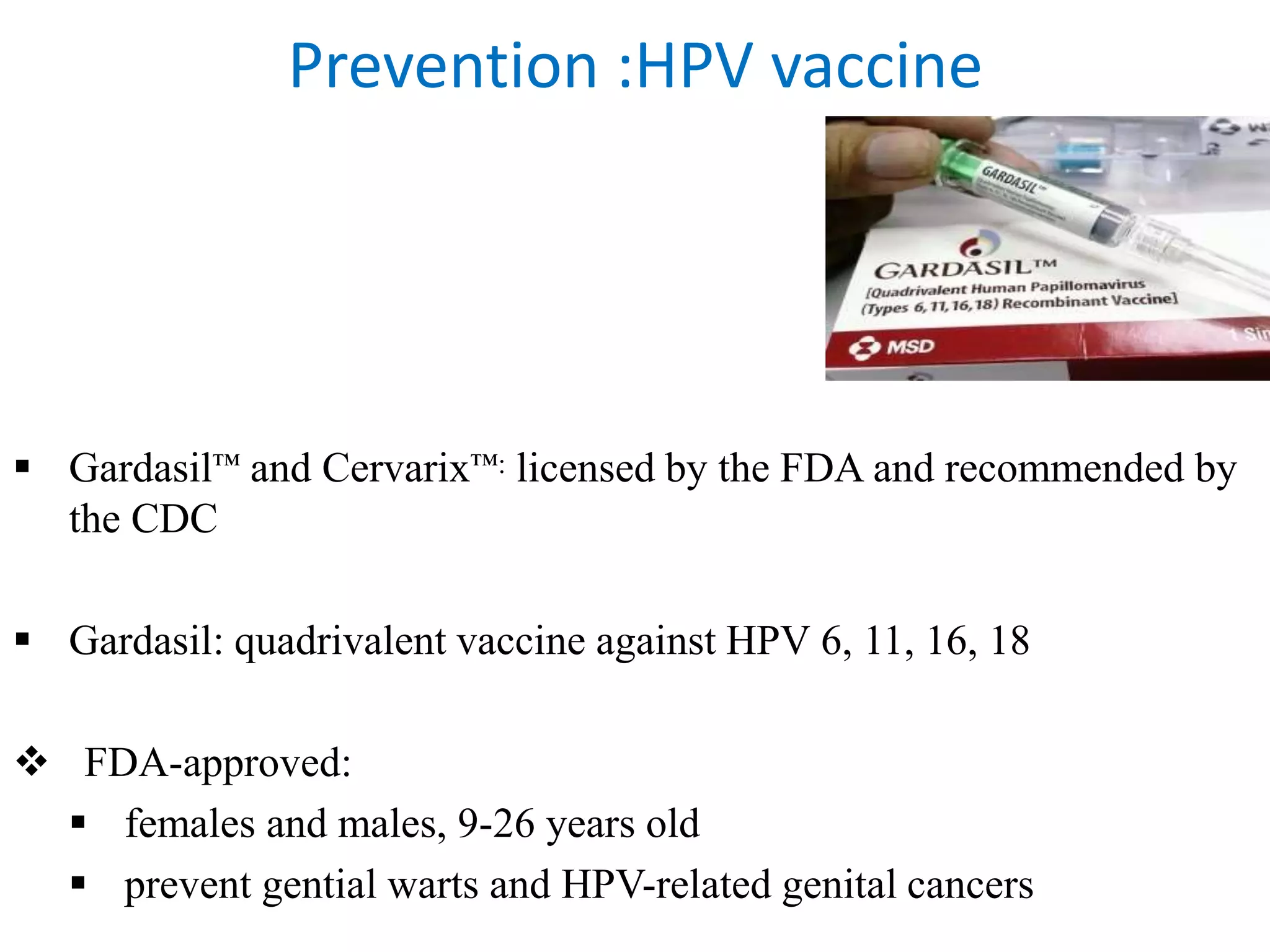
 Gardasil™ and Cervarix™: licensed by the FDA and recommended by
the CDC
 Gardasil: quadrivalent vaccine against HPV 6, 11, 16, 18
 FDA-approved:
 females and males, 9-26 years old
 prevent gential warts and HPV-related genital cancers
HPV Vaccine (contd..)
 Ceravix: bivalent vaccine against HPV 16, 18
 FDA-approved:
 females 10-25 years old (not approved for males)
 prevent HPV-related genital cancers
REFERENCES
• Kyan J. Kenneth,Sherris medical microbiology, 4th edition
• Jawetz medical microbiology, 26th edition
• Robbins pathologic basis of disease, 7th edition
• cdc.gov/hpv/whatishpv (retrieved on 28th july 2015)
• emedicine.medscape.com/article/763014-clinical#b4
(retrieved on 27th july 2015)
• medicinenet.com/image-
collection/genital_warts_hpv_picture (retrieved on 28th july
2015)
Genital warts

Genital warts

  • 1.
  • 2.
    Genital warts -Introduction  Epidermal manifestation attributed to epidermotropic human papilloma virus  About 100 types of ds HPV have been isolated and about 35 types have affinity to genital sites  frequently affected sites: penis, vulva, vagina, cervix, perineum, and perianal area  The mucosal lesions occasionally can be found in the oropharynx ,larynx, trachea and extremities
  • 3.
    Introduction contd… • Twocategories of genital HPV exist: low-risk benign HPV lesions and high-risk neoplastic HPV lesions • The low-risk strains are responsible for genital warts, recurrent respiratory papillomatosis (RRP),low-grade cervical lesions. • Types 6 and 11account for more than 90% of genital warts and most cases of RRP. • Type 16,18,31,33 and 35 are found as coinfection with HPV 6 and 11 and are associated with foci of high grade intraepithelial neoplasia (HIV infection)
  • 4.
  • 5.
    Human Papillomavirus Features Description FamilyPapillomaviridae Virion Icosahedreal , 55 nm in diameter composition Ds DNA (10%) and 2 structural protein (90%) envelope absent Outstanding features Restricted host range and tissue tropism Significant cause of human cancer – cervical cancer Viral oncoproteins interact with cellular tumor supression proteins
  • 6.
    Genital Warts  Features: Usually asymptomatic but can be painful or pruritic  Flat, papular or pedunculated growth on genital mucosa  Sites: • introitus in women • under foreskin of uncircumcised penis • shaft of circumcised penis • Anogenital epithelium: cervix, vagina, urethra, perineum, perianal skin and scrotum
  • 7.
    Genital Warts -Appearance Condylomata acuminata (anogenital warts ) • Cauliflower-like appearance • Skin-colored, pink or hyper pigmented • keratotic on skin and non-keratinized on mucosal surfaces
  • 8.
    Genital Warts -Appearance contd….  Smooth papules: Usually dome-shaped and skin-colored  Flat papules: • Macular to slightly raised • Flesh-colored with smooth surface • commonly found on internal structures (cervix) but also occur on external genitalia
  • 9.
    Genital Wart-Appearance contd…. Keratoticwarts :Thick horny layer that can resemble common warts or seborrheic keratosis
  • 10.
    Skin Papilloma •HPV infectionoccur at the basal cell layer of stratified Squamous epithelial cells •Stimulate cellular proliferation in epithelium and infected cells •interaction between viral proteins and cellular proteins (anti- oncoproteins) that normally function to regulate the cell cycle. •Two of these antioncogenic cellular proteins are p53 (cellular growth suppressor protein) and pRb (retinoblastoma gene product) •Display a broad spectrum of changes ranging from benign hyperplasia to dysplasia to invasive cancer
  • 11.
  • 12.
    Clinical manifestations • Painlessbumps, pruritus and discharge: chief complaints • multiple lesions rather than a single wart • Oral, laryngeal, or tracheal mucosal lesions (transfer through oral-genital contact) • Urethral bleeding or urinary obstruction: wart involving the meatus. • Vaginal bleeding during pregnancy: due to condyloma eruptions • Coital bleeding also may occur • h/o of previous or current sexually transmitted diseases (STDs) • Lesions may regress spontaneously, remain static, or progress
  • 13.
    Clinical Diagnosis  visualinspection  confirmed by biopsy and is indicated if: 1) the diagnosis is uncertain 2) the lesions do not respond to standard therapy 3) the disease worsens during therapy 4) the lesion is atypical 5) the patient has comprised immunity  application of 3%–5% acetic acid causes skin color to turn white used to detect HPV-infected genital mucosa(not recommended)  Papanicolaou test  Non specific tests :immunoassay, insitu hybridization and PCR ( HPV doesnot grow in routine tissue culture )
  • 14.
    Papanicolaou test- Paptest • cervical screening used to detect potentially pre-cancerous and cancerous processes in the cervix • Findings: perinuclear cytoplasmic vacuolization and nuclear enlargement • Abnormal findings are often followed up by more sensitive diagnostic procedures aiming to prevent progression to cervical cancer
  • 15.
  • 17.
    Management during pregnancy •Genital warts can proliferate and become more friable during pregnancy • Cytotoxic agents (podophyllin, podofilox, imiquimod) should not be used • Cryotherapy, Trichloroacetic acid(TCA), bichloroacetic acid(BCA) and surgical removal may be used • HPV types 6 and 11 can cause recurrent respiratory papillomatosis in childrens
  • 18.
    Genital Warts inHIV infected patients • No data that treatment should be different • Larger, more numerous warts • Might not respond as well to therapy • More frequent recurrence of lesions after treatment • Squamous cell carcinomas arising in or resembling genital warts might occur more frequently among immunosuppressed persons • Require biopsy for confirmation of diagnosis for suspicious cases, and referral to a specialist.
  • 19.
    Prevention :HPV vaccine Gardasil™ and Cervarix™: licensed by the FDA and recommended by the CDC  Gardasil: quadrivalent vaccine against HPV 6, 11, 16, 18  FDA-approved:  females and males, 9-26 years old  prevent gential warts and HPV-related genital cancers
  • 20.
    HPV Vaccine (contd..) Ceravix: bivalent vaccine against HPV 16, 18  FDA-approved:  females 10-25 years old (not approved for males)  prevent HPV-related genital cancers
  • 21.
    REFERENCES • Kyan J.Kenneth,Sherris medical microbiology, 4th edition • Jawetz medical microbiology, 26th edition • Robbins pathologic basis of disease, 7th edition • cdc.gov/hpv/whatishpv (retrieved on 28th july 2015) • emedicine.medscape.com/article/763014-clinical#b4 (retrieved on 27th july 2015) • medicinenet.com/image- collection/genital_warts_hpv_picture (retrieved on 28th july 2015)