Secondary Amenorrhea
Secondary amenorrhea is defined as absence of menses
for more than three cycles or six months in women
who previously had menses.

Pregnancy is the most common cause of secondary
amenorrhea.
I. Diagnosis of secondary amenorrhea
A. Step 1: Rule out pregnancy.
    A pregnancy test is the first step in
    evaluating secondary amenorrhea.
Measurement of serum beta subunit of hCG is
the most sensitive test
B. Step 2: Assess the history
1. Recent stress; change in weight, diet or exercise
habits; or illnesses that might result in hypothalamic
amenorrhea should be sought.
2. Drugs associated with amenorrhea, systemic
illnesses that can cause hypothalamic amenorrhea,
-recent initiation or discontinuationof an oral contraceptive,
-androgenic drugs(danazol)
- high-dose progestin,
-antipsychotic drugs should be evaluated.
3. Headaches, visual field defects, fatigue, or
polyuria and polydipsia may suggest
hypothalamic-pituitary disease.
4. Symptoms of estrogen deficiency include
hot flashes, vaginal dryness, poor sleep, or
decreased libido.
5. Galactorrhea is suggestive of
hyperprolactinemia.
6-Hirsutism, acne, and a history of irregular
menses are suggestive of hyperandrogenism.
7. A history of obstetrical
catastrophe, severe bleeding, dilatation
and curettage, or endometritis or other
infection that might have caused scarring of
the endometrial lining suggests Asherman's
syndrome.
C. Step 3: Physical examination.
Measurements of height and weight, signs of
other illnesses, and evidence of cachexia should
be assessed. The skin, breasts, and genital
tissues should be evaluated for estrogen
deficiency. The breasts should be
palpated, including an attempt to express
galactorrhea. The skin should be examined for
hirsutism, acne, striae, acanthosis
nigricans, vitiligo, thickness or thinness, and easy
bruisability.
D. Step 4: Basic laboratory testing.
• measurement of serum hCG to rule out
pregnancy
• serum prolactin to rule out hyperprolactinemia,
• TSH thyroid disease
• FSH to rule out ovarian failure (high serum
FSH).
• If there is hirsutism, acne or irregular
menses, serum dehydroepiandrosterone sulfate
(DHEA-S)
and testosterone should be measured.
E. Step 5: Follow-up laboratory evaluation
1. High serum prolactin concentration.
Prolactin secretion can be transiently increased
by stress or eating. Therefore, serum prolactin
should be measured at least twice before cranial
imaging is obtained, particularly in those
women with small elevations (<50 ng/mL).
These women should be screened for thyroid
disease with a TSH and free T4 because
hypothyroidism can cause hyperprolactinemia.
2. Women with verified high serum
prolactin values should have a cranial MRI
unless a very clear explanation is found for
the elevation (eg,antipsychotics). Imaging
should rule out a hypothalamic or pituitary
tumor.
3. High serum FSH concentration.
 A high serum FSH concentration indicates
the presence of ovarian failure. This test
should be repeated monthly on three
occasions to confirm. A karyotype should be
considered in most women with secondary
amenorrhea age 30 years or younger.
4. High serum androgen concentrations.
A high serum androgen value may suggest the
diagnosis of polycystic ovary syndrome or may suggest
an androgen-secreting tumor of the ovary or
adrenal gland.
 Further testing for a tumor might include a 24-hour urine
collection for cortisol and 17-ketosteroids, determination
of serum 17- hydroxyprogesterone after intravenous
injection of corticotropin (ACTH), and a dexamethasone
suppression test.
Elevation of 17-ketosteroids, DHEA-S, or 17-
hydroxyprogesterone is more consistent with an
adrenal, rather than ovarian, source of excess androgen.
5. Normal or low serum gonadotropin
concentrations and all other tests normal
a. This result is one of the most common outcomes
   of laboratory testing in women with amenorrhea. Women with
    hypothalamic amenorrhea (caused by excessive exercise or
    weight loss) have normal to low serum FSH values.
    Cranial MRI is indicated in all women without a clear
   explanation for hypogonadotropic hypogonadism and in most
   women who have visual field defects or headaches. No further
   testing is required if the onset of amenorrhea is recent or is
   easily explained (eg, weight loss, excessive exercise) and
   there are no symptoms suggestive of other disease.
6. Normal serum prolactin and FSH
concentrations with history of uterine
instrumentation preceding amenorrhea
evaluation for Asherman's syndrome should
   be completed.
   a-A progestin challenge should be performed
   (medroxyprogesterone acetate 10 mg for 10
   days). If withdrawal bleeding
occurs, an outflow tract disorder has been
ruled out. If bleeding does not occur, estrogen
and progestin should be administered.
b. Oral conjugated estrogens (0.625 to 2.5 mg
daily for 35 days) with medroxyprogesterone
added (10 mg daily for days 26 to 35); failure
to bleed upon cessation of this therapy
strongly suggests endometrial scarring. In
this situation, a hysterosalpingogram or
hysteroscopy can confirm the diagnosis of
Asherman syndrome.
II. Treatment
A. Athletic women should be counseled on the need
for increased caloric intake or reduced exercise.
Resumption of menses usually occurs.
B. Nonathletic women who are underweight
should receive nutritional counseling and treatment
of eating disorders.
C. Hyperprolactinemia is treated with a dopamine
agonist. Cabergoline (Dostinex) or bromocriptine
(Parlodel) are used for most adenomas. Ovulation,
regular menstrual cycles, and pregnancy may usually
result.
D. Ovarian failure should be treated with hormone
replacement therapy.
E. Hyperandrogenism is treated with
measures to reduce hirsutism, resume
menses, and fertility and
preventing endometrial hyperplasia, obesity, and
metabolic defects.
F. Asherman's syndrome is treated with
hysteroscopic lysis of adhesions followed by
longterm estrogen administration to stimulate
regrowth of endometrial tissue.
hyperandrogenism is any clinical or laboratory
evidence of androgen excess in women. The most
common clinical presentation of
hyperandrogenism in reproductive-aged women is
hirsutism or acne with or without evidence of
anovulation such as oligoamenorrhea - or
amenorrhea or dysfunctional uterine bleeding.
Elevated blood levels of androgens without clinical
symptoms is referred to as cryptic
hyperandrogenism.
Hirsutism refers to the presence of course terminal
hairs in androgen-dependent areas on the face
and body in women.
 hypertrichosis, which is excessive growth of thin
vellus hair at any body site. Hypertrichosis is
usually familial or associated with endocrine
disturbances such as anorexia nervosa or thyroid
dysfunction, or with medications such as
phenytoin, minoxidil or cyclosporin ).
                                                      .
   Hirsutism affects between 2-10% of
    women between the ages of 18 and 45.
    It is often a source of psychological
    discomfort and may be a sign of a
    significant medical disorder as will be
    discussed
Hirsutism develops when follicles in androgen
sensitive areas start to form thick, pigmented
(terminal) hair as opposed to thin, short, non-
pigmented (vellus) hair normally seen in those
areas in women.
causes
The causes of hyperandrogenism in
reproductive aged women can be
divided into five categories in
descending order of prevalence.
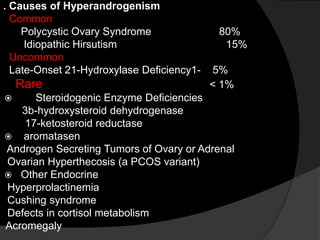
. Causes of Hyperandrogenism
  Common
    Polycystic Ovary Syndrome               80%
     Idiopathic Hirsutism                    15%
  Uncommon
  Late-Onset 21-Hydroxylase Deficiency1-    5%
    Rare                                   < 1%
     Steroidogenic Enzyme Deficiencies
   3b-hydroxysteroid dehydrogenase
    17-ketosteroid reductase
 aromatasen
Androgen Secreting Tumors of Ovary or Adrenal
Ovarian Hyperthecosis (a PCOS variant)
 Other Endocrine
Hyperprolactinemia
Cushing syndrome
Defects in cortisol metabolism
Acromegaly
Idiopathic Hirsutism
Idiopathic hirsutism is excess terminal hair
production in androgen dependent areas in the
presence of regular ovulation and normal
androgen levels .It is the second most common
cause of hirsutism after PCOS and occurs in
about 15% of hirsute women.
 The pathophysiology of this disorder still needs to
be fully elucidated, but is thought to be secondary
to increased 5a-reductase activity in the skin or its
appendages, to other alterations in androgen
metabolism or to increased sensitivity of the
androgen receptor
Polycystic Ovary
Syndrome
PCOS is the most common cause of
hirsutism and the most common
endocrinopathy in reproductive aged
women. It has a prevalence of about 5%
in Caucasian and African Americans and
in European populations (8-10 %).
Adrenal and Ovarian
Steroidogenic Enzyme
Deficiencies
Adrenal or ovarian steroidogenic enzyme
deficiencies are the most common
cause of hyperandrogenism in post-
menarcheal women after PCOS and
idiopathic hirsutism. Nevertheless these
conditions are uncommon to very rare.
Late-onset 21-hydroxylase deficiency
occurs in 1-5% of hirsute women, with
the greatest prevalence in women of
Askenazi Jewish descent
   Ovarian and Adrenal Tumors

 Both adrenal adenoma and carcinoma may
  present with virilization and hyperandrogenemia
  .
 Androgen secreting ovarian tumors include
  Sertoli-Leydig cell tumors, Leydig cell tumors,
  lipoid or lipid cell tumors and granulose-theca
  cell tumors
Typically women with androgen secreting tumors
   have abrupt onset of symptoms distinct from
   menarche and a more rapid progressions of
   symptoms compared to PCOS.
Signs of virilization such as clitoromegaly, frontal
   balding and deepening of the voice are also more
   common. Testosterone levels are usually greater
   than 200 ng/dl or 2 1/2 times the upper limit of
   normal, but there is clearly overlap between
   testosterone levels found in tumors and those
   seen in severe cases of PCOS or hyperthecosis,
If a tumor is suspected, both ovarian ultrasound and
   adrenal CT scan should be done to localize it
Other Endocrine Disorders
 Hirsutism may be present in hyperprolactinemia
  with or without pituitary adenoma, Cushing
  syndrome and acromegaly. However it is usually
  not the primary complaint in these disorders.
  Prolactin should be determined in all patients
  with anovulation.
Cushing syndrome can be ruled out by a normal
   24 hour urinary cortisol or normal overnight
dexamethasone suppression test . If there is any
suspicion of acromegaly, a somatomedin-C level
(IGF-I) and/or growth hormone suppression test
should be done.
gynaecology.Sec amenorrhea.(dr.hana)

gynaecology.Sec amenorrhea.(dr.hana)

  • 1.
    Secondary Amenorrhea Secondary amenorrheais defined as absence of menses for more than three cycles or six months in women who previously had menses. Pregnancy is the most common cause of secondary amenorrhea.
  • 2.
    I. Diagnosis ofsecondary amenorrhea A. Step 1: Rule out pregnancy. A pregnancy test is the first step in evaluating secondary amenorrhea. Measurement of serum beta subunit of hCG is the most sensitive test
  • 3.
    B. Step 2:Assess the history 1. Recent stress; change in weight, diet or exercise habits; or illnesses that might result in hypothalamic amenorrhea should be sought. 2. Drugs associated with amenorrhea, systemic illnesses that can cause hypothalamic amenorrhea, -recent initiation or discontinuationof an oral contraceptive, -androgenic drugs(danazol) - high-dose progestin, -antipsychotic drugs should be evaluated.
  • 4.
    3. Headaches, visualfield defects, fatigue, or polyuria and polydipsia may suggest hypothalamic-pituitary disease. 4. Symptoms of estrogen deficiency include hot flashes, vaginal dryness, poor sleep, or decreased libido. 5. Galactorrhea is suggestive of hyperprolactinemia. 6-Hirsutism, acne, and a history of irregular menses are suggestive of hyperandrogenism.
  • 5.
    7. A historyof obstetrical catastrophe, severe bleeding, dilatation and curettage, or endometritis or other infection that might have caused scarring of the endometrial lining suggests Asherman's syndrome.
  • 6.
    C. Step 3:Physical examination. Measurements of height and weight, signs of other illnesses, and evidence of cachexia should be assessed. The skin, breasts, and genital tissues should be evaluated for estrogen deficiency. The breasts should be palpated, including an attempt to express galactorrhea. The skin should be examined for hirsutism, acne, striae, acanthosis nigricans, vitiligo, thickness or thinness, and easy bruisability.
  • 7.
    D. Step 4:Basic laboratory testing. • measurement of serum hCG to rule out pregnancy • serum prolactin to rule out hyperprolactinemia, • TSH thyroid disease • FSH to rule out ovarian failure (high serum FSH). • If there is hirsutism, acne or irregular menses, serum dehydroepiandrosterone sulfate (DHEA-S) and testosterone should be measured.
  • 8.
    E. Step 5:Follow-up laboratory evaluation 1. High serum prolactin concentration. Prolactin secretion can be transiently increased by stress or eating. Therefore, serum prolactin should be measured at least twice before cranial imaging is obtained, particularly in those women with small elevations (<50 ng/mL). These women should be screened for thyroid disease with a TSH and free T4 because hypothyroidism can cause hyperprolactinemia.
  • 9.
    2. Women withverified high serum prolactin values should have a cranial MRI unless a very clear explanation is found for the elevation (eg,antipsychotics). Imaging should rule out a hypothalamic or pituitary tumor.
  • 10.
    3. High serumFSH concentration. A high serum FSH concentration indicates the presence of ovarian failure. This test should be repeated monthly on three occasions to confirm. A karyotype should be considered in most women with secondary amenorrhea age 30 years or younger.
  • 11.
    4. High serumandrogen concentrations. A high serum androgen value may suggest the diagnosis of polycystic ovary syndrome or may suggest an androgen-secreting tumor of the ovary or adrenal gland. Further testing for a tumor might include a 24-hour urine collection for cortisol and 17-ketosteroids, determination of serum 17- hydroxyprogesterone after intravenous injection of corticotropin (ACTH), and a dexamethasone suppression test. Elevation of 17-ketosteroids, DHEA-S, or 17- hydroxyprogesterone is more consistent with an adrenal, rather than ovarian, source of excess androgen.
  • 12.
    5. Normal orlow serum gonadotropin concentrations and all other tests normal a. This result is one of the most common outcomes of laboratory testing in women with amenorrhea. Women with hypothalamic amenorrhea (caused by excessive exercise or weight loss) have normal to low serum FSH values. Cranial MRI is indicated in all women without a clear explanation for hypogonadotropic hypogonadism and in most women who have visual field defects or headaches. No further testing is required if the onset of amenorrhea is recent or is easily explained (eg, weight loss, excessive exercise) and there are no symptoms suggestive of other disease.
  • 13.
    6. Normal serumprolactin and FSH concentrations with history of uterine instrumentation preceding amenorrhea evaluation for Asherman's syndrome should be completed. a-A progestin challenge should be performed (medroxyprogesterone acetate 10 mg for 10 days). If withdrawal bleeding occurs, an outflow tract disorder has been ruled out. If bleeding does not occur, estrogen and progestin should be administered.
  • 14.
    b. Oral conjugatedestrogens (0.625 to 2.5 mg daily for 35 days) with medroxyprogesterone added (10 mg daily for days 26 to 35); failure to bleed upon cessation of this therapy strongly suggests endometrial scarring. In this situation, a hysterosalpingogram or hysteroscopy can confirm the diagnosis of Asherman syndrome.
  • 15.
    II. Treatment A. Athleticwomen should be counseled on the need for increased caloric intake or reduced exercise. Resumption of menses usually occurs. B. Nonathletic women who are underweight should receive nutritional counseling and treatment of eating disorders. C. Hyperprolactinemia is treated with a dopamine agonist. Cabergoline (Dostinex) or bromocriptine (Parlodel) are used for most adenomas. Ovulation, regular menstrual cycles, and pregnancy may usually result. D. Ovarian failure should be treated with hormone replacement therapy.
  • 16.
    E. Hyperandrogenism istreated with measures to reduce hirsutism, resume menses, and fertility and preventing endometrial hyperplasia, obesity, and metabolic defects. F. Asherman's syndrome is treated with hysteroscopic lysis of adhesions followed by longterm estrogen administration to stimulate regrowth of endometrial tissue.
  • 18.
    hyperandrogenism is anyclinical or laboratory evidence of androgen excess in women. The most common clinical presentation of hyperandrogenism in reproductive-aged women is hirsutism or acne with or without evidence of anovulation such as oligoamenorrhea - or amenorrhea or dysfunctional uterine bleeding. Elevated blood levels of androgens without clinical symptoms is referred to as cryptic hyperandrogenism.
  • 19.
    Hirsutism refers tothe presence of course terminal hairs in androgen-dependent areas on the face and body in women. hypertrichosis, which is excessive growth of thin vellus hair at any body site. Hypertrichosis is usually familial or associated with endocrine disturbances such as anorexia nervosa or thyroid dysfunction, or with medications such as phenytoin, minoxidil or cyclosporin ). .
  • 20.
    Hirsutism affects between 2-10% of women between the ages of 18 and 45. It is often a source of psychological discomfort and may be a sign of a significant medical disorder as will be discussed
  • 21.
    Hirsutism develops whenfollicles in androgen sensitive areas start to form thick, pigmented (terminal) hair as opposed to thin, short, non- pigmented (vellus) hair normally seen in those areas in women.
  • 22.
    causes The causes ofhyperandrogenism in reproductive aged women can be divided into five categories in descending order of prevalence.
  • 23.
    . Causes ofHyperandrogenism Common Polycystic Ovary Syndrome 80% Idiopathic Hirsutism 15% Uncommon Late-Onset 21-Hydroxylase Deficiency1- 5% Rare < 1%  Steroidogenic Enzyme Deficiencies 3b-hydroxysteroid dehydrogenase 17-ketosteroid reductase  aromatasen Androgen Secreting Tumors of Ovary or Adrenal Ovarian Hyperthecosis (a PCOS variant)  Other Endocrine Hyperprolactinemia Cushing syndrome Defects in cortisol metabolism Acromegaly
  • 24.
    Idiopathic Hirsutism Idiopathic hirsutismis excess terminal hair production in androgen dependent areas in the presence of regular ovulation and normal androgen levels .It is the second most common cause of hirsutism after PCOS and occurs in about 15% of hirsute women. The pathophysiology of this disorder still needs to be fully elucidated, but is thought to be secondary to increased 5a-reductase activity in the skin or its appendages, to other alterations in androgen metabolism or to increased sensitivity of the androgen receptor
  • 25.
    Polycystic Ovary Syndrome PCOS isthe most common cause of hirsutism and the most common endocrinopathy in reproductive aged women. It has a prevalence of about 5% in Caucasian and African Americans and in European populations (8-10 %).
  • 26.
    Adrenal and Ovarian SteroidogenicEnzyme Deficiencies Adrenal or ovarian steroidogenic enzyme deficiencies are the most common cause of hyperandrogenism in post- menarcheal women after PCOS and idiopathic hirsutism. Nevertheless these conditions are uncommon to very rare. Late-onset 21-hydroxylase deficiency occurs in 1-5% of hirsute women, with the greatest prevalence in women of Askenazi Jewish descent
  • 27.
    Ovarian and Adrenal Tumors  Both adrenal adenoma and carcinoma may present with virilization and hyperandrogenemia .  Androgen secreting ovarian tumors include Sertoli-Leydig cell tumors, Leydig cell tumors, lipoid or lipid cell tumors and granulose-theca cell tumors
  • 28.
    Typically women withandrogen secreting tumors have abrupt onset of symptoms distinct from menarche and a more rapid progressions of symptoms compared to PCOS. Signs of virilization such as clitoromegaly, frontal balding and deepening of the voice are also more common. Testosterone levels are usually greater than 200 ng/dl or 2 1/2 times the upper limit of normal, but there is clearly overlap between testosterone levels found in tumors and those seen in severe cases of PCOS or hyperthecosis, If a tumor is suspected, both ovarian ultrasound and adrenal CT scan should be done to localize it
  • 29.
    Other Endocrine Disorders Hirsutism may be present in hyperprolactinemia with or without pituitary adenoma, Cushing syndrome and acromegaly. However it is usually not the primary complaint in these disorders. Prolactin should be determined in all patients with anovulation.
  • 30.
    Cushing syndrome canbe ruled out by a normal 24 hour urinary cortisol or normal overnight dexamethasone suppression test . If there is any suspicion of acromegaly, a somatomedin-C level (IGF-I) and/or growth hormone suppression test should be done.