CTG
Introduction
Aboubakr Elnashar
Benha university, Egypt
ABOUBAKR ELNASHAR
1. Fetal response to hypoxia
2. Fetal monitoring in labor
3. Indications
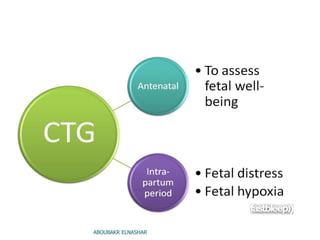
4. Types of CTG monitoring
5. Important considerations
6. Why care about CTG
7. Steps
8. Components of CTG paper
ABOUBAKR ELNASHAR
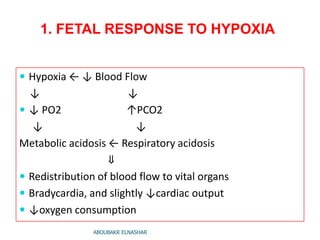
1. FETAL RESPONSE TO HYPOXIA
 Hypoxia ← ↓ Blood Flow
↓↓
 ↓ PO2 ↑PCO2
↓ ↓
Metabolic acidosis ← Respiratory acidosis
⇓
 Redistribution of blood flow to vital organs
 Bradycardia, and slightly ↓cardiac output
 ↓oxygen consumption
ABOUBAKR ELNASHAR
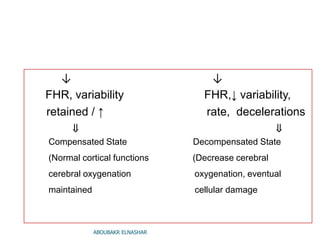
↓ ↓
FHR, variability FHR,↓ variability,
retained / ↑ rate, decelerations
⇓⇓
Compensated State Decompensated State
(Normal cortical functions (Decrease cerebral
cerebral oxygenation oxygenation, eventual
maintained cellular damage
ABOUBAKR ELNASHAR
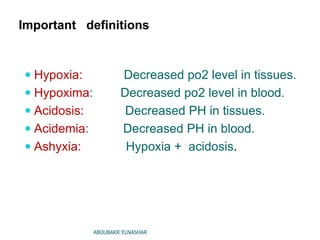
Important definitions
 Hypoxia: Decreased po2 level in tissues.
 Hypoxima: Decreased po2 level in blood.
 Acidosis: Decreased PH in tissues.
 Acidemia: Decreased PH in blood.
 Ashyxia: Hypoxia + acidosis.
ABOUBAKR ELNASHAR
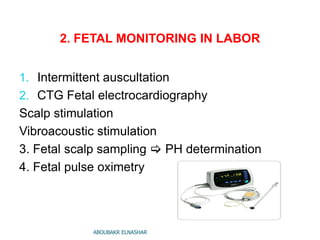
2. FETAL MONITORING IN LABOR
1. Intermittent auscultation
2. CTG Fetal electrocardiography
Scalp stimulation
Vibroacoustic stimulation
3. Fetal scalp sampling  PH determination
4. Fetal pulse oximetry
ABOUBAKR ELNASHAR
ABOUBAKR ELNASHAR
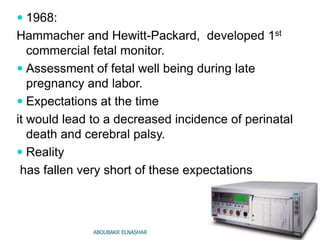
 1968:
Hammacher and Hewitt-Packard, developed 1st
commercial fetal monitor.
 Assessment of fetal well being during late
pregnancy and labor.
 Expectations at the time
it would lead to a decreased incidence of perinatal
death and cerebral palsy.
 Reality
has fallen very short of these expectations
ABOUBAKR ELNASHAR
3. INDICATIONS OF CONTINUOUS EFM
1. High-risk pregnancies where there is an
increased risk of perinatal death, cerebral palsy
or neonatal encephalopathy.
2. Where oxytocin is being used for induction or
augmentation of labour.
ABOUBAKR ELNASHAR
The admission CTG test
Commonly used screening test consisting of a short
(usually 20 minutes) recording of FHR and uterine
activity performed on the mother's admission to the labour
ward.
Admission CTG not be used for women who are low risk
on admission in labour. (Cochrane SR, 2012)
{:an increase in the incidence of CS without evidence of
benefit}.
ABOUBAKR ELNASHAR
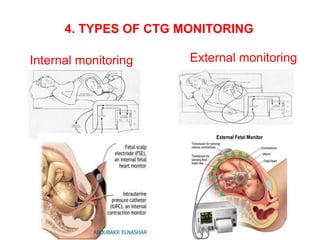
4. TYPES OF CTG MONITORING
External monitoringInternal monitoring
ABOUBAKR ELNASHAR
 CTG is best regarded as a screening tool (not
diagnostic)
 High negative predictive value (Specificity=
Healthy, 98%)
>98% of fetuses with a normal CTG will be OK
 Poor positive predictive value (Sensitivity) with
unnecessary operative intervention for f distress.
50% of fetuses with an abnormal CTG will be
hypoxic and acidotic but 50% will be OK
 CTG should always be interpreted in its clinical
context and backed by fetal blood sampling PRN
5. IMPORTANT CONSIDERATIONS
ABOUBAKR ELNASHAR
 Normal CTG indicate that there were
no abnormalities
no indication for intervention.
CTG could be viewed as part of Defensive Medicine
(permanent record)
 Abnormal/suspicious CTG may provide:
an evidence that inappropriate or lack of tt: litigation
 In spite of it is poor indicator of overall fetal status
but it remains The best we have
ABOUBAKR ELNASHAR
Disadvantages
 Insufficient understanding of the (patho-)physiologic
background
 Confusion due to the many influences on the FH
rhythm
 Lack of agreement on how, when, and whom to
monitor
 Lack of uniform classification systems
 Poor positive predictive value (Sensitivity):
unnecessary operative intervention for f distress.
 Substantial intra- and inter-observer variation
regarding the interpretation
 Contributes to medico-legal vulnerability
 Primarily qualitative information (pattern
recognition)
ABOUBAKR ELNASHAR
7. STEPS
External monitoring
• Explain the processes and reasons for the CTG, verbal
consent
 Ask to empty her bladder
 Ascertain the lie, presentation and position of the fetus
 Place and secure the FHR ultrasound transducer over the
fetal anterior shoulder
 Place and secure the toco-transducer on the fundus
 Position the woman: comfortable: sitting upright or laterally
 Ensure ultrasound contact is maintained
 Document on the FHR pattern: date and time, gestation,
indication for monitoring, maternal pulse/30 min
 Record the FHR pattern at the rate of 1cm or 3cm/min
ABOUBAKR ELNASHAR
Internal monitoring
Membranes: absent
Cervix: dilated enough.
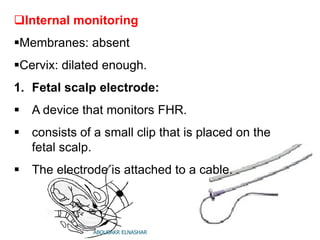
1. Fetal scalp electrode:
 A device that monitors FHR.
 consists of a small clip that is placed on the
fetal scalp.
 The electrode is attached to a cable.
ABOUBAKR ELNASHAR
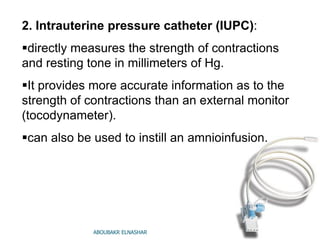
2. Intrauterine pressure catheter (IUPC):
directly measures the strength of contractions
and resting tone in millimeters of Hg.
It provides more accurate information as to the
strength of contractions than an external monitor
(tocodynameter).
can also be used to instill an amnioinfusion.
ABOUBAKR ELNASHAR
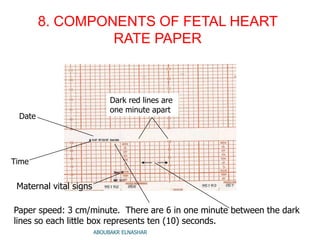
8. COMPONENTS OF FETAL HEART
RATE PAPER
Date
Time
Paper speed: 3 cm/minute. There are 6 in one minute between the dark
lines so each little box represents ten (10) seconds.
Dark red lines are
one minute apart
Maternal vital signs
ABOUBAKR ELNASHAR
LITIGATION
 Traces:
not done.
Unsatisfactory or
Missing: EFM traces should be kept up to 25 ys
 Abnormal CTG: ignored or not recognized
ABOUBAKR ELNASHAR
EDUCATION AND TRAINING
If you are going to use the CTG You must be
able to Interpret the trace & respond accordingly
Improves Knowledge/clinical skills for all staff
Training should include
instructions on documenting traces and
storage
appropriate clinical responses to suspicious or
pathological traces
local guidelines
ABOUBAKR ELNASHAR
Thank You
ABOUBAKR ELNASHAR

CTG introduction

  • 1.
  • 2.
    1. Fetal responseto hypoxia 2. Fetal monitoring in labor 3. Indications 4. Types of CTG monitoring 5. Important considerations 6. Why care about CTG 7. Steps 8. Components of CTG paper ABOUBAKR ELNASHAR
  • 3.
    1. FETAL RESPONSETO HYPOXIA  Hypoxia ← ↓ Blood Flow ↓↓  ↓ PO2 ↑PCO2 ↓ ↓ Metabolic acidosis ← Respiratory acidosis ⇓  Redistribution of blood flow to vital organs  Bradycardia, and slightly ↓cardiac output  ↓oxygen consumption ABOUBAKR ELNASHAR
  • 4.
    ↓ ↓ FHR, variabilityFHR,↓ variability, retained / ↑ rate, decelerations ⇓⇓ Compensated State Decompensated State (Normal cortical functions (Decrease cerebral cerebral oxygenation oxygenation, eventual maintained cellular damage ABOUBAKR ELNASHAR
  • 5.
    Important definitions  Hypoxia:Decreased po2 level in tissues.  Hypoxima: Decreased po2 level in blood.  Acidosis: Decreased PH in tissues.  Acidemia: Decreased PH in blood.  Ashyxia: Hypoxia + acidosis. ABOUBAKR ELNASHAR
  • 6.
    2. FETAL MONITORINGIN LABOR 1. Intermittent auscultation 2. CTG Fetal electrocardiography Scalp stimulation Vibroacoustic stimulation 3. Fetal scalp sampling  PH determination 4. Fetal pulse oximetry ABOUBAKR ELNASHAR
  • 7.
  • 8.
     1968: Hammacher andHewitt-Packard, developed 1st commercial fetal monitor.  Assessment of fetal well being during late pregnancy and labor.  Expectations at the time it would lead to a decreased incidence of perinatal death and cerebral palsy.  Reality has fallen very short of these expectations ABOUBAKR ELNASHAR
  • 9.
    3. INDICATIONS OFCONTINUOUS EFM 1. High-risk pregnancies where there is an increased risk of perinatal death, cerebral palsy or neonatal encephalopathy. 2. Where oxytocin is being used for induction or augmentation of labour. ABOUBAKR ELNASHAR
  • 10.
    The admission CTGtest Commonly used screening test consisting of a short (usually 20 minutes) recording of FHR and uterine activity performed on the mother's admission to the labour ward. Admission CTG not be used for women who are low risk on admission in labour. (Cochrane SR, 2012) {:an increase in the incidence of CS without evidence of benefit}. ABOUBAKR ELNASHAR
  • 11.
    4. TYPES OFCTG MONITORING External monitoringInternal monitoring ABOUBAKR ELNASHAR
  • 12.
     CTG isbest regarded as a screening tool (not diagnostic)  High negative predictive value (Specificity= Healthy, 98%) >98% of fetuses with a normal CTG will be OK  Poor positive predictive value (Sensitivity) with unnecessary operative intervention for f distress. 50% of fetuses with an abnormal CTG will be hypoxic and acidotic but 50% will be OK  CTG should always be interpreted in its clinical context and backed by fetal blood sampling PRN 5. IMPORTANT CONSIDERATIONS ABOUBAKR ELNASHAR
  • 13.
     Normal CTGindicate that there were no abnormalities no indication for intervention. CTG could be viewed as part of Defensive Medicine (permanent record)  Abnormal/suspicious CTG may provide: an evidence that inappropriate or lack of tt: litigation  In spite of it is poor indicator of overall fetal status but it remains The best we have ABOUBAKR ELNASHAR
  • 14.
    Disadvantages  Insufficient understandingof the (patho-)physiologic background  Confusion due to the many influences on the FH rhythm  Lack of agreement on how, when, and whom to monitor  Lack of uniform classification systems  Poor positive predictive value (Sensitivity): unnecessary operative intervention for f distress.  Substantial intra- and inter-observer variation regarding the interpretation  Contributes to medico-legal vulnerability  Primarily qualitative information (pattern recognition) ABOUBAKR ELNASHAR
  • 15.
    7. STEPS External monitoring •Explain the processes and reasons for the CTG, verbal consent  Ask to empty her bladder  Ascertain the lie, presentation and position of the fetus  Place and secure the FHR ultrasound transducer over the fetal anterior shoulder  Place and secure the toco-transducer on the fundus  Position the woman: comfortable: sitting upright or laterally  Ensure ultrasound contact is maintained  Document on the FHR pattern: date and time, gestation, indication for monitoring, maternal pulse/30 min  Record the FHR pattern at the rate of 1cm or 3cm/min ABOUBAKR ELNASHAR
  • 16.
    Internal monitoring Membranes: absent Cervix:dilated enough. 1. Fetal scalp electrode:  A device that monitors FHR.  consists of a small clip that is placed on the fetal scalp.  The electrode is attached to a cable. ABOUBAKR ELNASHAR
  • 17.
    2. Intrauterine pressurecatheter (IUPC): directly measures the strength of contractions and resting tone in millimeters of Hg. It provides more accurate information as to the strength of contractions than an external monitor (tocodynameter). can also be used to instill an amnioinfusion. ABOUBAKR ELNASHAR
  • 18.
    8. COMPONENTS OFFETAL HEART RATE PAPER Date Time Paper speed: 3 cm/minute. There are 6 in one minute between the dark lines so each little box represents ten (10) seconds. Dark red lines are one minute apart Maternal vital signs ABOUBAKR ELNASHAR
  • 19.
    LITIGATION  Traces: not done. Unsatisfactoryor Missing: EFM traces should be kept up to 25 ys  Abnormal CTG: ignored or not recognized ABOUBAKR ELNASHAR
  • 20.
    EDUCATION AND TRAINING Ifyou are going to use the CTG You must be able to Interpret the trace & respond accordingly Improves Knowledge/clinical skills for all staff Training should include instructions on documenting traces and storage appropriate clinical responses to suspicious or pathological traces local guidelines ABOUBAKR ELNASHAR
  • 21.