“ DR. MANJUSHREE BOOB”
M.B.B.S. M.D. D.N.B. F.I.C.M.C.H.
DIPLOMATE OF NATIONAL BOARDS
FELLOW GUIDE FOR DAWN DGO’S COURSES
“SHUBHAM HOSPITAL”
BADNERA ROAD
AMRAVATI [ M.S. ]
By,…By,…
HISTORY :
Harryreich , in 1988 had performed 1st
Laparoscopic hysterectomy at
Kingston.
INCIDENCE OF TAH, VH, LAVH
VALUE STUDY 1998 [ U. K. ]
[ Vaginal, Abdominal And Laparoscopic Uterine
Extirpation ]
Abdominal - 74%
Vaginal - 18.4%
Laparoscopic hysterectomy - 7.6% } 1995
U.S.A. STUDY BY KOVACK
Vaginal - 89%
Abdominal - 11%
Total Cases - 9095
Abdominal - 93% in 1990
Vaginal - 7%
FINLAND STUDY
While study in 1995 has shown rise in Vaginal hysterectomy
cases.
AUSTRALIAN STUDY
Abdominal route was more preferred up to 90%
DR. SETH’S SIR’S STUDY- INDIA :
Total 5985 cases
Vaginal - 80%
IN THIS NEW MILLENIUM
“ Advent of Laparoscopic surgery has revived and
increased the of incidence of VH tremendously in World
SELECT MOST SAEF AND MINIMALLY INVASIVE.
THREE MODES TO REMOVE UTERUS -
UTERINE EXTIRPATION => PLACE OF VARIOUS
ROUTESWHICH ROUTE ??? TO SELECT
[ True state of the art Indian
Legacy]
[ Modern Surgery ]
Vaginal
Hysterectomy
L.A.V.H.
TLH
[ Ultra Modern Surgery ]
Abdominal Hystectomy
[ AN OLD ART- NEED TO DECREASE THIS MORBID
SURGERY ]
CLASSIFICATION _-- laparoscopic hysterectomy.
I – BY HARRY REICH =>
1. LAPAROSCOPIC HYSTERECTOMY- Uterines are secured
L’scopically.
2. LAVH => Uterine secured vaginally.
II – BY ALAN JOHN’S =>
Stage
0 Laparoscopy done- no laparoscopic procedure performed prior to vaginal
hysterectomy.
1 Procedure included laparoscopic adhesiolysis and/or excision of
endometriosis.
2 Either or both adnexae freed laparoscopically
3 Bladder dissected from uterus.
4 Uterine artery transected laparoscopically.
5 Anterior and/or posterior colpotomy or entire uterus freed.
INDICATIONS FOR L.A.V.H.
1 Previous pelvic surgery ( fibroids, dysfunctional
uterine bleeding, adenomyosis)
2 Endometriosis
3 Chronic Pelvic pain
4 Significantly large uterus
5 Suspected or confirmed adnexal pathology
6 Associated bowel or appendicular disease.
7 Previous uterine suspension.
8 Previous one or more caesarean section.
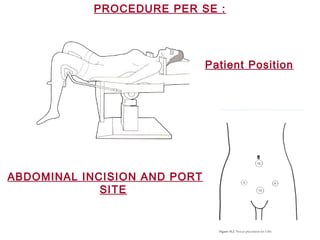
PROCEDURE PER SE :
ABDOMINAL INCISION AND PORT
SITE
Patient Position
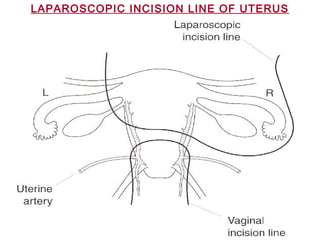
LAPAROSCOPIC INCISION LINE OF UTERUS
LAPAROSCOPIC COMPONENT OF LAVH
1. Division of major pedicles viz- Infundibulo pelvic ligaments or
uterovarian ligaments and round ligaments.
2. Dissection of the urinary bladder by opening UV fold by
monopolar spatula
3. Anterior colpotomy by inserting a wet sponge on holder in
anterior vagina and opening by monopolar spatula.
Vaginal Component:
1. Posterior colpotomy by direct cut with scissors
2. Clamping, cutting and Transfixing uterosacrals and cardinals
on either side.
3. Clamp, cut and ligate uterine artery on eitherside
4. Remove the uterus
5. Close the vaginal vault.
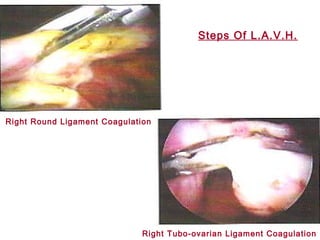
Right Round Ligament Coagulation
Right Tubo-ovarian Ligament Coagulation
Steps Of L.A.V.H.
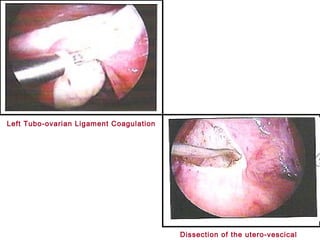
Left Tubo-ovarian Ligament Coagulation
Dissection of the utero-vescical
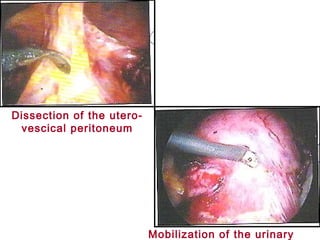
Mobilization of the urinary
Dissection of the utero-
vescical peritoneum
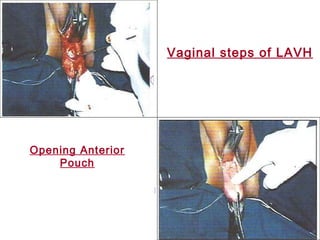
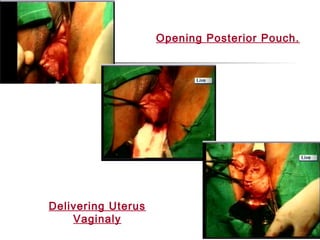
Vaginal steps of LAVH
Opening Anterior
Pouch
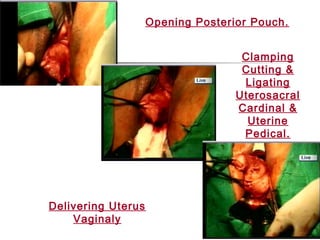
Opening Posterior Pouch.
Delivering Uterus
Vaginaly
Clamping
Cutting &
Ligating
Uterosacral
Cardinal &
Uterine
Pedical.
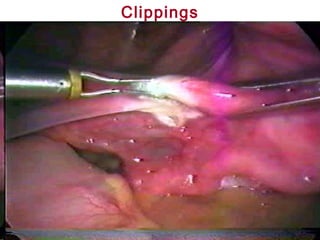
Clippings
Opening Posterior Pouch.
Delivering Uterus
Vaginaly
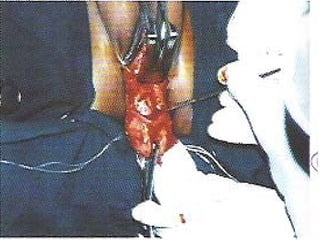
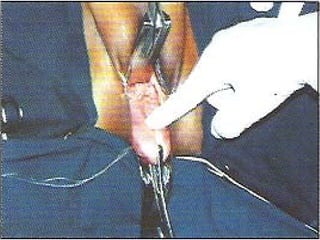
-Surgical procedure involving dissection of tubovarian pedicle and
bladder dissection is done through Laparoscope - while vaginally
uterines are ligated under vision by delevering uterus through
colpotomy incision.
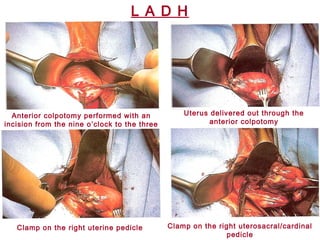
[ L A D H ]
Laparoscopic assisted Doderlein’s
Hysterectomy
Cutting the right infundibulopelvic
ligament
Dividing the peritoneum in the
uterovesicular pouch
L A D H
Anterior colpotomy performed with an
incision from the nine o’clock to the three
Uterus delivered out through the
anterior colpotomy
Clamp on the right uterine pedicle Clamp on the right uterosacral/cardinal
pedicle
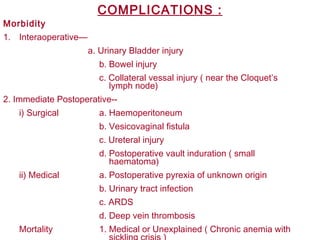
COMPLICATIONS :
Morbidity
1. Interaoperative—
a. Urinary Bladder injury
b. Bowel injury
c. Collateral vessal injury ( near the Cloquet’s
lymph node)
2. Immediate Postoperative--
i) Surgical a. Haemoperitoneum
b. Vesicovaginal fistula
c. Ureteral injury
d. Postoperative vault induration ( small
haematoma)
ii) Medical a. Postoperative pyrexia of unknown origin
b. Urinary tract infection
c. ARDS
d. Deep vein thrombosis
Mortality 1. Medical or Unexplained ( Chronic anemia with
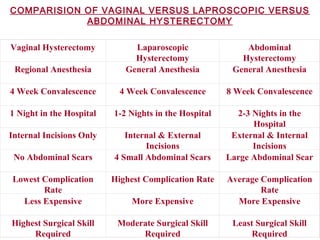
COMPARISION OF VAGINAL VERSUS LAPROSCOPIC VERSUS
ABDOMINAL HYSTERECTOMY
Vaginal Hysterectomy Laparoscopic
Hysterectomy
Abdominal
Hysterectomy
Regional Anesthesia General Anesthesia General Anesthesia
4 Week Convalescence 4 Week Convalescence 8 Week Convalescence
1 Night in the Hospital 1-2 Nights in the Hospital 2-3 Nights in the
Hospital
Internal Incisions Only Internal & External
Incisions
External & Internal
Incisions
No Abdominal Scars 4 Small Abdominal Scars Large Abdominal Scar
Lowest Complication
Rate
Highest Complication Rate Average Complication
Rate
Less Expensive More Expensive More Expensive
Highest Surgical Skill
Required
Moderate Surgical Skill
Required
Least Surgical Skill
Required
At last commenting on place of LAVH Today,
any procedure should have following A’s to be
popular amongst patient and doctors
1. Available
2. Affordable
3. Acceptable
4. Accessible
5. Adaptable
6. Artifice Ease
7. Aquantible
8. Acquisible
9. Admirable
“ Look on this procedure with WONDER, Love
this procedure and Enhance the learning skill
for LAVH And I assure,
“ALL THE NOVICE GYNAECOLOGIST CAN DO
IT IF ALL A’S PUT TOGETHER”
CONCLUSION:
LAPAROSCOPIC HYSTERECTOMY is glamorized more
than its actual scientific value. Laparoscopic
Hysterectomy should not be taken only for glitter or
glamour specially in cases were vaginal hysterectomy
is possible, So LAVH should be done where VH is
contraindicated and main aim is to the decrease the
incidence of morbid AH World wide.
INDEBTED TO ONE AND ALL
FOR
PATIENT LISTENING
Lavh 1

Lavh 1

  • 2.
    “ DR. MANJUSHREEBOOB” M.B.B.S. M.D. D.N.B. F.I.C.M.C.H. DIPLOMATE OF NATIONAL BOARDS FELLOW GUIDE FOR DAWN DGO’S COURSES “SHUBHAM HOSPITAL” BADNERA ROAD AMRAVATI [ M.S. ] By,…By,…
  • 3.
    HISTORY : Harryreich ,in 1988 had performed 1st Laparoscopic hysterectomy at Kingston.
  • 4.
    INCIDENCE OF TAH,VH, LAVH VALUE STUDY 1998 [ U. K. ] [ Vaginal, Abdominal And Laparoscopic Uterine Extirpation ] Abdominal - 74% Vaginal - 18.4% Laparoscopic hysterectomy - 7.6% } 1995 U.S.A. STUDY BY KOVACK Vaginal - 89% Abdominal - 11%
  • 5.
    Total Cases -9095 Abdominal - 93% in 1990 Vaginal - 7% FINLAND STUDY While study in 1995 has shown rise in Vaginal hysterectomy cases. AUSTRALIAN STUDY Abdominal route was more preferred up to 90% DR. SETH’S SIR’S STUDY- INDIA : Total 5985 cases Vaginal - 80% IN THIS NEW MILLENIUM “ Advent of Laparoscopic surgery has revived and increased the of incidence of VH tremendously in World
  • 6.
    SELECT MOST SAEFAND MINIMALLY INVASIVE. THREE MODES TO REMOVE UTERUS - UTERINE EXTIRPATION => PLACE OF VARIOUS ROUTESWHICH ROUTE ??? TO SELECT
  • 7.
    [ True stateof the art Indian Legacy] [ Modern Surgery ] Vaginal Hysterectomy L.A.V.H.
  • 8.
    TLH [ Ultra ModernSurgery ] Abdominal Hystectomy [ AN OLD ART- NEED TO DECREASE THIS MORBID SURGERY ]
  • 9.
    CLASSIFICATION _-- laparoscopichysterectomy. I – BY HARRY REICH => 1. LAPAROSCOPIC HYSTERECTOMY- Uterines are secured L’scopically. 2. LAVH => Uterine secured vaginally. II – BY ALAN JOHN’S => Stage 0 Laparoscopy done- no laparoscopic procedure performed prior to vaginal hysterectomy. 1 Procedure included laparoscopic adhesiolysis and/or excision of endometriosis. 2 Either or both adnexae freed laparoscopically 3 Bladder dissected from uterus. 4 Uterine artery transected laparoscopically. 5 Anterior and/or posterior colpotomy or entire uterus freed.
  • 10.
    INDICATIONS FOR L.A.V.H. 1Previous pelvic surgery ( fibroids, dysfunctional uterine bleeding, adenomyosis) 2 Endometriosis 3 Chronic Pelvic pain 4 Significantly large uterus 5 Suspected or confirmed adnexal pathology 6 Associated bowel or appendicular disease. 7 Previous uterine suspension. 8 Previous one or more caesarean section.
  • 11.
    PROCEDURE PER SE: ABDOMINAL INCISION AND PORT SITE Patient Position
  • 12.
  • 13.
    LAPAROSCOPIC COMPONENT OFLAVH 1. Division of major pedicles viz- Infundibulo pelvic ligaments or uterovarian ligaments and round ligaments. 2. Dissection of the urinary bladder by opening UV fold by monopolar spatula 3. Anterior colpotomy by inserting a wet sponge on holder in anterior vagina and opening by monopolar spatula. Vaginal Component: 1. Posterior colpotomy by direct cut with scissors 2. Clamping, cutting and Transfixing uterosacrals and cardinals on either side. 3. Clamp, cut and ligate uterine artery on eitherside 4. Remove the uterus 5. Close the vaginal vault.
  • 14.
    Right Round LigamentCoagulation Right Tubo-ovarian Ligament Coagulation Steps Of L.A.V.H.
  • 15.
    Left Tubo-ovarian LigamentCoagulation Dissection of the utero-vescical
  • 16.
    Mobilization of theurinary Dissection of the utero- vescical peritoneum
  • 17.
    Vaginal steps ofLAVH Opening Anterior Pouch
  • 18.
    Opening Posterior Pouch. DeliveringUterus Vaginaly Clamping Cutting & Ligating Uterosacral Cardinal & Uterine Pedical.
  • 19.
  • 22.
  • 23.
    -Surgical procedure involvingdissection of tubovarian pedicle and bladder dissection is done through Laparoscope - while vaginally uterines are ligated under vision by delevering uterus through colpotomy incision. [ L A D H ] Laparoscopic assisted Doderlein’s Hysterectomy Cutting the right infundibulopelvic ligament Dividing the peritoneum in the uterovesicular pouch
  • 24.
    L A DH Anterior colpotomy performed with an incision from the nine o’clock to the three Uterus delivered out through the anterior colpotomy Clamp on the right uterine pedicle Clamp on the right uterosacral/cardinal pedicle
  • 25.
    COMPLICATIONS : Morbidity 1. Interaoperative— a.Urinary Bladder injury b. Bowel injury c. Collateral vessal injury ( near the Cloquet’s lymph node) 2. Immediate Postoperative-- i) Surgical a. Haemoperitoneum b. Vesicovaginal fistula c. Ureteral injury d. Postoperative vault induration ( small haematoma) ii) Medical a. Postoperative pyrexia of unknown origin b. Urinary tract infection c. ARDS d. Deep vein thrombosis Mortality 1. Medical or Unexplained ( Chronic anemia with
  • 26.
    COMPARISION OF VAGINALVERSUS LAPROSCOPIC VERSUS ABDOMINAL HYSTERECTOMY Vaginal Hysterectomy Laparoscopic Hysterectomy Abdominal Hysterectomy Regional Anesthesia General Anesthesia General Anesthesia 4 Week Convalescence 4 Week Convalescence 8 Week Convalescence 1 Night in the Hospital 1-2 Nights in the Hospital 2-3 Nights in the Hospital Internal Incisions Only Internal & External Incisions External & Internal Incisions No Abdominal Scars 4 Small Abdominal Scars Large Abdominal Scar Lowest Complication Rate Highest Complication Rate Average Complication Rate Less Expensive More Expensive More Expensive Highest Surgical Skill Required Moderate Surgical Skill Required Least Surgical Skill Required
  • 27.
    At last commentingon place of LAVH Today, any procedure should have following A’s to be popular amongst patient and doctors 1. Available 2. Affordable 3. Acceptable 4. Accessible 5. Adaptable 6. Artifice Ease 7. Aquantible 8. Acquisible 9. Admirable
  • 28.
    “ Look onthis procedure with WONDER, Love this procedure and Enhance the learning skill for LAVH And I assure, “ALL THE NOVICE GYNAECOLOGIST CAN DO IT IF ALL A’S PUT TOGETHER”
  • 29.
    CONCLUSION: LAPAROSCOPIC HYSTERECTOMY isglamorized more than its actual scientific value. Laparoscopic Hysterectomy should not be taken only for glitter or glamour specially in cases were vaginal hysterectomy is possible, So LAVH should be done where VH is contraindicated and main aim is to the decrease the incidence of morbid AH World wide.
  • 30.
    INDEBTED TO ONEAND ALL FOR PATIENT LISTENING