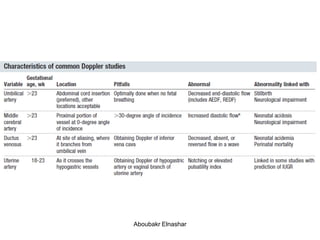
Interpretation
of Doppler
during
pregnancy
Aboubakr Elnashar
Aboubakr Elnashar
I. Umbilical artery Doppler
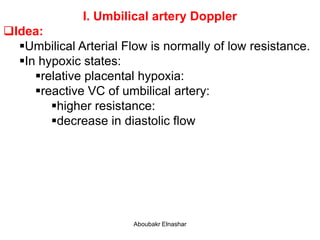
Idea:
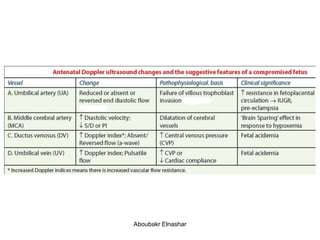
Umbilical Arterial Flow is normally of low resistance.
In hypoxic states:
relative placental hypoxia:
reactive VC of umbilical artery:
higher resistance:
decrease in diastolic flow
Aboubakr Elnashar
Interpretation:
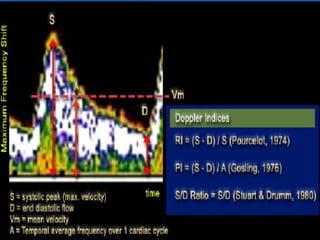
 Resistance index:
 best ability to predict abnormal outcomes
(RCOG,2002 Evidence level II)
 Enddiastolic flow
 Systolic/diastolic ratio
 Pulsatility index
 Diastolic average ratio
Aboubakr Elnashar
Doppler indices
Aboubakr Elnashar
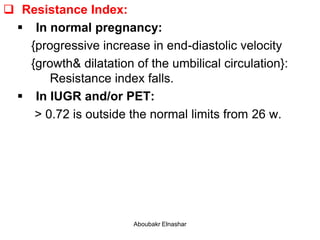
 Resistance Index:
 In normal pregnancy:
{progressive increase in end-diastolic velocity
{growth& dilatation of the umbilical circulation}:
Resistance index falls.
 In IUGR and/or PET:
> 0.72 is outside the normal limits from 26 w.
Aboubakr Elnashar
End Diastolic flow
 In IUGR and/or PET:
reduced, then
absent (AED) or
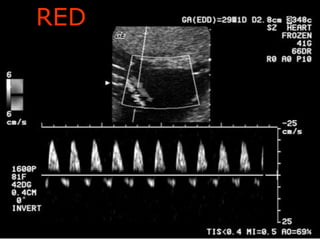
reversed (RED) in severe cases
 Absent or reversed:
Fetal distress is almost certain:
Immediate BPP or NST or
Delivery may be indicated.
Aboubakr Elnashar
S/D
Should be <3.
Small increases in S/D= 3-5:
IUGR.
Not strictly useful:
1. low sensitivity.
2. Gestation age dependent.
Aboubakr Elnashar
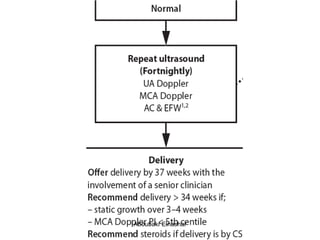
Surveillance= frequency of monitoring
Every 14 days.
in SFGA with normal Doppler
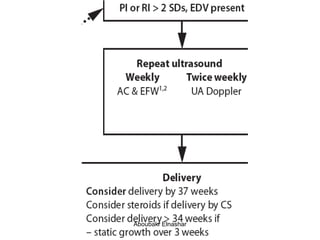
More frequent:
severe SGA
 Twice weekly:
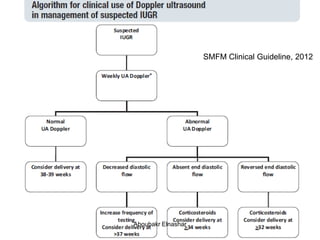
abnormal Um A D
(PI or RI > +2 SDs above mean for ges age) and
end–diastolic velocities present
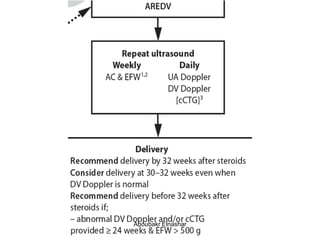
Daily:
AED/RED
Aboubakr Elnashar
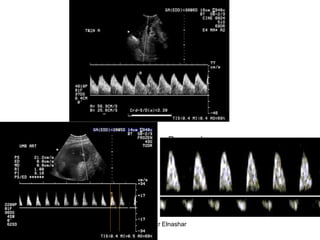
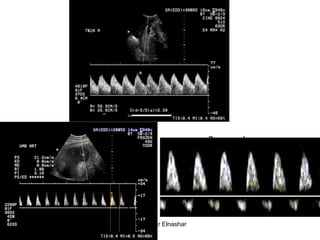
Normal
Absent
Reversed
Aboubakr Elnashar
Normal
Absent
Reversed
Aboubakr Elnashar
RED
Aboubakr Elnashar
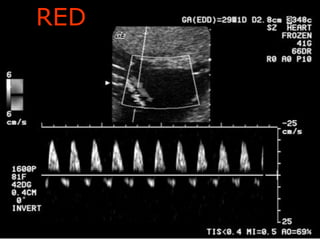
RED
Aboubakr Elnashar
Advantages
In low risk
No benefit on mother or baby
(Cochrane Library, 2003)
 In high risk:
 Reduction of
perinatal morbidity and mortality
number of antenatal admissions
inductions of labor
resources compared with CTG
(Grade A RCOG, 2002; The Cochrane Library, 2003)
 Comparing FHR monitoring, FBP and umbilical
artery Doppler:
only umbilical artery Doppler had value in predicting
poor perinatal outcomes in SGAAboubakr Elnashar
SMFM Clinical Guideline, 2012
Aboubakr Elnashar
II. Middle cerebral artery
In preterm SGA:
limited accuracy: should not be used
In term SGA:
Normal Um A D, an abnormal MCA D
(PI < 5th centile) has moderate predictive value
for acidosis at birth: used to time delivery.
Aboubakr Elnashar
In fetal anemia:
Enhanced fetal cardiac output and
Decrease in blood viscosity:
Increased blood flow velocity
preferentially shunt blood to brain faster
most pronounced MCA PSV
Aboubakr Elnashar
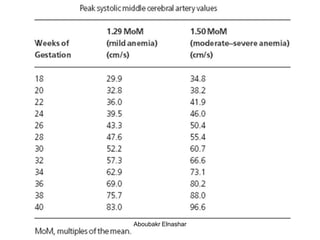
Frequency
•Initiated: 18 w
•Repeated: every 1–2 w as the clinical situation
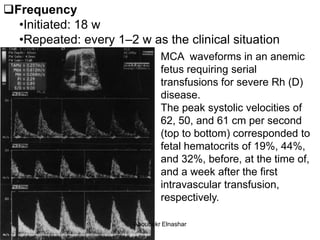
MCA waveforms in an anemic
fetus requiring serial
transfusions for severe Rh (D)
disease.
The peak systolic velocities of
62, 50, and 61 cm per second
(top to bottom) corresponded to
fetal hematocrits of 19%, 44%,
and 32%, before, at the time of,
and a week after the first
intravascular transfusion,
respectively.
Aboubakr Elnashar
Aboubakr Elnashar
Advantage
More sensitive for predicting f anemia than the
ΔOD450
Alternative to serial amniocenteses
Excellent noninvasive tool for the monitoring of f
anemia.
Aboubakr Elnashar
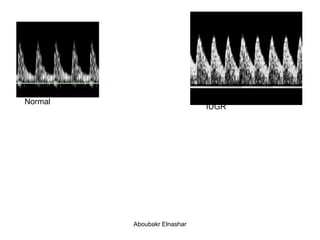
IUGR
Normal
Aboubakr Elnashar
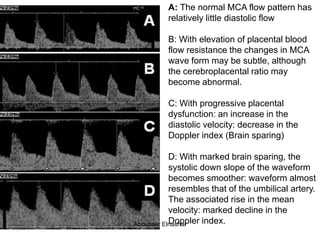
A: The normal MCA flow pattern has
relatively little diastolic flow
B: With elevation of placental blood
flow resistance the changes in MCA
wave form may be subtle, although
the cerebroplacental ratio may
become abnormal.
C: With progressive placental
dysfunction: an increase in the
diastolic velocity: decrease in the
Doppler index (Brain sparing)
D: With marked brain sparing, the
systolic down slope of the waveform
becomes smoother: waveform almost
resembles that of the umbilical artery.
The associated rise in the mean
velocity: marked decline in the
Doppler index.Aboubakr Elnashar
III. Ductus venosus (DV)
Moderate predictive value
used in:
preterm SGA with abnormal Um A D and to time
delivery.
Aboubakr Elnashar
Aboubakr Elnashar
Aboubakr Elnashar
Aboubakr Elnashar
Aboubakr Elnashar
IV.Uterine artery Doppler
• limited use in predicting FGR and perinatal death
(Grade A, RCOG,2002).
• Abnormal uterine artery suggest:
maternal cause for the growth restriction
• Normal uterine artery Doppler suggest:
fetal cause
Aboubakr Elnashar
Aboubakr Elnashar
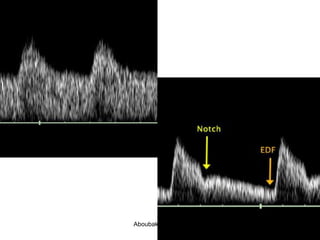
UAD: Normal
UAD: notch,
decreased diastolic
flow
Aboubakr Elnashar
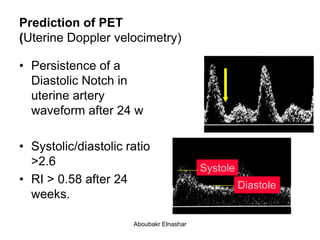
Prediction of PET
(Uterine Doppler velocimetry)
• Persistence of a
Diastolic Notch in
uterine artery
waveform after 24 w
• Systolic/diastolic ratio
>2.6
• RI > 0.58 after 24
weeks.
Systole
Diastole
Aboubakr Elnashar
Aboubakr Elnashar

Doppler interpretation in pregnancy

  • 1.
  • 2.
  • 3.
    I. Umbilical arteryDoppler Idea: Umbilical Arterial Flow is normally of low resistance. In hypoxic states: relative placental hypoxia: reactive VC of umbilical artery: higher resistance: decrease in diastolic flow Aboubakr Elnashar
  • 4.
    Interpretation:  Resistance index: best ability to predict abnormal outcomes (RCOG,2002 Evidence level II)  Enddiastolic flow  Systolic/diastolic ratio  Pulsatility index  Diastolic average ratio Aboubakr Elnashar
  • 5.
  • 6.
     Resistance Index: In normal pregnancy: {progressive increase in end-diastolic velocity {growth& dilatation of the umbilical circulation}: Resistance index falls.  In IUGR and/or PET: > 0.72 is outside the normal limits from 26 w. Aboubakr Elnashar
  • 7.
    End Diastolic flow In IUGR and/or PET: reduced, then absent (AED) or reversed (RED) in severe cases  Absent or reversed: Fetal distress is almost certain: Immediate BPP or NST or Delivery may be indicated. Aboubakr Elnashar
  • 8.
    S/D Should be <3. Smallincreases in S/D= 3-5: IUGR. Not strictly useful: 1. low sensitivity. 2. Gestation age dependent. Aboubakr Elnashar
  • 9.
    Surveillance= frequency ofmonitoring Every 14 days. in SFGA with normal Doppler More frequent: severe SGA  Twice weekly: abnormal Um A D (PI or RI > +2 SDs above mean for ges age) and end–diastolic velocities present Daily: AED/RED Aboubakr Elnashar
  • 10.
  • 11.
  • 12.
  • 13.
  • 14.
    Advantages In low risk Nobenefit on mother or baby (Cochrane Library, 2003)  In high risk:  Reduction of perinatal morbidity and mortality number of antenatal admissions inductions of labor resources compared with CTG (Grade A RCOG, 2002; The Cochrane Library, 2003)  Comparing FHR monitoring, FBP and umbilical artery Doppler: only umbilical artery Doppler had value in predicting poor perinatal outcomes in SGAAboubakr Elnashar
  • 15.
    SMFM Clinical Guideline,2012 Aboubakr Elnashar
  • 16.
    II. Middle cerebralartery In preterm SGA: limited accuracy: should not be used In term SGA: Normal Um A D, an abnormal MCA D (PI < 5th centile) has moderate predictive value for acidosis at birth: used to time delivery. Aboubakr Elnashar
  • 17.
    In fetal anemia: Enhancedfetal cardiac output and Decrease in blood viscosity: Increased blood flow velocity preferentially shunt blood to brain faster most pronounced MCA PSV Aboubakr Elnashar
  • 18.
    Frequency •Initiated: 18 w •Repeated:every 1–2 w as the clinical situation MCA waveforms in an anemic fetus requiring serial transfusions for severe Rh (D) disease. The peak systolic velocities of 62, 50, and 61 cm per second (top to bottom) corresponded to fetal hematocrits of 19%, 44%, and 32%, before, at the time of, and a week after the first intravascular transfusion, respectively. Aboubakr Elnashar
  • 19.
  • 20.
    Advantage More sensitive forpredicting f anemia than the ΔOD450 Alternative to serial amniocenteses Excellent noninvasive tool for the monitoring of f anemia. Aboubakr Elnashar
  • 21.
  • 22.
    A: The normalMCA flow pattern has relatively little diastolic flow B: With elevation of placental blood flow resistance the changes in MCA wave form may be subtle, although the cerebroplacental ratio may become abnormal. C: With progressive placental dysfunction: an increase in the diastolic velocity: decrease in the Doppler index (Brain sparing) D: With marked brain sparing, the systolic down slope of the waveform becomes smoother: waveform almost resembles that of the umbilical artery. The associated rise in the mean velocity: marked decline in the Doppler index.Aboubakr Elnashar
  • 23.
    III. Ductus venosus(DV) Moderate predictive value used in: preterm SGA with abnormal Um A D and to time delivery. Aboubakr Elnashar
  • 24.
  • 25.
  • 26.
  • 27.
  • 28.
    IV.Uterine artery Doppler •limited use in predicting FGR and perinatal death (Grade A, RCOG,2002). • Abnormal uterine artery suggest: maternal cause for the growth restriction • Normal uterine artery Doppler suggest: fetal cause Aboubakr Elnashar
  • 29.
  • 30.
    UAD: Normal UAD: notch, decreaseddiastolic flow Aboubakr Elnashar
  • 31.
    Prediction of PET (UterineDoppler velocimetry) • Persistence of a Diastolic Notch in uterine artery waveform after 24 w • Systolic/diastolic ratio >2.6 • RI > 0.58 after 24 weeks. Systole Diastole Aboubakr Elnashar
  • 32.