Acids and Bases
By:. Nitin H. Bansod
Associate Professor
Shri Shivaji Science College, Amravati.
Acid and Bases
Acid and Bases
Acid and Bases
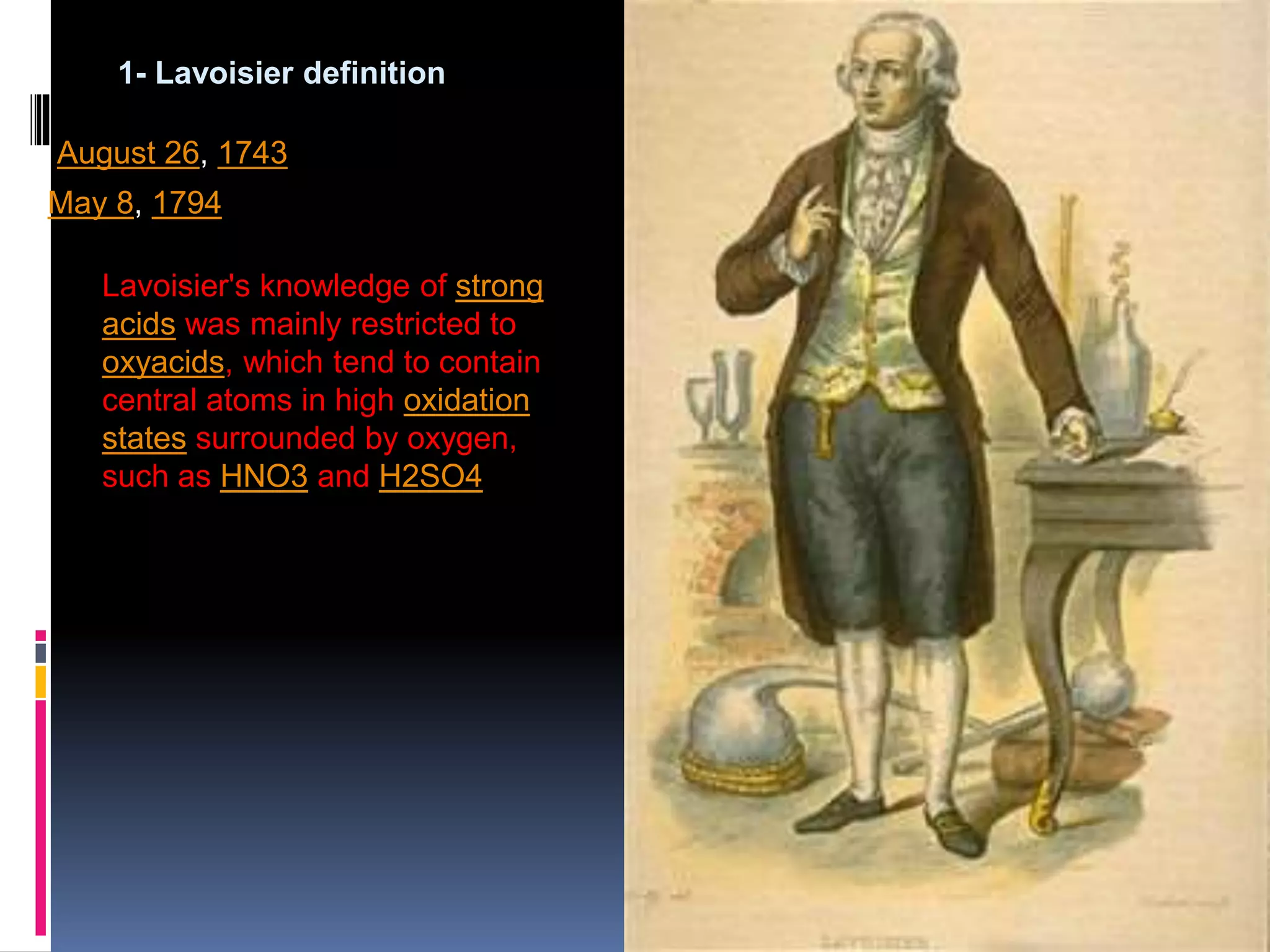
1- Lavoisier definition
August 26, 1743
May 8, 1794
Lavoisier's knowledge of strong
acids was mainly restricted to
oxyacids, which tend to contain
central atoms in high oxidation
states surrounded by oxygen,
such as HNO3 and H2SO4
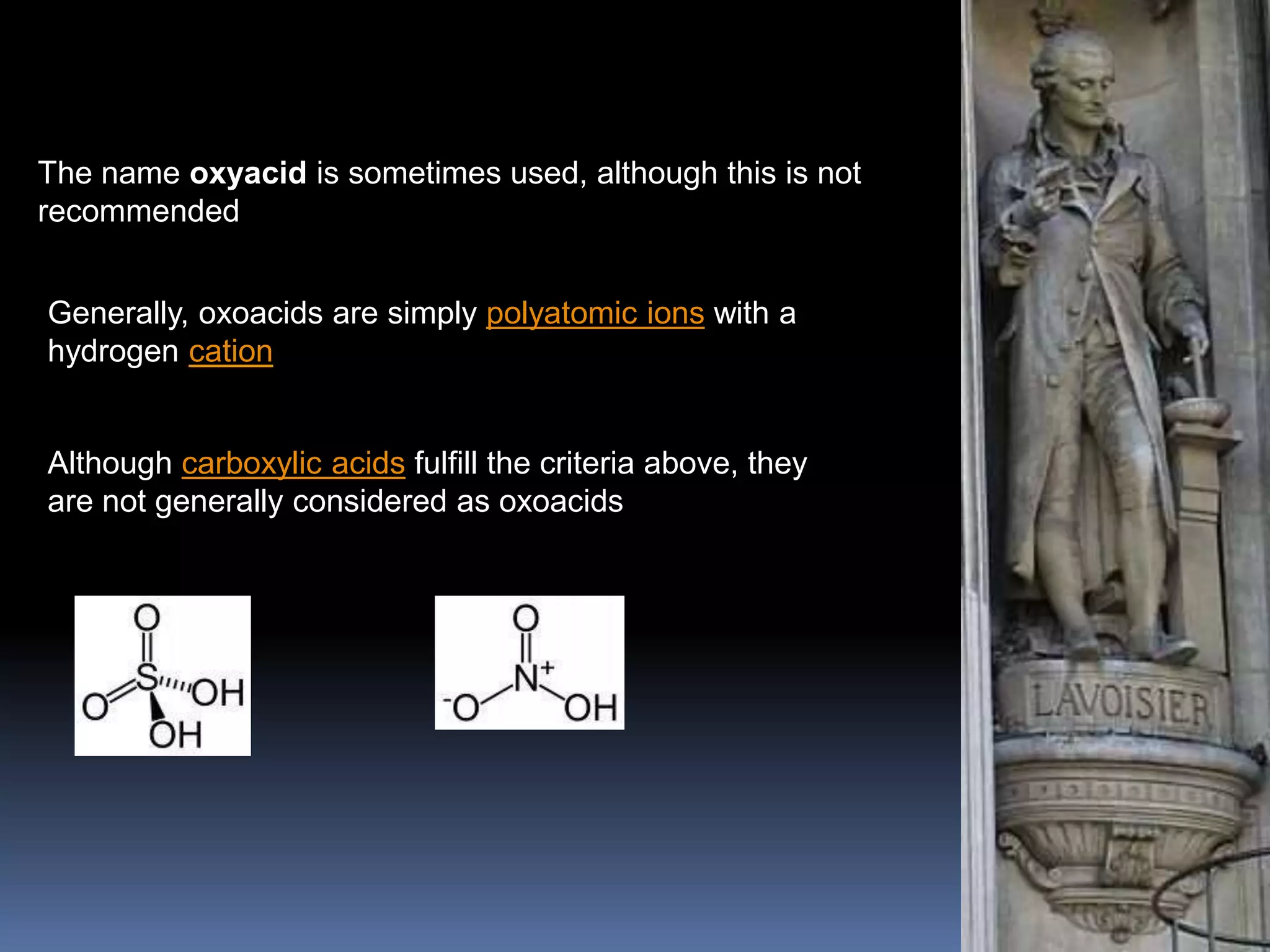
An oxoacid is an acid which
contains oxygen. More
specifically, it is an acid
which:
contains oxygen;
contains at least one other
element;
has at least one hydrogen
atom bound to oxygen; and
forms an ion by the loss of
one or more protons
The name oxyacid is sometimes used, although this is not
recommended
Generally, oxoacids are simply polyatomic ions with a
hydrogen cation
Although carboxylic acids fulfill the criteria above, they
are not generally considered as oxoacids
2- Liebig definition
(May 12, 1803 – April 18, 1873)
This definition was proposed by
Justus von Liebig circa 1838, based
on his extensive works on the
chemical composition of organic acids.
This finished the doctrinal shift from oxygen-
based acids to hydrogen-based acids,
started by Davy
According to Liebig, an acid is a hydrogen-containing substance in which the
hydrogen could be replaced by a metal. Liebig's definition, while completely
empirical, remained in use for almost 50 years until the adoption of the
Arrhenius definition.
3- Arrhenius definition
Nobel prize in chemistry in 1903
The Arrhenius definition of acid-
base reactions is a more simplified
acid-base concept devised by
Svante Arrhenius, which was used
to provide a modern definition of
bases that followed from his work
with Friedrich Wilhelm Ostwald in
establishing the presence of ions
in aqueous solution in 1884
As defined at the time of discovery, acid-base
reactions are characterized by Arrhenius acids,
which dissociate in aqueous solution form
hydrogen or the later-termed oxonium (H3O+)
ions, and Arrhenius bases which form hydroxide
(OH-) ions.
More recent IUPAC recommendations now suggest
the newer term "hydronium“ be used in favor of the
older accepted term "oxonium“.
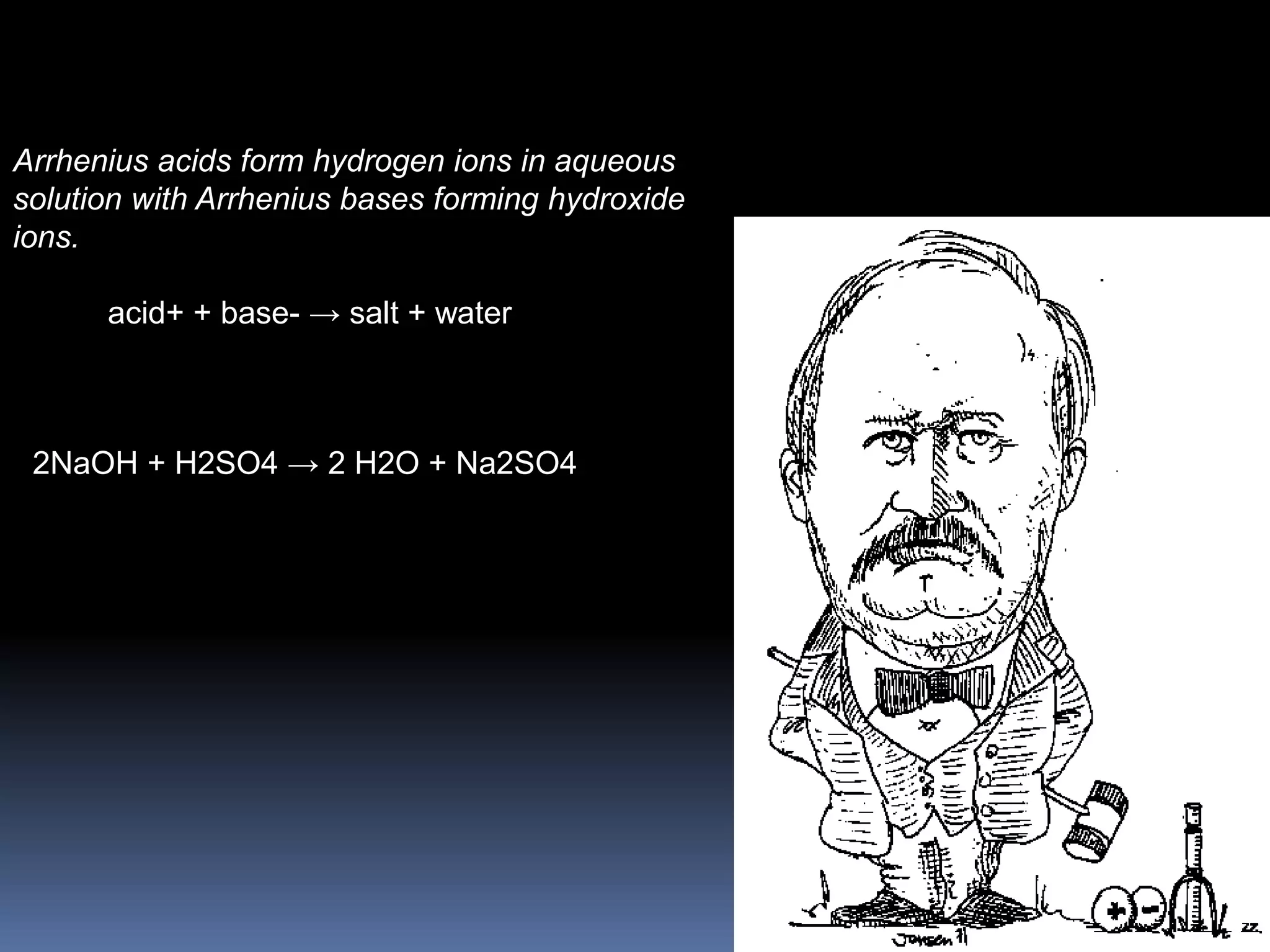
Arrhenius acids form hydrogen ions in aqueous
solution with Arrhenius bases forming hydroxide
ions.
acid+ + base- → salt + water
2NaOH + H2SO4 → 2 H2O + Na2SO4
4- Brønsted-Lowry definition
1923
professor of inorganic and
physical chemistry at Copenhagen
English physical chemist
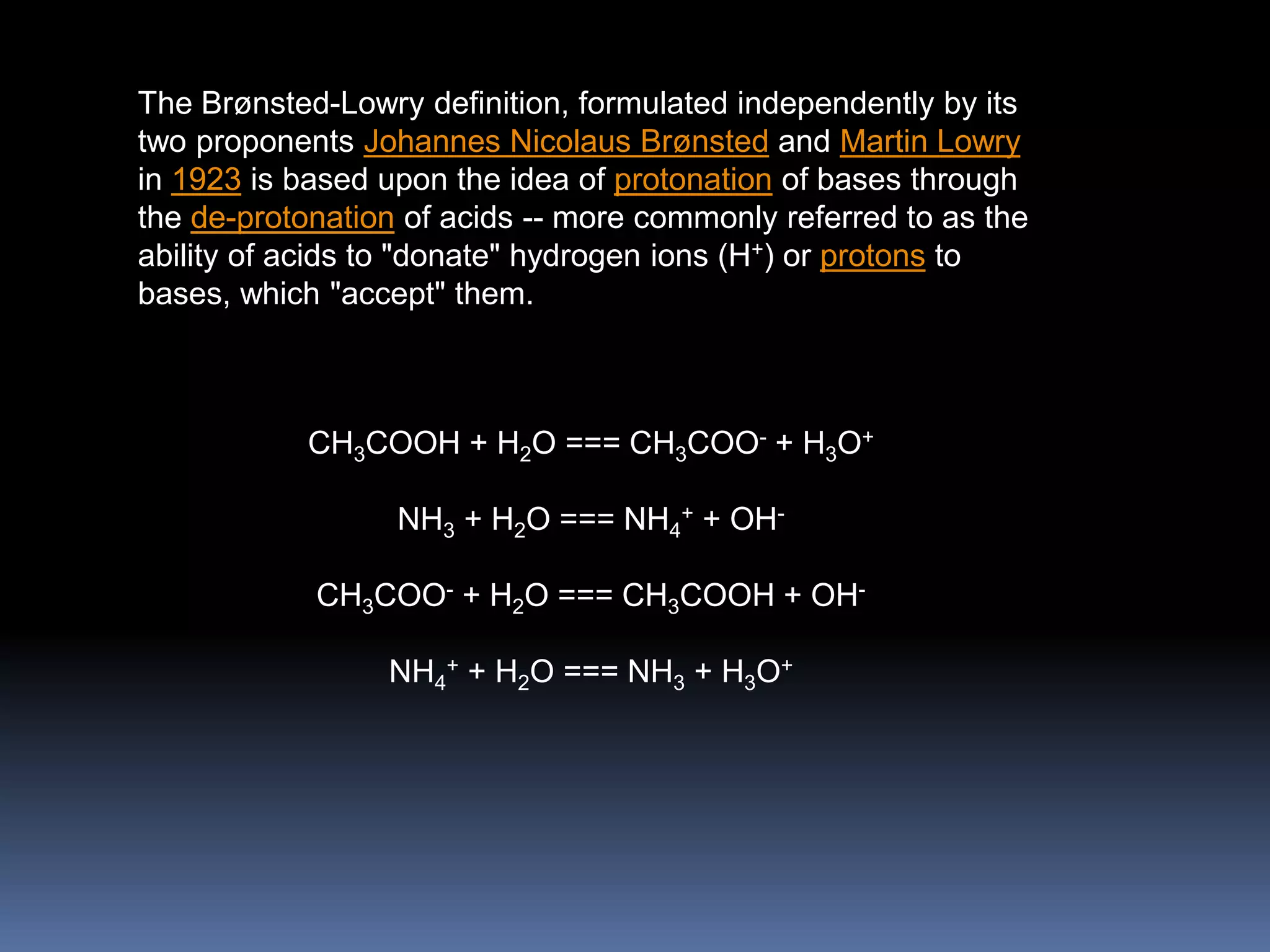
The Brønsted-Lowry definition, formulated independently by its
two proponents Johannes Nicolaus Brønsted and Martin Lowry
in 1923 is based upon the idea of protonation of bases through
the de-protonation of acids -- more commonly referred to as the
ability of acids to "donate" hydrogen ions (H+) or protons to
bases, which "accept" them.
CH3COOH + H2O === CH3COO- + H3O+
NH3 + H2O === NH4
+ + OH-
CH3COO- + H2O === CH3COOH + OH-
NH4
+ + H2O === NH3 + H3O+
In contrast to the Arrhenius definition, the Brønsted-Lowry definition refers
to the products of an acid-base reaction as conjugate acids and bases to
refer to the relation of one proton, and to indicate that there has been a
reaction between the two quantities, rather than a "formation" of salt and
water, as explained in the Arrhenius definition
AH + B → BH+ + A-
General formula for representing Brønsted-Lowry reactions.
HCl (aq) + H2O → H3O+ (aq) + Cl- (aq)
Hydrochloric acid completely reacts with water to form the
hydronium and chloride ions
CH3COOH + NH3 → NH4+ + CH3COO-
Acetic acid reacts incompletely with ammonia, no hydronium
ions being produced
In differentiation from the Arrhenius definition, the Brønsted-Lowry
definition postulates that for each acid, there is a conjugate acid and base
or "conjugate acid-base pair" that is formed through a complete reaction,
which also includes water, which is amphoteric
For example, zinc oxide (ZnO) reacts differently depending on the pH of the solution:
In acids: ZnO + 2H+ → Zn2+ + H2O
In bases: ZnO + H2O + 2OH- → [Zn(OH)4]2-
Base (Proton Acceptor): H2O + HCl → H3O+ + Cl−
Acid (Proton Donor): H2O + NH3 → NH4
+ + OH−
(Indeed, it can do both at once: 2H2O → H3O+ + OH−)
• The more recent Bronsted-Lowry concept is
that acids are H+ (proton) donors and bases
are proton acceptors
Ionization
+Cl H
H
H
O
+H
H
H O Cl+
• O (e.g.H2SO4) was originally thought to cause
acidic properties. Later, H was implicated, but
it was still not clear why CH4 was neutral.
• Arrhenius made the revolutionary suggestion
that some solutions contain ions & that acids
produce H3O+ (hydronium) ions in solution.
The Bronsted-Lowry concept
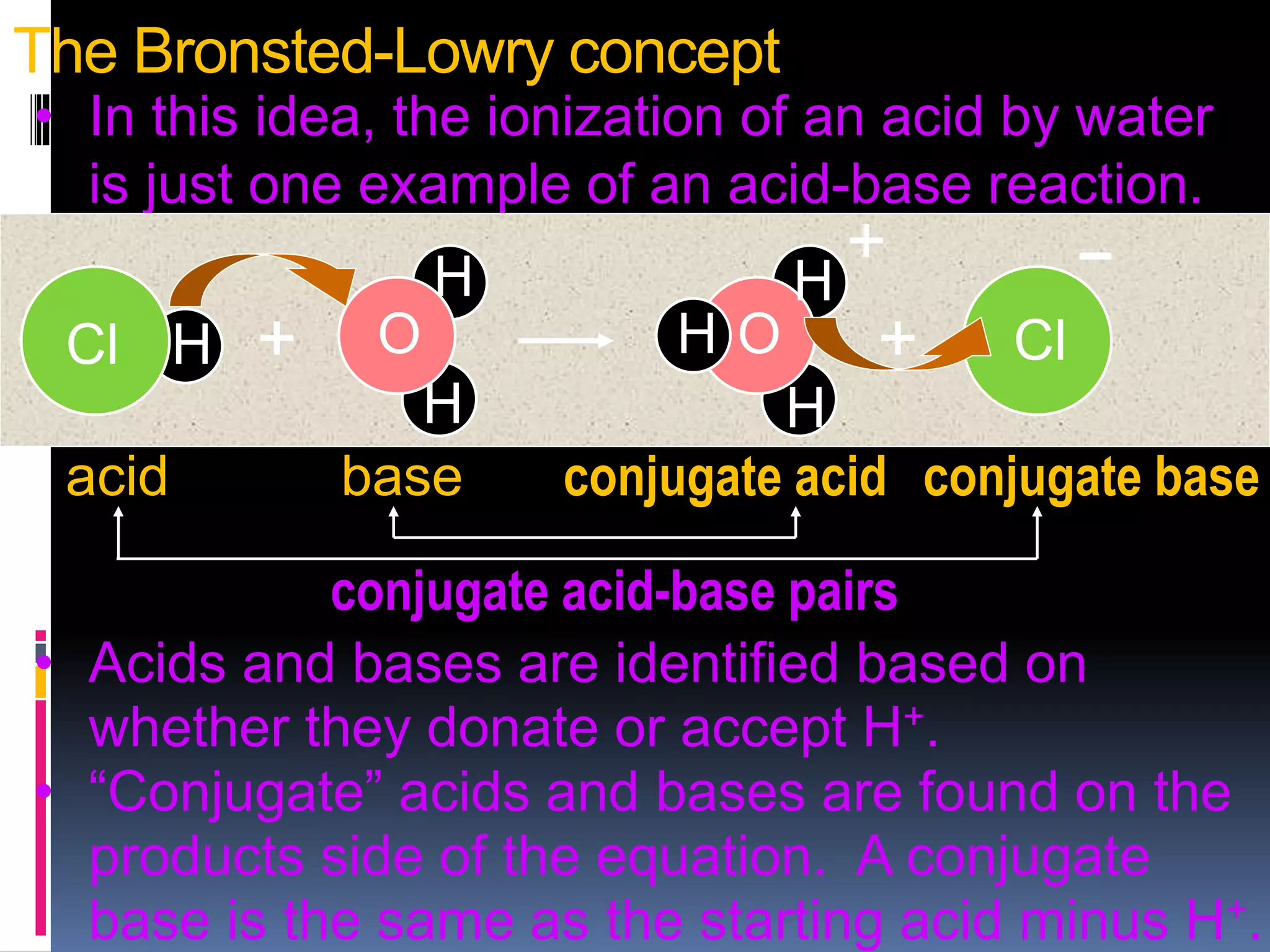
• In this idea, the ionization of an acid by water
is just one example of an acid-base reaction.
• Acids and bases are identified based on
whether they donate or accept H+.
• “Conjugate” acids and bases are found on the
products side of the equation. A conjugate
base is the same as the starting acid minus H+.
+Cl H
H
H
O
+H
H
H O Cl+
acid base conjugate acid conjugate base
conjugate acid-base pairs
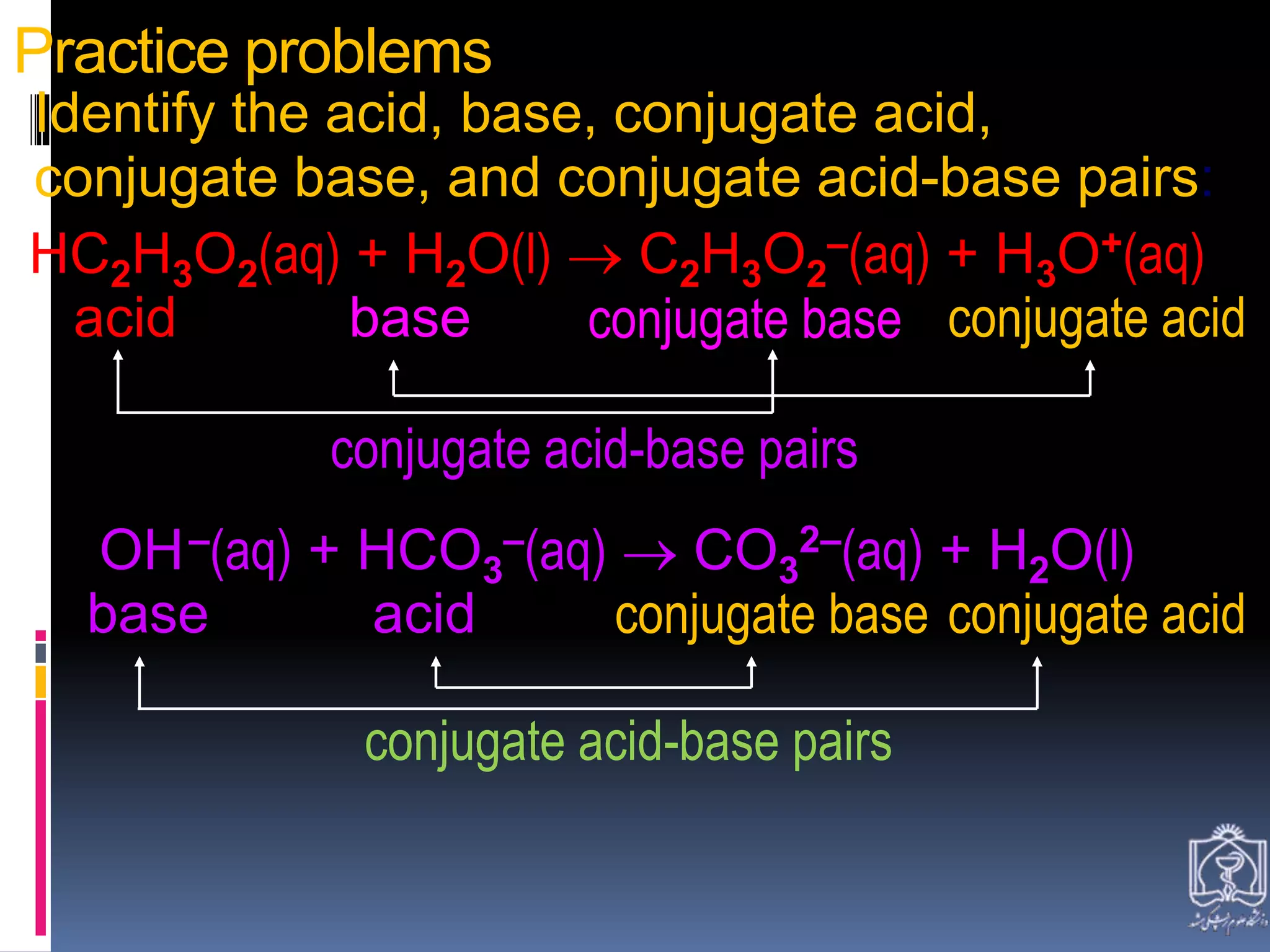
Practice problems
Identify the acid, base, conjugate acid,
conjugate base, and conjugate acid-base pairs:
acid base conjugate acidconjugate base
HC2H3O2(aq) + H2O(l)  C2H3O2
–(aq) + H3O+(aq)
conjugate acid-base pairs
acidbase conjugate acidconjugate base
OH–(aq) + HCO3
–(aq)  CO3
2–(aq) + H2O(l)
conjugate acid-base pairs
Acid – Base Strength
Strong Acid - Transfers all protons to water;
completely ionizes;
strong electrolyte;
conjugate base is weaker and has
negligible tendency to be protonated.
Weak Acid - Fraction of protons transferred to water;
partly ionized;
weak electrolyte;
conjugate base is stronger readily
accepting protons from water
 As acid strength decreases, base strength increases.
 The stronger the acid, the weaker its conjugate base
 The weaker the acid, the stronger its conjugate base
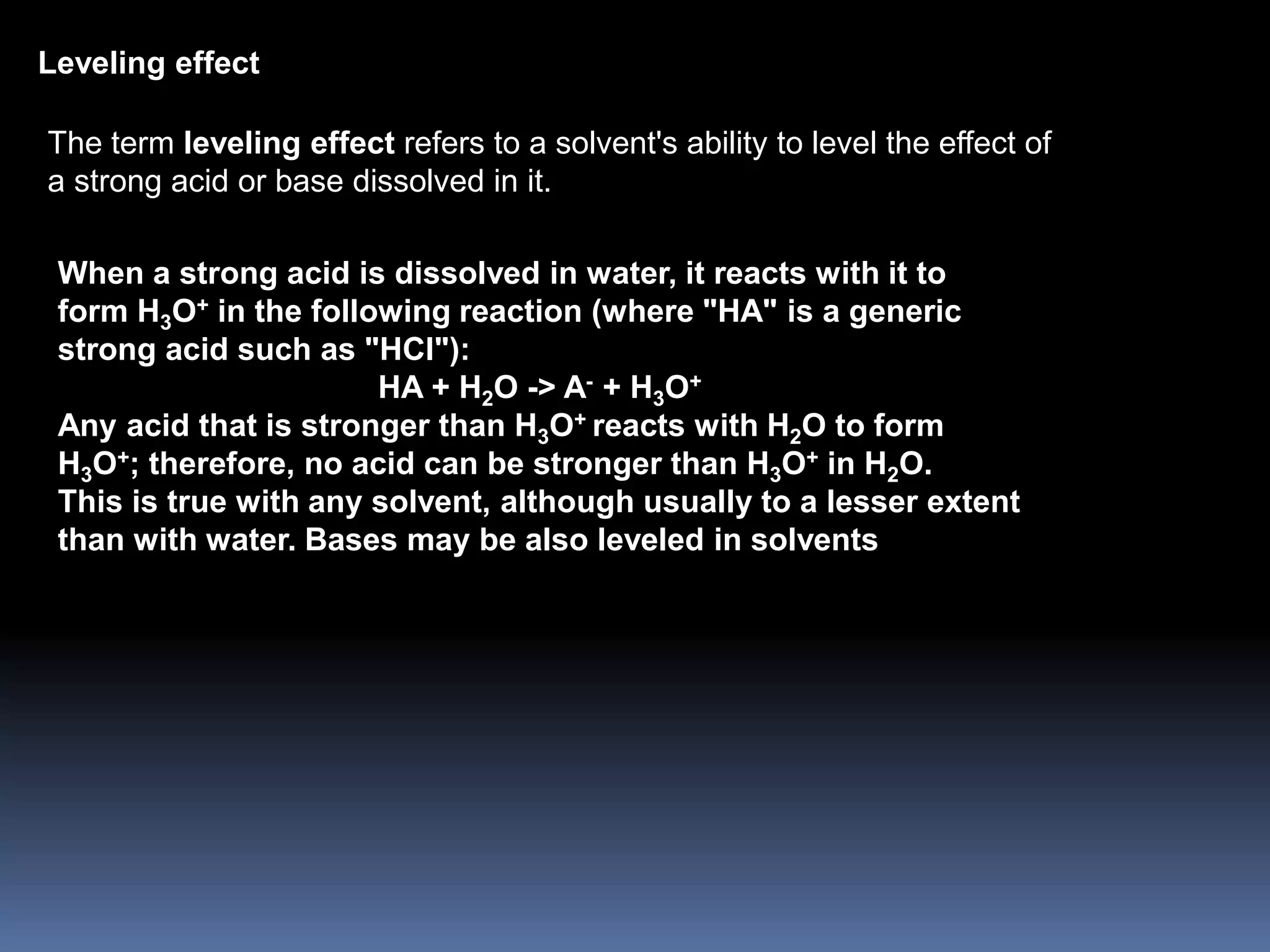
Leveling effect
The term leveling effect refers to a solvent's ability to level the effect of
a strong acid or base dissolved in it.
When a strong acid is dissolved in water, it reacts with it to
form H3O+ in the following reaction (where "HA" is a generic
strong acid such as "HCl"):
HA + H2O -> A- + H3O+
Any acid that is stronger than H3O+ reacts with H2O to form
H3O+; therefore, no acid can be stronger than H3O+ in H2O.
This is true with any solvent, although usually to a lesser extent
than with water. Bases may be also leveled in solvents
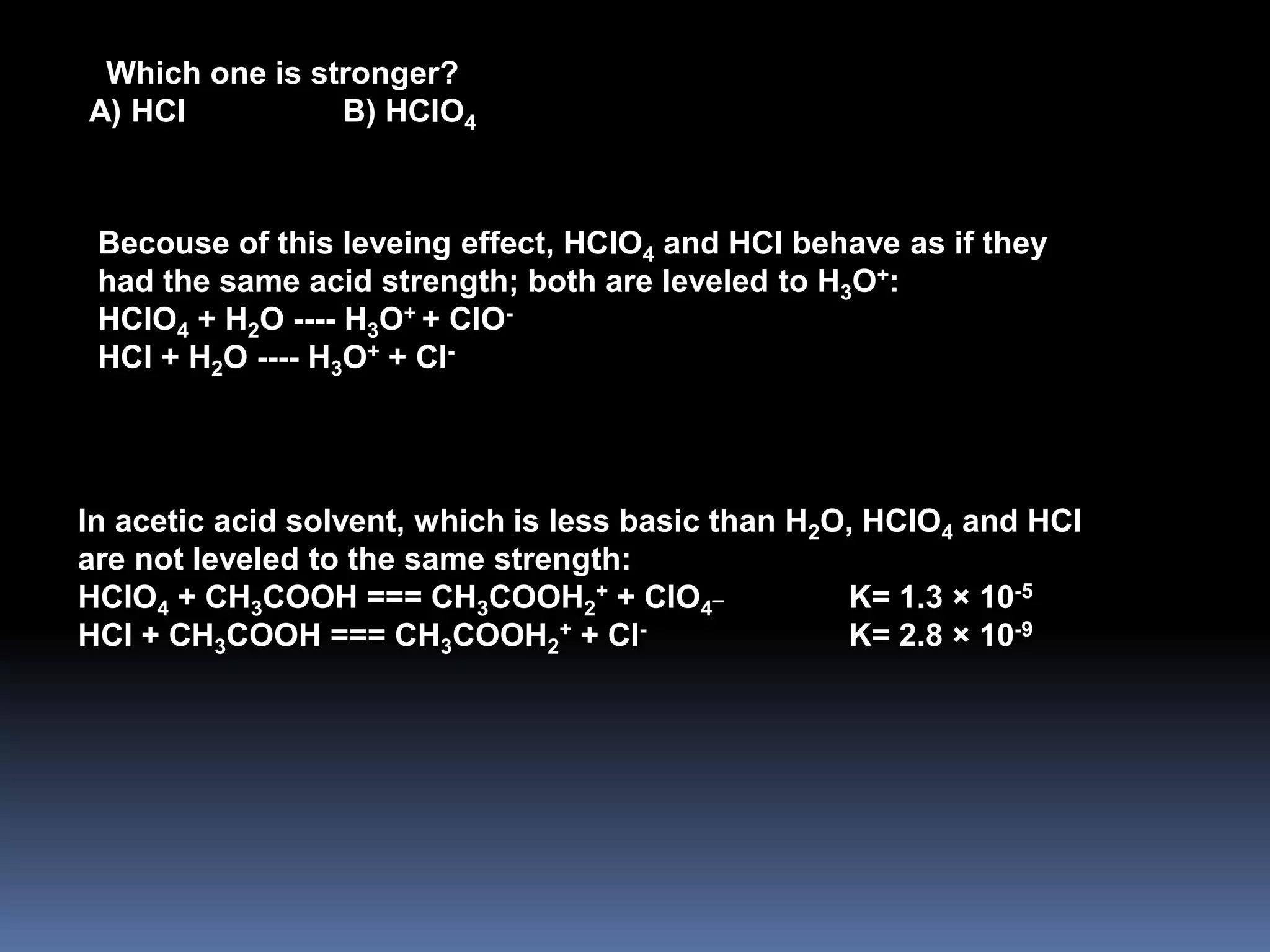
Which one is stronger?
A) HCl B) HClO4
Becouse of this leveing effect, HClO4 and HCl behave as if they
had the same acid strength; both are leveled to H3O+:
HClO4 + H2O ---- H3O+ + ClO-
HCl + H2O ---- H3O+ + Cl-
In acetic acid solvent, which is less basic than H2O, HClO4 and HCl
are not leveled to the same strength:
HClO4 + CH3COOH === CH3COOH2
+ + ClO4
_ K= 1.3 × 10⁻⁵
HCl + CH3COOH === CH3COOH2
+ + Cl- K= 2.8 × 10⁻⁹
5-Lewis definition
Gilbert Newton Lewis
(October 23, 1875 - March 23, 1946)
a famous American physical chemist
known for his 1902 Lewis dot
structures, his paper "The Atom and
the Molecule", which is the
foundation of modern valence bond
theory, developed in coordination
with Irving Langmuir .
In 1926, Lewis coined the term
"photon" for the smallest unit of
radiant energy.
The Lewis definition of acid base reactions, devised by Gilbert N. Lewis
in 1923 is an encompassing theory to the Brønsted-Lowry and solvent-
system definitions with regards to the premise of a donation
mechanism, which conversely attributes the donation of electron
pairs from bases and the acceptance by acids, rather than protons
or other bonded substances and spans both aqueous and non-aqueous
reactions
Ag+ + 2 :NH3 → [H3N:Ag:NH3]+
A silver cation reacts as an acid with ammonia which acts as
an electron-pair donor, forming an ammonia-silver adduct
Acid - An electron
pair acceptor
Base - An electron
pair donor
Franklin Theory of Solvent-system
Acid : Acid is a Substance on dissolution in a solvent give cation same
as that of auto ionization product of solvent.
Base : Base is a Substance on dissolution in a solvent give anion
same as that of auto ionization product of solvent.
Auto Ionization product
Protonic Solvent
2H2O ⇌ H3O+ (Hydronium) + OH- (Hydroxide)
2NH3 ⇌ NH4
+ (ammonium) + NH2
− (amide)
CH3COOH + CH3COOH ⇌ CH3COOH2
+ + CH3COO-
even some Non –protonic systems:
N2O4 ⇌ NO+ (nitrosonium) + NO3
− (nitrate)
2SbCl3 ⇌ SbCl2
+ (dichloroantimonium) + SbCl4
- (tetrachloroantimonate)
SO2 + SO2 ⇌ SO2
+ + SO3
2-
BrF3 + BrF3 ⇌ BrF2
+ + BrF4
–
COCl2 + COCl2 ⇌ COClCOCl2
+ + Cl-
Neutralization Reaction :
Acid + Base ⇌ Salt + Solvent
In liquid NH3 NH4Cl + NaNH2 ⇌ ? + 2NH3
in liquid SO2 SOCl2 + Na2SO3 ⇌ 2NaCl + ?
in liquid N2O4 NOCl + NaNO3 ⇌ ? + ?
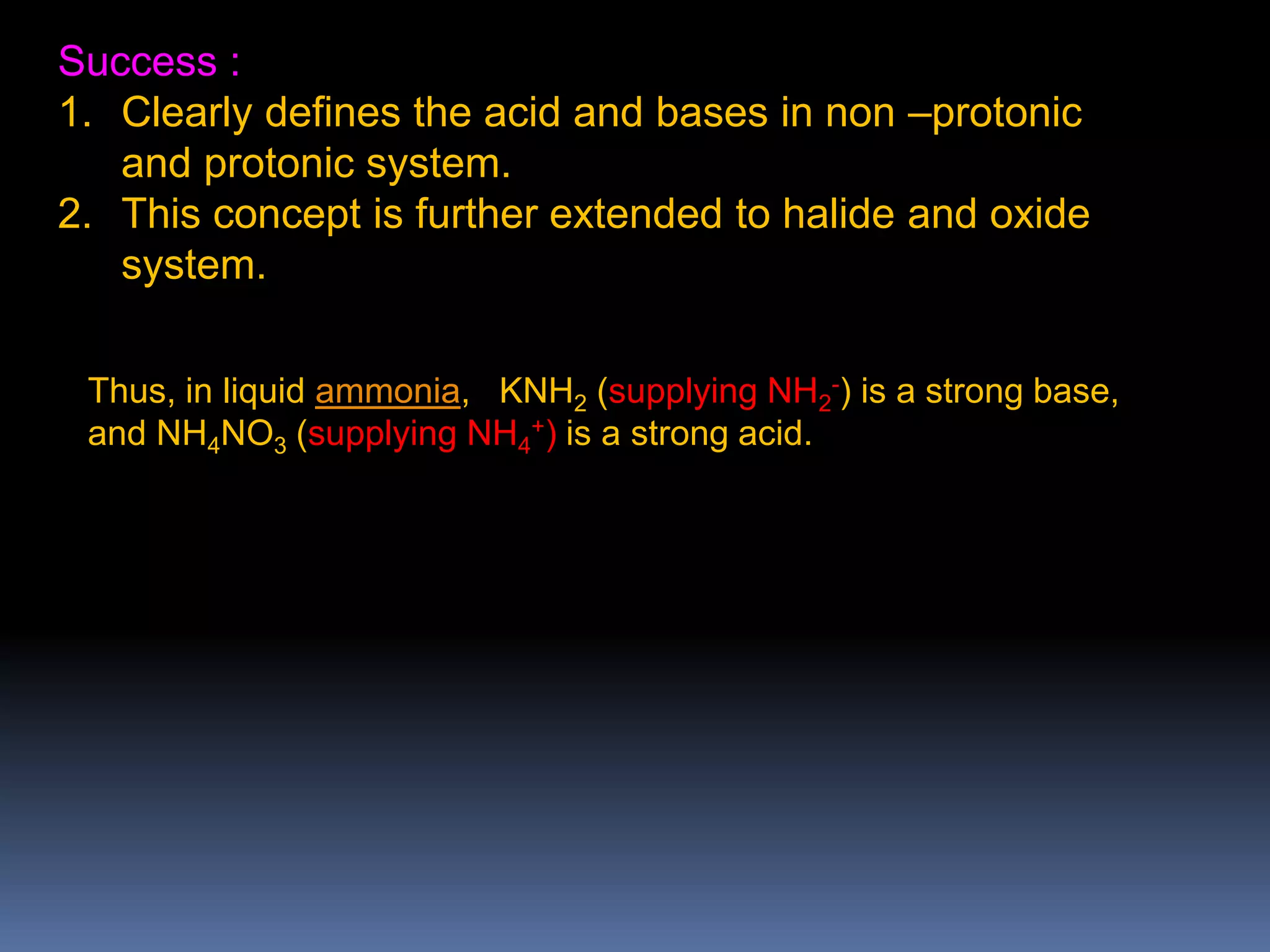
Success :
1. Clearly defines the acid and bases in non –protonic
and protonic system.
2. This concept is further extended to halide and oxide
system.
Thus, in liquid ammonia, KNH2 (supplying NH2
-) is a strong base,
and NH4NO3 (supplying NH4
+) is a strong acid.
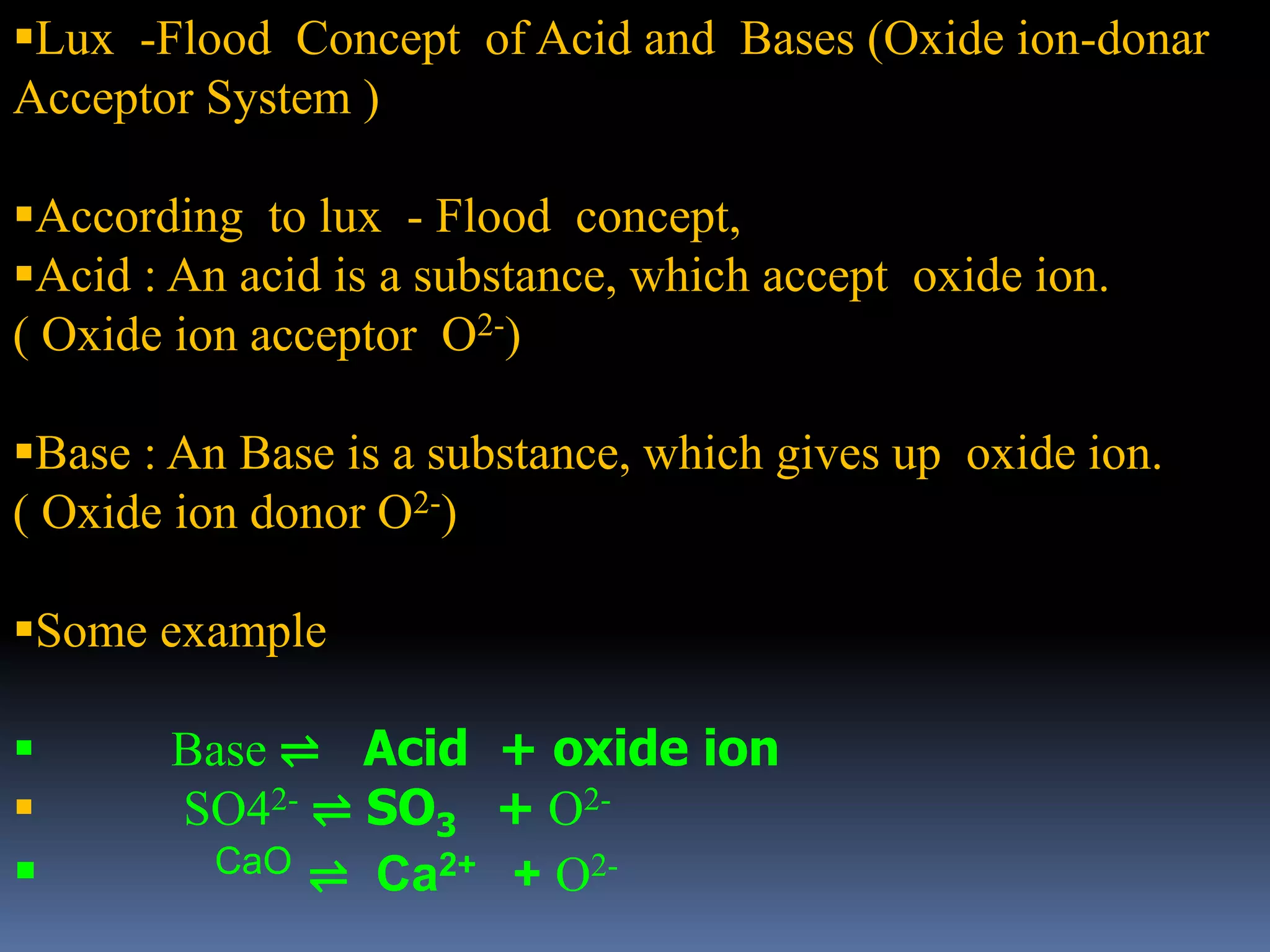
Lux -Flood Concept of Acid and Bases (Oxide ion-donar
Acceptor System )
According to lux - Flood concept,
Acid : An acid is a substance, which accept oxide ion.
( Oxide ion acceptor O2-)
Base : An Base is a substance, which gives up oxide ion.
( Oxide ion donor O2-)
Some example
 Base ⇌ Acid + oxide ion
 SO42- ⇌ SO3 + O2-
 CaO ⇌ Ca2+ + O2-
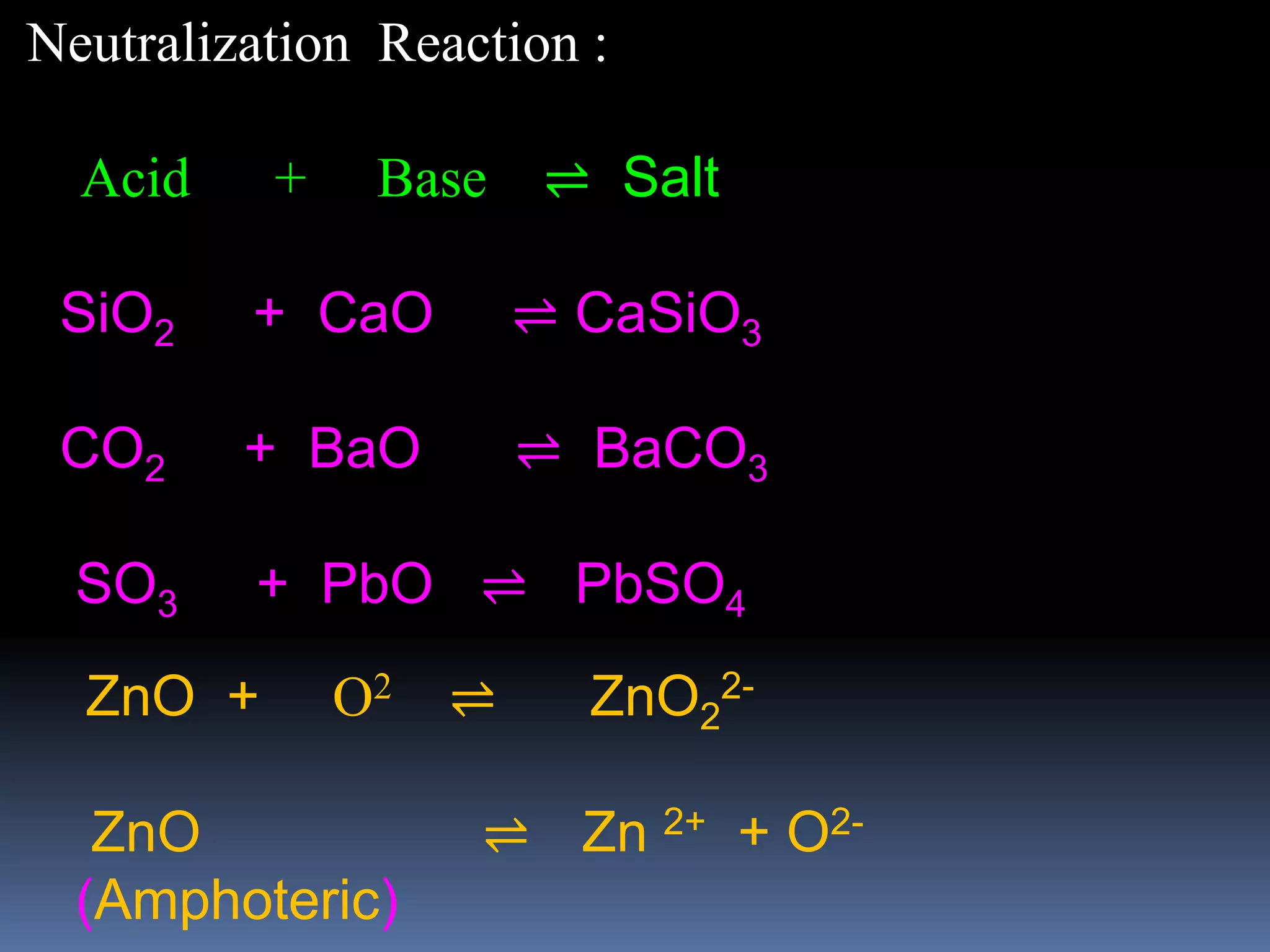
Neutralization Reaction :
Acid + Base ⇌ Salt
SiO2 + CaO ⇌ CaSiO3
CO2 + BaO ⇌ BaCO3
SO3 + PbO ⇌ PbSO4
ZnO + O2 ⇌ ZnO2
2-
ZnO ⇌ Zn 2+ + O2-
(Amphoteric)
Al2O3 + O2- ⇌ ?
Al2O3 ⇌ ? + ?
(Amphoteric)
Merits :
1. it is useful at higher temp. reaction as in a field of ceramics
and metallurgy
2. it explain acid base behavior of non- protonic solvent.
limitation :
1. only those reaction of acid base is allowed in which oxide ion
transfer involve
Concept of Hard and soft Acid and Base
R.G.Pearson in 1963 classified the Lewis acids (particularly
metal cations ) and Lewis bases into two types
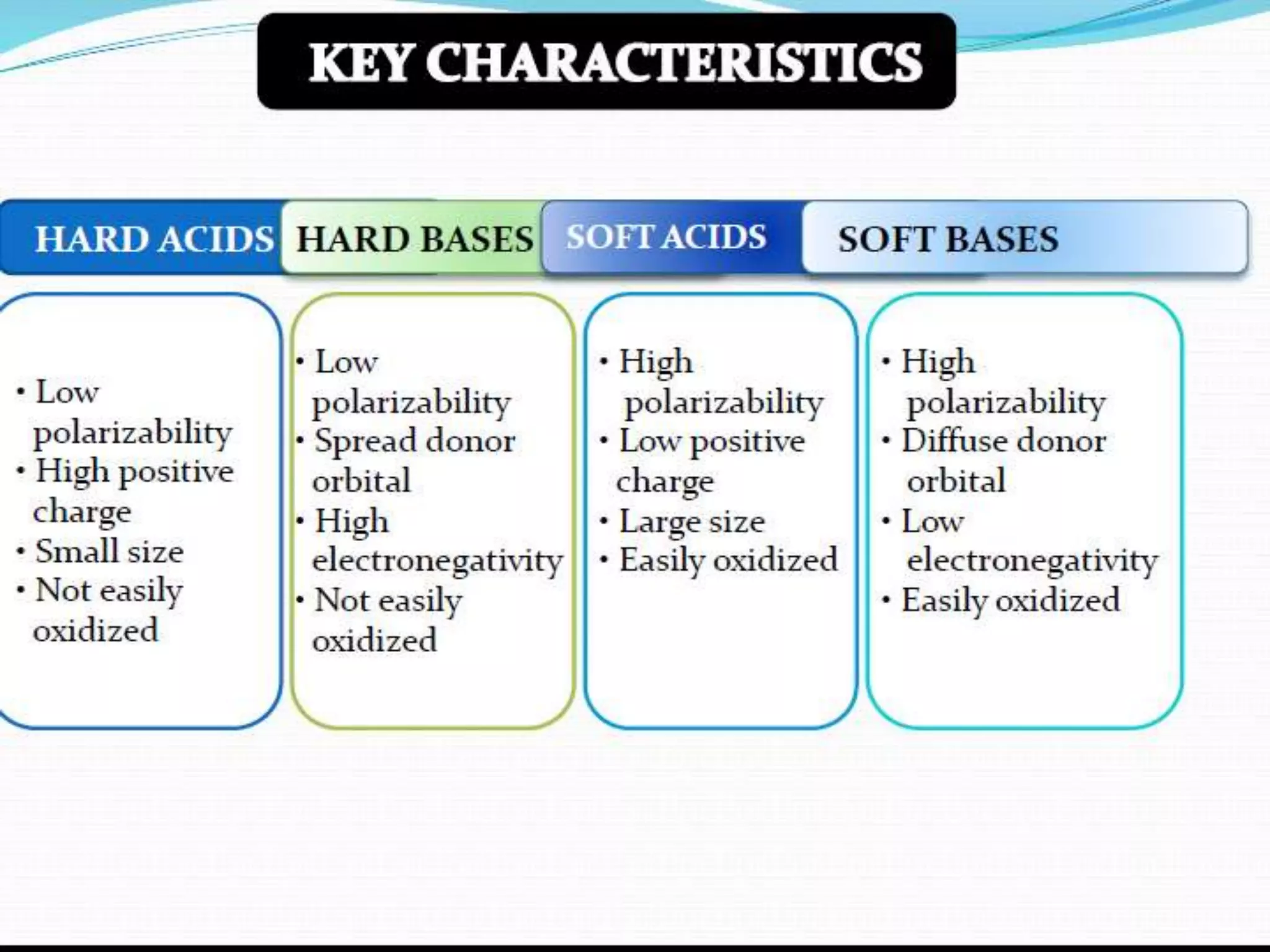
Hard acid : Hard acid is one, which ha s strong tendency to
accept electrons
Salient Features
1. They have small size
2. They have high positive charge (+3 ,+5)
3. They have high polarizing power
4. Outer electron are not easily distorted
5. High Ionization potential
thus alkali and alkaline earth metal, transition metal ions like
Ti4+, Fe3+, Co2+ .
Soft acid : Soft acid is one, which has weak tendency to
accept electrons
Salient Features
1. They have Large size
2. They have low or zero oxidation state (+0 or +1)
3. They have low polarizing power
4. Outer electron are easily distorted
5. Low Ionization potential
Heavier transition metal ions like Cu2+, Ag+, Hg2+ . Metal
ions in metal carbonyls are soft acid.
Applications of SHAB principle
1.In predicting stability of complexes
AgI2- is stable and AgF2- does not exist
CoF6
3- is more stable and CoI6
3-
2. In predicting solubility of compounds
Hg(OH)2 dissolve readily in acidic solution
while HgS or CuS does not
3. in predicting existence of metallic ores
Metal like Mg, Ca, Al are usually found in
Carbonates and oxides.
Cu, Hg, Ag occur as their sulphides
ACID BASE THEORY

ACID BASE THEORY

  • 1.
    Acids and Bases By:.Nitin H. Bansod Associate Professor Shri Shivaji Science College, Amravati.
  • 2.
  • 3.
  • 4.
  • 5.
    1- Lavoisier definition August26, 1743 May 8, 1794 Lavoisier's knowledge of strong acids was mainly restricted to oxyacids, which tend to contain central atoms in high oxidation states surrounded by oxygen, such as HNO3 and H2SO4
  • 6.
    An oxoacid isan acid which contains oxygen. More specifically, it is an acid which: contains oxygen; contains at least one other element; has at least one hydrogen atom bound to oxygen; and forms an ion by the loss of one or more protons
  • 7.
    The name oxyacidis sometimes used, although this is not recommended Generally, oxoacids are simply polyatomic ions with a hydrogen cation Although carboxylic acids fulfill the criteria above, they are not generally considered as oxoacids
  • 9.
    2- Liebig definition (May12, 1803 – April 18, 1873) This definition was proposed by Justus von Liebig circa 1838, based on his extensive works on the chemical composition of organic acids.
  • 10.
    This finished thedoctrinal shift from oxygen- based acids to hydrogen-based acids, started by Davy According to Liebig, an acid is a hydrogen-containing substance in which the hydrogen could be replaced by a metal. Liebig's definition, while completely empirical, remained in use for almost 50 years until the adoption of the Arrhenius definition.
  • 11.
    3- Arrhenius definition Nobelprize in chemistry in 1903 The Arrhenius definition of acid- base reactions is a more simplified acid-base concept devised by Svante Arrhenius, which was used to provide a modern definition of bases that followed from his work with Friedrich Wilhelm Ostwald in establishing the presence of ions in aqueous solution in 1884
  • 12.
    As defined atthe time of discovery, acid-base reactions are characterized by Arrhenius acids, which dissociate in aqueous solution form hydrogen or the later-termed oxonium (H3O+) ions, and Arrhenius bases which form hydroxide (OH-) ions. More recent IUPAC recommendations now suggest the newer term "hydronium“ be used in favor of the older accepted term "oxonium“.
  • 13.
    Arrhenius acids formhydrogen ions in aqueous solution with Arrhenius bases forming hydroxide ions. acid+ + base- → salt + water 2NaOH + H2SO4 → 2 H2O + Na2SO4
  • 14.
    4- Brønsted-Lowry definition 1923 professorof inorganic and physical chemistry at Copenhagen English physical chemist
  • 15.
    The Brønsted-Lowry definition,formulated independently by its two proponents Johannes Nicolaus Brønsted and Martin Lowry in 1923 is based upon the idea of protonation of bases through the de-protonation of acids -- more commonly referred to as the ability of acids to "donate" hydrogen ions (H+) or protons to bases, which "accept" them. CH3COOH + H2O === CH3COO- + H3O+ NH3 + H2O === NH4 + + OH- CH3COO- + H2O === CH3COOH + OH- NH4 + + H2O === NH3 + H3O+
  • 16.
    In contrast tothe Arrhenius definition, the Brønsted-Lowry definition refers to the products of an acid-base reaction as conjugate acids and bases to refer to the relation of one proton, and to indicate that there has been a reaction between the two quantities, rather than a "formation" of salt and water, as explained in the Arrhenius definition AH + B → BH+ + A- General formula for representing Brønsted-Lowry reactions. HCl (aq) + H2O → H3O+ (aq) + Cl- (aq) Hydrochloric acid completely reacts with water to form the hydronium and chloride ions CH3COOH + NH3 → NH4+ + CH3COO- Acetic acid reacts incompletely with ammonia, no hydronium ions being produced
  • 17.
    In differentiation fromthe Arrhenius definition, the Brønsted-Lowry definition postulates that for each acid, there is a conjugate acid and base or "conjugate acid-base pair" that is formed through a complete reaction, which also includes water, which is amphoteric For example, zinc oxide (ZnO) reacts differently depending on the pH of the solution: In acids: ZnO + 2H+ → Zn2+ + H2O In bases: ZnO + H2O + 2OH- → [Zn(OH)4]2- Base (Proton Acceptor): H2O + HCl → H3O+ + Cl− Acid (Proton Donor): H2O + NH3 → NH4 + + OH− (Indeed, it can do both at once: 2H2O → H3O+ + OH−)
  • 18.
    • The morerecent Bronsted-Lowry concept is that acids are H+ (proton) donors and bases are proton acceptors Ionization +Cl H H H O +H H H O Cl+ • O (e.g.H2SO4) was originally thought to cause acidic properties. Later, H was implicated, but it was still not clear why CH4 was neutral. • Arrhenius made the revolutionary suggestion that some solutions contain ions & that acids produce H3O+ (hydronium) ions in solution.
  • 19.
    The Bronsted-Lowry concept •In this idea, the ionization of an acid by water is just one example of an acid-base reaction. • Acids and bases are identified based on whether they donate or accept H+. • “Conjugate” acids and bases are found on the products side of the equation. A conjugate base is the same as the starting acid minus H+. +Cl H H H O +H H H O Cl+ acid base conjugate acid conjugate base conjugate acid-base pairs
  • 20.
    Practice problems Identify theacid, base, conjugate acid, conjugate base, and conjugate acid-base pairs: acid base conjugate acidconjugate base HC2H3O2(aq) + H2O(l)  C2H3O2 –(aq) + H3O+(aq) conjugate acid-base pairs acidbase conjugate acidconjugate base OH–(aq) + HCO3 –(aq)  CO3 2–(aq) + H2O(l) conjugate acid-base pairs
  • 21.
    Acid – BaseStrength Strong Acid - Transfers all protons to water; completely ionizes; strong electrolyte; conjugate base is weaker and has negligible tendency to be protonated. Weak Acid - Fraction of protons transferred to water; partly ionized; weak electrolyte; conjugate base is stronger readily accepting protons from water  As acid strength decreases, base strength increases.  The stronger the acid, the weaker its conjugate base  The weaker the acid, the stronger its conjugate base
  • 23.
    Leveling effect The termleveling effect refers to a solvent's ability to level the effect of a strong acid or base dissolved in it. When a strong acid is dissolved in water, it reacts with it to form H3O+ in the following reaction (where "HA" is a generic strong acid such as "HCl"): HA + H2O -> A- + H3O+ Any acid that is stronger than H3O+ reacts with H2O to form H3O+; therefore, no acid can be stronger than H3O+ in H2O. This is true with any solvent, although usually to a lesser extent than with water. Bases may be also leveled in solvents
  • 24.
    Which one isstronger? A) HCl B) HClO4 Becouse of this leveing effect, HClO4 and HCl behave as if they had the same acid strength; both are leveled to H3O+: HClO4 + H2O ---- H3O+ + ClO- HCl + H2O ---- H3O+ + Cl- In acetic acid solvent, which is less basic than H2O, HClO4 and HCl are not leveled to the same strength: HClO4 + CH3COOH === CH3COOH2 + + ClO4 _ K= 1.3 × 10⁻⁵ HCl + CH3COOH === CH3COOH2 + + Cl- K= 2.8 × 10⁻⁹
  • 25.
    5-Lewis definition Gilbert NewtonLewis (October 23, 1875 - March 23, 1946) a famous American physical chemist known for his 1902 Lewis dot structures, his paper "The Atom and the Molecule", which is the foundation of modern valence bond theory, developed in coordination with Irving Langmuir . In 1926, Lewis coined the term "photon" for the smallest unit of radiant energy.
  • 26.
    The Lewis definitionof acid base reactions, devised by Gilbert N. Lewis in 1923 is an encompassing theory to the Brønsted-Lowry and solvent- system definitions with regards to the premise of a donation mechanism, which conversely attributes the donation of electron pairs from bases and the acceptance by acids, rather than protons or other bonded substances and spans both aqueous and non-aqueous reactions Ag+ + 2 :NH3 → [H3N:Ag:NH3]+ A silver cation reacts as an acid with ammonia which acts as an electron-pair donor, forming an ammonia-silver adduct Acid - An electron pair acceptor Base - An electron pair donor
  • 27.
    Franklin Theory ofSolvent-system Acid : Acid is a Substance on dissolution in a solvent give cation same as that of auto ionization product of solvent. Base : Base is a Substance on dissolution in a solvent give anion same as that of auto ionization product of solvent. Auto Ionization product Protonic Solvent 2H2O ⇌ H3O+ (Hydronium) + OH- (Hydroxide) 2NH3 ⇌ NH4 + (ammonium) + NH2 − (amide) CH3COOH + CH3COOH ⇌ CH3COOH2 + + CH3COO- even some Non –protonic systems: N2O4 ⇌ NO+ (nitrosonium) + NO3 − (nitrate) 2SbCl3 ⇌ SbCl2 + (dichloroantimonium) + SbCl4 - (tetrachloroantimonate) SO2 + SO2 ⇌ SO2 + + SO3 2- BrF3 + BrF3 ⇌ BrF2 + + BrF4 – COCl2 + COCl2 ⇌ COClCOCl2 + + Cl-
  • 28.
    Neutralization Reaction : Acid+ Base ⇌ Salt + Solvent In liquid NH3 NH4Cl + NaNH2 ⇌ ? + 2NH3 in liquid SO2 SOCl2 + Na2SO3 ⇌ 2NaCl + ? in liquid N2O4 NOCl + NaNO3 ⇌ ? + ?
  • 29.
    Success : 1. Clearlydefines the acid and bases in non –protonic and protonic system. 2. This concept is further extended to halide and oxide system. Thus, in liquid ammonia, KNH2 (supplying NH2 -) is a strong base, and NH4NO3 (supplying NH4 +) is a strong acid.
  • 30.
    Lux -Flood Conceptof Acid and Bases (Oxide ion-donar Acceptor System ) According to lux - Flood concept, Acid : An acid is a substance, which accept oxide ion. ( Oxide ion acceptor O2-) Base : An Base is a substance, which gives up oxide ion. ( Oxide ion donor O2-) Some example  Base ⇌ Acid + oxide ion  SO42- ⇌ SO3 + O2-  CaO ⇌ Ca2+ + O2-
  • 31.
    Neutralization Reaction : Acid+ Base ⇌ Salt SiO2 + CaO ⇌ CaSiO3 CO2 + BaO ⇌ BaCO3 SO3 + PbO ⇌ PbSO4 ZnO + O2 ⇌ ZnO2 2- ZnO ⇌ Zn 2+ + O2- (Amphoteric)
  • 32.
    Al2O3 + O2-⇌ ? Al2O3 ⇌ ? + ? (Amphoteric) Merits : 1. it is useful at higher temp. reaction as in a field of ceramics and metallurgy 2. it explain acid base behavior of non- protonic solvent. limitation : 1. only those reaction of acid base is allowed in which oxide ion transfer involve
  • 33.
    Concept of Hardand soft Acid and Base R.G.Pearson in 1963 classified the Lewis acids (particularly metal cations ) and Lewis bases into two types Hard acid : Hard acid is one, which ha s strong tendency to accept electrons Salient Features 1. They have small size 2. They have high positive charge (+3 ,+5) 3. They have high polarizing power 4. Outer electron are not easily distorted 5. High Ionization potential thus alkali and alkaline earth metal, transition metal ions like Ti4+, Fe3+, Co2+ .
  • 34.
    Soft acid :Soft acid is one, which has weak tendency to accept electrons Salient Features 1. They have Large size 2. They have low or zero oxidation state (+0 or +1) 3. They have low polarizing power 4. Outer electron are easily distorted 5. Low Ionization potential Heavier transition metal ions like Cu2+, Ag+, Hg2+ . Metal ions in metal carbonyls are soft acid.
  • 39.
    Applications of SHABprinciple 1.In predicting stability of complexes AgI2- is stable and AgF2- does not exist CoF6 3- is more stable and CoI6 3- 2. In predicting solubility of compounds Hg(OH)2 dissolve readily in acidic solution while HgS or CuS does not 3. in predicting existence of metallic ores Metal like Mg, Ca, Al are usually found in Carbonates and oxides. Cu, Hg, Ag occur as their sulphides