BALANCING REDOX REACTIONS
      Oxidation Number Method
OXIDATION NUMBER METHOD
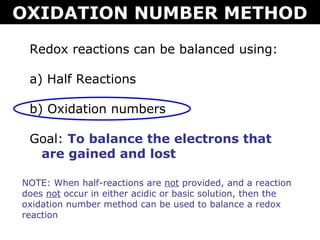
 Redox reactions can be balanced using:

 a) Half Reactions

 b) Oxidation numbers

 Goal: To balance the electrons that
  are gained and lost

NOTE: When half-reactions are not provided, and a reaction
does not occur in either acidic or basic solution, then the
oxidation number method can be used to balance a redox
reaction
OXIDATION NUMBER METHOD
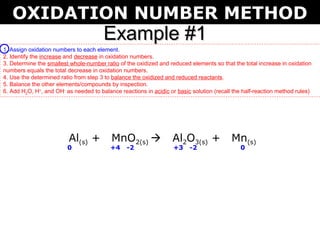
                                       Example #1
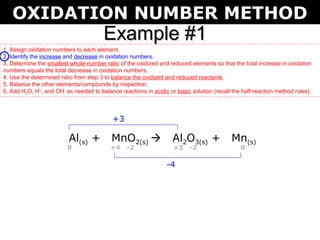
1. Assign oxidation numbers to each element.
2. Identify the increase and decrease in oxidation numbers.
3. Determine the smallest whole-number ratio of the oxidized and reduced elements so that the total increase in oxidation
numbers equals the total decrease in oxidation numbers.
4. Use the determined ratio from step 3 to balance the oxidized and reduced reactants.
5. Balance the other elements/compounds by inspection.
6. Add H2O, H+, and OH- as needed to balance reactions in acidic or basic solution (recall the half-reaction method rules)


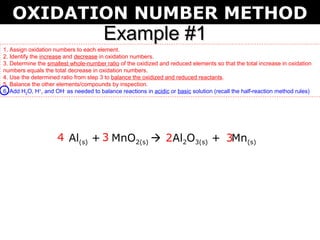
                         Al(s) +          MnO2(s)                 Al2O3(s) +             Mn(s)
                         0                +4    -2                 +3    -2                  0
OXIDATION NUMBER METHOD
                                       Example #1
1. Assign oxidation numbers to each element.
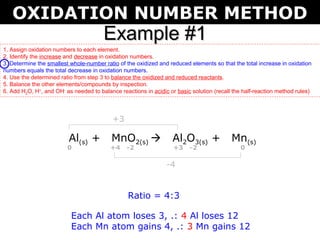
2. Identify the increase and decrease in oxidation numbers.
3. Determine the smallest whole-number ratio of the oxidized and reduced elements so that the total increase in oxidation
numbers equals the total decrease in oxidation numbers.
4. Use the determined ratio from step 3 to balance the oxidized and reduced reactants.
5. Balance the other elements/compounds by inspection.
6. Add H2O, H+, and OH- as needed to balance reactions in acidic or basic solution (recall the half-reaction method rules)


                                           +3

                         Al(s) +          MnO2(s)                 Al2O3(s) +             Mn(s)
                         0                +4    -2                 +3    -2                  0

                                                                -4
OXIDATION NUMBER METHOD
                                       Example #1
1. Assign oxidation numbers to each element.
2. Identify the increase and decrease in oxidation numbers.
3. Determine the smallest whole-number ratio of the oxidized and reduced elements so that the total increase in oxidation
numbers equals the total decrease in oxidation numbers.
4. Use the determined ratio from step 3 to balance the oxidized and reduced reactants.
5. Balance the other elements/compounds by inspection.
6. Add H2O, H+, and OH- as needed to balance reactions in acidic or basic solution (recall the half-reaction method rules)


                                           +3

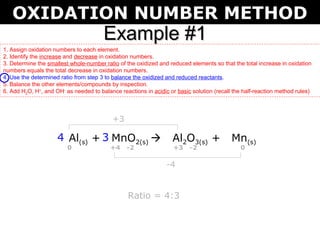
                         Al(s) +          MnO2(s)                 Al2O3(s) +             Mn(s)
                         0                +4    -2                 +3    -2                  0

                                                                -4


                                                 Ratio = 4:3

                          Each Al atom loses 3, .: 4 Al loses 12
                          Each Mn atom gains 4, .: 3 Mn gains 12
OXIDATION NUMBER METHOD
                                       Example #1
1. Assign oxidation numbers to each element.
2. Identify the increase and decrease in oxidation numbers.
3. Determine the smallest whole-number ratio of the oxidized and reduced elements so that the total increase in oxidation
numbers equals the total decrease in oxidation numbers.
4. Use the determined ratio from step 3 to balance the oxidized and reduced reactants.
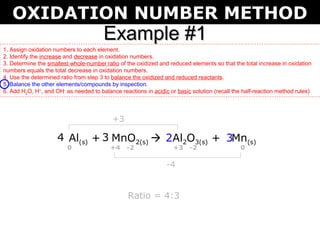
5. Balance the other elements/compounds by inspection.
6. Add H2O, H+, and OH- as needed to balance reactions in acidic or basic solution (recall the half-reaction method rules)


                                           +3

                     4 Al(s) + 3 MnO2(s)                          Al2O3(s) +             Mn(s)
                         0                +4    -2                 +3    -2                  0

                                                                -4


                                                 Ratio = 4:3
OXIDATION NUMBER METHOD
                                       Example #1
1. Assign oxidation numbers to each element.
2. Identify the increase and decrease in oxidation numbers.
3. Determine the smallest whole-number ratio of the oxidized and reduced elements so that the total increase in oxidation
numbers equals the total decrease in oxidation numbers.
4. Use the determined ratio from step 3 to balance the oxidized and reduced reactants.
5. Balance the other elements/compounds by inspection.
6. Add H2O, H+, and OH- as needed to balance reactions in acidic or basic solution (recall the half-reaction method rules)


                                           +3

                     4 Al(s) + 3 MnO2(s)  2Al2O3(s) + 3Mn(s)
                         0                +4    -2                 +3    -2                  0

                                                                -4


                                                 Ratio = 4:3
OXIDATION NUMBER METHOD
                                       Example #1
1. Assign oxidation numbers to each element.
2. Identify the increase and decrease in oxidation numbers.
3. Determine the smallest whole-number ratio of the oxidized and reduced elements so that the total increase in oxidation
numbers equals the total decrease in oxidation numbers.
4. Use the determined ratio from step 3 to balance the oxidized and reduced reactants.
5. Balance the other elements/compounds by inspection.
6. Add H2O, H+, and OH- as needed to balance reactions in acidic or basic solution (recall the half-reaction method rules)


                     4 Al(s) + 3 MnO2(s)  2Al2O3(s) + 3Mn(s)
OXIDATION NUMBER METHOD
                                       Example #2
1. Assign oxidation numbers to each element.
2. Identify the increase and decrease in oxidation numbers.
3. Determine the smallest whole-number ratio of the oxidized and reduced elements so that the total increase in oxidation
numbers equals the total decrease in oxidation numbers.
4. Use the determined ratio from step 3 to balance the oxidized and reduced reactants.
5. Balance the other elements/compounds by inspection.
6. Add H2O, H+, and OH- as needed to balance reactions in acidic or basic solution (recall the half-reaction method rules)


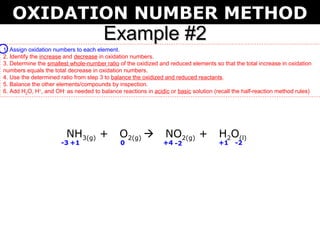
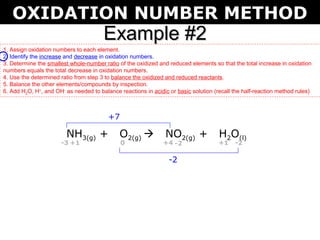
                         NH3(g) +             O2(g)            NO2(g) +             H2O(l)
                      -3 +1                   0                +4 -2                 +1    -2
OXIDATION NUMBER METHOD
                                       Example #2
1. Assign oxidation numbers to each element.
2. Identify the increase and decrease in oxidation numbers.
3. Determine the smallest whole-number ratio of the oxidized and reduced elements so that the total increase in oxidation
numbers equals the total decrease in oxidation numbers.
4. Use the determined ratio from step 3 to balance the oxidized and reduced reactants.
5. Balance the other elements/compounds by inspection.
6. Add H2O, H+, and OH- as needed to balance reactions in acidic or basic solution (recall the half-reaction method rules)


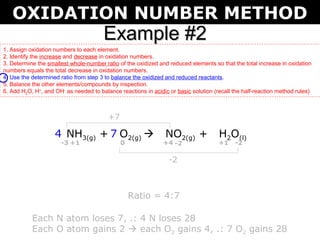
                                         +7

                         NH3(g) +             O2(g)            NO2(g) +             H2O(l)
                      -3 +1                   0                +4 -2                 +1    -2

                                                                 -2
OXIDATION NUMBER METHOD
                                       Example #2
1. Assign oxidation numbers to each element.
2. Identify the increase and decrease in oxidation numbers.
3. Determine the smallest whole-number ratio of the oxidized and reduced elements so that the total increase in oxidation
numbers equals the total decrease in oxidation numbers.
4. Use the determined ratio from step 3 to balance the oxidized and reduced reactants.
5. Balance the other elements/compounds by inspection.
6. Add H2O, H+, and OH- as needed to balance reactions in acidic or basic solution (recall the half-reaction method rules)


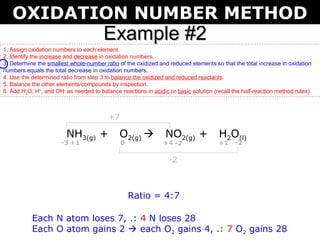
                                         +7

                         NH3(g) +             O2(g)            NO2(g) +             H2O(l)
                      -3 +1                   0                +4 -2                 +1    -2

                                                                 -2


                                                  Ratio = 4:7

           Each N atom loses 7, .: 4 N loses 28
           Each O atom gains 2  each O2 gains 4, .: 7 O2 gains 28
OXIDATION NUMBER METHOD
                                       Example #2
1. Assign oxidation numbers to each element.
2. Identify the increase and decrease in oxidation numbers.
3. Determine the smallest whole-number ratio of the oxidized and reduced elements so that the total increase in oxidation
numbers equals the total decrease in oxidation numbers.
4. Use the determined ratio from step 3 to balance the oxidized and reduced reactants.
5. Balance the other elements/compounds by inspection.
6. Add H2O, H+, and OH- as needed to balance reactions in acidic or basic solution (recall the half-reaction method rules)


                                         +7

                    4 NH3(g) + 7 O2(g)                         NO2(g) +             H2O(l)
                      -3 +1                   0                +4 -2                 +1    -2

                                                                 -2


                                                  Ratio = 4:7

           Each N atom loses 7, .: 4 N loses 28
           Each O atom gains 2  each O2 gains 4, .: 7 O2 gains 28
OXIDATION NUMBER METHOD
                                       Example #2
1. Assign oxidation numbers to each element.
2. Identify the increase and decrease in oxidation numbers.
3. Determine the smallest whole-number ratio of the oxidized and reduced elements so that the total increase in oxidation
numbers equals the total decrease in oxidation numbers.
4. Use the determined ratio from step 3 to balance the oxidized and reduced reactants.
5. Balance the other elements/compounds by inspection.
6. Add H2O, H+, and OH- as needed to balance reactions in acidic or basic solution (recall the half-reaction method rules)


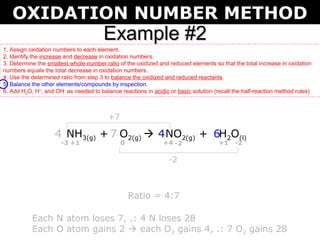
                                         +7

                    4 NH3(g) + 7 O2(g)  4 NO2(g) + 6H2O(l)
                      -3 +1                   0                +4 -2                 +1    -2

                                                                 -2


                                                  Ratio = 4:7

           Each N atom loses 7, .: 4 N loses 28
           Each O atom gains 2  each O2 gains 4, .: 7 O2 gains 28
OXIDATION NUMBER METHOD
                                       Example #2
1. Assign oxidation numbers to each element.
2. Identify the increase and decrease in oxidation numbers.
3. Determine the smallest whole-number ratio of the oxidized and reduced elements so that the total increase in oxidation
numbers equals the total decrease in oxidation numbers.
4. Use the determined ratio from step 3 to balance the oxidized and reduced reactants.
5. Balance the other elements/compounds by inspection.
6. Add H2O, H+, and OH- as needed to balance reactions in acidic or basic solution (recall the half-reaction method rules)


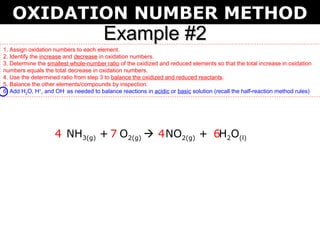
                    4 NH3(g) + 7 O2(g)  4 NO2(g) + 6H2O(l)
OXIDATION NUMBER METHOD
           Example #3: In acidic solution
1. Assign oxidation numbers to each element.
2. Identify the increase and decrease in oxidation numbers.
3. Determine the smallest whole-number ratio of the oxidized and reduced elements so that the total increase in oxidation
numbers equals the total decrease in oxidation numbers.
4. Use the determined ratio from step 3 to balance the oxidized and reduced reactants.
5. Balance the other elements/compounds by inspection.
6. Add H2O, H+, and OH- as needed to balance reactions in acidic or basic solution (recall the half-reaction method rules)


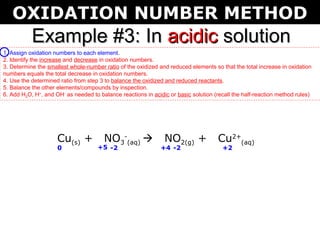
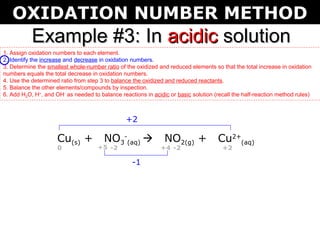
                     Cu(s) +           NO3-(aq)               NO2(g) +              Cu2+(aq)
                     0               +5 -2                    +4 -2                   +2
OXIDATION NUMBER METHOD
           Example #3: In acidic solution
1. Assign oxidation numbers to each element.
2. Identify the increase and decrease in oxidation numbers.
3. Determine the smallest whole-number ratio of the oxidized and reduced elements so that the total increase in oxidation
numbers equals the total decrease in oxidation numbers.
4. Use the determined ratio from step 3 to balance the oxidized and reduced reactants.
5. Balance the other elements/compounds by inspection.
6. Add H2O, H+, and OH- as needed to balance reactions in acidic or basic solution (recall the half-reaction method rules)


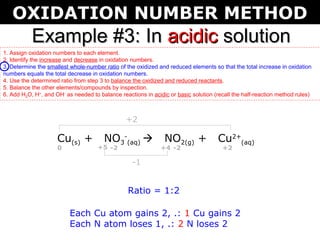
                                                +2

                     Cu(s) +           NO3-(aq)               NO2(g) +              Cu2+(aq)
                     0               +5 -2                    +4 -2                   +2

                                                   -1
OXIDATION NUMBER METHOD
           Example #3: In acidic solution
1. Assign oxidation numbers to each element.
2. Identify the increase and decrease in oxidation numbers.
3. Determine the smallest whole-number ratio of the oxidized and reduced elements so that the total increase in oxidation
numbers equals the total decrease in oxidation numbers.
4. Use the determined ratio from step 3 to balance the oxidized and reduced reactants.
5. Balance the other elements/compounds by inspection.
6. Add H2O, H+, and OH- as needed to balance reactions in acidic or basic solution (recall the half-reaction method rules)


                                                +2

                     Cu(s) +           NO3-(aq)               NO2(g) +              Cu2+(aq)
                     0               +5 -2                    +4 -2                   +2

                                                   -1


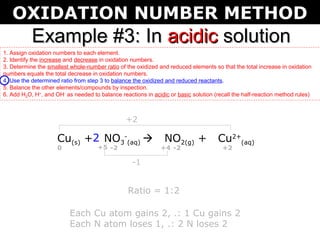
                                                 Ratio = 1:2

                          Each Cu atom gains 2, .: 1 Cu gains 2
                          Each N atom loses 1, .: 2 N loses 2
OXIDATION NUMBER METHOD
           Example #3: In acidic solution
1. Assign oxidation numbers to each element.
2. Identify the increase and decrease in oxidation numbers.
3. Determine the smallest whole-number ratio of the oxidized and reduced elements so that the total increase in oxidation
numbers equals the total decrease in oxidation numbers.
4. Use the determined ratio from step 3 to balance the oxidized and reduced reactants.
5. Balance the other elements/compounds by inspection.
6. Add H2O, H+, and OH- as needed to balance reactions in acidic or basic solution (recall the half-reaction method rules)


                                                +2

                     Cu(s) +2 NO3-(aq)                        NO2(g) +              Cu2+(aq)
                     0               +5 -2                    +4 -2                   +2

                                                   -1


                                                 Ratio = 1:2

                          Each Cu atom gains 2, .: 1 Cu gains 2
                          Each N atom loses 1, .: 2 N loses 2
OXIDATION NUMBER METHOD
           Example #3: In acidic solution
1. Assign oxidation numbers to each element.
2. Identify the increase and decrease in oxidation numbers.
3. Determine the smallest whole-number ratio of the oxidized and reduced elements so that the total increase in oxidation
numbers equals the total decrease in oxidation numbers.
4. Use the determined ratio from step 3 to balance the oxidized and reduced reactants.
5. Balance the other elements/compounds by inspection.
6. Add H2O, H+, and OH- as needed to balance reactions in acidic or basic solution (recall the half-reaction method rules)


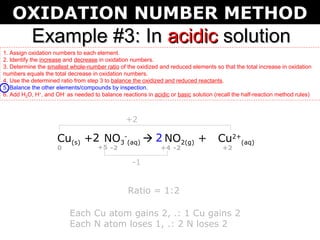
                                                +2

                     Cu(s) +2 NO3-(aq)  2 NO2(g) +                                  Cu2+(aq)
                     0               +5 -2                    +4 -2                   +2

                                                   -1


                                                 Ratio = 1:2

                          Each Cu atom gains 2, .: 1 Cu gains 2
                          Each N atom loses 1, .: 2 N loses 2
OXIDATION NUMBER METHOD
            Example #3: In acidic solution
1. Assign oxidation numbers to each element.
2. Identify the increase and decrease in oxidation numbers.
3. Determine the smallest whole-number ratio of the oxidized and reduced elements so that the total increase in oxidation
numbers equals the total decrease in oxidation numbers.
4. Use the determined ratio from step 3 to balance the oxidized and reduced reactants.
5. Balance the other elements/compounds by inspection.
6. Add H2O, H+, and OH- as needed to balance reactions in acidic or basic solution (recall the half-reaction method rules)


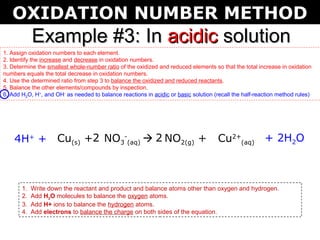
    4H+ + Cu(s) +2 NO3-(aq)  2 NO2(g) +                                             Cu2+(aq) + 2H2O


       1.   Write down the reactant and product and balance atoms other than oxygen and hydrogen.
       2.   Add H2O molecules to balance the oxygen atoms.
       3.   Add H+ ions to balance the hydrogen atoms.
       4.   Add electrons to balance the charge on both sides of the equation.
OXIDATION NUMBER METHOD
           Example #3: In acidic solution
1. Assign oxidation numbers to each element.
2. Identify the increase and decrease in oxidation numbers.
3. Determine the smallest whole-number ratio of the oxidized and reduced elements so that the total increase in oxidation
numbers equals the total decrease in oxidation numbers.
4. Use the determined ratio from step 3 to balance the oxidized and reduced reactants.
5. Balance the other elements/compounds by inspection.
6. Add H2O, H+, and OH- as needed to balance reactions in acidic or basic solution (recall the half-reaction method rules)


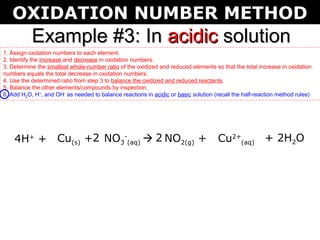
    4H+ + Cu(s) +2 NO3-(aq)  2 NO2(g) +                                             Cu2+(aq) + 2H2O

Tang 02 b oxidation number method 2

  • 1.
    BALANCING REDOX REACTIONS Oxidation Number Method
  • 2.
    OXIDATION NUMBER METHOD Redox reactions can be balanced using: a) Half Reactions b) Oxidation numbers Goal: To balance the electrons that are gained and lost NOTE: When half-reactions are not provided, and a reaction does not occur in either acidic or basic solution, then the oxidation number method can be used to balance a redox reaction
  • 3.
    OXIDATION NUMBER METHOD Example #1 1. Assign oxidation numbers to each element. 2. Identify the increase and decrease in oxidation numbers. 3. Determine the smallest whole-number ratio of the oxidized and reduced elements so that the total increase in oxidation numbers equals the total decrease in oxidation numbers. 4. Use the determined ratio from step 3 to balance the oxidized and reduced reactants. 5. Balance the other elements/compounds by inspection. 6. Add H2O, H+, and OH- as needed to balance reactions in acidic or basic solution (recall the half-reaction method rules) Al(s) + MnO2(s)  Al2O3(s) + Mn(s) 0 +4 -2 +3 -2 0
  • 4.
    OXIDATION NUMBER METHOD Example #1 1. Assign oxidation numbers to each element. 2. Identify the increase and decrease in oxidation numbers. 3. Determine the smallest whole-number ratio of the oxidized and reduced elements so that the total increase in oxidation numbers equals the total decrease in oxidation numbers. 4. Use the determined ratio from step 3 to balance the oxidized and reduced reactants. 5. Balance the other elements/compounds by inspection. 6. Add H2O, H+, and OH- as needed to balance reactions in acidic or basic solution (recall the half-reaction method rules) +3 Al(s) + MnO2(s)  Al2O3(s) + Mn(s) 0 +4 -2 +3 -2 0 -4
  • 5.
    OXIDATION NUMBER METHOD Example #1 1. Assign oxidation numbers to each element. 2. Identify the increase and decrease in oxidation numbers. 3. Determine the smallest whole-number ratio of the oxidized and reduced elements so that the total increase in oxidation numbers equals the total decrease in oxidation numbers. 4. Use the determined ratio from step 3 to balance the oxidized and reduced reactants. 5. Balance the other elements/compounds by inspection. 6. Add H2O, H+, and OH- as needed to balance reactions in acidic or basic solution (recall the half-reaction method rules) +3 Al(s) + MnO2(s)  Al2O3(s) + Mn(s) 0 +4 -2 +3 -2 0 -4 Ratio = 4:3 Each Al atom loses 3, .: 4 Al loses 12 Each Mn atom gains 4, .: 3 Mn gains 12
  • 6.
    OXIDATION NUMBER METHOD Example #1 1. Assign oxidation numbers to each element. 2. Identify the increase and decrease in oxidation numbers. 3. Determine the smallest whole-number ratio of the oxidized and reduced elements so that the total increase in oxidation numbers equals the total decrease in oxidation numbers. 4. Use the determined ratio from step 3 to balance the oxidized and reduced reactants. 5. Balance the other elements/compounds by inspection. 6. Add H2O, H+, and OH- as needed to balance reactions in acidic or basic solution (recall the half-reaction method rules) +3 4 Al(s) + 3 MnO2(s)  Al2O3(s) + Mn(s) 0 +4 -2 +3 -2 0 -4 Ratio = 4:3
  • 7.
    OXIDATION NUMBER METHOD Example #1 1. Assign oxidation numbers to each element. 2. Identify the increase and decrease in oxidation numbers. 3. Determine the smallest whole-number ratio of the oxidized and reduced elements so that the total increase in oxidation numbers equals the total decrease in oxidation numbers. 4. Use the determined ratio from step 3 to balance the oxidized and reduced reactants. 5. Balance the other elements/compounds by inspection. 6. Add H2O, H+, and OH- as needed to balance reactions in acidic or basic solution (recall the half-reaction method rules) +3 4 Al(s) + 3 MnO2(s)  2Al2O3(s) + 3Mn(s) 0 +4 -2 +3 -2 0 -4 Ratio = 4:3
  • 8.
    OXIDATION NUMBER METHOD Example #1 1. Assign oxidation numbers to each element. 2. Identify the increase and decrease in oxidation numbers. 3. Determine the smallest whole-number ratio of the oxidized and reduced elements so that the total increase in oxidation numbers equals the total decrease in oxidation numbers. 4. Use the determined ratio from step 3 to balance the oxidized and reduced reactants. 5. Balance the other elements/compounds by inspection. 6. Add H2O, H+, and OH- as needed to balance reactions in acidic or basic solution (recall the half-reaction method rules) 4 Al(s) + 3 MnO2(s)  2Al2O3(s) + 3Mn(s)
  • 9.
    OXIDATION NUMBER METHOD Example #2 1. Assign oxidation numbers to each element. 2. Identify the increase and decrease in oxidation numbers. 3. Determine the smallest whole-number ratio of the oxidized and reduced elements so that the total increase in oxidation numbers equals the total decrease in oxidation numbers. 4. Use the determined ratio from step 3 to balance the oxidized and reduced reactants. 5. Balance the other elements/compounds by inspection. 6. Add H2O, H+, and OH- as needed to balance reactions in acidic or basic solution (recall the half-reaction method rules) NH3(g) + O2(g)  NO2(g) + H2O(l) -3 +1 0 +4 -2 +1 -2
  • 10.
    OXIDATION NUMBER METHOD Example #2 1. Assign oxidation numbers to each element. 2. Identify the increase and decrease in oxidation numbers. 3. Determine the smallest whole-number ratio of the oxidized and reduced elements so that the total increase in oxidation numbers equals the total decrease in oxidation numbers. 4. Use the determined ratio from step 3 to balance the oxidized and reduced reactants. 5. Balance the other elements/compounds by inspection. 6. Add H2O, H+, and OH- as needed to balance reactions in acidic or basic solution (recall the half-reaction method rules) +7 NH3(g) + O2(g)  NO2(g) + H2O(l) -3 +1 0 +4 -2 +1 -2 -2
  • 11.
    OXIDATION NUMBER METHOD Example #2 1. Assign oxidation numbers to each element. 2. Identify the increase and decrease in oxidation numbers. 3. Determine the smallest whole-number ratio of the oxidized and reduced elements so that the total increase in oxidation numbers equals the total decrease in oxidation numbers. 4. Use the determined ratio from step 3 to balance the oxidized and reduced reactants. 5. Balance the other elements/compounds by inspection. 6. Add H2O, H+, and OH- as needed to balance reactions in acidic or basic solution (recall the half-reaction method rules) +7 NH3(g) + O2(g)  NO2(g) + H2O(l) -3 +1 0 +4 -2 +1 -2 -2 Ratio = 4:7 Each N atom loses 7, .: 4 N loses 28 Each O atom gains 2  each O2 gains 4, .: 7 O2 gains 28
  • 12.
    OXIDATION NUMBER METHOD Example #2 1. Assign oxidation numbers to each element. 2. Identify the increase and decrease in oxidation numbers. 3. Determine the smallest whole-number ratio of the oxidized and reduced elements so that the total increase in oxidation numbers equals the total decrease in oxidation numbers. 4. Use the determined ratio from step 3 to balance the oxidized and reduced reactants. 5. Balance the other elements/compounds by inspection. 6. Add H2O, H+, and OH- as needed to balance reactions in acidic or basic solution (recall the half-reaction method rules) +7 4 NH3(g) + 7 O2(g)  NO2(g) + H2O(l) -3 +1 0 +4 -2 +1 -2 -2 Ratio = 4:7 Each N atom loses 7, .: 4 N loses 28 Each O atom gains 2  each O2 gains 4, .: 7 O2 gains 28
  • 13.
    OXIDATION NUMBER METHOD Example #2 1. Assign oxidation numbers to each element. 2. Identify the increase and decrease in oxidation numbers. 3. Determine the smallest whole-number ratio of the oxidized and reduced elements so that the total increase in oxidation numbers equals the total decrease in oxidation numbers. 4. Use the determined ratio from step 3 to balance the oxidized and reduced reactants. 5. Balance the other elements/compounds by inspection. 6. Add H2O, H+, and OH- as needed to balance reactions in acidic or basic solution (recall the half-reaction method rules) +7 4 NH3(g) + 7 O2(g)  4 NO2(g) + 6H2O(l) -3 +1 0 +4 -2 +1 -2 -2 Ratio = 4:7 Each N atom loses 7, .: 4 N loses 28 Each O atom gains 2  each O2 gains 4, .: 7 O2 gains 28
  • 14.
    OXIDATION NUMBER METHOD Example #2 1. Assign oxidation numbers to each element. 2. Identify the increase and decrease in oxidation numbers. 3. Determine the smallest whole-number ratio of the oxidized and reduced elements so that the total increase in oxidation numbers equals the total decrease in oxidation numbers. 4. Use the determined ratio from step 3 to balance the oxidized and reduced reactants. 5. Balance the other elements/compounds by inspection. 6. Add H2O, H+, and OH- as needed to balance reactions in acidic or basic solution (recall the half-reaction method rules) 4 NH3(g) + 7 O2(g)  4 NO2(g) + 6H2O(l)
  • 15.
    OXIDATION NUMBER METHOD Example #3: In acidic solution 1. Assign oxidation numbers to each element. 2. Identify the increase and decrease in oxidation numbers. 3. Determine the smallest whole-number ratio of the oxidized and reduced elements so that the total increase in oxidation numbers equals the total decrease in oxidation numbers. 4. Use the determined ratio from step 3 to balance the oxidized and reduced reactants. 5. Balance the other elements/compounds by inspection. 6. Add H2O, H+, and OH- as needed to balance reactions in acidic or basic solution (recall the half-reaction method rules) Cu(s) + NO3-(aq)  NO2(g) + Cu2+(aq) 0 +5 -2 +4 -2 +2
  • 16.
    OXIDATION NUMBER METHOD Example #3: In acidic solution 1. Assign oxidation numbers to each element. 2. Identify the increase and decrease in oxidation numbers. 3. Determine the smallest whole-number ratio of the oxidized and reduced elements so that the total increase in oxidation numbers equals the total decrease in oxidation numbers. 4. Use the determined ratio from step 3 to balance the oxidized and reduced reactants. 5. Balance the other elements/compounds by inspection. 6. Add H2O, H+, and OH- as needed to balance reactions in acidic or basic solution (recall the half-reaction method rules) +2 Cu(s) + NO3-(aq)  NO2(g) + Cu2+(aq) 0 +5 -2 +4 -2 +2 -1
  • 17.
    OXIDATION NUMBER METHOD Example #3: In acidic solution 1. Assign oxidation numbers to each element. 2. Identify the increase and decrease in oxidation numbers. 3. Determine the smallest whole-number ratio of the oxidized and reduced elements so that the total increase in oxidation numbers equals the total decrease in oxidation numbers. 4. Use the determined ratio from step 3 to balance the oxidized and reduced reactants. 5. Balance the other elements/compounds by inspection. 6. Add H2O, H+, and OH- as needed to balance reactions in acidic or basic solution (recall the half-reaction method rules) +2 Cu(s) + NO3-(aq)  NO2(g) + Cu2+(aq) 0 +5 -2 +4 -2 +2 -1 Ratio = 1:2 Each Cu atom gains 2, .: 1 Cu gains 2 Each N atom loses 1, .: 2 N loses 2
  • 18.
    OXIDATION NUMBER METHOD Example #3: In acidic solution 1. Assign oxidation numbers to each element. 2. Identify the increase and decrease in oxidation numbers. 3. Determine the smallest whole-number ratio of the oxidized and reduced elements so that the total increase in oxidation numbers equals the total decrease in oxidation numbers. 4. Use the determined ratio from step 3 to balance the oxidized and reduced reactants. 5. Balance the other elements/compounds by inspection. 6. Add H2O, H+, and OH- as needed to balance reactions in acidic or basic solution (recall the half-reaction method rules) +2 Cu(s) +2 NO3-(aq)  NO2(g) + Cu2+(aq) 0 +5 -2 +4 -2 +2 -1 Ratio = 1:2 Each Cu atom gains 2, .: 1 Cu gains 2 Each N atom loses 1, .: 2 N loses 2
  • 19.
    OXIDATION NUMBER METHOD Example #3: In acidic solution 1. Assign oxidation numbers to each element. 2. Identify the increase and decrease in oxidation numbers. 3. Determine the smallest whole-number ratio of the oxidized and reduced elements so that the total increase in oxidation numbers equals the total decrease in oxidation numbers. 4. Use the determined ratio from step 3 to balance the oxidized and reduced reactants. 5. Balance the other elements/compounds by inspection. 6. Add H2O, H+, and OH- as needed to balance reactions in acidic or basic solution (recall the half-reaction method rules) +2 Cu(s) +2 NO3-(aq)  2 NO2(g) + Cu2+(aq) 0 +5 -2 +4 -2 +2 -1 Ratio = 1:2 Each Cu atom gains 2, .: 1 Cu gains 2 Each N atom loses 1, .: 2 N loses 2
  • 20.
    OXIDATION NUMBER METHOD Example #3: In acidic solution 1. Assign oxidation numbers to each element. 2. Identify the increase and decrease in oxidation numbers. 3. Determine the smallest whole-number ratio of the oxidized and reduced elements so that the total increase in oxidation numbers equals the total decrease in oxidation numbers. 4. Use the determined ratio from step 3 to balance the oxidized and reduced reactants. 5. Balance the other elements/compounds by inspection. 6. Add H2O, H+, and OH- as needed to balance reactions in acidic or basic solution (recall the half-reaction method rules) 4H+ + Cu(s) +2 NO3-(aq)  2 NO2(g) + Cu2+(aq) + 2H2O 1. Write down the reactant and product and balance atoms other than oxygen and hydrogen. 2. Add H2O molecules to balance the oxygen atoms. 3. Add H+ ions to balance the hydrogen atoms. 4. Add electrons to balance the charge on both sides of the equation.
  • 21.
    OXIDATION NUMBER METHOD Example #3: In acidic solution 1. Assign oxidation numbers to each element. 2. Identify the increase and decrease in oxidation numbers. 3. Determine the smallest whole-number ratio of the oxidized and reduced elements so that the total increase in oxidation numbers equals the total decrease in oxidation numbers. 4. Use the determined ratio from step 3 to balance the oxidized and reduced reactants. 5. Balance the other elements/compounds by inspection. 6. Add H2O, H+, and OH- as needed to balance reactions in acidic or basic solution (recall the half-reaction method rules) 4H+ + Cu(s) +2 NO3-(aq)  2 NO2(g) + Cu2+(aq) + 2H2O