5/26/2014
1
Focused Acceptance and
Commitment Therapy
Kirk Strosahl, Thomas Gustavsson
& Patricia Robinson
Kirk@mntviewconsulting.com
Thomas@humanact.se
Patti@mntviewconsulting.com
1 1
Our intention . . .
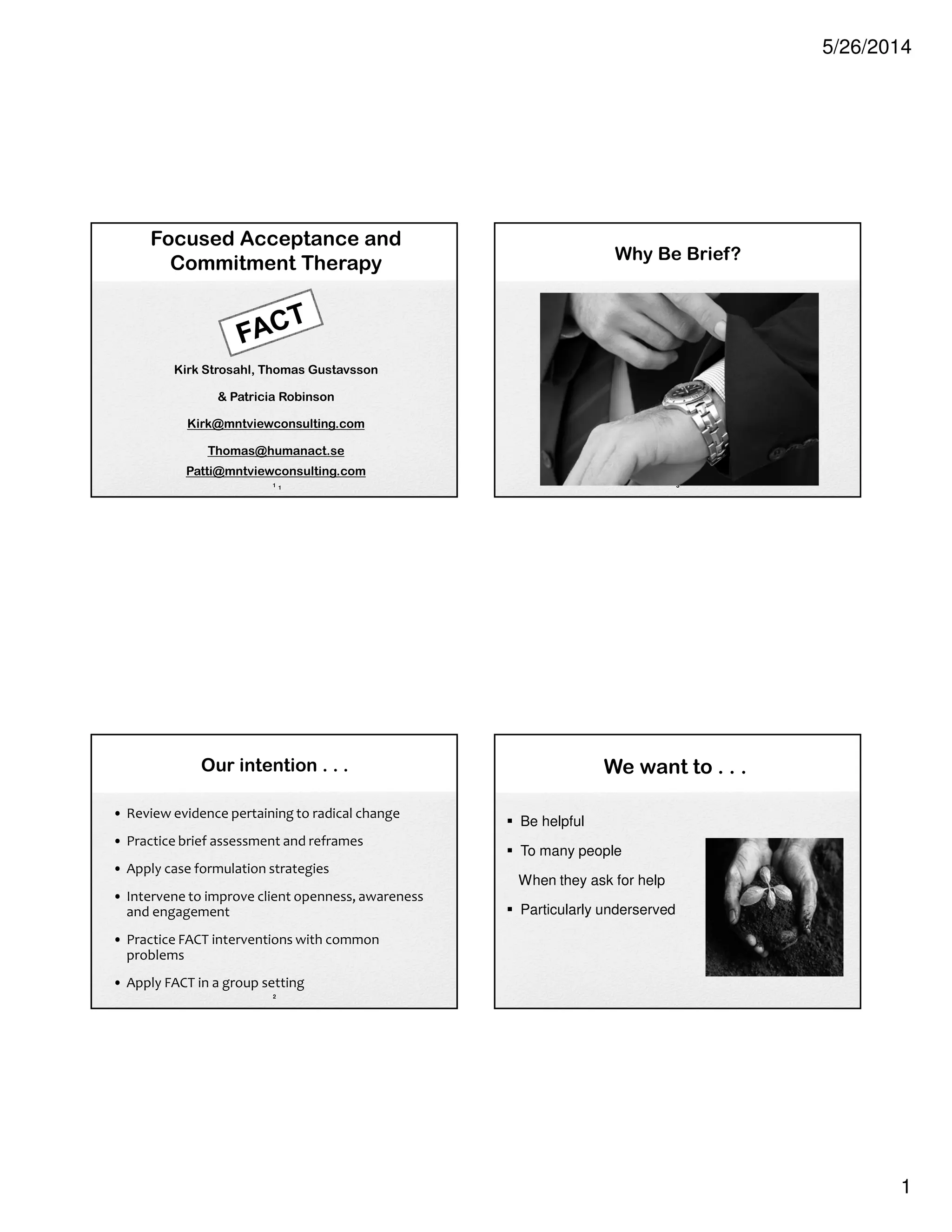
• Review evidence pertaining to radical change
• Practice brief assessment and reframes
• Apply case formulation strategies
• Intervene to improve client openness, awareness
and engagement
• Practice FACT interventions with common
problems
• Apply FACT in a group setting
2
Why Be Brief?
3
We want to . . .
 Be helpful
 To many people
When they ask for help
 Particularly underserved
5/26/2014
2
Practice Contexts Are Changing!
• Emergency Departments, Crisis Units
• Schools
• Primary Care or General Medicine Clinics
• Home-based Care
• Even in specialty MH treatment settings are
moving towards brief interventions to
improve access
5
Do Brief Interventions Work?
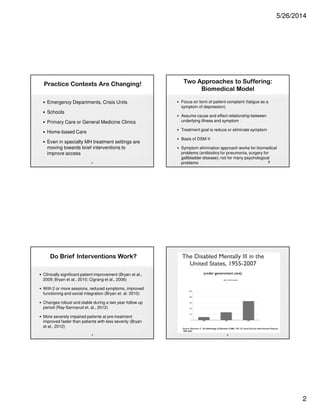
• Clinically significant patient improvement (Bryan et al.,
2009; Bryan et al., 2010; Cigrang et al., 2006)
• With 2 or more sessions, reduced symptoms, improved
functioning and social integration (Bryan et. al. 2010)
• Changes robust and stable during a two year follow up
period (Ray-Sannarud et. al., 2012)
• More severely impaired patients at pre-treatment
improved faster than patients with less severity (Bryan
et al., 2012)
6
Two Approaches to Suffering:
Biomedical Model
• Focus on form of patient complaint (fatigue as a
symptom of depression)
• Assume cause and effect relationship between
underlying illness and symptom
• Treatment goal is reduce or eliminate symptom
• Basis of DSM-V
• Symptom elimination approach works for biomedical
problems (antibiotics for pneumonia, surgery for
gallbladder disease); not for many psychological
problems 7
8
5/26/2014
3
9
10
Two Approaches to Suffering:
Contextualism
Patients are not “broken”; trapped
Identifies function of the symptoms; impact on patient’s life
(fatigue as a reason to avoid activities)
Looks at patient’s interaction with internal (mental) and
external (environmental) contexts
“Symptoms” signal imbalance in the internal or external
contexts, often a part of rule driven avoidance
Self “as perspective” is seen as a separate and powerful
context
11
Why Go With Brief ACT?
• Trans-diagnostic model of human suffering
• Strengths based approach to creating change (skill
building rather than curing illnesses)
• Acceptance and mindfulness are “qualitative”
processes that can instantly transform a life.
• Values and committed action are powerful motivational
tools
• Acceptance and change concepts are very transparent
and easily understood by lay professionals
12
5/26/2014
4
helps the client . . .
.
.
.
Focus on unworkable results of avoidance
Accept the presence of distressing, unwanted
private experiences
Choose a life path based in personal values
Take actions which propel the him/her down
that path
13
FACT
Fact Mantra
Treat every session as if it is the last session!
14
FACT Therapist Stance
• Assume that the first visit may be the last visit
• Instruct self and client that dramatic, powerful change is possible in one
visit
• Know that you cannot resue clients from the challenge of growth
• Workability, not reasonableness, is the issue
• Turn strong feelings into therapeutic opportunities; including your own
(it humanizes you)
• Don’t argue or persuade; your opinions and beliefs are not the issue
• You are are in the same boat. Never protect yourself by moving one up
on a client.
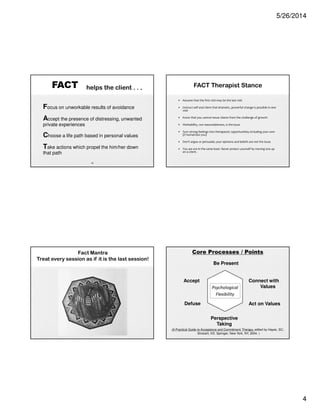
Core Processes / Points
Psychological
Flexibility
(A Practical Guide to Acceptance and Commitment Therapy, edited by Hayes, SC;
Strosahl, KD. Springer, New York, NY, 2004. )
Be Present
Accept
Defuse
Connect with
Values
Act on Values
Perspective
Taking
5/26/2014
5
Psychological
flexibility
Be Present
Connect with
Values
Acceptance
Defuse
Perspective
Taking
Act on Values
Mindfulness
Psychological
flexibility
Be Present
Connect with
Values
Acceptance
Defuse
Perspective
Taking
Act on Values
Values
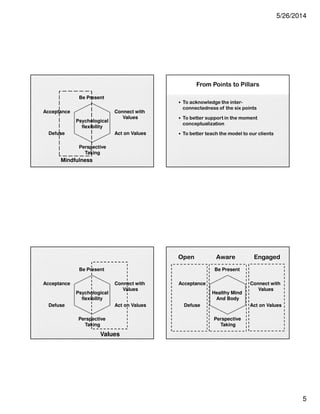
From Points to Pillars
• To acknowledge the inter-
connectedness of the six points
• To better support in the moment
conceptualization
• To better teach the model to our clients
Healthy Mind
And Body
Be Present
Connect with
Values
Acceptance
Defuse
Perspective
Taking
Act on Values
Engaged
Open Aware
5/26/2014
6
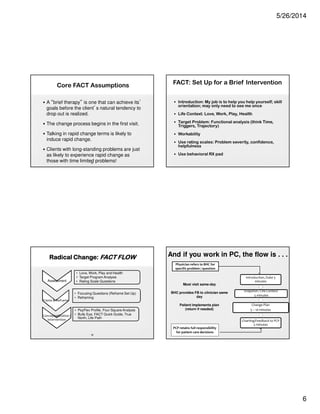
Core FACT Assumptions
21
• A “brief therapy” is one that can achieve its’
goals before the client’s natural tendency to
drop out is realized.
• The change process begins in the first visit.
• Talking in rapid change terms is likely to
induce rapid change.
• Clients with long-standing problems are just
as likely to experience rapid change as
those with time limited problems!
Radical Change:
Radical Change:
Radical Change:
Radical Change: FACT FLOW
FACT FLOW
FACT FLOW
FACT FLOW
22
Assessment
Assessment
• Love, Work, Play and Health
• Target Program Analysis
• Rating Scale Questions
Frame  Reframe
Frame  Reframe
• Focusing Questions (Reframe Set Up)
• Reframing
Conceptualization/
Intervention
Conceptualization/
Intervention
• PsyFlex Profile, Four Square Analysis
• Bulls Eye, FACT Quick Guide, True
North, Life Path
FACT: Set Up for a Brief Intervention
• Introduction: My job is to help you help yourself; skill
orientation; may only need to see me once
• Life Context: Love, Work, Play, Health
• Target Problem: Functional analysis (think Time,
Triggers, Trajectory)
• Workability
• Use rating scales: Problem severity, confidence,
helpfulness
• Use behavioral RX pad
And if you work in PC, the flow is . . .
Introduction, Duke 5
minutes
Snapshot / Life Context
5 minutes
Change Plan
5 – 10 minutes
Charting/Feedback to PCP
5 minutes
Physician refers to BHC for
specific problem / question
PCP retains full responsibility
for patient care decisions
Most visit same-day
BHC provides FB to clinician same
day
Patient implements plan
(return if needed)
5/26/2014
7
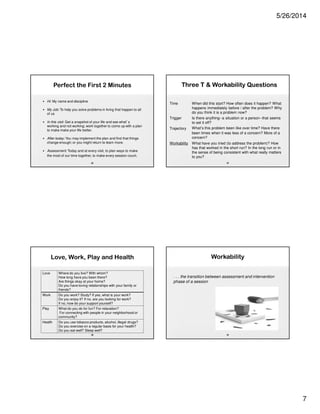
Perfect the First 2 Minutes
• Hi: My name and discipline
• My Job: To help you solve problems in living that happen to all
of us
• In this visit: Get a snapshot of your life and see what’s
working and not working; work together to come up with a plan
to make make your life better.
• After today: You may implement the plan and find that things
change enough; or you might return to learn more.
• Assessment: Today and at every visit, to plan ways to make
the most of our time together, to make every session count.
25
Love, Work, Play and Health
Love Where do you live? With whom?
How long have you been there?
Are things okay at your home?
Do you have loving relationships with your family or
friends?
Work Do you work? Study? If yes, what is your work?
Do you enjoy it? If no, are you looking for work?
If no, how do your support yourself?
Play What do you do for fun? For relaxation?
For connecting with people in your neighborhood or
community?
Health Do you use tobacco products, alcohol, illegal drugs?
Do you exercise on a regular basis for your health?
Do you eat well? Sleep well?
26
Three T  Workability Questions
27
Time When did this start? How often does it happen? What
happens immediately before / after the problem? Why
do you think it is a problem now?
Trigger Is there anything--a situation or a person--that seems
to set it off?
Trajectory What’s this problem been like over time? Have there
been times when it was less of a concern? More of a
concern?
Workability What have you tried (to address the problem)? How
has that worked in the short run? In the long run or in
the sense of being consistent with what really matters
to you?
17
Workability
. . . the transition between assessment and intervention
phase of a session
28
5/26/2014
8
FACT Visit Rating Scale
Assessment Questions
1. How big of a problem
is this for you? On a
scale of 0 = “not a
problem” and 10 = “a
very big problem”, how
would you rate it?
2. How confident are you
that you will follow
through with our plan?
Use a scale where 0 =
“no confidence” and 10 =
“very confident”.
3. How helpful was this
visit? Use a scale where 0
= “not helpful” and 10 =
“very helpful”.
29
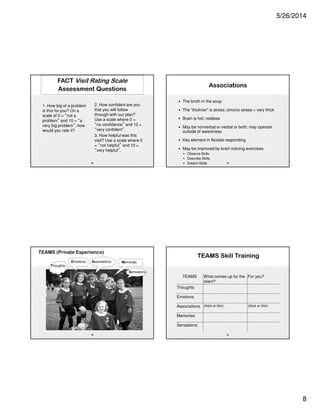
TEAMS (Private Experience)
30
Sensations
Thoughts
Emotions Associations Memories
Associations
• The broth in the soup
• The “thickner” is stress; chronic stress = very thick
• Brain is hot; restless
• May be nonverbal or verbal or both; may operate
outside of awareness
• Key element in flexible responding
• May be improved by brain training exercises
• Observe Skills
• Describe Skills
• Detach Skills 31
TEAMS Skill Training
32
TEAMS What comes up for the
client?
For you?
Thoughts
Emotions
Associations (thick or thin) (thick or thin)
Memories
Sensations
5/26/2014
9
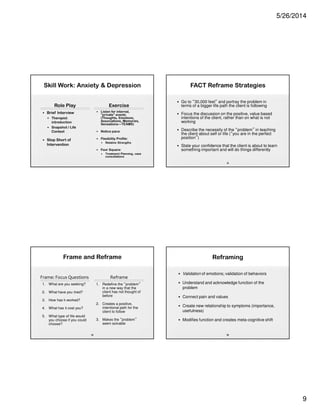
Skill Work: Anxiety  Depression
Role Play
• Brief Interview
• Therapist
introduction
• Snapshot / Life
Context
• Stop Short of
Intervention
Exercise
• Listen for internal,
“private” events
(Thoughts, Emotions,
Associations, Memories,
Sensations—TEAMS)
• Notice pace
• Flexibility Profile:
• Relative Strengths
• Four Square:
• Treatment Planning, case
consultations
Frame and Reframe
Frame: Focus Questions
1. What are you seeking?
2. What have you tried?
3. How has it worked?
4. What has it cost you?
5. What type of life would
you choose if you could
choose?
Reframe
1. Redefine the “problem”
in a new way that the
client has not thought of
before
2. Creates a positive,
intentional path for the
client to follow
3. Makes the “problem”
seem solvable
34
FACT Reframe Strategies
• Go to “30,000 feet” and portray the problem in
terms of a bigger life path the client is following
• Focus the discussion on the positive, value based
intentions of the client, rather than on what is not
working
• Describe the necessity of the “problem” in teaching
the client about self or life (“you are in the perfect
position”)
• State your confidence that the client is about to learn
something important and will do things differently
35
Reframing
• Validation of emotions; validation of behaviors
• Understand and acknowledge function of the
problem
• Connect pain and values
• Create new relationship to symptoms (importance,
usefulness)
• Modifies function and creates meta-cognitive shift
36
5/26/2014
10
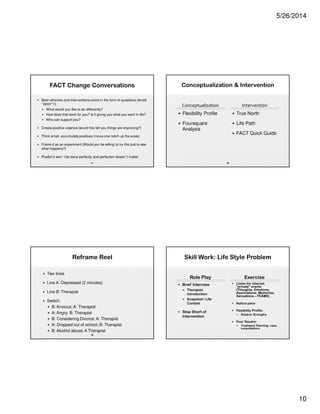
FACT Change Conversations
• Best reframes and interventions come in the form of questions (Avoid
“WHY”!!)
• What would you like to do differently?
• How does that work for you? Is it giving you what you want in life?
• Who can support you?
• Create positive valence (would this tell you things are improving?)
• Think small, accumulate positives (move one notch up the scale)
• Frame it as an experiment (Would you be willing to try this just to see
what happens?)
• Predict it won’t be done perfectly and perfection doesn’t matter
37
Reframe Reel
• Two lines
• Line A: Depressed (2 minutes)
• Line B: Therapist
• Switch:
• B: Anxious; A: Therapist
• A: Angry; B: Therapist
• B: Considering Divorce; A: Therapist
• A: Dropped out of school; B: Therapist
• B: Alcohol abuse; A Therapist
38
Conceptualization  Intervention
Conceptualization
• Flexibility Profile
• Foursquare
Analysis
Intervention
• True North
• Life Path
• FACT Quick Guide
39
Skill Work: Life Style Problem
Role Play
• Brief Interview
• Therapist
introduction
• Snapshot / Life
Context
• Stop Short of
Intervention
Exercise
• Listen for internal,
“private” events
(Thoughts, Emotions,
Associations, Memories,
Sensations—TEAMS)
• Notice pace
• Flexibility Profile:
• Relative Strengths
• Four Square:
• Treatment Planning, case
consultations
5/26/2014
11
41
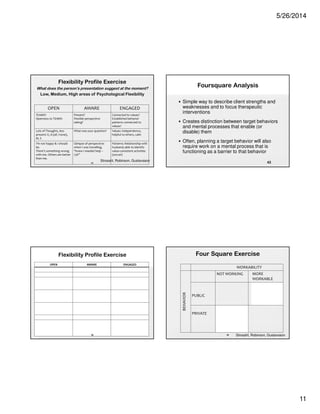
Flexibility Profile Exercise
What does the person’s presentation suggest at the moment?
Low, Medium, High areas of Psychological Flexibility
OPEN AWARE ENGAGED
TEAMS?
Openness to TEAMS
Present?
Flexible perspective-
taking?
Connected to values?
Established behavior
patterns connected to
values?
Lots of Thoughts, less
present: E, A (all / none),
M, S
What was your question? Values: independence,
helpful to others, calm
I’m not happy  I should
be.
There’s something wrong
with me. Others are better
than me.
Glimpse of perspective:
when I was travelling,
“knew I needed help –
73%”
Patterns: Relationship with
husband; able to identify
value-consistent activities
(soccer)
Strosahl, Robinson, Gustavsson
Flexibility Profile Exercise
OPEN AWARE ENGAGED
42
Foursquare Analysis
• Simple way to describe client strengths and
weaknesses and to focus therapeutic
interventions
• Creates distinction between target behaviors
and mental processes that enable (or
disable) them
• Often, planning a target behavior will also
require work on a mental process that is
functioning as a barrier to that behavior
43
44
Four Square Exercise
WORKABILITY
BEHAVIOR
NOT WORKING MORE
WORKABLE
PUBLIC
PRIVATE
Strosahl, Robinson, Gustavsson
5/26/2014
12
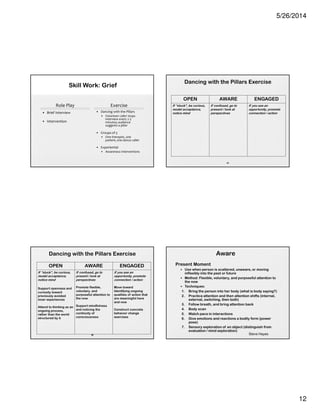
Skill Work: Grief
Role Play
• Brief Interview
• Intervention
Exercise
• Dancing with the Pillars
• Volunteer caller stops
interview every 2-3
minutes; audience
suggests a pillar
• Groups of 3
• One therapist, one
patient, one dance caller
• Experiential
• Awareness Interventions
46
Dancing with the Pillars Exercise
OPEN AWARE ENGAGED
If “stuck”, be curious,
model acceptance,
notice mind
Support openness and
curiosity toward
previously avoided
inner experiences
Attend to thinking as an
ongoing process,
rather than the world
structured by it
If confused, go to
present / look at
perspectives
Promote flexible,
voluntary, and
purposeful attention to
the now
Support mindfulness
and noticing the
continuity of
consciousness
If you see an
opportunity, promote
connection / action
Move toward
Identifying ongoing
qualities of action that
are meaningful here
and now
Construct concrete
behavior change
exercises
47
Dancing with the Pillars Exercise
OPEN AWARE ENGAGED
If “stuck”, be curious,
model acceptance,
notice mind
If confused, go to
present / look at
perspectives
If you see an
opportunity, promote
connection / action
Aware
Present Moment
• Use when person is scattered, unaware, or moving
inflexibly into the past or future
• Method: Flexible, voluntary, and purposeful attention to
the now
• Techniques:
1. Bring the person into her body (what is body saying?)
2. Practice attention and then attention shifts (internal,
external, switching, then both)
3. Follow breath, and bring attention back
4. Body scan
5. Watch pace in interactions
6. Give emotions and reactions a bodily form (power
pose)
7. Sensory exploration of an object (distinguish from
evaluation / mind exploration)
Steve Hayes
5/26/2014
13
Aware
Perspective Taking
• Use when the person is scattered; over identified with a
self story or story of other; afraid of exposure to the
world within
• Method: Mindfulness and noticing the continuity of
consciousness
• Techniques:
1. Notice who is noticing in different domains of
experience
2. Metaphors for context (suitcase / closet with stuff)
3. Riding a bicycle (always falling off balance, yet your
move forward)
4. Letter a letter from a wiser future
5. Re-write your story; chapters in a book; photographs
in a box
Engaged
Valuing
• Use when motivation is an issue; to provide a
direction for therapy and life
• Method: Choose ongoing qualities of action that
are meaningful here and now
• Techniques:
1. Tombstone; eulogy; graduation party
2. List values in major life domains (value
construction; jars in the pantry)
3. Taking a stand (stand up and declare a value w/o
avoidance
4. Flip the coins (pain on one side; list values on
other; throw-away both?)
5. Imagine no one could know of your
achievements; then, what would you value?
Engaged
Committed Action
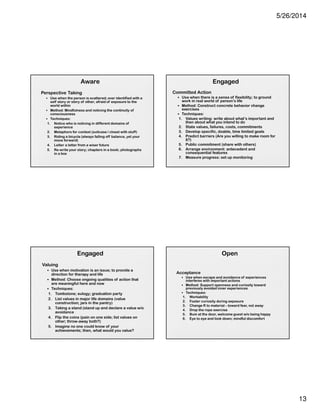
• Use when there is a sense of flexibility; to ground
work in real world of person’s life
• Method: Construct concrete behavior change
exercises
• Techniques:
1. Values writing: write about what’s important and
then about what you intend to do
2. State values, failures, costs, commitments
3. Develop specific, doable, time limited goals
4. Predict barriers (Are you willing to make room for
X?)
5. Public commitment (share with others)
6. Arrange environment: antecedent and
consequential features
7. Measure progress: set up monitoring
Open
Acceptance
• Use when escape and avoidance of experiences
interferes with important actions
• Method: Support openness and curiosity toward
previously avoided inner experiences
• Techniques:
1. Workability
2. Foster curiosity during exposure
3. Change R to material – toward fear, not away
4. Drop the rope exercise
5. Bum at the door, welcome guest w/o being happy
6. Eye to eye and look down; mindful discomfort
5/26/2014
14
Open
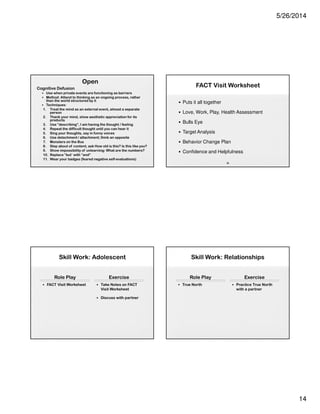
Cognitive Defusion
• Use when private events are functioning as barriers
• Method: Attend to thinking as an ongoing process, rather
than the world structured by it
• Techniques:
1. Treat the mind as an external event, almost a separate
person
2. Thank your mind, show aesthetic appreciation for its
products
3. Use “describing”, I am having the thought / feeling
4. Repeat the difficult thought until you can hear it
5. Sing your thoughts, say in funny voices
6. Use detachment / attachment; think an opposite
7. Monsters on the Bus
8. Step about of content; ask How old is this? Is this like you?
9. Show impossibility of unlearning: What are the numbers?
10. Replace “but’ with “and”
11. Wear your badges (feared negative self-evaluations)
Skill Work: Adolescent
Role Play
• FACT Visit Worksheet
Exercise
• Take Notes on FACT
Visit Worksheet
• Discuss with partner
FACT Visit Worksheet
• Puts it all together
• Love, Work, Play, Health Assessment
• Bulls Eye
• Target Analysis
• Behavior Change Plan
• Confidence and Helpfulness
55
Skill Work: Relationships
Role Play
• True North
Exercise
• Practice True North
with a partner
5/26/2014
15
57
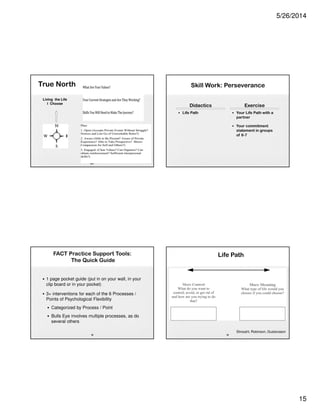
Living the Life
I Choose
True North
FACT Practice Support Tools:
The Quick Guide
• 1 page pocket guide (put in on your wall, in your
clip board or in your pocket)
• 3+ interventions for each of the 6 Processes /
Points of Psychological Flexibility
• Categorized by Process / Point
• Bulls Eye involves multiple processes, as do
several others
58
Skill Work: Perseverance
Didactics
• Life Path
Exercise
• Your Life Path with a
partner
• Your commitment
statement in groups
of 6-7
60
Life Path
Strosahl, Robinson, Gustavsson
5/26/2014
16
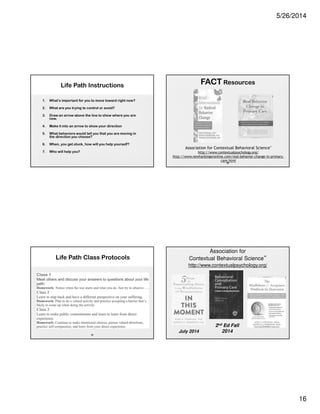
Life Path Instructions
1. What’s important for you to move toward right now?
2. What are you trying to control or avoid?
3. Draw an arrow above the line to show where you are
now.
4. Make it into an arrow to show your direction
5. What behaviors would tell you that you are moving in
the direction you choose?
6. When, you get stuck, how will you help yourself?
7. Who will help you?
Life Path Class Protocols
62
63
FACT Resources
Association for Contextual Behavioral Science”
http://www.contextualpsychology.org/
http://www.newharbingeronline.com/real-behavior-change-in-primary-
care.html
Association for
Contextual Behavioral Science”
http://www.contextualpsychology.org/
July 2014
2nd Ed Fall
2014
5/26/2014
17
Other Learning Opportunities
Videos:
1. Brief interview with chronic pain
2. Life Path 1:1
3. Life Path Class: Pre-Class orientation with a
patient with self-harm behavior
4. FACT Visit Worksheet Demonstration with
an adolescent
https://www.youtube.com/channel/UC9qv6S5a
etNlTgUQpLIoQXg/videos
65
We Bid You Adieu!
• Thanks for your precious time! We hope that FACT
will help you move forward on your Life Path.
And Ruby says,
66
Love
Yourself
 ACT
Mindfully
And look for me
at the Follies

FACT____Robinson Strosahl Gustavsson.pdf

  • 1.
    5/26/2014 1 Focused Acceptance and CommitmentTherapy Kirk Strosahl, Thomas Gustavsson & Patricia Robinson Kirk@mntviewconsulting.com Thomas@humanact.se Patti@mntviewconsulting.com 1 1 Our intention . . . • Review evidence pertaining to radical change • Practice brief assessment and reframes • Apply case formulation strategies • Intervene to improve client openness, awareness and engagement • Practice FACT interventions with common problems • Apply FACT in a group setting 2 Why Be Brief? 3 We want to . . . Be helpful To many people When they ask for help Particularly underserved
  • 2.
    5/26/2014 2 Practice Contexts AreChanging! • Emergency Departments, Crisis Units • Schools • Primary Care or General Medicine Clinics • Home-based Care • Even in specialty MH treatment settings are moving towards brief interventions to improve access 5 Do Brief Interventions Work? • Clinically significant patient improvement (Bryan et al., 2009; Bryan et al., 2010; Cigrang et al., 2006) • With 2 or more sessions, reduced symptoms, improved functioning and social integration (Bryan et. al. 2010) • Changes robust and stable during a two year follow up period (Ray-Sannarud et. al., 2012) • More severely impaired patients at pre-treatment improved faster than patients with less severity (Bryan et al., 2012) 6 Two Approaches to Suffering: Biomedical Model • Focus on form of patient complaint (fatigue as a symptom of depression) • Assume cause and effect relationship between underlying illness and symptom • Treatment goal is reduce or eliminate symptom • Basis of DSM-V • Symptom elimination approach works for biomedical problems (antibiotics for pneumonia, surgery for gallbladder disease); not for many psychological problems 7 8
  • 3.
    5/26/2014 3 9 10 Two Approaches toSuffering: Contextualism Patients are not “broken”; trapped Identifies function of the symptoms; impact on patient’s life (fatigue as a reason to avoid activities) Looks at patient’s interaction with internal (mental) and external (environmental) contexts “Symptoms” signal imbalance in the internal or external contexts, often a part of rule driven avoidance Self “as perspective” is seen as a separate and powerful context 11 Why Go With Brief ACT? • Trans-diagnostic model of human suffering • Strengths based approach to creating change (skill building rather than curing illnesses) • Acceptance and mindfulness are “qualitative” processes that can instantly transform a life. • Values and committed action are powerful motivational tools • Acceptance and change concepts are very transparent and easily understood by lay professionals 12
  • 4.
    5/26/2014 4 helps the client. . . . . . Focus on unworkable results of avoidance Accept the presence of distressing, unwanted private experiences Choose a life path based in personal values Take actions which propel the him/her down that path 13 FACT Fact Mantra Treat every session as if it is the last session! 14 FACT Therapist Stance • Assume that the first visit may be the last visit • Instruct self and client that dramatic, powerful change is possible in one visit • Know that you cannot resue clients from the challenge of growth • Workability, not reasonableness, is the issue • Turn strong feelings into therapeutic opportunities; including your own (it humanizes you) • Don’t argue or persuade; your opinions and beliefs are not the issue • You are are in the same boat. Never protect yourself by moving one up on a client. Core Processes / Points Psychological Flexibility (A Practical Guide to Acceptance and Commitment Therapy, edited by Hayes, SC; Strosahl, KD. Springer, New York, NY, 2004. ) Be Present Accept Defuse Connect with Values Act on Values Perspective Taking
  • 5.
    5/26/2014 5 Psychological flexibility Be Present Connect with Values Acceptance Defuse Perspective Taking Acton Values Mindfulness Psychological flexibility Be Present Connect with Values Acceptance Defuse Perspective Taking Act on Values Values From Points to Pillars • To acknowledge the inter- connectedness of the six points • To better support in the moment conceptualization • To better teach the model to our clients Healthy Mind And Body Be Present Connect with Values Acceptance Defuse Perspective Taking Act on Values Engaged Open Aware
  • 6.
    5/26/2014 6 Core FACT Assumptions 21 •A “brief therapy” is one that can achieve its’ goals before the client’s natural tendency to drop out is realized. • The change process begins in the first visit. • Talking in rapid change terms is likely to induce rapid change. • Clients with long-standing problems are just as likely to experience rapid change as those with time limited problems! Radical Change: Radical Change: Radical Change: Radical Change: FACT FLOW FACT FLOW FACT FLOW FACT FLOW 22 Assessment Assessment • Love, Work, Play and Health • Target Program Analysis • Rating Scale Questions Frame Reframe Frame Reframe • Focusing Questions (Reframe Set Up) • Reframing Conceptualization/ Intervention Conceptualization/ Intervention • PsyFlex Profile, Four Square Analysis • Bulls Eye, FACT Quick Guide, True North, Life Path FACT: Set Up for a Brief Intervention • Introduction: My job is to help you help yourself; skill orientation; may only need to see me once • Life Context: Love, Work, Play, Health • Target Problem: Functional analysis (think Time, Triggers, Trajectory) • Workability • Use rating scales: Problem severity, confidence, helpfulness • Use behavioral RX pad And if you work in PC, the flow is . . . Introduction, Duke 5 minutes Snapshot / Life Context 5 minutes Change Plan 5 – 10 minutes Charting/Feedback to PCP 5 minutes Physician refers to BHC for specific problem / question PCP retains full responsibility for patient care decisions Most visit same-day BHC provides FB to clinician same day Patient implements plan (return if needed)
  • 7.
    5/26/2014 7 Perfect the First2 Minutes • Hi: My name and discipline • My Job: To help you solve problems in living that happen to all of us • In this visit: Get a snapshot of your life and see what’s working and not working; work together to come up with a plan to make make your life better. • After today: You may implement the plan and find that things change enough; or you might return to learn more. • Assessment: Today and at every visit, to plan ways to make the most of our time together, to make every session count. 25 Love, Work, Play and Health Love Where do you live? With whom? How long have you been there? Are things okay at your home? Do you have loving relationships with your family or friends? Work Do you work? Study? If yes, what is your work? Do you enjoy it? If no, are you looking for work? If no, how do your support yourself? Play What do you do for fun? For relaxation? For connecting with people in your neighborhood or community? Health Do you use tobacco products, alcohol, illegal drugs? Do you exercise on a regular basis for your health? Do you eat well? Sleep well? 26 Three T Workability Questions Three T Workability Questions 27 Time When did this start? How often does it happen? What happens immediately before / after the problem? Why do you think it is a problem now? Trigger Is there anything--a situation or a person--that seems to set it off? Trajectory What’s this problem been like over time? Have there been times when it was less of a concern? More of a concern? Workability What have you tried (to address the problem)? How has that worked in the short run? In the long run or in the sense of being consistent with what really matters to you? 17 Workability . . . the transition between assessment and intervention phase of a session 28
  • 8.
    5/26/2014 8 FACT Visit RatingScale Assessment Questions 1. How big of a problem is this for you? On a scale of 0 = “not a problem” and 10 = “a very big problem”, how would you rate it? 2. How confident are you that you will follow through with our plan? Use a scale where 0 = “no confidence” and 10 = “very confident”. 3. How helpful was this visit? Use a scale where 0 = “not helpful” and 10 = “very helpful”. 29 TEAMS (Private Experience) 30 Sensations Thoughts Emotions Associations Memories Associations • The broth in the soup • The “thickner” is stress; chronic stress = very thick • Brain is hot; restless • May be nonverbal or verbal or both; may operate outside of awareness • Key element in flexible responding • May be improved by brain training exercises • Observe Skills • Describe Skills • Detach Skills 31 TEAMS Skill Training 32 TEAMS What comes up for the client? For you? Thoughts Emotions Associations (thick or thin) (thick or thin) Memories Sensations
  • 9.
    5/26/2014 9 Skill Work: Anxiety Depression Role Play • Brief Interview • Therapist introduction • Snapshot / Life Context • Stop Short of Intervention Exercise • Listen for internal, “private” events (Thoughts, Emotions, Associations, Memories, Sensations—TEAMS) • Notice pace • Flexibility Profile: • Relative Strengths • Four Square: • Treatment Planning, case consultations Frame and Reframe Frame: Focus Questions 1. What are you seeking? 2. What have you tried? 3. How has it worked? 4. What has it cost you? 5. What type of life would you choose if you could choose? Reframe 1. Redefine the “problem” in a new way that the client has not thought of before 2. Creates a positive, intentional path for the client to follow 3. Makes the “problem” seem solvable 34 FACT Reframe Strategies • Go to “30,000 feet” and portray the problem in terms of a bigger life path the client is following • Focus the discussion on the positive, value based intentions of the client, rather than on what is not working • Describe the necessity of the “problem” in teaching the client about self or life (“you are in the perfect position”) • State your confidence that the client is about to learn something important and will do things differently 35 Reframing • Validation of emotions; validation of behaviors • Understand and acknowledge function of the problem • Connect pain and values • Create new relationship to symptoms (importance, usefulness) • Modifies function and creates meta-cognitive shift 36
  • 10.
    5/26/2014 10 FACT Change Conversations •Best reframes and interventions come in the form of questions (Avoid “WHY”!!) • What would you like to do differently? • How does that work for you? Is it giving you what you want in life? • Who can support you? • Create positive valence (would this tell you things are improving?) • Think small, accumulate positives (move one notch up the scale) • Frame it as an experiment (Would you be willing to try this just to see what happens?) • Predict it won’t be done perfectly and perfection doesn’t matter 37 Reframe Reel • Two lines • Line A: Depressed (2 minutes) • Line B: Therapist • Switch: • B: Anxious; A: Therapist • A: Angry; B: Therapist • B: Considering Divorce; A: Therapist • A: Dropped out of school; B: Therapist • B: Alcohol abuse; A Therapist 38 Conceptualization Intervention Conceptualization • Flexibility Profile • Foursquare Analysis Intervention • True North • Life Path • FACT Quick Guide 39 Skill Work: Life Style Problem Role Play • Brief Interview • Therapist introduction • Snapshot / Life Context • Stop Short of Intervention Exercise • Listen for internal, “private” events (Thoughts, Emotions, Associations, Memories, Sensations—TEAMS) • Notice pace • Flexibility Profile: • Relative Strengths • Four Square: • Treatment Planning, case consultations
  • 11.
    5/26/2014 11 41 Flexibility Profile Exercise Whatdoes the person’s presentation suggest at the moment? Low, Medium, High areas of Psychological Flexibility OPEN AWARE ENGAGED TEAMS? Openness to TEAMS Present? Flexible perspective- taking? Connected to values? Established behavior patterns connected to values? Lots of Thoughts, less present: E, A (all / none), M, S What was your question? Values: independence, helpful to others, calm I’m not happy I should be. There’s something wrong with me. Others are better than me. Glimpse of perspective: when I was travelling, “knew I needed help – 73%” Patterns: Relationship with husband; able to identify value-consistent activities (soccer) Strosahl, Robinson, Gustavsson Flexibility Profile Exercise OPEN AWARE ENGAGED 42 Foursquare Analysis • Simple way to describe client strengths and weaknesses and to focus therapeutic interventions • Creates distinction between target behaviors and mental processes that enable (or disable) them • Often, planning a target behavior will also require work on a mental process that is functioning as a barrier to that behavior 43 44 Four Square Exercise WORKABILITY BEHAVIOR NOT WORKING MORE WORKABLE PUBLIC PRIVATE Strosahl, Robinson, Gustavsson
  • 12.
    5/26/2014 12 Skill Work: Grief RolePlay • Brief Interview • Intervention Exercise • Dancing with the Pillars • Volunteer caller stops interview every 2-3 minutes; audience suggests a pillar • Groups of 3 • One therapist, one patient, one dance caller • Experiential • Awareness Interventions 46 Dancing with the Pillars Exercise OPEN AWARE ENGAGED If “stuck”, be curious, model acceptance, notice mind Support openness and curiosity toward previously avoided inner experiences Attend to thinking as an ongoing process, rather than the world structured by it If confused, go to present / look at perspectives Promote flexible, voluntary, and purposeful attention to the now Support mindfulness and noticing the continuity of consciousness If you see an opportunity, promote connection / action Move toward Identifying ongoing qualities of action that are meaningful here and now Construct concrete behavior change exercises 47 Dancing with the Pillars Exercise OPEN AWARE ENGAGED If “stuck”, be curious, model acceptance, notice mind If confused, go to present / look at perspectives If you see an opportunity, promote connection / action Aware Present Moment • Use when person is scattered, unaware, or moving inflexibly into the past or future • Method: Flexible, voluntary, and purposeful attention to the now • Techniques: 1. Bring the person into her body (what is body saying?) 2. Practice attention and then attention shifts (internal, external, switching, then both) 3. Follow breath, and bring attention back 4. Body scan 5. Watch pace in interactions 6. Give emotions and reactions a bodily form (power pose) 7. Sensory exploration of an object (distinguish from evaluation / mind exploration) Steve Hayes
  • 13.
    5/26/2014 13 Aware Perspective Taking • Usewhen the person is scattered; over identified with a self story or story of other; afraid of exposure to the world within • Method: Mindfulness and noticing the continuity of consciousness • Techniques: 1. Notice who is noticing in different domains of experience 2. Metaphors for context (suitcase / closet with stuff) 3. Riding a bicycle (always falling off balance, yet your move forward) 4. Letter a letter from a wiser future 5. Re-write your story; chapters in a book; photographs in a box Engaged Valuing • Use when motivation is an issue; to provide a direction for therapy and life • Method: Choose ongoing qualities of action that are meaningful here and now • Techniques: 1. Tombstone; eulogy; graduation party 2. List values in major life domains (value construction; jars in the pantry) 3. Taking a stand (stand up and declare a value w/o avoidance 4. Flip the coins (pain on one side; list values on other; throw-away both?) 5. Imagine no one could know of your achievements; then, what would you value? Engaged Committed Action • Use when there is a sense of flexibility; to ground work in real world of person’s life • Method: Construct concrete behavior change exercises • Techniques: 1. Values writing: write about what’s important and then about what you intend to do 2. State values, failures, costs, commitments 3. Develop specific, doable, time limited goals 4. Predict barriers (Are you willing to make room for X?) 5. Public commitment (share with others) 6. Arrange environment: antecedent and consequential features 7. Measure progress: set up monitoring Open Acceptance • Use when escape and avoidance of experiences interferes with important actions • Method: Support openness and curiosity toward previously avoided inner experiences • Techniques: 1. Workability 2. Foster curiosity during exposure 3. Change R to material – toward fear, not away 4. Drop the rope exercise 5. Bum at the door, welcome guest w/o being happy 6. Eye to eye and look down; mindful discomfort
  • 14.
    5/26/2014 14 Open Cognitive Defusion • Usewhen private events are functioning as barriers • Method: Attend to thinking as an ongoing process, rather than the world structured by it • Techniques: 1. Treat the mind as an external event, almost a separate person 2. Thank your mind, show aesthetic appreciation for its products 3. Use “describing”, I am having the thought / feeling 4. Repeat the difficult thought until you can hear it 5. Sing your thoughts, say in funny voices 6. Use detachment / attachment; think an opposite 7. Monsters on the Bus 8. Step about of content; ask How old is this? Is this like you? 9. Show impossibility of unlearning: What are the numbers? 10. Replace “but’ with “and” 11. Wear your badges (feared negative self-evaluations) Skill Work: Adolescent Role Play • FACT Visit Worksheet Exercise • Take Notes on FACT Visit Worksheet • Discuss with partner FACT Visit Worksheet • Puts it all together • Love, Work, Play, Health Assessment • Bulls Eye • Target Analysis • Behavior Change Plan • Confidence and Helpfulness 55 Skill Work: Relationships Role Play • True North Exercise • Practice True North with a partner
  • 15.
    5/26/2014 15 57 Living the Life IChoose True North FACT Practice Support Tools: The Quick Guide • 1 page pocket guide (put in on your wall, in your clip board or in your pocket) • 3+ interventions for each of the 6 Processes / Points of Psychological Flexibility • Categorized by Process / Point • Bulls Eye involves multiple processes, as do several others 58 Skill Work: Perseverance Didactics • Life Path Exercise • Your Life Path with a partner • Your commitment statement in groups of 6-7 60 Life Path Strosahl, Robinson, Gustavsson
  • 16.
    5/26/2014 16 Life Path Instructions 1.What’s important for you to move toward right now? 2. What are you trying to control or avoid? 3. Draw an arrow above the line to show where you are now. 4. Make it into an arrow to show your direction 5. What behaviors would tell you that you are moving in the direction you choose? 6. When, you get stuck, how will you help yourself? 7. Who will help you? Life Path Class Protocols 62 63 FACT Resources Association for Contextual Behavioral Science” http://www.contextualpsychology.org/ http://www.newharbingeronline.com/real-behavior-change-in-primary- care.html Association for Contextual Behavioral Science” http://www.contextualpsychology.org/ July 2014 2nd Ed Fall 2014
  • 17.
    5/26/2014 17 Other Learning Opportunities Videos: 1.Brief interview with chronic pain 2. Life Path 1:1 3. Life Path Class: Pre-Class orientation with a patient with self-harm behavior 4. FACT Visit Worksheet Demonstration with an adolescent https://www.youtube.com/channel/UC9qv6S5a etNlTgUQpLIoQXg/videos 65 We Bid You Adieu! • Thanks for your precious time! We hope that FACT will help you move forward on your Life Path. And Ruby says, 66 Love Yourself ACT Mindfully And look for me at the Follies