Brief Overview
• Thesolutions focus
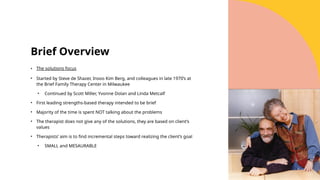
• Started by Steve de Shazer, Insoo Kim Berg, and colleagues in late 1970’s at
the Brief Family Therapy Center in Milwaukee
• Continued by Scott Miller, Yvonne Dolan and Linda Metcalf
• First leading strengths-based therapy intended to be brief
• Majority of the time is spent NOT talking about the problems
• The therapist does not give any of the solutions, they are based on client’s
values
• Therapists’ aim is to find incremental steps toward realizing the client’s goal
• SMALL and MESAURABLE
3.
Common Myths
About Solution-
FocusedTherapy
• Therapists propose solutions or
give advice
• Therapist never talk about the
problem
• Therapist never talk about the
past
• Therapists never talk about
emotions
4.
Key Technique:
Assessing Client
Strengths
•What are client strengths?
• Don’t underestimate the difficulty of identifying client
strengths
• Need an unshakeable belief that your client always has
meaningful strengths to uncover no matter what
• Assessed with direct questions and careful listening
• Two sides to every coin: every weakness is a hidden
strength
• Make sure not to use problem-focused language
5.
Overview of
Treatment
• Assesswhat works and what doesn’t
• Find exceptions and desired outcomes
• Identify small steps that will help clients
enact solutions
• Sometimes this approach is time limited
to 1-10 sessions
• Insoo and Steve
6.
The Therapeutic Relationship
•“In a beginner’s mind there are many possibilities; in the expert’s mind
there are few.”
• Make no assumptions and be curious about each person’s reality
• Use client’s words and understand what they mean by them
• Humanistic reflections with a twist – delimiting the difficult feeling or
thought through context
• 1) Past Tense vs. Chronic State Characteristic, 2) Partial vs.
Global, 3) Perception vs. Unchangeable Truth
• Optimism and hope
• Assumption of possibility and that problems will resolve
7.
Case
Conceptualization
• Strengths andResources
• Exceptions and “What Works”
• Identifying through direct questions and
careful listening
• When it is not there? OR When is it less
intense or not as bad?
• At times need a paradoxica approach:
When is it worse?
8.
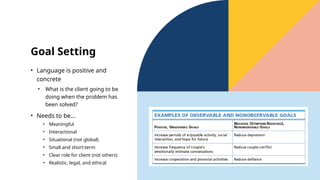
Goal Setting
• Languageis positive and
concrete
• What is the client going to be
doing when the problem has
been solved?
• Needs to be…
• Meaningful
• Interactional
• Situational (not global)
• Small and short-term
• Clear role for client (not others)
• Realistic, legal, and ethical
9.
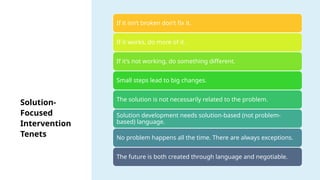
Solution-
Focused
Intervention
Tenets
If it isn’tbroken don’t fix it.
If it works, do more of it.
If it’s not working, do something different.
Small steps lead to big changes.
The solution is not necessarily related to the problem.
Solution development needs solution-based (not problem-
based) language.
No problem happens all the time. There are always exceptions.
The future is both created through language and negotiable.
10.
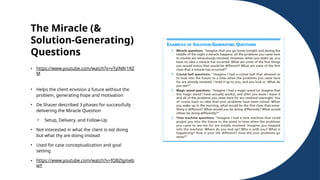
The Miracle (&
Solution-Generating)
Questions
•https://www.youtube.com/watch?v=vTylNRr1RZ
M
• Helps the client envision a future without the
problem, generating hope and motivation
• De Shazer described 3 phases for successfully
delivering the Miracle Question
• Setup, Delivery, and Follow-Up
• Not interested in what the client is not doing
but what thy are doing instead
• Used for case conceptualization and goal
setting
• https://www.youtube.com/watch?v=fQBZlgmeb
wY
11.
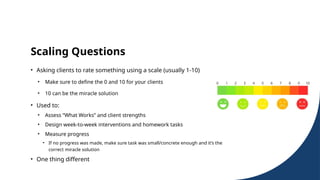
Scaling Questions
• Askingclients to rate something using a scale (usually 1-10)
• Make sure to define the 0 and 10 for your clients
• 10 can be the miracle solution
• Used to:
• Assess “What Works” and client strengths
• Design week-to-week interventions and homework tasks
• Measure progress
• If no progress was made, make sure task was small/concrete enough and it’s the
correct miracle solution
• One thing different
12.
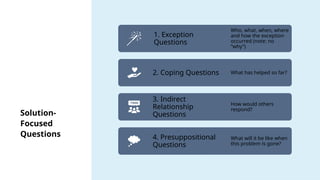
Solution-
Focused
Questions
1. Exception
Questions
Who, what,when, where
and how the exception
occurred (note: no
“why”)
2. Coping Questions What has helped so far?
3. Indirect
Relationship
Questions
How would others
respond?
4. Presuppositional
Questions
What will it be like when
this problem is gone?
13.
Other
Interventions
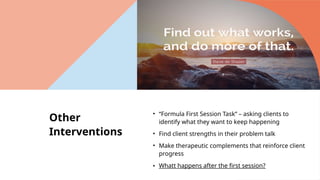
• “Formula FirstSession Task” – asking clients to
identify what they want to keep happening
• Find client strengths in their problem talk
• Make therapeutic complements that reinforce client
progress
• Whatt happens after the first session?
14.
Solution-Focused Work with
SpecificPopulations
• An optimistic and hopeful stance emphasizes resilience of trauma
survivors
• Video talk separates events from intense emotions
• There is no “theory of health” so it is adaptable to multiple cultures
• The clients identify their own solutions
• Transfers to numerous settings due to it’s positive and brief nature
• Schools, prisons, hospitals, businesses, college counseling
• Has a behavioral rather than emotional focus - helps in cultures
where emotions aren’t highly valued
• Does it work with serious problems?
15.
Critiques
• Look beforeyou leap
• Too simplistic and too brief
• Ignores the development or root of problems
• Ignores the systemic nature of challenges faced by people
with marginalized identities
• Ignores meta power dynamics
• Cognitively focused with little room for emotions
• Solution “forced”
• Doesn’t accept the clients where they’re at


![Solution Focused Approach Dd Site[1]](https://cdn.slidesharecdn.com/ss_thumbnails/solutionfocusedapproachddsite1-12583018415491-phpapp02-thumbnail.jpg?width=640&height=640&fit=bounds)


