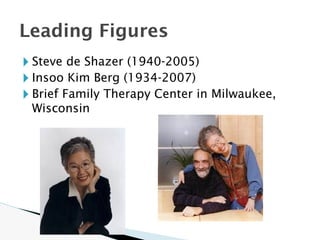
🞂 Steve deShazer (1940-2005)
🞂 Insoo Kim Berg (1934-2007)
🞂 Brief Family Therapy Center in Milwaukee,
Wisconsin
Leading Figures
3.
🞂 Focus onwhere problems are maintained
rather than their origin
🞂 Future-oriented
🞂 Refuse the idea that people somehow need
their problems: “the death of resistance”
🞂 Assume that people really want to change
Basic Principles
4.
🞂 People areconstrained by narrow views of
their problems into perpetuating rigid
patterns of false solutions
🞂 Problem talk language is very different than
solution talk language
◦ Negative, past vs. positive and future oriented
Basic Principles
5.
🞂 Positive, solutionbuilding approach
🞂 Replace the focus from problems to client
strengths and resources
◦ Belief that people have untapped and often
unconscious resources
🞂 Client is the expert of the problem
Basic Principles
6.
🞂 Who cares?
🞂Solutions are independent of the way
problems developed
🞂 Don’t look at the past, only to the future
Why do problems happen?
7.
• Be not-knowing:Therapy is
collaborative and cooperative.
🞂 Notice something positive about the client
🞂 Listen for what the client might want different
🞂 Accept what the client wants as valid and
reasonable
🞂 Make sure that the goals are specific,
behavioral and obtainable.
Basic Principles: Therapist’s roles
8.
Three Types ofClient Progress:
◦ Progressive: Indicates that clients are moving
forward and acting on goals.
◦ Stability: Indicates client’s are keeping the
status quo.
◦ Regressive: Indicates client’s are retreating
from goals.
Solution-Focused Brief Therapy
9.
◦ Customer—Seller; Complainant—Listener;Visitor—
Host.
◦ Customers: These clients are active and want to do
something about their situation.
◦ Complainant: These clients don’t want to do
anything themselves but want someone or
something else to change.
◦ Visitor: A client who does not know or cannot
verbalize his or her complaint or problem.
Counselor/client relationship
10.
🞂 Role Clarification
🞂Problem Description
🞂 Goal Formulation
🞂 Moving Toward a Solution by using various
SFT techniques
🞂 Ending
Therapeutic Steps
11.
🞂 After thepaperwork, introductions, & brief
rapport building, clarify how you work.
🞂 For example, taking a break after
approximately 40 minutes to “think about
what you told me.”
Role Clarification
12.
🞂 How canI help?
🞂 How is this a problem for you?
🞂 Get the problem description; if more than
one, which is most important to work on
first?)
🞂 What have you tried? (Was it helpful?)
Problem Description
13.
🞂 What wouldhave to be different as a result of
our meeting today for you to say that our
work was worthwhile? Or therapy worked?
🞂 http://www.youtube.com/watch?v=fQBZlgme
bwY
Goal Formulation
14.
🞂 Tell meabout the times when this problem is a
little bit better.
🞂 Tell me about the most recent times when this
happened.
🞂 How did you do it?
🞂 What are you doing differently during those
times when things are a little bit better?
🞂 What would your best friend say you do when
things are going a little bit better for you?
Think about the solution: Solution
Building
15.
🞂 Purpose isto make the conversation as useful
as possible
◦ What do you want to come out of this conversation?
◦ How can we make this conversation as useful as
possible?
◦ What do you want to come out of this conversation?
◦ How would you notice later that this conversation
was worth your time?
When communication breaks down:
Usefulness question
16.
🞂 When youare interested in level of difficulty
or progress?
◦ What tells you that you are at 6?
◦ What would it take to move 1 point higher?
◦ How long did it take you to get to 6?
◦ What do you need to do to keep your 6?
◦ How come it’s not –1?
Scaling Questions
17.
🞂 When theclient has barely have any energy to
do something about their problem
◦ How do you manage to keep going?
◦ What keeps you going under such difficult
circumstances?
◦ How do you manage to deal with such difficult
situations everyday?
Coping Questions
18.
🞂 (Once asked,focus on what will be different
when the miracle happens.)
🞂 Regarding client: What will you notice that's
different? (What will be the first thing that you
notice? What else?)
🞂 Regarding significant others: Who else will
notice when the miracle happens?
The Miracle Question
19.
🞂 1. Ifclient is concrete, give compliments and
suggest: 'in the next week, pick one day and
pretend that the miracle has happened and
look for what a difference it makes.
🞂 2. If the client is not concrete, give
compliments and suggest: "Think about
what’s happening in your life that tells you
that this problem can be solved. And I'll do
some thinking too”
3. Observational tasks are common.
Moving toward a solution
20.
🞂 Client: “Idon’t know when things were better”
“Things were never better”
🞂 Therapist: “Could you between now and the
next session pay attention to when things are
better. When you notice that things are
better, could you pay attention to what is
different in that situation and what you are
doing differently?”
Observation suggestions
21.
🞂 Depathologize theclient
🞂 “Of course, you are feeling angry, it’s normal
to be angry right now, I would be surprised if
you weren’t”.
Normalization
22.
🞂 Mom: “Iwant my child to live with me
because that’s what’s best for my child”
🞂 Dad: “ I think her living with me at least half
of the time would be best for her
development”
🞂 Therapist: “It seems like you both want what’s
best for your daughter. You just can’t seem
to agree on how to achieve it at the moment.
Can we agree on that?”
Mutulazing
23.
🞂 Coping questionsare helpful.
🞂 Scaling questions are helpful in assessing
crisis situations.
🞂 Most clients stabilize and make progress as
they participate in solution-building progress.
🞂 Clients improve by focusing on past
successes and strengths.
Solution Focused Crisis Therapy
🞂 What’s better?
🞂Doing more
🞂 If nothing is better – How are you coping?
🞂 Scaling Progress
🞂 Compliments
🞂 Tasks
Overview: Session # 2 Protocol
26.
🞂Focus is onfinding, amplifying,
and measuring client progress
🞂Opening and sustaining a
dialogue around what’s better for
the client
🞂EARS
◦ Elicit exceptions
◦ Amplify exceptions
◦ Reinforce successes
◦ Start again
Later Sessions
27.
🞂 Insoo KimBerg & Therese Steiner
🞂 Power Hands Activity
◦ Draw an outline of each activity
finger
◦ Have the child name an activity
that they are good at for each
finger.
◦ Have the child color in or write in
the activity.
◦ Child should do all 10 fingers.
Children’s Solution Work
28.
🞂 Letter tothe Future
◦ Pick a time in the future (5 – 20) years from now.
Date the letter with the imaginary date and
write to a supportive friend. Imagine that you
have resolved or coped with whatever is
bothering you at the present time. Describe
what helped you. Describe how you are
spending your time and the joyous things you
are enjoying.
Dealing with Sexual Abuse




![Solution Focused Approach Dd Site[1]](https://cdn.slidesharecdn.com/ss_thumbnails/solutionfocusedapproachddsite1-12583018415491-phpapp02-thumbnail.jpg?width=640&height=640&fit=bounds)


