Facilitator: Dr.Naeem Aslam
Presenter: Sana Shahzadi
National institute of psychology
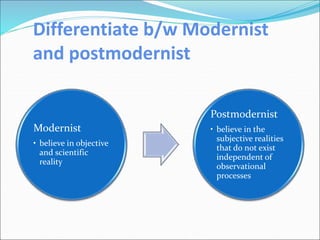
Differentiate b/w Modernist
and postmodernist
Modernist
• believe in objective
and scientific
reality
Postmodernist
• believe in the
subjective realities
that do not exist
independent of
observational
processes
Social Constructionism:
Key Concepts
o Social constructionism is a therapeutic
perspective within a postmodern worldview.
o It stresses the client's reality
o Reality is based on the use of language and
function of situation of people E.g story telling
…continued
 In postmodern thinking, language and the use of
language in stories create meaning.
 Therapist refuse the role of expert, preferring a more
collaborative or consultative stance.
 Clients viewed as experts in their own lives.
 Realities are socially constructed. There is no
absolute reality
Best Known postmodern
therapies are:
1-Collaborative language system approach
2-Solution Focused brief therapy
3-Solution oriented Therapy
4-Narrative Therapy
5-Feminist Therapy
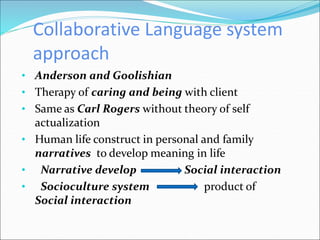
Collaborative Language system
approach
• Anderson and Goolishian
• Therapy of caring and being with client
• Same as Carl Rogers without theory of self
actualization
• Human life construct in personal and family
narratives to develop meaning in life
• Narrative develop Social interaction
• Socioculture system product of
Social interaction
Cont…
 Problem Dialogic system(Unique
language -meaning –process related to problem)
 Therapy Conversational system
(problem organizing and problem dissolving
system)
 Collaborative relationship(enter therapuatic
conversation from not-knowing postion)
 Aims to enter client’s world
Cont…
 Therapist ask question to get answer from client
expert
 Method similar to Socratic method
(stimulate critical thinking )
 Not knowing position is the key concept for
both therapies
Solution-Focused Brief
Therapy
De Shazer suggests that it is not necessary to know the
cause of the problem to solve it.
 Therapy grounded on a positive orientation-- people
are healthy and competent (Rogers)
 Past is avoid, while present and future are
highlighted (Rogers , Existential, Gestalt)
Cont…
 Therapy emphasizes what is working
 Emphasis is on constructing solutions rather
than problem solving
 This therapy is parallel to positive
psychology
Basic Assumptions of SFBT
 Analyzing the problem is not necessary to find
effective solutions
› “What will be different in your life when your problem is
solved?”
 People can create their own solutions
› Times when problem did not exist or was less severe
 Small changes lead to large changes
› Achievable changes
The Therapeutic Process
 Bertolino and O’Hanlon stress collaborative
therapeutic relationships
ď‚— If the clients are involved in the therapeutic
process from beginning to end, the chances are
increased that therapy will be successful.
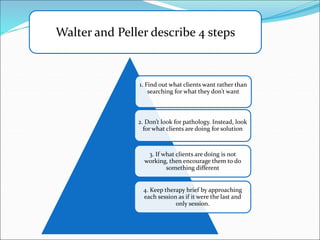
1. Find out what clients want rather than
searching for what they don’t want
2. Don’t look for pathology. Instead, look
for what clients are doing for solution
3. If what clients are doing is not
working, then encourage them to do
something different
4. Keep therapy brief by approaching
each session as if it were the last and
only session.
Walter and Peller describe 4 steps
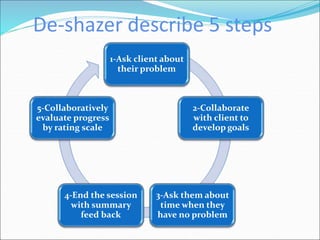
De-shazer describe 5 steps
1-Ask client about
their problem
2-Collaborate
with client to
develop goals
3-Ask them about
time when they
have no problem
4-End the session
with summary
feed back
5-Collaboratively
evaluate progress
by rating scale
Therapeutic Goals
ď‚— Believe clients have the ability to define their goals
and the resources required to solve their problems
ď‚— Focus on small, realistic, and achievable changes
ď‚— Small change leads to big change
ď‚— Remain goal-directed and future-oriented
ď‚— E.g., what has changed since last session?
ď‚— Talk about solutions instead of talking about
problems
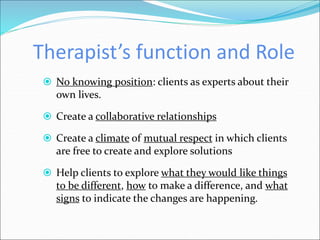
Therapist’s function and Role
 No knowing position: clients as experts about their
own lives.
 Create a collaborative relationships
 Create a climate of mutual respect in which clients
are free to create and explore solutions
 Help clients to explore what they would like things
to be different, how to make a difference, and what
signs to indicate the changes are happening.
Relationship Between Therapist and Client
ď‚— Therapeutic relationship
ď‚— Help clients to use their strengths and resources to
construct solutions
ď‚— Facilitate client to explore solution
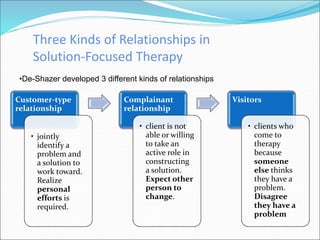
Three Kinds of Relationships in
Solution-Focused Therapy
Customer-type
relationship
• jointly
identify a
problem and
a solution to
work toward.
Realize
personal
efforts is
required.
Complainant
relationship
• client is not
able or willing
to take an
active role in
constructing
a solution.
Expect other
person to
change.
Visitors
• clients who
come to
therapy
because
someone
else thinks
they have a
problem.
Disagree
they have a
problem
•De-Shazer developed 3 different kinds of relationships
Techniques Used in
Solution-Focused Brief Therapy
 Pre-therapy change: What have you done
since you made the appointment that has
made a difference in your problem?
 Exception questions: Direct clients to times
in their lives when the problem did not exist.
Cont…
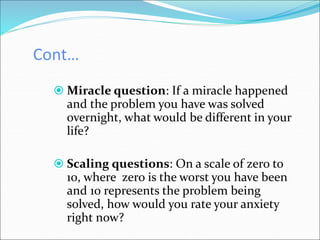
 Miracle question: If a miracle happened
and the problem you have was solved
overnight, what would be different in your
life?
 Scaling questions: On a scale of zero to
10, where zero is the worst you have been
and 10 represents the problem being
solved, how would you rate your anxiety
right now?
Cont…
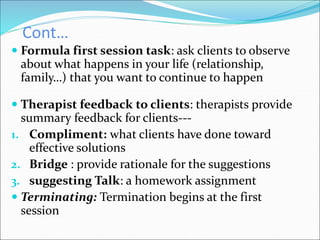
ď‚— Formula first session task: ask clients to observe
about what happens in your life (relationship,
family…) that you want to continue to happen
ď‚— Therapist feedback to clients: therapists provide
summary feedback for clients---
1. Compliment: what clients have done toward
effective solutions
2. Bridge : provide rationale for the suggestions
3. suggesting Talk: a homework assignment
ď‚— Terminating: Termination begins at the first
session
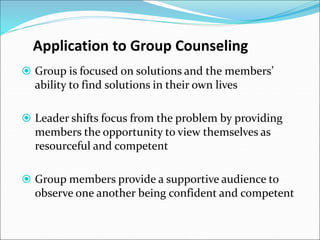
Application to Group Counseling
 Group is focused on solutions and the members’
ability to find solutions in their own lives
 Leader shifts focus from the problem by providing
members the opportunity to view themselves as
resourceful and competent
 Group members provide a supportive audience to
observe one another being confident and competent
Cont…
 Questioning is used to facilitate client’s establishing
goals early in the group process
ď‚— Goals for therapy are small, realistic, and achievable
Contributions of SFBP
ď‚— Optimistic orientation
ď‚— Major strength: use of questioning to generate
solutions
ď‚— Brief therapy has been shown to be effective for a
wide range of clinical problems
Limitations of the
Postmodern Approaches
ď‚— Therapists must be skilled in implementing brief
interventions
ď‚— Therapists may employ techniques in a mechanistic
fashion
ď‚— Reliance on techniques may detract from building a
therapeutic relationship
postmodern approaches

postmodern approaches

  • 1.
    Facilitator: Dr.Naeem Aslam Presenter:Sana Shahzadi National institute of psychology
  • 2.
    Differentiate b/w Modernist andpostmodernist Modernist • believe in objective and scientific reality Postmodernist • believe in the subjective realities that do not exist independent of observational processes
  • 3.
    Social Constructionism: Key Concepts oSocial constructionism is a therapeutic perspective within a postmodern worldview. o It stresses the client's reality o Reality is based on the use of language and function of situation of people E.g story telling
  • 4.
    …continued  In postmodernthinking, language and the use of language in stories create meaning.  Therapist refuse the role of expert, preferring a more collaborative or consultative stance.  Clients viewed as experts in their own lives.  Realities are socially constructed. There is no absolute reality
  • 5.
    Best Known postmodern therapiesare: 1-Collaborative language system approach 2-Solution Focused brief therapy 3-Solution oriented Therapy 4-Narrative Therapy 5-Feminist Therapy
  • 6.
    Collaborative Language system approach •Anderson and Goolishian • Therapy of caring and being with client • Same as Carl Rogers without theory of self actualization • Human life construct in personal and family narratives to develop meaning in life • Narrative develop Social interaction • Socioculture system product of Social interaction
  • 7.
    Cont…  Problem Dialogicsystem(Unique language -meaning –process related to problem)  Therapy Conversational system (problem organizing and problem dissolving system)  Collaborative relationship(enter therapuatic conversation from not-knowing postion)  Aims to enter client’s world
  • 8.
    Cont…  Therapist askquestion to get answer from client expert  Method similar to Socratic method (stimulate critical thinking )  Not knowing position is the key concept for both therapies
  • 9.
    Solution-Focused Brief Therapy De Shazersuggests that it is not necessary to know the cause of the problem to solve it.  Therapy grounded on a positive orientation-- people are healthy and competent (Rogers)  Past is avoid, while present and future are highlighted (Rogers , Existential, Gestalt)
  • 10.
    Cont…  Therapy emphasizeswhat is working  Emphasis is on constructing solutions rather than problem solving  This therapy is parallel to positive psychology
  • 11.
    Basic Assumptions ofSFBT  Analyzing the problem is not necessary to find effective solutions › “What will be different in your life when your problem is solved?”  People can create their own solutions › Times when problem did not exist or was less severe  Small changes lead to large changes › Achievable changes
  • 12.
    The Therapeutic Process Bertolino and O’Hanlon stress collaborative therapeutic relationships  If the clients are involved in the therapeutic process from beginning to end, the chances are increased that therapy will be successful.
  • 13.
    1. Find outwhat clients want rather than searching for what they don’t want 2. Don’t look for pathology. Instead, look for what clients are doing for solution 3. If what clients are doing is not working, then encourage them to do something different 4. Keep therapy brief by approaching each session as if it were the last and only session. Walter and Peller describe 4 steps
  • 14.
    De-shazer describe 5steps 1-Ask client about their problem 2-Collaborate with client to develop goals 3-Ask them about time when they have no problem 4-End the session with summary feed back 5-Collaboratively evaluate progress by rating scale
  • 15.
    Therapeutic Goals ď‚— Believeclients have the ability to define their goals and the resources required to solve their problems ď‚— Focus on small, realistic, and achievable changes ď‚— Small change leads to big change ď‚— Remain goal-directed and future-oriented ď‚— E.g., what has changed since last session? ď‚— Talk about solutions instead of talking about problems
  • 16.
    Therapist’s function andRole  No knowing position: clients as experts about their own lives.  Create a collaborative relationships  Create a climate of mutual respect in which clients are free to create and explore solutions  Help clients to explore what they would like things to be different, how to make a difference, and what signs to indicate the changes are happening.
  • 17.
    Relationship Between Therapistand Client ď‚— Therapeutic relationship ď‚— Help clients to use their strengths and resources to construct solutions ď‚— Facilitate client to explore solution
  • 18.
    Three Kinds ofRelationships in Solution-Focused Therapy Customer-type relationship • jointly identify a problem and a solution to work toward. Realize personal efforts is required. Complainant relationship • client is not able or willing to take an active role in constructing a solution. Expect other person to change. Visitors • clients who come to therapy because someone else thinks they have a problem. Disagree they have a problem •De-Shazer developed 3 different kinds of relationships
  • 19.
    Techniques Used in Solution-FocusedBrief Therapy  Pre-therapy change: What have you done since you made the appointment that has made a difference in your problem?  Exception questions: Direct clients to times in their lives when the problem did not exist.
  • 20.
    Cont…  Miracle question:If a miracle happened and the problem you have was solved overnight, what would be different in your life?  Scaling questions: On a scale of zero to 10, where zero is the worst you have been and 10 represents the problem being solved, how would you rate your anxiety right now?
  • 21.
    Cont…  Formula firstsession task: ask clients to observe about what happens in your life (relationship, family…) that you want to continue to happen  Therapist feedback to clients: therapists provide summary feedback for clients--- 1. Compliment: what clients have done toward effective solutions 2. Bridge : provide rationale for the suggestions 3. suggesting Talk: a homework assignment  Terminating: Termination begins at the first session
  • 22.
    Application to GroupCounseling  Group is focused on solutions and the members’ ability to find solutions in their own lives  Leader shifts focus from the problem by providing members the opportunity to view themselves as resourceful and competent  Group members provide a supportive audience to observe one another being confident and competent
  • 23.
    Cont…  Questioning isused to facilitate client’s establishing goals early in the group process  Goals for therapy are small, realistic, and achievable
  • 24.
    Contributions of SFBP ď‚—Optimistic orientation ď‚— Major strength: use of questioning to generate solutions ď‚— Brief therapy has been shown to be effective for a wide range of clinical problems
  • 25.
    Limitations of the PostmodernApproaches ď‚— Therapists must be skilled in implementing brief interventions ď‚— Therapists may employ techniques in a mechanistic fashion ď‚— Reliance on techniques may detract from building a therapeutic relationship