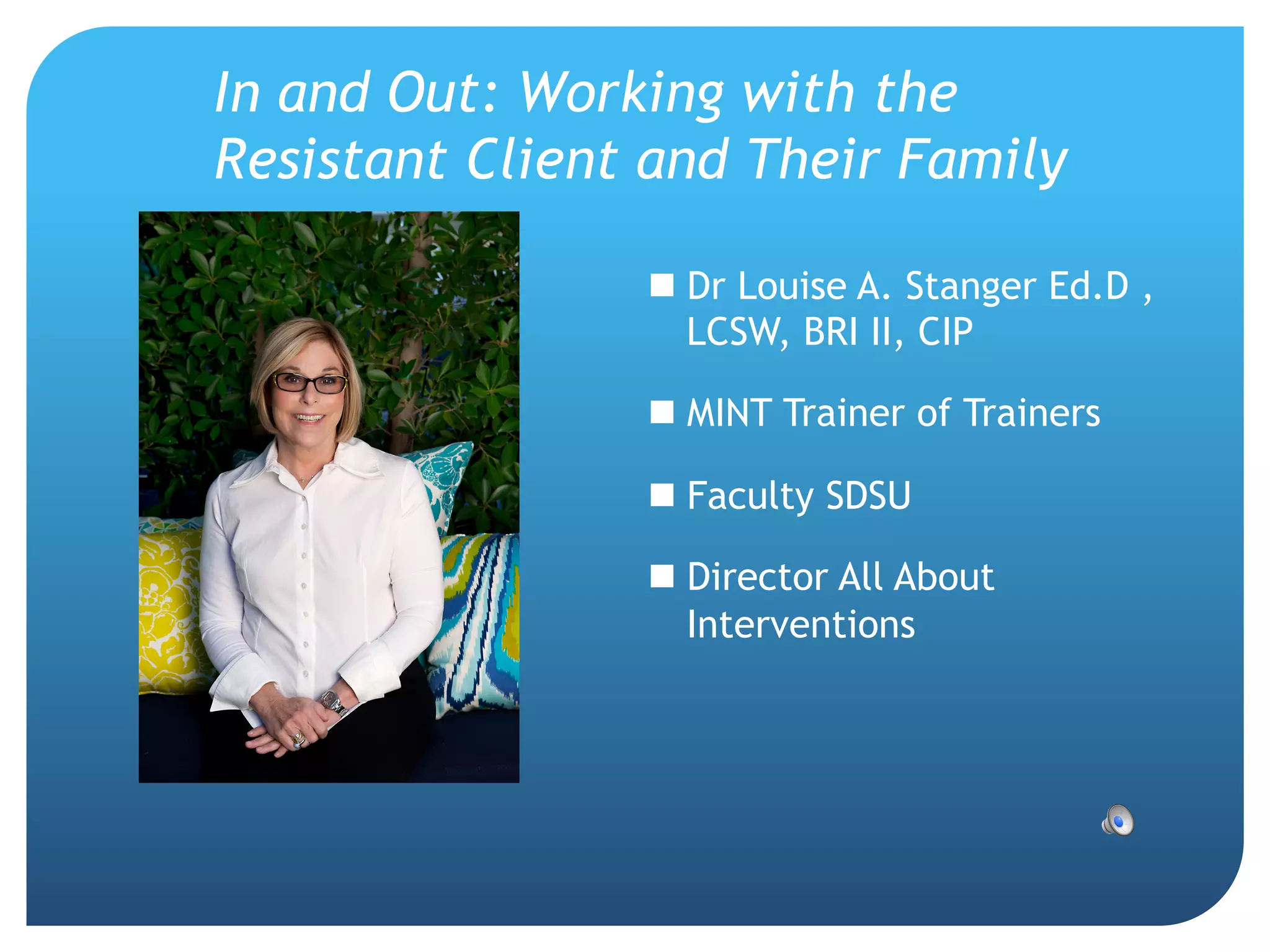
In and Out: Working with the
Resistant Client and Their Family
 Dr Louise A. Stanger Ed.D ,
LCSW, BRI II, CIP
 MINT Trainer of Trainers
 Faculty SDSU
 Director All About
Interventions
Objectives:
 Identify Who is the Resistant Client
and Family ?
 To Introduce SFT and MI and Parallel
Processess
 To Demonstrate how they differ from
other processes
 To teach how professionals may
integrate these transformational
processes into practice.
 Identify Who is the Resistant Client
and Family ?
 To Introduce SFT and MI and Parallel
Processess
 To Demonstrate how they differ from
other processes
 To teach how professionals may
integrate these transformational
processes into practice.
2
How do our Families Arrive ?
Substance Abuse
Mental Health
Other –Legal, Physical,
Family History
Family History
Attributes of Healthy Families
( McMannis PHD & McMannis MSW)
Talking & Loving
Expressing Language
Adapting to Change
Sharing Time Together
Who’s in Charge
Balancing Closeness &
Difference
Accepting Difference
Seeing The Positive
Effective Problem Solving
Parenting Together
Family Strengths
( Lamm, 2009)
Communication
Caring
Health
Commitment
Resilience
Spirituality
Family Systems Minuchin
Parent
SiblingCouple
Families that have Substance Abuse
and Mental health
 Are behavioral systems in which SA and MH-related behaviors
have become the central organizing structure
 An identity is forged around this, family accommodates to the
special needs of the person with SA or MH behavior
 Daily rituals reflect this new identity and can alter the balance
that exists between growth and regulation in the family
 Families begin to count on a conscious or unconscious way of this
new identity and are somewhat resistant to change in other
words SA is actually maintained by the family
 Hence the introduction of change most often appears as
emphasis on short tem stability at the expense of long term
growth.
 Family distortions
Good - Not So Good
Portlandia
Family Fusion & Lack of Boundaries
Lack of personal space
Taking over-controlling
Blurred lines
Blaming
Power
Denying
Rescuing faulty reasoning
Lack of boundaries
Before Treatment Families
Confused
Bewildered
Attached to The Problem
Deny
Minimize
Feelings Families Have
Confusion
Anger
Sadness
Love
So, What Type of Families Do You
Encounter?
Agreeable Family –Does everything you ask
The Invisible Family-Always in the background
The Questioner- Calls all the time and emails …
The Know it all-Knows everything about everything
The Talker – Talks –Talks and Talks
The Complainer- Nothing is ever good enough
The Worrier
The Micro-Manager
What’s your Attitude ?
Families are hurting experts (SFT)
1.Client is the expert
about their own life
2. Professionals adopt
posture of not knowing
(easier said then done)!
20
21
Families/Clients are experts
3. Counselor expertise is
called along the way.
4. Remember this is not
about you
5. Avoid one upmanship
Assumption is they are motivated
 Probability of behavior change
or movement toward or against
goal
 Extrinsic…….
 Intrinsic ……
 What are they motivated to do?
Parallel Processes
Families must have
opportunities to grow
alongside their loved one
that is in treatment.
Krissy Pozatek, LICSW
Parallel Processes
Letting go of Reins
Emotional Attunement
Listening Reflectively
Shifting Responsibility
Multidimensional Family Therapy
Solution-based
Behavioral
Narrative
Family systems model
Family disease model
Cognitive-behavioral
Multidimensional
What if
The Parent is right
The Procedures and or
policies are incorrect
The flow of information is
wrong
The presentation of material
needs adjusting
The parents get caught in an
alienation coalition
Recovery Issues
Issues Early Middle Advanced
Grieving Identify ones
losses
Learning to
grieve
Grieve past and
present losses
Neglecting ones
own needs
Realization of
needs
Beginning to get
needs met
Getting needs
met
Being Over
responsible
Identifying
boundaries
Setting limits Responsible for
self-clear
boundaries
Low self-esteem Identify Sharing Affirming –
improved SE
Control Identify Taking
responsibility
Responsibility&
letting go
All or none
thinking
Recognize &
identify
Learning there
are choices
Multicolored
world
Being Real Recognize Risking being
real
Being real
Recovery Issues
Issues Early Middle Advanced
Trust Trust can be
helpful
Selective
Trusting
Trusting
appropriately
Feeling Recognizing &
Identifying
Experiencing Observing &
Using
Hi Tolerance
inappropriate
beh.
Questioning
behaviors
Learning Knowing &
having safe folks
Abandonment &
Conflict
Recognizing &
Identifying
Grieving &
Resolving
Freedom From &
work thru
current conflicts
Giving and
Receiving Love
Defining: What is
love
Practicing Refining, loving
self, higher
power
Dependence &
Independence
Identifying Learning/
Practicing
Being healthy
Stages Of Change
Precontemplation
Contemplation
Preparation
Action
Maintenance
In between the cravings
Find the Spaces In between
Omar Manejawa MD
Cravings – Myopic
Spaces- Change
Habits -Actions
Motivational Interviewing
 Directive client center approach
 Process not Technique
 Collaborative
 Evocation- elicit clients internal
viewpoint
 Autonomy
 Roll With Resistance
MI Spirit
 Rogerian approach
 Coupled with a direction
 Equalitarian
 Warm, Empathetic, Affirming & Respectful
 Guiding & eliciting vs. instructing & persuading
Characteristics of MI
 Counselor is active and directive
 Counselor helps shape behavior
 MI strategy is specific and systematic
 Consistent with principles of client choice and
empowerment
 Consistent with cultural sensitivity in that client leads
and counselors agenda is not imposed
Traps to Avoid
 Question-Answer
 Labeling Trap – dx codes
 Premature Focus Trap-start
with clients concern not yours
 Expert
 Taking sides
 Blaming Others _ who is to
blame is not as important as
to what your concerns are
Principles Of MI
Express Empathy
Roll with Resistance
Develop Discrepancy
Support Self Efficacy
How to Express Empathy
Use your Oars
Open Ended Questions
Affirmations
Reflections
Summaries
What Type of Communication Skills
Do you Have?
 Echo Key Words
 Open Ended
Questions
 Paraphrase
 Body Language
 Summarize
 Self -Disclose
How do you Listen ?
Listening Exercise
Break up in dyads
Practice Listening – 3
minutes- Listen to
what is said and what
is unsaid
Debrief
Personal Roadblocks
Kids are sick
Had a fight with partner
Phones are ringing-cannot
spend a lot of time
Woke up late
Boss is edgy
Oh no not that Family–
AGAIN !
12 Roadblocks to Listening
 1. Ordering, directing,
commanding
 2. Warning or threatening
 3. Giving advice,
suggestions, solutions
 4. Persuading with logic,
arguing,
 5. Moralizing, preaching
 6.Disagreening, judging,
criticizing , blaming
12 Roadblocks to Listening
 7.Agreeing, approving,
praising
 8. Shaming, ridiculing or
labeling
 9. Interpreting or analyzing
 10. Reassuring,
sympathizing
 11. Questioning or probing
 12.Withdrawing, distracting
Assumptions To Avoid
 Person OUGHT to change
 Person WANTS to change
 Persons health is prime
motivation factor
 If she/he decides not to
change consultation is a
failure
 Individuals are either
motivated to change or
they are not
 Now is the right time to
consider change
 A tough approach is always the
best approach
 I am the expert and know best
 A equalitarian approach is
always best
Listen Reflectively
Being quiet and
actively listening
Responding with a
statement that
accurately reflects the
essence of what the
client meant
Listen carefully think
Reflections
Reflections
 Think in terms of forming
an hypotheses or best
guess at what client is
saying
 Take a guess –Do you
mean…
 You have to differentiate
between a question and
a statement
 Voice goes down at end
of statement rather then
up with a question
 “You're angry with your
mother …
 A statement does not
require an answer .
 Used strategically
emaphsize, clients view ,
feelings, ambivalence,
emotion change talk
Level of Reflection
 Repeating repeat what someone has just said
 Rephrase – substitute a few different words
 Paraphrasing-make a fairly major restatement inferring
what you think a person has said
 Reflecting feeling – special kind of paraphrase where you
are not necessarily relecting content rather feeling
Simple Reflection
 Client: This parent is
driving me crazy trying
to make a decision
Counselor; Her methods
are really bothering you
Client: I don’t have
anything to say
Counselor- You are not
feeling talkative today
Amplified Reflections
Exaggerate what
client says be careful
not to be sarcastic
So if I hear you
correctly your
son/daughter needs…
you to bring him xx
So you are likely to
keep bailing ..
Other strategies for Handing
Resistance
Clarification
Shift focus away from
stumbling block
Emphasize Personal
Choice and Control
Provide Summaries
 Communicate what you have tracked what the client has
said so that you have understanding of what is being said
 Helps structure session so you do not get sidetracked
 Provide opportunity to emphasize statements a client has
made about change talk gives client another opportunity to
hear what she has said in context provided by the counselor
Example
 So Sally , let me know if I heard you correctly. You care
about your children and you are hoping social services does
not intervene. You believe you need to change your
realtionships that involve using and aren’t quite sure how to
do that?
 Or what else would you add ?......
Decisional Balance Worksheet
(Fill in what you are considering as change )
Good things aboutGood things about
Changing behaviorChanging behavior
Good things aboutGood things about
changing behaviorchanging behavior
Not so good things aboutNot so good things about
behaviorbehavior
Not so good things aboutNot so good things about
changing behaviorchanging behavior
Exploring Ambivalence
The Existence of
conflicting emotions
or thoughts about a
person object or idea
DARN (Desire, Ability , Reason, Need)
 What do you think you will
do ?
 What does this mean about
your habit ?
 What are your options?
 What's the next step for
you?
 What are some good things
about making a change ?
 Where does this leave you?
59
Scaling QuestionsScaling Questions
 Motivation MIMotivation MI
On a scale of 1-10, ten
being most important, how
important is it for you to do
things differently?
On a scale of 1-10, ten
being most important, how
important is it for you to do
things differently?
Confidence - SFTConfidence - SFT
On a scale of 1-10, 10
being the most confident -
how confident are you that
you can do x, y, z?
Confidence teaches you
what skills you need to
teach your participants.
On a scale of 1-10, 10
being the most confident -
how confident are you that
you can do x, y, z?
Confidence teaches you
what skills you need to
teach your participants.
Resistance
Traditional
 Client not getting it
MI View
 Counselor may not be
getting it
 Case Example –Jon
Signs of Resistance
 Arguing
Challenging
Discounting
Hostility
 Ignoring
-Inattention
-Non-answer
-No response
-Sidetracking
 Denying
 Blaming
 Disagreeing
 Excuses
 Claiming impunity
 Minimizing
 Pessimism
 Reluctance
 Unwilling to change
•InterruptingInterrupting
Taking OverTaking Over
Cutting OffCutting Off
Hard Questions to Ask about Resistance
Ten Strategies for Evoking
Change
 1. Ask Evocative questions
 Why would you want to make this change? (Desire)
 How might you go about that ? (Ability)
 What are the three best reasons for doing that ? (Reasons)
 How important is it for you to make this change? (Need)
 So what do you think you will do? (Commitment)
Ten Strategies for Evoking
Change
 2. Ask for Elaboration
 When change talk emerges ask for more detail. In what
ways?
 3. Ask For Examples
Ask for specific examples, when was the last time that
happened ? give me an example
 4. Look Back
Ask about a time before current concern emerged. How were
things better? different?
Ten Strategies for Evoking Change
 5. Looking Forward-
What would happen if things
stay the same/ If you are
100% successful in making
changes you want what
would life look like ?
 6. Extremes
What is the worst thing that
could happen? What is the
best thing that could
happen
Ten Strategies for Evoking Change
7. Use Change Rulers
 On a scale of
1-------------------10
8. Explore Goals and
Values
 What are the persons
values and goals
9. Join up –Come
along side
Ten Strategies for Evoking Change
10. Responding to
Change Talk (EARS)
 EXPLORE
 AFFIRM
 SUMMARIZE
Solution-Focused Coaching
1. Not necessary to
understand deeper cause
or meaning
2. Goals are defined by
client, focusing on the
possible and changeable,
honorig client choice
3. Small change is often all
that is possible
68
Assumptions of SFT
4. When goal is defined by
client, you have
cooperative client
5. Counselor, interventionist,
admissions, call center
person adopt a posture of
inquiry, of not knowing
69
Assumptions of SFT
4. When goal is defined by
client, you have
cooperative client
5. Counselor, interventionist,
admissions, call center
person adopt a posture of
inquiry, of not knowing
70
Have Crucial Conversations
1. Client is always right
2. Agree with clients
goal, its about choice
3. Use client’s language
4. Develop Compliments
to support change
71
Talking With Families
4. Develop Compliments
to support change
5. Provide bridging
statement and
rationale for
suggestions
6. Assign Tasks based on
relationships
7. Seek solutions
72
The Interview
Initial
Break
Ending or Close
73
Interviewing Questions
1. Precession Change
2. Coping
3. Relationship
4. Exception
5. Miracle- In a Perfect
6. Scaling
74
Compliments
Direct: Positive verb,
attribute or reaction to
client
Indirect-Something that
implies positive
Self Compliment- “I”
statement
75
Assignments
Always based on
relationship
Readiness to Change
Focus on Attainable
goals
Design ,Small steps
Proceed slowly
76
Cases
I want to know
everything that is said
in treatment
You are not
responding to my
child’s needs
King Baby- and Father- VIP
WE are VIP
I only talk to Mike
Neatherton or Paul
Alexander
If I have to I will call Greg,
Elizabeth, Colin , etc
though all reluctantly as I
am a VIP
Queen Baby – Mother and Daughter
The problem is you your
treatment center does
not understand our
daughter. She is unique
She requires we speak
every day
She requires her phone
She requires ……….
Heroic Families
Attunement
Individualization
Healthy Boundaries
Own Recovery
Talking care of ones self
physically, emotionally and
consistent with ones values
Always Have Heroic Counselors
Always Remember
83
Recovery is Like Walking on Sunshine
Resources
 The Daring Way-Brene Brown
 Crucial Conversations-Patterson et al
 The Parallel Process- Krissy Pozatek LCSW
 The Journey of the Heroic Parents-Brad M. Reedy PHD
 If You Meet The Buddah on The Road-Kill Them- Sheldon
Kopp
 Motivational Interviewing- Miller and Rollnick
 Solution Focused Therapy –Insoo Young and Peter Berg
Resources
http://www.minuchincenter.org
Minuchin Family Center Therapy
http://www.Allaboutinterventions.com
Dr. Louise Stanger
http://www.motivationalinterviewing.org
Motivational Interviewing
http://www.solutionfocused.net
Institute For Solution Focused

Working with the resistant client and their family

  • 1.
    In and Out:Working with the Resistant Client and Their Family  Dr Louise A. Stanger Ed.D , LCSW, BRI II, CIP  MINT Trainer of Trainers  Faculty SDSU  Director All About Interventions
  • 2.
    Objectives:  Identify Whois the Resistant Client and Family ?  To Introduce SFT and MI and Parallel Processess  To Demonstrate how they differ from other processes  To teach how professionals may integrate these transformational processes into practice.  Identify Who is the Resistant Client and Family ?  To Introduce SFT and MI and Parallel Processess  To Demonstrate how they differ from other processes  To teach how professionals may integrate these transformational processes into practice. 2
  • 3.
    How do ourFamilies Arrive ? Substance Abuse Mental Health Other –Legal, Physical, Family History
  • 4.
  • 6.
    Attributes of HealthyFamilies ( McMannis PHD & McMannis MSW) Talking & Loving Expressing Language Adapting to Change Sharing Time Together Who’s in Charge Balancing Closeness & Difference Accepting Difference Seeing The Positive Effective Problem Solving Parenting Together
  • 7.
    Family Strengths ( Lamm,2009) Communication Caring Health Commitment Resilience Spirituality
  • 8.
  • 9.
    Families that haveSubstance Abuse and Mental health  Are behavioral systems in which SA and MH-related behaviors have become the central organizing structure  An identity is forged around this, family accommodates to the special needs of the person with SA or MH behavior  Daily rituals reflect this new identity and can alter the balance that exists between growth and regulation in the family  Families begin to count on a conscious or unconscious way of this new identity and are somewhat resistant to change in other words SA is actually maintained by the family  Hence the introduction of change most often appears as emphasis on short tem stability at the expense of long term growth.  Family distortions
  • 10.
    Good - NotSo Good
  • 11.
  • 13.
    Family Fusion &Lack of Boundaries Lack of personal space Taking over-controlling Blurred lines Blaming Power Denying Rescuing faulty reasoning Lack of boundaries
  • 14.
  • 15.
  • 16.
    So, What Typeof Families Do You Encounter? Agreeable Family –Does everything you ask The Invisible Family-Always in the background The Questioner- Calls all the time and emails … The Know it all-Knows everything about everything The Talker – Talks –Talks and Talks The Complainer- Nothing is ever good enough The Worrier The Micro-Manager
  • 17.
  • 19.
    Families are hurtingexperts (SFT) 1.Client is the expert about their own life 2. Professionals adopt posture of not knowing (easier said then done)! 20
  • 20.
    21 Families/Clients are experts 3.Counselor expertise is called along the way. 4. Remember this is not about you 5. Avoid one upmanship
  • 21.
    Assumption is theyare motivated  Probability of behavior change or movement toward or against goal  Extrinsic…….  Intrinsic ……  What are they motivated to do?
  • 22.
    Parallel Processes Families musthave opportunities to grow alongside their loved one that is in treatment. Krissy Pozatek, LICSW
  • 23.
    Parallel Processes Letting goof Reins Emotional Attunement Listening Reflectively Shifting Responsibility
  • 24.
    Multidimensional Family Therapy Solution-based Behavioral Narrative Familysystems model Family disease model Cognitive-behavioral Multidimensional
  • 25.
    What if The Parentis right The Procedures and or policies are incorrect The flow of information is wrong The presentation of material needs adjusting The parents get caught in an alienation coalition
  • 26.
    Recovery Issues Issues EarlyMiddle Advanced Grieving Identify ones losses Learning to grieve Grieve past and present losses Neglecting ones own needs Realization of needs Beginning to get needs met Getting needs met Being Over responsible Identifying boundaries Setting limits Responsible for self-clear boundaries Low self-esteem Identify Sharing Affirming – improved SE Control Identify Taking responsibility Responsibility& letting go All or none thinking Recognize & identify Learning there are choices Multicolored world Being Real Recognize Risking being real Being real
  • 27.
    Recovery Issues Issues EarlyMiddle Advanced Trust Trust can be helpful Selective Trusting Trusting appropriately Feeling Recognizing & Identifying Experiencing Observing & Using Hi Tolerance inappropriate beh. Questioning behaviors Learning Knowing & having safe folks Abandonment & Conflict Recognizing & Identifying Grieving & Resolving Freedom From & work thru current conflicts Giving and Receiving Love Defining: What is love Practicing Refining, loving self, higher power Dependence & Independence Identifying Learning/ Practicing Being healthy
  • 28.
  • 29.
    In between thecravings Find the Spaces In between Omar Manejawa MD Cravings – Myopic Spaces- Change Habits -Actions
  • 30.
    Motivational Interviewing  Directiveclient center approach  Process not Technique  Collaborative  Evocation- elicit clients internal viewpoint  Autonomy  Roll With Resistance
  • 31.
    MI Spirit  Rogerianapproach  Coupled with a direction  Equalitarian  Warm, Empathetic, Affirming & Respectful  Guiding & eliciting vs. instructing & persuading
  • 32.
    Characteristics of MI Counselor is active and directive  Counselor helps shape behavior  MI strategy is specific and systematic  Consistent with principles of client choice and empowerment  Consistent with cultural sensitivity in that client leads and counselors agenda is not imposed
  • 33.
    Traps to Avoid Question-Answer  Labeling Trap – dx codes  Premature Focus Trap-start with clients concern not yours  Expert  Taking sides  Blaming Others _ who is to blame is not as important as to what your concerns are
  • 34.
    Principles Of MI ExpressEmpathy Roll with Resistance Develop Discrepancy Support Self Efficacy
  • 35.
    How to ExpressEmpathy Use your Oars Open Ended Questions Affirmations Reflections Summaries
  • 36.
    What Type ofCommunication Skills Do you Have?  Echo Key Words  Open Ended Questions  Paraphrase  Body Language  Summarize  Self -Disclose
  • 37.
    How do youListen ?
  • 38.
    Listening Exercise Break upin dyads Practice Listening – 3 minutes- Listen to what is said and what is unsaid Debrief
  • 39.
    Personal Roadblocks Kids aresick Had a fight with partner Phones are ringing-cannot spend a lot of time Woke up late Boss is edgy Oh no not that Family– AGAIN !
  • 40.
    12 Roadblocks toListening  1. Ordering, directing, commanding  2. Warning or threatening  3. Giving advice, suggestions, solutions  4. Persuading with logic, arguing,  5. Moralizing, preaching  6.Disagreening, judging, criticizing , blaming
  • 41.
    12 Roadblocks toListening  7.Agreeing, approving, praising  8. Shaming, ridiculing or labeling  9. Interpreting or analyzing  10. Reassuring, sympathizing  11. Questioning or probing  12.Withdrawing, distracting
  • 42.
    Assumptions To Avoid Person OUGHT to change  Person WANTS to change  Persons health is prime motivation factor  If she/he decides not to change consultation is a failure  Individuals are either motivated to change or they are not  Now is the right time to consider change  A tough approach is always the best approach  I am the expert and know best  A equalitarian approach is always best
  • 43.
    Listen Reflectively Being quietand actively listening Responding with a statement that accurately reflects the essence of what the client meant Listen carefully think Reflections
  • 44.
    Reflections  Think interms of forming an hypotheses or best guess at what client is saying  Take a guess –Do you mean…  You have to differentiate between a question and a statement  Voice goes down at end of statement rather then up with a question  “You're angry with your mother …  A statement does not require an answer .  Used strategically emaphsize, clients view , feelings, ambivalence, emotion change talk
  • 45.
    Level of Reflection Repeating repeat what someone has just said  Rephrase – substitute a few different words  Paraphrasing-make a fairly major restatement inferring what you think a person has said  Reflecting feeling – special kind of paraphrase where you are not necessarily relecting content rather feeling
  • 46.
    Simple Reflection  Client:This parent is driving me crazy trying to make a decision Counselor; Her methods are really bothering you Client: I don’t have anything to say Counselor- You are not feeling talkative today
  • 47.
    Amplified Reflections Exaggerate what clientsays be careful not to be sarcastic So if I hear you correctly your son/daughter needs… you to bring him xx So you are likely to keep bailing ..
  • 48.
    Other strategies forHanding Resistance Clarification Shift focus away from stumbling block Emphasize Personal Choice and Control
  • 49.
    Provide Summaries  Communicatewhat you have tracked what the client has said so that you have understanding of what is being said  Helps structure session so you do not get sidetracked  Provide opportunity to emphasize statements a client has made about change talk gives client another opportunity to hear what she has said in context provided by the counselor
  • 50.
    Example  So Sally, let me know if I heard you correctly. You care about your children and you are hoping social services does not intervene. You believe you need to change your realtionships that involve using and aren’t quite sure how to do that?  Or what else would you add ?......
  • 51.
    Decisional Balance Worksheet (Fillin what you are considering as change ) Good things aboutGood things about Changing behaviorChanging behavior Good things aboutGood things about changing behaviorchanging behavior Not so good things aboutNot so good things about behaviorbehavior Not so good things aboutNot so good things about changing behaviorchanging behavior
  • 52.
    Exploring Ambivalence The Existenceof conflicting emotions or thoughts about a person object or idea
  • 53.
    DARN (Desire, Ability, Reason, Need)  What do you think you will do ?  What does this mean about your habit ?  What are your options?  What's the next step for you?  What are some good things about making a change ?  Where does this leave you?
  • 54.
    59 Scaling QuestionsScaling Questions Motivation MIMotivation MI On a scale of 1-10, ten being most important, how important is it for you to do things differently? On a scale of 1-10, ten being most important, how important is it for you to do things differently? Confidence - SFTConfidence - SFT On a scale of 1-10, 10 being the most confident - how confident are you that you can do x, y, z? Confidence teaches you what skills you need to teach your participants. On a scale of 1-10, 10 being the most confident - how confident are you that you can do x, y, z? Confidence teaches you what skills you need to teach your participants.
  • 55.
    Resistance Traditional  Client notgetting it MI View  Counselor may not be getting it  Case Example –Jon
  • 56.
    Signs of Resistance Arguing Challenging Discounting Hostility  Ignoring -Inattention -Non-answer -No response -Sidetracking  Denying  Blaming  Disagreeing  Excuses  Claiming impunity  Minimizing  Pessimism  Reluctance  Unwilling to change •InterruptingInterrupting Taking OverTaking Over Cutting OffCutting Off
  • 57.
    Hard Questions toAsk about Resistance
  • 58.
    Ten Strategies forEvoking Change  1. Ask Evocative questions  Why would you want to make this change? (Desire)  How might you go about that ? (Ability)  What are the three best reasons for doing that ? (Reasons)  How important is it for you to make this change? (Need)  So what do you think you will do? (Commitment)
  • 59.
    Ten Strategies forEvoking Change  2. Ask for Elaboration  When change talk emerges ask for more detail. In what ways?  3. Ask For Examples Ask for specific examples, when was the last time that happened ? give me an example  4. Look Back Ask about a time before current concern emerged. How were things better? different?
  • 60.
    Ten Strategies forEvoking Change  5. Looking Forward- What would happen if things stay the same/ If you are 100% successful in making changes you want what would life look like ?  6. Extremes What is the worst thing that could happen? What is the best thing that could happen
  • 61.
    Ten Strategies forEvoking Change 7. Use Change Rulers  On a scale of 1-------------------10 8. Explore Goals and Values  What are the persons values and goals 9. Join up –Come along side
  • 62.
    Ten Strategies forEvoking Change 10. Responding to Change Talk (EARS)  EXPLORE  AFFIRM  SUMMARIZE
  • 63.
    Solution-Focused Coaching 1. Notnecessary to understand deeper cause or meaning 2. Goals are defined by client, focusing on the possible and changeable, honorig client choice 3. Small change is often all that is possible 68
  • 64.
    Assumptions of SFT 4.When goal is defined by client, you have cooperative client 5. Counselor, interventionist, admissions, call center person adopt a posture of inquiry, of not knowing 69
  • 65.
    Assumptions of SFT 4.When goal is defined by client, you have cooperative client 5. Counselor, interventionist, admissions, call center person adopt a posture of inquiry, of not knowing 70
  • 66.
    Have Crucial Conversations 1.Client is always right 2. Agree with clients goal, its about choice 3. Use client’s language 4. Develop Compliments to support change 71
  • 67.
    Talking With Families 4.Develop Compliments to support change 5. Provide bridging statement and rationale for suggestions 6. Assign Tasks based on relationships 7. Seek solutions 72
  • 68.
  • 69.
    Interviewing Questions 1. PrecessionChange 2. Coping 3. Relationship 4. Exception 5. Miracle- In a Perfect 6. Scaling 74
  • 70.
    Compliments Direct: Positive verb, attributeor reaction to client Indirect-Something that implies positive Self Compliment- “I” statement 75
  • 71.
    Assignments Always based on relationship Readinessto Change Focus on Attainable goals Design ,Small steps Proceed slowly 76
  • 72.
    Cases I want toknow everything that is said in treatment You are not responding to my child’s needs
  • 73.
    King Baby- andFather- VIP WE are VIP I only talk to Mike Neatherton or Paul Alexander If I have to I will call Greg, Elizabeth, Colin , etc though all reluctantly as I am a VIP
  • 74.
    Queen Baby –Mother and Daughter The problem is you your treatment center does not understand our daughter. She is unique She requires we speak every day She requires her phone She requires ……….
  • 75.
    Heroic Families Attunement Individualization Healthy Boundaries OwnRecovery Talking care of ones self physically, emotionally and consistent with ones values
  • 76.
  • 77.
  • 78.
    83 Recovery is LikeWalking on Sunshine
  • 79.
    Resources  The DaringWay-Brene Brown  Crucial Conversations-Patterson et al  The Parallel Process- Krissy Pozatek LCSW  The Journey of the Heroic Parents-Brad M. Reedy PHD  If You Meet The Buddah on The Road-Kill Them- Sheldon Kopp  Motivational Interviewing- Miller and Rollnick  Solution Focused Therapy –Insoo Young and Peter Berg
  • 80.
    Resources http://www.minuchincenter.org Minuchin Family CenterTherapy http://www.Allaboutinterventions.com Dr. Louise Stanger http://www.motivationalinterviewing.org Motivational Interviewing http://www.solutionfocused.net Institute For Solution Focused

Editor's Notes

  • #52 I don’t know whty everybody is maing such a big deal over my drinking. I don’t drink that much