1
BRICK MASONRY
2
C O N T E N T
•DESCRIPTION OF BRICK
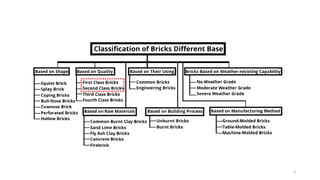
•CLASSIFICATION OF BRICK
•MATERIALS FOR BRICK
•MASONRY
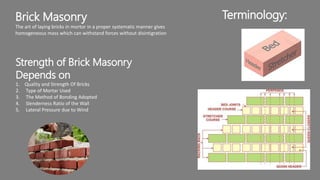
•TERMINOLOGY
•BONDS IN BRICK WORK
•TEE JUNCTION
•DIFECTS IN BRICK MASONRY
•REINFORCED BRICK WORK
•BONDS IN PIERS
•PIERS ATTACHTED TO MAIN WALLS
•SQUINT JUNCTION
•SQUINT QUOINS
•TOOLS OF BRICK LAYERS
•RETAINING WALL
•DESIGNING RETAIN WALLS
•WALL ROCK
•BACKFIL SOILS
•STRENGTH OF BRICK MASONRY
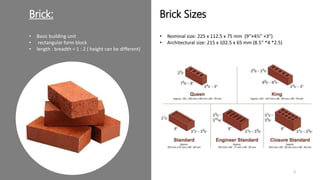
Brick:
• Basic building unit
• rectangular form block
• length : breadth = 1 : 2 ( height can be different)
Brick Sizes
• Nominal size: 225 x 112.5 x 75 mm (9''×4½" ×3“)
• Architectural size: 215 x 102.5 x 65 mm (8.5“ *4 *2.5)
3
4
Materials for Bricks
5
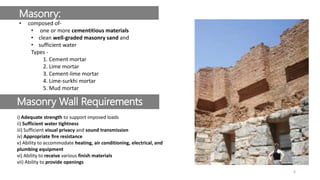
Masonry:
• composed of-
• one or more cementitious materials
• clean well-graded masonry sand and
• sufficient water
Types -
1. Cement mortar
2. Lime mortar
3. Cement-lime mortar
4. Lime-surkhi mortar
5. Mud mortar
Masonry Wall Requirements
i) Adequate strength to support imposed loads
ii) Sufficient water tightness
iii) Sufficient visual privacy and sound transmission
iv) Appropriate fire resistance
v) Ability to accommodate heating, air conditioning, electrical, and
plumbing equipment
vi) Ability to receive various finish materials
vii) Ability to provide openings
6
Strength of Brick Masonry
Depends on
1. Quality and Strength Of Bricks
2. Type of Mortar Used
3. The Method of Bonding Adopted
4. Slenderness Ratio of the Wall
5. Lateral Pressure due to Wind
Brick Masonry
The art of laying bricks in mortor in a proper systematic manner gives
homogeneous mass which can withstand forces without disintigration
7
Terminology:
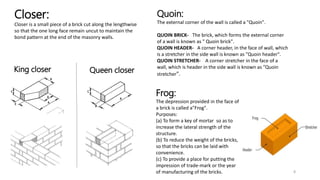
Closer:
Closer is a small piece of a brick cut along the lengthwise
so that the one long face remain uncut to maintain the
bond pattern at the end of the masonry walls.
King closer Queen closer
8
Quoin:
The external corner of the wall is called a "Quoin".
QUOIN BRICK- The brick, which forms the external corner
of a wall is known as " Quoin brick".
QUOIN HEADER- A corner header, in the face of wall, which
is a stretcher in the side wall is known as "Quoin header".
QUOIN STRETCHER- A corner stretcher in the face of a
wall, which is header in the side wall is known as "Quoin
stretcher".
Frog:
The depression provided in the face of
a brick is called a"Frog".
Purposes:
(a) To form a key of mortar so as to
increase the lateral strength of the
structure.
(b) To reduce the weight of the bricks,
so that the bricks can be laid with
convenience.
(c) To provide a place for putting the
impression of trade-mark or the year
of manufacturing of the bricks.
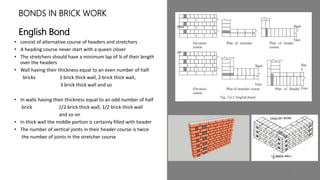
English Bond
• consist of alternative course of headers and stretchers
• A heading course never start with a queen closer
• The stretchers should have a minimum lap of ¼ of their length
over the headers
• Wall having their thickness equal to an even number of half
bricks 1 brick thick wall, 2 brick thick wall,
3 brick thick wall and so
• In walls having their thickness equal to an odd number of half
brick 1/2 brick thick wall, 1/2 brick thick wall
and so on
• In thick wall the middle portion is certainly filled with header
• The number of vertical joints in their header course is twice
the number of joints in the stretcher course
9
BONDS IN BRICK WORK
Flemish Bond
• each course consist of alternative headers and
stretchers
• alternative course starts with a header at the
corner
• having their thickness equal to odd number of
half brick,
bats are essentially used to achieve their load
2 types of Flemish bond.
. Single Flemish Bond
. Double Flemish Bond
10
Single Flemish Bond
This bond is a combination of English and Flemish bond.
In this
work the facing of the wall consist of Flemish bond and
the back consist of
English bond. In this bonding can not be adopted in walls
less than
1 and half brick in thickness.
11
In the system of bonding brick work, each course presents
the same
appearance both in the front and back elevations.
Every course consist of headers and stretchers laid
alternatively.
It enables the one brick wall to have flush and uniform
faces on both
the sides
Double Flemish Bond:
ENGLISH and FLEMISH BOND COMPARATIVE
ENGLISH BOND > FLEMISH BOND
STRONGER
ENGLISH BOND < FLEMISH BOND
ENGLISH BOND > FLEMISH BOND
12
ATTRACTIVE
ECONOMICAL
CAREFUL
SUPERVISION
PROGRESS
OF WORK
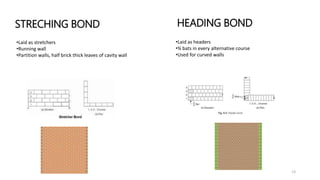
STRECHING BOND
•Laid as stretchers
•Running wall
•Partition walls, half brick thick leaves of cavity wall
13
HEADING BOND
•Laid as headers
•¾ bats in every alternative course
•Used for curved walls
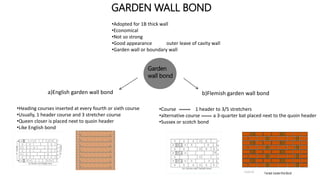
GARDEN WALL BOND
•Adopted for 1B thick wall
•Economical
•Not so strong
•Good appearance outer leave of cavity wall
•Garden wall or boundary wall
Garden
wall bond
a)English garden wall bond b)Flemish garden wall bond
14
•Heading courses inserted at every fourth or sixth course
•Usually, 1 header course and 3 stretcher course
•Queen closer is placed next to quoin header
•Like English bond
•Course 1 header to 3/5 stretchers
•alternative course a 3-quarter bat placed next to the quoin header
•Sussex or scotch bond
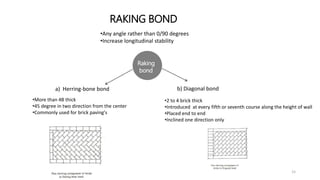
RAKING BOND
•Any angle rather than 0/90 degrees
•Increase longitudinal stability
a) Herring-bone bond b) Diagonal bond
15
Raking
bond
•More than 4B thick
•45 degree in two direction from the center
•Commonly used for brick paving's
•2 to 4 brick thick
•Introduced at every fifth or seventh course along the height of wall
•Placed end to end
•Inclined one direction only
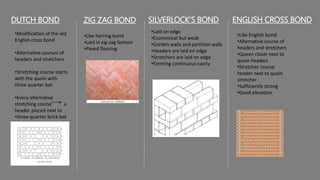
DUTCH BOND
•Modification of the old
English cross bond
•Alternative courses of
headers and stretchers
•Stretching course starts
with the quoin with
three quarter bat
•Every alternative
stretching course a
header placed next to
•three-quarter brick bat
•Like herring bond
•Laid in zig-zag fashion
•Paved flooring
16
ZIG ZAG BOND
•Laid on edge
•Economical but weak
•Garden walls and partition walls
•Headers are laid on edge
•Stretchers are laid on edge
•Forming continuous cavity
SILVERLOCK’S BOND
•Like English bond.
•Alternative course of
headers and stretchers
•Queen closer next to
quoin headers
•Stretcher course
header next to quoin
stretcher
•Sufficiently strong
•Good elevation
ENGLISH CROSS BOND
TEE JUNCTION
17
•For thick walls
•Facing and backing constructed with brick of different thickness
•1 heading course comes after several stretching course
•Load distribution is not uniform
FACING BOND
DEFECTS IN BRICK MESONARY
• SULPHATE ATTACK
• CRYSTALLIZATION OF SALTS FROM BRICK
• CORRISION OF EMBEDDED IRON OR STEEL
• SRINKAGE ON DRYING
Defects due to sulphate attack
Defects due to crystallization of salts from bricks
18
Defects due to corrosion of embedded iron or steel
Defects due to shrinkage on drying
19
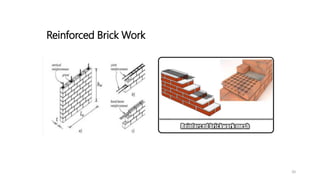
Reinforced Brick Work
20
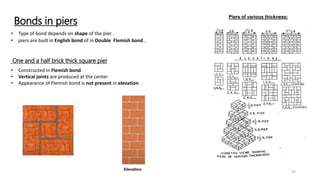
Bonds in piers
• Type of bond depends on shape of the pier .
• piers are built in English bond of in Double Flemish bond .
Piers of various thickness:
One and a half brick thick square pier
• Constructed in Flemish bond.
• Vertical joints are produced at the center
• Appearance of Flemish bond is not present in elevation
Elevation
21
Two brick thick square detached pier
• Vertical joints in the center
• In course -1 : four ¾ bats
four headers
two queen closer
• Flemish bond appear by rotating course-1 to 90 degrees
• Vertical join can be avoided by using Beveled closer inside of header and queen closer.
Beveled closer
Piers attached to main walls ;
• Providing a large bearing area for giving support to the roof .
• increasing the stability of the wall by stiffening it at intermediate points.
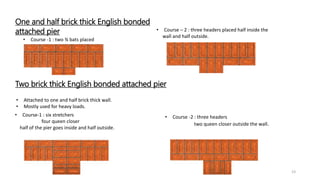
One brick thick English bonded attached pier
• Course -1 : headers facing in it
header comes in the center
• Course -2 : two headers penetrating inside the wall
create an overlap between wall and pier.
22
One and half brick thick English bonded
attached pier
• Course -1 : two ¾ bats placed
• Course – 2 : three headers placed half inside the
wall and half outside.
Two brick thick English bonded attached pier
• Attached to one and half brick thick wall.
• Mostly used for heavy loads.
• Course-1 : six stretchers
four queen closer
half of the pier goes inside and half outside.
• Course -2 : three headers
two queen closer outside the wall.
23
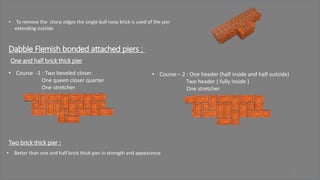
• To remove the sharp edges the single bull nose brick is used of the pier
extending outside
Dabble Flemish bonded attached piers :
One and half brick thick pier
• Course -1 : Two beveled closer
One queen closer quarter
One stretcher
• Course – 2 : One header (half inside and half outside)
Two header ( fully inside )
One stretcher
Two brick thick pier :
• Better than one and half brick thick pier in strength and appearance
24
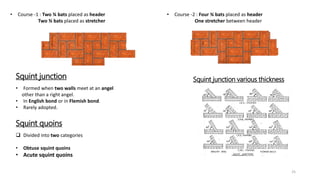
• Course -1 : Two ¾ bats placed as header
Two ¾ bats placed as stretcher
• Course -2 : Four ¾ bats placed as header
One stretcher between header
Squint junction
• Formed when two walls meet at an angel
other than a right angel.
• In English bond or in Flemish bond.
• Rarely adopted.
Squint junction various thickness
Squint quoins
 Divided into two categories
• Obtuse squint quoins
• Acute squint quoins
25
Obtuse and Acute squint quoins in English bond Obtuse and Acute squint quoins in Flemish bond
Tools of brick-layers
1. Hammer
2. Line and pins
3. Brick axe
4. Spirit level
5. Plumb rule
6. Mason’s square
7. Trowel
8. Two-foot four-fold rule
1
7
2
3
4
5
6
8
26
Retaining wall
 Dry stone retaining wall
 Day stone pitching or revetment
 Breast walls
 Brick masonry
• Rigid walls used for supporting soil
• For retaining at different levels on the two sides.
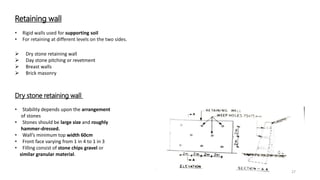
Dry stone retaining wall
• Stability depends upon the arrangement
of stones
• Stones should be large size and roughly
hammer-dressed.
• Wall’s minimum top width 60cm
• Front face varying from 1 in 4 to 1 in 3
• Filling consist of stone chips gravel or
similar granular material.
27
Day stone pitching or revetment
• Used for protecting slopping face
• Stone should be perfectly sound and roughly cut
• Slopes should not be steeper than 1:1
• No projecting stones are allowed
Breast walls
• Used for protecting slopes from the action of weather
• Section of wall depends upon the Hight of wall
• Front and back batters vary from 1 in 4 to 1 in 2
• Minimum top width of 60cm
Brick masonry
• Used for supporting earth, loose stone , coal
etc.
• Stability depends upon its dead weight.
• The top width of masonry walls and concrete
walls should not be less than 60 cm and 45 cm
• Necessary to have proper drainage
28
29
Designing Retaining Walls
The design process for a segmental retaining wall typically has a Wall Design Engineer or Site Civil Engineer
responsible for the wall design envelope. Geotechnical engineers should be hired to evaluate the overall stability of
the site.
Proper retaining wall design requires evaluation of the following:
1.Select the retaining wall location
 Minimize soil excavation and backfill.
 Optimize grading and drainage patterns.
 Consider existing sitefeatures.
2.Determine retaining wall height and geometry
 Calculate the retaining wall height at its tallest position.
 Identify slopes above and below the wall.
 Select the appropriate wall batter or setback.
Determine wall height
and geometry
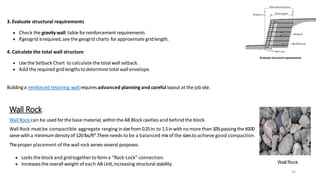
3. Evaluate structural requirements
 Check the gravitywall table for reinforcement requirements
 Ifgeogrid isrequired,see the geogrid charts for approximate gridlength.
4. Calculate the total wall structure
 Usethe Setback Chart to calculate the totalwall setback.
 Add the required gridlengthsto determinetotal wall envelope.
Buildinga reinforced retaining wall requiresadvanced planning and careful layout at the job site.
Wall Rock
WallRock can be used for the base material,withinthe ABBlock cavities and behind the block.
Wall Rock mustbe compactible aggregate ranging insizefrom 0.25in.to 1.5inwithno more than 10%passing the #200
sievewith a minimum densityof 120lbs/ft³.Thereneeds to be a balanced mixof the sizesto achieve good compaction.
Theproper placement of the wall rock servesseveral purposes:
 Locks the block and grid together to forma “Rock-Lock” connection.
 Increasesthe overall weight of each ABUnit,increasing structural stability. Wall Rock
30
Evaluate structural requirements
Backfill Soils
 On-sitesoilscan be used for backfill around the geogrid reinforcement only ifthey meet or exceed the design specificationsintheapproved
plans.
 Heavy expansive clays or organic soilsshallnot be used inthe reinforced zone.
Foundation Soil Preparation
 Foundation soilshallbe excavated asdimensionedon the plansand compacted to a minimum of 95% of Standard Proctor prior to
placement of thebase material.
 Foundation soilshallbe examined by the on-sitesoilsengineer to ensure that theactual foundationsoilstrengthmeets or exceeds assumed
design strength. Soilnot meeting the required propertiesshallbe removed and replaced with acceptable material
What are the Stability of Different Type of Retaining Walls?
Thestability of a gravity wall isdue to the self –weight of the wall and the passive resistance developed in front of the wall. Thegravity walls
are designed using Coulomb’s theory. Reinforced concretes are more economical to gravity walls because the backfillitselfprovidesmostof
the required dead load.
31
Strength of Brick Mansonry
The strength of brick masonry mainly depends on the strength of bricks that are used in the
construction.The strength of bricks depends on the soilused to make the bricks,method and
making process,burningof bricks.Sincethe nature ofthe soilvaries from region to region,the
average strength of bricks also varies from region to region.
The permissible compressive stress of brick masonry depend upon several factors such as,
1.Type of bricks (1st class, 2nd class, 3rdclass)
2.Strength of bricks
3.Size and shape of the masonry construction.
4.Mix of mortar.
5.Workmanship.
6. The method adopted for Laying bricks ; There are some useful checklists which can be applied
to increase the strength of brick masonry.
7. Visual check-The bricks to be used should be good quality , burnt well with uniform shape,
size, and color .
32
33
CONCLUSION

Brick Masonry

  • 1.
  • 2.
    2 C O NT E N T •DESCRIPTION OF BRICK •CLASSIFICATION OF BRICK •MATERIALS FOR BRICK •MASONRY •TERMINOLOGY •BONDS IN BRICK WORK •TEE JUNCTION •DIFECTS IN BRICK MASONRY •REINFORCED BRICK WORK •BONDS IN PIERS •PIERS ATTACHTED TO MAIN WALLS •SQUINT JUNCTION •SQUINT QUOINS •TOOLS OF BRICK LAYERS •RETAINING WALL •DESIGNING RETAIN WALLS •WALL ROCK •BACKFIL SOILS •STRENGTH OF BRICK MASONRY
  • 3.
    Brick: • Basic buildingunit • rectangular form block • length : breadth = 1 : 2 ( height can be different) Brick Sizes • Nominal size: 225 x 112.5 x 75 mm (9''×4½" ×3“) • Architectural size: 215 x 102.5 x 65 mm (8.5“ *4 *2.5) 3
  • 4.
  • 5.
  • 6.
    Masonry: • composed of- •one or more cementitious materials • clean well-graded masonry sand and • sufficient water Types - 1. Cement mortar 2. Lime mortar 3. Cement-lime mortar 4. Lime-surkhi mortar 5. Mud mortar Masonry Wall Requirements i) Adequate strength to support imposed loads ii) Sufficient water tightness iii) Sufficient visual privacy and sound transmission iv) Appropriate fire resistance v) Ability to accommodate heating, air conditioning, electrical, and plumbing equipment vi) Ability to receive various finish materials vii) Ability to provide openings 6
  • 7.
    Strength of BrickMasonry Depends on 1. Quality and Strength Of Bricks 2. Type of Mortar Used 3. The Method of Bonding Adopted 4. Slenderness Ratio of the Wall 5. Lateral Pressure due to Wind Brick Masonry The art of laying bricks in mortor in a proper systematic manner gives homogeneous mass which can withstand forces without disintigration 7 Terminology:
  • 8.
    Closer: Closer is asmall piece of a brick cut along the lengthwise so that the one long face remain uncut to maintain the bond pattern at the end of the masonry walls. King closer Queen closer 8 Quoin: The external corner of the wall is called a "Quoin". QUOIN BRICK- The brick, which forms the external corner of a wall is known as " Quoin brick". QUOIN HEADER- A corner header, in the face of wall, which is a stretcher in the side wall is known as "Quoin header". QUOIN STRETCHER- A corner stretcher in the face of a wall, which is header in the side wall is known as "Quoin stretcher". Frog: The depression provided in the face of a brick is called a"Frog". Purposes: (a) To form a key of mortar so as to increase the lateral strength of the structure. (b) To reduce the weight of the bricks, so that the bricks can be laid with convenience. (c) To provide a place for putting the impression of trade-mark or the year of manufacturing of the bricks.
  • 9.
    English Bond • consistof alternative course of headers and stretchers • A heading course never start with a queen closer • The stretchers should have a minimum lap of ¼ of their length over the headers • Wall having their thickness equal to an even number of half bricks 1 brick thick wall, 2 brick thick wall, 3 brick thick wall and so • In walls having their thickness equal to an odd number of half brick 1/2 brick thick wall, 1/2 brick thick wall and so on • In thick wall the middle portion is certainly filled with header • The number of vertical joints in their header course is twice the number of joints in the stretcher course 9 BONDS IN BRICK WORK
  • 10.
    Flemish Bond • eachcourse consist of alternative headers and stretchers • alternative course starts with a header at the corner • having their thickness equal to odd number of half brick, bats are essentially used to achieve their load 2 types of Flemish bond. . Single Flemish Bond . Double Flemish Bond 10
  • 11.
    Single Flemish Bond Thisbond is a combination of English and Flemish bond. In this work the facing of the wall consist of Flemish bond and the back consist of English bond. In this bonding can not be adopted in walls less than 1 and half brick in thickness. 11 In the system of bonding brick work, each course presents the same appearance both in the front and back elevations. Every course consist of headers and stretchers laid alternatively. It enables the one brick wall to have flush and uniform faces on both the sides Double Flemish Bond:
  • 12.
    ENGLISH and FLEMISHBOND COMPARATIVE ENGLISH BOND > FLEMISH BOND STRONGER ENGLISH BOND < FLEMISH BOND ENGLISH BOND < FLEMISH BOND ENGLISH BOND < FLEMISH BOND ENGLISH BOND > FLEMISH BOND 12 ATTRACTIVE ECONOMICAL CAREFUL SUPERVISION PROGRESS OF WORK
  • 13.
    STRECHING BOND •Laid asstretchers •Running wall •Partition walls, half brick thick leaves of cavity wall 13 HEADING BOND •Laid as headers •¾ bats in every alternative course •Used for curved walls
  • 14.
    GARDEN WALL BOND •Adoptedfor 1B thick wall •Economical •Not so strong •Good appearance outer leave of cavity wall •Garden wall or boundary wall Garden wall bond a)English garden wall bond b)Flemish garden wall bond 14 •Heading courses inserted at every fourth or sixth course •Usually, 1 header course and 3 stretcher course •Queen closer is placed next to quoin header •Like English bond •Course 1 header to 3/5 stretchers •alternative course a 3-quarter bat placed next to the quoin header •Sussex or scotch bond
  • 15.
    RAKING BOND •Any anglerather than 0/90 degrees •Increase longitudinal stability a) Herring-bone bond b) Diagonal bond 15 Raking bond •More than 4B thick •45 degree in two direction from the center •Commonly used for brick paving's •2 to 4 brick thick •Introduced at every fifth or seventh course along the height of wall •Placed end to end •Inclined one direction only
  • 16.
    DUTCH BOND •Modification ofthe old English cross bond •Alternative courses of headers and stretchers •Stretching course starts with the quoin with three quarter bat •Every alternative stretching course a header placed next to •three-quarter brick bat •Like herring bond •Laid in zig-zag fashion •Paved flooring 16 ZIG ZAG BOND •Laid on edge •Economical but weak •Garden walls and partition walls •Headers are laid on edge •Stretchers are laid on edge •Forming continuous cavity SILVERLOCK’S BOND •Like English bond. •Alternative course of headers and stretchers •Queen closer next to quoin headers •Stretcher course header next to quoin stretcher •Sufficiently strong •Good elevation ENGLISH CROSS BOND
  • 17.
    TEE JUNCTION 17 •For thickwalls •Facing and backing constructed with brick of different thickness •1 heading course comes after several stretching course •Load distribution is not uniform FACING BOND
  • 18.
    DEFECTS IN BRICKMESONARY • SULPHATE ATTACK • CRYSTALLIZATION OF SALTS FROM BRICK • CORRISION OF EMBEDDED IRON OR STEEL • SRINKAGE ON DRYING Defects due to sulphate attack Defects due to crystallization of salts from bricks 18
  • 19.
    Defects due tocorrosion of embedded iron or steel Defects due to shrinkage on drying 19
  • 20.
  • 21.
    Bonds in piers •Type of bond depends on shape of the pier . • piers are built in English bond of in Double Flemish bond . Piers of various thickness: One and a half brick thick square pier • Constructed in Flemish bond. • Vertical joints are produced at the center • Appearance of Flemish bond is not present in elevation Elevation 21
  • 22.
    Two brick thicksquare detached pier • Vertical joints in the center • In course -1 : four ¾ bats four headers two queen closer • Flemish bond appear by rotating course-1 to 90 degrees • Vertical join can be avoided by using Beveled closer inside of header and queen closer. Beveled closer Piers attached to main walls ; • Providing a large bearing area for giving support to the roof . • increasing the stability of the wall by stiffening it at intermediate points. One brick thick English bonded attached pier • Course -1 : headers facing in it header comes in the center • Course -2 : two headers penetrating inside the wall create an overlap between wall and pier. 22
  • 23.
    One and halfbrick thick English bonded attached pier • Course -1 : two ¾ bats placed • Course – 2 : three headers placed half inside the wall and half outside. Two brick thick English bonded attached pier • Attached to one and half brick thick wall. • Mostly used for heavy loads. • Course-1 : six stretchers four queen closer half of the pier goes inside and half outside. • Course -2 : three headers two queen closer outside the wall. 23
  • 24.
    • To removethe sharp edges the single bull nose brick is used of the pier extending outside Dabble Flemish bonded attached piers : One and half brick thick pier • Course -1 : Two beveled closer One queen closer quarter One stretcher • Course – 2 : One header (half inside and half outside) Two header ( fully inside ) One stretcher Two brick thick pier : • Better than one and half brick thick pier in strength and appearance 24
  • 25.
    • Course -1: Two ¾ bats placed as header Two ¾ bats placed as stretcher • Course -2 : Four ¾ bats placed as header One stretcher between header Squint junction • Formed when two walls meet at an angel other than a right angel. • In English bond or in Flemish bond. • Rarely adopted. Squint junction various thickness Squint quoins  Divided into two categories • Obtuse squint quoins • Acute squint quoins 25
  • 26.
    Obtuse and Acutesquint quoins in English bond Obtuse and Acute squint quoins in Flemish bond Tools of brick-layers 1. Hammer 2. Line and pins 3. Brick axe 4. Spirit level 5. Plumb rule 6. Mason’s square 7. Trowel 8. Two-foot four-fold rule 1 7 2 3 4 5 6 8 26
  • 27.
    Retaining wall  Drystone retaining wall  Day stone pitching or revetment  Breast walls  Brick masonry • Rigid walls used for supporting soil • For retaining at different levels on the two sides. Dry stone retaining wall • Stability depends upon the arrangement of stones • Stones should be large size and roughly hammer-dressed. • Wall’s minimum top width 60cm • Front face varying from 1 in 4 to 1 in 3 • Filling consist of stone chips gravel or similar granular material. 27
  • 28.
    Day stone pitchingor revetment • Used for protecting slopping face • Stone should be perfectly sound and roughly cut • Slopes should not be steeper than 1:1 • No projecting stones are allowed Breast walls • Used for protecting slopes from the action of weather • Section of wall depends upon the Hight of wall • Front and back batters vary from 1 in 4 to 1 in 2 • Minimum top width of 60cm Brick masonry • Used for supporting earth, loose stone , coal etc. • Stability depends upon its dead weight. • The top width of masonry walls and concrete walls should not be less than 60 cm and 45 cm • Necessary to have proper drainage 28
  • 29.
    29 Designing Retaining Walls Thedesign process for a segmental retaining wall typically has a Wall Design Engineer or Site Civil Engineer responsible for the wall design envelope. Geotechnical engineers should be hired to evaluate the overall stability of the site. Proper retaining wall design requires evaluation of the following: 1.Select the retaining wall location  Minimize soil excavation and backfill.  Optimize grading and drainage patterns.  Consider existing sitefeatures. 2.Determine retaining wall height and geometry  Calculate the retaining wall height at its tallest position.  Identify slopes above and below the wall.  Select the appropriate wall batter or setback. Determine wall height and geometry
  • 30.
    3. Evaluate structuralrequirements  Check the gravitywall table for reinforcement requirements  Ifgeogrid isrequired,see the geogrid charts for approximate gridlength. 4. Calculate the total wall structure  Usethe Setback Chart to calculate the totalwall setback.  Add the required gridlengthsto determinetotal wall envelope. Buildinga reinforced retaining wall requiresadvanced planning and careful layout at the job site. Wall Rock WallRock can be used for the base material,withinthe ABBlock cavities and behind the block. Wall Rock mustbe compactible aggregate ranging insizefrom 0.25in.to 1.5inwithno more than 10%passing the #200 sievewith a minimum densityof 120lbs/ft³.Thereneeds to be a balanced mixof the sizesto achieve good compaction. Theproper placement of the wall rock servesseveral purposes:  Locks the block and grid together to forma “Rock-Lock” connection.  Increasesthe overall weight of each ABUnit,increasing structural stability. Wall Rock 30 Evaluate structural requirements
  • 31.
    Backfill Soils  On-sitesoilscanbe used for backfill around the geogrid reinforcement only ifthey meet or exceed the design specificationsintheapproved plans.  Heavy expansive clays or organic soilsshallnot be used inthe reinforced zone. Foundation Soil Preparation  Foundation soilshallbe excavated asdimensionedon the plansand compacted to a minimum of 95% of Standard Proctor prior to placement of thebase material.  Foundation soilshallbe examined by the on-sitesoilsengineer to ensure that theactual foundationsoilstrengthmeets or exceeds assumed design strength. Soilnot meeting the required propertiesshallbe removed and replaced with acceptable material What are the Stability of Different Type of Retaining Walls? Thestability of a gravity wall isdue to the self –weight of the wall and the passive resistance developed in front of the wall. Thegravity walls are designed using Coulomb’s theory. Reinforced concretes are more economical to gravity walls because the backfillitselfprovidesmostof the required dead load. 31
  • 32.
    Strength of BrickMansonry The strength of brick masonry mainly depends on the strength of bricks that are used in the construction.The strength of bricks depends on the soilused to make the bricks,method and making process,burningof bricks.Sincethe nature ofthe soilvaries from region to region,the average strength of bricks also varies from region to region. The permissible compressive stress of brick masonry depend upon several factors such as, 1.Type of bricks (1st class, 2nd class, 3rdclass) 2.Strength of bricks 3.Size and shape of the masonry construction. 4.Mix of mortar. 5.Workmanship. 6. The method adopted for Laying bricks ; There are some useful checklists which can be applied to increase the strength of brick masonry. 7. Visual check-The bricks to be used should be good quality , burnt well with uniform shape, size, and color . 32
  • 33.