AR. LENIN SACHDEVA
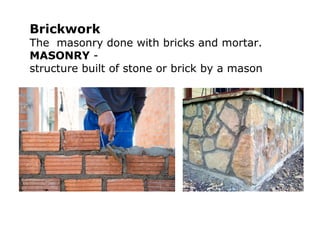
Brickwork
The masonry done with bricks and mortar.
MASONRY -
structure built of stone or brick by a mason
 DIFFERENT SYSTEMS OF BONDING 
The following are the principal forms of bonding :-
English
Double Flemish
Single Flemish
Heading
Stretching
Rat trap bond
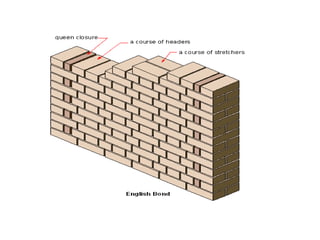
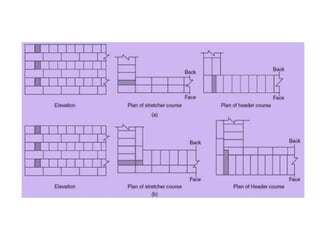
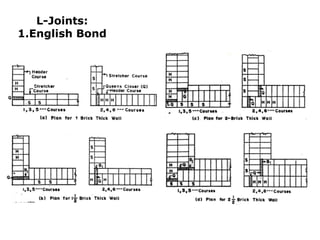
ENGLISH BOND
The facing bricks are laid in alternate courses of
headers and stretchers.
Queen-closer inserted next to quoin-headers to
produce overlap.
Avoids continuous vertical joints.
DISADVANTAGE:  
 Penetration of damp through transverse joints.
 Appearance not as good as Flemish bond.
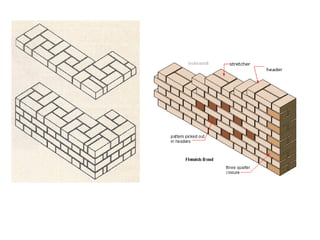
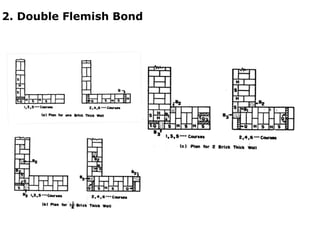
FLEMISH BOND
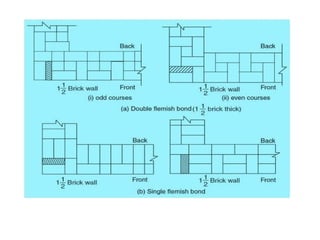
Double Flemish bond
Single Flemish bond
The headers and stretchers alternate in
each course.
The lap is produced by placing a queen-
closer next to the quoin-header in every
course.
Flemish bond is weaker than English bond.
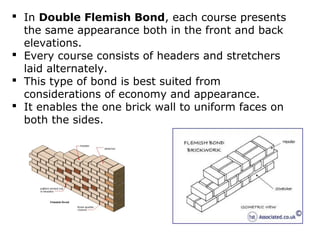
 In Double Flemish Bond, each course presents
the same appearance both in the front and back
elevations.
 Every course consists of headers and stretchers
laid alternately.
 This type of bond is best suited from
considerations of economy and appearance.
 It enables the one brick wall to uniform faces on
both the sides.
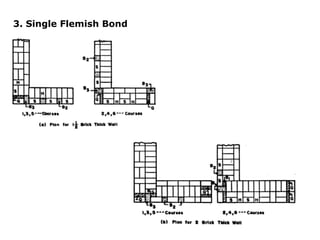
Single Flemish Bond:
It is a species of bond in which placement of
Flemish bond on the face of the walls.
the rest of the wall is built in English bond.
Used for walls requiring a good appearance and
strength.
Not employed for wall less than 1 and a half
bricks thick.
ADVANTAGES OF FLEMISH BOND:
It is highly economical.
Walls one brick in thickness are easier to
produce a fair face on both sides in Flemish than
in English bond.
The appearance of Flemish bond is more
appealing to eye than that of English bond.
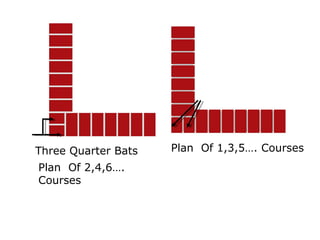
HEADER BOND
It is the bond in which all the bricks are laid as
headers on the faces of walls.
There is use of three-quarter bats in each
alternate courses as quoins.
This bond usually suitable in case of curved walls
but is not preferred for straight walls as it does not
have strength in the direction of the wall.
Plan Of 1,3,5…. Courses
Plan Of 2,4,6….
Courses
Three Quarter Bats
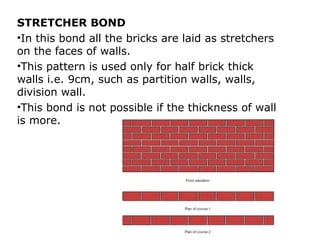
STRETCHER BOND
•In this bond all the bricks are laid as stretchers
on the faces of walls.
•This pattern is used only for half brick thick
walls i.e. 9cm, such as partition walls, walls,
division wall.
•This bond is not possible if the thickness of wall
is more.
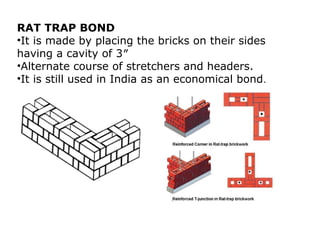
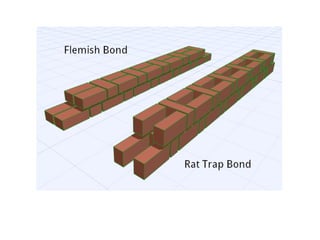
RAT TRAP BOND
•It is made by placing the bricks on their sides
having a cavity of 3″
•Alternate course of stretchers and headers.
•It is still used in India as an economical bond.
THE ADVANTAGES OF RAT TRAP BOND:
It is highly economical because:
Can make a wall of one brick thickness with
fewer bricks than a solid bond.
Strength is equal to the standard 9″ (230 mm)
brick wall, but consumes 20% less bricks.
Maintains thermal comfort inside the building
due to air medium.
Bricks aligned on both sides, plastering not
required.
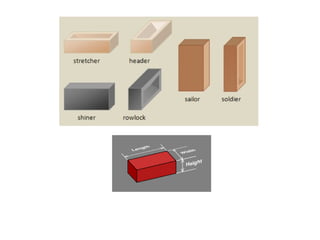
CLASSIFICATION OF BRICK WORK ACCORDING
TO ORIENTATION
Stretcher A brick laid flat with its long narrow side
exposed.
Header A brick laid flat with its width exposed.
Soldier A brick laid vertically with its long narrowside
exposed.
Sailor A brick laid vertically with the broad face of the
brick exposed.
Rowlock A brick laid on the long narrow side with the
short end of the brick exposed
ShinerA brick laid on the long narrow side with the
broad face of the brick exposed.
L-Joints:
1.English Bond
2. Double Flemish Bond
3. Single Flemish Bond

DIFFERENT TYPE OF BONDING SYSTEM

  • 1.
  • 2.
    Brickwork The masonry donewith bricks and mortar. MASONRY - structure built of stone or brick by a mason
  • 3.
     DIFFERENT SYSTEMS OF BONDING  The following arethe principal forms of bonding :- English Double Flemish Single Flemish Heading Stretching Rat trap bond
  • 4.
    ENGLISH BOND The facing bricksare laid in alternate courses of headers and stretchers. Queen-closer inserted next to quoin-headers to produce overlap. Avoids continuous vertical joints. DISADVANTAGE:    Penetration of damp through transverse joints.  Appearance not as good as Flemish bond.
  • 7.
    FLEMISH BOND Double Flemishbond Single Flemish bond The headers and stretchers alternate in each course. The lap is produced by placing a queen- closer next to the quoin-header in every course. Flemish bond is weaker than English bond.
  • 8.
     In DoubleFlemish Bond, each course presents the same appearance both in the front and back elevations.  Every course consists of headers and stretchers laid alternately.  This type of bond is best suited from considerations of economy and appearance.  It enables the one brick wall to uniform faces on both the sides.
  • 9.
    Single Flemish Bond: Itis a species of bond in which placement of Flemish bond on the face of the walls. the rest of the wall is built in English bond. Used for walls requiring a good appearance and strength. Not employed for wall less than 1 and a half bricks thick. ADVANTAGES OF FLEMISH BOND: It is highly economical. Walls one brick in thickness are easier to produce a fair face on both sides in Flemish than in English bond. The appearance of Flemish bond is more appealing to eye than that of English bond.
  • 12.
    HEADER BOND It isthe bond in which all the bricks are laid as headers on the faces of walls. There is use of three-quarter bats in each alternate courses as quoins. This bond usually suitable in case of curved walls but is not preferred for straight walls as it does not have strength in the direction of the wall.
  • 13.
    Plan Of 1,3,5….Courses Plan Of 2,4,6…. Courses Three Quarter Bats
  • 14.
    STRETCHER BOND •In thisbond all the bricks are laid as stretchers on the faces of walls. •This pattern is used only for half brick thick walls i.e. 9cm, such as partition walls, walls, division wall. •This bond is not possible if the thickness of wall is more.
  • 15.
    RAT TRAP BOND •Itis made by placing the bricks on their sides having a cavity of 3″ •Alternate course of stretchers and headers. •It is still used in India as an economical bond.
  • 16.
    THE ADVANTAGES OFRAT TRAP BOND: It is highly economical because: Can make a wall of one brick thickness with fewer bricks than a solid bond. Strength is equal to the standard 9″ (230 mm) brick wall, but consumes 20% less bricks. Maintains thermal comfort inside the building due to air medium. Bricks aligned on both sides, plastering not required.
  • 18.
    CLASSIFICATION OF BRICKWORK ACCORDING TO ORIENTATION Stretcher A brick laid flat with its long narrow side exposed. Header A brick laid flat with its width exposed. Soldier A brick laid vertically with its long narrowside exposed. Sailor A brick laid vertically with the broad face of the brick exposed. Rowlock A brick laid on the long narrow side with the short end of the brick exposed ShinerA brick laid on the long narrow side with the broad face of the brick exposed.
  • 20.
  • 21.
  • 22.