
The Medieval Town
Conte
nt
 Introduction
 LOCATION
 The Return Of Urban Life
 Medieval towns Characteristics
 SIGNIFICANCE:
 Political Background
 Urban Activities
 City Government and Culture
 Technological Achievement and Its Reflection in Planning
 Culture and it impact on Architecture and City Planning
 Crisis in the Lower Middle Ages
 Architectural Character of the Cities
 Crisis in the Lower Middle Ages
 Town planning: Carcassonne
2
Introduction:
After Crist and Roman Empire had crumbled under the weight of luxury, pomp and ceremony. Medieval Town played an
important role in the history of cities. Western civilization declined, trade disintegrated, and the urban population return to
rural life. In the 12th and 13th centuries, a period of economic growth led to the rebirth of cities. Cities became important
centers of artisan activity and trade.
3
LOCATION:
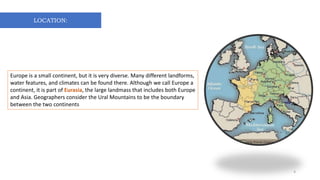
Europe is a small continent, but it is very diverse. Many different landforms,
water features, and climates can be found there. Although we call Europe a
continent, it is part of Eurasia, the large landmass that includes both Europe
and Asia. Geographers consider the Ural Mountains to be the boundary
between the two continents
4
The Return Of Urban Life:
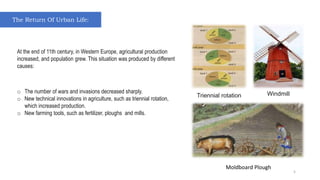
At the end of 11th century, in Western Europe, agricultural production
increased, and population grew. This situation was produced by different
causes:
o The number of wars and invasions decreased sharply.
o New technical innovations in agriculture, such as triennial rotation,
which increased production.
o New farming tools, such as fertilizer, ploughs and mills. mills
Triennial rotation
Moldboard Plough
Windmill
5
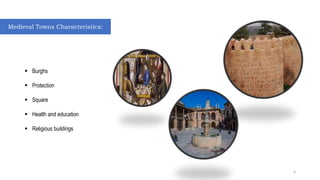
Medieval Towns Characteristics:
 Burghs
 Protection
 Square
 Health and education
 Religious buildings
6
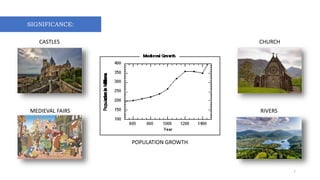
SIGNIFICANCE:
POPULATION GROWTH
CHURCH
RIVERS
MEDIEVAL FAIRS
CASTLES
7
Political Background:
Feudalism can be described as a type of government in which political power is exercised
locally by private individuals rather than through the bureaucracy of a centralized state.
MONARCH
TENANTS IN CHIEF
(LORDS AND BISHOPS)
SUB TENANTS
(KNIGHTS AND LESSER CLERGY)
PEASANTRY
8
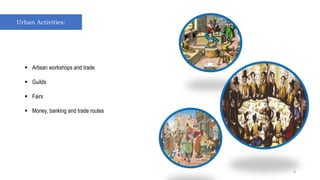
Urban Activities:
 Artisan workshops and trade
 Guilds
 Fairs
 Money, banking and trade routes
9
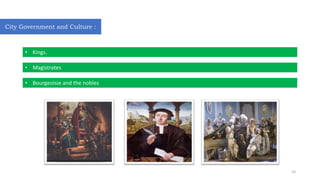
City Government and Culture :
• Kings.
• Magistrates
• Bourgeoisie and the nobles
10
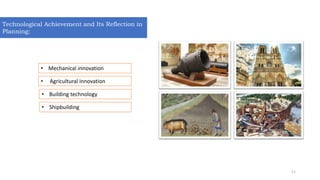
• Building technology
• Shipbuilding
• Agricultural innovation
• Mechanical innovation
Technological Achievement and Its Reflection in
Planning:
11
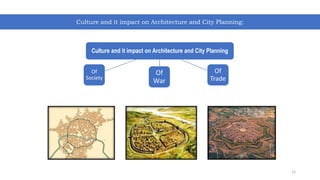
Culture and it impact on Architecture and City Planning:
Culture and it impact on Architecture and City Planning
Of
Society
Of
Trade
Of
War
12
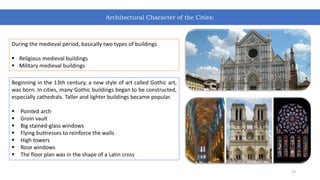
During the medieval period, basically two types of buildings
 Religious medieval buildings
 Military medieval buildings
Beginning in the 13th century, a new style of art called Gothic art,
was born. In cities, many Gothic buildings began to be constructed,
especially cathedrals. Taller and lighter buildings became popular.
 Pointed arch
 Groin vault
 Big stained-glass windows
 Flying buttresses to reinforce the walls
 High towers
 Rose windows
 The floor plan was in the shape of a Latin cross
Architectural Character of the Cities:
13
Crisis in the Lower Middle Ages :
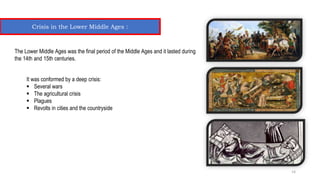
The Lower Middle Ages was the final period of the Middle Ages and it lasted during
the 14th and 15th centuries.
It was conformed by a deep crisis:
 Several wars
 The agricultural crisis
 Plagues
 Revolts in cities and the countryside
14
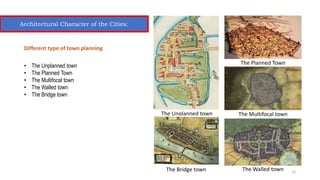
Different type of town planning
• The Unplanned town
• The Planned Town
• The Multifocal town
• The Walled town
• The Bridge town
The Unplanned town
The Planned Town
The Multifocal town
The Walled town
The Bridge town
Architectural Character of the Cities:
15
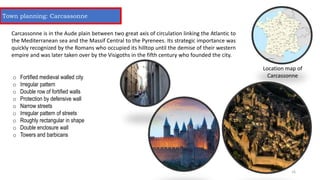
Location map of
Carcassonne
Carcassonne is in the Aude plain between two great axis of circulation linking the Atlantic to
the Mediterranean sea and the Massif Central to the Pyrenees. Its strategic importance was
quickly recognized by the Romans who occupied its hilltop until the demise of their western
empire and was later taken over by the Visigoths in the fifth century who founded the city.
o Fortified medieval walled city
o Irregular pattern
o Double row of fortified walls
o Protection by defensive wall
o Narrow streets
o Irregular pattern of streets
o Roughly rectangular in shape
o Double enclosure wall
o Towers and barbicans
Town planning: Carcassonne
16
Thank You!
17

The Medieval Town

  • 1.
  • 2.
    Conte nt  Introduction  LOCATION The Return Of Urban Life  Medieval towns Characteristics  SIGNIFICANCE:  Political Background  Urban Activities  City Government and Culture  Technological Achievement and Its Reflection in Planning  Culture and it impact on Architecture and City Planning  Crisis in the Lower Middle Ages  Architectural Character of the Cities  Crisis in the Lower Middle Ages  Town planning: Carcassonne 2
  • 3.
    Introduction: After Crist andRoman Empire had crumbled under the weight of luxury, pomp and ceremony. Medieval Town played an important role in the history of cities. Western civilization declined, trade disintegrated, and the urban population return to rural life. In the 12th and 13th centuries, a period of economic growth led to the rebirth of cities. Cities became important centers of artisan activity and trade. 3
  • 4.
    LOCATION: Europe is asmall continent, but it is very diverse. Many different landforms, water features, and climates can be found there. Although we call Europe a continent, it is part of Eurasia, the large landmass that includes both Europe and Asia. Geographers consider the Ural Mountains to be the boundary between the two continents 4
  • 5.
    The Return OfUrban Life: At the end of 11th century, in Western Europe, agricultural production increased, and population grew. This situation was produced by different causes: o The number of wars and invasions decreased sharply. o New technical innovations in agriculture, such as triennial rotation, which increased production. o New farming tools, such as fertilizer, ploughs and mills. mills Triennial rotation Moldboard Plough Windmill 5
  • 6.
    Medieval Towns Characteristics: Burghs  Protection  Square  Health and education  Religious buildings 6
  • 7.
  • 8.
    Political Background: Feudalism canbe described as a type of government in which political power is exercised locally by private individuals rather than through the bureaucracy of a centralized state. MONARCH TENANTS IN CHIEF (LORDS AND BISHOPS) SUB TENANTS (KNIGHTS AND LESSER CLERGY) PEASANTRY 8
  • 9.
    Urban Activities:  Artisanworkshops and trade  Guilds  Fairs  Money, banking and trade routes 9
  • 10.
    City Government andCulture : • Kings. • Magistrates • Bourgeoisie and the nobles 10
  • 11.
    • Building technology •Shipbuilding • Agricultural innovation • Mechanical innovation Technological Achievement and Its Reflection in Planning: 11
  • 12.
    Culture and itimpact on Architecture and City Planning: Culture and it impact on Architecture and City Planning Of Society Of Trade Of War 12
  • 13.
    During the medievalperiod, basically two types of buildings  Religious medieval buildings  Military medieval buildings Beginning in the 13th century, a new style of art called Gothic art, was born. In cities, many Gothic buildings began to be constructed, especially cathedrals. Taller and lighter buildings became popular.  Pointed arch  Groin vault  Big stained-glass windows  Flying buttresses to reinforce the walls  High towers  Rose windows  The floor plan was in the shape of a Latin cross Architectural Character of the Cities: 13
  • 14.
    Crisis in theLower Middle Ages : The Lower Middle Ages was the final period of the Middle Ages and it lasted during the 14th and 15th centuries. It was conformed by a deep crisis:  Several wars  The agricultural crisis  Plagues  Revolts in cities and the countryside 14
  • 15.
    Different type oftown planning • The Unplanned town • The Planned Town • The Multifocal town • The Walled town • The Bridge town The Unplanned town The Planned Town The Multifocal town The Walled town The Bridge town Architectural Character of the Cities: 15
  • 16.
    Location map of Carcassonne Carcassonneis in the Aude plain between two great axis of circulation linking the Atlantic to the Mediterranean sea and the Massif Central to the Pyrenees. Its strategic importance was quickly recognized by the Romans who occupied its hilltop until the demise of their western empire and was later taken over by the Visigoths in the fifth century who founded the city. o Fortified medieval walled city o Irregular pattern o Double row of fortified walls o Protection by defensive wall o Narrow streets o Irregular pattern of streets o Roughly rectangular in shape o Double enclosure wall o Towers and barbicans Town planning: Carcassonne 16
  • 17.