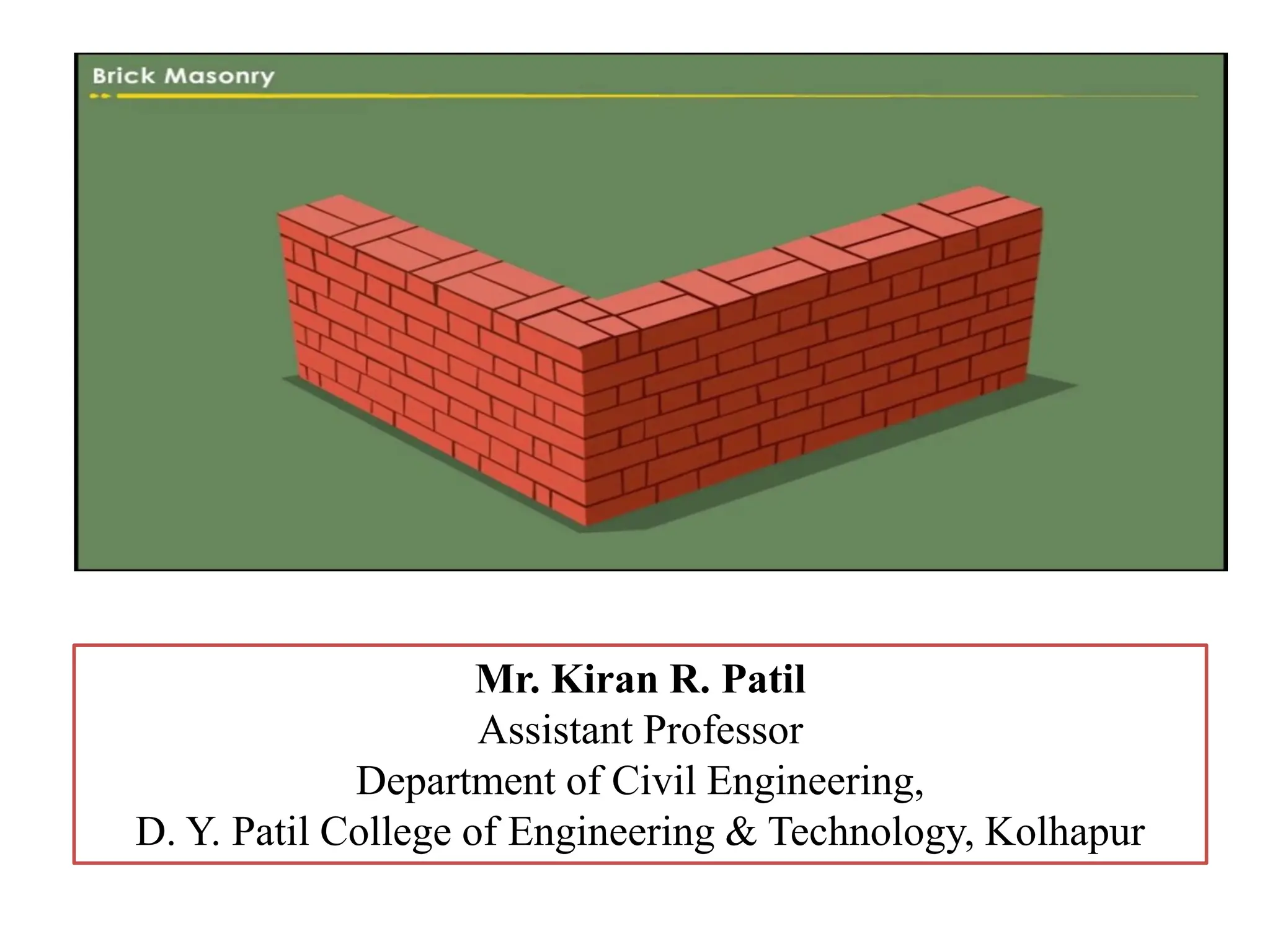
Mr. Kiran R. Patil
Assistant Professor
Department of Civil Engineering,
D. Y. Patil College of Engineering & Technology, Kolhapur
Brick Masonary
• Masonry may defined as the construction of building units
bonded together with mortar.
• The building units may be stones, bricks, or precast concrete
blocks.
• Depending upon the types of buildings units used MASONARY
can be classified into following categories:
a) Stone Masonry.
b) Brick Masonry
Bricks
• Clay bricks are commonly used as they are
cheap, readily available and easy to handle
and work with.
• Clay bricks are used for construction of
walls, partitions and other load bearing
structures.
• Bricks are prepared by moulding clay in
rectangular blocks of uniform size and then
drying and burning these blocks.
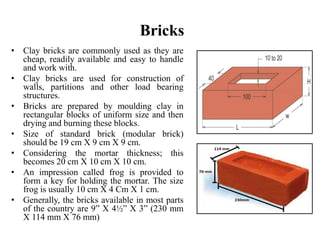
• Size of standard brick (modular brick)
should be 19 cm X 9 cm X 9 cm.
• Considering the mortar thickness; this
becomes 20 cm X 10 cm X 10 cm.
• An impression called frog is provided to
form a key for holding the mortar. The size
frog is usually 10 cm X 4 Cm X 1 cm.
• Generally, the bricks available in most parts
of the country are 9ˮ X 4½ˮ X 3” (230 mm
X 114 mm X 76 mm)
Some Important Terms Used In Masonary
1. STRETCHER:
A brick, laid with its length horizontal and parallel with the face of the wall
or other masonry member is called a "Stretcher"
A course, in which, all the bricks are laid as Stretchers is called a
“Stretching course" or "Stretcher course“.
2. HEADER:
A brick laid, so that only its end shows on the face of a wall is called a
"Header“
A course, in which all the bricks are laid as headers, is known as "Heading
Course“ or "Header course“.
3. BOND:
Bond is the arrangement of bricks or stones in each course, so as to ensure the greatest
possible interlocking and to avoid the continuity of vertical joints in two successive
courses, both on the face and in back of a wall.
4. COURSE:
Each horizontal layer of bricks or stone laid on mortar in a brick or stone work is called
a "course".
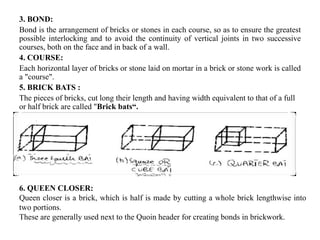
5. BRICK BATS :
The pieces of bricks, cut long their length and having width equivalent to that of a full
or half brick are called "Brick bats“.
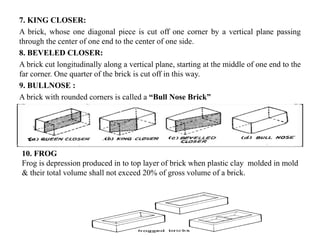
6. QUEEN CLOSER:
Queen closer is a brick, which is half is made by cutting a whole brick lengthwise into
two portions.
These are generally used next to the Quoin header for creating bonds in brickwork.
7. KING CLOSER:
A brick, whose one diagonal piece is cut off one corner by a vertical plane passing
through the center of one end to the center of one side.
8. BEVELED CLOSER:
A brick cut longitudinally along a vertical plane, starting at the middle of one end to the
far corner. One quarter of the brick is cut off in this way.
9. BULLNOSE :
A brick with rounded corners is called a “Bull Nose Brick”
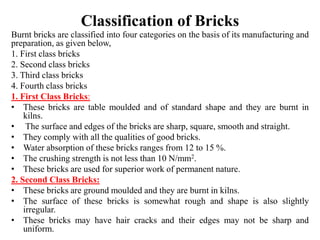
10. FROG
Frog is depression produced in to top layer of brick when plastic clay molded in mold
& their total volume shall not exceed 20% of gross volume of a brick.
Classification of Bricks
Burnt bricks are classified into four categories on the basis of its manufacturing and
preparation, as given below,
1. First class bricks
2. Second class bricks
3. Third class bricks
4. Fourth class bricks
1. First Class Bricks:
• These bricks are table moulded and of standard shape and they are burnt in
kilns.
• The surface and edges of the bricks are sharp, square, smooth and straight.
• They comply with all the qualities of good bricks.
• Water absorption of these bricks ranges from 12 to 15 %.
• The crushing strength is not less than 10 N/mm2.
• These bricks are used for superior work of permanent nature.
2. Second Class Bricks:
• These bricks are ground moulded and they are burnt in kilns.
• The surface of these bricks is somewhat rough and shape is also slightly
irregular.
• These bricks may have hair cracks and their edges may not be sharp and
uniform.
• Water absorption of these bricks ranges from 16 to 20 %.
• The crushing strength is not less than 7 N/mm2.
• These bricks are commonly used at places where brick work is to be
provided with a coat of plaster.
3. Third Class Bricks:
• These bricks are ground moulded and they are burnt in clamps.
• These bricks are not hard and they have rough surfaces with irregular and
distorted edges.
• These bricks give dull sound when struck together.
• Water absorption of these bricks is about 25 %.
• They are used for unimportant and temporary structures and at places where
rainfall is not heavy.
4. Fourth Class Bricks:
• These are over burnt bricks with irregular shape and dark colour.
• These bricks are used as aggregate for concrete in foundations, floors, roads
etc, because of the fact that the over burnt bricks have a compact structure
and hence they are sometimes found to be stronger than even the first class
bricks.
• Requirements of Good Bricks
• Size and Shape: The bricks should have uniform size and plane,
rectangular faces with parallel sides and sharp straight edges.
• Colour: The bricks should have uniform red colour indicating uniform
chemical composition and proper burning.
• Texture and Compactness: The surfaces of brick should not be too
smooth to cause slipping of mortar. The brick should have pre-compact
and uniform texture. A fractured surface should not show cracks, holes or
lumps of lime.
• Soundness: The brick should give a clear metallic ringing sound
when struck with hammer or another brick.
• Hardness: The brick should be so hard that when scratched by a finger
nail no impression is made. The brick should not break when dropped on
the ground on their flat face in a saturated condition from a height of 600
mm.
• Efflorescence: It should not be than 10% of the exposed area of the
brick.
• Water absorption: After immersion in cold water for 24 hours,
absorption by weight should not exceed 20 percent of the dry weight of
the brick.
• Compressive Strength: The crushing strength of the brick to be used in
all types of works should not be less than 3.5 N/mm2.
TYPES OF BONDS
1) Stretching Bond
2) Heading Bond
3) English Bond
4) Flemish Bond
(i)Double Flemish Bond
(ii)Single Flemish Bond
5) Garden Wall Bond
(i)English Garden Wall Bond
(ii)Flemish Garden Wall Bond
6) Raking Bond
(I) Herring BoneBond
(Ii) DiagonalBond
7) Dutch Bond
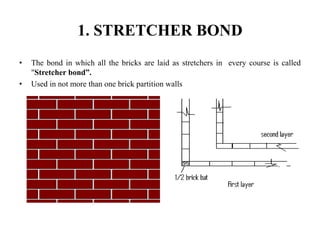
1. STRETCHER BOND
• The bond in which all the bricks are laid as stretchers in every course is called
"Stretcher bond”.
• Used in not more than one brick partition walls
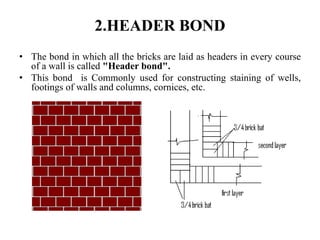
2.HEADER BOND
• The bond in which all the bricks are laid as headers in every course
of a wall is called "Header bond".
• This bond is Commonly used for constructing staining of wells,
footings of walls and columns, cornices, etc.
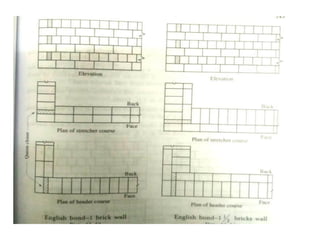
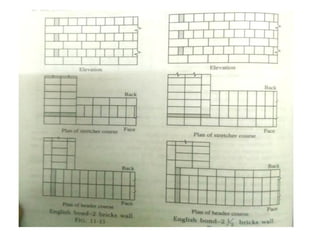
3.ENGLISH BOND
• This bond consists of headers and stretchers laid in alternative
courses.
• It is strongest of all the bonds.
• It provides rough appearance especially for one brick thick walls.
• There are avoid provision of continuous vertical joints in the
structure built in this bond.
• Much attention is not required in providing this bond.
• Progress of work is more.
• It is costly because the use of brick bats is not allowed.
• In stretcher course , the stretcher have a minimum lap of one
fourth of their length.
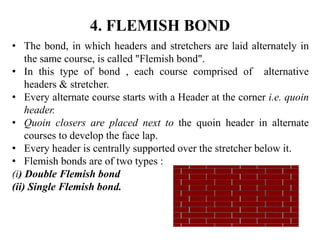
4. FLEMISH BOND
• The bond, in which headers and stretchers are laid alternately in
the same course, is called "Flemish bond".
• In this type of bond , each course comprised of alternative
headers & stretcher.
• Every alternate course starts with a Header at the corner i.e. quoin
header.
• Quoin closers are placed next to the quoin header in alternate
courses to develop the face lap.
• Every header is centrally supported over the stretcher below it.
• Flemish bonds are of two types :
(i) Double Flemish bond
(ii) Single Flemish bond.
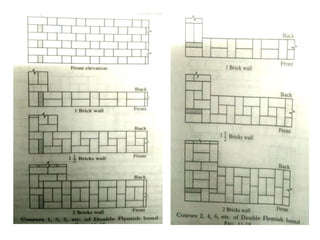
a) Double Flemish Bond:-
• The bond in which headers and stretchers are laid alternately in each course, both
in the face and back of the wall is called Double Flemish Bond.
• In the double Flemish bond, each course presents the same appearance both in the
front face as well as in the back face.
• Flemish bond presents better appearance than English bond.
 Special features of Double Flemish Bond.
1) Every course consists of headers and stretchers placed alternately
2) The facing and backing of the wall, in each course, have the same appearance.
3) Quoin closers are used next to quoin headers in every alternate course.
4) In walls having thickness equal to odd multiple of half bricks, half bats and three-
quarter bats are sufficiently used.
5) For walls having thickness equal to even multiple of half bricks, no bats are
required.
6) A header or stretcher will come out as header or stretcher on the same course in
front as well as back faces.
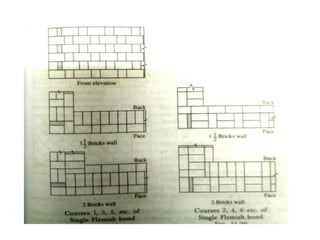
(b) Single Flemish Bond:
• The bond provided with Flemish bond in facing and English
bond in backing is called "Single Flemish bond”.
• This bond combines the advantages of both English and
Flemish bonds and simultaneously eliminates their
disadvantages.
• Single Flemish bond is consist of double Flemish bond facing
and English bond backing in each course.
• This bond gives the strength of the English bond and
appearance of Flemish bond.
• However, this bond can be used for those walls having
thickness at least equal to 11/2 brick.
• Double Flemish bond facing is done with good quality
expensive bricks.
• However, cheaper bricks can be used for backing and hearting.
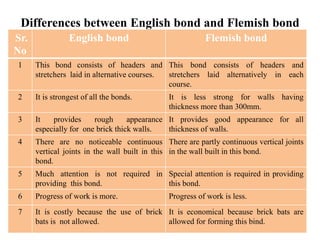
Differences between English bond and Flemish bond
Sr.
No
English bond Flemish bond
1 This bond consists of headers and
stretchers laid in alternative courses.
This bond consists of headers and
stretchers laid alternatively in each
course.
2 It is strongest of all the bonds. It is less strong for walls having
thickness more than 300mm.
3 It provides rough appearance
especially for one brick thick walls.
It provides good appearance for all
thickness of walls.
4 There are no noticeable continuous
vertical joints in the wall built in this
bond.
There are partly continuous vertical joints
in the wall built in this bond.
5 Much attention is not required in
providing this bond.
Special attention is required in providing
this bond.
6 Progress of work is more. Progress of work is less.
7 It is costly because the use of brick
bats is not allowed.
It is economical because brick bats are
allowed for forming this bind.

Brick Masonry and its types used in construction

  • 1.
    Mr. Kiran R.Patil Assistant Professor Department of Civil Engineering, D. Y. Patil College of Engineering & Technology, Kolhapur
  • 2.
    Brick Masonary • Masonrymay defined as the construction of building units bonded together with mortar. • The building units may be stones, bricks, or precast concrete blocks. • Depending upon the types of buildings units used MASONARY can be classified into following categories: a) Stone Masonry. b) Brick Masonry
  • 3.
    Bricks • Clay bricksare commonly used as they are cheap, readily available and easy to handle and work with. • Clay bricks are used for construction of walls, partitions and other load bearing structures. • Bricks are prepared by moulding clay in rectangular blocks of uniform size and then drying and burning these blocks. • Size of standard brick (modular brick) should be 19 cm X 9 cm X 9 cm. • Considering the mortar thickness; this becomes 20 cm X 10 cm X 10 cm. • An impression called frog is provided to form a key for holding the mortar. The size frog is usually 10 cm X 4 Cm X 1 cm. • Generally, the bricks available in most parts of the country are 9ˮ X 4½ˮ X 3” (230 mm X 114 mm X 76 mm)
  • 4.
    Some Important TermsUsed In Masonary 1. STRETCHER: A brick, laid with its length horizontal and parallel with the face of the wall or other masonry member is called a "Stretcher" A course, in which, all the bricks are laid as Stretchers is called a “Stretching course" or "Stretcher course“. 2. HEADER: A brick laid, so that only its end shows on the face of a wall is called a "Header“ A course, in which all the bricks are laid as headers, is known as "Heading Course“ or "Header course“.
  • 5.
    3. BOND: Bond isthe arrangement of bricks or stones in each course, so as to ensure the greatest possible interlocking and to avoid the continuity of vertical joints in two successive courses, both on the face and in back of a wall. 4. COURSE: Each horizontal layer of bricks or stone laid on mortar in a brick or stone work is called a "course". 5. BRICK BATS : The pieces of bricks, cut long their length and having width equivalent to that of a full or half brick are called "Brick bats“. 6. QUEEN CLOSER: Queen closer is a brick, which is half is made by cutting a whole brick lengthwise into two portions. These are generally used next to the Quoin header for creating bonds in brickwork.
  • 6.
    7. KING CLOSER: Abrick, whose one diagonal piece is cut off one corner by a vertical plane passing through the center of one end to the center of one side. 8. BEVELED CLOSER: A brick cut longitudinally along a vertical plane, starting at the middle of one end to the far corner. One quarter of the brick is cut off in this way. 9. BULLNOSE : A brick with rounded corners is called a “Bull Nose Brick” 10. FROG Frog is depression produced in to top layer of brick when plastic clay molded in mold & their total volume shall not exceed 20% of gross volume of a brick.
  • 7.
    Classification of Bricks Burntbricks are classified into four categories on the basis of its manufacturing and preparation, as given below, 1. First class bricks 2. Second class bricks 3. Third class bricks 4. Fourth class bricks 1. First Class Bricks: • These bricks are table moulded and of standard shape and they are burnt in kilns. • The surface and edges of the bricks are sharp, square, smooth and straight. • They comply with all the qualities of good bricks. • Water absorption of these bricks ranges from 12 to 15 %. • The crushing strength is not less than 10 N/mm2. • These bricks are used for superior work of permanent nature. 2. Second Class Bricks: • These bricks are ground moulded and they are burnt in kilns. • The surface of these bricks is somewhat rough and shape is also slightly irregular. • These bricks may have hair cracks and their edges may not be sharp and uniform.
  • 8.
    • Water absorptionof these bricks ranges from 16 to 20 %. • The crushing strength is not less than 7 N/mm2. • These bricks are commonly used at places where brick work is to be provided with a coat of plaster. 3. Third Class Bricks: • These bricks are ground moulded and they are burnt in clamps. • These bricks are not hard and they have rough surfaces with irregular and distorted edges. • These bricks give dull sound when struck together. • Water absorption of these bricks is about 25 %. • They are used for unimportant and temporary structures and at places where rainfall is not heavy. 4. Fourth Class Bricks: • These are over burnt bricks with irregular shape and dark colour. • These bricks are used as aggregate for concrete in foundations, floors, roads etc, because of the fact that the over burnt bricks have a compact structure and hence they are sometimes found to be stronger than even the first class bricks.
  • 9.
    • Requirements ofGood Bricks • Size and Shape: The bricks should have uniform size and plane, rectangular faces with parallel sides and sharp straight edges. • Colour: The bricks should have uniform red colour indicating uniform chemical composition and proper burning. • Texture and Compactness: The surfaces of brick should not be too smooth to cause slipping of mortar. The brick should have pre-compact and uniform texture. A fractured surface should not show cracks, holes or lumps of lime. • Soundness: The brick should give a clear metallic ringing sound when struck with hammer or another brick. • Hardness: The brick should be so hard that when scratched by a finger nail no impression is made. The brick should not break when dropped on the ground on their flat face in a saturated condition from a height of 600 mm. • Efflorescence: It should not be than 10% of the exposed area of the brick. • Water absorption: After immersion in cold water for 24 hours, absorption by weight should not exceed 20 percent of the dry weight of the brick. • Compressive Strength: The crushing strength of the brick to be used in all types of works should not be less than 3.5 N/mm2.
  • 10.
    TYPES OF BONDS 1)Stretching Bond 2) Heading Bond 3) English Bond 4) Flemish Bond (i)Double Flemish Bond (ii)Single Flemish Bond 5) Garden Wall Bond (i)English Garden Wall Bond (ii)Flemish Garden Wall Bond 6) Raking Bond (I) Herring BoneBond (Ii) DiagonalBond 7) Dutch Bond
  • 11.
    1. STRETCHER BOND •The bond in which all the bricks are laid as stretchers in every course is called "Stretcher bond”. • Used in not more than one brick partition walls
  • 12.
    2.HEADER BOND • Thebond in which all the bricks are laid as headers in every course of a wall is called "Header bond". • This bond is Commonly used for constructing staining of wells, footings of walls and columns, cornices, etc.
  • 13.
    3.ENGLISH BOND • Thisbond consists of headers and stretchers laid in alternative courses. • It is strongest of all the bonds. • It provides rough appearance especially for one brick thick walls. • There are avoid provision of continuous vertical joints in the structure built in this bond. • Much attention is not required in providing this bond. • Progress of work is more. • It is costly because the use of brick bats is not allowed. • In stretcher course , the stretcher have a minimum lap of one fourth of their length.
  • 16.
    4. FLEMISH BOND •The bond, in which headers and stretchers are laid alternately in the same course, is called "Flemish bond". • In this type of bond , each course comprised of alternative headers & stretcher. • Every alternate course starts with a Header at the corner i.e. quoin header. • Quoin closers are placed next to the quoin header in alternate courses to develop the face lap. • Every header is centrally supported over the stretcher below it. • Flemish bonds are of two types : (i) Double Flemish bond (ii) Single Flemish bond.
  • 17.
    a) Double FlemishBond:- • The bond in which headers and stretchers are laid alternately in each course, both in the face and back of the wall is called Double Flemish Bond. • In the double Flemish bond, each course presents the same appearance both in the front face as well as in the back face. • Flemish bond presents better appearance than English bond.  Special features of Double Flemish Bond. 1) Every course consists of headers and stretchers placed alternately 2) The facing and backing of the wall, in each course, have the same appearance. 3) Quoin closers are used next to quoin headers in every alternate course. 4) In walls having thickness equal to odd multiple of half bricks, half bats and three- quarter bats are sufficiently used. 5) For walls having thickness equal to even multiple of half bricks, no bats are required. 6) A header or stretcher will come out as header or stretcher on the same course in front as well as back faces.
  • 19.
    (b) Single FlemishBond: • The bond provided with Flemish bond in facing and English bond in backing is called "Single Flemish bond”. • This bond combines the advantages of both English and Flemish bonds and simultaneously eliminates their disadvantages. • Single Flemish bond is consist of double Flemish bond facing and English bond backing in each course. • This bond gives the strength of the English bond and appearance of Flemish bond. • However, this bond can be used for those walls having thickness at least equal to 11/2 brick. • Double Flemish bond facing is done with good quality expensive bricks. • However, cheaper bricks can be used for backing and hearting.
  • 21.
    Differences between Englishbond and Flemish bond Sr. No English bond Flemish bond 1 This bond consists of headers and stretchers laid in alternative courses. This bond consists of headers and stretchers laid alternatively in each course. 2 It is strongest of all the bonds. It is less strong for walls having thickness more than 300mm. 3 It provides rough appearance especially for one brick thick walls. It provides good appearance for all thickness of walls. 4 There are no noticeable continuous vertical joints in the wall built in this bond. There are partly continuous vertical joints in the wall built in this bond. 5 Much attention is not required in providing this bond. Special attention is required in providing this bond. 6 Progress of work is more. Progress of work is less. 7 It is costly because the use of brick bats is not allowed. It is economical because brick bats are allowed for forming this bind.