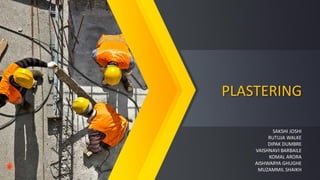
PLASTERING
SAKSHI JOSHI
RUTUJA WALKE
DIPAK DUMBRE
VAISHNAVI BARBAILE
KOMAL ARORA
AISHWARYA GHUGHE
MUZAMMIL SHAIKH
WHAT IS PLASTERING?
• The thin plaster covering that is applied on surface of
walls and ceiling.
• The process of covering rough surfaces and uneven
surfaces with plastic material is called PLASTER.
PLASTER
• Mixture of lime or gypsum , sand and water , sometimes
with fiber added , that harden to a smooth solid and is
used for coating walls and ceilings.
Requirement of good plaster
• It should be hard and durable
• Should posses good workability
• Should be possible to apply it during all weather
condition
• Should be cheap
• Should effectively check penetration of moisture
Types of mortars for
plastering
• 1)lime mortar
• 2)cement mortar
• 3)lime-cement mortar
• 4) waterproof mortar
• 5) mud mortar
• 6)stucco plastering
lime mortar
• -Mortor for lime plaster is usually prepared by mixing sand and lime in equal
proportion , cement in small quantity added to the mixture to improve its
strength.
• -When lime is used as the binding materials ,it is called lime plaster .
• -Lime plaster is type of plaster composed of hydrated lime ,sand and water .
• - Lime plaster sets up to a solid mass that is durable yet relatively flexible.
• - The fat like recommended for plaster work because the fat like contains 75% of
CaO combines with CO2 of atmosphere gives CaCO3 quickly.
cement mortar
• -Best Mortar for external plastering work since it is
practically non- absorbant .
• -It is much stronger than lime mortar.
• -The mix proportion (i.e cement : sand ) may vary from
1:4 to 1:6 4- Sand used for plastering should be
clean , coarse and angular.
• -Cement plaster usually applied in one coat .
• -It is especially suited for damp condition.
LIME - CEMENT MORTAR
• - It contains properties of both the lime mortar as well as
cement mortar .
• - Cement mortar as such does not possess sufficient
plasticity.
• -Addition of time to it imparts plasticity resulting in
smooth plastered surface .
• -Mix proportions generally used are 1:1:6
(cement : lime : sand),1:1:8 or 1:2:8.
Waterproof Mortar
• -It is prepared by mixing on part of cement , two
parts of sand and pulverized alum at the rate of 120N
per m^3 of sand .
• -In the water to be used,0.75 N of soft soap is
dissolved per one liter of water.
• -This soap water is then added to dry mix
MUD PLASTERING
• -The surface to be plastered is prepared exactly in
same manner as that for lime or cement mortar.
• -Mud plaster is generally applied in two coats ,the
first coat being 18 mm thick while the thickness of
the second coat is kept 6mm.
STUCCO PLASTERING
• -Stucco is the name given to a decorative type of plaster
which gives an excellent finish.
• - stucco plaster can be used for interior as well as exterior
surfaces.
• -It is usually laid in three coats making the total thickness
of the plaster of about 25 mm.
• - The first coat is called the scratch coat ; the second a
finer coat ;also known as a brown coat , and the third is
called white coat or finishing coat
Types of mortars for
plastering
Cement
mortar
Selection of type of mortar
• Availability of binding materials
• Durability requirements
• Finishing requirements
• Atmospheric condition
• Location of surfaces
Method of plastering
• - The plaster may be applied in one or more coast , but the thickness of a
single coat should not exceed 12 mm.
• -In the case of inferior or cheaper type of construction, the plaster may
usually be one coat .For ordinary type of construction , the plaster is
usually applied in two coats, where as for superior type of works it is
applied in three coats.
• -The final setting coat should not be applied until the previous coat is
almost dry.
• -The previous surface should be scratched or roughed before applying the
next coat of plaster
• -In plastering the plaster mix is either applied by throwing it with great
force against the walls or by pressing it on the surface.
TOOLS
• Gauging trowel
• Float :-
a]Metal float
b]Wooden float
• Floating route
• miscellaneous
TOOLS
TOOLS
Special material for
plastered surface
• 1-Acoustic plaster –
-To give acoustic treatment to the hall or room
-plaster is usually applied in two coats , each having thickness of
6mm
• 2-Asbestos-
-marble plaster
- mixture of finely crushed marble , asbestos , cement
• 3- Barium plaster
-used as a final coat for surface of x-ray rooms.
-Essentially made from Barium Sulphate
• 4-Granite silicon plaster-
-quick setting
-highly elastic
-not liable to crack
-used for superior type of work
Special material for
plastered surface
• 5-Gypsum plaster –
-Fire resisting Material
-It is light weight
-It is practically not affected by bacteria
-Slightly soluble in water.
-In sets by natural processes of crystallization
-It shows good adhesion to the fibre material
-When used as final coat, the lime putty is added.
Special material for
plastered surface
• 6- Keene’s cemet-
-When alum is calcined with plaster of paris , This Material is obtained.
• 7- Martin’s cement-
-When pearl ash is calcined with plaster of paris ,This material is obtained.
• 8- Parian cement –
- when borax is calcined with plaster of paris ,this material is obtained
• 9-scagliola-
-This material is obtained by dissolving keene’s and coloring pigment in
glue.
• 10- Sirapite –
-When plaster on paris is shaked is petroleum,this material is obtained.
Special material for
plastered surface
Acoustic
plaster
Berium
plaster
Granitet
plaster
Scagliola
Special material for
plastered surface
GYPSUM
PLASTER
Keene's
cement
Parian cement
plaster
Sirapite
Types of plaster finishes
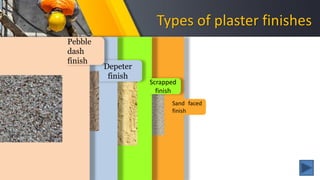
• 1)- Sand-faced finish:
-The first coat of sand-faced cement plaster is carried out in cement
mortar of proportion 1:4 i.e. one part of cement to four parts of
clean , coarse and angular river sand by volume.
-Thickness of first coat is 12mm.
-First coat is to be well watered for at least 7 days.
- Second coat is carried out in proportion 1:1 and the thickness of second coat is
8mm .It is apply after 7 days of first coating.
-Surface is kept well watered for at least 15 days.
• 2) Pebble-Dash or dry-dash finish –
-It is a finish in which small pebbles or crushed stones of suitable size are thrown on to a freshly
applied final coat of mortar and left exposed.
-Ratio- cement : coarse sand 1:3
Types of plaster finishes
• 3) rough-cast or spatter dash finish –
-It is a finish in the which the mortar for the final coat
contains a proportion of fairly big size coarse aggregates.
-The mortar for the finish is made by mixing cement fine
sand and coarse aggregates in the ration of 1:1/2:3.
• 4)Smooth cast finish-
-The finish in which presents smooth and leveled surface .
-The mortar for finish is made by mixing cement and fine
sand in ratio of 1:3`
Types of plaster finishes
• 5) Depeter finish-
-This is just another form of rough-cast finish.
-The rendering coat of 12mm thickness is prepared as in case of pebble
dash finish and while this coat is wet.
-The pieces of gravel or flint are pressed with hand on
surface.
• 6)Scrapped finish –
-The final coat of 6mm to 12 mm is applied and it is allowed to become stiff for few hours.
-The surface is then scrapped for the depth of 3mm by suitable tool such as steel straight edge
saw.
• 7)Textured Finish-
- In this finish , ornamental patterns or textured surface are produced by working with various
tools
on the freshly applied final coat .
Types of plaster finishes
Sand faced
finish
Scrapped
finish
Depeter
finish
Pebble
dash
finish
Types of plaster finishes
Textured
Finish-
Raugh
cast
Smooth
cast
PROPERTIES OF GOOD
PLASTER
• -It should be cheap and economical.
• -It should be hard and durable.
• -It should adhere to the background.
• -It should effectively check penetration of moisture.
• -It should possess good workability.
• -It should be possible to apply it during all weather
conditions.
• -It should offer good insulation against sound.
ADVANTAGES OF
PLASTERING
• -It gives decorative effect.
• -It gives smooth surface.
• -It protects external surfaces against penetration of
rain water.
• -Easy in installation.
• -Plaster coating creates a stronger and more durable
wall.
DEFECTS
• 1)Blistering of plastered surface-
-Formation of small patches of plaster swelling out.
• 2)Cracking-
-Consists of formation of cracks.
• 3)Grazing-
-Formation of series of hair cracks.
• 4)Flaking-
-Formation of very small loose mass on plastered surface.
• 5)Rust stains-
-When plaster is applied on metal lath.
• 6)Softness-
-Excessive dampness at certain points on plastered surface.
• 7)Uneven surface-
-Becomes prominent due to poor workmanship.
Why plastering ?
• To protect the external surface.
• To give smooth surface
• To give decorative effect
• To protect the surface from the effects of
atmospheric agencies
• To conceal inferior materials or defective
workmanship
Sources
• Building Construction –Rangwala
• Building Construction –Bindra Arora
Plaster

Plaster

  • 1.
    PLASTERING SAKSHI JOSHI RUTUJA WALKE DIPAKDUMBRE VAISHNAVI BARBAILE KOMAL ARORA AISHWARYA GHUGHE MUZAMMIL SHAIKH
  • 2.
    WHAT IS PLASTERING? •The thin plaster covering that is applied on surface of walls and ceiling. • The process of covering rough surfaces and uneven surfaces with plastic material is called PLASTER.
  • 3.
    PLASTER • Mixture oflime or gypsum , sand and water , sometimes with fiber added , that harden to a smooth solid and is used for coating walls and ceilings.
  • 4.
    Requirement of goodplaster • It should be hard and durable • Should posses good workability • Should be possible to apply it during all weather condition • Should be cheap • Should effectively check penetration of moisture
  • 5.
    Types of mortarsfor plastering • 1)lime mortar • 2)cement mortar • 3)lime-cement mortar • 4) waterproof mortar • 5) mud mortar • 6)stucco plastering
  • 6.
    lime mortar • -Mortorfor lime plaster is usually prepared by mixing sand and lime in equal proportion , cement in small quantity added to the mixture to improve its strength. • -When lime is used as the binding materials ,it is called lime plaster . • -Lime plaster is type of plaster composed of hydrated lime ,sand and water . • - Lime plaster sets up to a solid mass that is durable yet relatively flexible. • - The fat like recommended for plaster work because the fat like contains 75% of CaO combines with CO2 of atmosphere gives CaCO3 quickly.
  • 7.
    cement mortar • -BestMortar for external plastering work since it is practically non- absorbant . • -It is much stronger than lime mortar. • -The mix proportion (i.e cement : sand ) may vary from 1:4 to 1:6 4- Sand used for plastering should be clean , coarse and angular. • -Cement plaster usually applied in one coat . • -It is especially suited for damp condition.
  • 8.
    LIME - CEMENTMORTAR • - It contains properties of both the lime mortar as well as cement mortar . • - Cement mortar as such does not possess sufficient plasticity. • -Addition of time to it imparts plasticity resulting in smooth plastered surface . • -Mix proportions generally used are 1:1:6 (cement : lime : sand),1:1:8 or 1:2:8.
  • 9.
    Waterproof Mortar • -Itis prepared by mixing on part of cement , two parts of sand and pulverized alum at the rate of 120N per m^3 of sand . • -In the water to be used,0.75 N of soft soap is dissolved per one liter of water. • -This soap water is then added to dry mix
  • 10.
    MUD PLASTERING • -Thesurface to be plastered is prepared exactly in same manner as that for lime or cement mortar. • -Mud plaster is generally applied in two coats ,the first coat being 18 mm thick while the thickness of the second coat is kept 6mm.
  • 11.
    STUCCO PLASTERING • -Stuccois the name given to a decorative type of plaster which gives an excellent finish. • - stucco plaster can be used for interior as well as exterior surfaces. • -It is usually laid in three coats making the total thickness of the plaster of about 25 mm. • - The first coat is called the scratch coat ; the second a finer coat ;also known as a brown coat , and the third is called white coat or finishing coat
  • 12.
    Types of mortarsfor plastering Cement mortar
  • 13.
    Selection of typeof mortar • Availability of binding materials • Durability requirements • Finishing requirements • Atmospheric condition • Location of surfaces
  • 14.
    Method of plastering •- The plaster may be applied in one or more coast , but the thickness of a single coat should not exceed 12 mm. • -In the case of inferior or cheaper type of construction, the plaster may usually be one coat .For ordinary type of construction , the plaster is usually applied in two coats, where as for superior type of works it is applied in three coats. • -The final setting coat should not be applied until the previous coat is almost dry. • -The previous surface should be scratched or roughed before applying the next coat of plaster • -In plastering the plaster mix is either applied by throwing it with great force against the walls or by pressing it on the surface.
  • 16.
    TOOLS • Gauging trowel •Float :- a]Metal float b]Wooden float • Floating route • miscellaneous
  • 17.
  • 18.
  • 19.
    Special material for plasteredsurface • 1-Acoustic plaster – -To give acoustic treatment to the hall or room -plaster is usually applied in two coats , each having thickness of 6mm • 2-Asbestos- -marble plaster - mixture of finely crushed marble , asbestos , cement • 3- Barium plaster -used as a final coat for surface of x-ray rooms. -Essentially made from Barium Sulphate • 4-Granite silicon plaster- -quick setting -highly elastic -not liable to crack -used for superior type of work
  • 20.
    Special material for plasteredsurface • 5-Gypsum plaster – -Fire resisting Material -It is light weight -It is practically not affected by bacteria -Slightly soluble in water. -In sets by natural processes of crystallization -It shows good adhesion to the fibre material -When used as final coat, the lime putty is added.
  • 21.
    Special material for plasteredsurface • 6- Keene’s cemet- -When alum is calcined with plaster of paris , This Material is obtained. • 7- Martin’s cement- -When pearl ash is calcined with plaster of paris ,This material is obtained. • 8- Parian cement – - when borax is calcined with plaster of paris ,this material is obtained • 9-scagliola- -This material is obtained by dissolving keene’s and coloring pigment in glue. • 10- Sirapite – -When plaster on paris is shaked is petroleum,this material is obtained.
  • 22.
    Special material for plasteredsurface Acoustic plaster Berium plaster Granitet plaster Scagliola
  • 23.
    Special material for plasteredsurface GYPSUM PLASTER Keene's cement Parian cement plaster Sirapite
  • 24.
    Types of plasterfinishes • 1)- Sand-faced finish: -The first coat of sand-faced cement plaster is carried out in cement mortar of proportion 1:4 i.e. one part of cement to four parts of clean , coarse and angular river sand by volume. -Thickness of first coat is 12mm. -First coat is to be well watered for at least 7 days. - Second coat is carried out in proportion 1:1 and the thickness of second coat is 8mm .It is apply after 7 days of first coating. -Surface is kept well watered for at least 15 days. • 2) Pebble-Dash or dry-dash finish – -It is a finish in which small pebbles or crushed stones of suitable size are thrown on to a freshly applied final coat of mortar and left exposed. -Ratio- cement : coarse sand 1:3
  • 25.
    Types of plasterfinishes • 3) rough-cast or spatter dash finish – -It is a finish in the which the mortar for the final coat contains a proportion of fairly big size coarse aggregates. -The mortar for the finish is made by mixing cement fine sand and coarse aggregates in the ration of 1:1/2:3. • 4)Smooth cast finish- -The finish in which presents smooth and leveled surface . -The mortar for finish is made by mixing cement and fine sand in ratio of 1:3`
  • 26.
    Types of plasterfinishes • 5) Depeter finish- -This is just another form of rough-cast finish. -The rendering coat of 12mm thickness is prepared as in case of pebble dash finish and while this coat is wet. -The pieces of gravel or flint are pressed with hand on surface. • 6)Scrapped finish – -The final coat of 6mm to 12 mm is applied and it is allowed to become stiff for few hours. -The surface is then scrapped for the depth of 3mm by suitable tool such as steel straight edge saw. • 7)Textured Finish- - In this finish , ornamental patterns or textured surface are produced by working with various tools on the freshly applied final coat .
  • 27.
    Types of plasterfinishes Sand faced finish Scrapped finish Depeter finish Pebble dash finish
  • 28.
    Types of plasterfinishes Textured Finish- Raugh cast Smooth cast
  • 29.
    PROPERTIES OF GOOD PLASTER •-It should be cheap and economical. • -It should be hard and durable. • -It should adhere to the background. • -It should effectively check penetration of moisture. • -It should possess good workability. • -It should be possible to apply it during all weather conditions. • -It should offer good insulation against sound.
  • 30.
    ADVANTAGES OF PLASTERING • -Itgives decorative effect. • -It gives smooth surface. • -It protects external surfaces against penetration of rain water. • -Easy in installation. • -Plaster coating creates a stronger and more durable wall.
  • 31.
    DEFECTS • 1)Blistering ofplastered surface- -Formation of small patches of plaster swelling out. • 2)Cracking- -Consists of formation of cracks. • 3)Grazing- -Formation of series of hair cracks. • 4)Flaking- -Formation of very small loose mass on plastered surface. • 5)Rust stains- -When plaster is applied on metal lath. • 6)Softness- -Excessive dampness at certain points on plastered surface. • 7)Uneven surface- -Becomes prominent due to poor workmanship.
  • 32.
    Why plastering ? •To protect the external surface. • To give smooth surface • To give decorative effect • To protect the surface from the effects of atmospheric agencies • To conceal inferior materials or defective workmanship
  • 33.
    Sources • Building Construction–Rangwala • Building Construction –Bindra Arora