Break Even Analysis
Professor Ed Dansereau
Why we need Break Even
Break even is a tool to help analyze the potential profitability of a new product
or a new business venture. Break Even is simply the point where expected
revenue equals expect costs. Every unit sold beyond this point contributes to
profit. If this break even quantity is not achieve, a loss will occur.
In this way Break Even is a business analytics tool for managers to help decide
if a new venture is realistic. Gone are the days when management made
decisions by “Gut Feel”. Gut-Feel is a signal that further analysis is needed.
Modern times require hard numbers to justify decisions.
Break-Even
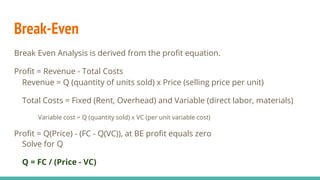
Break Even Analysis is derived from the profit equation.
Profit = Revenue - Total Costs
Revenue = Q (quantity of units sold) x Price (selling price per unit)
Total Costs = Fixed (Rent, Overhead) and Variable (direct labor, materials)
Variable cost = Q (quantity sold) x VC (per unit variable cost)
Profit = Q(Price) - (FC - Q(VC)), at BE profit equals zero
Solve for Q
Q = FC / (Price - VC)
Example
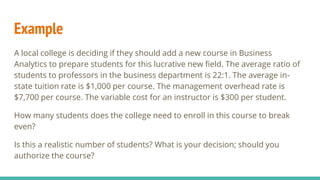
A local college is deciding if they should add a new course in Business
Analytics to prepare students for this lucrative new field. The average ratio of
students to professors in the business department is 22:1. The average in-
state tuition rate is $1,000 per course. The management overhead rate is
$7,700 per course. The variable cost for an instructor is $300 per student.
How many students does the college need to enroll in this course to break
even?
Is this a realistic number of students? What is your decision; should you
authorize the course?
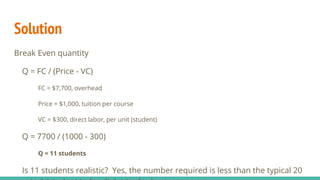
Solution
Break Even quantity
Q = FC / (Price - VC)
FC = $7,700, overhead
Price = $1,000, tuition per course
VC = $300, direct labor, per unit (student)
Q = 7700 / (1000 - 300)
Q = 11 students
Is 11 students realistic? Yes, the number required is less than the typical 20
Practice Problem
You have decided to self-publish a book on Amazon. The printing company
charges $50,000 to make a book. A book marketing company charges $4 for
each book sold to design and promote the book. If you charge $10 per book,
how many books do you need to sell to break even?
Partial Answer
Price = $10
Fixed = ?
VC = ?
Q = 8,334 (rounded up. It is difficult to sell ⅓ of a book)
Break Even - Outsourcing
The break even calculation is sometimes extended to outsourcing.
Outsourcing is letting another organization do part of the process for you. In
theory, outsourcing works best when another organization has superior
knowledge of a process or lower costs by operating at full capacity.
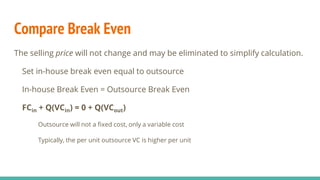
Compare Break Even
The selling price will not change and may be eliminated to simplify calculation.
Set in-house break even equal to outsource
In-house Break Even = Outsource Break Even
FCin + Q(VCin) = 0 + Q(VCout)
Outsource will not a fixed cost, only a variable cost
Typically, the per unit outsource VC is higher per unit
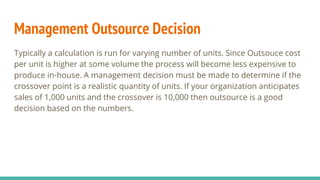
Management Outsource Decision
Typically a calculation is run for varying number of units. Since Outsouce cost
per unit is higher at some volume the process will become less expensive to
produce in-house. A management decision must be made to determine if the
crossover point is a realistic quantity of units. If your organization anticipates
sales of 1,000 units and the crossover is 10,000 then outsource is a good
decision based on the numbers.
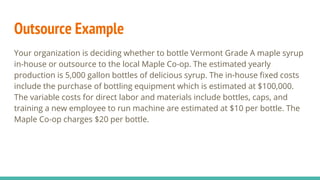
Outsource Example
Your organization is deciding whether to bottle Vermont Grade A maple syrup
in-house or outsource to the local Maple Co-op. The estimated yearly
production is 5,000 gallon bottles of delicious syrup. The in-house fixed costs
include the purchase of bottling equipment which is estimated at $100,000.
The variable costs for direct labor and materials include bottles, caps, and
training a new employee to run machine are estimated at $10 per bottle. The
Maple Co-op charges $20 per bottle.
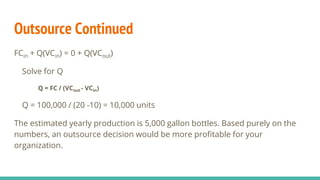
Outsource Continued
FCin + Q(VCin) = 0 + Q(VCout)
Solve for Q
Q = FC / (VCout - VCin)
Q = 100,000 / (20 -10) = 10,000 units
The estimated yearly production is 5,000 gallon bottles. Based purely on the
numbers, an outsource decision would be more profitable for your
organization.
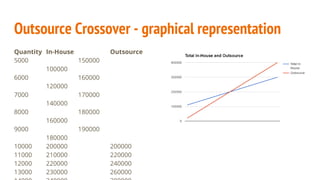
Outsource Crossover - graphical representation
Quantity In-House Outsource
5000 150000
100000
6000 160000
120000
7000 170000
140000
8000 180000
160000
9000 190000
180000
10000 200000 200000
11000 210000 220000
12000 220000 240000
13000 230000 260000

Break even and outsource analysis

  • 1.
  • 2.
    Why we needBreak Even Break even is a tool to help analyze the potential profitability of a new product or a new business venture. Break Even is simply the point where expected revenue equals expect costs. Every unit sold beyond this point contributes to profit. If this break even quantity is not achieve, a loss will occur. In this way Break Even is a business analytics tool for managers to help decide if a new venture is realistic. Gone are the days when management made decisions by “Gut Feel”. Gut-Feel is a signal that further analysis is needed. Modern times require hard numbers to justify decisions.
  • 3.
    Break-Even Break Even Analysisis derived from the profit equation. Profit = Revenue - Total Costs Revenue = Q (quantity of units sold) x Price (selling price per unit) Total Costs = Fixed (Rent, Overhead) and Variable (direct labor, materials) Variable cost = Q (quantity sold) x VC (per unit variable cost) Profit = Q(Price) - (FC - Q(VC)), at BE profit equals zero Solve for Q Q = FC / (Price - VC)
  • 4.
    Example A local collegeis deciding if they should add a new course in Business Analytics to prepare students for this lucrative new field. The average ratio of students to professors in the business department is 22:1. The average in- state tuition rate is $1,000 per course. The management overhead rate is $7,700 per course. The variable cost for an instructor is $300 per student. How many students does the college need to enroll in this course to break even? Is this a realistic number of students? What is your decision; should you authorize the course?
  • 5.
    Solution Break Even quantity Q= FC / (Price - VC) FC = $7,700, overhead Price = $1,000, tuition per course VC = $300, direct labor, per unit (student) Q = 7700 / (1000 - 300) Q = 11 students Is 11 students realistic? Yes, the number required is less than the typical 20
  • 6.
    Practice Problem You havedecided to self-publish a book on Amazon. The printing company charges $50,000 to make a book. A book marketing company charges $4 for each book sold to design and promote the book. If you charge $10 per book, how many books do you need to sell to break even?
  • 7.
    Partial Answer Price =$10 Fixed = ? VC = ? Q = 8,334 (rounded up. It is difficult to sell ⅓ of a book)
  • 8.
    Break Even -Outsourcing The break even calculation is sometimes extended to outsourcing. Outsourcing is letting another organization do part of the process for you. In theory, outsourcing works best when another organization has superior knowledge of a process or lower costs by operating at full capacity.
  • 9.
    Compare Break Even Theselling price will not change and may be eliminated to simplify calculation. Set in-house break even equal to outsource In-house Break Even = Outsource Break Even FCin + Q(VCin) = 0 + Q(VCout) Outsource will not a fixed cost, only a variable cost Typically, the per unit outsource VC is higher per unit
  • 10.
    Management Outsource Decision Typicallya calculation is run for varying number of units. Since Outsouce cost per unit is higher at some volume the process will become less expensive to produce in-house. A management decision must be made to determine if the crossover point is a realistic quantity of units. If your organization anticipates sales of 1,000 units and the crossover is 10,000 then outsource is a good decision based on the numbers.
  • 11.
    Outsource Example Your organizationis deciding whether to bottle Vermont Grade A maple syrup in-house or outsource to the local Maple Co-op. The estimated yearly production is 5,000 gallon bottles of delicious syrup. The in-house fixed costs include the purchase of bottling equipment which is estimated at $100,000. The variable costs for direct labor and materials include bottles, caps, and training a new employee to run machine are estimated at $10 per bottle. The Maple Co-op charges $20 per bottle.
  • 12.
    Outsource Continued FCin +Q(VCin) = 0 + Q(VCout) Solve for Q Q = FC / (VCout - VCin) Q = 100,000 / (20 -10) = 10,000 units The estimated yearly production is 5,000 gallon bottles. Based purely on the numbers, an outsource decision would be more profitable for your organization.
  • 13.
    Outsource Crossover -graphical representation Quantity In-House Outsource 5000 150000 100000 6000 160000 120000 7000 170000 140000 8000 180000 160000 9000 190000 180000 10000 200000 200000 11000 210000 220000 12000 220000 240000 13000 230000 260000