LINEAR
PROGRAMMING
SUBMITTED BY:
JASJEET KAUR
A1000702021
MCA 2A
What is Linear Programming?
• Linear programming (LP) refers to a
technique to solve a specific class of
mathematical optimization problems.
• LP optimization problems have linear
objective functions and constraints
Standard Form
Let:

X1, X2, X3, ………, Xn = decision variables
Z = Objective function or linear function

Requirement: Maximization of the linear function Z.

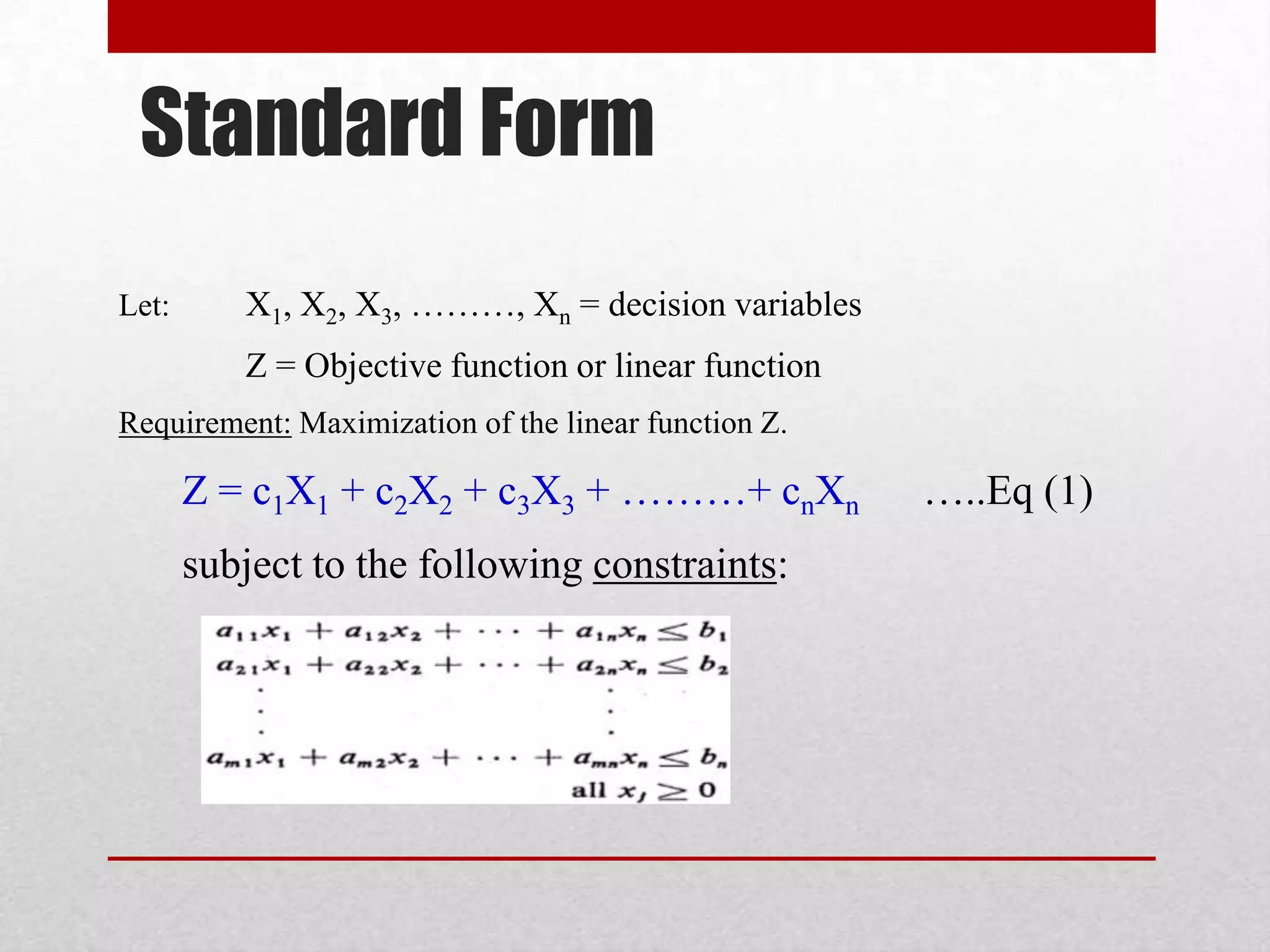
Z = c1X1 + c2X2 + c3X3 + ………+ cnXn

subject to the following constraints:

…..Eq (1)
EXAMPLE
Graphical Solution to LP
Problem
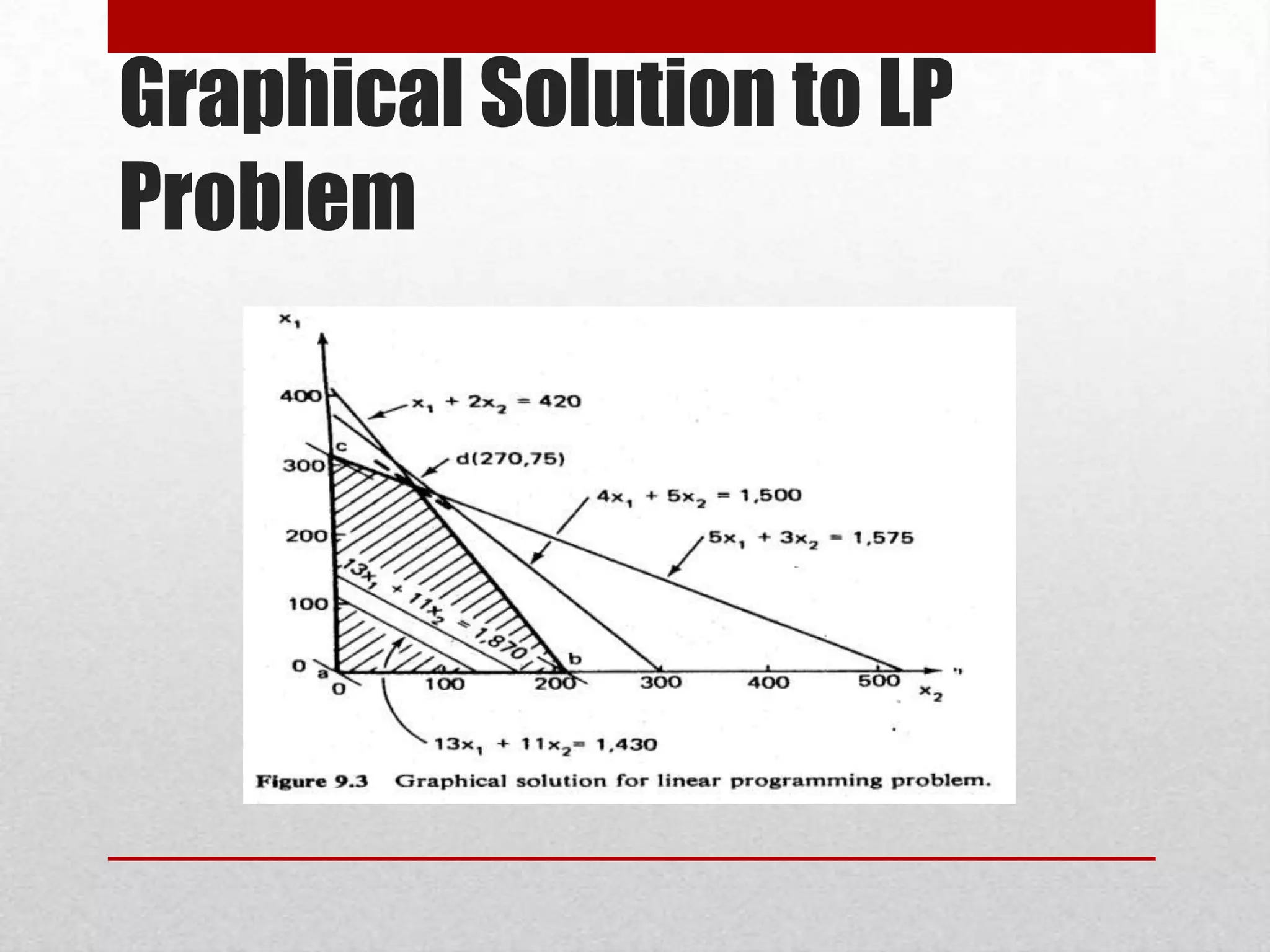
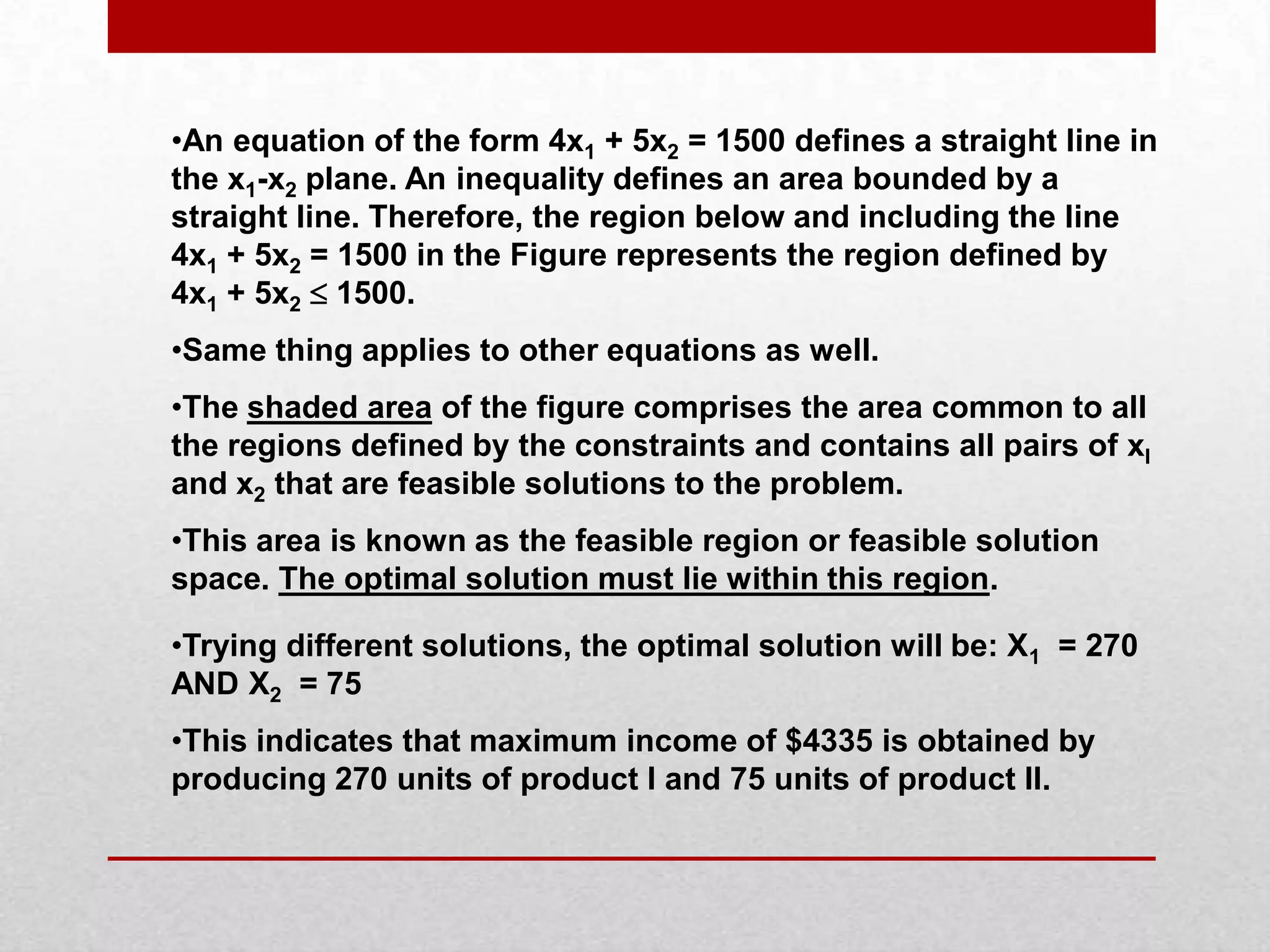
•An equation of the form 4x1 + 5x2 = 1500 defines a straight line in
the x1-x2 plane. An inequality defines an area bounded by a
straight line. Therefore, the region below and including the line
4x1 + 5x2 = 1500 in the Figure represents the region defined by
4x1 + 5x2  1500.
•Same thing applies to other equations as well.
•The shaded area of the figure comprises the area common to all
the regions defined by the constraints and contains all pairs of xI
and x2 that are feasible solutions to the problem.
•This area is known as the feasible region or feasible solution
space. The optimal solution must lie within this region.
•Trying different solutions, the optimal solution will be: X1 = 270
AND X2 = 75
•This indicates that maximum income of $4335 is obtained by
producing 270 units of product I and 75 units of product II.
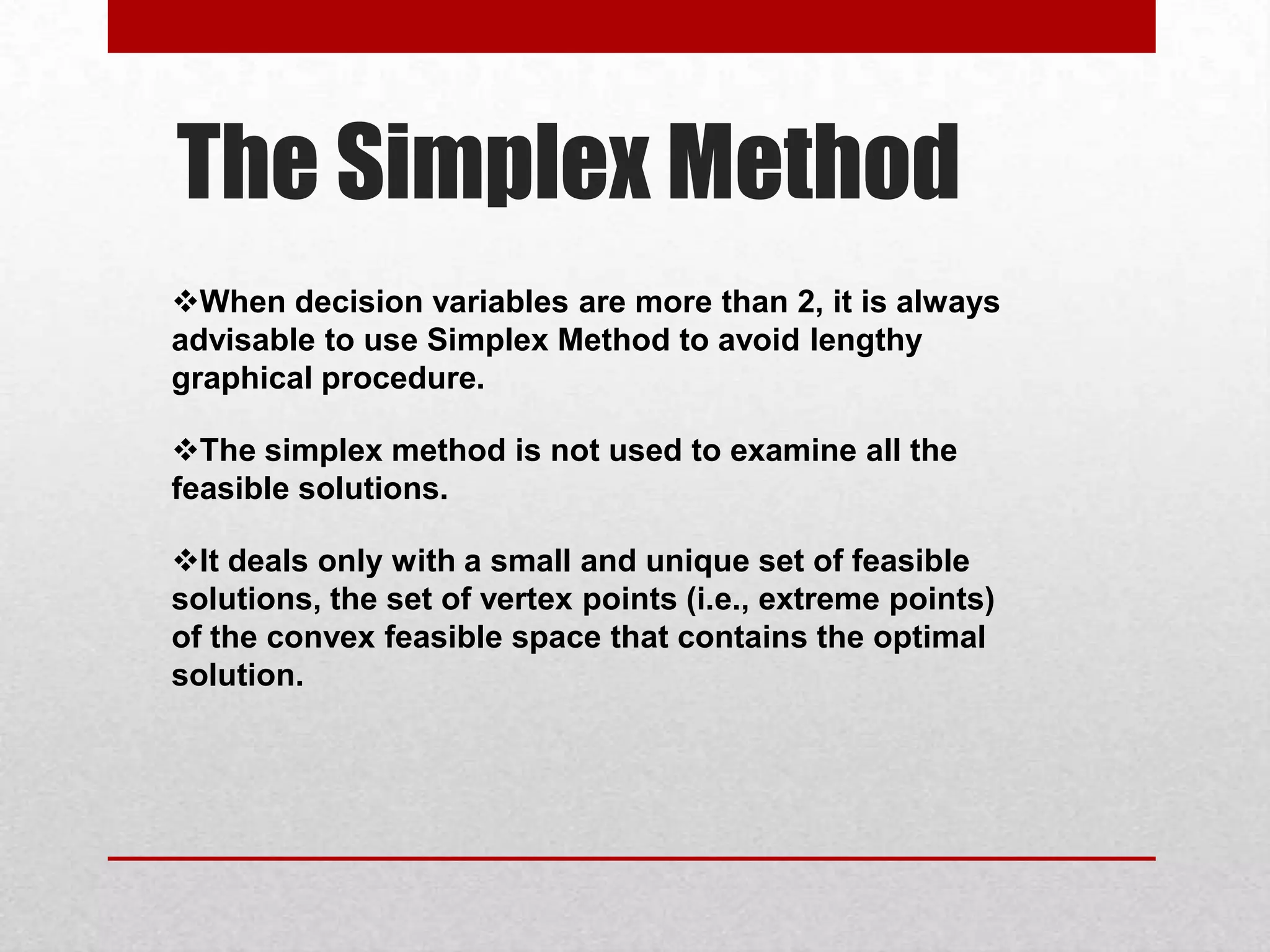
The Simplex Method
When decision variables are more than 2, it is always
advisable to use Simplex Method to avoid lengthy
graphical procedure.
The simplex method is not used to examine all the
feasible solutions.

It deals only with a small and unique set of feasible
solutions, the set of vertex points (i.e., extreme points)
of the convex feasible space that contains the optimal
solution.
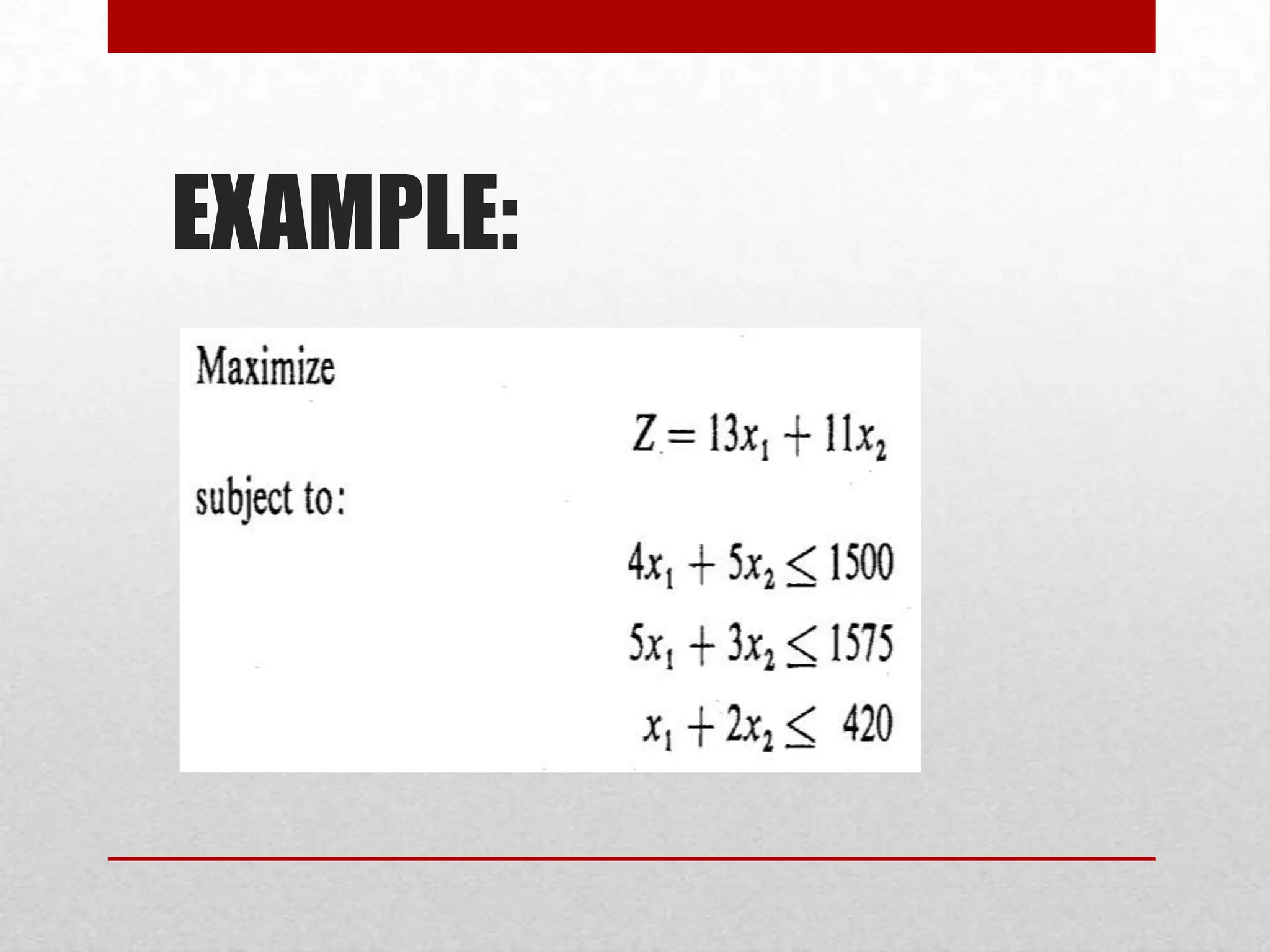
EXAMPLE:
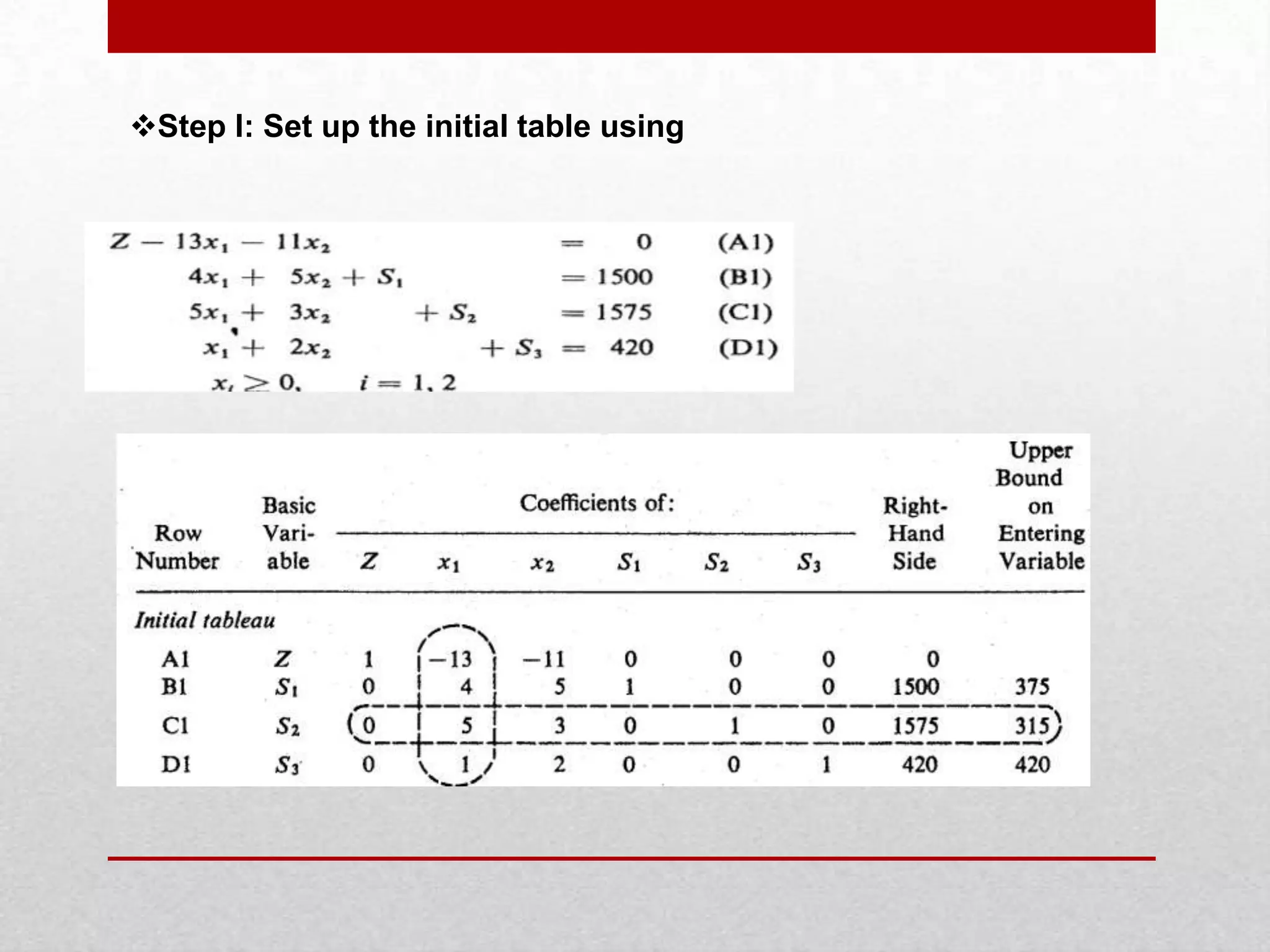
Step I: Set up the initial table using
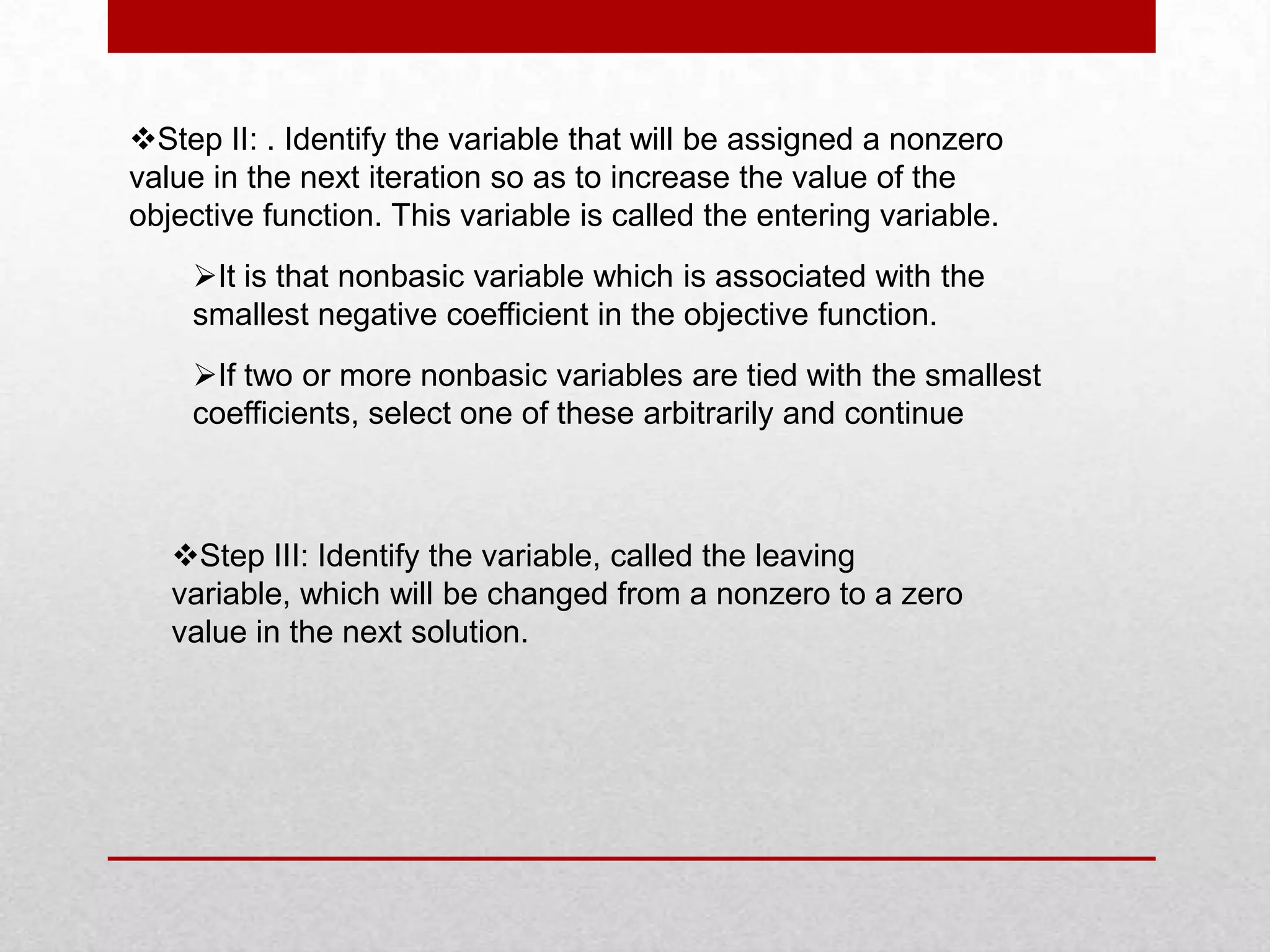
Step II: . Identify the variable that will be assigned a nonzero
value in the next iteration so as to increase the value of the
objective function. This variable is called the entering variable.
It is that nonbasic variable which is associated with the
smallest negative coefficient in the objective function.

If two or more nonbasic variables are tied with the smallest
coefficients, select one of these arbitrarily and continue

Step III: Identify the variable, called the leaving
variable, which will be changed from a nonzero to a zero
value in the next solution.
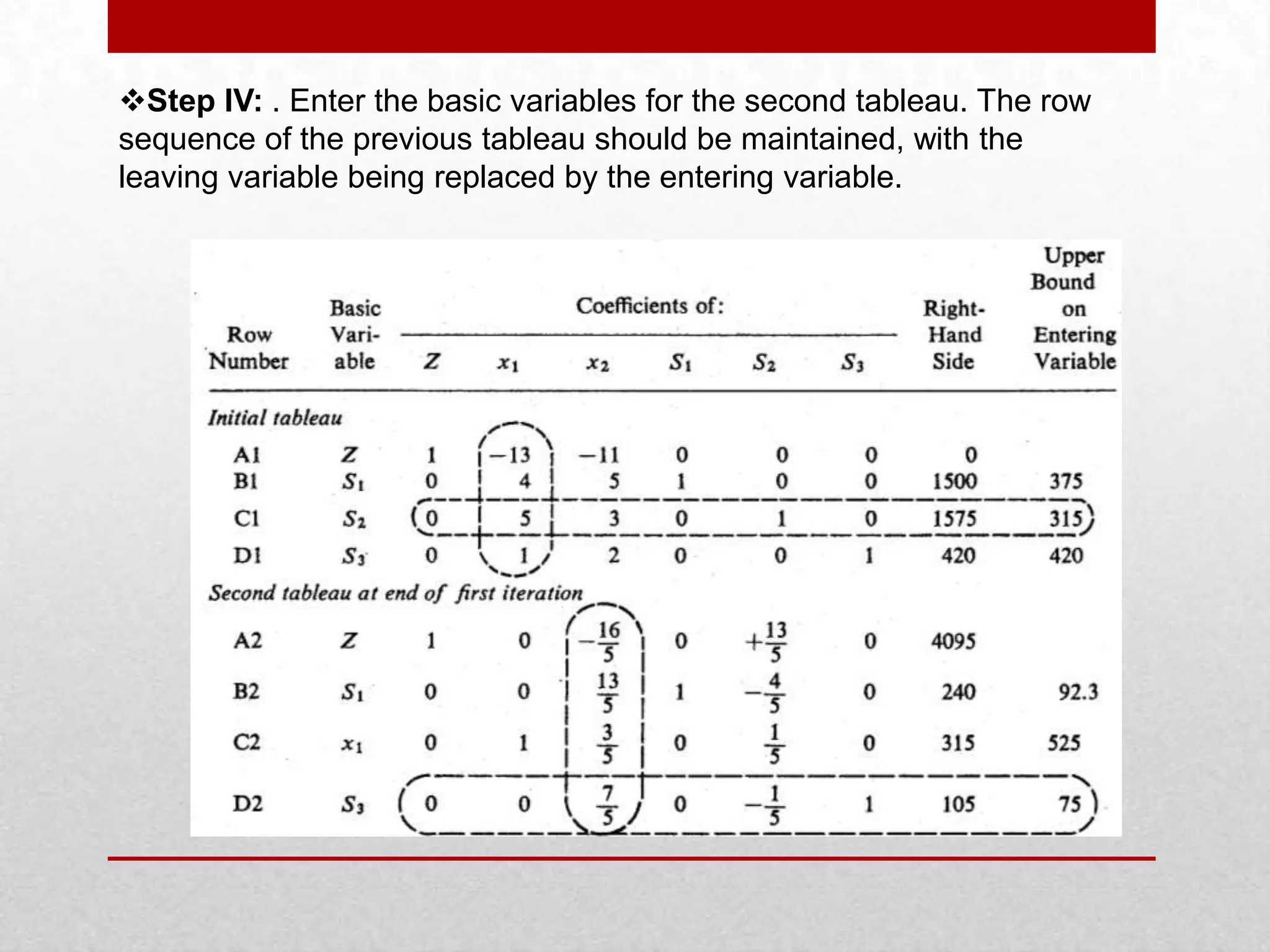
Step IV: . Enter the basic variables for the second tableau. The row
sequence of the previous tableau should be maintained, with the
leaving variable being replaced by the entering variable.
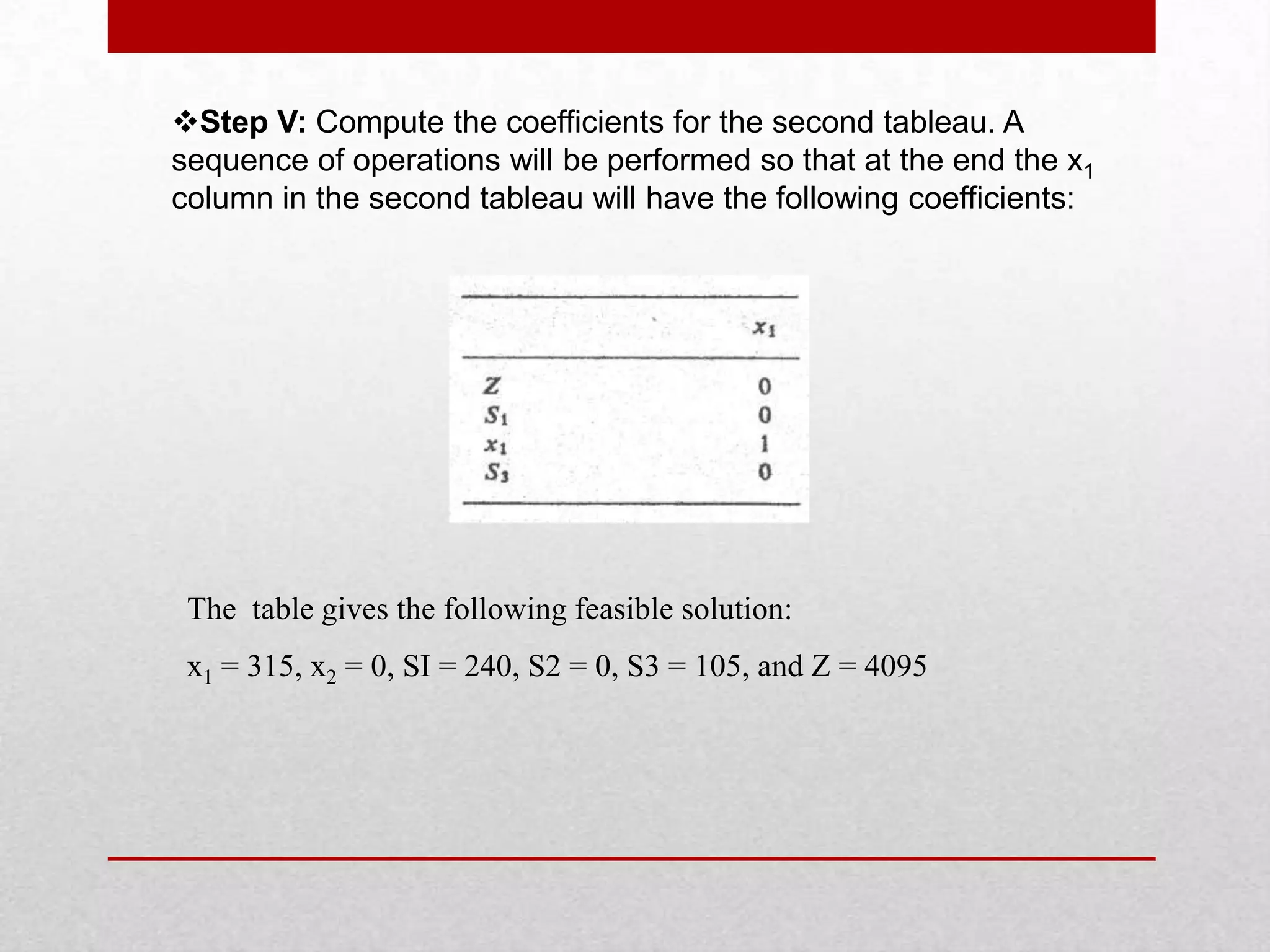
Step V: Compute the coefficients for the second tableau. A
sequence of operations will be performed so that at the end the x1
column in the second tableau will have the following coefficients:

The table gives the following feasible solution:
x1 = 315, x2 = 0, SI = 240, S2 = 0, S3 = 105, and Z = 4095
Duality
With every linear programming
problem, there is associated another linear
programming problem which is called the
dual of the original (or the primal) problem.
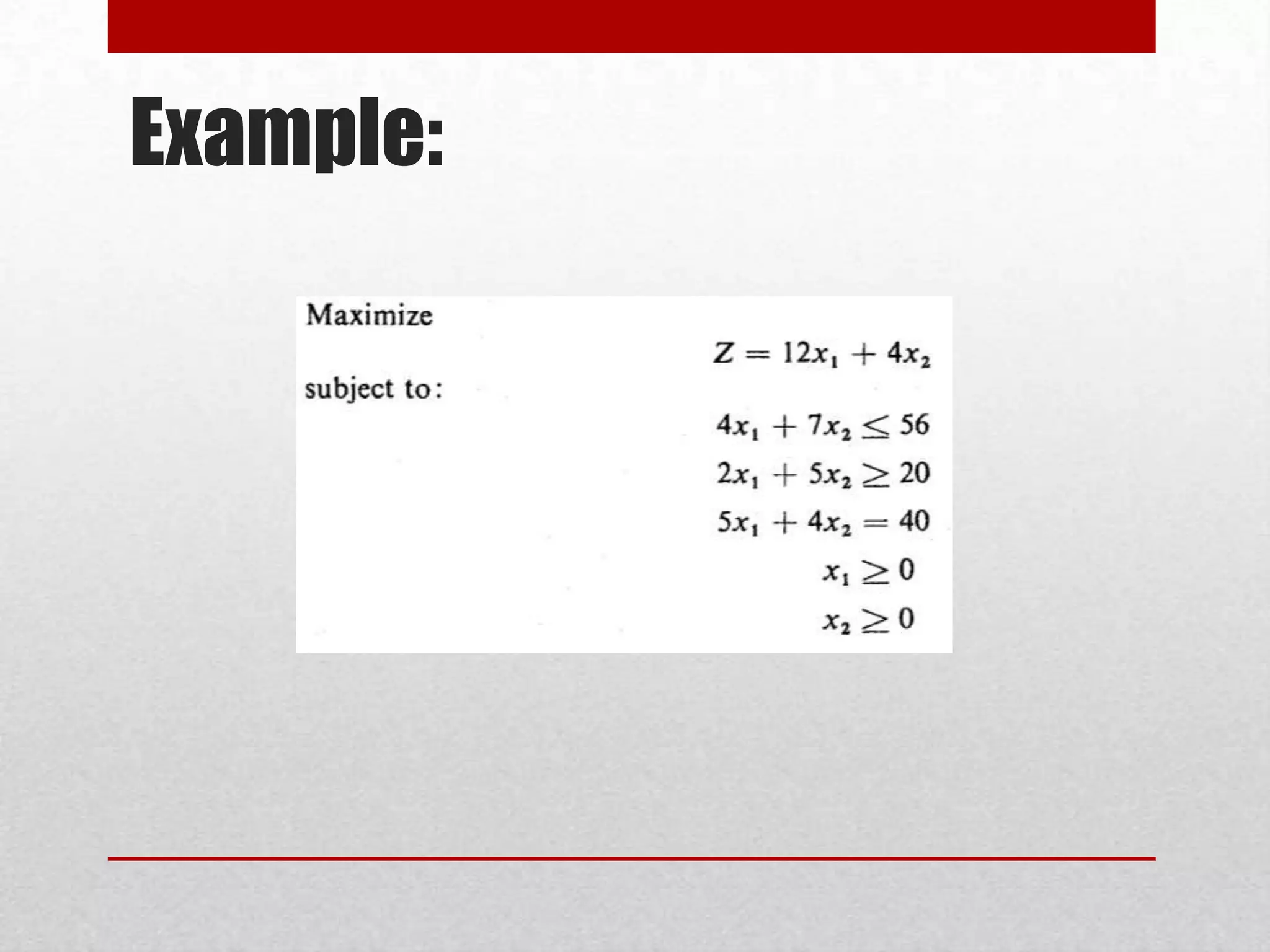
Example:
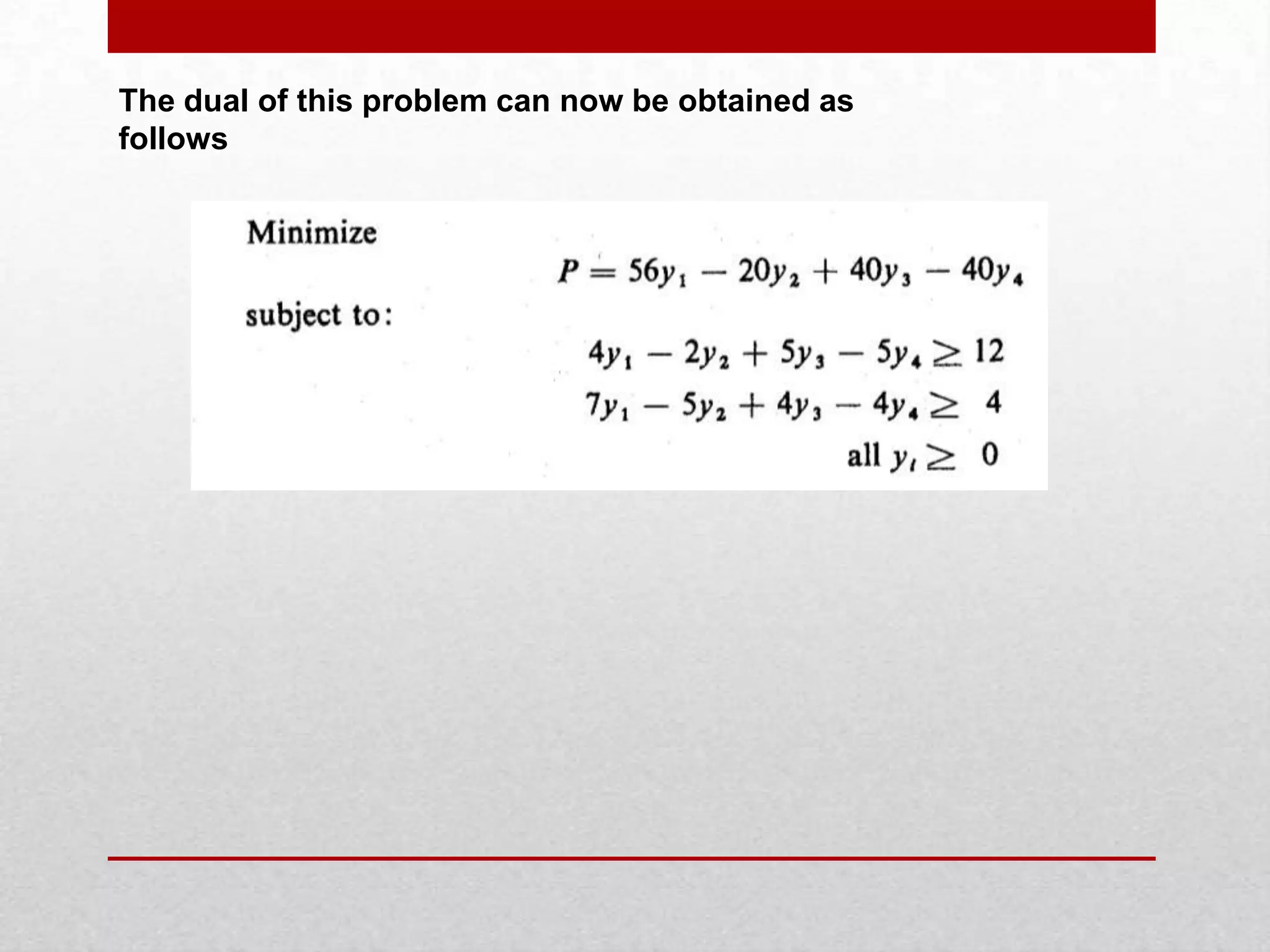
The dual of this problem can now be obtained as
follows
linear programming

linear programming

  • 1.
  • 2.
    What is LinearProgramming? • Linear programming (LP) refers to a technique to solve a specific class of mathematical optimization problems. • LP optimization problems have linear objective functions and constraints
  • 3.
    Standard Form Let: X1, X2,X3, ………, Xn = decision variables Z = Objective function or linear function Requirement: Maximization of the linear function Z. Z = c1X1 + c2X2 + c3X3 + ………+ cnXn subject to the following constraints: …..Eq (1)
  • 4.
  • 5.
  • 6.
    •An equation ofthe form 4x1 + 5x2 = 1500 defines a straight line in the x1-x2 plane. An inequality defines an area bounded by a straight line. Therefore, the region below and including the line 4x1 + 5x2 = 1500 in the Figure represents the region defined by 4x1 + 5x2  1500. •Same thing applies to other equations as well. •The shaded area of the figure comprises the area common to all the regions defined by the constraints and contains all pairs of xI and x2 that are feasible solutions to the problem. •This area is known as the feasible region or feasible solution space. The optimal solution must lie within this region. •Trying different solutions, the optimal solution will be: X1 = 270 AND X2 = 75 •This indicates that maximum income of $4335 is obtained by producing 270 units of product I and 75 units of product II.
  • 7.
    The Simplex Method Whendecision variables are more than 2, it is always advisable to use Simplex Method to avoid lengthy graphical procedure. The simplex method is not used to examine all the feasible solutions. It deals only with a small and unique set of feasible solutions, the set of vertex points (i.e., extreme points) of the convex feasible space that contains the optimal solution.
  • 8.
  • 9.
    Step I: Setup the initial table using
  • 10.
    Step II: .Identify the variable that will be assigned a nonzero value in the next iteration so as to increase the value of the objective function. This variable is called the entering variable. It is that nonbasic variable which is associated with the smallest negative coefficient in the objective function. If two or more nonbasic variables are tied with the smallest coefficients, select one of these arbitrarily and continue Step III: Identify the variable, called the leaving variable, which will be changed from a nonzero to a zero value in the next solution.
  • 11.
    Step IV: .Enter the basic variables for the second tableau. The row sequence of the previous tableau should be maintained, with the leaving variable being replaced by the entering variable.
  • 12.
    Step V: Computethe coefficients for the second tableau. A sequence of operations will be performed so that at the end the x1 column in the second tableau will have the following coefficients: The table gives the following feasible solution: x1 = 315, x2 = 0, SI = 240, S2 = 0, S3 = 105, and Z = 4095
  • 13.
    Duality With every linearprogramming problem, there is associated another linear programming problem which is called the dual of the original (or the primal) problem.
  • 14.
  • 15.
    The dual ofthis problem can now be obtained as follows