BREAK EVEN ANALYSIS

GROUP MEMBERS
 Nikhil Das M
 Gopi Nath
 Lalitha Ashok
 Mahindran
 Don
CONTENTS
 definition
 Purpose
 Construction/Computation
 Margin of safety

 Types of costs
 Break even analysis
 Limitations
 Available calculators for
calculating BEP
conclusion
DEFINITION
“Break even point (Bep) is the point
at which cost or expenses and
revenue are equal”
 There

is no net loss or gain

 All cost that need to by paid by the firm are paid
but the profit remains “zero”
Break Even Point (IN UNIT)= Fixed
Cost /S. Price- Variable Unit Cost

Break Even Point (in Rs)=Fixed
Cost/ S. Price-Variable unit
Cost*Units
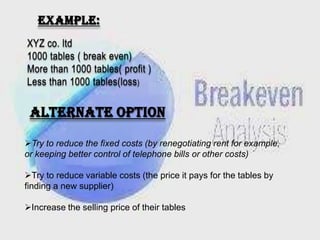
Example:
XYZ co. ltd
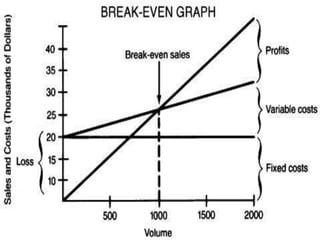
1000 tables ( break even)
More than 1000 tables( profit )
Less than 1000 tables(loss )

Alternate option
Try to reduce the fixed costs (by renegotiating rent for example,
or keeping better control of telephone bills or other costs)
Try to reduce variable costs (the price it pays for the tables by
finding a new supplier)
Increase the selling price of their tables
purpose
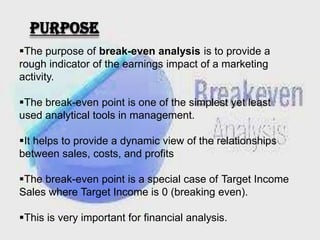
The purpose of break-even analysis is to provide a
rough indicator of the earnings impact of a marketing
activity.
The break-even point is one of the simplest yet least
used analytical tools in management.

It helps to provide a dynamic view of the relationships
between sales, costs, and profits
The break-even point is a special case of Target Income
Sales where Target Income is 0 (breaking even).
This is very important for financial analysis.
Computation /construction of BEP
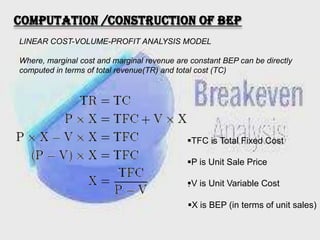
LINEAR COST-VOLUME-PROFIT ANALYSIS MODEL
Where, marginal cost and marginal revenue are constant BEP can be directly
computed in terms of total revenue(TR) and total cost (TC)

TFC is Total Fixed Cost
P is Unit Sale Price
V is Unit Variable Cost
.
X is BEP (in terms of unit sales)
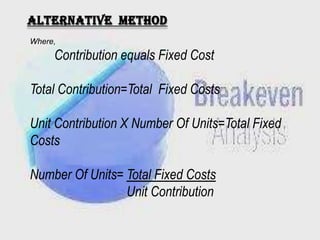
Alternative method
Where,

Contribution equals Fixed Cost
Total Contribution=Total Fixed Costs
Unit Contribution X Number Of Units=Total Fixed
Costs
Number Of Units= Total Fixed Costs
Unit Contribution
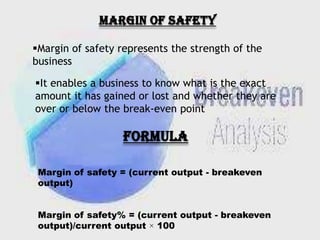
MARGIN OF SAFETY
Margin of safety represents the strength of the
business

It enables a business to know what is the exact
amount it has gained or lost and whether they are
over or below the break-even point

FORMULA
Margin of safety = (current output - breakeven
output)
Margin of safety% = (current output - breakeven
output)/current output × 100
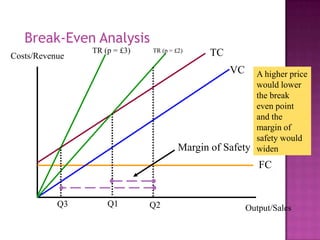
Break-Even Analysis
Costs/Revenue

TR (p = £3)

TR (p = £2)

TC
VC

AAssumeprice
higher
would lower
current sales
the break
at Q2
even point
and the
margin of
safety would
Margin of Safety widen

FC

Q3

Q1

Q2

Output/Sales
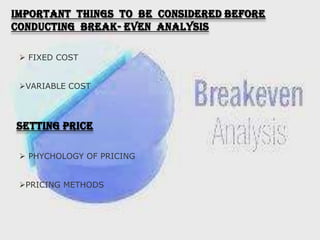
Important things to be considered before
conducting break- even analysis
 FIXED COST
VARIABLE COST

SETTING PRICE
 PHYCHOLOGY OF PRICING
PRICING METHODS
Costs/Revenue

TR

TR

TC

VC

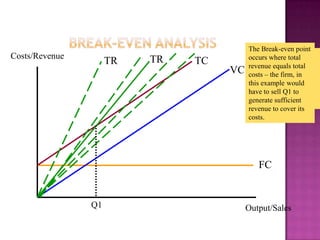
TheAs output is point
Break-even
Totallowercosts
The total the
The revenue is
occurs where total
generated, firm
Initially a
determined the
therefore less
revenue equalsby the
price,will incur
the total
firm charged and
will incur fixed
pricethe firm, in
(assuming
costs – thecosts –
variable total
steep these do –
costs,
the quantity sold
this accurate would
example
thesethis will
not vary
revenue curve.
again depend on
have to sell Q1 tobe
forecasts!) is the
directly or bythe
output with
determined sales.
generate sufficient
amount FC+VC
sum of forecast
expected produced
revenue to cover its
sales
costs. initially.

FC

Q1

Output/Sales
Break-Even Analysis
Costs/Revenue

TR (p = £3)

TR (p = £2)

TC

VC

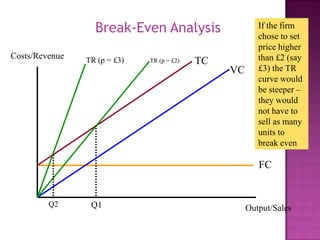
If the firm
chose to set
price higher
than £2 (say
£3) the TR
curve would
be steeper –
they would
not have to
sell as many
units to
break even

FC

Q2

Q1

Output/Sales
Break-Even Analysis
TR (p = £1)

Costs/Revenue

TR (p = £2)

TC

VC

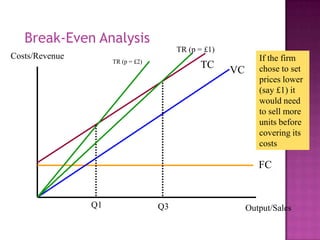
If the firm
chose to set
prices lower
(say £1) it
would need
to sell more
units before
covering its
costs

FC

Q1

Q3

Output/Sales
example,
suppose that your fixed costs for
producing 100,000 product were 30,000 rs a
year.
Your variable costs are 2.20 rs materials,
4.00 rs labour, and 0.80 rs overhead, for a
total of 7.00 rs per unit.
If you choose a selling price of 12.00 rs for
each product, then:
30,000 divided by (12.00 - 7.00) equals
6000 units.
This is the number of products that have
to be sold at a selling price of 12.00 rs
before your business will start to make a
profit.
LIMITATIONS
•Break-even analysis is only a supply-side (i.e., costs only)
analysis, as it tells you nothing about what sales are actually likely
to be for the product at these various prices.
•It assumes that fixed costs (FC) are constant. Although this is
true in the short run, an increase in the scale of production is likely
to cause fixed costs to rise.
•It assumes average variable costs are constant per unit of output,
at least in the range of likely quantities of sales. (i.e., linearity).
It assumes that the quantity of goods produced is equal to the
quantity of goods sold (i.e., there is no change in the quantity of
goods held in inventory at the beginning of the period and the
quantity of goods held in inventory at the end of the period).

In multi-product companies, it assumes that the relative proportions
of each product sold and produced are constant (i.e., the sales mix is
constant).
CALCULATORS
Case Western Reserve University offers a breakeven
analysis calculator that includes a review of relevant
microeconomic terms.
 financial calculator allows you to chart your costs and
profits appear in a graph.
Inc.com offers a breakeven analysis calculator that requires
a user to enter in total annual overhead and annual year-todate sales and cost of sales, and lets the user delineate the
period for the YTD calculations in terms of weeks
CONCLUSION
“Breakeven analysis is not a predictor of
demand, so if you go into market with
the wrong product or the wrong price, it
may be tough to ever hit the breakeven
point”

Break Even Analysis

  • 1.
    BREAK EVEN ANALYSIS GROUPMEMBERS  Nikhil Das M  Gopi Nath  Lalitha Ashok  Mahindran  Don
  • 2.
    CONTENTS  definition  Purpose Construction/Computation  Margin of safety  Types of costs  Break even analysis  Limitations  Available calculators for calculating BEP conclusion
  • 3.
    DEFINITION “Break even point(Bep) is the point at which cost or expenses and revenue are equal”  There is no net loss or gain  All cost that need to by paid by the firm are paid but the profit remains “zero”
  • 4.
    Break Even Point(IN UNIT)= Fixed Cost /S. Price- Variable Unit Cost Break Even Point (in Rs)=Fixed Cost/ S. Price-Variable unit Cost*Units
  • 5.
    Example: XYZ co. ltd 1000tables ( break even) More than 1000 tables( profit ) Less than 1000 tables(loss ) Alternate option Try to reduce the fixed costs (by renegotiating rent for example, or keeping better control of telephone bills or other costs) Try to reduce variable costs (the price it pays for the tables by finding a new supplier) Increase the selling price of their tables
  • 7.
    purpose The purpose ofbreak-even analysis is to provide a rough indicator of the earnings impact of a marketing activity. The break-even point is one of the simplest yet least used analytical tools in management. It helps to provide a dynamic view of the relationships between sales, costs, and profits The break-even point is a special case of Target Income Sales where Target Income is 0 (breaking even). This is very important for financial analysis.
  • 8.
    Computation /construction ofBEP LINEAR COST-VOLUME-PROFIT ANALYSIS MODEL Where, marginal cost and marginal revenue are constant BEP can be directly computed in terms of total revenue(TR) and total cost (TC) TFC is Total Fixed Cost P is Unit Sale Price V is Unit Variable Cost . X is BEP (in terms of unit sales)
  • 9.
    Alternative method Where, Contribution equalsFixed Cost Total Contribution=Total Fixed Costs Unit Contribution X Number Of Units=Total Fixed Costs Number Of Units= Total Fixed Costs Unit Contribution
  • 10.
    MARGIN OF SAFETY Marginof safety represents the strength of the business It enables a business to know what is the exact amount it has gained or lost and whether they are over or below the break-even point FORMULA Margin of safety = (current output - breakeven output) Margin of safety% = (current output - breakeven output)/current output × 100
  • 11.
    Break-Even Analysis Costs/Revenue TR (p= £3) TR (p = £2) TC VC AAssumeprice higher would lower current sales the break at Q2 even point and the margin of safety would Margin of Safety widen FC Q3 Q1 Q2 Output/Sales
  • 12.
    Important things tobe considered before conducting break- even analysis  FIXED COST VARIABLE COST SETTING PRICE  PHYCHOLOGY OF PRICING PRICING METHODS
  • 13.
    Costs/Revenue TR TR TC VC TheAs output ispoint Break-even Totallowercosts The total the The revenue is occurs where total generated, firm Initially a determined the therefore less revenue equalsby the price,will incur the total firm charged and will incur fixed pricethe firm, in (assuming costs – thecosts – variable total steep these do – costs, the quantity sold this accurate would example thesethis will not vary revenue curve. again depend on have to sell Q1 tobe forecasts!) is the directly or bythe output with determined sales. generate sufficient amount FC+VC sum of forecast expected produced revenue to cover its sales costs. initially. FC Q1 Output/Sales
  • 14.
    Break-Even Analysis Costs/Revenue TR (p= £3) TR (p = £2) TC VC If the firm chose to set price higher than £2 (say £3) the TR curve would be steeper – they would not have to sell as many units to break even FC Q2 Q1 Output/Sales
  • 15.
    Break-Even Analysis TR (p= £1) Costs/Revenue TR (p = £2) TC VC If the firm chose to set prices lower (say £1) it would need to sell more units before covering its costs FC Q1 Q3 Output/Sales
  • 16.
    example, suppose that yourfixed costs for producing 100,000 product were 30,000 rs a year. Your variable costs are 2.20 rs materials, 4.00 rs labour, and 0.80 rs overhead, for a total of 7.00 rs per unit. If you choose a selling price of 12.00 rs for each product, then: 30,000 divided by (12.00 - 7.00) equals 6000 units. This is the number of products that have to be sold at a selling price of 12.00 rs before your business will start to make a profit.
  • 17.
    LIMITATIONS •Break-even analysis isonly a supply-side (i.e., costs only) analysis, as it tells you nothing about what sales are actually likely to be for the product at these various prices. •It assumes that fixed costs (FC) are constant. Although this is true in the short run, an increase in the scale of production is likely to cause fixed costs to rise. •It assumes average variable costs are constant per unit of output, at least in the range of likely quantities of sales. (i.e., linearity).
  • 18.
    It assumes thatthe quantity of goods produced is equal to the quantity of goods sold (i.e., there is no change in the quantity of goods held in inventory at the beginning of the period and the quantity of goods held in inventory at the end of the period). In multi-product companies, it assumes that the relative proportions of each product sold and produced are constant (i.e., the sales mix is constant).
  • 19.
    CALCULATORS Case Western ReserveUniversity offers a breakeven analysis calculator that includes a review of relevant microeconomic terms.  financial calculator allows you to chart your costs and profits appear in a graph. Inc.com offers a breakeven analysis calculator that requires a user to enter in total annual overhead and annual year-todate sales and cost of sales, and lets the user delineate the period for the YTD calculations in terms of weeks
  • 20.
    CONCLUSION “Breakeven analysis isnot a predictor of demand, so if you go into market with the wrong product or the wrong price, it may be tough to ever hit the breakeven point”