Break Even Analysis
Accountants use various approaches for expressing the relationship of costs, sales(volume), and
income from operations (operating profit), The mathematical approach is one method that is used
often in practice.
The mathematical approach to cost-volume-profit analysis uses equations (1) to determine the
units of sales necessary to achieve the break-even point in operations or (2) to determine the
units of sales necessary to achieve a target or desired profit.
The break-even point is the level of operations at which a business’s revenues and expired costs
are exactly equal. At break-even, a business will have neither an income nor loss from
operations. The break-even point is useful in business planning, especially when expanding or
decreasing operations.
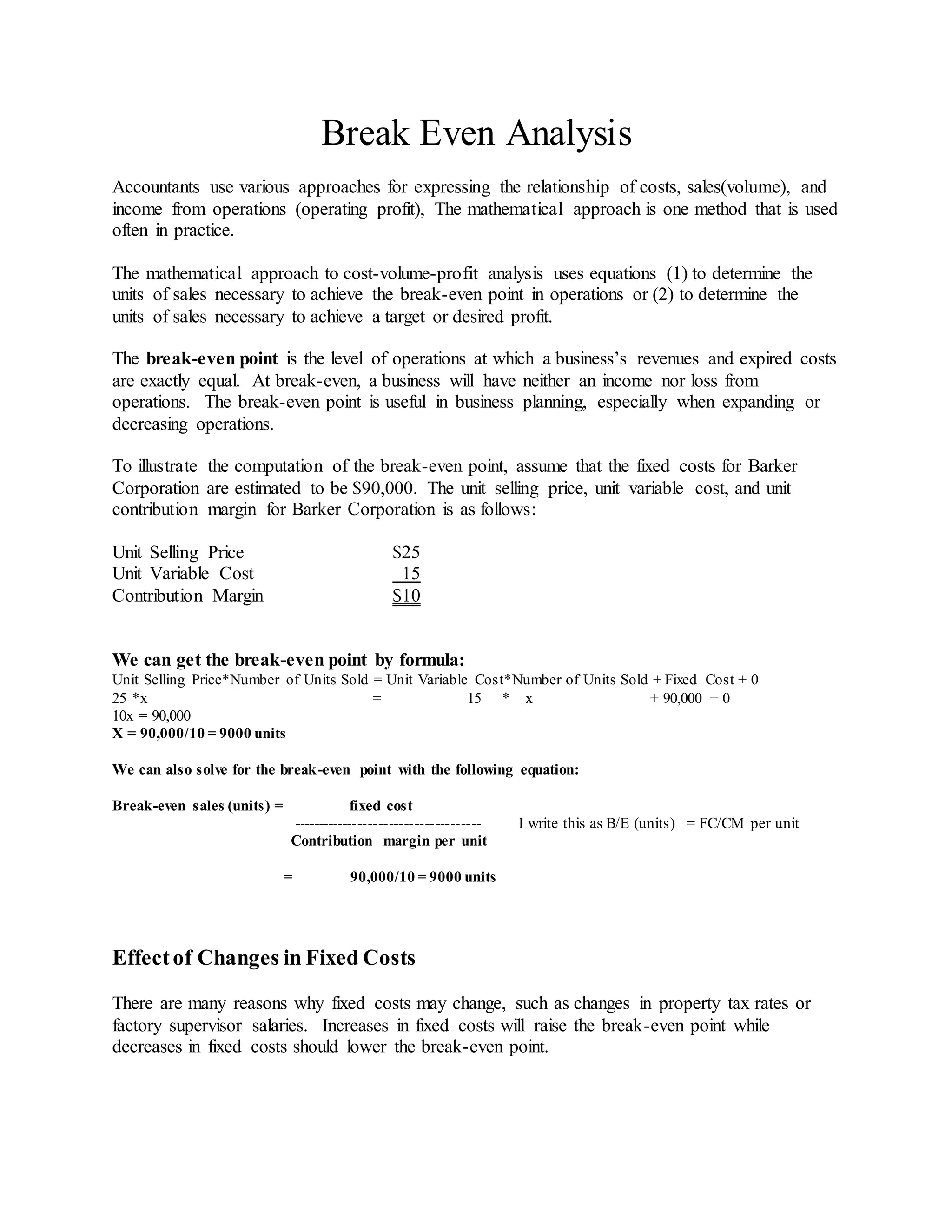
To illustrate the computation of the break-even point, assume that the fixed costs for Barker
Corporation are estimated to be $90,000. The unit selling price, unit variable cost, and unit
contribution margin for Barker Corporation is as follows:
Unit Selling Price $25
Unit Variable Cost 15
Contribution Margin $10
We can get the break-even point by formula:
Unit Selling Price*Number of Units Sold = Unit Variable Cost*Number of Units Sold + Fixed Cost + 0
25 *x = 15 * x + 90,000 + 0
10x = 90,000
X = 90,000/10 = 9000 units
We can also solve for the break-even point with the following equation:
Break-even sales (units) = fixed cost
------------------------------------- I write this as B/E (units) = FC/CM per unit
Contribution margin per unit
= 90,000/10 = 9000 units
Effectof Changes in Fixed Costs
There are many reasons why fixed costs may change, such as changes in property tax rates or
factory supervisor salaries. Increases in fixed costs will raise the break-even point while
decreases in fixed costs should lower the break-even point.
Consider the following: The Bishop Company is evaluating a proposal to budget an additional
$100,000 for advertising. Fixed costs before the additional advertising are estimated at
$600,000, and the unit contribution margin is $20.
Before any additional expense is incurred, the break-even point is $600,000/$20 = 30,000 units
[ that’s fixed cost/unit contribution margin]
If the additional advertising cost is incurred, the fixed cost will now become $700,000 ; all other
relationships and figures will remain the same, and the break-even point will now become
$700,000/20 = 35,000 units.
Effectof Change in Unit Variable Costs
Unit variable costs are not affected by changes in volume of activity, but they may be affected by
other factors such as changes in the price of direct materials and/or changes in the wages of
factory workers providing direct labour. Increases in unit variable costs will raise the break-even
point whereas decreases in unit variable costs will lower the break-even point.
Consider the following: Park company is evaluating a proposal to pay an additional 2%
commission on sales to salespeople as an incentive to increase sales. Fixed costs are estimated at
$840,000, and the unit selling price, variable cost and unit contribution margin before the
additional 2% commission are as follows.
Unit selling price $250
Unit variable cost 145
Unit Contribution margin $105
The break even point in units is currently FC/unit CM or $840,000/$105 = 8000 units.
The addition of a 2% commission will add 2% of $250 = $5 per unit variable cost.
With this revision, SP= $250, variable cost (VC) = $145 + $5 = $150, and the contribution
margin drops to $100 per unit.
This increase in VC will cause the break-even point in units to increase.
FC/unit CM = $840,000/$100 = 8400 units are required to break even.
Effectof Changes in the Unit Selling Price
Increases in the unit selling price will lower the break-even point, while decreases in the unit
selling price will raise the break-even point.
Consider the following: Graham Company is evaluating a proposal to increase the unit selling
price of its product from $50 to $60. The following data have been gathered.
Current Proposed
Unit Selling Price $50 $60
Unit Variable Cost $30 $30
Unit Contribution Margin $20 $30
Total Fixed costs $600,000 $600,000
The break-even point based on the current selling price is as follows:
B/E(units) = FC/unit CM = $600,000/$20 = 30,000 units
The break-even point based on the proposed selling price is as follows:
B/E(units) = FC/unit CM = $600,000/$30 = 20,000 units
TargetProfit
At the break-even point, sales and costs are exactly equal. That, however, is not the goal of
businesses. Managers are looking to maximize profits. It is possible to modify the break-even
equation to target a desired profit, and therefore estimate the required sales volume to meet that
profit target.
Target Sales = Fixed Cost + Target Profit
CM per unit
Consider the following: Fixed costs are estimated at $200,000, and the desired profit is
$100,000. The unit selling price, unit variable cost, and unti contribution margin are as follows.
Unit selling price $75
Unit variable cost 45
Unit contribution margin $30
The sales volume necessary to earn a profit of $100,000 is $200,000 +$100,000/$30
$300,000/$30 = 10,000 units.
FYI
In class, we not only spoke about determining the break-even point in units, but also determining
the break-even point in sales dollars.
One way to approach this problem is to solve for the break-even point in units, take that value
and multiply by the selling price per unit.
Look at the following figures:
Selling price per unit $100
Variable cost per unit $ 60
Unit contribution margin $ 40
Fixed costs = $240,000
Break even point in units = FC/CM per unit = $240,000/$40 = 60,000 units.
The break-even point in dollars = 60,000 units * $100/unit = $6,000,000
The second approach to this problem is to determine the per cent ratio of contribution margin to
sales. In this scenario, we solve for break-even sales as dollars ($) by the following formula:
c
B/E ($) = Fixed Cost
Contribution Margin (%)
Contribution margin is 40% of the selling price (40/100)
B/E ($) = $240,000/.4 = $6,000,000
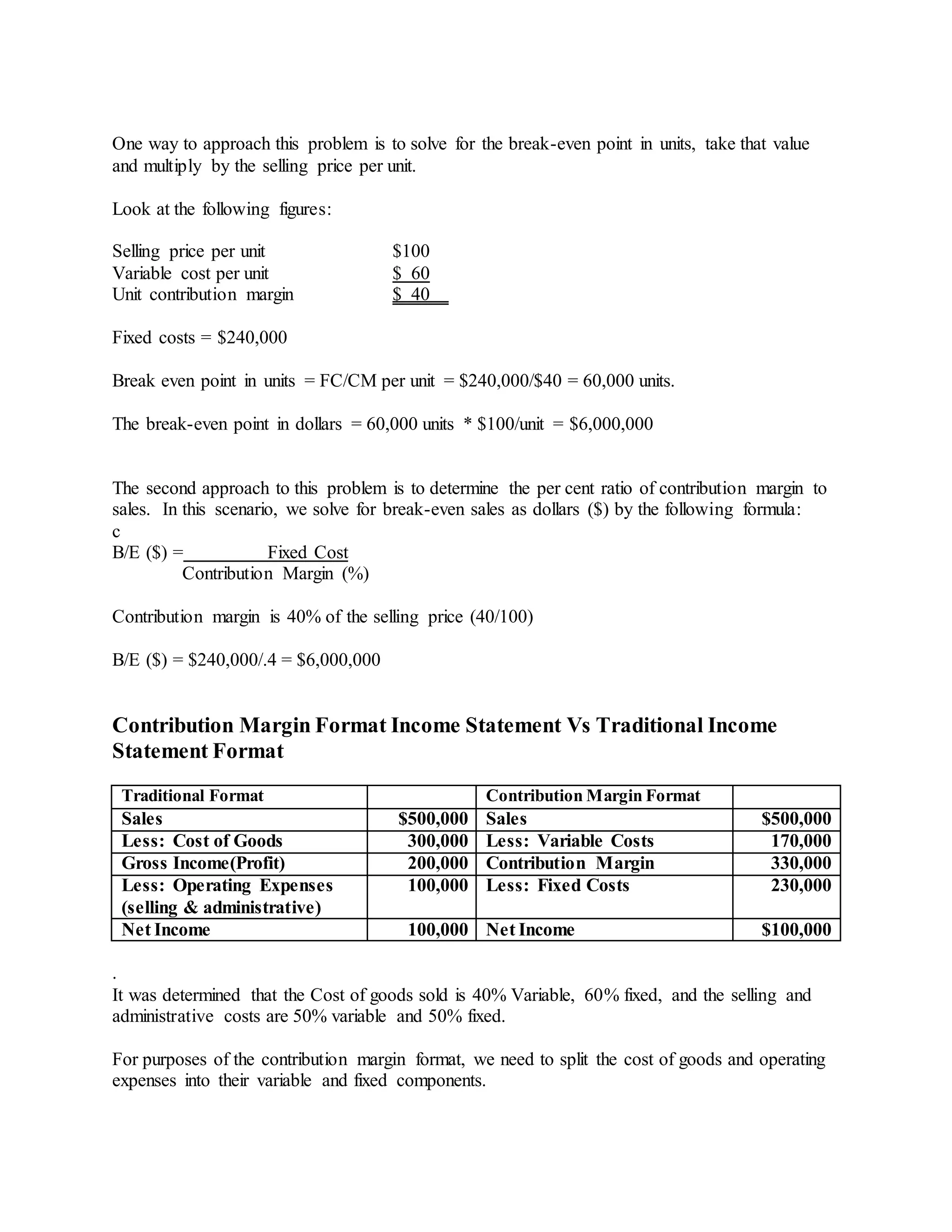
Contribution Margin Format Income Statement Vs Traditional Income
Statement Format
Traditional Format Contribution Margin Format
Sales $500,000 Sales $500,000
Less: Cost of Goods 300,000 Less: Variable Costs 170,000
Gross Income(Profit) 200,000 Contribution Margin 330,000
Less: Operating Expenses
(selling & administrative)
100,000 Less: Fixed Costs 230,000
Net Income 100,000 Net Income $100,000
.
It was determined that the Cost of goods sold is 40% Variable, 60% fixed, and the selling and
administrative costs are 50% variable and 50% fixed.
For purposes of the contribution margin format, we need to split the cost of goods and operating
expenses into their variable and fixed components.
Cost of goods: Variable = 40% *300,000 = $120,000. Fixed = 60% *$300,000 = $180,000
Operating Expenses are 50% variable or $50,000, and 50% fixed = $50,000.
Total Variable expenses = $120,000 + $50,000 = $170,000
Total Fixed Expenses = $180,000 + $50,000 = $230,000

Break Even Analysis

  • 1.
    Break Even Analysis Accountantsuse various approaches for expressing the relationship of costs, sales(volume), and income from operations (operating profit), The mathematical approach is one method that is used often in practice. The mathematical approach to cost-volume-profit analysis uses equations (1) to determine the units of sales necessary to achieve the break-even point in operations or (2) to determine the units of sales necessary to achieve a target or desired profit. The break-even point is the level of operations at which a business’s revenues and expired costs are exactly equal. At break-even, a business will have neither an income nor loss from operations. The break-even point is useful in business planning, especially when expanding or decreasing operations. To illustrate the computation of the break-even point, assume that the fixed costs for Barker Corporation are estimated to be $90,000. The unit selling price, unit variable cost, and unit contribution margin for Barker Corporation is as follows: Unit Selling Price $25 Unit Variable Cost 15 Contribution Margin $10 We can get the break-even point by formula: Unit Selling Price*Number of Units Sold = Unit Variable Cost*Number of Units Sold + Fixed Cost + 0 25 *x = 15 * x + 90,000 + 0 10x = 90,000 X = 90,000/10 = 9000 units We can also solve for the break-even point with the following equation: Break-even sales (units) = fixed cost ------------------------------------- I write this as B/E (units) = FC/CM per unit Contribution margin per unit = 90,000/10 = 9000 units Effectof Changes in Fixed Costs There are many reasons why fixed costs may change, such as changes in property tax rates or factory supervisor salaries. Increases in fixed costs will raise the break-even point while decreases in fixed costs should lower the break-even point.
  • 2.
    Consider the following:The Bishop Company is evaluating a proposal to budget an additional $100,000 for advertising. Fixed costs before the additional advertising are estimated at $600,000, and the unit contribution margin is $20. Before any additional expense is incurred, the break-even point is $600,000/$20 = 30,000 units [ that’s fixed cost/unit contribution margin] If the additional advertising cost is incurred, the fixed cost will now become $700,000 ; all other relationships and figures will remain the same, and the break-even point will now become $700,000/20 = 35,000 units. Effectof Change in Unit Variable Costs Unit variable costs are not affected by changes in volume of activity, but they may be affected by other factors such as changes in the price of direct materials and/or changes in the wages of factory workers providing direct labour. Increases in unit variable costs will raise the break-even point whereas decreases in unit variable costs will lower the break-even point. Consider the following: Park company is evaluating a proposal to pay an additional 2% commission on sales to salespeople as an incentive to increase sales. Fixed costs are estimated at $840,000, and the unit selling price, variable cost and unit contribution margin before the additional 2% commission are as follows. Unit selling price $250 Unit variable cost 145 Unit Contribution margin $105 The break even point in units is currently FC/unit CM or $840,000/$105 = 8000 units. The addition of a 2% commission will add 2% of $250 = $5 per unit variable cost. With this revision, SP= $250, variable cost (VC) = $145 + $5 = $150, and the contribution margin drops to $100 per unit. This increase in VC will cause the break-even point in units to increase. FC/unit CM = $840,000/$100 = 8400 units are required to break even. Effectof Changes in the Unit Selling Price Increases in the unit selling price will lower the break-even point, while decreases in the unit selling price will raise the break-even point.
  • 3.
    Consider the following:Graham Company is evaluating a proposal to increase the unit selling price of its product from $50 to $60. The following data have been gathered. Current Proposed Unit Selling Price $50 $60 Unit Variable Cost $30 $30 Unit Contribution Margin $20 $30 Total Fixed costs $600,000 $600,000 The break-even point based on the current selling price is as follows: B/E(units) = FC/unit CM = $600,000/$20 = 30,000 units The break-even point based on the proposed selling price is as follows: B/E(units) = FC/unit CM = $600,000/$30 = 20,000 units TargetProfit At the break-even point, sales and costs are exactly equal. That, however, is not the goal of businesses. Managers are looking to maximize profits. It is possible to modify the break-even equation to target a desired profit, and therefore estimate the required sales volume to meet that profit target. Target Sales = Fixed Cost + Target Profit CM per unit Consider the following: Fixed costs are estimated at $200,000, and the desired profit is $100,000. The unit selling price, unit variable cost, and unti contribution margin are as follows. Unit selling price $75 Unit variable cost 45 Unit contribution margin $30 The sales volume necessary to earn a profit of $100,000 is $200,000 +$100,000/$30 $300,000/$30 = 10,000 units. FYI In class, we not only spoke about determining the break-even point in units, but also determining the break-even point in sales dollars.
  • 4.
    One way toapproach this problem is to solve for the break-even point in units, take that value and multiply by the selling price per unit. Look at the following figures: Selling price per unit $100 Variable cost per unit $ 60 Unit contribution margin $ 40 Fixed costs = $240,000 Break even point in units = FC/CM per unit = $240,000/$40 = 60,000 units. The break-even point in dollars = 60,000 units * $100/unit = $6,000,000 The second approach to this problem is to determine the per cent ratio of contribution margin to sales. In this scenario, we solve for break-even sales as dollars ($) by the following formula: c B/E ($) = Fixed Cost Contribution Margin (%) Contribution margin is 40% of the selling price (40/100) B/E ($) = $240,000/.4 = $6,000,000 Contribution Margin Format Income Statement Vs Traditional Income Statement Format Traditional Format Contribution Margin Format Sales $500,000 Sales $500,000 Less: Cost of Goods 300,000 Less: Variable Costs 170,000 Gross Income(Profit) 200,000 Contribution Margin 330,000 Less: Operating Expenses (selling & administrative) 100,000 Less: Fixed Costs 230,000 Net Income 100,000 Net Income $100,000 . It was determined that the Cost of goods sold is 40% Variable, 60% fixed, and the selling and administrative costs are 50% variable and 50% fixed. For purposes of the contribution margin format, we need to split the cost of goods and operating expenses into their variable and fixed components.
  • 5.
    Cost of goods:Variable = 40% *300,000 = $120,000. Fixed = 60% *$300,000 = $180,000 Operating Expenses are 50% variable or $50,000, and 50% fixed = $50,000. Total Variable expenses = $120,000 + $50,000 = $170,000 Total Fixed Expenses = $180,000 + $50,000 = $230,000