Alisha Ancheary
B-Tech in Chemical Engineering
MBA in Human resource Management
Manufacturing Work-Ex-9 years
About me
• From Blue city-Jodhpur, Rajasthan
• Graduated in B.Tech –Chemical engineering From NIT Surat in 2012
• Worked as Assistant Manager With Adityabirla GRASIM In Gujarat for
9 years in Operations.
• Key experience in Production planning , Demand forecast , Project
evaluation, ERP system
• Post graduate in MBA –HRM 2018
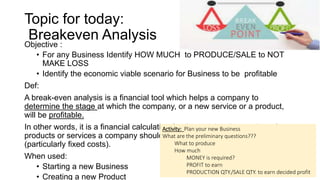
Topic for today:
Breakeven Analysis
Objective :
• For any Business Identify HOW MUCH to PRODUCE/SALE to NOT
MAKE LOSS
• Identify the economic viable scenario for Business to be profitable
Def:
A break-even analysis is a financial tool which helps a company to
determine the stage at which the company, or a new service or a product,
will be profitable.
In other words, it is a financial calculation for determining the number of
products or services a company should sell or provide to cover its costs
(particularly fixed costs).
When used:
• Starting a new Business
• Creating a new Product
Activity: Plan your new Business
What are the preliminary questions???
What to produce
How much
MONEY is required?
PROFIT to earn
PRODUCTION QTY./SALE QTY. to earn decided profit
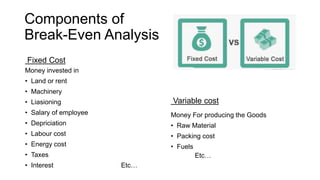
Components of
Break-Even Analysis
Fixed Cost
Money invested in
• Land or rent
• Machinery
• Liasioning
• Salary of employee
• Depriciation
• Labour cost
• Energy cost
• Taxes
• Interest Etc…
Variable cost
Money For producing the Goods
• Raw Material
• Packing cost
• Fuels
Etc…
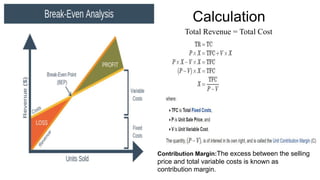
Calculation
Total Revenue = Total Cost
Contribution Margin:The excess between the selling
price and total variable costs is known as
contribution margin.
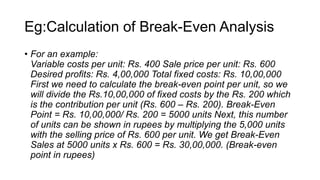
Eg:Calculation of Break-Even Analysis
• For an example:
Variable costs per unit: Rs. 400 Sale price per unit: Rs. 600
Desired profits: Rs. 4,00,000 Total fixed costs: Rs. 10,00,000
First we need to calculate the break-even point per unit, so we
will divide the Rs.10,00,000 of fixed costs by the Rs. 200 which
is the contribution per unit (Rs. 600 – Rs. 200). Break-Even
Point = Rs. 10,00,000/ Rs. 200 = 5000 units Next, this number
of units can be shown in rupees by multiplying the 5,000 units
with the selling price of Rs. 600 per unit. We get Break-Even
Sales at 5000 units x Rs. 600 = Rs. 30,00,000. (Break-even
point in rupees)
Useful to
• Tap in remaining/unused capacity of the
company once the breakeven is reached.
This will help to show the maximum profit
on a particular product/service that can be
generated.
• System improvisation :It helps to
determine the impact on profit on
changing to automation from manual (a
fixed cost replaces a variable cost).
• Price Determination: It helps to determine
the change in profits if the price of a
product is altered.
• Amount of Sustainable losses ,if there is a
sales downturn
Ways to Monitor
• Pricing analysis: Minimize or eliminate the
use of coupons or other price reductions
offers, since such promotional strategies
increase the breakeven point.
• Technology analysis: Implementing any
technology that can enhance the business
efficiency, thus increasing capacity with no
extra cost.
• Cost analysis: Reviewing all fixed costs
constantly to verify if any can be
eliminated can surely help. Also, review
the total variable costs to see if they can
be eliminated. This analysis will increase
the margin and reduce the breakeven
point.
• Margin analysis: Push sales of the
highest-margin (high contribution earning)
items and pay close attention to product
margins, thus reducing the breakeven
point.
• Outsourcing: If an activity consists of a
fixed cost, try to outsource such activity
(whenever possible), which reduces the
breakeven point.
Benefits of Break even analysis
• Catch missing expenses: You may forget about a few
expenses. Therefore, a break-even analysis can help you to
review all financial commitments to figure out your break-even
point. This analysis certainly restricts the number of surprises
down the road or at least prepares a company for them.
• Set revenue targets: To know how much you need to sell to be
profitable. This will help you and your sales team to set more
concrete sales goals.
• Make smarter decisions: Entrepreneurs often take decisions in
relation to their business based on emotion. Emotion is
important i.e. how you feel, though it’s not enough. In order to
be a successful entrepreneur, decisions should be based on
facts.
• Fund your business: This analysis is a key component in any
business plan. It’s generally a requirement if you want outsiders
to fund your business. In order to fund your business, you have
to prove that your plan is viable. Furthermore, if the analysis
looks good, you will be comfortable enough to take the burden
of various ways of financing.
• Better pricing: Finding the break-even point will help in pricing
the products better. This tool is highly used for providing the
best price of a product that can fetch maximum profit without
increasing the existing price.
Limitation
• The Break-even analysis is only a supply-side
(i.e., costs only) analysis, as it tells you
nothing about what sales are actually likely to
be for the product at these various prices.
• It assumes that fixed costs (FC) are constant.
Although this is true in the short run, an
increase in the scale of production is likely to
cause fixed costs to rise.
• It assumes average variable costs are constant
per unit of output, at least in the range of
likely quantities of sales. (i.e., linearity).
• It assumes that the quantity of goods
produced is equal to the quantity of goods
sold (i.e., there is no change in the quantity of
goods held in inventory at the beginning of
the period and the quantity of goods held in
inventory at the end of the period).
• In multi-product companies, it assumes that
the relative proportions of each product sold
and produced are constant (i.e., the sales mix
is constant).
END

Break-even analysis.pptx

  • 1.
    Alisha Ancheary B-Tech inChemical Engineering MBA in Human resource Management Manufacturing Work-Ex-9 years
  • 2.
    About me • FromBlue city-Jodhpur, Rajasthan • Graduated in B.Tech –Chemical engineering From NIT Surat in 2012 • Worked as Assistant Manager With Adityabirla GRASIM In Gujarat for 9 years in Operations. • Key experience in Production planning , Demand forecast , Project evaluation, ERP system • Post graduate in MBA –HRM 2018
  • 3.
    Topic for today: BreakevenAnalysis Objective : • For any Business Identify HOW MUCH to PRODUCE/SALE to NOT MAKE LOSS • Identify the economic viable scenario for Business to be profitable Def: A break-even analysis is a financial tool which helps a company to determine the stage at which the company, or a new service or a product, will be profitable. In other words, it is a financial calculation for determining the number of products or services a company should sell or provide to cover its costs (particularly fixed costs). When used: • Starting a new Business • Creating a new Product Activity: Plan your new Business What are the preliminary questions??? What to produce How much MONEY is required? PROFIT to earn PRODUCTION QTY./SALE QTY. to earn decided profit
  • 4.
    Components of Break-Even Analysis FixedCost Money invested in • Land or rent • Machinery • Liasioning • Salary of employee • Depriciation • Labour cost • Energy cost • Taxes • Interest Etc… Variable cost Money For producing the Goods • Raw Material • Packing cost • Fuels Etc…
  • 5.
    Calculation Total Revenue =Total Cost Contribution Margin:The excess between the selling price and total variable costs is known as contribution margin.
  • 6.
    Eg:Calculation of Break-EvenAnalysis • For an example: Variable costs per unit: Rs. 400 Sale price per unit: Rs. 600 Desired profits: Rs. 4,00,000 Total fixed costs: Rs. 10,00,000 First we need to calculate the break-even point per unit, so we will divide the Rs.10,00,000 of fixed costs by the Rs. 200 which is the contribution per unit (Rs. 600 – Rs. 200). Break-Even Point = Rs. 10,00,000/ Rs. 200 = 5000 units Next, this number of units can be shown in rupees by multiplying the 5,000 units with the selling price of Rs. 600 per unit. We get Break-Even Sales at 5000 units x Rs. 600 = Rs. 30,00,000. (Break-even point in rupees)
  • 7.
    Useful to • Tapin remaining/unused capacity of the company once the breakeven is reached. This will help to show the maximum profit on a particular product/service that can be generated. • System improvisation :It helps to determine the impact on profit on changing to automation from manual (a fixed cost replaces a variable cost). • Price Determination: It helps to determine the change in profits if the price of a product is altered. • Amount of Sustainable losses ,if there is a sales downturn Ways to Monitor • Pricing analysis: Minimize or eliminate the use of coupons or other price reductions offers, since such promotional strategies increase the breakeven point. • Technology analysis: Implementing any technology that can enhance the business efficiency, thus increasing capacity with no extra cost. • Cost analysis: Reviewing all fixed costs constantly to verify if any can be eliminated can surely help. Also, review the total variable costs to see if they can be eliminated. This analysis will increase the margin and reduce the breakeven point. • Margin analysis: Push sales of the highest-margin (high contribution earning) items and pay close attention to product margins, thus reducing the breakeven point. • Outsourcing: If an activity consists of a fixed cost, try to outsource such activity (whenever possible), which reduces the breakeven point.
  • 8.
    Benefits of Breakeven analysis • Catch missing expenses: You may forget about a few expenses. Therefore, a break-even analysis can help you to review all financial commitments to figure out your break-even point. This analysis certainly restricts the number of surprises down the road or at least prepares a company for them. • Set revenue targets: To know how much you need to sell to be profitable. This will help you and your sales team to set more concrete sales goals. • Make smarter decisions: Entrepreneurs often take decisions in relation to their business based on emotion. Emotion is important i.e. how you feel, though it’s not enough. In order to be a successful entrepreneur, decisions should be based on facts. • Fund your business: This analysis is a key component in any business plan. It’s generally a requirement if you want outsiders to fund your business. In order to fund your business, you have to prove that your plan is viable. Furthermore, if the analysis looks good, you will be comfortable enough to take the burden of various ways of financing. • Better pricing: Finding the break-even point will help in pricing the products better. This tool is highly used for providing the best price of a product that can fetch maximum profit without increasing the existing price. Limitation • The Break-even analysis is only a supply-side (i.e., costs only) analysis, as it tells you nothing about what sales are actually likely to be for the product at these various prices. • It assumes that fixed costs (FC) are constant. Although this is true in the short run, an increase in the scale of production is likely to cause fixed costs to rise. • It assumes average variable costs are constant per unit of output, at least in the range of likely quantities of sales. (i.e., linearity). • It assumes that the quantity of goods produced is equal to the quantity of goods sold (i.e., there is no change in the quantity of goods held in inventory at the beginning of the period and the quantity of goods held in inventory at the end of the period). • In multi-product companies, it assumes that the relative proportions of each product sold and produced are constant (i.e., the sales mix is constant). END

Editor's Notes

  • #4 Starting a new business: To start a new business, a break-even analysis is a must. Not only it helps in deciding whether the idea of starting a new business is viable, but it will force the startup to be realistic about the costs, as well as provide a basis for the pricing strategy. Creating a new product: In the case of an existing business, the company should still peform a break-even analysis before launching a new product—particularly if such a product is going to add a significant expenditure. Changing the business model: If the company is about to the change the business model, like, switching from wholesale business to retail business, then a break-even analysis must be performed. The costs could change considerably and breakeven analysis will help in setting the selling price.
  • #6 Break-even analysis is useful in studying the relation between the variable cost, fixed cost and revenue. Generally, a company with low fixed costs will have a low break-even point of sale.
  • #8 break-even analysis is very useful for knowing the overall ability of a business to generate a profit. In the case of a company whose breakeven point is near to the maximum sales level, this signifies that it is nearly impractical for the business to earn a profit even under the best of circumstances