1
Cost-Volume-Profit Analysis (CVP)
Cost-volume-profit (CVP) analysis is used to
determine how changes in costs and volume affect a
company's operating income and net income. In
performing this analysis, there are several
assumptions made, including:
 Sales price per unit is constant.
 Variable costs per unit are constant.
 Total fixed costs are constant.
 Everything produced is sold.
 Costs are only affected because activity changes.
 If a company sells more than one product, they are
sold in the same mix.
CVP analysis requires that all the company's costs,
including manufacturing, selling, and administrative
costs, be identified as variable or fixed.
2
CVP analysis is the analysis of three variable viz. cost,
volume and profit. Such analysis explores the
relationship existing amongst costs, revenue, and
activity level and resulting profit. It aims at measuring
variation of cost with profit. It shows:
- The total costs (fixed and variable)
- The total sales revenues
- Desired profits vis-a-vis the sales volume.
Uses:-
1) It is used for forecasting or predicting how the
changes in costs and sales volume affect profit. It
is also known as 'Break-Even Analysis'.
2)Budget planning: for forecasting profit by
considering cost and profit relation, and volume of
3
production volume. This will help in determining
the sales volume required to make a profit.
3)To make decisions regarding pricing and sales
volume.
4)Determining the sales mix of different products,
in what proportions each of the products can be
sold.
5)Preparing flexible budget considering costs at
different levels of production.
6)Many companies and accounting professionals use
cost-volume-profit analysis to make informed
decisions about the products or services they sell.
Objectives of CVP Analysis:-
 Prices of products.
 Volume or level of activity.
 Per unit variable cost.
4
 Total fixed cost.
 Mix of product sold.
IMPORTANCE:
 It provides an insight into the effects and inter-
relationship of factors, which influence the profits of
the firm. The relationship between cost, volume and
profit makes up the profit structure of an enterprise.
The CVP relationship becomes essential for budgeting
and profit planning.
 A starting point in profit planning, it helps to
determine the maximum sales volume to avoid losses,
and the sales volume at which the profit goal of the
firm will be achieved.
 As an ultimate objective it helps management to find
the most profitable combination of costs and volume.
5
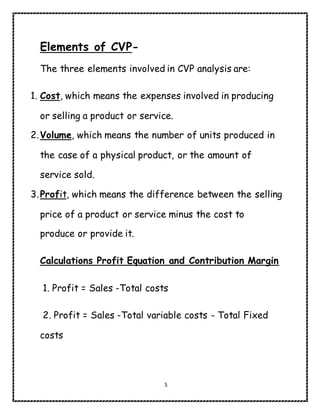
Elements of CVP-
The three elements involved in CVP analysis are:
1. Cost, which means the expenses involved in producing
or selling a product or service.
2.Volume, which means the number of units produced in
the case of a physical product, or the amount of
service sold.
3.Profit, which means the difference between the selling
price of a product or service minus the cost to
produce or provide it.
Calculations Profit Equation and Contribution Margin
1. Profit = Sales -Total costs
2. Profit = Sales -Total variable costs - Total Fixed
costs
6
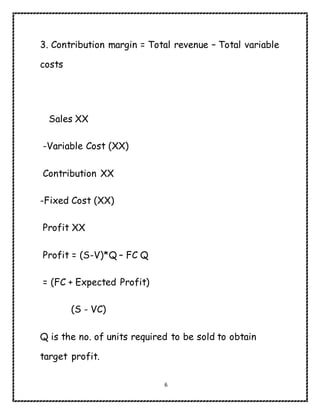
3. Contribution margin = Total revenue – Total variable
costs
Sales XX
-Variable Cost (XX)
Contribution XX
-Fixed Cost (XX)
Profit XX
Profit = (S-V)*Q – FC Q
= (FC + Expected Profit)
(S - VC)
Q is the no. of units required to be sold to obtain
target profit.
7
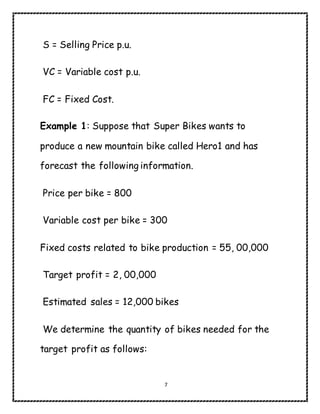
S = Selling Price p.u.
VC = Variable cost p.u.
FC = Fixed Cost.
Example 1: Suppose that Super Bikes wants to
produce a new mountain bike called Hero1 and has
forecast the following information.
Price per bike = 800
Variable cost per bike = 300
Fixed costs related to bike production = 55, 00,000
Target profit = 2, 00,000
Estimated sales = 12,000 bikes
We determine the quantity of bikes needed for the
target profit as follows:
8
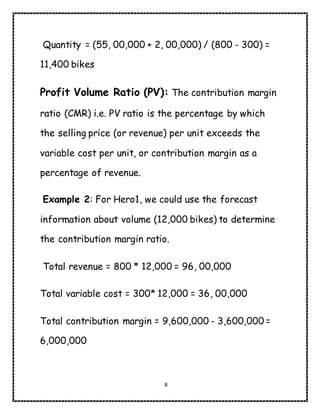
Quantity = (55, 00,000 + 2, 00,000) / (800 - 300) =
11,400 bikes
Profit Volume Ratio (PV): The contribution margin
ratio (CMR) i.e. PV ratio is the percentage by which
the selling price (or revenue) per unit exceeds the
variable cost per unit, or contribution margin as a
percentage of revenue.
Example 2: For Hero1, we could use the forecast
information about volume (12,000 bikes) to determine
the contribution margin ratio.
Total revenue = 800 * 12,000 = 96, 00,000
Total variable cost = 300* 12,000 = 36, 00,000
Total contribution margin = 9,600,000 - 3,600,000 =
6,000,000
9
Contribution margin ratio = 6,000,000 / 9,600,000 =
0.625
BEP analysis: Breakeven analysis is used to find the
minimum level of production required.
Evaluates both fixed and variable costs.
Uses:
1. To find a suitable product mix.
2. To find the sales required to reach a desired
revenue.
3. The profits at certain price level and sales.
10
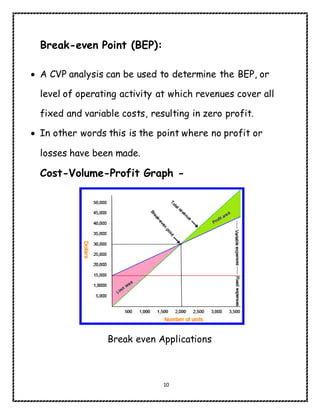
Break-even Point (BEP):
 A CVP analysis can be used to determine the BEP, or
level of operating activity at which revenues cover all
fixed and variable costs, resulting in zero profit.
 In other words this is the point where no profit or
losses have been made.
Cost-Volume-Profit Graph -
Break even Applications
11
 New Product decisions:- Enables to determine the
sale volume required for a firm (or an individual
product) to breakeven, given expected sales price
and expected costs.
 Pricing decisions: - Enables to study the effect of
changing price and volume relationship on total
profits.
 Modernizations or automation decisions:- Analysis
the profit in implication of a modernization or
automation programme.
 Expansion Decisions:- studies the aggregate
effect of a general expansion in production and
sales.
 Formulae BEP in units = Total fixed costs/
(Sales price – variable cost p.u.)
=Fixed cost/ Contribution per unit
 BEP in sales value = Fixed cost/PV Ratio
12
Example
I. Sales 5000 units.
II. Sales price per unit Rs. 50.
III. Variable cost per unit Rs. 30.
IV. Fixed cost Rs. 35000.
Therefore, contribution per unit = 50 - 30 = Rs. 20
BEP in units = 35000/20 = 1750 units
1750 * 50 = Rs. 87500
BEP in sales value = 35000 * 250000 / 87500 = Rs.
100000
Margin of safety
Represents the strength of the business.
Margin of Safety = Actual Sale – BEP Sale
Margin of safety % = (Sales - BEP) / Sales x 100
Margin of safety = (5000 - 1750) 5000 = 65 %
Hence even if the sales decrease by 65%,%, the
business won’t face any loss.
13
Desired profit/desired sale:
 In terms of Rs =Fixed cost +desired profit/p.v
ratio
 In terms of volume= fixed cost + desired
profit/contribution per unit
Alternatives choice decision
Relevant cost: Management needs sufficient and
relevant information makes the correct decisions.
Hence, the need to understand relevant costs. A
relevant cost relates to future expected costs that
will differ with each alternative used. Because of
the difference amongst alternative, hence it has a
bearing on the decision to be made. Irrelevant costs
simply are costs that will not affect the decision. By
analyzing these types of irrelevant costs,
management will be wasting their time and efforts
14
as these costs do not affect the decision they are
going to make.
FEATURES or CRITERIA of Relevant Costs:
•Relevant cost is a cost that will be incurred in the
future. Historical costs are sunk costs which has no
relevancy in the decision making.
•The costs must differ between alternatives. If a
cost is the same whether we choose alternative A or
B then this is an irrelevant cost. A good example is
factory rental which remains the same irrespective
of management wanting to manufacture product A or
B.
•Only CASH flow item And Incremental fixed costs
are relevant. Non cash item like depreciation and
absorbed fixed overheads are not relevant costs as
they do not involve any additional cash flow.
15
Applications:-
•Limiting factor due to scarce resources;
•Make or Buy decision;
•Accept or Reject special order;
•To continue or discontinue or shut down decisions;
•Pricing
SUNK COST: Sunk cost is a cost that has already
been incurred and will not be changed or avoided in
the future. In other words, sunk costs are costs
that have already been recorded. In accounting, sunk
costs represent costs that have already been
incurred and will not require current or future cash
expenditures. Because sunk costs cannot be changed
or avoided in the future, they are not relevant for
decision making purposes. That is, when evaluating
16
multiple alternatives, sunk costs should not be
considered. Sunk costs are unavoidable and do not
matter at that point. It might be somewhat
counterintuitive for many people.
Programmed cost: Project Cost Management is a
series of activities for estimating, allocating, and
controlling costs within the project. It allows
determining and approving budget for the project
and controlling spending. For example, in
construction project cost management it is vital to
estimate cost of materials, equipment, salary of
workers, etc. In IT project cost management it is
critical to estimate cost of software development,
salary of IT staff, etc.
17
Make or buy process:
Ina make or buy situation with no limiting factors,
the relevant costs for the decision are the
Differential costs between the two options.
A make or buy problem involves a decision by
an organization about whether it should make a
product/carry out an activity with its own internal
resources, or whether it should pay another
organization to make the production/carry out the a
ctivity. Examples of make or buy decisions would be
as follows.
1) Whether a company should manufacture its own
components, or buy the components from an
outside supplier.
2)Whether a construction company should do some
work with its own employees, or
18
whether it should
subcontract the work to another company.
Itan organization has the freedom of choice about
whether to make internally or buy externally
and has no scarce resources that put a restriction
on what it can do itself, the relevant costs for
the decision will be the differential costs between
the two options.
Reasons for Making:
 Cost concerns
 Need of direct control over the product
 Quality control concerns
 Lack of competent suppliers
 Volume too small to get a supplier attracted
 Reduction of logistic costs
19
Reasons for Buying:
 Lack of technical experience
 Supplier's expertise on the technical areas and
the domain
 Cost considerations
 Need of small volume
 Insufficient capacity to produce in-house
 Brand preferences
 Strategic partnerships
The Process: The make or buy decision can be in
many scales. If the decision is small in nature and
has less impact on the business, then even one
person can make the decision. The person can
consider the pros and cons between making and
buying and finally arrive at a decision. When it
comes to larger and high impact decisions, usually
20
organizations follow a standard method to arrive
at a decision. This method can be divided into four
main stages as below:
1. Preparation:-
i).Team creation and appointment of the team
leader
ii).Identifying the product requirements and
analysis.
iii).Team briefing and aspect/area destitution
2. Data Collection: Collecting information on
various aspects of make-or-buy decision.
Workshops on weightings, ratings, and cost for both
make-or-buy
3. Data Analysis: Analysis of data gathered
21
4. Feedback: Feedback on the decision made By
following the above structured process, the
organization can make an informed decision on make-
or-buy. Although this is a standard process for
making the make-or-buy decision, the organizations
can have their own varieties.

Notes on Cost volume profit analysis

  • 1.
    1 Cost-Volume-Profit Analysis (CVP) Cost-volume-profit(CVP) analysis is used to determine how changes in costs and volume affect a company's operating income and net income. In performing this analysis, there are several assumptions made, including:  Sales price per unit is constant.  Variable costs per unit are constant.  Total fixed costs are constant.  Everything produced is sold.  Costs are only affected because activity changes.  If a company sells more than one product, they are sold in the same mix. CVP analysis requires that all the company's costs, including manufacturing, selling, and administrative costs, be identified as variable or fixed.
  • 2.
    2 CVP analysis isthe analysis of three variable viz. cost, volume and profit. Such analysis explores the relationship existing amongst costs, revenue, and activity level and resulting profit. It aims at measuring variation of cost with profit. It shows: - The total costs (fixed and variable) - The total sales revenues - Desired profits vis-a-vis the sales volume. Uses:- 1) It is used for forecasting or predicting how the changes in costs and sales volume affect profit. It is also known as 'Break-Even Analysis'. 2)Budget planning: for forecasting profit by considering cost and profit relation, and volume of
  • 3.
    3 production volume. Thiswill help in determining the sales volume required to make a profit. 3)To make decisions regarding pricing and sales volume. 4)Determining the sales mix of different products, in what proportions each of the products can be sold. 5)Preparing flexible budget considering costs at different levels of production. 6)Many companies and accounting professionals use cost-volume-profit analysis to make informed decisions about the products or services they sell. Objectives of CVP Analysis:-  Prices of products.  Volume or level of activity.  Per unit variable cost.
  • 4.
    4  Total fixedcost.  Mix of product sold. IMPORTANCE:  It provides an insight into the effects and inter- relationship of factors, which influence the profits of the firm. The relationship between cost, volume and profit makes up the profit structure of an enterprise. The CVP relationship becomes essential for budgeting and profit planning.  A starting point in profit planning, it helps to determine the maximum sales volume to avoid losses, and the sales volume at which the profit goal of the firm will be achieved.  As an ultimate objective it helps management to find the most profitable combination of costs and volume.
  • 5.
    5 Elements of CVP- Thethree elements involved in CVP analysis are: 1. Cost, which means the expenses involved in producing or selling a product or service. 2.Volume, which means the number of units produced in the case of a physical product, or the amount of service sold. 3.Profit, which means the difference between the selling price of a product or service minus the cost to produce or provide it. Calculations Profit Equation and Contribution Margin 1. Profit = Sales -Total costs 2. Profit = Sales -Total variable costs - Total Fixed costs
  • 6.
    6 3. Contribution margin= Total revenue – Total variable costs Sales XX -Variable Cost (XX) Contribution XX -Fixed Cost (XX) Profit XX Profit = (S-V)*Q – FC Q = (FC + Expected Profit) (S - VC) Q is the no. of units required to be sold to obtain target profit.
  • 7.
    7 S = SellingPrice p.u. VC = Variable cost p.u. FC = Fixed Cost. Example 1: Suppose that Super Bikes wants to produce a new mountain bike called Hero1 and has forecast the following information. Price per bike = 800 Variable cost per bike = 300 Fixed costs related to bike production = 55, 00,000 Target profit = 2, 00,000 Estimated sales = 12,000 bikes We determine the quantity of bikes needed for the target profit as follows:
  • 8.
    8 Quantity = (55,00,000 + 2, 00,000) / (800 - 300) = 11,400 bikes Profit Volume Ratio (PV): The contribution margin ratio (CMR) i.e. PV ratio is the percentage by which the selling price (or revenue) per unit exceeds the variable cost per unit, or contribution margin as a percentage of revenue. Example 2: For Hero1, we could use the forecast information about volume (12,000 bikes) to determine the contribution margin ratio. Total revenue = 800 * 12,000 = 96, 00,000 Total variable cost = 300* 12,000 = 36, 00,000 Total contribution margin = 9,600,000 - 3,600,000 = 6,000,000
  • 9.
    9 Contribution margin ratio= 6,000,000 / 9,600,000 = 0.625 BEP analysis: Breakeven analysis is used to find the minimum level of production required. Evaluates both fixed and variable costs. Uses: 1. To find a suitable product mix. 2. To find the sales required to reach a desired revenue. 3. The profits at certain price level and sales.
  • 10.
    10 Break-even Point (BEP): A CVP analysis can be used to determine the BEP, or level of operating activity at which revenues cover all fixed and variable costs, resulting in zero profit.  In other words this is the point where no profit or losses have been made. Cost-Volume-Profit Graph - Break even Applications
  • 11.
    11  New Productdecisions:- Enables to determine the sale volume required for a firm (or an individual product) to breakeven, given expected sales price and expected costs.  Pricing decisions: - Enables to study the effect of changing price and volume relationship on total profits.  Modernizations or automation decisions:- Analysis the profit in implication of a modernization or automation programme.  Expansion Decisions:- studies the aggregate effect of a general expansion in production and sales.  Formulae BEP in units = Total fixed costs/ (Sales price – variable cost p.u.) =Fixed cost/ Contribution per unit  BEP in sales value = Fixed cost/PV Ratio
  • 12.
    12 Example I. Sales 5000units. II. Sales price per unit Rs. 50. III. Variable cost per unit Rs. 30. IV. Fixed cost Rs. 35000. Therefore, contribution per unit = 50 - 30 = Rs. 20 BEP in units = 35000/20 = 1750 units 1750 * 50 = Rs. 87500 BEP in sales value = 35000 * 250000 / 87500 = Rs. 100000 Margin of safety Represents the strength of the business. Margin of Safety = Actual Sale – BEP Sale Margin of safety % = (Sales - BEP) / Sales x 100 Margin of safety = (5000 - 1750) 5000 = 65 % Hence even if the sales decrease by 65%,%, the business won’t face any loss.
  • 13.
    13 Desired profit/desired sale: In terms of Rs =Fixed cost +desired profit/p.v ratio  In terms of volume= fixed cost + desired profit/contribution per unit Alternatives choice decision Relevant cost: Management needs sufficient and relevant information makes the correct decisions. Hence, the need to understand relevant costs. A relevant cost relates to future expected costs that will differ with each alternative used. Because of the difference amongst alternative, hence it has a bearing on the decision to be made. Irrelevant costs simply are costs that will not affect the decision. By analyzing these types of irrelevant costs, management will be wasting their time and efforts
  • 14.
    14 as these costsdo not affect the decision they are going to make. FEATURES or CRITERIA of Relevant Costs: •Relevant cost is a cost that will be incurred in the future. Historical costs are sunk costs which has no relevancy in the decision making. •The costs must differ between alternatives. If a cost is the same whether we choose alternative A or B then this is an irrelevant cost. A good example is factory rental which remains the same irrespective of management wanting to manufacture product A or B. •Only CASH flow item And Incremental fixed costs are relevant. Non cash item like depreciation and absorbed fixed overheads are not relevant costs as they do not involve any additional cash flow.
  • 15.
    15 Applications:- •Limiting factor dueto scarce resources; •Make or Buy decision; •Accept or Reject special order; •To continue or discontinue or shut down decisions; •Pricing SUNK COST: Sunk cost is a cost that has already been incurred and will not be changed or avoided in the future. In other words, sunk costs are costs that have already been recorded. In accounting, sunk costs represent costs that have already been incurred and will not require current or future cash expenditures. Because sunk costs cannot be changed or avoided in the future, they are not relevant for decision making purposes. That is, when evaluating
  • 16.
    16 multiple alternatives, sunkcosts should not be considered. Sunk costs are unavoidable and do not matter at that point. It might be somewhat counterintuitive for many people. Programmed cost: Project Cost Management is a series of activities for estimating, allocating, and controlling costs within the project. It allows determining and approving budget for the project and controlling spending. For example, in construction project cost management it is vital to estimate cost of materials, equipment, salary of workers, etc. In IT project cost management it is critical to estimate cost of software development, salary of IT staff, etc.
  • 17.
    17 Make or buyprocess: Ina make or buy situation with no limiting factors, the relevant costs for the decision are the Differential costs between the two options. A make or buy problem involves a decision by an organization about whether it should make a product/carry out an activity with its own internal resources, or whether it should pay another organization to make the production/carry out the a ctivity. Examples of make or buy decisions would be as follows. 1) Whether a company should manufacture its own components, or buy the components from an outside supplier. 2)Whether a construction company should do some work with its own employees, or
  • 18.
    18 whether it should subcontractthe work to another company. Itan organization has the freedom of choice about whether to make internally or buy externally and has no scarce resources that put a restriction on what it can do itself, the relevant costs for the decision will be the differential costs between the two options. Reasons for Making:  Cost concerns  Need of direct control over the product  Quality control concerns  Lack of competent suppliers  Volume too small to get a supplier attracted  Reduction of logistic costs
  • 19.
    19 Reasons for Buying: Lack of technical experience  Supplier's expertise on the technical areas and the domain  Cost considerations  Need of small volume  Insufficient capacity to produce in-house  Brand preferences  Strategic partnerships The Process: The make or buy decision can be in many scales. If the decision is small in nature and has less impact on the business, then even one person can make the decision. The person can consider the pros and cons between making and buying and finally arrive at a decision. When it comes to larger and high impact decisions, usually
  • 20.
    20 organizations follow astandard method to arrive at a decision. This method can be divided into four main stages as below: 1. Preparation:- i).Team creation and appointment of the team leader ii).Identifying the product requirements and analysis. iii).Team briefing and aspect/area destitution 2. Data Collection: Collecting information on various aspects of make-or-buy decision. Workshops on weightings, ratings, and cost for both make-or-buy 3. Data Analysis: Analysis of data gathered
  • 21.
    21 4. Feedback: Feedbackon the decision made By following the above structured process, the organization can make an informed decision on make- or-buy. Although this is a standard process for making the make-or-buy decision, the organizations can have their own varieties.