- By Sundarrajan M [email_address] Based on Shank and Govindarajan’s “Strategic Cost Management”: The New Tool for Competitive Advantage
Traditionally viewed as a process of assessing the financial impact of alternative managerial decisions Establishes budget and actual cost of operations, processes, departments or product and the analysis of variances, profitability or social use of funds Important tool used is “variance analysis” to show the variation b/w actual cost and standard costs volume variation Material cost variation Labor cost variation Limitations felt in using variance analysis Why costs were different from what was planned? Lack of integration with organizational goal
Cost analysis in terms of products, customers and functions Strongly internal focus Basic objective in identifying the cost is  Score keeping (recording and compliance of the profession) Attention directing  Problem solving Cost is assumed as a function of output volume (variable cost, fixed cost and mixed cost) Standard cost system with normal allowance for scrap, waste, rework; zero defect standard  is not practical. Overhead variance analysis; maximize  production volume (not quality) to absorb overhead. Variance analysis on raw material price; procedure from multiple suppliers to avoid unfavorable price variance; low price/low- quality raw materials No emphasis on nonfinancial performance measure
It is cost analysis in a broader context, where the strategic elements become more conscious, explicit, and formal Cost data is used to develop superior strategies in route to gaining sustainable competitive advantage SCM gives a clear understanding of the firm’s cost structure in search of sustainable competitive advantage  SCM is the managerial use of cost information explicitly directed at one or more of the four stages (strategy formulation, communicating the strategy, implementing and controlling) of strategic management  Overall recognition of the cost relationships among the activities in the value chain, and the process of managing those cost relationships to a firm's advantage
“ My team has created a very innovative solution, but we’re still looking for a problem to go with it.” Problems identified:  We  have solutions, but we have a problem in fitting the correct solution Lack of integration with the system and the synchronization with central theme of the Organization / Project
Cost analysis in terms of overall value chain of which the firm is a part  Strongly external focus The design of cost management systems changes dramatically depending on the basic strategic positioning of the firm Cost leadership or  Product differentiation Cost is a function of strategic choice about the structure of how to compete and managerial skill in executing the strategic choices Structural cost drivers  and Executional cost drivers
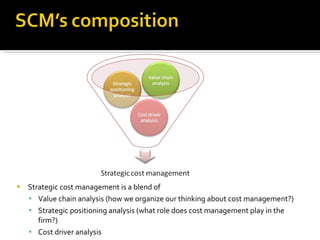
Strategic cost management is a blend of  Value chain analysis (how we organize our thinking about cost management?) Strategic positioning analysis (what role does cost management play in the firm?) Cost driver analysis
Organize our thinking about cost management A Systematic approach to examining the development of competitive advantage The chain consists of a series of activities that create and build value They culminate in the total value delivered by an organization Helps to determine which type of competitive advantage to pursue, and how to pursue it Value is referred to as the price that the customer is willing to pay for a certain offering
External focus perspective, linked with activities from raw material suppliers to ultimate end user Multiple cost driver concept Structural drivers (scale, scope, experience, technology, complexity) Executional drivers (participative management, TQM) Cost containment is a function of the cost drivers regulating each value activity Exploiting linkages with suppliers, customers and process within the firm Insights for strategic decision by  identifying the cost drivers at the individual activity level  Develop drivers by controlling those drivers better than competitors or by reconfiguration of value chain Quantify and asses stake holders power and exploit the linkages
Source: Adopted from Porter's  5 force model (Competitive Advantage (1980).
Depends on the firm’s idea, how to compete? Cost leadership Product differentiation Cost leadership  Mature market Commodity business Target cost Product differentiation Market driven Rapidly growing market Fast changing business Effective control system should be implemented to monitor the cost
Primary Strategic Emphasis Product Differentiation Cost Leadership Role of product cost in assessing performance Not very important Very important Importance of flexible budgeting for cost control Moderate to Low High to very high Perceived importance of meeting budgets Moderate to Low High to very high Importance of marketing cost analysis Critical to success Not done on formal basis Importance of product cost as an input to pricing decision Low High Importance of competitor cost analysis Low High
Third key to strategic cost management Output cost is seen to capture very little of the richness of the cost behavior Cost drivers in SCM can be classified as Structural drivers Executional drivers Structural cost drives the product cost of the organization Scale: how big an investment to make in manufacturing, R&D, and in marketing resources? Scope: Degree if vertical integration Experience: how many times in the past the firm has already done what it is doing again? Technology: what process technologies are used at each step of the firm’s value chain?  Complexity: how wise a line or products of services to offer to customers? (usage of ABC)
Executional cost determines the firm’s cost position to execute the strategy successfully These cost drivers are scaled with the performance Basic executional drivers Work force involvement (participation) – workforce commitment to continual improvement TQM, Capacity utilization, Plan layout efficiency and Product configuration For strategic analysis, volume is usually not the most useful way to explain cost behavior In a strategic sense, it is more useful to explain cost position in terms of the structural choices about executional skills that shape the firm’s competitive position Not all the strategic drivers are equally important all the time, but some of them are very important in every case For each driver there is a particular cost analysis frame work that is critical to understanding the positioning of a firm
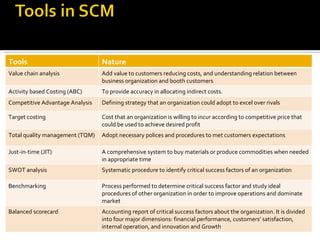
Tools Nature Value chain analysis Add value to customers reducing costs, and understanding relation between business organization and booth customers Activity based Costing (ABC) To provide accuracy in allocating indirect costs. Competitive Advantage Analysis Defining strategy that an organization could adopt to excel over rivals Target costing  Cost that an organization is willing to incur according to competitive price that could be used to achieve desired profit Total quality management (TQM) Adopt necessary polices and procedures to met customers expectations Just-in-time (JIT) A comprehensive system to buy materials or produce commodities when needed in appropriate time SWOT analysis  Systematic procedure to identify critical success factors of an organization Benchmarking  Process performed to determine critical success factor and study ideal procedures of other organization in order to improve operations and dominate market Balanced scorecard Accounting report of critical success factors about the organization. It is divided into four major dimensions: financial performance, customers’ satisfaction, internal operation, and innovation and Growth
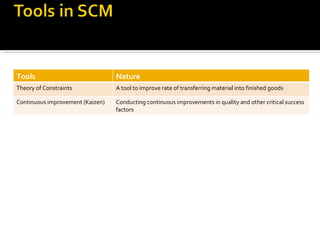
Tools Nature Theory of Constraints A tool to improve rate of transferring material into finished goods Continuous improvement (Kaizen) Conducting continuous improvements in quality and other critical success factors
 
 
A firm can create a cost advantage by 2 ways Reducing the cost of individual value chain activities Reconfiguring the value chain
Some of the tools used to find cost in value analysis are Lifecycle costing  Supply chain management Return on Asset Discounted cash flow analysis
Product’s costs over its entire lifetime when deciding whether to introduce a new product Not all products will follow this pattern Some products will fail early and have a truncated life cycle  5 Stages in product life cycle Product development and planning Introduction phase Growth phase Product maturity phase Product decline and abandonment phase
Send your feedbacks to:  [email_address]

Strategic Cost Management

  • 1.
    - By SundarrajanM [email_address] Based on Shank and Govindarajan’s “Strategic Cost Management”: The New Tool for Competitive Advantage
  • 2.
    Traditionally viewed asa process of assessing the financial impact of alternative managerial decisions Establishes budget and actual cost of operations, processes, departments or product and the analysis of variances, profitability or social use of funds Important tool used is “variance analysis” to show the variation b/w actual cost and standard costs volume variation Material cost variation Labor cost variation Limitations felt in using variance analysis Why costs were different from what was planned? Lack of integration with organizational goal
  • 3.
    Cost analysis interms of products, customers and functions Strongly internal focus Basic objective in identifying the cost is Score keeping (recording and compliance of the profession) Attention directing Problem solving Cost is assumed as a function of output volume (variable cost, fixed cost and mixed cost) Standard cost system with normal allowance for scrap, waste, rework; zero defect standard is not practical. Overhead variance analysis; maximize production volume (not quality) to absorb overhead. Variance analysis on raw material price; procedure from multiple suppliers to avoid unfavorable price variance; low price/low- quality raw materials No emphasis on nonfinancial performance measure
  • 4.
    It is costanalysis in a broader context, where the strategic elements become more conscious, explicit, and formal Cost data is used to develop superior strategies in route to gaining sustainable competitive advantage SCM gives a clear understanding of the firm’s cost structure in search of sustainable competitive advantage SCM is the managerial use of cost information explicitly directed at one or more of the four stages (strategy formulation, communicating the strategy, implementing and controlling) of strategic management Overall recognition of the cost relationships among the activities in the value chain, and the process of managing those cost relationships to a firm's advantage
  • 5.
    “ My teamhas created a very innovative solution, but we’re still looking for a problem to go with it.” Problems identified: We have solutions, but we have a problem in fitting the correct solution Lack of integration with the system and the synchronization with central theme of the Organization / Project
  • 6.
    Cost analysis interms of overall value chain of which the firm is a part Strongly external focus The design of cost management systems changes dramatically depending on the basic strategic positioning of the firm Cost leadership or Product differentiation Cost is a function of strategic choice about the structure of how to compete and managerial skill in executing the strategic choices Structural cost drivers and Executional cost drivers
  • 7.
    Strategic cost managementis a blend of Value chain analysis (how we organize our thinking about cost management?) Strategic positioning analysis (what role does cost management play in the firm?) Cost driver analysis
  • 8.
    Organize our thinkingabout cost management A Systematic approach to examining the development of competitive advantage The chain consists of a series of activities that create and build value They culminate in the total value delivered by an organization Helps to determine which type of competitive advantage to pursue, and how to pursue it Value is referred to as the price that the customer is willing to pay for a certain offering
  • 9.
    External focus perspective,linked with activities from raw material suppliers to ultimate end user Multiple cost driver concept Structural drivers (scale, scope, experience, technology, complexity) Executional drivers (participative management, TQM) Cost containment is a function of the cost drivers regulating each value activity Exploiting linkages with suppliers, customers and process within the firm Insights for strategic decision by identifying the cost drivers at the individual activity level Develop drivers by controlling those drivers better than competitors or by reconfiguration of value chain Quantify and asses stake holders power and exploit the linkages
  • 10.
    Source: Adopted fromPorter's 5 force model (Competitive Advantage (1980).
  • 11.
    Depends on thefirm’s idea, how to compete? Cost leadership Product differentiation Cost leadership Mature market Commodity business Target cost Product differentiation Market driven Rapidly growing market Fast changing business Effective control system should be implemented to monitor the cost
  • 12.
    Primary Strategic EmphasisProduct Differentiation Cost Leadership Role of product cost in assessing performance Not very important Very important Importance of flexible budgeting for cost control Moderate to Low High to very high Perceived importance of meeting budgets Moderate to Low High to very high Importance of marketing cost analysis Critical to success Not done on formal basis Importance of product cost as an input to pricing decision Low High Importance of competitor cost analysis Low High
  • 13.
    Third key tostrategic cost management Output cost is seen to capture very little of the richness of the cost behavior Cost drivers in SCM can be classified as Structural drivers Executional drivers Structural cost drives the product cost of the organization Scale: how big an investment to make in manufacturing, R&D, and in marketing resources? Scope: Degree if vertical integration Experience: how many times in the past the firm has already done what it is doing again? Technology: what process technologies are used at each step of the firm’s value chain? Complexity: how wise a line or products of services to offer to customers? (usage of ABC)
  • 14.
    Executional cost determinesthe firm’s cost position to execute the strategy successfully These cost drivers are scaled with the performance Basic executional drivers Work force involvement (participation) – workforce commitment to continual improvement TQM, Capacity utilization, Plan layout efficiency and Product configuration For strategic analysis, volume is usually not the most useful way to explain cost behavior In a strategic sense, it is more useful to explain cost position in terms of the structural choices about executional skills that shape the firm’s competitive position Not all the strategic drivers are equally important all the time, but some of them are very important in every case For each driver there is a particular cost analysis frame work that is critical to understanding the positioning of a firm
  • 15.
    Tools Nature Valuechain analysis Add value to customers reducing costs, and understanding relation between business organization and booth customers Activity based Costing (ABC) To provide accuracy in allocating indirect costs. Competitive Advantage Analysis Defining strategy that an organization could adopt to excel over rivals Target costing Cost that an organization is willing to incur according to competitive price that could be used to achieve desired profit Total quality management (TQM) Adopt necessary polices and procedures to met customers expectations Just-in-time (JIT) A comprehensive system to buy materials or produce commodities when needed in appropriate time SWOT analysis Systematic procedure to identify critical success factors of an organization Benchmarking Process performed to determine critical success factor and study ideal procedures of other organization in order to improve operations and dominate market Balanced scorecard Accounting report of critical success factors about the organization. It is divided into four major dimensions: financial performance, customers’ satisfaction, internal operation, and innovation and Growth
  • 16.
    Tools Nature Theoryof Constraints A tool to improve rate of transferring material into finished goods Continuous improvement (Kaizen) Conducting continuous improvements in quality and other critical success factors
  • 17.
  • 18.
  • 19.
    A firm cancreate a cost advantage by 2 ways Reducing the cost of individual value chain activities Reconfiguring the value chain
  • 20.
    Some of thetools used to find cost in value analysis are Lifecycle costing Supply chain management Return on Asset Discounted cash flow analysis
  • 21.
    Product’s costs overits entire lifetime when deciding whether to introduce a new product Not all products will follow this pattern Some products will fail early and have a truncated life cycle 5 Stages in product life cycle Product development and planning Introduction phase Growth phase Product maturity phase Product decline and abandonment phase
  • 22.
    Send your feedbacksto: [email_address]