Dimensions of Business Process Change Brett Champlin, President,  Association of BPM Professionals
Association of BPM Professionals   www.ABPMP.org Non-profit, vendor-independent, professional organization  Dedicated to the advancement of business process management concepts and its practices Practitioner-oriented and practitioner-led Founded 2003 10 Active US Chapters, many more forming Affiliations with BPM groups internationally Guide to BPM Common Body of Knowledge (BPM CBOK™)  BPM Model Curriculum  Certified Business Process Professional (CBPP)™
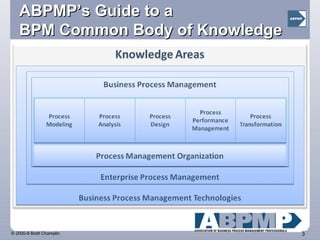
ABPMP’s Guide to a BPM Common Body of Knowledge
What is BPM? BPM is a Management Discipline Process-oriented thinking Manage end-to-end business process Strategy is carried out through process Process assessment, analysis and design Process performance over functional performance Enabled by an evolving set of technologies Process discovery and definition Process execution and orchestration Process monitoring and control Process performance decision support
APQC BPM Benchmarking Study “ BPM is the way best-practice organizations conduct business ” It also confirmed that regardless of where an organization stands in terms of process ‘maturity’, technology continues to play a vital role.  While the APQC research participants agreed that technology, by itself, does not constitute “Business Process Management”,  they concluded that much of  the promise of BPM initiatives will not be realized without powerful, flexible and user-friendly IT solutions to support them .  Four of the five of APQC’s best practice partners cited  technology support being a key success factor for managing, aligning and integrating business processes - --thus impacting profitability and their ability to compete in today’s competitive, global market.” Source: APQC
BPM Has Become Mainstream Two recent Forrester Surveys (Sept-Oct 2007) 449 decision makers in North America and Europe 60% were already using BPM an additional 19% plan to do so in next 12 months 160 US and UK enterprise architects 85% were actively planning or already had BPM deployments under way BPM Centers of Excellence (COEs) are the catalyst for BPM success Source: Forrester
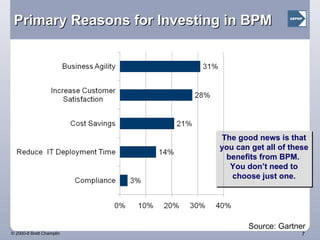
Primary Reasons for Investing in BPM The good news is that you can get all of these benefits from BPM.  You don’t need to choose just one. Source: Gartner
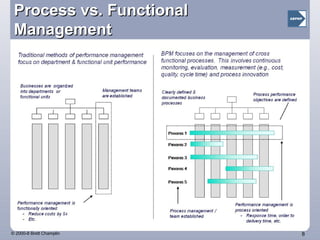
Process vs. Functional Management
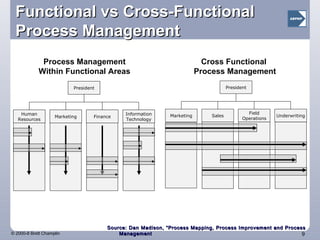
Functional vs Cross-Functional Process Management Source: Dan Madison, “Process Mapping, Process Improvement and Process Management President Human Resources Marketing Finance Information Technology Process Management Within Functional Areas Cross Functional  Process Management President Marketing Sales Field Operations Underwriting
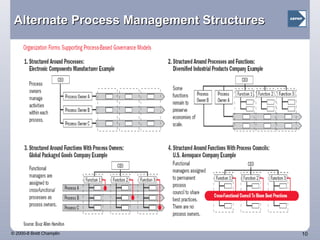
Alternate Process Management Structures
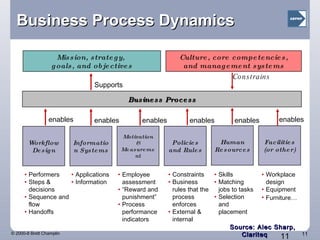
Business Process Dynamics Mission, strategy,  goals, and objectives Business Process Workflow Design Information Systems Motivation & Measurement Policies and Rules Human Resources Facilities (or other) Performers Steps & decisions Sequence and flow Handoffs Applications Information Employee assessment “ Reward and punishment” Process performance indicators Constraints Business rules that the process enforces External & internal Skills Matching jobs to tasks Selection and placement Workplace design Equipment Furniture…   enables enables enables enables enables Culture, core competencies, and management systems Supports Constrains enables Source: Alec Sharp, Clariteq
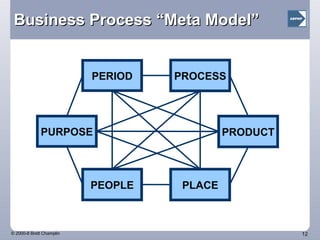
Business Process “Meta Model” PURPOSE PEOPLE PLACE PROCESS PRODUCT PERIOD
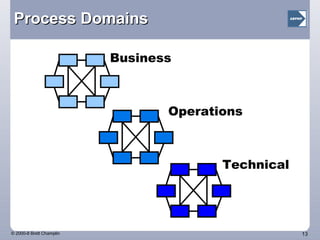
Process Domains Business Operations Technical
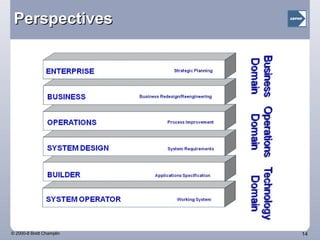
Perspectives
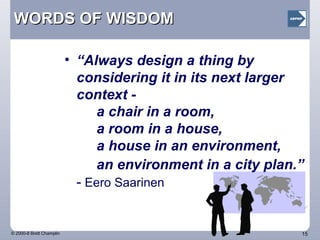
WORDS OF WISDOM “ Always design a thing by considering it in its next larger context -  a chair in a room,  a room in a house,  a house in an environment,  an environment in a city plan.”   -  Eero Saarinen
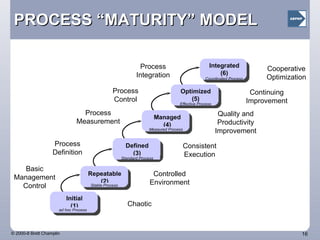
PROCESS “MATURITY” MODEL Integrated (6) Coordinated Process Initial (1) ad hoc Process Repeatable (2) Stable Process Defined (3) Standard Process Managed (4) Measured Process Optimized (5) Effective Process Process Control Process Measurement Process Definition Basic Management Control Process Integration Consistent Execution Controlled Environment Quality and Productivity Improvement Continuing Improvement Chaotic Cooperative Optimization
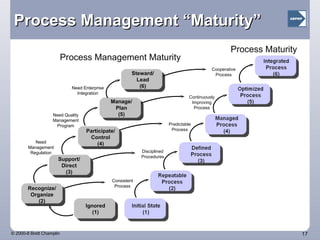
Process Management “Maturity” Continuously Improving Process Predictable Process Disciplined Procedures Consistent Process Cooperative Process Need Quality Management Program Need Management Regulation Ignored (1) Manage/ Plan (5) Participate/ Control (4) Support/ Direct (3) Recognize/ Organize (2) Steward/ Lead (6) Need Enterprise Integration Process Management Maturity Process Maturity
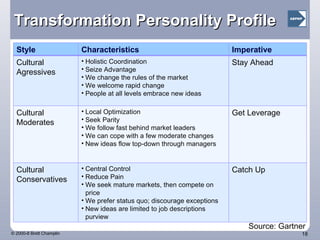
Transformation Personality Profile Source: Gartner Style Characteristics Imperative Cultural Agressives Holistic Coordination Seize Advantage We change the rules of the market We welcome rapid change People at all levels embrace new ideas Stay Ahead Cultural Moderates Local Optimization Seek Parity We follow fast behind market leaders We can cope with a few moderate changes New ideas flow top-down through managers Get Leverage Cultural Conservatives Central Control Reduce Pain We seek mature markets, then compete on price We prefer status quo; discourage exceptions New ideas are limited to job descriptions purview Catch Up
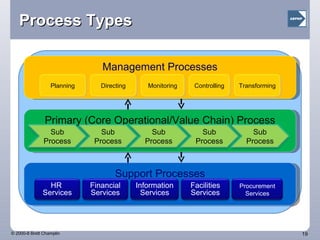
Process Types Primary (Core Operational/Value Chain) Process Support Processes Management Processes Sub Process Sub Process Sub Process Sub Process Sub Process HR  Services Financial Services Information Services Facilities Services Procurement Services Planning Directing Monitoring Controlling Transforming
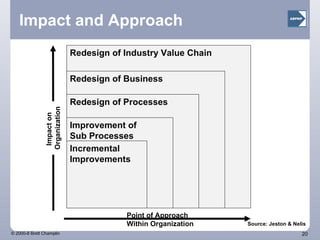
Impact and Approach Source: Jeston & Nelis Point of Approach  Within Organization Redesign of Industry Value Chain Redesign of Business Redesign of Processes Improvement of  Sub Processes Incremental Improvements Impact on  Organization
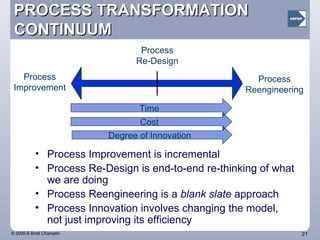
PROCESS TRANSFORMATION CONTINUUM Process Improvement is incremental  Process Re-Design is end-to-end re-thinking of what we are doing  Process Reengineering is a  blank slate  approach Process Innovation involves changing the model, not just improving its efficiency Process Improvement Process Reengineering Process Re-Design Time Degree of Innovation Cost
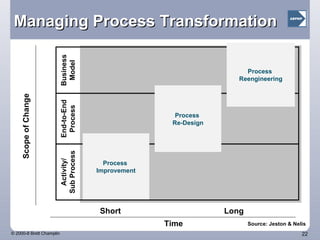
Managing Process Transformation  Source: Jeston & Nelis End-to-End Process Activity/ Sub Process Scope of Change Short Long Time Process  Improvement Business Model Process  Re-Design Process  Reengineering
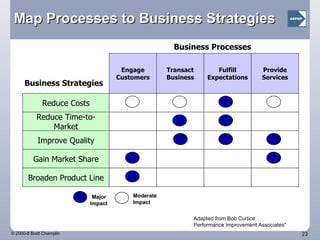
Map Processes to Business Strategies Business Processes Major  Impact Moderate  Impact Major  Impact Moderate  Impact Engage Customers Transact Business Fulfill Expectations Provide Services Reduce Costs Reduce Time-to-Market Improve Quality Gain Market Share Broaden Product Line Business Strategies Adapted from Bob Curtice Performance Improvement Associates"
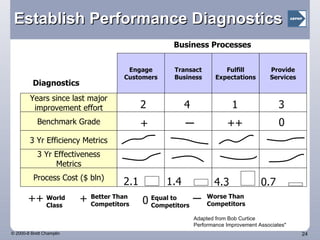
Establish Performance Diagnostics Business Processes Diagnostics + ++ 0 World Class Better Than Competitors Equal to Competitors Worse Than Competitors 4.3 0.7 Years since last major improvement effort Benchmark Grade 3 Yr Efficiency Metrics 3 Yr Effectiveness Metrics Process Cost ($ bln) 2 4 1 3 ++ 0 + 2.1 1.4 Engage Customers Transact Business Fulfill Expectations Provide Services Adapted from Bob Curtice Performance Improvement Associates"
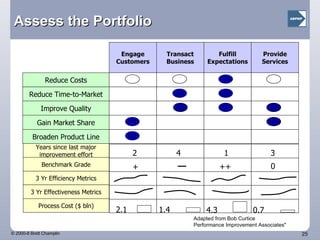
Assess the Portfolio Adapted from Bob Curtice Performance Improvement Associates" Engage Customers Transact Business Fulfill Expectations Provide Services Reduce Costs Reduce Time-to-Market Improve Quality Gain Market Share Broaden Product Line Years since last major improvement effort Benchmark Grade 3 Yr Efficiency Metrics 3 Yr Effectiveness Metrics Process Cost ($ bln) 4.3 0.7 2 4 1 3 ++ 0 + 2.1 1.4
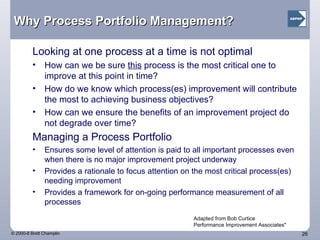
Why Process Portfolio Management?  Looking at one process at a time is not optimal  How can we be sure  this  process is the most critical one to improve at this point in time? How do we know which process(es) improvement will contribute the most to achieving business objectives? How can we ensure the benefits of an improvement project do not degrade over time? Managing a Process Portfolio   Ensures some level of attention is paid to all important processes even when there is no major improvement project underway Provides a rationale to focus attention on the most critical process(es) needing improvement Provides a framework for on-going performance measurement of all processes Adapted from Bob Curtice Performance Improvement Associates"
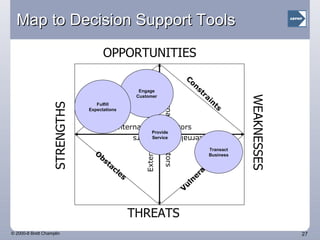
Map to Decision Support Tools  Engage Customer Provide Service Transact Business Fulfill Expectations OPPORTUNITIES THREATS Internal  Factors External  Factors STRENGTHS WEAKNESSES Leverage Constraints Obstacles Vulnerabilities External  Factors Internal  Factors
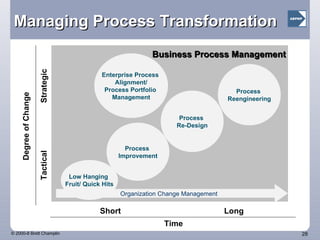
Strategic Tactical Degree of Change Short Long Time Process  Improvement Process  Re-Design Enterprise Process  Alignment/ Process Portfolio  Management Process  Reengineering Business Process Management Managing Process Transformation  Organization Change Management Low Hanging  Fruit/ Quick Hits
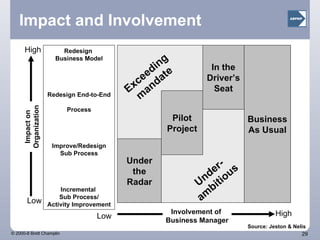
Impact and Involvement Source: Jeston & Nelis Involvement of  Business Manager Impact on Organization Low High High Redesign  Business Model Redesign End-to-End  Process Improve/Redesign Sub Process Incremental  Sub Process/ Activity Improvement Business As Usual In the Driver’s Seat Pilot Project Under the Radar Under- ambitious Exceeding mandate Low
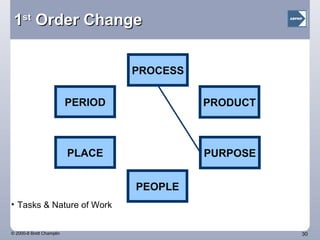
1 st  Order Change Tasks & Nature of Work PLACE PEOPLE PURPOSE PROCESS PRODUCT PERIOD
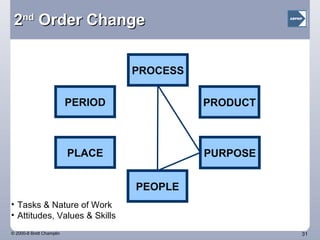
2 nd  Order Change Tasks & Nature of Work Attitudes, Values & Skills PLACE PEOPLE PURPOSE PROCESS PRODUCT PERIOD
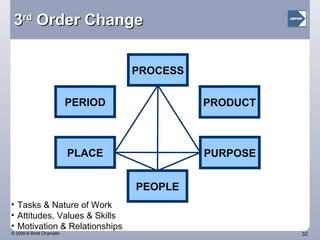
3 rd  Order Change Tasks & Nature of Work Attitudes, Values & Skills Motivation & Relationships PLACE PEOPLE PURPOSE PROCESS PRODUCT PERIOD
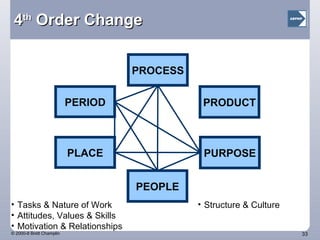
4 th  Order Change Tasks & Nature of Work Attitudes, Values & Skills Motivation & Relationships Structure & Culture PLACE PEOPLE PURPOSE PROCESS PRODUCT PERIOD
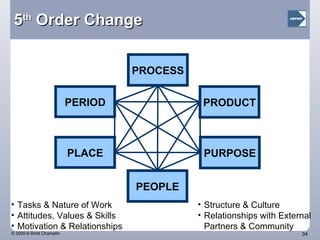
5 th  Order Change Tasks & Nature of Work Attitudes, Values & Skills Motivation & Relationships Structure & Culture Relationships with External Partners & Community PLACE PEOPLE PURPOSE PROCESS PRODUCT PERIOD
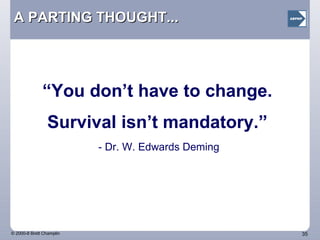
A PARTING THOUGHT... “ You don’t have to change. Survival isn’t mandatory.” - Dr. W. Edwards Deming
Dimensions of Business Process Change Brett Champlin President, ABPMP www.ABPMP.org    [email_address]

Dimensions Of Change

  • 1.
    Dimensions of BusinessProcess Change Brett Champlin, President, Association of BPM Professionals
  • 2.
    Association of BPMProfessionals www.ABPMP.org Non-profit, vendor-independent, professional organization Dedicated to the advancement of business process management concepts and its practices Practitioner-oriented and practitioner-led Founded 2003 10 Active US Chapters, many more forming Affiliations with BPM groups internationally Guide to BPM Common Body of Knowledge (BPM CBOK™) BPM Model Curriculum Certified Business Process Professional (CBPP)™
  • 3.
    ABPMP’s Guide toa BPM Common Body of Knowledge
  • 4.
    What is BPM?BPM is a Management Discipline Process-oriented thinking Manage end-to-end business process Strategy is carried out through process Process assessment, analysis and design Process performance over functional performance Enabled by an evolving set of technologies Process discovery and definition Process execution and orchestration Process monitoring and control Process performance decision support
  • 5.
    APQC BPM BenchmarkingStudy “ BPM is the way best-practice organizations conduct business ” It also confirmed that regardless of where an organization stands in terms of process ‘maturity’, technology continues to play a vital role. While the APQC research participants agreed that technology, by itself, does not constitute “Business Process Management”, they concluded that much of the promise of BPM initiatives will not be realized without powerful, flexible and user-friendly IT solutions to support them . Four of the five of APQC’s best practice partners cited technology support being a key success factor for managing, aligning and integrating business processes - --thus impacting profitability and their ability to compete in today’s competitive, global market.” Source: APQC
  • 6.
    BPM Has BecomeMainstream Two recent Forrester Surveys (Sept-Oct 2007) 449 decision makers in North America and Europe 60% were already using BPM an additional 19% plan to do so in next 12 months 160 US and UK enterprise architects 85% were actively planning or already had BPM deployments under way BPM Centers of Excellence (COEs) are the catalyst for BPM success Source: Forrester
  • 7.
    Primary Reasons forInvesting in BPM The good news is that you can get all of these benefits from BPM. You don’t need to choose just one. Source: Gartner
  • 8.
  • 9.
    Functional vs Cross-FunctionalProcess Management Source: Dan Madison, “Process Mapping, Process Improvement and Process Management President Human Resources Marketing Finance Information Technology Process Management Within Functional Areas Cross Functional Process Management President Marketing Sales Field Operations Underwriting
  • 10.
  • 11.
    Business Process DynamicsMission, strategy, goals, and objectives Business Process Workflow Design Information Systems Motivation & Measurement Policies and Rules Human Resources Facilities (or other) Performers Steps & decisions Sequence and flow Handoffs Applications Information Employee assessment “ Reward and punishment” Process performance indicators Constraints Business rules that the process enforces External & internal Skills Matching jobs to tasks Selection and placement Workplace design Equipment Furniture… enables enables enables enables enables Culture, core competencies, and management systems Supports Constrains enables Source: Alec Sharp, Clariteq
  • 12.
    Business Process “MetaModel” PURPOSE PEOPLE PLACE PROCESS PRODUCT PERIOD
  • 13.
    Process Domains BusinessOperations Technical
  • 14.
  • 15.
    WORDS OF WISDOM“ Always design a thing by considering it in its next larger context - a chair in a room, a room in a house, a house in an environment, an environment in a city plan.” - Eero Saarinen
  • 16.
    PROCESS “MATURITY” MODELIntegrated (6) Coordinated Process Initial (1) ad hoc Process Repeatable (2) Stable Process Defined (3) Standard Process Managed (4) Measured Process Optimized (5) Effective Process Process Control Process Measurement Process Definition Basic Management Control Process Integration Consistent Execution Controlled Environment Quality and Productivity Improvement Continuing Improvement Chaotic Cooperative Optimization
  • 17.
    Process Management “Maturity”Continuously Improving Process Predictable Process Disciplined Procedures Consistent Process Cooperative Process Need Quality Management Program Need Management Regulation Ignored (1) Manage/ Plan (5) Participate/ Control (4) Support/ Direct (3) Recognize/ Organize (2) Steward/ Lead (6) Need Enterprise Integration Process Management Maturity Process Maturity
  • 18.
    Transformation Personality ProfileSource: Gartner Style Characteristics Imperative Cultural Agressives Holistic Coordination Seize Advantage We change the rules of the market We welcome rapid change People at all levels embrace new ideas Stay Ahead Cultural Moderates Local Optimization Seek Parity We follow fast behind market leaders We can cope with a few moderate changes New ideas flow top-down through managers Get Leverage Cultural Conservatives Central Control Reduce Pain We seek mature markets, then compete on price We prefer status quo; discourage exceptions New ideas are limited to job descriptions purview Catch Up
  • 19.
    Process Types Primary(Core Operational/Value Chain) Process Support Processes Management Processes Sub Process Sub Process Sub Process Sub Process Sub Process HR Services Financial Services Information Services Facilities Services Procurement Services Planning Directing Monitoring Controlling Transforming
  • 20.
    Impact and ApproachSource: Jeston & Nelis Point of Approach Within Organization Redesign of Industry Value Chain Redesign of Business Redesign of Processes Improvement of Sub Processes Incremental Improvements Impact on Organization
  • 21.
    PROCESS TRANSFORMATION CONTINUUMProcess Improvement is incremental Process Re-Design is end-to-end re-thinking of what we are doing Process Reengineering is a blank slate approach Process Innovation involves changing the model, not just improving its efficiency Process Improvement Process Reengineering Process Re-Design Time Degree of Innovation Cost
  • 22.
    Managing Process Transformation Source: Jeston & Nelis End-to-End Process Activity/ Sub Process Scope of Change Short Long Time Process Improvement Business Model Process Re-Design Process Reengineering
  • 23.
    Map Processes toBusiness Strategies Business Processes Major Impact Moderate Impact Major Impact Moderate Impact Engage Customers Transact Business Fulfill Expectations Provide Services Reduce Costs Reduce Time-to-Market Improve Quality Gain Market Share Broaden Product Line Business Strategies Adapted from Bob Curtice Performance Improvement Associates"
  • 24.
    Establish Performance DiagnosticsBusiness Processes Diagnostics + ++ 0 World Class Better Than Competitors Equal to Competitors Worse Than Competitors 4.3 0.7 Years since last major improvement effort Benchmark Grade 3 Yr Efficiency Metrics 3 Yr Effectiveness Metrics Process Cost ($ bln) 2 4 1 3 ++ 0 + 2.1 1.4 Engage Customers Transact Business Fulfill Expectations Provide Services Adapted from Bob Curtice Performance Improvement Associates"
  • 25.
    Assess the PortfolioAdapted from Bob Curtice Performance Improvement Associates" Engage Customers Transact Business Fulfill Expectations Provide Services Reduce Costs Reduce Time-to-Market Improve Quality Gain Market Share Broaden Product Line Years since last major improvement effort Benchmark Grade 3 Yr Efficiency Metrics 3 Yr Effectiveness Metrics Process Cost ($ bln) 4.3 0.7 2 4 1 3 ++ 0 + 2.1 1.4
  • 26.
    Why Process PortfolioManagement? Looking at one process at a time is not optimal How can we be sure this process is the most critical one to improve at this point in time? How do we know which process(es) improvement will contribute the most to achieving business objectives? How can we ensure the benefits of an improvement project do not degrade over time? Managing a Process Portfolio Ensures some level of attention is paid to all important processes even when there is no major improvement project underway Provides a rationale to focus attention on the most critical process(es) needing improvement Provides a framework for on-going performance measurement of all processes Adapted from Bob Curtice Performance Improvement Associates"
  • 27.
    Map to DecisionSupport Tools Engage Customer Provide Service Transact Business Fulfill Expectations OPPORTUNITIES THREATS Internal Factors External Factors STRENGTHS WEAKNESSES Leverage Constraints Obstacles Vulnerabilities External Factors Internal Factors
  • 28.
    Strategic Tactical Degreeof Change Short Long Time Process Improvement Process Re-Design Enterprise Process Alignment/ Process Portfolio Management Process Reengineering Business Process Management Managing Process Transformation Organization Change Management Low Hanging Fruit/ Quick Hits
  • 29.
    Impact and InvolvementSource: Jeston & Nelis Involvement of Business Manager Impact on Organization Low High High Redesign Business Model Redesign End-to-End Process Improve/Redesign Sub Process Incremental Sub Process/ Activity Improvement Business As Usual In the Driver’s Seat Pilot Project Under the Radar Under- ambitious Exceeding mandate Low
  • 30.
    1 st Order Change Tasks & Nature of Work PLACE PEOPLE PURPOSE PROCESS PRODUCT PERIOD
  • 31.
    2 nd Order Change Tasks & Nature of Work Attitudes, Values & Skills PLACE PEOPLE PURPOSE PROCESS PRODUCT PERIOD
  • 32.
    3 rd Order Change Tasks & Nature of Work Attitudes, Values & Skills Motivation & Relationships PLACE PEOPLE PURPOSE PROCESS PRODUCT PERIOD
  • 33.
    4 th Order Change Tasks & Nature of Work Attitudes, Values & Skills Motivation & Relationships Structure & Culture PLACE PEOPLE PURPOSE PROCESS PRODUCT PERIOD
  • 34.
    5 th Order Change Tasks & Nature of Work Attitudes, Values & Skills Motivation & Relationships Structure & Culture Relationships with External Partners & Community PLACE PEOPLE PURPOSE PROCESS PRODUCT PERIOD
  • 35.
    A PARTING THOUGHT...“ You don’t have to change. Survival isn’t mandatory.” - Dr. W. Edwards Deming
  • 36.
    Dimensions of BusinessProcess Change Brett Champlin President, ABPMP www.ABPMP.org [email_address]