LEADERSHIP The art  of influencing people  so that they will strive willingly and enthusiastically toward the achievement of groups goals The ability to influence people toward the attainment of organizational objectives
The art of influencing people by persuasion or example to follow a line of action Interpersonal influence directed through communication toward goal attention
Principle of Leadership People tend to follow those who offer then a means of satisfying their own personal goals “ The more managers understand what motivates their subordinates that more  they are effective they are likely to be leaders”
Ingredients  of Leadership Ability to use power effectively and in a responsible manner Ability to comprehend that human beings have different motivation forces at different times and in different situations Ability to inspire  Ability to act in a manner that  will develop a climate conducive to responding to and arousing motivations.
Leaders Those who are able to influence others and who possess managerial authority
Autocratic style   Describes authority, dictate  work methods make unilateral decisions, and limit subordinate participation
Democratic style Describes a leader who tends to involve subordinates in decision making, delegate authority, encourage participation in deciding work methods and objectives, and use feedback as an opportunity for training.
Laissez-fair style (or free-rein) Describes a leader who generally gives the group complete freedom to make decisions and complete the work in whatever way it sees fit
Roles of Leaders Figurehead Spokesperson Negotiator Coach Team builder Team player Technical problem solver Entrepreneur
Types of Leaders   Transactional  Leader   A leader who clarifies subordinate’s role and task requirements, initiates structure, provides rewards and displays consideration for subordinates
Charismatic Leader A leader who has the ability to motivate subordinates to excel and surpass expected performance.
Transformational Leader A leader distinguished  by a special ability to bring about innovation and change.
Interactive Leader A leader who is concerned with consensus building, is open and accommodating, and encourages participation
Servant Leader A leader of works to fulfill subordinate’s needs and goals as well as to achieve the organizations larger objectives and mission
Satisfaction of Leaders A feeling of power and prestige  A chance to help others High income  Respect and status  Good opportunities for advancements Knowing “inside” information opportunities of control money and other resources
Dissatisfaction & Frustration of Leaders Too much uncompensated time Too many “headaches” Not enough authority to carryout responsibility  Too many “people” problems To much organizational “politics” Pursuit of conflicting objects( or goals)
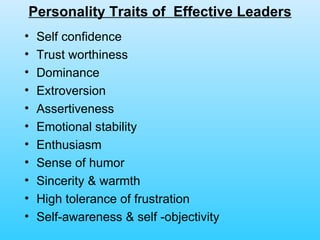
Personality Traits of  Effective Leaders Self confidence Trust worthiness Dominance Extroversion Assertiveness Emotional stability Enthusiasm Sense of humor  Sincerity & warmth High tolerance of frustration Self-awareness & self -objectivity
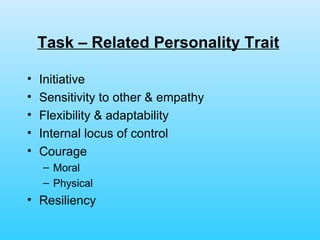
Task – Related Personality Trait   Initiative Sensitivity to other & empathy  Flexibility & adaptability Internal locus of control Courage Moral Physical Resiliency
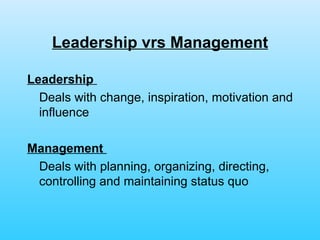
Leadership vrs Management Leadership   Deals with change, inspiration, motivation and influence Management   Deals with planning, organizing, directing, controlling and maintaining status quo
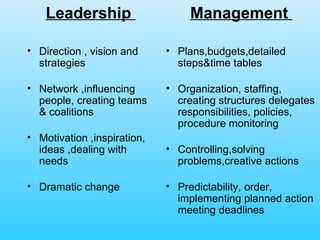
Leadership  Direction , vision and strategies Network ,influencing people, creating teams & coalitions Motivation ,inspiration, ideas ,dealing with needs  Dramatic change Management  Plans,budgets,detailed steps&time tables Organization, staffing, creating structures delegates responsibilities, policies, procedure monitoring Controlling,solving problems,creative actions  Predictability, order, implementing planned action meeting deadlines
Systems of Management Exploitive – authoritative Benevolent - authoritative Consultative Participative -group
Power The potential ability to influence behavior
Legitimate power Power that stems from a  formal management position in an organization and authority granted to it
Coercive Power Power that stems from the authority to punish or recommend punishment
Reward Power Power that results from the authority to reward others
Expert Power  Power that stems from special knowledge of or skill in the tasks performed by subordinates. (In non-organization situation, by customers, clients, and those seeking professional advice)
Referent Power  Power that results from characteristics that command subordinates’ identification with, respect and admiration for, and desire to equal excel or imitate zealously
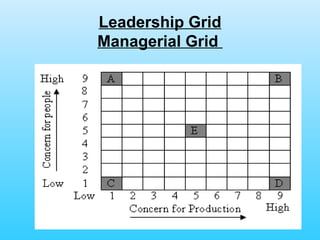
Leadership Grid Managerial Grid
1.9 Management / Country-club Management 9.9 Management / Team management 1.1 Management / Impoverished management 9.1 Management / Task management. 5.5 Management / Middle-Of-The-Road management
1.9 Management  Thoughtful attention to needs of people leads to a friendly and comfortable organization atmosphere and easy and relaxed work tempo. Country club management
9.9 Management  work accomplished is from committed people through a common stake in organization purpose with trust and respect.  Team Management
1.1Management exertion of minimum effort is required to get minimum work done and sustain organization morale. Impoverished Management
9.1 Management  Efficiency result from arranging work in such a way that human elements have little effect.  Task Management
5.5 Management  satisfactory performance through balance of work requirements and maintaining satisfactory morale.  Middle of the Road Management
Committee  Is a group of person to whom, as a group, some matter is committed,
Process of Committees  Forming Storming Norming Performing Adjourning
Forming The first stage of process during which people join the group and a get to know each other.
Storming The second stage of process in which members determine the objectives of the meeting. Conflicts arise.
Norming The third stage in which members agree on norms and conflicts begin to be resolved.
Performing  The fourth stage where full functionality is achieved and conflicts are turned into agreements.
Adjourning The final stage characterized with ending activities of committee.
TYPE OF COMMITTEES  Formal   A committee created by the organization as part of the formal organization structure with specific delegation of authority.
Informal A committee formed without specific delegation of authority and usually in advisory capacity (without any authority to take decisions)
Vertical  A formal committee composed of a manager and his subordinates in the organization’s formal chain of command.
Horizontal  A formal committee composed of persons from about the some hierarchical level but from different areas of expertise.
Special Purpose  A committee created outside the formal organization to under take a project of specific importance or creativity.
Self Directed An informal committee formed by persons on voluntary basis to discuss ways of improving quality, efficiency and working conditions.
Virtual  A committee that uses computer technology and groupware so that geographically distant members can interact to reach objectives
Reasons for Using Committees  Group deliberation and judgment Representation of interested groups  Dissipation of authority Coordination of plans, policies & departments  Transmission & sharing of information Motivation through participation Avoidance of action
Misuse of Committees Replacement of a manager Research or study Unimportant decisions Decisions beyond authority Consolidation of divided authority
Disadvantages of Committees High Cost in time and money Compromise at the least common denominator Indecision Tendency to be self destructive Splitting of responsibility Imposition of view by strong minority
Characteristics of Effective Committees Clear agenda/objectives Relevant skills and experience. Mutual trust Unified commitment Good Management/Communication Negotiating skills Appropriate Leadership Internal and external support
Group Two or more interdependent people interacting in a unified manner toward achievement of common goals
Characteristics of Groups Common Goal(s) Communication Roles Norms and conformity Belongingness
Functions of Groups Disciplining members Decision making, negotiating and bargaining Effective group interaction Motivation
Advantages of Groups Social satisfaction Support for needs Security Promote communication Promote self-esteem through recognition

Pom 7

  • 1.
    LEADERSHIP The art of influencing people so that they will strive willingly and enthusiastically toward the achievement of groups goals The ability to influence people toward the attainment of organizational objectives
  • 2.
    The art ofinfluencing people by persuasion or example to follow a line of action Interpersonal influence directed through communication toward goal attention
  • 3.
    Principle of LeadershipPeople tend to follow those who offer then a means of satisfying their own personal goals “ The more managers understand what motivates their subordinates that more they are effective they are likely to be leaders”
  • 4.
    Ingredients ofLeadership Ability to use power effectively and in a responsible manner Ability to comprehend that human beings have different motivation forces at different times and in different situations Ability to inspire Ability to act in a manner that will develop a climate conducive to responding to and arousing motivations.
  • 5.
    Leaders Those whoare able to influence others and who possess managerial authority
  • 6.
    Autocratic style Describes authority, dictate work methods make unilateral decisions, and limit subordinate participation
  • 7.
    Democratic style Describesa leader who tends to involve subordinates in decision making, delegate authority, encourage participation in deciding work methods and objectives, and use feedback as an opportunity for training.
  • 8.
    Laissez-fair style (orfree-rein) Describes a leader who generally gives the group complete freedom to make decisions and complete the work in whatever way it sees fit
  • 9.
    Roles of LeadersFigurehead Spokesperson Negotiator Coach Team builder Team player Technical problem solver Entrepreneur
  • 10.
    Types of Leaders Transactional Leader A leader who clarifies subordinate’s role and task requirements, initiates structure, provides rewards and displays consideration for subordinates
  • 11.
    Charismatic Leader Aleader who has the ability to motivate subordinates to excel and surpass expected performance.
  • 12.
    Transformational Leader Aleader distinguished by a special ability to bring about innovation and change.
  • 13.
    Interactive Leader Aleader who is concerned with consensus building, is open and accommodating, and encourages participation
  • 14.
    Servant Leader Aleader of works to fulfill subordinate’s needs and goals as well as to achieve the organizations larger objectives and mission
  • 15.
    Satisfaction of LeadersA feeling of power and prestige A chance to help others High income Respect and status Good opportunities for advancements Knowing “inside” information opportunities of control money and other resources
  • 16.
    Dissatisfaction & Frustrationof Leaders Too much uncompensated time Too many “headaches” Not enough authority to carryout responsibility Too many “people” problems To much organizational “politics” Pursuit of conflicting objects( or goals)
  • 17.
    Personality Traits of Effective Leaders Self confidence Trust worthiness Dominance Extroversion Assertiveness Emotional stability Enthusiasm Sense of humor Sincerity & warmth High tolerance of frustration Self-awareness & self -objectivity
  • 18.
    Task – RelatedPersonality Trait Initiative Sensitivity to other & empathy Flexibility & adaptability Internal locus of control Courage Moral Physical Resiliency
  • 19.
    Leadership vrs ManagementLeadership Deals with change, inspiration, motivation and influence Management Deals with planning, organizing, directing, controlling and maintaining status quo
  • 20.
    Leadership Direction, vision and strategies Network ,influencing people, creating teams & coalitions Motivation ,inspiration, ideas ,dealing with needs Dramatic change Management Plans,budgets,detailed steps&time tables Organization, staffing, creating structures delegates responsibilities, policies, procedure monitoring Controlling,solving problems,creative actions Predictability, order, implementing planned action meeting deadlines
  • 21.
    Systems of ManagementExploitive – authoritative Benevolent - authoritative Consultative Participative -group
  • 22.
    Power The potentialability to influence behavior
  • 23.
    Legitimate power Powerthat stems from a formal management position in an organization and authority granted to it
  • 24.
    Coercive Power Powerthat stems from the authority to punish or recommend punishment
  • 25.
    Reward Power Powerthat results from the authority to reward others
  • 26.
    Expert Power Power that stems from special knowledge of or skill in the tasks performed by subordinates. (In non-organization situation, by customers, clients, and those seeking professional advice)
  • 27.
    Referent Power Power that results from characteristics that command subordinates’ identification with, respect and admiration for, and desire to equal excel or imitate zealously
  • 28.
  • 29.
    1.9 Management /Country-club Management 9.9 Management / Team management 1.1 Management / Impoverished management 9.1 Management / Task management. 5.5 Management / Middle-Of-The-Road management
  • 30.
    1.9 Management Thoughtful attention to needs of people leads to a friendly and comfortable organization atmosphere and easy and relaxed work tempo. Country club management
  • 31.
    9.9 Management work accomplished is from committed people through a common stake in organization purpose with trust and respect. Team Management
  • 32.
    1.1Management exertion ofminimum effort is required to get minimum work done and sustain organization morale. Impoverished Management
  • 33.
    9.1 Management Efficiency result from arranging work in such a way that human elements have little effect. Task Management
  • 34.
    5.5 Management satisfactory performance through balance of work requirements and maintaining satisfactory morale. Middle of the Road Management
  • 35.
    Committee Isa group of person to whom, as a group, some matter is committed,
  • 36.
    Process of Committees Forming Storming Norming Performing Adjourning
  • 37.
    Forming The firststage of process during which people join the group and a get to know each other.
  • 38.
    Storming The secondstage of process in which members determine the objectives of the meeting. Conflicts arise.
  • 39.
    Norming The thirdstage in which members agree on norms and conflicts begin to be resolved.
  • 40.
    Performing Thefourth stage where full functionality is achieved and conflicts are turned into agreements.
  • 41.
    Adjourning The finalstage characterized with ending activities of committee.
  • 42.
    TYPE OF COMMITTEES Formal A committee created by the organization as part of the formal organization structure with specific delegation of authority.
  • 43.
    Informal A committeeformed without specific delegation of authority and usually in advisory capacity (without any authority to take decisions)
  • 44.
    Vertical Aformal committee composed of a manager and his subordinates in the organization’s formal chain of command.
  • 45.
    Horizontal Aformal committee composed of persons from about the some hierarchical level but from different areas of expertise.
  • 46.
    Special Purpose A committee created outside the formal organization to under take a project of specific importance or creativity.
  • 47.
    Self Directed Aninformal committee formed by persons on voluntary basis to discuss ways of improving quality, efficiency and working conditions.
  • 48.
    Virtual Acommittee that uses computer technology and groupware so that geographically distant members can interact to reach objectives
  • 49.
    Reasons for UsingCommittees Group deliberation and judgment Representation of interested groups Dissipation of authority Coordination of plans, policies & departments Transmission & sharing of information Motivation through participation Avoidance of action
  • 50.
    Misuse of CommitteesReplacement of a manager Research or study Unimportant decisions Decisions beyond authority Consolidation of divided authority
  • 51.
    Disadvantages of CommitteesHigh Cost in time and money Compromise at the least common denominator Indecision Tendency to be self destructive Splitting of responsibility Imposition of view by strong minority
  • 52.
    Characteristics of EffectiveCommittees Clear agenda/objectives Relevant skills and experience. Mutual trust Unified commitment Good Management/Communication Negotiating skills Appropriate Leadership Internal and external support
  • 53.
    Group Two ormore interdependent people interacting in a unified manner toward achievement of common goals
  • 54.
    Characteristics of GroupsCommon Goal(s) Communication Roles Norms and conformity Belongingness
  • 55.
    Functions of GroupsDisciplining members Decision making, negotiating and bargaining Effective group interaction Motivation
  • 56.
    Advantages of GroupsSocial satisfaction Support for needs Security Promote communication Promote self-esteem through recognition