Re-engineering a
business process
-A Dr Martens case study
61th Case Presented By:
Shaibal Halder
Ahmed Farhad
Introduction
• Some of the recent headlines in the popular press
read,“Wal-Mart reduces restocking time from six
weeks to thirty-six hours.””
• In today’s ever-changing world, the only thing that
doesn’t change is ‘change’ itself. In a world
increasingly driven by the three Cs: Customer,
Competition and Change,
What is a Business Process?
“A business process is a collection of activities
which together produce something of value to a
customer”
Change Process
Organizational
Diagnosis
is an effective
ways of looking at
an organization t
o determine gaps
between current
and desired
performance and
how it can
achieve its goals.
Business process reengineering…
• BPR is a business management strategy, originally
pioneered in the early 1990s, focusing on the
analysis and design of workflows and business
processes within an organization.
• BPR advocates that enterprises go back to the
basics and reexamine their very roots. It doesn’t
believe in small improvements. Rather it aims at
total reinvention.
• BPR focuses on processes and not on tasks, jobs
or people.
…Business process reengineering
• BPR aimed to help organizations
fundamentally rethink how they do their work
in order to dramatically improve customer
service, cut operational costs, and become
world-class competitors.
• In the mid-1990s, as many as 60% of the
Fortune 500 companies claimed to either have
initiated reengineering efforts, or to have
plans to do so.
THE BEGINNINGS 'OF AN ICON'
• Starting in 1901, the Griggs family were known for
making boots in the small town of Wollaston,
Northampton shire in the English Midlands.
• The story then switched to post-war Munich, 1945 and
Dr. Klaus Martens, a 25-year-old soldier.
• By 1947 they began formal production and within a
decade had a booming business
• In 1959, they decided it was time to advertise their
revolutionary footwear invention in overseas magazines.
• The 1960s – the decade in which the Dr. Martens boot
was born – saw an unprecedented wave of change, new
ideas, cultural upheaval and eventually social revolution.
What is reengineering?
“Reengineering is the fundamental rethinking
and radical redesign of business processes to
achieve dramatic improvements in critical,
contemporary measures of performance such as
cost, quality, service and speed”.
Why Reengineering?
• Historical ‘reality’ for organizations:
– High level of demand: organizations are order
takers
– Management (and IT!) focus – efficiency and
control of operations
• Modern ‘reality’ since 1990s:
– Hyper-competiveness
– Globalization
– Very demanding customers
– Management and IT focus: Innovation,
responsiveness/speed, quality and service.
Re-structuring
Operational review in August 1995
• unclear boundaries between
managers and departments
• inadequate systems and the absence
of meaningful management
information
• lack of encouragement for local
management to take ownership of
issues under their control
• lack of visibility of the number of
orders and the available production
capacity.
Operational review
Technology was a key element of the process re-
engineering, as it allowed the R Griggs Company to
improve its organization and its response.
Senior Management’s major
concerns were:
• Centralization
• Late deliveries
• Order process reporting
• Supply chain management
• Production and capacity
planning.
Centralization is the allocation of the major
responsibilities of an organization to a central
headquarters whilst avoiding central domination.
'we don’t want a progress report, we just want our shoes.’
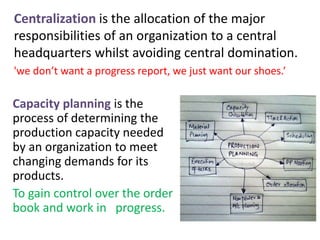
Capacity planning is the
process of determining the
production capacity needed
by an organization to meet
changing demands for its
products.
To gain control over the order
book and work in progress.
Using report’s recommendations
Orders were delivered on time
• In June 1995- 55%
• August -47%
• September -45%
• October -67%
• November -84%
Obtain the Organizational Goal
• It’s depend upon the nature of the operation,
the capacity, the required level of customer
service, the time period and the organization’s
hopes for the future.
• Reducing lead-time from in excess of 18 weeks
to below 12 weeks over a six month period.
• Has an accurate forecast of dispatch date.
• Over the last 12 months, production increased
by a staggering 20.25%.
• Has forecasted an increased volume in excess
of 40%.
An intense customer focus, superior process design
and a strong and motivated leadership are vital
ingredients to the recipe for the success of any
business corporation. Reengineering is the key that
every organization should possess to attain these
prerequisites to success.
Re engineering a business process

Re engineering a business process

  • 1.
    Re-engineering a business process -ADr Martens case study 61th Case Presented By: Shaibal Halder Ahmed Farhad
  • 2.
    Introduction • Some ofthe recent headlines in the popular press read,“Wal-Mart reduces restocking time from six weeks to thirty-six hours.”” • In today’s ever-changing world, the only thing that doesn’t change is ‘change’ itself. In a world increasingly driven by the three Cs: Customer, Competition and Change,
  • 3.
    What is aBusiness Process? “A business process is a collection of activities which together produce something of value to a customer”
  • 4.
    Change Process Organizational Diagnosis is aneffective ways of looking at an organization t o determine gaps between current and desired performance and how it can achieve its goals.
  • 5.
    Business process reengineering… •BPR is a business management strategy, originally pioneered in the early 1990s, focusing on the analysis and design of workflows and business processes within an organization. • BPR advocates that enterprises go back to the basics and reexamine their very roots. It doesn’t believe in small improvements. Rather it aims at total reinvention. • BPR focuses on processes and not on tasks, jobs or people.
  • 6.
    …Business process reengineering •BPR aimed to help organizations fundamentally rethink how they do their work in order to dramatically improve customer service, cut operational costs, and become world-class competitors. • In the mid-1990s, as many as 60% of the Fortune 500 companies claimed to either have initiated reengineering efforts, or to have plans to do so.
  • 7.
    THE BEGINNINGS 'OFAN ICON' • Starting in 1901, the Griggs family were known for making boots in the small town of Wollaston, Northampton shire in the English Midlands. • The story then switched to post-war Munich, 1945 and Dr. Klaus Martens, a 25-year-old soldier. • By 1947 they began formal production and within a decade had a booming business • In 1959, they decided it was time to advertise their revolutionary footwear invention in overseas magazines. • The 1960s – the decade in which the Dr. Martens boot was born – saw an unprecedented wave of change, new ideas, cultural upheaval and eventually social revolution.
  • 8.
    What is reengineering? “Reengineeringis the fundamental rethinking and radical redesign of business processes to achieve dramatic improvements in critical, contemporary measures of performance such as cost, quality, service and speed”.
  • 9.
    Why Reengineering? • Historical‘reality’ for organizations: – High level of demand: organizations are order takers – Management (and IT!) focus – efficiency and control of operations • Modern ‘reality’ since 1990s: – Hyper-competiveness – Globalization – Very demanding customers – Management and IT focus: Innovation, responsiveness/speed, quality and service.
  • 10.
    Re-structuring Operational review inAugust 1995 • unclear boundaries between managers and departments • inadequate systems and the absence of meaningful management information • lack of encouragement for local management to take ownership of issues under their control • lack of visibility of the number of orders and the available production capacity.
  • 11.
    Operational review Technology wasa key element of the process re- engineering, as it allowed the R Griggs Company to improve its organization and its response. Senior Management’s major concerns were: • Centralization • Late deliveries • Order process reporting • Supply chain management • Production and capacity planning.
  • 12.
    Centralization is theallocation of the major responsibilities of an organization to a central headquarters whilst avoiding central domination. 'we don’t want a progress report, we just want our shoes.’ Capacity planning is the process of determining the production capacity needed by an organization to meet changing demands for its products. To gain control over the order book and work in progress.
  • 13.
    Using report’s recommendations Orderswere delivered on time • In June 1995- 55% • August -47% • September -45% • October -67% • November -84%
  • 14.
    Obtain the OrganizationalGoal • It’s depend upon the nature of the operation, the capacity, the required level of customer service, the time period and the organization’s hopes for the future. • Reducing lead-time from in excess of 18 weeks to below 12 weeks over a six month period. • Has an accurate forecast of dispatch date. • Over the last 12 months, production increased by a staggering 20.25%. • Has forecasted an increased volume in excess of 40%.
  • 15.
    An intense customerfocus, superior process design and a strong and motivated leadership are vital ingredients to the recipe for the success of any business corporation. Reengineering is the key that every organization should possess to attain these prerequisites to success.