Business Process Reengineering Vipen Mahajan Principal Consultant Leo Systems http://www.leo-systems.com
Business Process Reengineering “ The  FUNDAMENTAL  rethinking and  RADICAL  redesign of business  PROCESSES  to bring about  DRAMATIC  improvements in critical, contemporary measures of performance, such as cost, quality, service and speed.” -Hammer, Champy (1993)‏
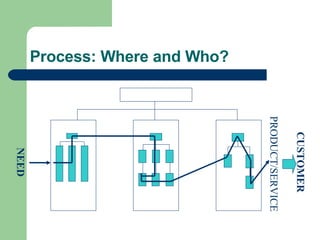
Process: Where and Who? NEED CUSTOMER PRODUCT/SERVICE
What is NOT Business Process Reengineering TQM ISO9000 Automation Downsizing Restructuring Change Management
Why BRP? Do or Die Minimize threat from rival firms Attain sustainable competitive advantage Leverage on unprecedented opportunity to take giant leap forward
Some of the BPR Objectives Improve  Efficiency  e.g reduce time to market, provide quicker response to customers Increase  Effectiveness  e.g deliver higher quality Achieve  Cost Saving  in the longer run Provide more  Meaningful  work for employees Increase  Flexibility  and  Adaptability  to change Enable new business  Growth
Scope of BPR Intra-functional Small scope within department, least impact Inter-functional Horizontal view across departments, more impact Inter-organizational Broad view including entire supply & delivery chain, most impact
4 Generic Steps in BPR Create a  Vision Identify and understand  Existing Processes Redesign  the processes Implement  the redesigned processes
Readiness Analysis Is there a compelling business need for strategic change? Is the organization prepared to challenge it status quo?  Would it have the courage to create a new vision? What’s the degree and quality of sponsorship and commitment of senior management?  Are they prepared to be deeply involved?  Do they have the energy to follow through the entire change process?
Readiness Analysis Is the organization prepared to commit resources (time, energy, money) to undertake BPR project? What is the overall organization’s attitude towards change? Is the organization prepared to overcome resistance to change?
BPR Team Composition Top management (e.g. CEO) as  SPONSOR Senior & middle management in  EXECUTIVE TEAM Selected senior & junior mgmt/staff to form  PROCESS TEAMS Enthusiastic and energetic individual as  BPR COORDINATOR
Case Example:  Kodak In 1987 Kodak’s arch-rival, Fuji came up with a new 35mm single-use camera Kodak has no competitive offering Kodak’s Traditional Product Development Process Slow:  would take 70 weeks to produce a rival to Fuji’s camera! Result: the new process, “Concurrent Engineering” Reduce turnaround time to 38 weeks
Case Example:  Kodak Key Redesign Strategy Apply innovative use of CAD/CAM + integrated product design database Allow engineer to design at computer workstations Database collect each engineer’s work and combines into overall design Each morning, problems are resolved immediately Manufacturing can begin tooling design just 10 weeks into product design instead of 28 weeks in the past
Minimize Risk and Ensure Success Top Management Support and Commitment Show some result quickly Set Stretch Targets for redesign Apply a holistic and disciplined approach to manage change Involve people in the change process Communicate sufficiently to dispel uncertainty and fear
Conclusion BPR is a multi-discipline approach for strategic change Methodology provides missing “how to” that must follow the “why” BPR must be managed as a project BPR must be owned by the organization, not driven by consultants BPR requires constant communication and feedback
Next Steps For more information email V. Mahajan at: [email_address] Or Skype at – Vmahajan Or Phone +1-630-303-9881 (VOIP Call with Voice Mail)‏ Would like to hear from you.

BPR- An Introduction

  • 1.
  • 2.
    Business Process ReengineeringVipen Mahajan Principal Consultant Leo Systems http://www.leo-systems.com
  • 3.
    Business Process Reengineering“ The FUNDAMENTAL rethinking and RADICAL redesign of business PROCESSES to bring about DRAMATIC improvements in critical, contemporary measures of performance, such as cost, quality, service and speed.” -Hammer, Champy (1993)‏
  • 4.
    Process: Where andWho? NEED CUSTOMER PRODUCT/SERVICE
  • 5.
    What is NOTBusiness Process Reengineering TQM ISO9000 Automation Downsizing Restructuring Change Management
  • 6.
    Why BRP? Door Die Minimize threat from rival firms Attain sustainable competitive advantage Leverage on unprecedented opportunity to take giant leap forward
  • 7.
    Some of theBPR Objectives Improve Efficiency e.g reduce time to market, provide quicker response to customers Increase Effectiveness e.g deliver higher quality Achieve Cost Saving in the longer run Provide more Meaningful work for employees Increase Flexibility and Adaptability to change Enable new business Growth
  • 8.
    Scope of BPRIntra-functional Small scope within department, least impact Inter-functional Horizontal view across departments, more impact Inter-organizational Broad view including entire supply & delivery chain, most impact
  • 9.
    4 Generic Stepsin BPR Create a Vision Identify and understand Existing Processes Redesign the processes Implement the redesigned processes
  • 10.
    Readiness Analysis Isthere a compelling business need for strategic change? Is the organization prepared to challenge it status quo? Would it have the courage to create a new vision? What’s the degree and quality of sponsorship and commitment of senior management? Are they prepared to be deeply involved? Do they have the energy to follow through the entire change process?
  • 11.
    Readiness Analysis Isthe organization prepared to commit resources (time, energy, money) to undertake BPR project? What is the overall organization’s attitude towards change? Is the organization prepared to overcome resistance to change?
  • 12.
    BPR Team CompositionTop management (e.g. CEO) as SPONSOR Senior & middle management in EXECUTIVE TEAM Selected senior & junior mgmt/staff to form PROCESS TEAMS Enthusiastic and energetic individual as BPR COORDINATOR
  • 13.
    Case Example: Kodak In 1987 Kodak’s arch-rival, Fuji came up with a new 35mm single-use camera Kodak has no competitive offering Kodak’s Traditional Product Development Process Slow: would take 70 weeks to produce a rival to Fuji’s camera! Result: the new process, “Concurrent Engineering” Reduce turnaround time to 38 weeks
  • 14.
    Case Example: Kodak Key Redesign Strategy Apply innovative use of CAD/CAM + integrated product design database Allow engineer to design at computer workstations Database collect each engineer’s work and combines into overall design Each morning, problems are resolved immediately Manufacturing can begin tooling design just 10 weeks into product design instead of 28 weeks in the past
  • 15.
    Minimize Risk andEnsure Success Top Management Support and Commitment Show some result quickly Set Stretch Targets for redesign Apply a holistic and disciplined approach to manage change Involve people in the change process Communicate sufficiently to dispel uncertainty and fear
  • 16.
    Conclusion BPR isa multi-discipline approach for strategic change Methodology provides missing “how to” that must follow the “why” BPR must be managed as a project BPR must be owned by the organization, not driven by consultants BPR requires constant communication and feedback
  • 17.
    Next Steps Formore information email V. Mahajan at: [email_address] Or Skype at – Vmahajan Or Phone +1-630-303-9881 (VOIP Call with Voice Mail)‏ Would like to hear from you.