BLS (box-fitting least squares) algorithm
Paper:
A box-fitting algorithm in the search for periodic transits
G. Kovacs, S. Zucker and T. Mazeh, A&A 391, 369-377 (2002)
Box-fitting
Algorithm
@ridlo | 2016
Transit Method
Measure
Detect
Fig: Winn (2009)
Geometrical criterion Short transit duration < 5% P
White noise
Red noise
Algorithm: DFT (Discrete Fourier Transform) , PDM (Phase Dispersion
Minimization)?
Box-fitting algorithm
Assumptions
• The light curve only has two discrete values: high (H) and low (L). Ignoring gradual
ingress and egress phases of the transit.
• White noise embedded data set (Gaussian noise)
• Fitting to the box-shaped function to get five parameter P (period), H, L, q (fractional
transit length, ttransit = qP), and e (epoch of the transit).
• Only for detection (fast)
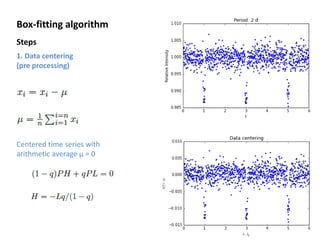
Box-fitting algorithm
Steps
1. Data centering
(pre processing)
Centered time series with
arithmetic average µ = 0
Box-fitting algorithm
Steps
2. Data folding binning
trial period
Folded with correct trial period and
binned
• Large deviation to the
correct period result in very
scattered folded time series
• Alleviates the problem of
missing data
Binning: less computation
Unbinned
Box-fitting algorithm
Steps
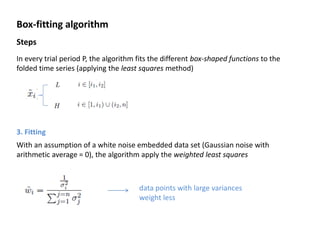
In every trial period P, the algorithm fits the different box-shaped functions to the
folded time series (applying the least squares method)
3. Fitting
With an assumption of a white noise embedded data set (Gaussian noise with
arithmetic average = 0), the algorithm apply the weighted least squares
data points with large variances
weight less
Box-fitting algorithm
Steps
For any test period ( ) in a trial period we minimize residual sum of squares
with
Box-fitting algorithm
Steps
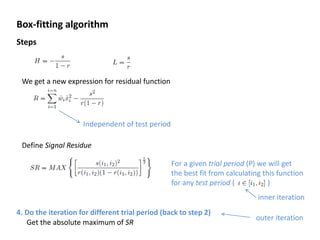
Independent of test period
Define Signal Residue
We get a new expression for residual function
For a given trial period (P) we will get
the best fit from calculating this function
for any test period ( )
4. Do the iteration for different trial period (back to step 2)
Get the absolute maximum of SR
inner iteration
outer iteration
Box-fitting algorithm
Steps
Input x(t)
Data centering
Data folding
(with trial period (P))
Data binning
ITERATE over P
ITERATE over q ([qmin, qmax]) and over the data xi
Calculate SR for a test
period q ([i1, i2])
Save MAX(SR)
and corresponding
parameters
Box-fitting algorithm
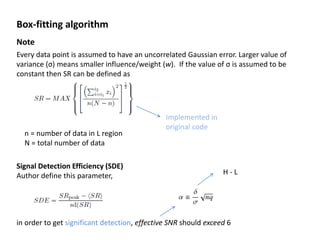
Note
Every data point is assumed to have an uncorrelated Gaussian error. Larger value of
variance (σ) means smaller influence/weight (w). If the value of σ is assumed to be
constant then SR can be defined as
Implemented in
original code
n = number of data in L region
N = total number of data
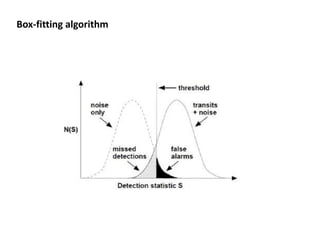
Signal Detection Efficiency (SDE)
Author define this parameter,
in order to get significant detection, effective SNR should exceed 6
H - L
Box-fitting algorithm
Author’s original code (http://www.konkoly.hu/staff/kovacs/index.html)
http://www.konkoly.hu/staff/kovacs/bls_code.html
F77: bls.f, eebls.f
Python binding:
https://github.com/dfm/python-bls
https://github.com/hpparvi/PyBLS (modified: multithreaded, F2003)
Online: http://exoplanetarchive.ipac.caltech.edu/cgi-bin/TransitView/nph-
visibletbls?dataset=transits
Code
Exploration
http://nbviewer.jupyter.org/github/ridlo/exoplanet_notebook/blob/master/bls_
test01.ipynb
http://nbviewer.jupyter.org/github/ridlo/exoplanet_notebook/blob/master/bls_
test02.ipynb
Box-fitting algorithm
Result:
Box-fitting algorithm
References
A box-fitting algorithm in the search for periodic transits, G. Kovacs, S. Zucker and T.
Mazeh, A&A 391, 369-377 (2002)
J. Zijlstra's Bachelor Thesis

Box-fitting algorithm presentation

  • 1.
    BLS (box-fitting leastsquares) algorithm Paper: A box-fitting algorithm in the search for periodic transits G. Kovacs, S. Zucker and T. Mazeh, A&A 391, 369-377 (2002) Box-fitting Algorithm @ridlo | 2016
  • 2.
    Transit Method Measure Detect Fig: Winn(2009) Geometrical criterion Short transit duration < 5% P White noise Red noise Algorithm: DFT (Discrete Fourier Transform) , PDM (Phase Dispersion Minimization)?
  • 3.
    Box-fitting algorithm Assumptions • Thelight curve only has two discrete values: high (H) and low (L). Ignoring gradual ingress and egress phases of the transit. • White noise embedded data set (Gaussian noise) • Fitting to the box-shaped function to get five parameter P (period), H, L, q (fractional transit length, ttransit = qP), and e (epoch of the transit). • Only for detection (fast)
  • 4.
    Box-fitting algorithm Steps 1. Datacentering (pre processing) Centered time series with arithmetic average µ = 0
  • 5.
    Box-fitting algorithm Steps 2. Datafolding binning trial period Folded with correct trial period and binned • Large deviation to the correct period result in very scattered folded time series • Alleviates the problem of missing data Binning: less computation Unbinned
  • 6.
    Box-fitting algorithm Steps In everytrial period P, the algorithm fits the different box-shaped functions to the folded time series (applying the least squares method) 3. Fitting With an assumption of a white noise embedded data set (Gaussian noise with arithmetic average = 0), the algorithm apply the weighted least squares data points with large variances weight less
  • 7.
    Box-fitting algorithm Steps For anytest period ( ) in a trial period we minimize residual sum of squares with
  • 8.
    Box-fitting algorithm Steps Independent oftest period Define Signal Residue We get a new expression for residual function For a given trial period (P) we will get the best fit from calculating this function for any test period ( ) 4. Do the iteration for different trial period (back to step 2) Get the absolute maximum of SR inner iteration outer iteration
  • 9.
    Box-fitting algorithm Steps Input x(t) Datacentering Data folding (with trial period (P)) Data binning ITERATE over P ITERATE over q ([qmin, qmax]) and over the data xi Calculate SR for a test period q ([i1, i2]) Save MAX(SR) and corresponding parameters
  • 10.
    Box-fitting algorithm Note Every datapoint is assumed to have an uncorrelated Gaussian error. Larger value of variance (σ) means smaller influence/weight (w). If the value of σ is assumed to be constant then SR can be defined as Implemented in original code n = number of data in L region N = total number of data Signal Detection Efficiency (SDE) Author define this parameter, in order to get significant detection, effective SNR should exceed 6 H - L
  • 11.
    Box-fitting algorithm Author’s originalcode (http://www.konkoly.hu/staff/kovacs/index.html) http://www.konkoly.hu/staff/kovacs/bls_code.html F77: bls.f, eebls.f Python binding: https://github.com/dfm/python-bls https://github.com/hpparvi/PyBLS (modified: multithreaded, F2003) Online: http://exoplanetarchive.ipac.caltech.edu/cgi-bin/TransitView/nph- visibletbls?dataset=transits Code Exploration http://nbviewer.jupyter.org/github/ridlo/exoplanet_notebook/blob/master/bls_ test01.ipynb http://nbviewer.jupyter.org/github/ridlo/exoplanet_notebook/blob/master/bls_ test02.ipynb
  • 12.
  • 13.
  • 14.
    References A box-fitting algorithmin the search for periodic transits, G. Kovacs, S. Zucker and T. Mazeh, A&A 391, 369-377 (2002) J. Zijlstra's Bachelor Thesis