GENERATION OF ERROR CONTROL
CODES – BCH AND REED-
SOLOMON CODES IN FREQUENCY
DOMAIN
Fourier Transforms in Galois Field, Linear
complexity, LFSR, Conjugacy Constraints
FOURIER TRANSFORMS IN GALOIS FIELDS
 Discrete Fourier transforms reveal periodicities in input data
and the relative strengths of any periodic components.
 Discrete Fourier transform of a real sequence of numbers
will be a sequence of complex numbers of the same length.
 In complex field,
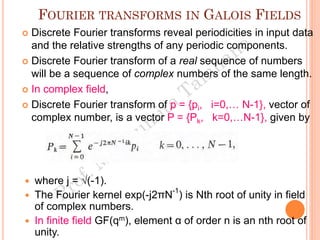
 Discrete Fourier transform of p = {pi, i=0,… N-1}, vector of
complex number, is a vector P = {Pk, k=0,…N-1}, given by
 where j = √(-1).
 The Fourier kernel exp(-j2πN-1
) is Nth root of unity in field
of complex numbers.
 In finite field GF(qm), element α of order n is an nth root of
unity.
FOURIER TRANSFORMS IN GALOIS FIELDS
 Drawing analogy between exp(-j2πN-1
) and α, Fourier
transform in Galois field can be given by—
 Let v = {vi, i=0,… n-1}, be a vector over GF(q), where n
divides qm-1 for some m, and let α be an element of GF(qm)
of order n.
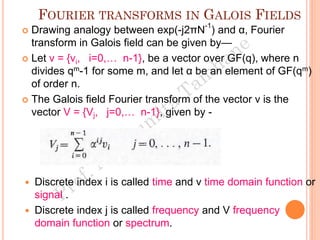
 The Galois field Fourier transform of the vector v is the
vector V = {Vj, j=0,… n-1}, given by -
 Discrete index i is called time and v time domain function or
signal .
 Discrete index j is called frequency and V frequency
domain function or spectrum.
FOURIER TRANSFORMS IN GALOIS FIELDS
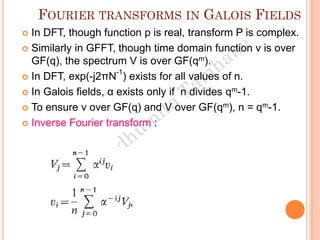
 In DFT, though function p is real, transform P is complex.
 Similarly in GFFT, though time domain function v is over
GF(q), the spectrum V is over GF(qm).
 In DFT, exp(-j2πN-1
) exists for all values of n.
 In Galois fields, α exists only if n divides qm-1.
 To ensure v over GF(q) and V over GF(qm), n = qm-1.
 Inverse Fourier transform :
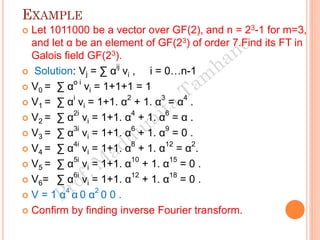
EXAMPLE
 Let 1011000 be a vector over GF(2), and n = 23-1 for m=3,
and let α be an element of GF(23) of order 7.Find its FT in
Galois field GF(23).
 Solution: Vj = ∑ α
ij
vi , i = 0…n-1
 V0 = ∑ αo i
vi = 1+1+1 = 1
 V1 = ∑ αi
vi = 1+1. α2
+ 1. α3
= α4
.
 V2 = ∑ α
2i
vi = 1+1. α
4
+ 1. α
6
= α .
 V3 = ∑ α3i
vi = 1+1. α6
+ 1. α9
= 0 .
 V4 = ∑ α4i
vi = 1+1. α8
+ 1. α12
= α2
.
 V5 = ∑ α
5i
vi = 1+1. α
10
+ 1. α
15
= 0 .
 V6= ∑ α6i
vi = 1+1. α12
+ 1. α18
= 0 .
 V = 1 α4
α 0 α2
0 0 .
 Confirm by finding inverse Fourier transform.
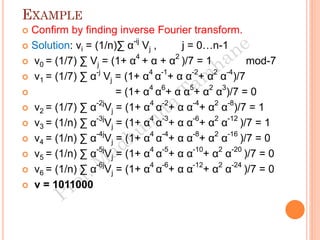
EXAMPLE
 Confirm by finding inverse Fourier transform.
 Solution: vi = (1/n)∑ α-ij
Vj , j = 0…n-1
 v0 = (1/7) ∑ Vj = (1+ α4
+ α + α2
)/7 = 1 mod-7
 v1 = (1/7) ∑ α-j
Vj = (1+ α4
α-1
+ α α-2
+ α2
α-4
)/7
 = (1+ α4
α6
+ α α5
+ α2
α3
)/7 = 0
 v2 = (1/7) ∑ α-2j
Vj = (1+ α4
α-2
+ α α-4
+ α2
α-8
)/7 = 1
 v3 = (1/n) ∑ α-3j
Vj = (1+ α4
α-3
+ α α-6
+ α2
α-12
)/7 = 1
 v4 = (1/n) ∑ α-4j
Vj = (1+ α4
α-4
+ α α-8
+ α2
α-16
)/7 = 0
 v5 = (1/n) ∑ α-5j
Vj = (1+ α4
α-5
+ α α-10
+ α2
α-20
)/7 = 0
 v6 = (1/n) ∑ α-6j
Vj = (1+ α4
α-6
+ α α-12
+ α2
α-24
)/7 = 0
 v = 1011000
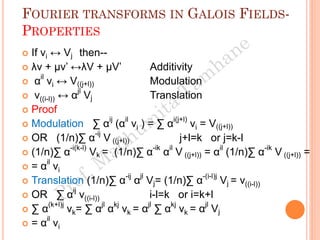
FOURIER TRANSFORMS IN GALOIS FIELDS-
PROPERTIES
 If vi ↔ Vj then--
 v + v’ ↔ V + V’ Additivity
 αil
vi ↔ V((j+l)) Modulation
 v((i-l)) ↔ αjl
Vj Translation
 Proof
 Modulation ∑ αij
(αil
vi ) = ∑ αi(j+l)
vi = V((j+l))
 OR (1/n)∑ α
-ij
V ((j+l)) j+l=k or j=k-l
 (1/n)∑ α-i(k-l)
Vk = (1/n)∑ α-ik
αil
V ((j+l)) = αil
(1/n)∑ α-ik
V ((j+l)) =
 = αil
vi
 Translation (1/n)∑ α-ij
αjl
Vj= (1/n)∑ α-(i-l)j
Vj = v((i-l))
 OR ∑ αij
v((i-l)) i-l=k or i=k+l
 ∑ α
(k+l)j
vk= ∑ α
jl
α
kj
vk = α
jl
∑ α
kj
vk = α
jl
Vj
 = αil
vi
FOURIER TRANSFORMS IN GALOIS FIELDS-
PROPERTIES
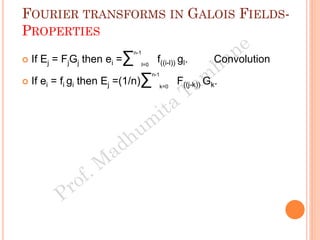
 If Ej = FjGj then ei =∑n-1
l=0
f((i-l)) gl. Convolution
 If ei = fi gi then Ej =(1/n)∑n-1
k=0
F((j-k)) Gk.
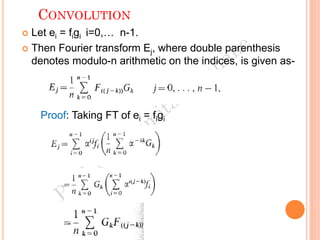
CONVOLUTION
 Let ei = figi i=0,… n-1.
 Then Fourier transform Ej, where double parenthesis
denotes modulo-n arithmetic on the indices, is given as-
Proof: Taking FT of ei = figi
FOURIER TRANSFORMS IN GALOIS FIELDS -
THEOREMS
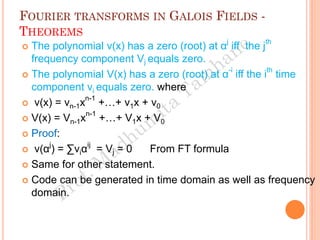
 The polynomial v(x) has a zero (root) at αj
iff the jth
frequency component Vj equals zero.
 The polynomial V(x) has a zero (root) at α-i
iff the ith
time
component vi equals zero. where
 v(x) = vn-1xn-1
+…+ v1x + v0
 V(x) = Vn-1x
n-1
+…+ V1x + V0
 Proof:
 v(αj
) = ∑viαij
= Vj = 0 From FT formula
 Same for other statement.
 Code can be generated in time domain as well as frequency
domain.
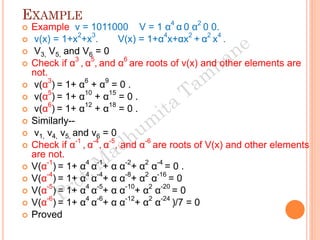
EXAMPLE
 Example v = 1011000 V = 1 α
4
α 0 α
2
0 0.
 v(x) = 1+x
2
+x
3
. V(x) = 1+α
4
x+αx
2
+ α
2
x
4
.
 V3, V5, and V6 = 0
 Check if α
3
, α
5
, and α
6
are roots of v(x) and other elements are
not.
 v(α
3
) = 1+ α
6
+ α
9
= 0 .
 v(α
5
) = 1+ α
10
+ α
15
= 0 .
 v(α
6
) = 1+ α
12
+ α
18
= 0 .
 Similarly--
 v1, v4, v5, and v6 = 0
 Check if α
-1
, α
-4
, α
-5
, and α
-6
are roots of V(x) and other elements
are not.
 V(α
-1
) = 1+ α
4
α
-1
+ α α
-2
+ α
2
α
-4
= 0 .
 V(α
-4
) = 1+ α
4
α
-4
+ α α
-8
+ α
2
α
-16
= 0
 V(α
-5
) = 1+ α
4
α
-5
+ α α
-10
+ α
2
α
-20
= 0
 V(α
-6
) = 1+ α
4
α
-6
+ α α
-12
+ α
2
α
-24
)/7 = 0
 Proved
EXAMPLE
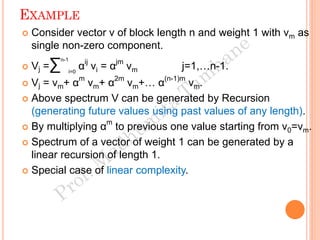
 Consider vector v of block length n and weight 1 with vm as
single non-zero component.
 Vj =∑n-1
i=0
αij
vi = αjm
vm j=1,…n-1.
 Vj = vm+ αm
vm+ α2m
vm+… α(n-1)m
vm.
 Above spectrum V can be generated by Recursion
(generating future values using past values of any length).
 By multiplying α
m
to previous one value starting from v0=vm.
 Spectrum of a vector of weight 1 can be generated by a
linear recursion of length 1.
 Special case of linear complexity.
IMPORTANCE OF REED-SOLOMON CODES
 RS codes are important for several reasons:
 (i) They are the natural codes to use when a code is
required of length less than the size of the field. For, being
MDS, they have the highest possible minimum distance.
 (ii) They are convenient for building other codes, as they
can be mapped into binary codes with high minimum
distance.
 (iii) They are also used in constructing concatenated and
Justesen codes.
 (iii) They are useful for correcting bursts of errors.
LINEAR COMPLEXITY LA
 La = Degree of its minimum polynomial m
 = Length of shortest Linear Feedback Shift Register (LFSR)
capable of producing a sequence which agrees with ‘a’ for
first k entries a0…ak-1.
 = maximum number of linearly independent vectors among
state vectors produced by LFSR.
 La = n-k = d-1
LINEAR FEEDBACK SHIFT REGISTER (LFSR)
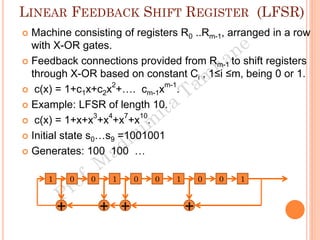
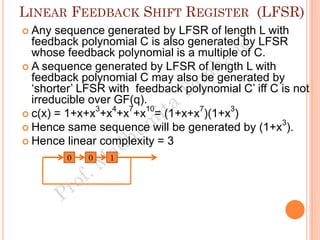
 Machine consisting of registers R0 ..Rm-1, arranged in a row
with X-OR gates.
 Feedback connections provided from Rm-1 to shift registers
through X-OR based on constant Ci , 1≤i ≤m, being 0 or 1.
 c(x) = 1+c1x+c2x2
+…. cm-1xm-1
.
 Example: LFSR of length 10.
 c(x) = 1+x+x3
+x4
+x7
+x10
.
 Initial state s0…s9 =1001001
 Generatesμ 100 100 …
+
1 0 0 1 0 0 1 0 0 1
+++
LINEAR FEEDBACK SHIFT REGISTER (LFSR)
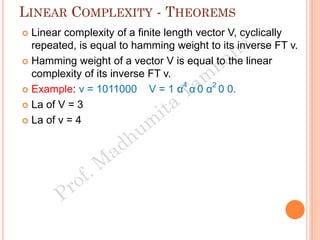
 Any sequence generated by LFSR of length L with
feedback polynomial C is also generated by LFSR
whose feedback polynomial is a multiple of C.
 A sequence generated by LFSR of length L with
feedback polynomial C may also be generated by
‘shorter’ LFSR with feedback polynomial C’ iff C is not
irreducible over GF(q).
 c(x) = 1+x+x3
+x4
+x7
+x10
= (1+x+x7
)(1+x3
)
 Hence same sequence will be generated by (1+x3
).
 Hence linear complexity = 3
0 0 1
LINEAR COMPLEXITY - THEOREMS
 Linear complexity of a finite length vector V, cyclically
repeated, is equal to hamming weight to its inverse FT v.
 Hamming weight of a vector V is equal to the linear
complexity of its inverse FT v.
 Example: v = 1011000 V = 1 α4
α 0 α2
0 0.
 La of V = 3
 La of v = 4
SPECTRAL PROPERTIES OF CYCLIC CODES –
REED-SOLOMON CODES
 A R-S code C of block length n over GF(q), with n a divisor
of q-1, is defined as the set of all codewords whose FT is
equal to zeros in a specified block of d-1 consecutive
components j0, j0+1,… j0+d - 2 .
 As n divides q-1, codewords and spectrum components are
symbols in same field GF(q).
 If codeword C is cyclically shifted by one place, then its
spectral component cj is multiplied by αj
.
 If cj = zero, cjαj
= zero, cyclic shift of C does not alter
spectrum and hence a valid codeword.
 Coded using g(x)= (x- α j0) (x- α j0+1
) (x- α j0+2
) …(x- α j0+d-2
)
 dmin = d2t+1
 Polynomial of degree n-k = d-1
FREQUENCY /TRANSFORM DOMAIN ENCODER
 Every spectrum consistent with the spectral constraints
yields a code word.
 (d-1) cyclically consecutive frequencies j= j0, j0+1,… j0+d - 2
chosen as set of spectral components constrained to be
zero.
 (n-(d-1)) unconstrained components filled with data symbols
from GF(q).
 Inverse FT produces non-systematic codewords.
 d=2t+1, (n,n-d+1) codeword.
 Roots of g(x) = roots of c(x)
 If αi
is root of c(x), Vi = 0.
 d-1=n-k roots, and d-1 components zero.
EXAMPLE
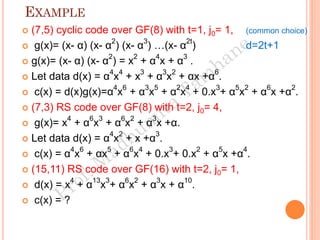
 (7,5) cyclic code over GF(8) with t=1, j0= 1, (common choice)
 g(x)= (x- α) (x- α2
) (x- α3
) …(x- α2t
) d=2t+1
 g(x)= (x- α) (x- α2
) = x2
+ α4
x + α3
.
 Let data d(x) = α4
x4
+ x3
+ α3
x2
+ αx +α6
.
 c(x) = d(x)g(x)=α4
x6
+ α3
x5
+ α2
x4
+ 0.x3
+ α5
x2
+ α6
x +α2
.
 (7,3) RS code over GF(8) with t=2, j0= 4,
 g(x)= x4
+ α6
x3
+ α6
x2
+ α3
x +α.
 Let data d(x) = α4
x2
+ x +α3
.
 c(x) = α4
x6
+ αx5
+ α6
x4
+ 0.x3
+ 0.x2
+ α5
x +α4
.
 (15,11) RS code over GF(16) with t=2, j0= 1,
 d(x) = x4
+ α13
x3
+ α6
x2
+ α3
x + α10
.
 c(x) = ?
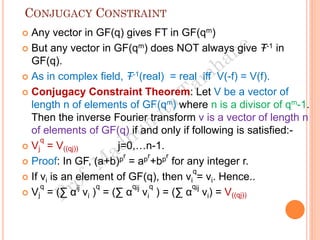
CONJUGACY CONSTRAINT
 Any vector in GF(q) gives FT in GF(qm)
 But any vector in GF(qm) does NOT always give Ŧ-1 in
GF(q).
 As in complex field, Ŧ-1(real) = real iff V(-f) = V(f).
 Conjugacy Constraint Theorem: Let V be a vector of
length n of elements of GF(qm) where n is a divisor of qm-1.
Then the inverse Fourier transform v is a vector of length n
of elements of GF(q) if and only if following is satisfied:-
 Vj
q
= V((qj)) j=0,…n-1.
 Proof: In GF, (a+b)pr
= apr
+bpr
for any integer r.
 If vi is an element of GF(q), then vi
q
= vi. Hence..
 Vj
q
= (∑ αij
vi )
q
= (∑ α
qij
vi
q
) = (∑ α
qij
vi) = V((qj))
CONJUGACY CLASSES
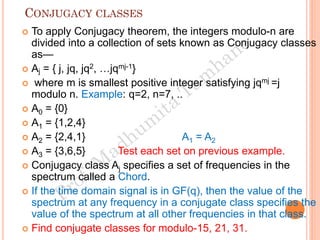
 To apply Conjugacy theorem, the integers modulo-n are
divided into a collection of sets known as Conjugacy classes
as—
 Aj = { j, jq, jq2, …jqmj-1}
 where m is smallest positive integer satisfying jqmj =j
modulo n. Example: q=2, n=7, ..
 A0 = {0}
 A1 = {1,2,4}
 A2 = {2,4,1} A1 = A2
 A3 = {3,6,5} Test each set on previous example.
 Conjugacy class Aj specifies a set of frequencies in the
spectrum called a Chord.
 If the time domain signal is in GF(q), then the value of the
spectrum at any frequency in a conjugate class specifies the
value of the spectrum at all other frequencies in that class.
 Find conjugate classes for modulo-15, 21, 31.
Q-ARY TRACE
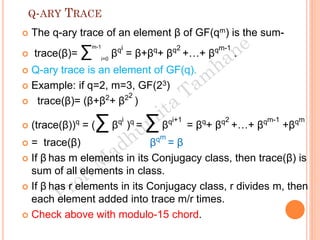
 The q-ary trace of an element β of GF(qm) is the sum-
 trace(β)= ∑m-1
i=0
βqi
= β+βq
+ βq2
+…+ βqm-1
.
 Q-ary trace is an element of GF(q).
 Example: if q=2, m=3, GF(23)
 trace(β)= (β+β2
+ β22
)
 (trace(β))q
= (∑βqi
)q
= ∑ βqi+1
= βq
+ βq2
+…+ βqm-1
+βqm
 = trace(β) βqm
= β
 If β has m elements in its Conjugacy class, then trace(β) is
sum of all elements in class.
 If β has r elements in its Conjugacy class, r divides m, then
each element added into trace m/r times.
 Check above with modulo-15 chord.
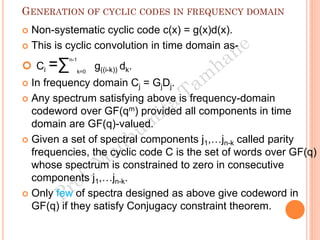
GENERATION OF CYCLIC CODES IN FREQUENCY DOMAIN
 Non-systematic cyclic code c(x) = g(x)d(x).
 This is cyclic convolution in time domain as-
 Ci =∑n-1
k=0
g((i-k)) dk.
 In frequency domain Cj = GjDj.
 Any spectrum satisfying above is frequency-domain
codeword over GF(qm) provided all components in time
domain are GF(q)-valued.
 Given a set of spectral components j1,…jn-k called parity
frequencies, the cyclic code C is the set of words over GF(q)
whose spectrum is constrained to zero in consecutive
components j1,…jn-k.
 Only few of spectra designed as above give codeword in
GF(q) if they satisfy Conjugacy constraint theorem.
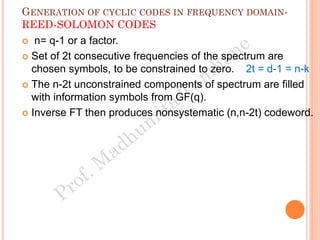
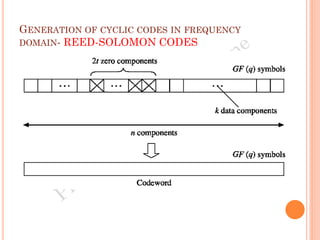
GENERATION OF CYCLIC CODES IN FREQUENCY DOMAIN-
REED-SOLOMON CODES
 n= q-1 or a factor.
 Set of 2t consecutive frequencies of the spectrum are
chosen symbols, to be constrained to zero. 2t = d-1 = n-k
 The n-2t unconstrained components of spectrum are filled
with information symbols from GF(q).
 Inverse FT then produces nonsystematic (n,n-2t) codeword.
GENERATION OF CYCLIC CODES IN FREQUENCY
DOMAIN- REED-SOLOMON CODES
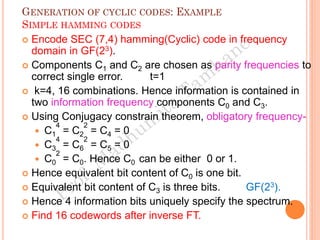
GENERATION OF CYCLIC CODES: EXAMPLE
SIMPLE HAMMING CODES
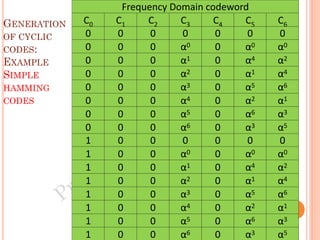
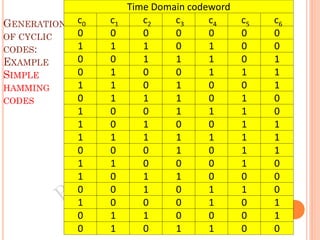
 Encode SEC (7,4) hamming(Cyclic) code in frequency
domain in GF(23).
 Components C1 and C2 are chosen as parity frequencies to
correct single error. t=1
 k=4, 16 combinations. Hence information is contained in
two information frequency components C0 and C3.
 Using Conjugacy constrain theorem, obligatory frequency-
 C1
4
= C2
2
= C4 = 0
 C3
4
= C6
2
= C5 = 0
 C0
2
= C0. Hence C0 can be either 0 or 1.
 Hence equivalent bit content of C0 is one bit.
 Equivalent bit content of C3 is three bits. GF(23).
 Hence 4 information bits uniquely specify the spectrum.
 Find 16 codewords after inverse FT.
GENERATION
OF CYCLIC
CODES:
EXAMPLE
SIMPLE
HAMMING
CODES
Frequency Domain codeword
C0 C1 C2 C3 C4 C5 C6
0 0 0 0 0 0 0
0 0 0 α0 0 α0 α0
0 0 0 α1 0 α4 α2
0 0 0 α2 0 α1 α4
0 0 0 α3 0 α5 α6
0 0 0 α4 0 α2 α1
0 0 0 α5 0 α6 α3
0 0 0 α6 0 α3 α5
1 0 0 0 0 0 0
1 0 0 α0 0 α0 α0
1 0 0 α1 0 α4 α2
1 0 0 α2 0 α1 α4
1 0 0 α3 0 α5 α6
1 0 0 α4 0 α2 α1
1 0 0 α5 0 α6 α3
1 0 0 α6 0 α3 α5
GENERATION
OF CYCLIC
CODES:
EXAMPLE
SIMPLE
HAMMING
CODES
Time Domain codeword
c0 c1 c2 c3 c4 c5 c6
0 0 0 0 0 0 0
1 1 1 0 1 0 0
0 0 1 1 1 0 1
0 1 0 0 1 1 1
1 1 0 1 0 0 1
0 1 1 1 0 1 0
1 0 0 1 1 1 0
1 0 1 0 0 1 1
1 1 1 1 1 1 1
0 0 0 1 0 1 1
1 1 0 0 0 1 0
1 0 1 1 0 0 0
0 0 1 0 1 1 0
1 0 0 0 1 0 1
0 1 1 0 0 0 1
0 1 0 1 1 0 0
GENERATION OF CYCLIC CODES: BCH CODES
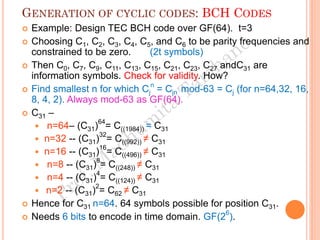
 Example: Design TEC BCH code over GF(64). t=3
 Choosing C1, C2, C3, C4, C5, and C6 to be parity frequencies and
constrained to be zero. (2t symbols)
 Then C0, C7, C9, C11, C13, C15, C21, C23, C27 andC31 are
information symbols. Check for validity. How?
 Find smallest n for which Cj
n
= Cjn mod-63 = Cj (for n=64,32, 16,
8, 4, 2). Always mod-63 as GF(64).
 C31 –
 n=64– (C31)
64
= C((1984)) = C31
 n=32 -- (C31)
32
= C((992)) ≠ C31
 n=16 -- (C31)
16
= C((496)) ≠ C31
 n=8 -- (C31)
8
= C((248)) ≠ C31
 n=4 -- (C31)
4
= C((124)) ≠ C31
 n=2 -- (C31)
2
= C62 ≠ C31
 Hence for C31 n=64. 64 symbols possible for position C31.
 Needs 6 bits to encode in time domain. GF(2
6
).
GENERATION OF CYCLIC CODES: BCH CODES
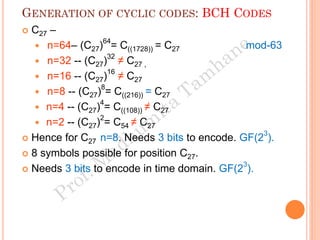
 C27 –
 n=64– (C27)64
= C((1728)) = C27 mod-63
 n=32 -- (C27)32
≠ C27 ,
 n=16 -- (C27)16
≠ C27
 n=8 -- (C27)8
= C((216)) = C27
 n=4 -- (C27)4
= C((108)) ≠ C27
 n=2 -- (C27)2
= C54 ≠ C27
 Hence for C27 n=8. Needs 3 bits to encode. GF(23
).
 8 symbols possible for position C27.
 Needs 3 bits to encode in time domain. GF(23
).
GENERATION OF CYCLIC CODES: BCH CODES
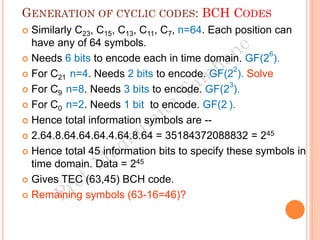
 Similarly C23, C15, C13, C11, C7, n=64. Each position can
have any of 64 symbols.
 Needs 6 bits to encode each in time domain. GF(26
).
 For C21 n=4. Needs 2 bits to encode. GF(22
). Solve
 For C9 n=8. Needs 3 bits to encode. GF(23
).
 For C0 n=2. Needs 1 bit to encode. GF(2 ).
 Hence total information symbols are --
 2.64.8.64.64.64.4.64.8.64 = 35184372088832 = 245
 Hence total 45 information bits to specify these symbols in
time domain. Data = 245
 Gives TEC (63,45) BCH code.
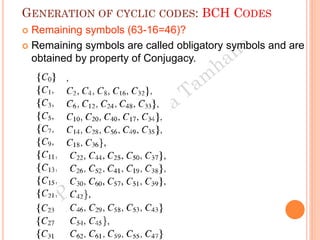
 Remaining symbols (63-16=46)?
GENERATION OF CYCLIC CODES: BCH CODES
 Remaining symbols (63-16=46)?
 Remaining symbols are called obligatory symbols and are
obtained by property of Conjugacy.
GENERATION OF CYCLIC CODES: BCH CODES
 Complete spectrum of 64 symbols are transformed into time
domain 245 codewords.
 Operation of decoder is same as earlier irrespective of
time/frequency domain encoding.
 At last step, to extract information, however, decoder must
know how information is stored in codeword.
 If information bits are encoded in the frequency domain,
they must be read out from frequency domain.

Bch and reed solomon codes generation in frequency domain

  • 1.
    GENERATION OF ERRORCONTROL CODES – BCH AND REED- SOLOMON CODES IN FREQUENCY DOMAIN Fourier Transforms in Galois Field, Linear complexity, LFSR, Conjugacy Constraints
  • 2.
    FOURIER TRANSFORMS INGALOIS FIELDS  Discrete Fourier transforms reveal periodicities in input data and the relative strengths of any periodic components.  Discrete Fourier transform of a real sequence of numbers will be a sequence of complex numbers of the same length.  In complex field,  Discrete Fourier transform of p = {pi, i=0,… N-1}, vector of complex number, is a vector P = {Pk, k=0,…N-1}, given by  where j = √(-1).  The Fourier kernel exp(-j2πN-1 ) is Nth root of unity in field of complex numbers.  In finite field GF(qm), element α of order n is an nth root of unity.
  • 3.
    FOURIER TRANSFORMS INGALOIS FIELDS  Drawing analogy between exp(-j2πN-1 ) and α, Fourier transform in Galois field can be given by—  Let v = {vi, i=0,… n-1}, be a vector over GF(q), where n divides qm-1 for some m, and let α be an element of GF(qm) of order n.  The Galois field Fourier transform of the vector v is the vector V = {Vj, j=0,… n-1}, given by -  Discrete index i is called time and v time domain function or signal .  Discrete index j is called frequency and V frequency domain function or spectrum.
  • 4.
    FOURIER TRANSFORMS INGALOIS FIELDS  In DFT, though function p is real, transform P is complex.  Similarly in GFFT, though time domain function v is over GF(q), the spectrum V is over GF(qm).  In DFT, exp(-j2πN-1 ) exists for all values of n.  In Galois fields, α exists only if n divides qm-1.  To ensure v over GF(q) and V over GF(qm), n = qm-1.  Inverse Fourier transform :
  • 5.
    EXAMPLE  Let 1011000be a vector over GF(2), and n = 23-1 for m=3, and let α be an element of GF(23) of order 7.Find its FT in Galois field GF(23).  Solution: Vj = ∑ α ij vi , i = 0…n-1  V0 = ∑ αo i vi = 1+1+1 = 1  V1 = ∑ αi vi = 1+1. α2 + 1. α3 = α4 .  V2 = ∑ α 2i vi = 1+1. α 4 + 1. α 6 = α .  V3 = ∑ α3i vi = 1+1. α6 + 1. α9 = 0 .  V4 = ∑ α4i vi = 1+1. α8 + 1. α12 = α2 .  V5 = ∑ α 5i vi = 1+1. α 10 + 1. α 15 = 0 .  V6= ∑ α6i vi = 1+1. α12 + 1. α18 = 0 .  V = 1 α4 α 0 α2 0 0 .  Confirm by finding inverse Fourier transform.
  • 6.
    EXAMPLE  Confirm byfinding inverse Fourier transform.  Solution: vi = (1/n)∑ α-ij Vj , j = 0…n-1  v0 = (1/7) ∑ Vj = (1+ α4 + α + α2 )/7 = 1 mod-7  v1 = (1/7) ∑ α-j Vj = (1+ α4 α-1 + α α-2 + α2 α-4 )/7  = (1+ α4 α6 + α α5 + α2 α3 )/7 = 0  v2 = (1/7) ∑ α-2j Vj = (1+ α4 α-2 + α α-4 + α2 α-8 )/7 = 1  v3 = (1/n) ∑ α-3j Vj = (1+ α4 α-3 + α α-6 + α2 α-12 )/7 = 1  v4 = (1/n) ∑ α-4j Vj = (1+ α4 α-4 + α α-8 + α2 α-16 )/7 = 0  v5 = (1/n) ∑ α-5j Vj = (1+ α4 α-5 + α α-10 + α2 α-20 )/7 = 0  v6 = (1/n) ∑ α-6j Vj = (1+ α4 α-6 + α α-12 + α2 α-24 )/7 = 0  v = 1011000
  • 7.
    FOURIER TRANSFORMS INGALOIS FIELDS- PROPERTIES  If vi ↔ Vj then--  v + v’ ↔ V + V’ Additivity  αil vi ↔ V((j+l)) Modulation  v((i-l)) ↔ αjl Vj Translation  Proof  Modulation ∑ αij (αil vi ) = ∑ αi(j+l) vi = V((j+l))  OR (1/n)∑ α -ij V ((j+l)) j+l=k or j=k-l  (1/n)∑ α-i(k-l) Vk = (1/n)∑ α-ik αil V ((j+l)) = αil (1/n)∑ α-ik V ((j+l)) =  = αil vi  Translation (1/n)∑ α-ij αjl Vj= (1/n)∑ α-(i-l)j Vj = v((i-l))  OR ∑ αij v((i-l)) i-l=k or i=k+l  ∑ α (k+l)j vk= ∑ α jl α kj vk = α jl ∑ α kj vk = α jl Vj  = αil vi
  • 8.
    FOURIER TRANSFORMS INGALOIS FIELDS- PROPERTIES  If Ej = FjGj then ei =∑n-1 l=0 f((i-l)) gl. Convolution  If ei = fi gi then Ej =(1/n)∑n-1 k=0 F((j-k)) Gk.
  • 9.
    CONVOLUTION  Let ei= figi i=0,… n-1.  Then Fourier transform Ej, where double parenthesis denotes modulo-n arithmetic on the indices, is given as- Proof: Taking FT of ei = figi
  • 10.
    FOURIER TRANSFORMS INGALOIS FIELDS - THEOREMS  The polynomial v(x) has a zero (root) at αj iff the jth frequency component Vj equals zero.  The polynomial V(x) has a zero (root) at α-i iff the ith time component vi equals zero. where  v(x) = vn-1xn-1 +…+ v1x + v0  V(x) = Vn-1x n-1 +…+ V1x + V0  Proof:  v(αj ) = ∑viαij = Vj = 0 From FT formula  Same for other statement.  Code can be generated in time domain as well as frequency domain.
  • 11.
    EXAMPLE  Example v= 1011000 V = 1 α 4 α 0 α 2 0 0.  v(x) = 1+x 2 +x 3 . V(x) = 1+α 4 x+αx 2 + α 2 x 4 .  V3, V5, and V6 = 0  Check if α 3 , α 5 , and α 6 are roots of v(x) and other elements are not.  v(α 3 ) = 1+ α 6 + α 9 = 0 .  v(α 5 ) = 1+ α 10 + α 15 = 0 .  v(α 6 ) = 1+ α 12 + α 18 = 0 .  Similarly--  v1, v4, v5, and v6 = 0  Check if α -1 , α -4 , α -5 , and α -6 are roots of V(x) and other elements are not.  V(α -1 ) = 1+ α 4 α -1 + α α -2 + α 2 α -4 = 0 .  V(α -4 ) = 1+ α 4 α -4 + α α -8 + α 2 α -16 = 0  V(α -5 ) = 1+ α 4 α -5 + α α -10 + α 2 α -20 = 0  V(α -6 ) = 1+ α 4 α -6 + α α -12 + α 2 α -24 )/7 = 0  Proved
  • 12.
    EXAMPLE  Consider vectorv of block length n and weight 1 with vm as single non-zero component.  Vj =∑n-1 i=0 αij vi = αjm vm j=1,…n-1.  Vj = vm+ αm vm+ α2m vm+… α(n-1)m vm.  Above spectrum V can be generated by Recursion (generating future values using past values of any length).  By multiplying α m to previous one value starting from v0=vm.  Spectrum of a vector of weight 1 can be generated by a linear recursion of length 1.  Special case of linear complexity.
  • 13.
    IMPORTANCE OF REED-SOLOMONCODES  RS codes are important for several reasons:  (i) They are the natural codes to use when a code is required of length less than the size of the field. For, being MDS, they have the highest possible minimum distance.  (ii) They are convenient for building other codes, as they can be mapped into binary codes with high minimum distance.  (iii) They are also used in constructing concatenated and Justesen codes.  (iii) They are useful for correcting bursts of errors.
  • 14.
    LINEAR COMPLEXITY LA La = Degree of its minimum polynomial m  = Length of shortest Linear Feedback Shift Register (LFSR) capable of producing a sequence which agrees with ‘a’ for first k entries a0…ak-1.  = maximum number of linearly independent vectors among state vectors produced by LFSR.  La = n-k = d-1
  • 15.
    LINEAR FEEDBACK SHIFTREGISTER (LFSR)  Machine consisting of registers R0 ..Rm-1, arranged in a row with X-OR gates.  Feedback connections provided from Rm-1 to shift registers through X-OR based on constant Ci , 1≤i ≤m, being 0 or 1.  c(x) = 1+c1x+c2x2 +…. cm-1xm-1 .  Example: LFSR of length 10.  c(x) = 1+x+x3 +x4 +x7 +x10 .  Initial state s0…s9 =1001001  Generatesμ 100 100 … + 1 0 0 1 0 0 1 0 0 1 +++
  • 16.
    LINEAR FEEDBACK SHIFTREGISTER (LFSR)  Any sequence generated by LFSR of length L with feedback polynomial C is also generated by LFSR whose feedback polynomial is a multiple of C.  A sequence generated by LFSR of length L with feedback polynomial C may also be generated by ‘shorter’ LFSR with feedback polynomial C’ iff C is not irreducible over GF(q).  c(x) = 1+x+x3 +x4 +x7 +x10 = (1+x+x7 )(1+x3 )  Hence same sequence will be generated by (1+x3 ).  Hence linear complexity = 3 0 0 1
  • 17.
    LINEAR COMPLEXITY -THEOREMS  Linear complexity of a finite length vector V, cyclically repeated, is equal to hamming weight to its inverse FT v.  Hamming weight of a vector V is equal to the linear complexity of its inverse FT v.  Example: v = 1011000 V = 1 α4 α 0 α2 0 0.  La of V = 3  La of v = 4
  • 18.
    SPECTRAL PROPERTIES OFCYCLIC CODES – REED-SOLOMON CODES  A R-S code C of block length n over GF(q), with n a divisor of q-1, is defined as the set of all codewords whose FT is equal to zeros in a specified block of d-1 consecutive components j0, j0+1,… j0+d - 2 .  As n divides q-1, codewords and spectrum components are symbols in same field GF(q).  If codeword C is cyclically shifted by one place, then its spectral component cj is multiplied by αj .  If cj = zero, cjαj = zero, cyclic shift of C does not alter spectrum and hence a valid codeword.  Coded using g(x)= (x- α j0) (x- α j0+1 ) (x- α j0+2 ) …(x- α j0+d-2 )  dmin = d2t+1  Polynomial of degree n-k = d-1
  • 19.
    FREQUENCY /TRANSFORM DOMAINENCODER  Every spectrum consistent with the spectral constraints yields a code word.  (d-1) cyclically consecutive frequencies j= j0, j0+1,… j0+d - 2 chosen as set of spectral components constrained to be zero.  (n-(d-1)) unconstrained components filled with data symbols from GF(q).  Inverse FT produces non-systematic codewords.  d=2t+1, (n,n-d+1) codeword.  Roots of g(x) = roots of c(x)  If αi is root of c(x), Vi = 0.  d-1=n-k roots, and d-1 components zero.
  • 20.
    EXAMPLE  (7,5) cycliccode over GF(8) with t=1, j0= 1, (common choice)  g(x)= (x- α) (x- α2 ) (x- α3 ) …(x- α2t ) d=2t+1  g(x)= (x- α) (x- α2 ) = x2 + α4 x + α3 .  Let data d(x) = α4 x4 + x3 + α3 x2 + αx +α6 .  c(x) = d(x)g(x)=α4 x6 + α3 x5 + α2 x4 + 0.x3 + α5 x2 + α6 x +α2 .  (7,3) RS code over GF(8) with t=2, j0= 4,  g(x)= x4 + α6 x3 + α6 x2 + α3 x +α.  Let data d(x) = α4 x2 + x +α3 .  c(x) = α4 x6 + αx5 + α6 x4 + 0.x3 + 0.x2 + α5 x +α4 .  (15,11) RS code over GF(16) with t=2, j0= 1,  d(x) = x4 + α13 x3 + α6 x2 + α3 x + α10 .  c(x) = ?
  • 21.
    CONJUGACY CONSTRAINT  Anyvector in GF(q) gives FT in GF(qm)  But any vector in GF(qm) does NOT always give Ŧ-1 in GF(q).  As in complex field, Ŧ-1(real) = real iff V(-f) = V(f).  Conjugacy Constraint Theorem: Let V be a vector of length n of elements of GF(qm) where n is a divisor of qm-1. Then the inverse Fourier transform v is a vector of length n of elements of GF(q) if and only if following is satisfied:-  Vj q = V((qj)) j=0,…n-1.  Proof: In GF, (a+b)pr = apr +bpr for any integer r.  If vi is an element of GF(q), then vi q = vi. Hence..  Vj q = (∑ αij vi ) q = (∑ α qij vi q ) = (∑ α qij vi) = V((qj))
  • 22.
    CONJUGACY CLASSES  Toapply Conjugacy theorem, the integers modulo-n are divided into a collection of sets known as Conjugacy classes as—  Aj = { j, jq, jq2, …jqmj-1}  where m is smallest positive integer satisfying jqmj =j modulo n. Example: q=2, n=7, ..  A0 = {0}  A1 = {1,2,4}  A2 = {2,4,1} A1 = A2  A3 = {3,6,5} Test each set on previous example.  Conjugacy class Aj specifies a set of frequencies in the spectrum called a Chord.  If the time domain signal is in GF(q), then the value of the spectrum at any frequency in a conjugate class specifies the value of the spectrum at all other frequencies in that class.  Find conjugate classes for modulo-15, 21, 31.
  • 23.
    Q-ARY TRACE  Theq-ary trace of an element β of GF(qm) is the sum-  trace(β)= ∑m-1 i=0 βqi = β+βq + βq2 +…+ βqm-1 .  Q-ary trace is an element of GF(q).  Example: if q=2, m=3, GF(23)  trace(β)= (β+β2 + β22 )  (trace(β))q = (∑βqi )q = ∑ βqi+1 = βq + βq2 +…+ βqm-1 +βqm  = trace(β) βqm = β  If β has m elements in its Conjugacy class, then trace(β) is sum of all elements in class.  If β has r elements in its Conjugacy class, r divides m, then each element added into trace m/r times.  Check above with modulo-15 chord.
  • 24.
    GENERATION OF CYCLICCODES IN FREQUENCY DOMAIN  Non-systematic cyclic code c(x) = g(x)d(x).  This is cyclic convolution in time domain as-  Ci =∑n-1 k=0 g((i-k)) dk.  In frequency domain Cj = GjDj.  Any spectrum satisfying above is frequency-domain codeword over GF(qm) provided all components in time domain are GF(q)-valued.  Given a set of spectral components j1,…jn-k called parity frequencies, the cyclic code C is the set of words over GF(q) whose spectrum is constrained to zero in consecutive components j1,…jn-k.  Only few of spectra designed as above give codeword in GF(q) if they satisfy Conjugacy constraint theorem.
  • 25.
    GENERATION OF CYCLICCODES IN FREQUENCY DOMAIN- REED-SOLOMON CODES  n= q-1 or a factor.  Set of 2t consecutive frequencies of the spectrum are chosen symbols, to be constrained to zero. 2t = d-1 = n-k  The n-2t unconstrained components of spectrum are filled with information symbols from GF(q).  Inverse FT then produces nonsystematic (n,n-2t) codeword.
  • 26.
    GENERATION OF CYCLICCODES IN FREQUENCY DOMAIN- REED-SOLOMON CODES
  • 27.
    GENERATION OF CYCLICCODES: EXAMPLE SIMPLE HAMMING CODES  Encode SEC (7,4) hamming(Cyclic) code in frequency domain in GF(23).  Components C1 and C2 are chosen as parity frequencies to correct single error. t=1  k=4, 16 combinations. Hence information is contained in two information frequency components C0 and C3.  Using Conjugacy constrain theorem, obligatory frequency-  C1 4 = C2 2 = C4 = 0  C3 4 = C6 2 = C5 = 0  C0 2 = C0. Hence C0 can be either 0 or 1.  Hence equivalent bit content of C0 is one bit.  Equivalent bit content of C3 is three bits. GF(23).  Hence 4 information bits uniquely specify the spectrum.  Find 16 codewords after inverse FT.
  • 28.
    GENERATION OF CYCLIC CODES: EXAMPLE SIMPLE HAMMING CODES Frequency Domaincodeword C0 C1 C2 C3 C4 C5 C6 0 0 0 0 0 0 0 0 0 0 α0 0 α0 α0 0 0 0 α1 0 α4 α2 0 0 0 α2 0 α1 α4 0 0 0 α3 0 α5 α6 0 0 0 α4 0 α2 α1 0 0 0 α5 0 α6 α3 0 0 0 α6 0 α3 α5 1 0 0 0 0 0 0 1 0 0 α0 0 α0 α0 1 0 0 α1 0 α4 α2 1 0 0 α2 0 α1 α4 1 0 0 α3 0 α5 α6 1 0 0 α4 0 α2 α1 1 0 0 α5 0 α6 α3 1 0 0 α6 0 α3 α5
  • 29.
    GENERATION OF CYCLIC CODES: EXAMPLE SIMPLE HAMMING CODES Time Domaincodeword c0 c1 c2 c3 c4 c5 c6 0 0 0 0 0 0 0 1 1 1 0 1 0 0 0 0 1 1 1 0 1 0 1 0 0 1 1 1 1 1 0 1 0 0 1 0 1 1 1 0 1 0 1 0 0 1 1 1 0 1 0 1 0 0 1 1 1 1 1 1 1 1 1 0 0 0 1 0 1 1 1 1 0 0 0 1 0 1 0 1 1 0 0 0 0 0 1 0 1 1 0 1 0 0 0 1 0 1 0 1 1 0 0 0 1 0 1 0 1 1 0 0
  • 30.
    GENERATION OF CYCLICCODES: BCH CODES  Example: Design TEC BCH code over GF(64). t=3  Choosing C1, C2, C3, C4, C5, and C6 to be parity frequencies and constrained to be zero. (2t symbols)  Then C0, C7, C9, C11, C13, C15, C21, C23, C27 andC31 are information symbols. Check for validity. How?  Find smallest n for which Cj n = Cjn mod-63 = Cj (for n=64,32, 16, 8, 4, 2). Always mod-63 as GF(64).  C31 –  n=64– (C31) 64 = C((1984)) = C31  n=32 -- (C31) 32 = C((992)) ≠ C31  n=16 -- (C31) 16 = C((496)) ≠ C31  n=8 -- (C31) 8 = C((248)) ≠ C31  n=4 -- (C31) 4 = C((124)) ≠ C31  n=2 -- (C31) 2 = C62 ≠ C31  Hence for C31 n=64. 64 symbols possible for position C31.  Needs 6 bits to encode in time domain. GF(2 6 ).
  • 31.
    GENERATION OF CYCLICCODES: BCH CODES  C27 –  n=64– (C27)64 = C((1728)) = C27 mod-63  n=32 -- (C27)32 ≠ C27 ,  n=16 -- (C27)16 ≠ C27  n=8 -- (C27)8 = C((216)) = C27  n=4 -- (C27)4 = C((108)) ≠ C27  n=2 -- (C27)2 = C54 ≠ C27  Hence for C27 n=8. Needs 3 bits to encode. GF(23 ).  8 symbols possible for position C27.  Needs 3 bits to encode in time domain. GF(23 ).
  • 32.
    GENERATION OF CYCLICCODES: BCH CODES  Similarly C23, C15, C13, C11, C7, n=64. Each position can have any of 64 symbols.  Needs 6 bits to encode each in time domain. GF(26 ).  For C21 n=4. Needs 2 bits to encode. GF(22 ). Solve  For C9 n=8. Needs 3 bits to encode. GF(23 ).  For C0 n=2. Needs 1 bit to encode. GF(2 ).  Hence total information symbols are --  2.64.8.64.64.64.4.64.8.64 = 35184372088832 = 245  Hence total 45 information bits to specify these symbols in time domain. Data = 245  Gives TEC (63,45) BCH code.  Remaining symbols (63-16=46)?
  • 33.
    GENERATION OF CYCLICCODES: BCH CODES  Remaining symbols (63-16=46)?  Remaining symbols are called obligatory symbols and are obtained by property of Conjugacy.
  • 34.
    GENERATION OF CYCLICCODES: BCH CODES  Complete spectrum of 64 symbols are transformed into time domain 245 codewords.  Operation of decoder is same as earlier irrespective of time/frequency domain encoding.  At last step, to extract information, however, decoder must know how information is stored in codeword.  If information bits are encoded in the frequency domain, they must be read out from frequency domain.