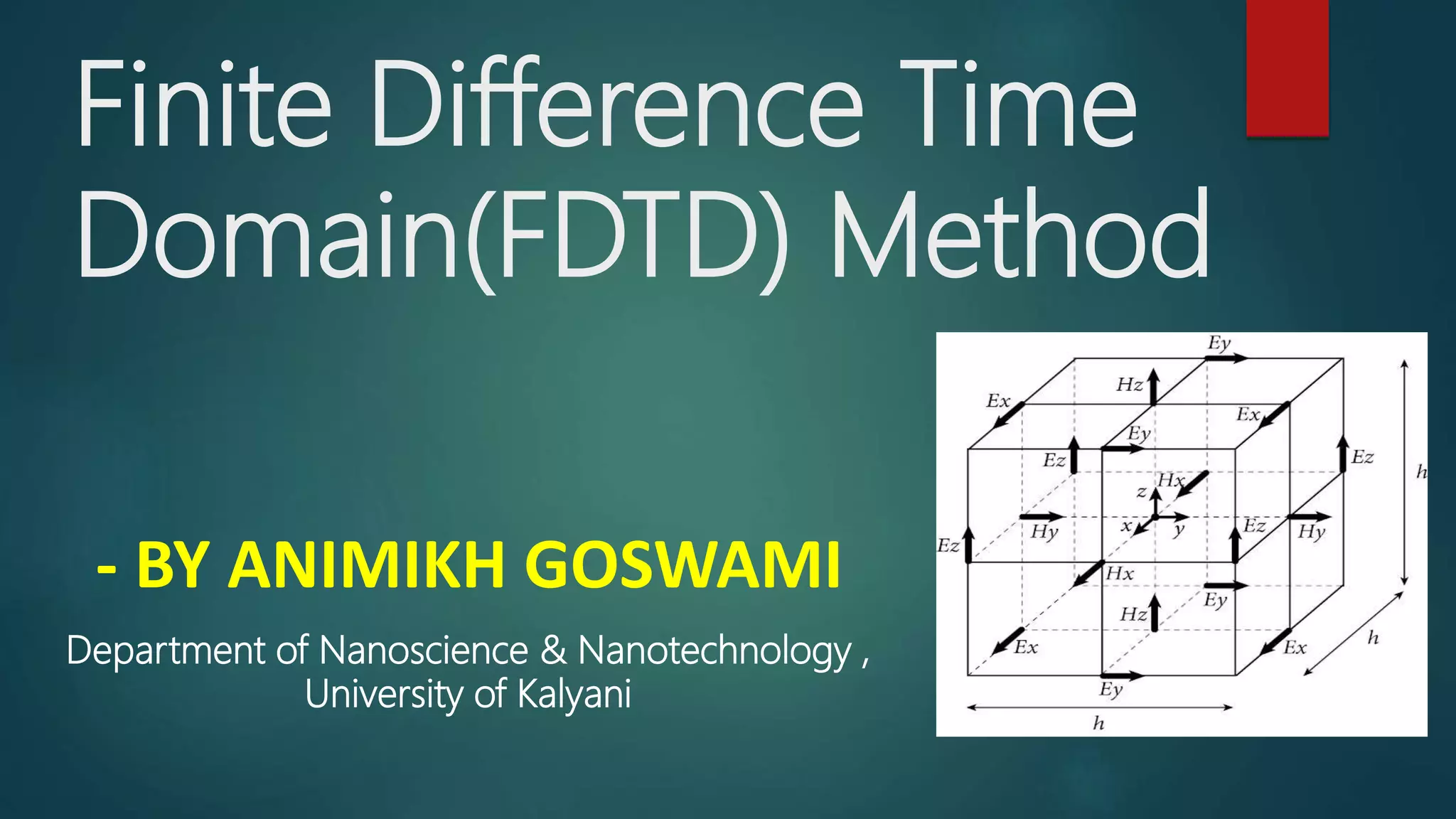
Finite Difference Time
Domain(FDTD) Method
- BY ANIMIKH GOSWAMI
Department of Nanoscience & Nanotechnology ,
University of Kalyani
Declaimer
Before going to Finite Difference Time Method (FDTD)
(FDTD) we should know about the following topic :
 Vector Algebra and Vector Calculus
 Different form of Maxwell’s equation and their
solving.
 Interpolation and Numerical Analysis
 Finite Difference Method
 Computer Programming
@Animikh Goswami
Finite Difference Time Domain Method
Contents :
 Introduction to FDTD
 2D Formulation
 Time Stepping
 Perfectly Matched Layer(PML)
@Animikh Goswami
Finite Difference Time Domain Method
(Introduction to FDTD)
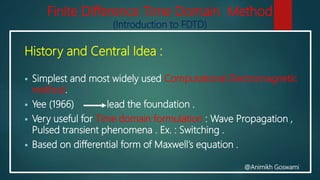
History and Central Idea :
 Simplest and most widely used Computational Electromagnetic
method.
 Yee (1966) lead the foundation .
 Very useful for Time domain formulation : Wave Propagation ,
Pulsed transient phenomena . Ex. : Switching .
 Based on differential form of Maxwell’s equation .
@Animikh Goswami
Finite Difference Time Domain Method
(Introduction to FDTD)
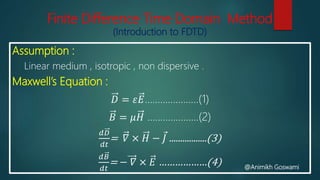
Assumption :
Linear medium , isotropic , non dispersive .
Maxwell’s Equation :
𝐷 = 𝜀𝐸…………………(1)
𝐵 = 𝜇𝐻 ………………..(2)
𝑑𝐷
𝑑𝑡
= 𝛻 × 𝐻 − 𝐽 .................(3)
𝑑𝐵
𝑑𝑡
= − 𝛻 × 𝐸 ………………(4) @Animikh Goswami
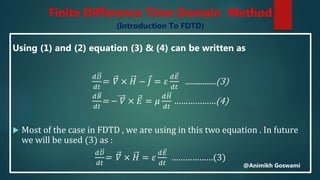
Using (1) and (2) equation (3) & (4) can be written as
𝑑𝐷
𝑑𝑡
= 𝛻 × 𝐻 − 𝐽 = 𝜀
𝑑𝐸
𝑑𝑡
................(3)
𝑑𝐵
𝑑𝑡
= − 𝛻 × 𝐸 = 𝜇
𝑑𝐻
𝑑𝑡
………………(4)
 Most of the case in FDTD , we are using in this two equation . In future
we will be used (3) as :
𝑑𝐷
𝑑𝑡
= 𝛻 × 𝐻 = 𝜀
𝑑𝐸
𝑑𝑡
………………(3)
Finite Difference Time Domain Method
(Introduction To FDTD)
@Animikh Goswami
Finite Difference Time Domain Method
(Introduction To FDTD)
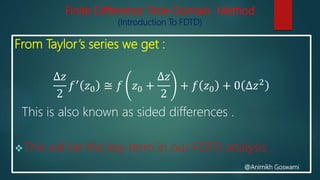
From Taylor’s series we get :
∆𝑧
2
𝑓′
𝑧0 ≅ 𝑓 𝑧0 +
∆𝑧
2
+ 𝑓 𝑧0 + 0 ∆𝑧2
This is also known as sided differences .
This will be the key term in our FDTD analysis .
@Animikh Goswami
Finite Difference Time Domain Method
(2D formulation )
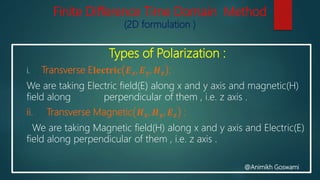
Types of Polarization :
i. Transverse E𝐥𝐞𝐜𝐭𝐫𝐢𝐜 𝑬 𝒙, 𝑬 𝒚, 𝑯 𝒛 :
We are taking Electric field(E) along x and y axis and magnetic(H)
field along perpendicular of them , i.e. z axis .
ii. Transverse Magnetic 𝑯 𝒙, 𝑯 𝒚, 𝑬 𝒛 :
We are taking Magnetic field(H) along x and y axis and Electric(E)
field along perpendicular of them , i.e. z axis .
@Animikh Goswami
Finite Difference Time Domain Method
(2D formulation)
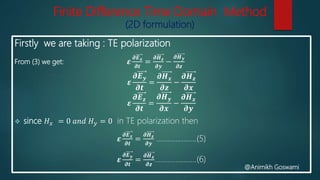
Firstly we are taking : TE polarization
From (3) we get: 𝜺
𝝏𝑬 𝒙
𝝏𝒕
=
𝝏𝑯 𝒛
𝝏𝒚
−
𝝏𝑯 𝒚
𝝏𝒛
𝜺
𝝏𝑬 𝒚
𝝏𝒕
=
𝝏𝑯 𝒙
𝝏𝒛
−
𝝏𝑯 𝒛
𝝏𝒙
𝜺
𝝏𝑬 𝒛
𝝏𝒕
=
𝝏𝑯 𝒚
𝝏𝒙
−
𝝏𝑯 𝒙
𝝏𝒚
 since 𝐻 𝑥 = 0 𝑎𝑛𝑑 𝐻 𝑦 = 0 in TE polarization then
𝜺
𝝏𝑬 𝒙
𝝏𝒕
=
𝝏𝑯 𝒛
𝝏𝒚
…………………(5)
𝜺
𝝏𝑬 𝒚
𝝏𝒕
=
𝝏𝑯 𝒙
𝝏𝒛
………………….(6)
@Animikh Goswami
Finite Difference Time Domain Method
(2D Formulation )
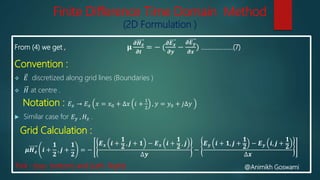
From (4) we get , 𝛍
𝝏𝑯 𝒛
𝝏𝒕
= − (
𝝏𝑬 𝒙
𝝏𝒚
−
𝝏𝑬 𝒚
𝝏𝒙
) ….................(7)
Convention :
 𝐸 discretized along grid lines (Boundaries )
 𝐻 at centre .
Notation : 𝐸 𝑥 → 𝐸 𝑥 𝑥 = 𝑥0 + ∆𝑥 𝑖 +
1
2
, 𝑦 = 𝑦0 + 𝑗∆𝑦
 Similar case for 𝐸 𝑦 , 𝐻𝑧 .
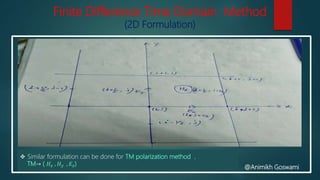
Grid Calculation :
𝝁𝑯 𝒛 𝒊 +
𝟏
𝟐
, 𝒋 +
𝟏
𝟐
= −
𝑬 𝒙 𝒊 +
𝟏
𝟐
, 𝒋 + 𝟏 − 𝑬 𝒙 𝒊 +
𝟏
𝟐
, 𝒋
∆𝒚
−
𝑬 𝒚 𝒊 + 𝟏, 𝒋 +
𝟏
𝟐
− 𝑬 𝒚 𝒊, 𝒋 +
𝟏
𝟐
∆𝒙
Trick : (top- bottom) and (Left- Right) @Animikh Goswami
Finite Difference Time Domain Method
(2D Formulation)
@Animikh Goswami
 Similar formulation can be done for TM polarization method .
TM→ ( 𝐻 𝑥 , 𝐻 𝑦 , 𝐸𝑧)
Finite Difference Time Domain Method
(Time Stepping)
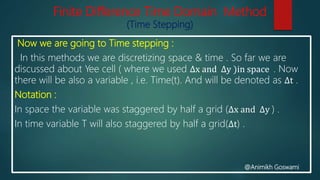
Now we are going to Time stepping :
In this methods we are discretizing space & time . So far we are
discussed about Yee cell ( where we used ∆x and ∆y )in space . Now
there will be also a variable , i.e. Time(t). And will be denoted as ∆t .
Notation :
In space the variable was staggered by half a grid (∆x and ∆y ) .
In time variable T will also staggered by half a grid(∆t) .
@Animikh Goswami
Finite Difference Time Domain Method
(Time Stepping)
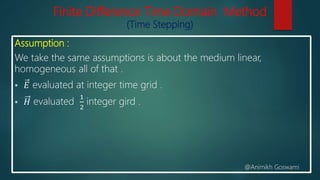
Assumption :
We take the same assumptions is about the medium linear,
homogeneous all of that .
 𝐸 evaluated at integer time grid .
 𝐻 evaluated
1
2
integer gird .
@Animikh Goswami
Finite Difference Time Domain Method
(Time Stepping)
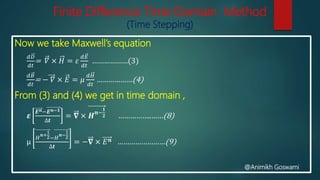
Now we take Maxwell’s equation
𝑑𝐷
𝑑𝑡
= 𝛻 × 𝐻 = 𝜀
𝑑𝐸
𝑑𝑡
………………(3)
𝑑𝐵
𝑑𝑡
= − 𝛻 × 𝐸 = 𝜇
𝑑𝐻
𝑑𝑡
………………(4)
From (3) and (4) we get in time domain ,
𝜺
𝑬 𝒏−𝑬 𝒏−𝟏
∆𝒕
= 𝛁 × 𝑯 𝒏−
𝟏
𝟐 ……………..……(8)
μ
𝐻
𝒏+
1
2−𝐻
𝒏−
1
2
∆𝒕
= −𝛁 × 𝐸 𝒏 ……………………(9)
@Animikh Goswami
Finite Difference Time Domain Method
(Time Stepping)
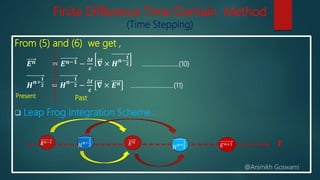
From (5) and (6) we get ,
𝑬 𝒏 = 𝑬 𝒏−𝟏 −
∆𝒕
𝜺
𝛁 × 𝑯 𝒏−
𝟏
𝟐 …………………..(10)
𝑯 𝒏+
𝟏
𝟐 = 𝑯 𝒏−
𝟏
𝟐 −
∆𝒕
𝜺
𝛁 × 𝑬 𝒏 ……………............(11)
 Leap Frog Integration Scheme :
Present Past
𝑬 𝑛−1
𝐻 𝑛−
1
2
𝐻 𝑛+
1
2
𝐸 𝑛
𝐸 𝑛+1 t
@Animikh Goswami
Finite Difference Time Domain Method
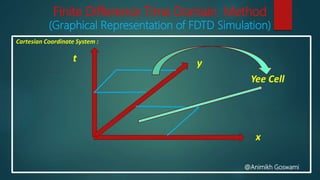
(Graphical Representation of FDTD Simulation)
Cartesian Coordinate System :
yt
x
Yee Cell
@Animikh Goswami
Finite Difference Time Domain Method
(Perfectly Matched Layer)
Before going to Perfectly Matched Layer in FDTD ,we should know
about the following topic :
 Accuracy Condition
 Dispersive and Non Dispersive Media
 ABC Implementation in FDTD
 ABC failure in FDTD
@Animikh Goswami
Finite Difference Time Domain Method
(Perfectly Matched Layer)
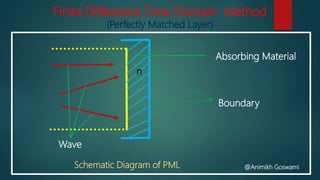
 This is a relatively new development on the Field of FDTD, proposed
by Berenger in 1994.
Advantages (Our wish list for an Absorbing Material based PML ):
1. It observes waves at all angles , so R=0.
2. It works for evanescent waves .
@Animikh Goswami
Finite Difference Time Domain Method
(Perfectly Matched Layer)
Schematic Diagram of PML @Animikh Goswami
Wave
Boundary
Absorbing Material
n
Finite Difference Time Domain Method
(Perfectly Matched Layer)
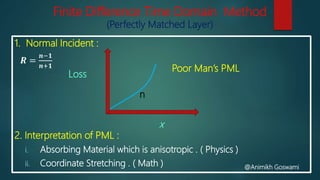
1. Normal Incident :
𝑹 =
𝒏−𝟏
𝒏+𝟏
2. Interpretation of PML :
i. Absorbing Material which is anisotropic . ( Physics )
ii. Coordinate Stretching . ( Math ) @Animikh Goswami
Loss
x
Poor Man’s PML
n
Finite Difference Time Domain Method
(Perfectly Matched Layer)
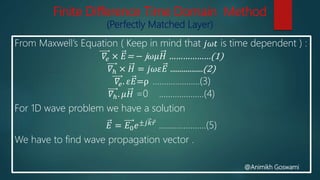
From Maxwell’s Equation ( Keep in mind that 𝑗𝜔𝑡 is time dependent ) :
𝛻𝑒 × 𝐸= − j 𝜔𝜇𝐻 ………………(1)
𝛻ℎ × 𝐻 = 𝑗𝜔𝜀𝐸 .................(2)
𝛻𝑒. 𝜀𝐸=ρ …………………(3)
𝛻ℎ. 𝜇𝐻 =0 ………………..(4)
For 1D wave problem we have a solution
𝐸 = 𝐸0 𝑒±𝑗𝑘 𝑟 …………………(5)
We have to find wave propagation vector .
@Animikh Goswami
Finite Difference Time Domain Method
(Perfectly Matched Layer)
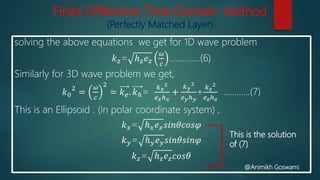
solving the above equations we get for 1D wave problem
𝑘 𝑧= ℎ 𝑧 𝑒 𝑧
𝜔
𝑐
…………..(6)
Similarly for 3D wave problem we get,
𝑘0
2
=
𝜔
𝑐
2
= 𝑘 𝑒. 𝑘ℎ=
𝑘 𝑥
2
𝑒 𝑥ℎ 𝑥
+
𝑘 𝑦
2
𝑒 𝑦ℎ 𝑦
+
𝑘 𝑧
2
𝑒 𝑧ℎ 𝑧
…………(7)
This is an Ellipsoid . (in polar coordinate system) ,
𝑘 𝑥= ℎ 𝑥 𝑒 𝑥 𝑠𝑖𝑛𝜃𝑐𝑜𝑠𝜑
𝑘 𝑦= ℎ 𝑦 𝑒 𝑦 𝑠𝑖𝑛𝜃𝑠𝑖𝑛𝜑
𝑘 𝑧= ℎ 𝑧 𝑒 𝑧 𝑐𝑜𝑠𝜃
@Animikh Goswami
This is the solution
of (7)
Finite Difference Time Domain Method
(Perfectly Matched Layer)
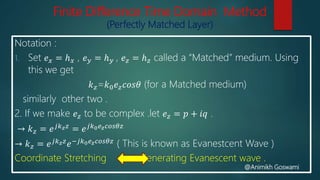
Notation :
1. Set 𝑒 𝑥 = ℎ 𝑥 , 𝑒 𝑦 = ℎ 𝑦 , 𝑒 𝑧 = ℎ 𝑧 called a “Matched” medium. Using
this we get
𝑘 𝑧=𝑘0 𝑒 𝑧 𝑐𝑜𝑠𝜃 (for a Matched medium)
similarly other two .
2. If we make 𝑒 𝑧 to be complex .let 𝑒 𝑧 = 𝑝 + 𝑖𝑞 .
→ 𝑘 𝑧 = 𝑒 𝑗𝑘 𝑧 𝑧 = 𝑒 𝑗𝑘0 𝑒 𝑧 𝑐𝑜𝑠𝜃𝑧
→ 𝑘 𝑧 = 𝑒 𝑗𝑘 𝑧 𝑧 𝑒−𝑗𝑘0 𝑒 𝑧 𝑐𝑜𝑠𝜃𝑧 ( This is known as Evanestcent Wave )
Coordinate Stretching Generating Evanescent wave .
@Animikh Goswami
Finite Difference Time Domain Method
Acknowledgement
1. Dr. Ahamed Hossian ( Faculty , Department of
Mathematics , B.K.C.College)
2. Shawon Kumar Awon ( Faculty , Department of
Mathematics , The Heritage College)
3. Subhom Mukherjee
4. Sayon Chakraborty
@Animikh Goswami
Finite Difference Time Domain Method
Source :
1. Optical Properties of Metallic Nanoparticles Basic Principles and
Simulation - Andreas Trügler
2. https://en.wikipedia.org/wiki/Finite-difference_time-domain_method#
3. http://www.iitg.ac.in/engfac/krs/public_html/lectures/ee340/FDTD.pdf
@Animikh Goswami
Finite Difference Time Domain Method
Thank You
@Animikh Goswami

Fdtd ppt for mine

  • 1.
    Finite Difference Time Domain(FDTD)Method - BY ANIMIKH GOSWAMI Department of Nanoscience & Nanotechnology , University of Kalyani
  • 2.
    Declaimer Before going toFinite Difference Time Method (FDTD) (FDTD) we should know about the following topic :  Vector Algebra and Vector Calculus  Different form of Maxwell’s equation and their solving.  Interpolation and Numerical Analysis  Finite Difference Method  Computer Programming @Animikh Goswami
  • 3.
    Finite Difference TimeDomain Method Contents :  Introduction to FDTD  2D Formulation  Time Stepping  Perfectly Matched Layer(PML) @Animikh Goswami
  • 4.
    Finite Difference TimeDomain Method (Introduction to FDTD) History and Central Idea :  Simplest and most widely used Computational Electromagnetic method.  Yee (1966) lead the foundation .  Very useful for Time domain formulation : Wave Propagation , Pulsed transient phenomena . Ex. : Switching .  Based on differential form of Maxwell’s equation . @Animikh Goswami
  • 5.
    Finite Difference TimeDomain Method (Introduction to FDTD) Assumption : Linear medium , isotropic , non dispersive . Maxwell’s Equation : 𝐷 = 𝜀𝐸…………………(1) 𝐵 = 𝜇𝐻 ………………..(2) 𝑑𝐷 𝑑𝑡 = 𝛻 × 𝐻 − 𝐽 .................(3) 𝑑𝐵 𝑑𝑡 = − 𝛻 × 𝐸 ………………(4) @Animikh Goswami
  • 6.
    Using (1) and(2) equation (3) & (4) can be written as 𝑑𝐷 𝑑𝑡 = 𝛻 × 𝐻 − 𝐽 = 𝜀 𝑑𝐸 𝑑𝑡 ................(3) 𝑑𝐵 𝑑𝑡 = − 𝛻 × 𝐸 = 𝜇 𝑑𝐻 𝑑𝑡 ………………(4)  Most of the case in FDTD , we are using in this two equation . In future we will be used (3) as : 𝑑𝐷 𝑑𝑡 = 𝛻 × 𝐻 = 𝜀 𝑑𝐸 𝑑𝑡 ………………(3) Finite Difference Time Domain Method (Introduction To FDTD) @Animikh Goswami
  • 7.
    Finite Difference TimeDomain Method (Introduction To FDTD) From Taylor’s series we get : ∆𝑧 2 𝑓′ 𝑧0 ≅ 𝑓 𝑧0 + ∆𝑧 2 + 𝑓 𝑧0 + 0 ∆𝑧2 This is also known as sided differences . This will be the key term in our FDTD analysis . @Animikh Goswami
  • 8.
    Finite Difference TimeDomain Method (2D formulation ) Types of Polarization : i. Transverse E𝐥𝐞𝐜𝐭𝐫𝐢𝐜 𝑬 𝒙, 𝑬 𝒚, 𝑯 𝒛 : We are taking Electric field(E) along x and y axis and magnetic(H) field along perpendicular of them , i.e. z axis . ii. Transverse Magnetic 𝑯 𝒙, 𝑯 𝒚, 𝑬 𝒛 : We are taking Magnetic field(H) along x and y axis and Electric(E) field along perpendicular of them , i.e. z axis . @Animikh Goswami
  • 9.
    Finite Difference TimeDomain Method (2D formulation) Firstly we are taking : TE polarization From (3) we get: 𝜺 𝝏𝑬 𝒙 𝝏𝒕 = 𝝏𝑯 𝒛 𝝏𝒚 − 𝝏𝑯 𝒚 𝝏𝒛 𝜺 𝝏𝑬 𝒚 𝝏𝒕 = 𝝏𝑯 𝒙 𝝏𝒛 − 𝝏𝑯 𝒛 𝝏𝒙 𝜺 𝝏𝑬 𝒛 𝝏𝒕 = 𝝏𝑯 𝒚 𝝏𝒙 − 𝝏𝑯 𝒙 𝝏𝒚  since 𝐻 𝑥 = 0 𝑎𝑛𝑑 𝐻 𝑦 = 0 in TE polarization then 𝜺 𝝏𝑬 𝒙 𝝏𝒕 = 𝝏𝑯 𝒛 𝝏𝒚 …………………(5) 𝜺 𝝏𝑬 𝒚 𝝏𝒕 = 𝝏𝑯 𝒙 𝝏𝒛 ………………….(6) @Animikh Goswami
  • 10.
    Finite Difference TimeDomain Method (2D Formulation ) From (4) we get , 𝛍 𝝏𝑯 𝒛 𝝏𝒕 = − ( 𝝏𝑬 𝒙 𝝏𝒚 − 𝝏𝑬 𝒚 𝝏𝒙 ) ….................(7) Convention :  𝐸 discretized along grid lines (Boundaries )  𝐻 at centre . Notation : 𝐸 𝑥 → 𝐸 𝑥 𝑥 = 𝑥0 + ∆𝑥 𝑖 + 1 2 , 𝑦 = 𝑦0 + 𝑗∆𝑦  Similar case for 𝐸 𝑦 , 𝐻𝑧 . Grid Calculation : 𝝁𝑯 𝒛 𝒊 + 𝟏 𝟐 , 𝒋 + 𝟏 𝟐 = − 𝑬 𝒙 𝒊 + 𝟏 𝟐 , 𝒋 + 𝟏 − 𝑬 𝒙 𝒊 + 𝟏 𝟐 , 𝒋 ∆𝒚 − 𝑬 𝒚 𝒊 + 𝟏, 𝒋 + 𝟏 𝟐 − 𝑬 𝒚 𝒊, 𝒋 + 𝟏 𝟐 ∆𝒙 Trick : (top- bottom) and (Left- Right) @Animikh Goswami
  • 11.
    Finite Difference TimeDomain Method (2D Formulation) @Animikh Goswami  Similar formulation can be done for TM polarization method . TM→ ( 𝐻 𝑥 , 𝐻 𝑦 , 𝐸𝑧)
  • 12.
    Finite Difference TimeDomain Method (Time Stepping) Now we are going to Time stepping : In this methods we are discretizing space & time . So far we are discussed about Yee cell ( where we used ∆x and ∆y )in space . Now there will be also a variable , i.e. Time(t). And will be denoted as ∆t . Notation : In space the variable was staggered by half a grid (∆x and ∆y ) . In time variable T will also staggered by half a grid(∆t) . @Animikh Goswami
  • 13.
    Finite Difference TimeDomain Method (Time Stepping) Assumption : We take the same assumptions is about the medium linear, homogeneous all of that .  𝐸 evaluated at integer time grid .  𝐻 evaluated 1 2 integer gird . @Animikh Goswami
  • 14.
    Finite Difference TimeDomain Method (Time Stepping) Now we take Maxwell’s equation 𝑑𝐷 𝑑𝑡 = 𝛻 × 𝐻 = 𝜀 𝑑𝐸 𝑑𝑡 ………………(3) 𝑑𝐵 𝑑𝑡 = − 𝛻 × 𝐸 = 𝜇 𝑑𝐻 𝑑𝑡 ………………(4) From (3) and (4) we get in time domain , 𝜺 𝑬 𝒏−𝑬 𝒏−𝟏 ∆𝒕 = 𝛁 × 𝑯 𝒏− 𝟏 𝟐 ……………..……(8) μ 𝐻 𝒏+ 1 2−𝐻 𝒏− 1 2 ∆𝒕 = −𝛁 × 𝐸 𝒏 ……………………(9) @Animikh Goswami
  • 15.
    Finite Difference TimeDomain Method (Time Stepping) From (5) and (6) we get , 𝑬 𝒏 = 𝑬 𝒏−𝟏 − ∆𝒕 𝜺 𝛁 × 𝑯 𝒏− 𝟏 𝟐 …………………..(10) 𝑯 𝒏+ 𝟏 𝟐 = 𝑯 𝒏− 𝟏 𝟐 − ∆𝒕 𝜺 𝛁 × 𝑬 𝒏 ……………............(11)  Leap Frog Integration Scheme : Present Past 𝑬 𝑛−1 𝐻 𝑛− 1 2 𝐻 𝑛+ 1 2 𝐸 𝑛 𝐸 𝑛+1 t @Animikh Goswami
  • 16.
    Finite Difference TimeDomain Method (Graphical Representation of FDTD Simulation) Cartesian Coordinate System : yt x Yee Cell @Animikh Goswami
  • 17.
    Finite Difference TimeDomain Method (Perfectly Matched Layer) Before going to Perfectly Matched Layer in FDTD ,we should know about the following topic :  Accuracy Condition  Dispersive and Non Dispersive Media  ABC Implementation in FDTD  ABC failure in FDTD @Animikh Goswami
  • 18.
    Finite Difference TimeDomain Method (Perfectly Matched Layer)  This is a relatively new development on the Field of FDTD, proposed by Berenger in 1994. Advantages (Our wish list for an Absorbing Material based PML ): 1. It observes waves at all angles , so R=0. 2. It works for evanescent waves . @Animikh Goswami
  • 19.
    Finite Difference TimeDomain Method (Perfectly Matched Layer) Schematic Diagram of PML @Animikh Goswami Wave Boundary Absorbing Material n
  • 20.
    Finite Difference TimeDomain Method (Perfectly Matched Layer) 1. Normal Incident : 𝑹 = 𝒏−𝟏 𝒏+𝟏 2. Interpretation of PML : i. Absorbing Material which is anisotropic . ( Physics ) ii. Coordinate Stretching . ( Math ) @Animikh Goswami Loss x Poor Man’s PML n
  • 21.
    Finite Difference TimeDomain Method (Perfectly Matched Layer) From Maxwell’s Equation ( Keep in mind that 𝑗𝜔𝑡 is time dependent ) : 𝛻𝑒 × 𝐸= − j 𝜔𝜇𝐻 ………………(1) 𝛻ℎ × 𝐻 = 𝑗𝜔𝜀𝐸 .................(2) 𝛻𝑒. 𝜀𝐸=ρ …………………(3) 𝛻ℎ. 𝜇𝐻 =0 ………………..(4) For 1D wave problem we have a solution 𝐸 = 𝐸0 𝑒±𝑗𝑘 𝑟 …………………(5) We have to find wave propagation vector . @Animikh Goswami
  • 22.
    Finite Difference TimeDomain Method (Perfectly Matched Layer) solving the above equations we get for 1D wave problem 𝑘 𝑧= ℎ 𝑧 𝑒 𝑧 𝜔 𝑐 …………..(6) Similarly for 3D wave problem we get, 𝑘0 2 = 𝜔 𝑐 2 = 𝑘 𝑒. 𝑘ℎ= 𝑘 𝑥 2 𝑒 𝑥ℎ 𝑥 + 𝑘 𝑦 2 𝑒 𝑦ℎ 𝑦 + 𝑘 𝑧 2 𝑒 𝑧ℎ 𝑧 …………(7) This is an Ellipsoid . (in polar coordinate system) , 𝑘 𝑥= ℎ 𝑥 𝑒 𝑥 𝑠𝑖𝑛𝜃𝑐𝑜𝑠𝜑 𝑘 𝑦= ℎ 𝑦 𝑒 𝑦 𝑠𝑖𝑛𝜃𝑠𝑖𝑛𝜑 𝑘 𝑧= ℎ 𝑧 𝑒 𝑧 𝑐𝑜𝑠𝜃 @Animikh Goswami This is the solution of (7)
  • 23.
    Finite Difference TimeDomain Method (Perfectly Matched Layer) Notation : 1. Set 𝑒 𝑥 = ℎ 𝑥 , 𝑒 𝑦 = ℎ 𝑦 , 𝑒 𝑧 = ℎ 𝑧 called a “Matched” medium. Using this we get 𝑘 𝑧=𝑘0 𝑒 𝑧 𝑐𝑜𝑠𝜃 (for a Matched medium) similarly other two . 2. If we make 𝑒 𝑧 to be complex .let 𝑒 𝑧 = 𝑝 + 𝑖𝑞 . → 𝑘 𝑧 = 𝑒 𝑗𝑘 𝑧 𝑧 = 𝑒 𝑗𝑘0 𝑒 𝑧 𝑐𝑜𝑠𝜃𝑧 → 𝑘 𝑧 = 𝑒 𝑗𝑘 𝑧 𝑧 𝑒−𝑗𝑘0 𝑒 𝑧 𝑐𝑜𝑠𝜃𝑧 ( This is known as Evanestcent Wave ) Coordinate Stretching Generating Evanescent wave . @Animikh Goswami
  • 24.
    Finite Difference TimeDomain Method Acknowledgement 1. Dr. Ahamed Hossian ( Faculty , Department of Mathematics , B.K.C.College) 2. Shawon Kumar Awon ( Faculty , Department of Mathematics , The Heritage College) 3. Subhom Mukherjee 4. Sayon Chakraborty @Animikh Goswami
  • 25.
    Finite Difference TimeDomain Method Source : 1. Optical Properties of Metallic Nanoparticles Basic Principles and Simulation - Andreas Trügler 2. https://en.wikipedia.org/wiki/Finite-difference_time-domain_method# 3. http://www.iitg.ac.in/engfac/krs/public_html/lectures/ee340/FDTD.pdf @Animikh Goswami
  • 26.
    Finite Difference TimeDomain Method Thank You @Animikh Goswami