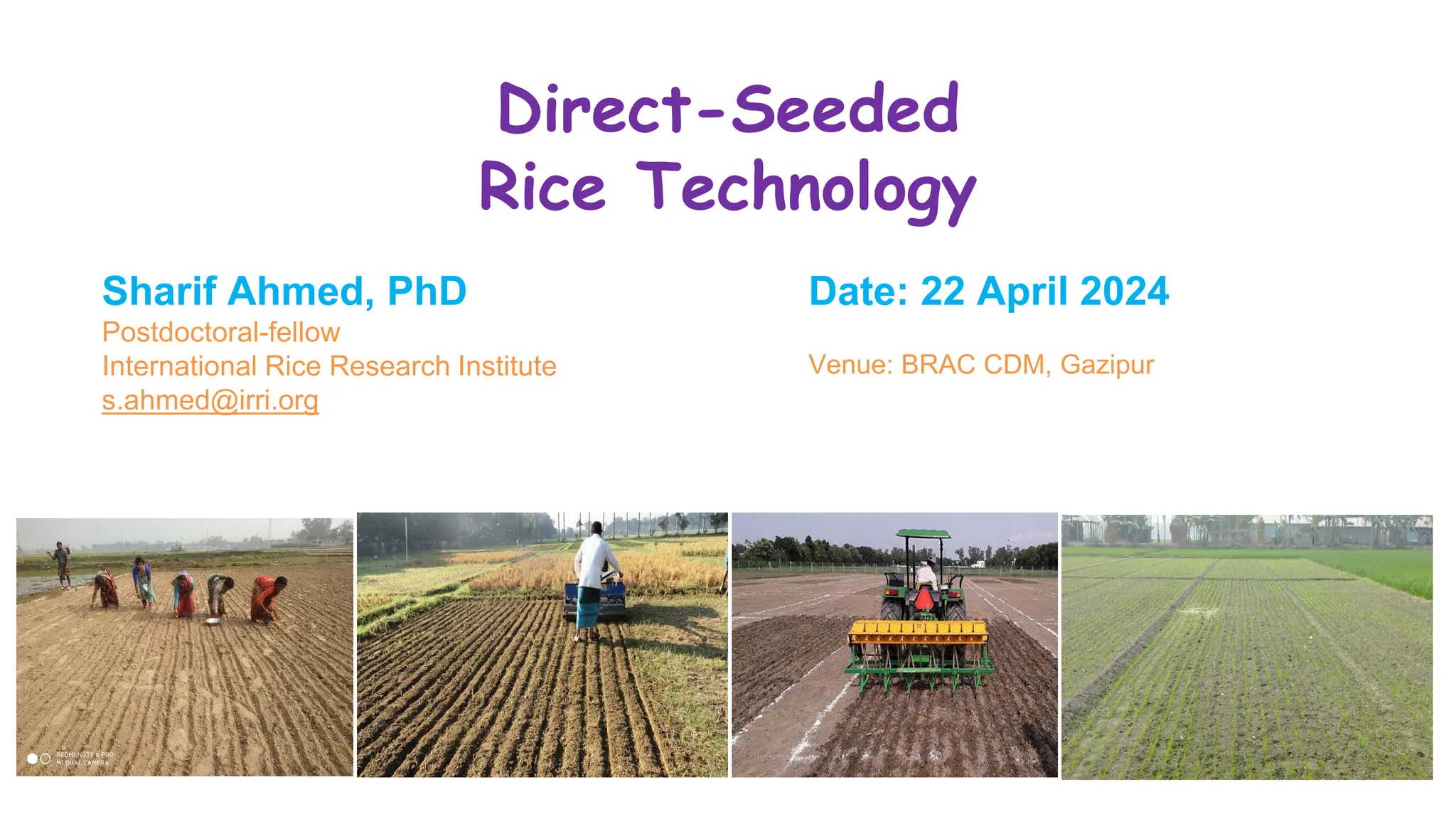
Direct-Seeded
Rice Technology
Sharif Ahmed, PhD
Postdoctoral-fellow
International Rice Research Institute
s.ahmed@irri.org
Date: 22 April 2024
Venue: BRAC CDM, Gazipur
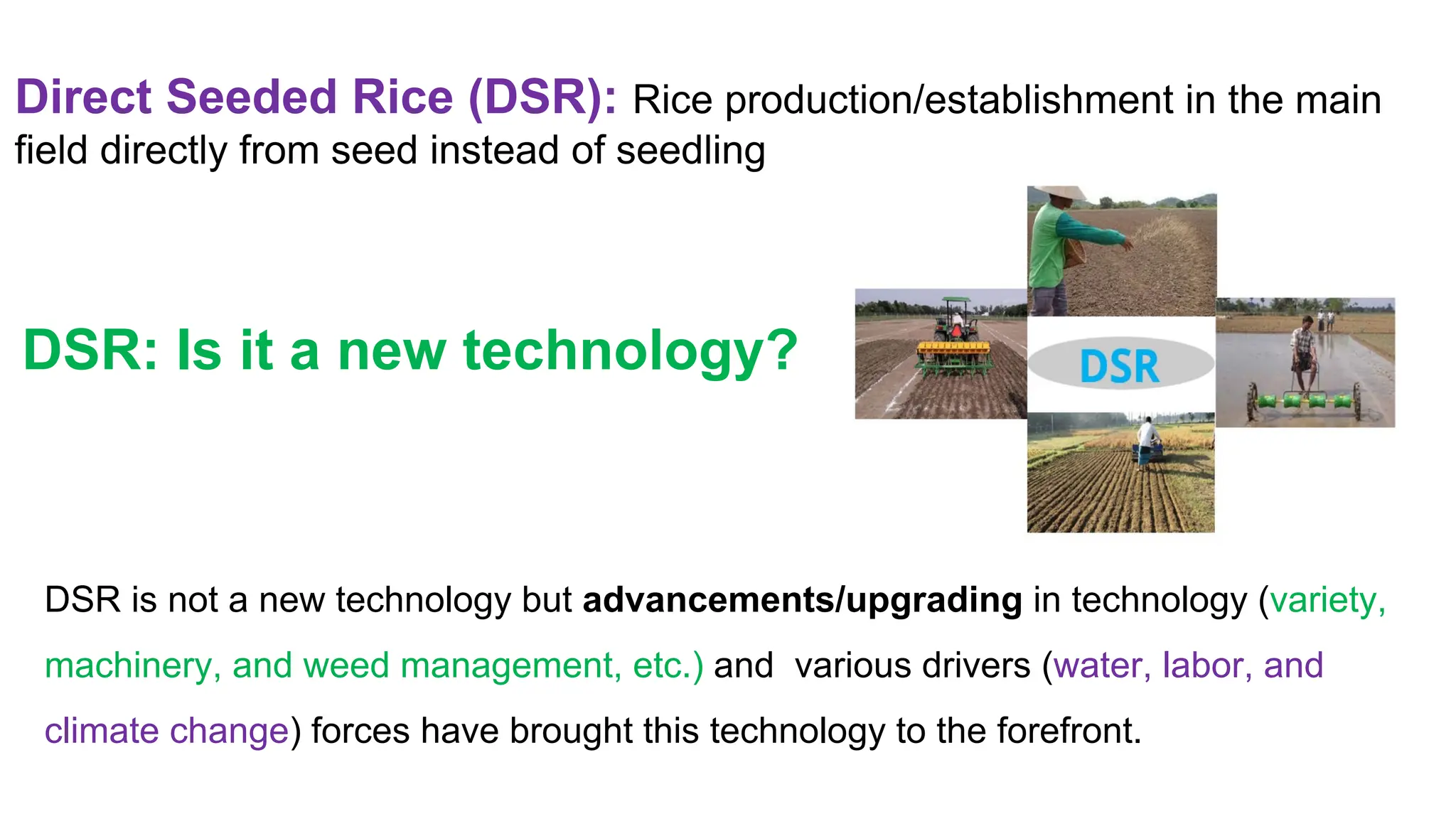
DSR is not a new technology but advancements/upgrading in technology (variety,
machinery, and weed management, etc.) and various drivers (water, labor, and
climate change) forces have brought this technology to the forefront.
DSR: Is it a new technology?
Direct Seeded Rice (DSR): Rice production/establishment in the main
field directly from seed instead of seedling
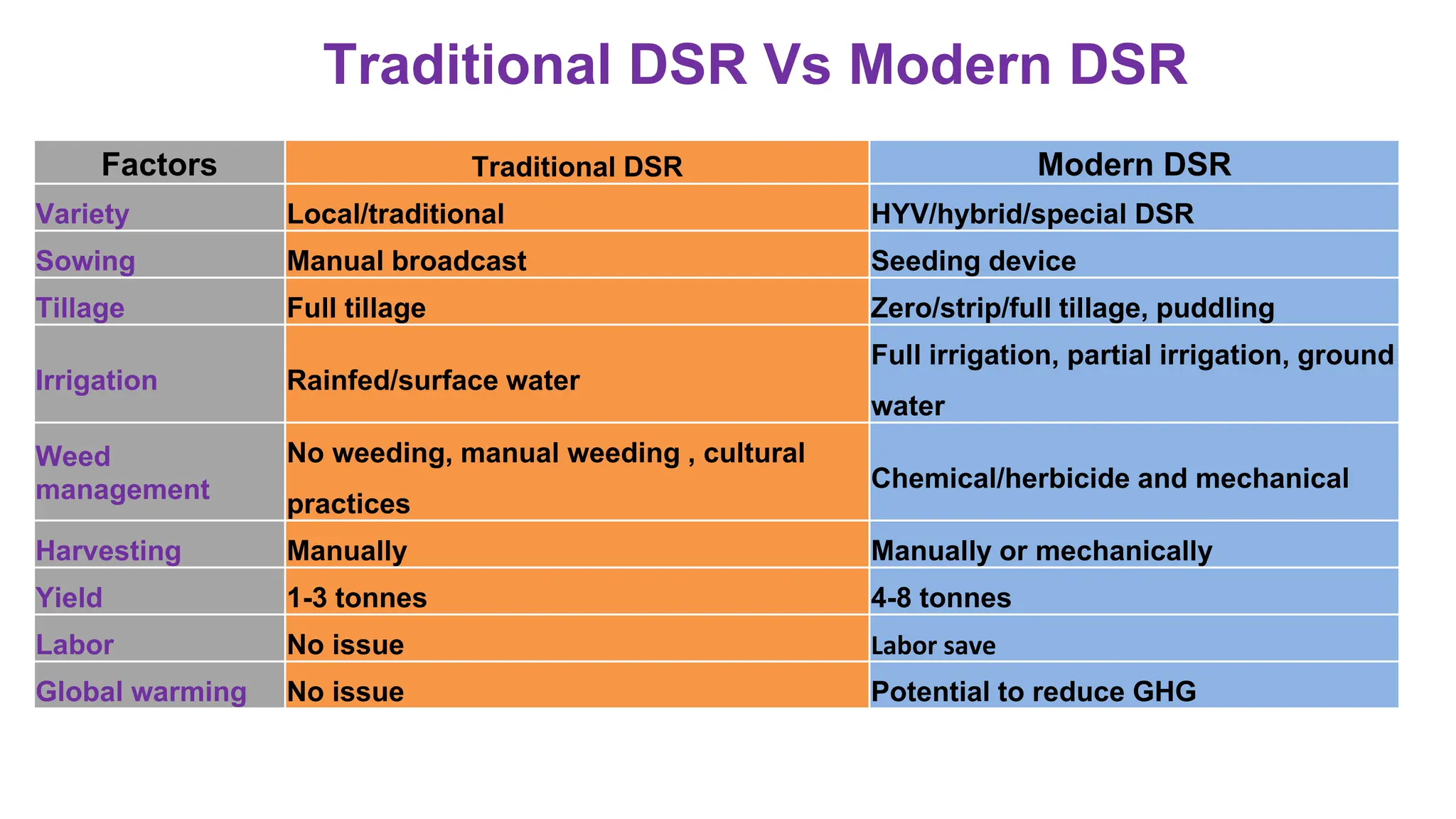
Traditional DSR Vs Modern DSR
Factors Traditional DSR Modern DSR
Variety Local/traditional HYV/hybrid/special DSR
Sowing Manual broadcast Seeding device
Tillage Full tillage Zero/strip/full tillage, puddling
Irrigation Rainfed/surface water
Full irrigation, partial irrigation, ground
water
Weed
management
No weeding, manual weeding , cultural
practices
Chemical/herbicide and mechanical
Harvesting Manually Manually or mechanically
Yield 1-3 tonnes 4-8 tonnes
Labor No issue Labor save
Global warming No issue Potential to reduce GHG
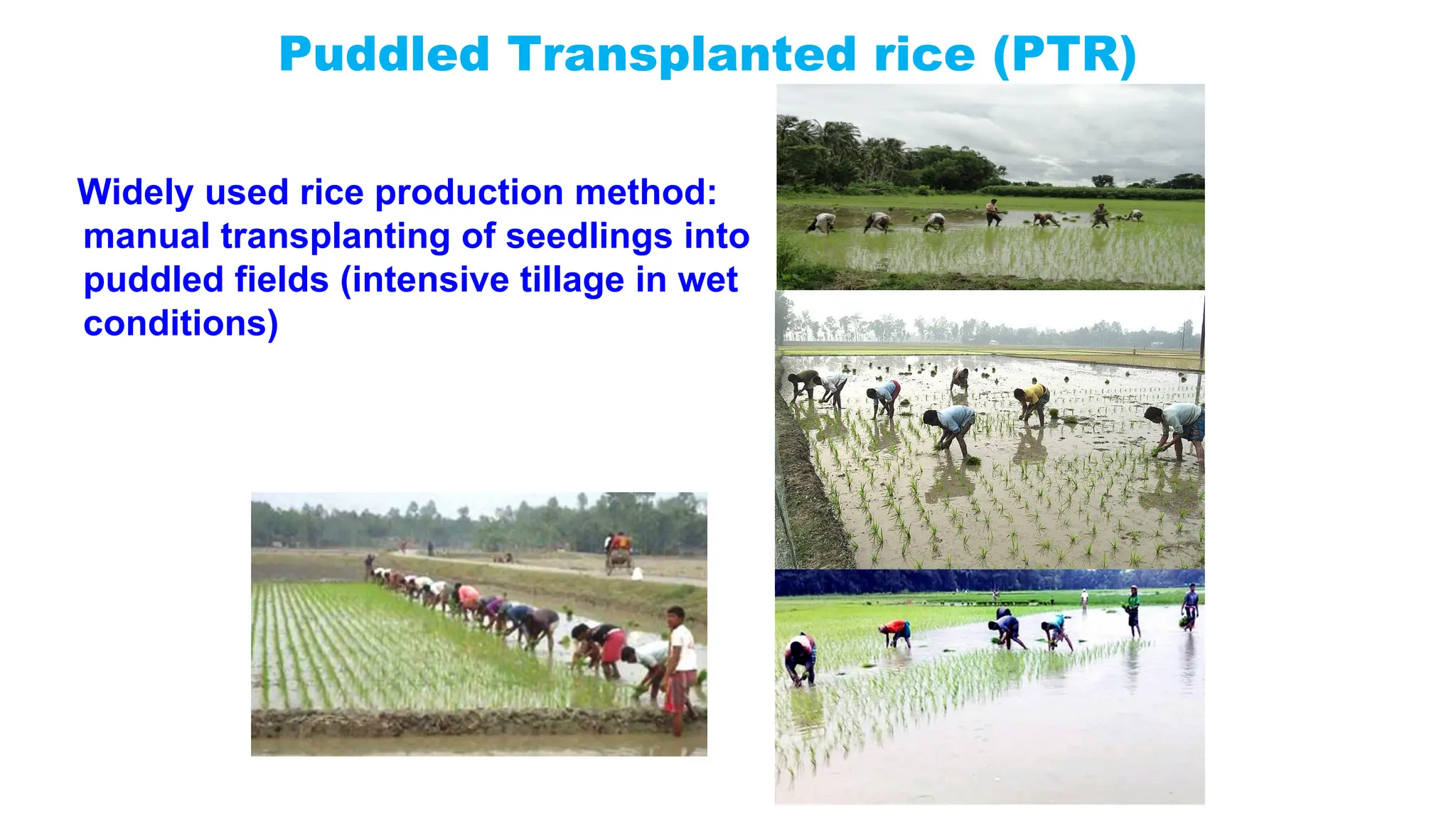
Widely used rice production method:
manual transplanting of seedlings into
puddled fields (intensive tillage in wet
conditions)
Puddled Transplanted rice (PTR)
Your Text
Here
Your Text
Here
Your Text
Here
Your Text
Here
Your Text
Here
Labor, water and energy intensive production
system
PTR
Deep wet tillage
Leveling
Seed bed
Seedling uprooting
Transplanting
Alternate Rice Establishment Methods
Mechanical rice transplanting Manual broadcasting
Wet -direct seeding
Dry-direct seeding in line
Saves labor
Up to 60%
(Addresses:Labor scarcity)
Saves water
Up to 50%
(Addresses: Water scarcity)
Reduces GHG emission
Up to 60%
(Addresses: Climate change)
Increases income by
reducing cost of cultivation
[Addresses: Rising cultivation
cost and declining income]
Positive impact on
succeeding non-rice crop
[Creates enabling condition for
diversification]
DSR offers both adaptation (adapt to water shortage) and mitigation (reduction in GHG
emissions) options to climate change
Benefits of DSR over puddled transplanted rice
Direct Seeded
rice
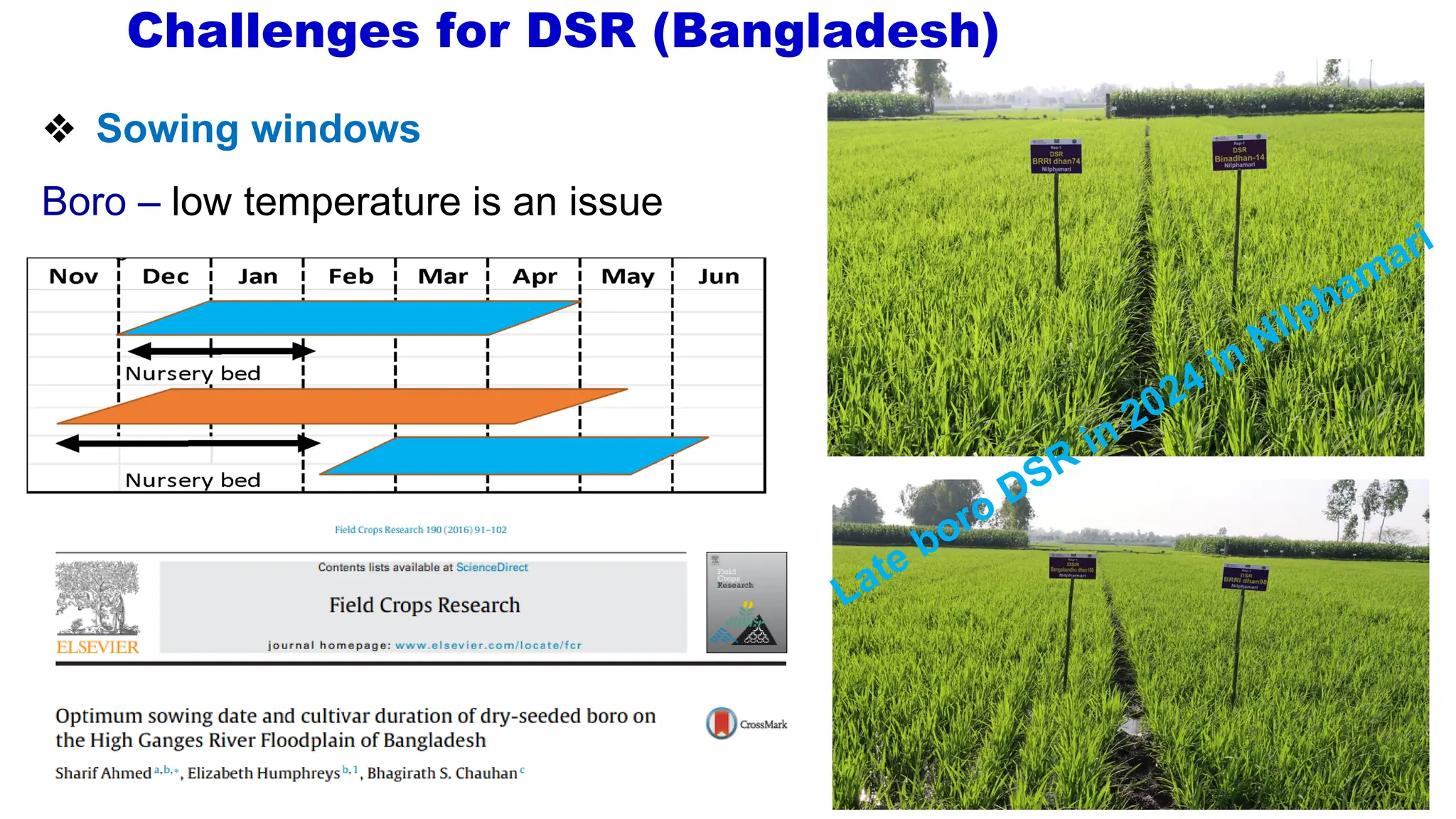
❖ Sowing windows
Boro – low temperature is an issue
Challenges for DSR (Bangladesh)
❖ Sowing windows
Aman –late seeding higher risk of:
- Inability to sow (soil too wet)
- failed establishment because of heavy rain after sowing
⮚ earlier seeding less risky but higher irrigation requirement
Challenges for DSR (Bangladesh)
Risk
Solutions
Trade-off
Solution AG-tolerant varieties
not available to
farmers
Pre-sowing Irrigation
Shallow cultivation at field capacity
Soil Mulch DSR
Machine Seeding after tillage
Delay first irrigation up to 21 days
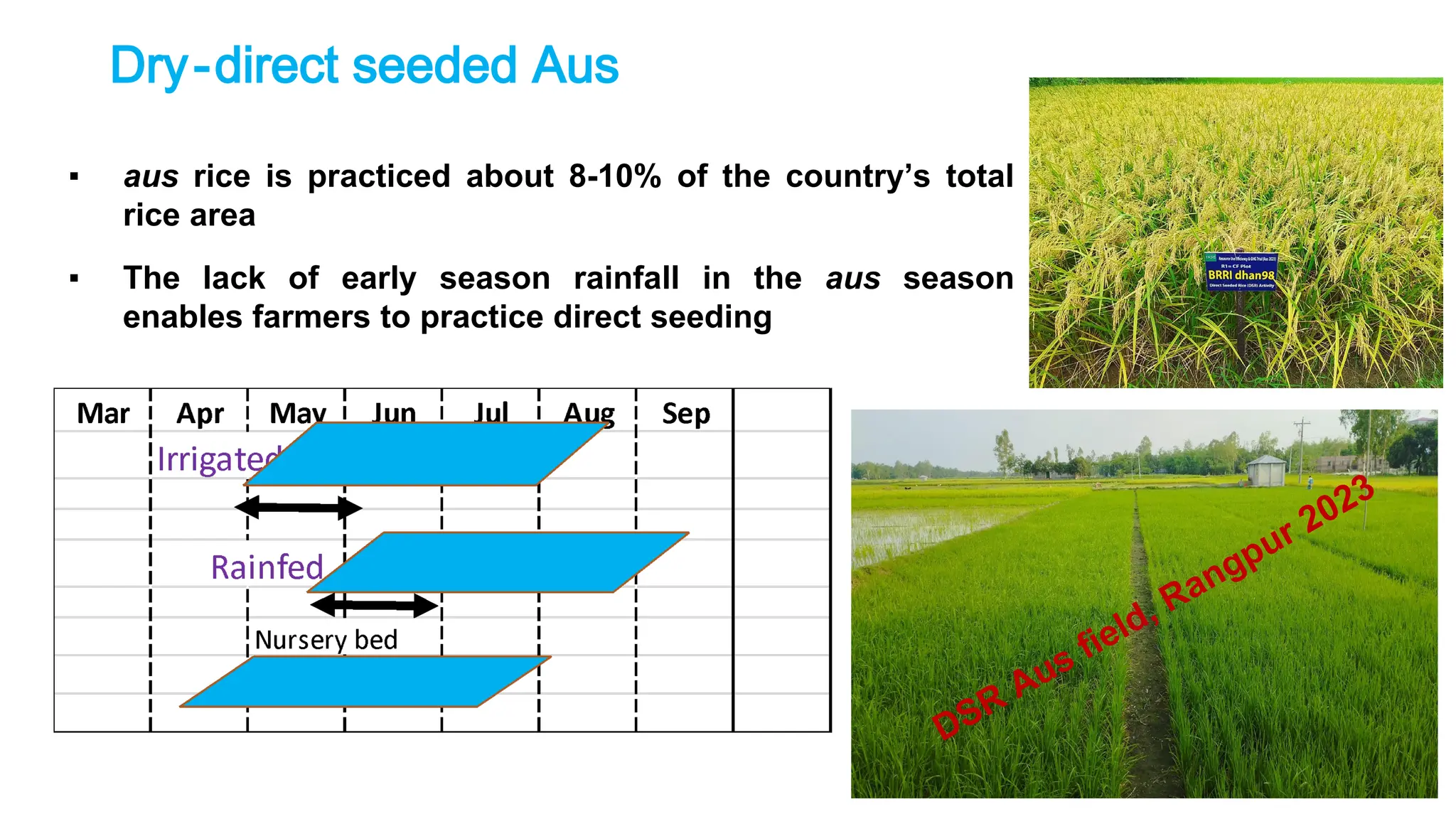
▪ aus rice is practiced about 8-10% of the country’s total
rice area
▪ The lack of early season rainfall in the aus season
enables farmers to practice direct seeding
Dry-direct seeded Aus
❖ Weed management
Farmers need
specific information
on herbicide
❖Seeding device
❖ Suitable variety for DSR
⮚ Cold tolerant during early growth stage (boro)
⮚ Tolerance of anaerobic conditions during
germination (aman)
⮚ Early seedling vigour
⮚ Short duration (inbred/hybrid)
⮚ Weed competitive ability
❖ Knowledge on management practices
⮚ to identify the appropriate landscape position for
DSR in aus season
⮚ to quantify the impact of DSR on yield, profitability,
energy use and GWP
⮚ to identify the suitable rice varieties for DSR
CSISA’s experience on Aus DSR
Treatments:
Establishment method:
▪ Machine seeding with power-tiller operated seeder (PTOS)
▪ Broadcast seeding by hand
▪ Manual transplanting in puddled soil
Landscape position:
▪ High land
▪ Medium highland
▪ Low land
Varieties: BRRI dhan83, BRRI dhan85, Binadhan-19
Trial Period: Aus 2019, Aus 2020 and Aus 2021
Location: Jhenaidah, Faridpur, and Dinajpur
Fig. Grain yield of of Aus rice
Faridpur
Jhenaidah
Dinajpur
Results and Discussion
Fig. Human labor used Fig. Total production cost Fig. Global warming potential
0.00
0.20
0.40
0.60
0.80
1.00
1.20
1.40
1.60
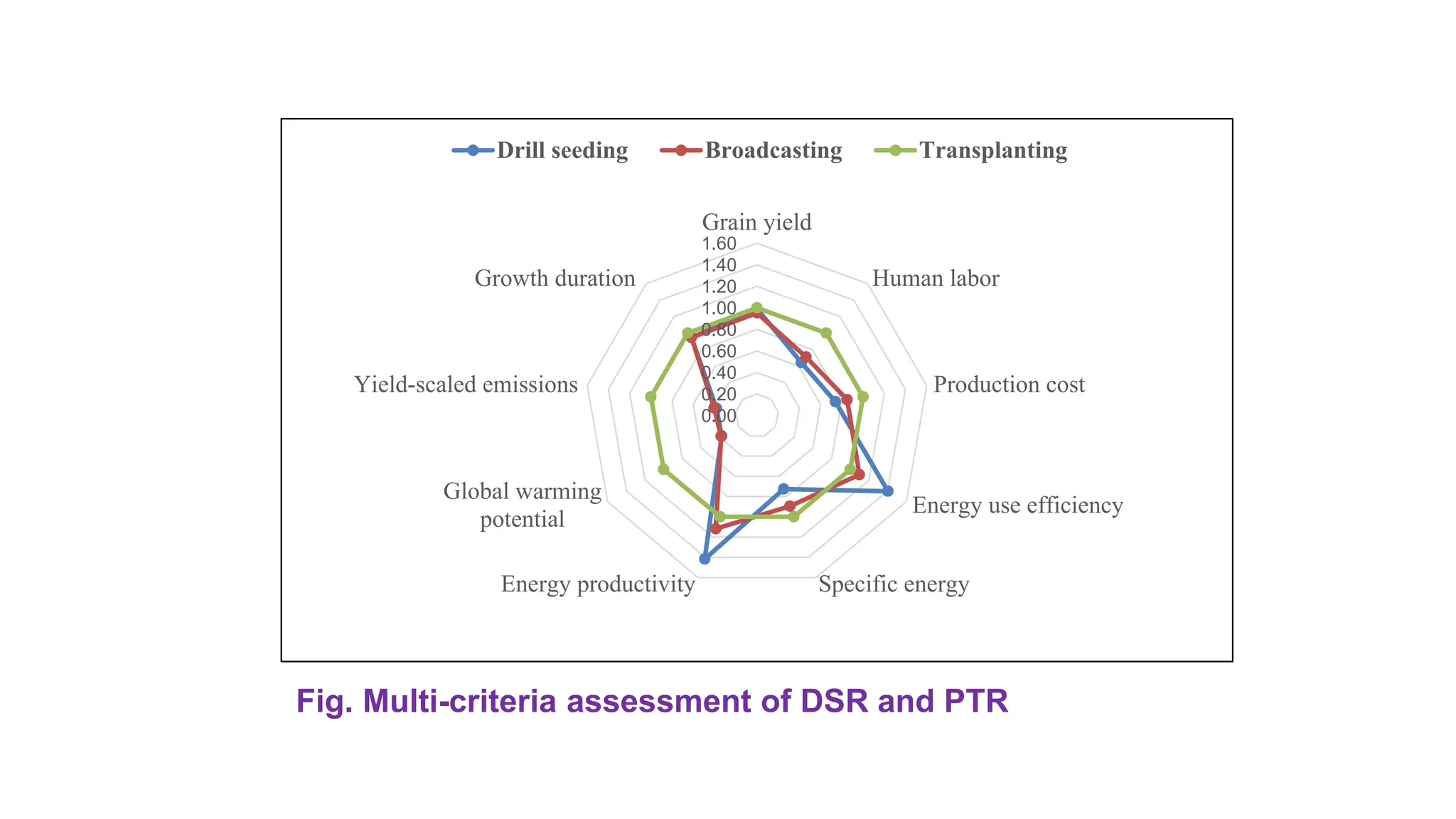
Grain yield
Human labor
Production cost
Energy use efficiency
Specific energy
Energy productivity
Global warming
potential
Yield-scaled emissions
Growth duration
Drill seeding Broadcasting Transplanting
Fig. Multi-criteria assessment of DSR and PTR
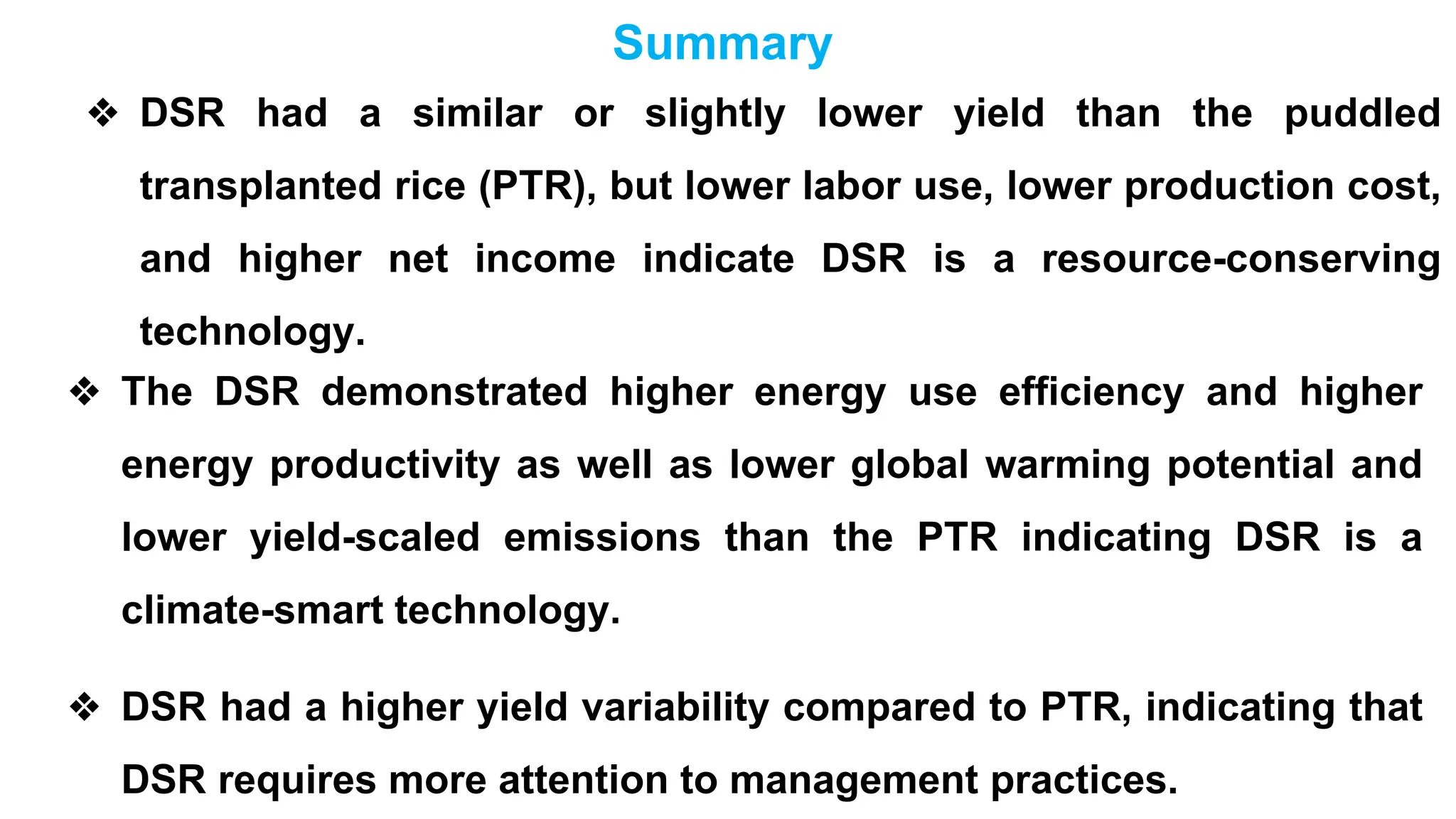
Summary
❖ DSR had a similar or slightly lower yield than the puddled
transplanted rice (PTR), but lower labor use, lower production cost,
and higher net income indicate DSR is a resource-conserving
technology.
❖ The DSR demonstrated higher energy use efficiency and higher
energy productivity as well as lower global warming potential and
lower yield-scaled emissions than the PTR indicating DSR is a
climate-smart technology.
❖ DSR had a higher yield variability compared to PTR, indicating that
DSR requires more attention to management practices.
CSISA’s DSR workshop outcomes
Thanks to
All

Direct Seeded Rice - Climate Smart Agriculture

  • 1.
    Direct-Seeded Rice Technology Sharif Ahmed,PhD Postdoctoral-fellow International Rice Research Institute s.ahmed@irri.org Date: 22 April 2024 Venue: BRAC CDM, Gazipur
  • 2.
    DSR is nota new technology but advancements/upgrading in technology (variety, machinery, and weed management, etc.) and various drivers (water, labor, and climate change) forces have brought this technology to the forefront. DSR: Is it a new technology? Direct Seeded Rice (DSR): Rice production/establishment in the main field directly from seed instead of seedling
  • 3.
    Traditional DSR VsModern DSR Factors Traditional DSR Modern DSR Variety Local/traditional HYV/hybrid/special DSR Sowing Manual broadcast Seeding device Tillage Full tillage Zero/strip/full tillage, puddling Irrigation Rainfed/surface water Full irrigation, partial irrigation, ground water Weed management No weeding, manual weeding , cultural practices Chemical/herbicide and mechanical Harvesting Manually Manually or mechanically Yield 1-3 tonnes 4-8 tonnes Labor No issue Labor save Global warming No issue Potential to reduce GHG
  • 4.
    Widely used riceproduction method: manual transplanting of seedlings into puddled fields (intensive tillage in wet conditions) Puddled Transplanted rice (PTR)
  • 5.
    Your Text Here Your Text Here YourText Here Your Text Here Your Text Here Labor, water and energy intensive production system PTR Deep wet tillage Leveling Seed bed Seedling uprooting Transplanting
  • 6.
    Alternate Rice EstablishmentMethods Mechanical rice transplanting Manual broadcasting Wet -direct seeding Dry-direct seeding in line
  • 7.
    Saves labor Up to60% (Addresses:Labor scarcity) Saves water Up to 50% (Addresses: Water scarcity) Reduces GHG emission Up to 60% (Addresses: Climate change) Increases income by reducing cost of cultivation [Addresses: Rising cultivation cost and declining income] Positive impact on succeeding non-rice crop [Creates enabling condition for diversification] DSR offers both adaptation (adapt to water shortage) and mitigation (reduction in GHG emissions) options to climate change Benefits of DSR over puddled transplanted rice Direct Seeded rice
  • 8.
    ❖ Sowing windows Boro– low temperature is an issue Challenges for DSR (Bangladesh)
  • 9.
    ❖ Sowing windows Aman–late seeding higher risk of: - Inability to sow (soil too wet) - failed establishment because of heavy rain after sowing ⮚ earlier seeding less risky but higher irrigation requirement Challenges for DSR (Bangladesh)
  • 10.
  • 11.
    Pre-sowing Irrigation Shallow cultivationat field capacity Soil Mulch DSR Machine Seeding after tillage Delay first irrigation up to 21 days
  • 12.
    ▪ aus riceis practiced about 8-10% of the country’s total rice area ▪ The lack of early season rainfall in the aus season enables farmers to practice direct seeding Dry-direct seeded Aus
  • 13.
    ❖ Weed management Farmersneed specific information on herbicide
  • 14.
  • 15.
    ❖ Suitable varietyfor DSR ⮚ Cold tolerant during early growth stage (boro) ⮚ Tolerance of anaerobic conditions during germination (aman) ⮚ Early seedling vigour ⮚ Short duration (inbred/hybrid) ⮚ Weed competitive ability
  • 16.
    ❖ Knowledge onmanagement practices
  • 17.
    ⮚ to identifythe appropriate landscape position for DSR in aus season ⮚ to quantify the impact of DSR on yield, profitability, energy use and GWP ⮚ to identify the suitable rice varieties for DSR CSISA’s experience on Aus DSR
  • 18.
    Treatments: Establishment method: ▪ Machineseeding with power-tiller operated seeder (PTOS) ▪ Broadcast seeding by hand ▪ Manual transplanting in puddled soil Landscape position: ▪ High land ▪ Medium highland ▪ Low land Varieties: BRRI dhan83, BRRI dhan85, Binadhan-19 Trial Period: Aus 2019, Aus 2020 and Aus 2021 Location: Jhenaidah, Faridpur, and Dinajpur
  • 19.
    Fig. Grain yieldof of Aus rice Faridpur Jhenaidah Dinajpur Results and Discussion
  • 20.
    Fig. Human laborused Fig. Total production cost Fig. Global warming potential
  • 21.
    0.00 0.20 0.40 0.60 0.80 1.00 1.20 1.40 1.60 Grain yield Human labor Productioncost Energy use efficiency Specific energy Energy productivity Global warming potential Yield-scaled emissions Growth duration Drill seeding Broadcasting Transplanting Fig. Multi-criteria assessment of DSR and PTR
  • 22.
    Summary ❖ DSR hada similar or slightly lower yield than the puddled transplanted rice (PTR), but lower labor use, lower production cost, and higher net income indicate DSR is a resource-conserving technology. ❖ The DSR demonstrated higher energy use efficiency and higher energy productivity as well as lower global warming potential and lower yield-scaled emissions than the PTR indicating DSR is a climate-smart technology. ❖ DSR had a higher yield variability compared to PTR, indicating that DSR requires more attention to management practices.
  • 23.
  • 24.