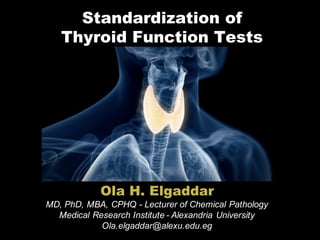
Standardization of
Thyroid Function Tests
Ola H. Elgaddar
MD, PhD, MBA, CPHQ - Lecturer of Chemical Pathology
Medical Research Institute - Alexandria University
Ola.elgaddar@alexu.edu.eg
Clinical laboratory tests performed
by different laboratories have
comparable results
1.Imprecision +
2.systematic differences in method results, which
can arise from inherent differences in method
design +++ (Very obvious in immunoassays)
Is this a problem??
Immunoassays are critical to many clinical
decisions, and many parameters are present
in several guidelines…..... Assuming that
there is no difference between test results
assayed in different settings!
UK NEQAS [Edinburgh], Department ofLaboratoryMedicine,Royal Infirmary ofEdinburgh,Edinburgh EH164SA,UK
Harmonization of Measurements
Any process that enables the establishment
of equivalence of reported values produced
by different measurement procedures for the
same measurand, (i.e. the quantity
intended to be measured)
Harmonization is achieved via:
1) Method #1 = Standardization:
The conventional approach which depends
on the application of a well-understood
reference measurement procedure (RMP)
and commutable reference materials to
establish the calibration for each available
routine measurement procedure.
Commutability
The ability of a reference material to have
inter-assay properties comparable to the
properties demonstrated by authentic
clinical samples when measured by more
than one measurement procedure
The core component of standardization is
the “establishment of metrological
traceability” which requires the availability of
an ISO conform reference measurement
system (RMS)
Components of ISO conform RMS:
ØDefined measurand,
ØUnits for expression of measurement
results (ideally the Système International
d’Unités or SI),
ØDifferent hierarchical levels of materials
and measurement procedures.
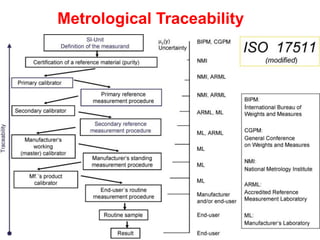
Metrological Traceability
Accordingly, the provided lab results in the
lower part of the hierarchy (routine IVD
methods), will provide measurements
traceable to the top of the hierarchy, within
stated uncertainty constraints.
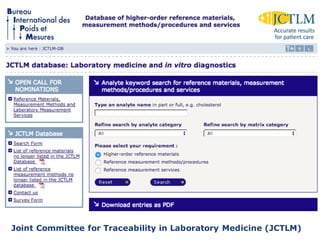
Joint Committee for Traceability in Laboratory Medicine (JCTLM)
Harmonization is achieved via:
2) Method #2:
Considered only when RMPs are not
available and is based on application of
sound statistical methodology to produce
arbitrary equivalence of otherwise disparate
results generated by the various non-
standardized routine measurement
procedures (i.e: surrogate RMPs)
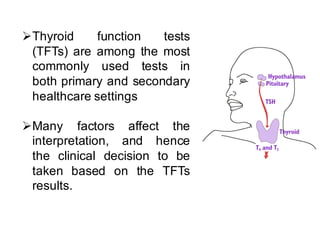
ØThyroid function tests
(TFTs) are among the most
commonly used tests in
both primary and secondary
healthcare settings
ØMany factors affect the
interpretation, and hence
the clinical decision to be
taken based on the TFTs
results.
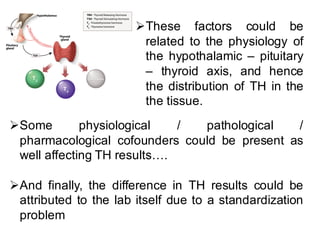
ØThese factors could be
related to the physiology of
the hypothalamic – pituitary
– thyroid axis, and hence
the distribution of TH in the
the tissue.
ØSome physiological / pathological /
pharmacological cofounders could be present as
well affecting TH results….
ØAnd finally, the difference in TH results could be
attributed to the lab itself due to a standardization
problem
Till the end of this presentation, all data
is obtained either from the C-STFT
official website, or from their progress
reports released periodically!
Aim of the project
The C-STFT aims at global
standardization of thyroid function testing
and works towards this with the
international in vitro diagnostic (IVD)
industry.
Aim of the project
The overall expected benefit:
ØProduce equivalent laboratory data so
that common reference intervals and/or
clinical practice decision limits can be
used;
ØInclude laboratory data in electronic
patient records;
Aim of the project
The overall expected benefit:
ØDevelop evidence-based clinical
practice guidelines for application of
consistent standards of medical care;
ØCombine laboratory data across studies to
translate research into patient care &
disease prevention activities.
Total T3 & T4
Standardization of TT4 and TT3
The mission was easy as there is an existing
SI- traceable reference measurement
system that could be recommended by the
C-STFT to the IVD industry for
implementation in accordance with the ISO
17511.
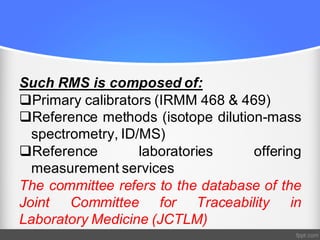
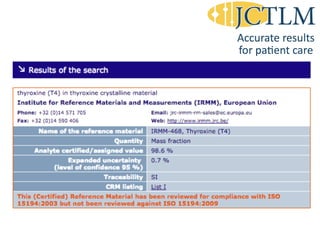
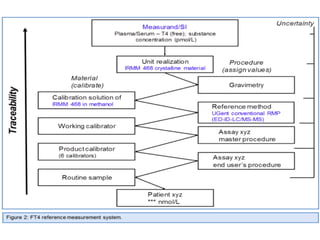
Such RMS is composed of:
qPrimary calibrators (IRMM 468 & 469)
qReference methods (isotope dilution-mass
spectrometry, ID/MS)
qReference laboratories offering
measurement services
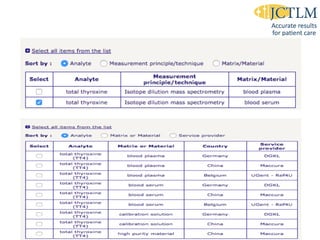
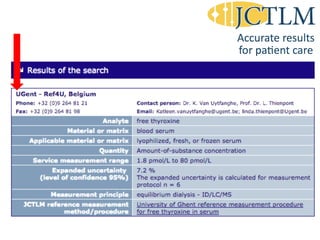
The committee refers to the database of the
Joint Committee for Traceability in
Laboratory Medicine (JCTLM)
Free T3 & T4
Standardization of FT4 & FT3
When the C-STFT started its activities in
2005, no reference measurement system
was available for free thyroid hormones
(FT4, FT3). Therefore, the C-STFT started
from scratch with defining the measurand,
and proposing a reference measurement
procedure (RMP)
Definition of the measurand
According to the International Union of Pure and
Applied Chemistry (IUPAC)/IFCC format, the
component was ‘‘T4 that is not bound to proteins’’
(present in the water fraction of plasma or serum),
the kind-of-quantity to measure the ‘‘amount-of-
substance concentration’’ and the system ‘‘plasma
or serum at physiological conditions (pH 7.40,
temperature 37.0°C)’’. The preferred unit for
expression of measurement results was pmol/L.
The conventional Reference
Measurement Procedure (cRMP)
qIdeally, metrological traceability of assays should
be established with a trueness-based RMP as
key element
qSince free thyroid hormones have to include a
physical step for separation of the free from
bound fraction (by equilibrium dialysis (ED) or
ultrafiltration (UF), it is by no means possible to
unequivocally demonstrate that the T4
concentration in dialysate or ultrafiltrate is
identical to the true free hormone concentration
in the original sample
The conventional Reference
Measurement Procedure (cRMP)
qTherefore, the C-STFT decided to propose
an international “conventional” RMP
(cRMP)
qIt should be based on ED and be combined
with direct determination of the T4
concentration in the dialysate with a
trueness-based RMP utilizing ID-liquid
chromatography/ tandem MS (ID-
LC/tandem MS) as measurement principle.
The conventional Reference
Measurement Procedure (cRMP)
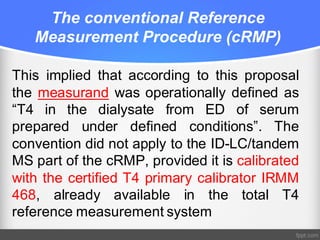
This implied that according to this proposal
the measurand was operationally defined as
“T4 in the dialysate from ED of serum
prepared under defined conditions”. The
convention did not apply to the ID-LC/tandem
MS part of the cRMP, provided it is calibrated
with the certified T4 primary calibrator IRMM
468, already available in the total T4
reference measurement system
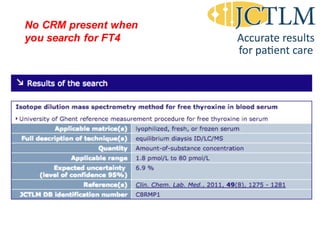
No CRM present when
you search for FT4
TSH
Harmonization of TSH
qTSH is a glycoprotein circulating in the
bloodstream as mixture of components
comprising disease-specific glycoforms.
qCurrent TSH immunoassays all are
traceable to the same WHO IRP TSH
80/558, and express their measurements in
mIU/L.
Harmonization of TSH
qThe WHO IRP TSH 80/558 is from human
cadaver pituitary and may comprise
glycosylation forms that differ from those
typically present in serum TSH. Therefore,
the above issues of non commutability
applies, and hence, IRP-traceable TSH
measurements do not give equivalent or
interchangeable results.
Before defining the TSH measurand
TSH measurement is mixture analysis. This
implies that each component in the mixture
must contribute significantly to the
diagnostic application of the assay used for
mixture analysis, and that the latter should
measure the components in the mixture in
an “equimolar” way, but to the diagnostic
relevant extent.
Before defining the TSH measurand
qThis means that the important changes in overall
concentration of the mixture in health and
disease should outweigh the minor changes in
composition of the mixture in individual samples.
qThis requirement of equimolar measurement is
of utmost relevance for TSH, since glycoforms
are different in euthyroidism versus subclinical
and overt hypothyroidism, and because there is
evidence that immunoassays may be sensitive
to the differences
Definition of TSH measurand
The C-STFT defined the measurand as
“TSH, intact, total, glycosylation
encountered in diagnostic applications which
should be specified”.
This definition requires in first instance that
TSH assays examined for harmonization
deliver a measure for “total TSH”. It also
implies that harmonization should be based
on the glycoforms present in native samples.
The “All Procedure Trimmed Mean
APTM” as surrogate RMP for TSH
Ø Current TSH assays are expressed in IUs
(concentrations in mIU/L). However, it is to
expect that one day it will be possible to
establish the relation between the IU and mass
units (SI) for TSH.
Ø From this point of view, the reference
measurement system for TSH and its realization
should be viewed as continuum from discovery
of the analyte to final translation into the SI, with
different needs at different stages of the
continuum
The “All Procedure Trimmed Mean
APTM” as surrogate RMP for TSH
Ø Therefore, the C-STFT decided to preserve the
traceability of TSH assays to the WHO IRP in
their proposed harmonization process, and
recommends the “All Procedure Trimmed Mean”
(APTM, expressed in IU) as surrogate RMP. It is
proposed to statistically derive the APTM from
data of a dedicated method comparison study
with native human samples, in which as many
TSH assays as possible participate
The “All Procedure Trimmed Mean
APTM” as surrogate RMP for TSH
ØAccording to this proposal, the APTM
targeted panel becomes the key tool in the
harmonization process.
ØIt has the big advantage that it is composed
of samples that contain the typical
glycoforms of TSH in the blood circulation,
thus are as commutable as possible.
The “All Procedure Trimmed Mean
APTM” as surrogate RMP for TSH
ØAfter being assigned with the APTM
(expressed in mIU/L) derived from the
measurement values of the WHO traceable
assays that participated in the method
comparison study, the panel is intended
to serve as a new measurement
standard, in other words, at that point in
the harmonization process, the IU of the
WHO IRP is transferred to the panel.
The “All Procedure Trimmed Mean
APTM” as surrogate RMP for TSH
Note that for the process to be successful,
proof of sufficient correlation of the
concerned assays to the APTM is a
prerequisite. Also the new standard should
be sustainable. This requires that the IU is
transferred from the first panel to the follow-
up panels via analogous method comparison
studies.
Standardization of Thyroid Function Tests, 05   05 - 2017

Standardization of Thyroid Function Tests, 05 05 - 2017

  • 1.
    Standardization of Thyroid FunctionTests Ola H. Elgaddar MD, PhD, MBA, CPHQ - Lecturer of Chemical Pathology Medical Research Institute - Alexandria University Ola.elgaddar@alexu.edu.eg
  • 2.
    Clinical laboratory testsperformed by different laboratories have comparable results
  • 3.
    1.Imprecision + 2.systematic differencesin method results, which can arise from inherent differences in method design +++ (Very obvious in immunoassays)
  • 4.
    Is this aproblem?? Immunoassays are critical to many clinical decisions, and many parameters are present in several guidelines…..... Assuming that there is no difference between test results assayed in different settings!
  • 5.
    UK NEQAS [Edinburgh],Department ofLaboratoryMedicine,Royal Infirmary ofEdinburgh,Edinburgh EH164SA,UK
  • 6.
    Harmonization of Measurements Anyprocess that enables the establishment of equivalence of reported values produced by different measurement procedures for the same measurand, (i.e. the quantity intended to be measured)
  • 7.
    Harmonization is achievedvia: 1) Method #1 = Standardization: The conventional approach which depends on the application of a well-understood reference measurement procedure (RMP) and commutable reference materials to establish the calibration for each available routine measurement procedure.
  • 8.
    Commutability The ability ofa reference material to have inter-assay properties comparable to the properties demonstrated by authentic clinical samples when measured by more than one measurement procedure
  • 9.
    The core componentof standardization is the “establishment of metrological traceability” which requires the availability of an ISO conform reference measurement system (RMS)
  • 10.
    Components of ISOconform RMS: ØDefined measurand, ØUnits for expression of measurement results (ideally the Système International d’Unités or SI), ØDifferent hierarchical levels of materials and measurement procedures.
  • 11.
  • 12.
    Accordingly, the providedlab results in the lower part of the hierarchy (routine IVD methods), will provide measurements traceable to the top of the hierarchy, within stated uncertainty constraints.
  • 13.
    Joint Committee forTraceability in Laboratory Medicine (JCTLM)
  • 14.
    Harmonization is achievedvia: 2) Method #2: Considered only when RMPs are not available and is based on application of sound statistical methodology to produce arbitrary equivalence of otherwise disparate results generated by the various non- standardized routine measurement procedures (i.e: surrogate RMPs)
  • 15.
    ØThyroid function tests (TFTs)are among the most commonly used tests in both primary and secondary healthcare settings ØMany factors affect the interpretation, and hence the clinical decision to be taken based on the TFTs results.
  • 16.
    ØThese factors couldbe related to the physiology of the hypothalamic – pituitary – thyroid axis, and hence the distribution of TH in the the tissue. ØSome physiological / pathological / pharmacological cofounders could be present as well affecting TH results…. ØAnd finally, the difference in TH results could be attributed to the lab itself due to a standardization problem
  • 19.
    Till the endof this presentation, all data is obtained either from the C-STFT official website, or from their progress reports released periodically!
  • 20.
    Aim of theproject The C-STFT aims at global standardization of thyroid function testing and works towards this with the international in vitro diagnostic (IVD) industry.
  • 21.
    Aim of theproject The overall expected benefit: ØProduce equivalent laboratory data so that common reference intervals and/or clinical practice decision limits can be used; ØInclude laboratory data in electronic patient records;
  • 22.
    Aim of theproject The overall expected benefit: ØDevelop evidence-based clinical practice guidelines for application of consistent standards of medical care; ØCombine laboratory data across studies to translate research into patient care & disease prevention activities.
  • 23.
  • 24.
    Standardization of TT4and TT3 The mission was easy as there is an existing SI- traceable reference measurement system that could be recommended by the C-STFT to the IVD industry for implementation in accordance with the ISO 17511.
  • 25.
    Such RMS iscomposed of: qPrimary calibrators (IRMM 468 & 469) qReference methods (isotope dilution-mass spectrometry, ID/MS) qReference laboratories offering measurement services The committee refers to the database of the Joint Committee for Traceability in Laboratory Medicine (JCTLM)
  • 28.
  • 29.
    Standardization of FT4& FT3 When the C-STFT started its activities in 2005, no reference measurement system was available for free thyroid hormones (FT4, FT3). Therefore, the C-STFT started from scratch with defining the measurand, and proposing a reference measurement procedure (RMP)
  • 30.
    Definition of themeasurand According to the International Union of Pure and Applied Chemistry (IUPAC)/IFCC format, the component was ‘‘T4 that is not bound to proteins’’ (present in the water fraction of plasma or serum), the kind-of-quantity to measure the ‘‘amount-of- substance concentration’’ and the system ‘‘plasma or serum at physiological conditions (pH 7.40, temperature 37.0°C)’’. The preferred unit for expression of measurement results was pmol/L.
  • 31.
    The conventional Reference MeasurementProcedure (cRMP) qIdeally, metrological traceability of assays should be established with a trueness-based RMP as key element qSince free thyroid hormones have to include a physical step for separation of the free from bound fraction (by equilibrium dialysis (ED) or ultrafiltration (UF), it is by no means possible to unequivocally demonstrate that the T4 concentration in dialysate or ultrafiltrate is identical to the true free hormone concentration in the original sample
  • 32.
    The conventional Reference MeasurementProcedure (cRMP) qTherefore, the C-STFT decided to propose an international “conventional” RMP (cRMP) qIt should be based on ED and be combined with direct determination of the T4 concentration in the dialysate with a trueness-based RMP utilizing ID-liquid chromatography/ tandem MS (ID- LC/tandem MS) as measurement principle.
  • 33.
    The conventional Reference MeasurementProcedure (cRMP) This implied that according to this proposal the measurand was operationally defined as “T4 in the dialysate from ED of serum prepared under defined conditions”. The convention did not apply to the ID-LC/tandem MS part of the cRMP, provided it is calibrated with the certified T4 primary calibrator IRMM 468, already available in the total T4 reference measurement system
  • 35.
    No CRM presentwhen you search for FT4
  • 37.
  • 38.
    Harmonization of TSH qTSHis a glycoprotein circulating in the bloodstream as mixture of components comprising disease-specific glycoforms. qCurrent TSH immunoassays all are traceable to the same WHO IRP TSH 80/558, and express their measurements in mIU/L.
  • 39.
    Harmonization of TSH qTheWHO IRP TSH 80/558 is from human cadaver pituitary and may comprise glycosylation forms that differ from those typically present in serum TSH. Therefore, the above issues of non commutability applies, and hence, IRP-traceable TSH measurements do not give equivalent or interchangeable results.
  • 40.
    Before defining theTSH measurand TSH measurement is mixture analysis. This implies that each component in the mixture must contribute significantly to the diagnostic application of the assay used for mixture analysis, and that the latter should measure the components in the mixture in an “equimolar” way, but to the diagnostic relevant extent.
  • 41.
    Before defining theTSH measurand qThis means that the important changes in overall concentration of the mixture in health and disease should outweigh the minor changes in composition of the mixture in individual samples. qThis requirement of equimolar measurement is of utmost relevance for TSH, since glycoforms are different in euthyroidism versus subclinical and overt hypothyroidism, and because there is evidence that immunoassays may be sensitive to the differences
  • 42.
    Definition of TSHmeasurand The C-STFT defined the measurand as “TSH, intact, total, glycosylation encountered in diagnostic applications which should be specified”. This definition requires in first instance that TSH assays examined for harmonization deliver a measure for “total TSH”. It also implies that harmonization should be based on the glycoforms present in native samples.
  • 43.
    The “All ProcedureTrimmed Mean APTM” as surrogate RMP for TSH Ø Current TSH assays are expressed in IUs (concentrations in mIU/L). However, it is to expect that one day it will be possible to establish the relation between the IU and mass units (SI) for TSH. Ø From this point of view, the reference measurement system for TSH and its realization should be viewed as continuum from discovery of the analyte to final translation into the SI, with different needs at different stages of the continuum
  • 44.
    The “All ProcedureTrimmed Mean APTM” as surrogate RMP for TSH Ø Therefore, the C-STFT decided to preserve the traceability of TSH assays to the WHO IRP in their proposed harmonization process, and recommends the “All Procedure Trimmed Mean” (APTM, expressed in IU) as surrogate RMP. It is proposed to statistically derive the APTM from data of a dedicated method comparison study with native human samples, in which as many TSH assays as possible participate
  • 45.
    The “All ProcedureTrimmed Mean APTM” as surrogate RMP for TSH ØAccording to this proposal, the APTM targeted panel becomes the key tool in the harmonization process. ØIt has the big advantage that it is composed of samples that contain the typical glycoforms of TSH in the blood circulation, thus are as commutable as possible.
  • 46.
    The “All ProcedureTrimmed Mean APTM” as surrogate RMP for TSH ØAfter being assigned with the APTM (expressed in mIU/L) derived from the measurement values of the WHO traceable assays that participated in the method comparison study, the panel is intended to serve as a new measurement standard, in other words, at that point in the harmonization process, the IU of the WHO IRP is transferred to the panel.
  • 47.
    The “All ProcedureTrimmed Mean APTM” as surrogate RMP for TSH Note that for the process to be successful, proof of sufficient correlation of the concerned assays to the APTM is a prerequisite. Also the new standard should be sustainable. This requires that the IU is transferred from the first panel to the follow- up panels via analogous method comparison studies.