NORMAL COMPOSITION OF
BODY FLUID
Ginus Partadiredja
Department of Physiology
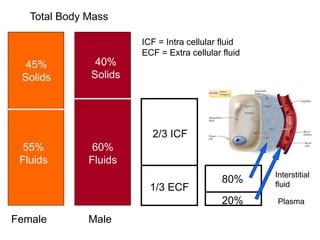
Total Body Mass
Female Male
45%
Solids
40%
Solids
55%
Fluids
60%
Fluids
2/3 ICF
1/3 ECF
ICF = Intra cellular fluid
ECF = Extra cellular fluid
80%
20%
Interstitial
fluid
Plasma
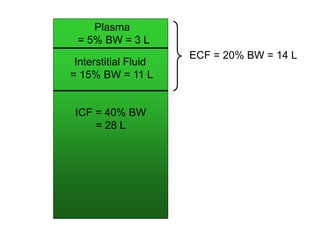
ICF = 40% BW
= 28 L
Interstitial Fluid
= 15% BW = 11 L
Plasma
= 5% BW = 3 L
ECF = 20% BW = 14 L
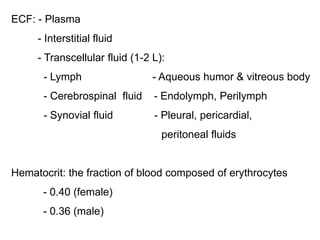
ECF: - Plasma
- Interstitial fluid
- Transcellular fluid (1-2 L):
- Lymph - Aqueous humor & vitreous body
- Cerebrospinal fluid - Endolymph, Perilymph
- Synovial fluid - Pleural, pericardial,
peritoneal fluids
Hematocrit: the fraction of blood composed of erythrocytes
- 0.40 (female)
- 0.36 (male)
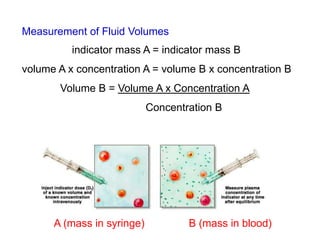
Measurement of Fluid Volumes
indicator mass A = indicator mass B
volume A x concentration A = volume B x concentration B
Volume B = Volume A x Concentration A
Concentration B
A (mass in syringe) B (mass in blood)
Volume Indicators
Total body water 3H2O (tritium/ radioactive water), 2H2O
(deuterium/ heavy water), antipyrine
Extracellular fluid 22Na, 125I-iothalamate, thiosulfate, inulin
Intracellular fluid Total body water – extracellular fluid
volume
Plasma volume 125I-albumin, Evans blue dye (T-1824)
Blood volume 51Cr-labeled erythrocytes, or
Blood volume = Plasma volume/(1 – Ht)
Interstitial fluid Extracellular fluid volume – plasma
volume
Measurement of Body Fluid Volumes
Sources of Body Fluid (input & output)
2500
2000
1500
1000
500
0
Drink
1600 ml
Kidney
1500 ml
Metabolic 200 ml
Food
700 ml Skin 600 ml
Lung 300 ml
GIT 100 ml
• Metabolic  Cellular aerobic respiration (production of ATP)
 Dehydration sinthesis
(glucose + fructose  sucrose + H2O)
Input
Output
• Insensible water loss (skin + lung) = 700 ml
• Skin = 200 ml (sweat) + 400 ml (insensible water loss)
• Insensible water loss via lungs = 300 – 400 ml
• 47 mmHg (vapour pressure in lung)
• cold weather  vapour pressure = 0 mmHg
The Concentration of Electrolytes & Anion Protein in
Plasma, Interstitial and Intracellular Fluid
mEq/L
175
150
125
100
75
50
25
0
Na+ K+ Ca+2 Mg+2 Cl- HCO3
- HPO4
2- SO4
2- Anion
Protein
Plasma
Interstitial fluid
Intracellular fluid
142 145
10
4 4
140
5 3 0.2
2 2 35
100 117 3
24 27 15
2 2 100
1 1 20
20 2 50
• Interstitial fluid  plasma, except proteins
• Interstitial fluids >< plasma  proteins  plasma colloid
osmotic pressure
• Cell membrane  permeable to water, but not to ions
• Extra cellular fluid: Na+ & Cl-
• Intra cellular fluid: K+, protein, HPO4
2-
• The functions of ions of electrolytes:
1.Control of water osmosis
2.Acid – base balance (H+, HCO3
-)
3.Current flows (Na+, K+, Cl-, Ca+2)  action potential (in
neurons)
4. Enzyme cofactors (Mg)
• Natrium/ Sodium
- Affects ½ ECF osmolarity (142 mOsm/L of 300 mOsm/L)
- Aldosteron  Na+ reabsorption increases
- Hyponatremia  ADH  water excretion increases
- ANP hormone  Na+ excretion increases
- Renal failure  Na+ retention  blood volume ,
- Hyperaldosteronism (hypernatremia) edema
- Adrenal insufficiency  aldosteron
- Diuretics  Na+ excretion  hypovolemia,
- Diarrhea, vomiting  hyponatremia
• Chloride
- Easy to move in/ out between ECF & ICF
- Important for anion balance (in erythrocytes)
O2 + HbH  HbO2 + H+
H+ + HbO2  HbH + O2
• Kalium/ Potassium
- Resting membrane potential & repolarization
- Aldosterone  K+ secretion
• Bicarbonate (HCO3
-)
- Kidneys: main regulator of HCO3
-
• Calcium
- 98%  skeleton & teeth
- Blood clotting, neurotransmitter, muscle tone, nerve &
muscle excitability
- Parathyroid & calcitriol hormones  Ca2+
- Ca2+ plasma  PTH  stimulating osteoclasts
releases Ca2+  blood (resorption )
Ca2+ reabsorption (kidneys)
Calcitriol  Ca2+ absorption (GIT)
• Phosphate (H2PO4
-, HPO4
2-, PO4
3-)
- 85% calcium phosphate (bones)
- HPO4
2-  buffer H+, organic molecule, nucleic acids, ATP
- PTH  HPO4
2- resorption  blood
 inhibition of HPO4
2- reabsorption
- Calcitriol  phosphate & Ca+2 absorption
• Magnesium
- Enzymes cofactor
- Na+ – K+ pumps
- Neuromuscular activities
- Synapse transmission
- Myocardial function
Fluid and electrolytes exchange:
- Filtration - Diffusion
- Reabsorption - Osmosis
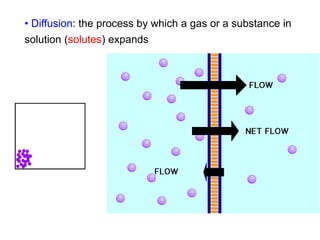
• Diffusion: the process by which a gas or a substance in
solution (solutes) expands
• Osmosis: - the diffusion of solvent
- the net diffusion of water across a selectively permeable
membrane from a region of high water concentration (low
solute concentration) to one that has a lower water
concentration (high solute concentration)
Basic Principles of Osmosis and Osmotic Pressure
• Mole (mol)  gram-molecular weight of a substance (g)
• 1 mol NaCl = 23 g + 35.5 g = 58.5 g
• Osmole  the number of osmotically active particles in a
solution
• 1 mol/L glucose = 1 osm/L
• 1 mol/L NaCl = 2 osm/L
• 1 mol/L Na2SO4 = 3 osm/L
• Osmolality  concentration expressed as osmoles per kg
of water
• Osmolarity  concentration expressed as osmoles per L of
solution (clinically more frequently used)
• Osmotic pressure: the pressure required to prevent
osmosis
• Osmotic pressure  proportional to osmolarity, regardless
large or small molecules
• Osmotic effect of albumin (MW = 70,000) = glucose (MW =
180) < NaCl (2x of glucose or albumin)
• van’t Hoff’s law of osmotic pressure:  = CRT
• C = concentration of solutes in osmoles/ L
• R = ideal gas constant
• T = normal body temperature (273° + 37° = 310° kelvin)
•  = 1 mOsm/L x R x 310°K = 19.3 mmHg
Osmotic pressure of 0.9% NaCl (infusion solution)
0.9% = 0.9 g/ 100 mL = 9 g/ 1 L
MW NaCl = 58.5 g/mol
The molarity of 0.9% NaCl = 9 : 58.5 = 0.154 mol/ L
1 mol/ L of NaCl = 2 osm/ L  0.154 x 2 = 0.308 osm/ L
= 308 mOsm/ L
The potential osmotic pressure = 308 x 19.3 = 5944 mmHg
Osmotic coefficient of NaCl = 0.93
308 x 0.93 = 286 mOsm/ L
308 mOsm/ L or 286 mOsm/ L  close to ± 300 mOsm/ L
(plasma osmolarity)
Plasma
(mOsm/L H2O)
Interstitial
(mOsm/L H2O)
Intracellular
(mOsm/L H2O)
Na+
142 139 14
K 4.2 4.0 140
Ca 1.3 1.2 0
Mg 0.8 0.7 20
Cl 108 108 4
HCO 24 28.3 10
HPO, HPO 2 2 11
SO 0.5 0.5 1
Phosphocreatine 45
Carnosine 14
Amino acids 2 2 8
Creatine 0.2 0.2 9
Osmolar Substances in ECF and ICF
Plasma
(mOsm/L H2O)
Interstitial
(mOsm/L H2O)
Intracellular
(mOsm/L H2O)
Lactate 1.2 1.2 1.5
ATP 5
Hexose
monophosphate
3.7
Glucose 5.6 5.6
Protein 1.2 0.2 4
Urea 4 4 4
Others 4.8 3.9 10
Total mOsm/ L 301.8 300.8 301.2
Corrected
osmolar activity
282.0 281.0 281.0
Total osmotic
pressure at 37°C
(mm Hg)
5443 5423 5423
• Isotonic fluid: a solution of impermeant solutes with an
osmolarity of 282 mOsm/ L (e.g. 0.9% NaCl; 5% glucose)
• Hypotonic fluid: osmolarity < 282 mOsm/ L
• Hypertonic fluid: osmolarity > 282 mOsm/ L
 Isosmotic fluid: a solution with the same osmolarity with
cells, regardless the solute can penetrate the cell
membrane
 Hypo-osmotic fluid: lower osmolarity
 Hyper-osmotic fluid: higher osmolarity
Dehydration
Saliva Blood volume
Blood osmolarity
Mouth & pharynx
dryness
Stimulation of osmoreceptor
(hypothalamus)
Blood pressure
Renin production by
juxtaglomeral cells
in kidneys
Angiotensin II
Stimulation of thirst centre
(hypothalamus)
Thirst Drink Body fluid
Fluid Intake Regulation
• Body fluid osmolarity  ADH  protein aquoporin 2 
cell apical membrane  permeability to water  osmosis
to blood
• Blood volume
• Dehydration
• Hiperventilation
• Vomitus ADH
• Diarrhea
• Fever
• Heavy sweating
• Combustio (burn)  up to 3 – 5 L/ day
• Water exchange between body compartments
• Water loss  replaced by plain water  ECF osmolarity
 ECF osmosis  ICF
• Too much plain water consumption  water intoxication
• Enema
NaCl intake
(80% of ECF
Osmolarity)
Na+ & Cl- plasma
concentration
Osmosis of water from ICF
 Interstitial  plasma
Blood volume
Strecthing the atrium of the heart Renin production
Atrial Natriuretic Peptide (ANP) Angiotensin II
GFR Aldosterone
Reabsorption of NaCl by kidneys
Na+ & Cl- via urine (Natriuresis)
Water loss in urine via osmosis Blood volume
Hormonal Regulation of Renal Na+ & Cl-
Age & Fluid Balance
Infant Adults
Proportion of water 75% - 90%
ECF > ICF (2x)
55% - 60%
ICF > ECF
(2x)
Input – output rate 7x >
Metabolic rate 2x >
The development of
kidneys
Infant ½ x adults efficiency
Ratio of body surface :
volume
3x >
Respiratory frequency 30 – 80x/ min
Ion concentration K+, Cl- >
• Elderly: - ICF volume decreases
- K+ decreases
- fat increases
• Elderly  vulnerable to:
- dehydration
- hypernatremia
- hyponatremia
- hypokalemia
- acidosis
Edema
• Edema: Excess fluid in the body tissues
• Edema:
- Intracellular edema
e.g. low blood supply  cell membrane ionic pumps
depressed  sodium retention in the cell  osmosis into
the cell  intracellular edema
- Extracellular edema
1. Abnormal leakage: plasma  interstitial spaces
2. Failure of lymphatic return into the blood
Causes of Extracellular Edema
1. Increased capillary pressure
A. Kidney retention of salt & water (kidney failure,
mineralocorticoid excess)
B. High venous pressure & venous constriction (heart
failure, venous obstruction, failure of venous pumps)
C. Decreased arteriolar resistance (excessive body
heat, vasodilator drugs, sympathetic insufficiency)
2. Decreased plasma proteins
A. Loss of proteins in urine (nephrotic syndrome)
B. Loss of proteins from skin (burns, wounds)
C.Failure to produce proteins (liver diseases,
malnutrition)
3. Increased capillary permeability
A. Immune reactions
B. Toxins
C. Bacterial infections
D. Vitamin deficiency (vitamin C)
E. Prolonged ischemia
F. Burns
4. Blockage of lymph return
A. Cancer
B. Infections
C. Surgery
D. Congenital absence/ abnormality of lymph vessels
Safety Factors that Prevent Edema
1. Low tissue compliance in the negative pressure range
(safety factor = 3 mm Hg). Compliance = the change in
volume per milimeter of mercury pressure change)
2. Increased lymph flow  10 – 50x (safety factor = 7 mm Hg)
3. Washdown of proteins from the interstitial spaces (safety
factor = 7 mm Hg).
Marked edema occurs if capillary pressure rise by 17 mm Hg
Effusion = edema fluid in the potential spaces (pleural cavity,
peritoneal cavity, pericardial cavity, synovial cavity). E.g.
ascites
• References:
1. Tortora GJ & Derickson B (2006). Principles of Anatomy &
Physiology, Chapter 27: Fluid, Electrolyte, and Acid-Base
Homeostasis
2. Ganong WF (2005). Review of Medical Physiology, 22nd
ed. Chapter 1: The General & Cellular Basis of Medical
Physiology, Pages 1–8; Chapter 39: Regulation of
Extracellular Fluid Composition & Volume, Pages 729-730
3. Gutyon AC & Hall JE (2006). Textbook of Medical
Physiology, 11th ed. Chapter 25: The Body Fluid
Compartments: Extracellular and Intracellular Fluids;
Interstitial Fluids and Edema, Pages 291-306

BODY FLUID.ppt

  • 1.
    NORMAL COMPOSITION OF BODYFLUID Ginus Partadiredja Department of Physiology
  • 2.
    Total Body Mass FemaleMale 45% Solids 40% Solids 55% Fluids 60% Fluids 2/3 ICF 1/3 ECF ICF = Intra cellular fluid ECF = Extra cellular fluid 80% 20% Interstitial fluid Plasma
  • 3.
    ICF = 40%BW = 28 L Interstitial Fluid = 15% BW = 11 L Plasma = 5% BW = 3 L ECF = 20% BW = 14 L
  • 4.
    ECF: - Plasma -Interstitial fluid - Transcellular fluid (1-2 L): - Lymph - Aqueous humor & vitreous body - Cerebrospinal fluid - Endolymph, Perilymph - Synovial fluid - Pleural, pericardial, peritoneal fluids Hematocrit: the fraction of blood composed of erythrocytes - 0.40 (female) - 0.36 (male)
  • 5.
    Measurement of FluidVolumes indicator mass A = indicator mass B volume A x concentration A = volume B x concentration B Volume B = Volume A x Concentration A Concentration B A (mass in syringe) B (mass in blood)
  • 6.
    Volume Indicators Total bodywater 3H2O (tritium/ radioactive water), 2H2O (deuterium/ heavy water), antipyrine Extracellular fluid 22Na, 125I-iothalamate, thiosulfate, inulin Intracellular fluid Total body water – extracellular fluid volume Plasma volume 125I-albumin, Evans blue dye (T-1824) Blood volume 51Cr-labeled erythrocytes, or Blood volume = Plasma volume/(1 – Ht) Interstitial fluid Extracellular fluid volume – plasma volume Measurement of Body Fluid Volumes
  • 7.
    Sources of BodyFluid (input & output) 2500 2000 1500 1000 500 0 Drink 1600 ml Kidney 1500 ml Metabolic 200 ml Food 700 ml Skin 600 ml Lung 300 ml GIT 100 ml • Metabolic  Cellular aerobic respiration (production of ATP)  Dehydration sinthesis (glucose + fructose  sucrose + H2O) Input Output
  • 8.
    • Insensible waterloss (skin + lung) = 700 ml • Skin = 200 ml (sweat) + 400 ml (insensible water loss) • Insensible water loss via lungs = 300 – 400 ml • 47 mmHg (vapour pressure in lung) • cold weather  vapour pressure = 0 mmHg
  • 9.
    The Concentration ofElectrolytes & Anion Protein in Plasma, Interstitial and Intracellular Fluid mEq/L 175 150 125 100 75 50 25 0 Na+ K+ Ca+2 Mg+2 Cl- HCO3 - HPO4 2- SO4 2- Anion Protein Plasma Interstitial fluid Intracellular fluid 142 145 10 4 4 140 5 3 0.2 2 2 35 100 117 3 24 27 15 2 2 100 1 1 20 20 2 50
  • 10.
    • Interstitial fluid plasma, except proteins • Interstitial fluids >< plasma  proteins  plasma colloid osmotic pressure • Cell membrane  permeable to water, but not to ions • Extra cellular fluid: Na+ & Cl- • Intra cellular fluid: K+, protein, HPO4 2-
  • 11.
    • The functionsof ions of electrolytes: 1.Control of water osmosis 2.Acid – base balance (H+, HCO3 -) 3.Current flows (Na+, K+, Cl-, Ca+2)  action potential (in neurons) 4. Enzyme cofactors (Mg)
  • 12.
    • Natrium/ Sodium -Affects ½ ECF osmolarity (142 mOsm/L of 300 mOsm/L) - Aldosteron  Na+ reabsorption increases - Hyponatremia  ADH  water excretion increases - ANP hormone  Na+ excretion increases - Renal failure  Na+ retention  blood volume , - Hyperaldosteronism (hypernatremia) edema - Adrenal insufficiency  aldosteron - Diuretics  Na+ excretion  hypovolemia, - Diarrhea, vomiting  hyponatremia
  • 13.
    • Chloride - Easyto move in/ out between ECF & ICF - Important for anion balance (in erythrocytes) O2 + HbH  HbO2 + H+ H+ + HbO2  HbH + O2
  • 14.
    • Kalium/ Potassium -Resting membrane potential & repolarization - Aldosterone  K+ secretion • Bicarbonate (HCO3 -) - Kidneys: main regulator of HCO3 - • Calcium - 98%  skeleton & teeth - Blood clotting, neurotransmitter, muscle tone, nerve & muscle excitability - Parathyroid & calcitriol hormones  Ca2+
  • 15.
    - Ca2+ plasma PTH  stimulating osteoclasts releases Ca2+  blood (resorption ) Ca2+ reabsorption (kidneys) Calcitriol  Ca2+ absorption (GIT)
  • 17.
    • Phosphate (H2PO4 -,HPO4 2-, PO4 3-) - 85% calcium phosphate (bones) - HPO4 2-  buffer H+, organic molecule, nucleic acids, ATP - PTH  HPO4 2- resorption  blood  inhibition of HPO4 2- reabsorption - Calcitriol  phosphate & Ca+2 absorption • Magnesium - Enzymes cofactor - Na+ – K+ pumps - Neuromuscular activities - Synapse transmission - Myocardial function
  • 18.
    Fluid and electrolytesexchange: - Filtration - Diffusion - Reabsorption - Osmosis
  • 19.
    • Diffusion: theprocess by which a gas or a substance in solution (solutes) expands
  • 20.
    • Osmosis: -the diffusion of solvent - the net diffusion of water across a selectively permeable membrane from a region of high water concentration (low solute concentration) to one that has a lower water concentration (high solute concentration)
  • 21.
    Basic Principles ofOsmosis and Osmotic Pressure • Mole (mol)  gram-molecular weight of a substance (g) • 1 mol NaCl = 23 g + 35.5 g = 58.5 g • Osmole  the number of osmotically active particles in a solution • 1 mol/L glucose = 1 osm/L • 1 mol/L NaCl = 2 osm/L • 1 mol/L Na2SO4 = 3 osm/L • Osmolality  concentration expressed as osmoles per kg of water • Osmolarity  concentration expressed as osmoles per L of solution (clinically more frequently used) • Osmotic pressure: the pressure required to prevent osmosis
  • 22.
    • Osmotic pressure proportional to osmolarity, regardless large or small molecules • Osmotic effect of albumin (MW = 70,000) = glucose (MW = 180) < NaCl (2x of glucose or albumin) • van’t Hoff’s law of osmotic pressure:  = CRT • C = concentration of solutes in osmoles/ L • R = ideal gas constant • T = normal body temperature (273° + 37° = 310° kelvin) •  = 1 mOsm/L x R x 310°K = 19.3 mmHg
  • 23.
    Osmotic pressure of0.9% NaCl (infusion solution) 0.9% = 0.9 g/ 100 mL = 9 g/ 1 L MW NaCl = 58.5 g/mol The molarity of 0.9% NaCl = 9 : 58.5 = 0.154 mol/ L 1 mol/ L of NaCl = 2 osm/ L  0.154 x 2 = 0.308 osm/ L = 308 mOsm/ L The potential osmotic pressure = 308 x 19.3 = 5944 mmHg Osmotic coefficient of NaCl = 0.93 308 x 0.93 = 286 mOsm/ L 308 mOsm/ L or 286 mOsm/ L  close to ± 300 mOsm/ L (plasma osmolarity)
  • 24.
    Plasma (mOsm/L H2O) Interstitial (mOsm/L H2O) Intracellular (mOsm/LH2O) Na+ 142 139 14 K 4.2 4.0 140 Ca 1.3 1.2 0 Mg 0.8 0.7 20 Cl 108 108 4 HCO 24 28.3 10 HPO, HPO 2 2 11 SO 0.5 0.5 1 Phosphocreatine 45 Carnosine 14 Amino acids 2 2 8 Creatine 0.2 0.2 9 Osmolar Substances in ECF and ICF
  • 25.
    Plasma (mOsm/L H2O) Interstitial (mOsm/L H2O) Intracellular (mOsm/LH2O) Lactate 1.2 1.2 1.5 ATP 5 Hexose monophosphate 3.7 Glucose 5.6 5.6 Protein 1.2 0.2 4 Urea 4 4 4 Others 4.8 3.9 10 Total mOsm/ L 301.8 300.8 301.2 Corrected osmolar activity 282.0 281.0 281.0 Total osmotic pressure at 37°C (mm Hg) 5443 5423 5423
  • 26.
    • Isotonic fluid:a solution of impermeant solutes with an osmolarity of 282 mOsm/ L (e.g. 0.9% NaCl; 5% glucose) • Hypotonic fluid: osmolarity < 282 mOsm/ L • Hypertonic fluid: osmolarity > 282 mOsm/ L
  • 27.
     Isosmotic fluid:a solution with the same osmolarity with cells, regardless the solute can penetrate the cell membrane  Hypo-osmotic fluid: lower osmolarity  Hyper-osmotic fluid: higher osmolarity
  • 28.
    Dehydration Saliva Blood volume Bloodosmolarity Mouth & pharynx dryness Stimulation of osmoreceptor (hypothalamus) Blood pressure Renin production by juxtaglomeral cells in kidneys Angiotensin II Stimulation of thirst centre (hypothalamus) Thirst Drink Body fluid Fluid Intake Regulation
  • 29.
    • Body fluidosmolarity  ADH  protein aquoporin 2  cell apical membrane  permeability to water  osmosis to blood • Blood volume • Dehydration • Hiperventilation • Vomitus ADH • Diarrhea • Fever • Heavy sweating • Combustio (burn)  up to 3 – 5 L/ day
  • 30.
    • Water exchangebetween body compartments • Water loss  replaced by plain water  ECF osmolarity  ECF osmosis  ICF • Too much plain water consumption  water intoxication • Enema
  • 31.
    NaCl intake (80% ofECF Osmolarity) Na+ & Cl- plasma concentration Osmosis of water from ICF  Interstitial  plasma Blood volume Strecthing the atrium of the heart Renin production Atrial Natriuretic Peptide (ANP) Angiotensin II GFR Aldosterone Reabsorption of NaCl by kidneys Na+ & Cl- via urine (Natriuresis) Water loss in urine via osmosis Blood volume Hormonal Regulation of Renal Na+ & Cl-
  • 32.
    Age & FluidBalance Infant Adults Proportion of water 75% - 90% ECF > ICF (2x) 55% - 60% ICF > ECF (2x) Input – output rate 7x > Metabolic rate 2x > The development of kidneys Infant ½ x adults efficiency Ratio of body surface : volume 3x > Respiratory frequency 30 – 80x/ min Ion concentration K+, Cl- >
  • 33.
    • Elderly: -ICF volume decreases - K+ decreases - fat increases • Elderly  vulnerable to: - dehydration - hypernatremia - hyponatremia - hypokalemia - acidosis
  • 34.
    Edema • Edema: Excessfluid in the body tissues • Edema: - Intracellular edema e.g. low blood supply  cell membrane ionic pumps depressed  sodium retention in the cell  osmosis into the cell  intracellular edema - Extracellular edema 1. Abnormal leakage: plasma  interstitial spaces 2. Failure of lymphatic return into the blood
  • 35.
    Causes of ExtracellularEdema 1. Increased capillary pressure A. Kidney retention of salt & water (kidney failure, mineralocorticoid excess) B. High venous pressure & venous constriction (heart failure, venous obstruction, failure of venous pumps) C. Decreased arteriolar resistance (excessive body heat, vasodilator drugs, sympathetic insufficiency) 2. Decreased plasma proteins A. Loss of proteins in urine (nephrotic syndrome) B. Loss of proteins from skin (burns, wounds) C.Failure to produce proteins (liver diseases, malnutrition)
  • 36.
    3. Increased capillarypermeability A. Immune reactions B. Toxins C. Bacterial infections D. Vitamin deficiency (vitamin C) E. Prolonged ischemia F. Burns 4. Blockage of lymph return A. Cancer B. Infections C. Surgery D. Congenital absence/ abnormality of lymph vessels
  • 37.
    Safety Factors thatPrevent Edema 1. Low tissue compliance in the negative pressure range (safety factor = 3 mm Hg). Compliance = the change in volume per milimeter of mercury pressure change) 2. Increased lymph flow  10 – 50x (safety factor = 7 mm Hg) 3. Washdown of proteins from the interstitial spaces (safety factor = 7 mm Hg). Marked edema occurs if capillary pressure rise by 17 mm Hg Effusion = edema fluid in the potential spaces (pleural cavity, peritoneal cavity, pericardial cavity, synovial cavity). E.g. ascites
  • 38.
    • References: 1. TortoraGJ & Derickson B (2006). Principles of Anatomy & Physiology, Chapter 27: Fluid, Electrolyte, and Acid-Base Homeostasis 2. Ganong WF (2005). Review of Medical Physiology, 22nd ed. Chapter 1: The General & Cellular Basis of Medical Physiology, Pages 1–8; Chapter 39: Regulation of Extracellular Fluid Composition & Volume, Pages 729-730 3. Gutyon AC & Hall JE (2006). Textbook of Medical Physiology, 11th ed. Chapter 25: The Body Fluid Compartments: Extracellular and Intracellular Fluids; Interstitial Fluids and Edema, Pages 291-306